Poetry, Art, Architecture, Gardening, Landscape: Ian Hamilton Finlay in the Drawing Matter Collection – 24 October 2026
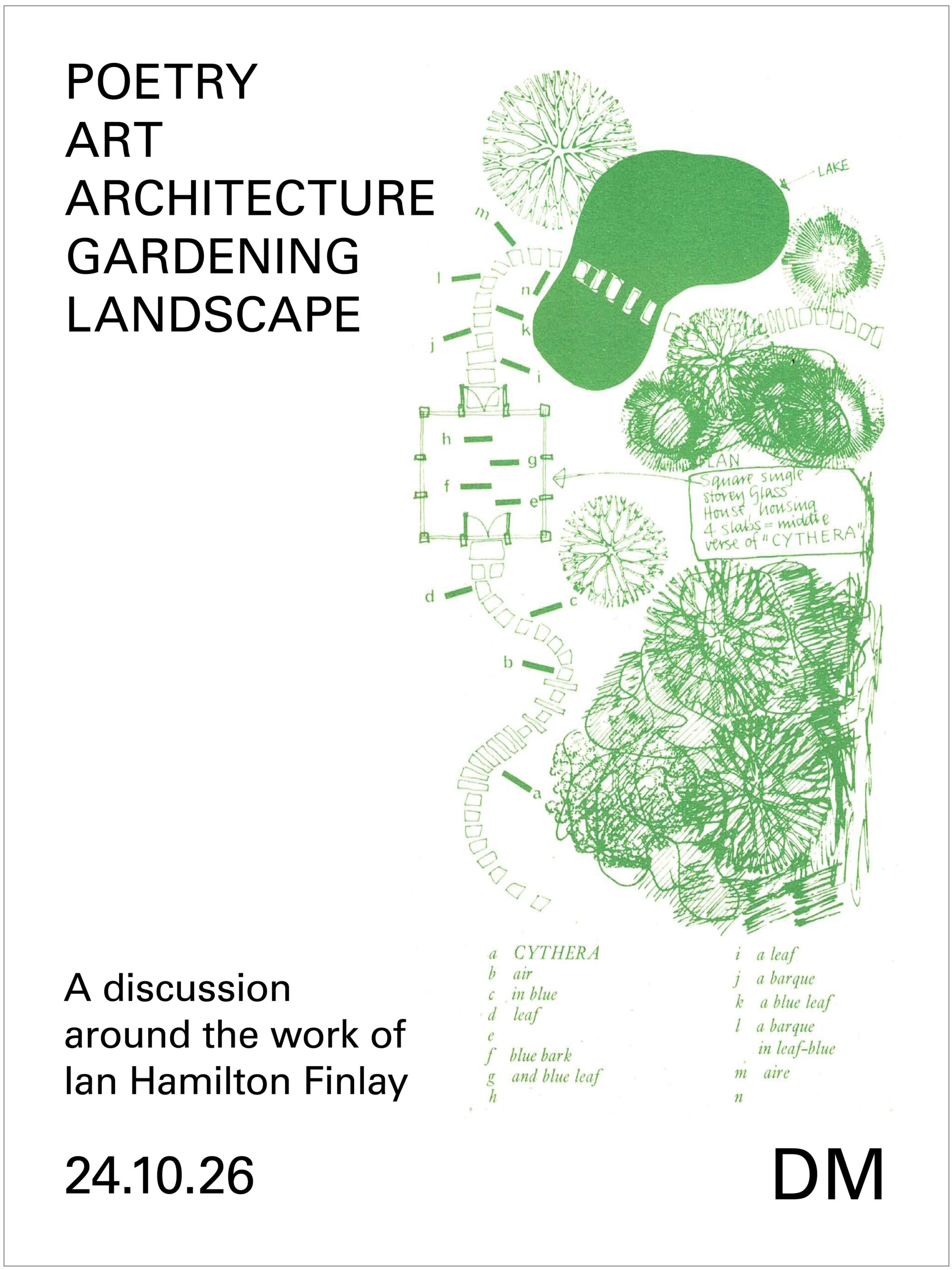
Saturday 24 October 2026
8 Smart’s Place, London, WC2B 5LW
14:30–17:30
On Saturday 24 October, Drawing Matter is hosting a participatory discussion on the work of Ian Hamilton Finlay and contextually/thematically related drawings from the Drawing Matter Collection. The event has been conceived in collaboration with Michael Archer (Professor Emeritus, Goldsmiths College, University of London), who has written on Finlay many times, and has recently donated to Drawing Matter his own collection of Finlay’s printed works.
The discussion will take place in the Drawing Matter archive around original material. We have invited a select number of guests—including artists, architects and landscape architects, gardeners and poets—and have 15 spaces for participants by application.
If you would like to participate, please send an email to info@drawingmatter.org by 5pm on Thursday 24 September with a brief description of your interests in the work of Ian Hamilton Finlay and/or the broader themes of Poetry, Art, Architecture, Gardening, Landscape. Selected participants will be notified by 2 October.
*
Poetry, Art, Architecture, Gardening, Landscape: Ian Hamilton Finlay in the Drawing Matter Collection
The Scottish poet, artist and gardener Ian Hamilton Finlay published his first collection of concrete poetry, Rapel: 10 fauve and suprematist poems, in 1963. Among so much that quickly followed were Standing Poems, printed on folded card and designed to be stood on end, requiring the reader to walk around them, and booklets in which the successive turning of pages constituted a physical as much as an imaginative progression. At that time, too, Finlay conceived the One Word Poem, in which a title of any length might map out a space within which the poem’s single word could resonate. For Finlay, concrete poetry was a ‘classical’ form that enabled him to concentrate on the essential elements of poetic composition and structure, its words and their placement, unencumbered by the extraneous requirement to describe or represent events outwith its material.
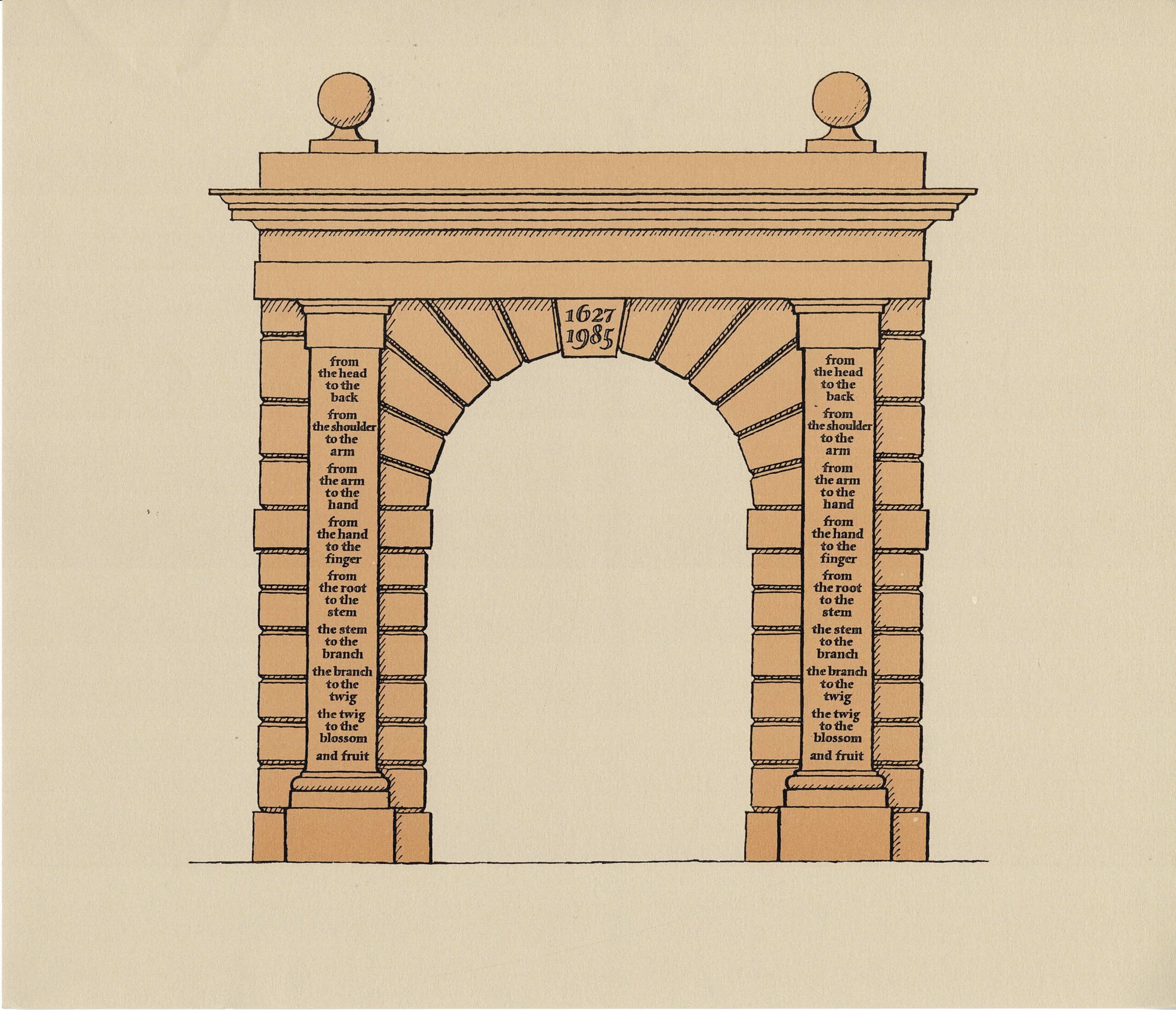
By the mid-60s, he was expressing an interest in architecture and ‘avant-gardening’, and a wish, not only to place his poems in relation to buildings and landscape, but also to realise them fully as objects in glass, metal, stone and concrete. Use of such a wide range of materials meant that of necessity Finlay’s practice became a collaborative one, and he worked with a number of designers and craftspeople in bringing his ideas to fruition. The most well-known fulfilment of his desire to work in this way is Little Sparta, the garden at Dunsyre, south of Edinburgh, that Finlay created over a period of forty years. It is a neo-classical literary landscape in which his poems of many kinds—paths, walks, inscriptions, monuments, bridges, gateways, architectural fragments, reconfigured buildings, and more – are situated. Alongside this, a stream of commissions saw him conceiving works for buildings, squares, parks, gardens, and the general urban landscape in locations throughout the UK and Europe.
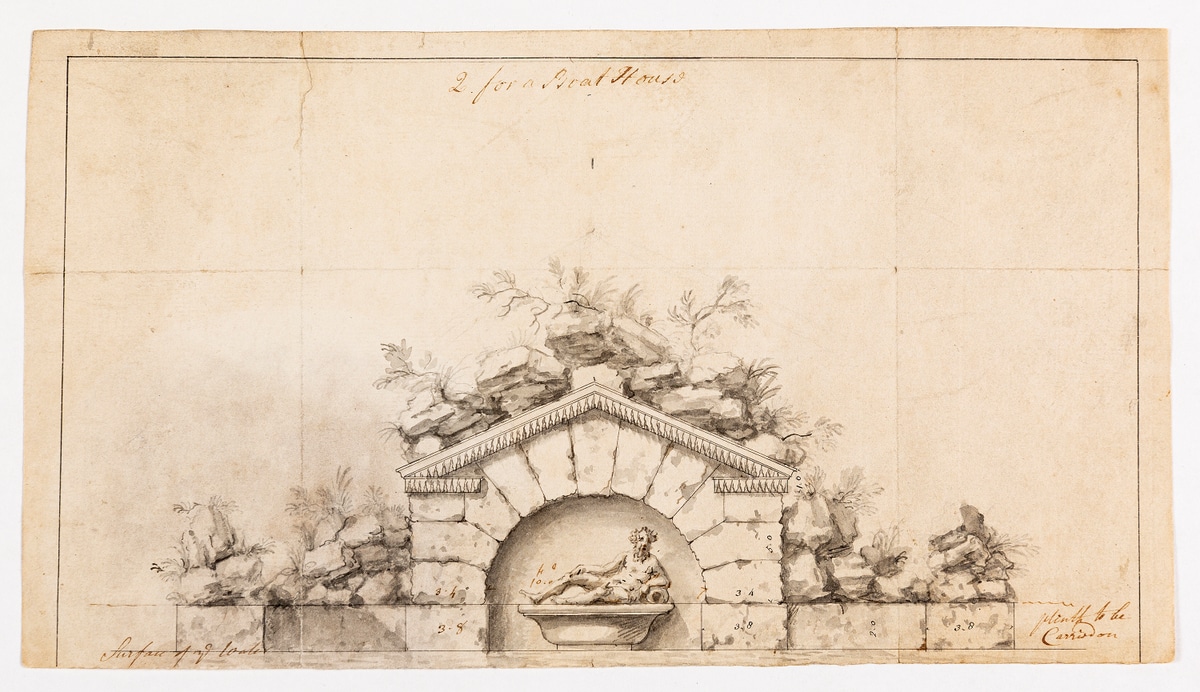
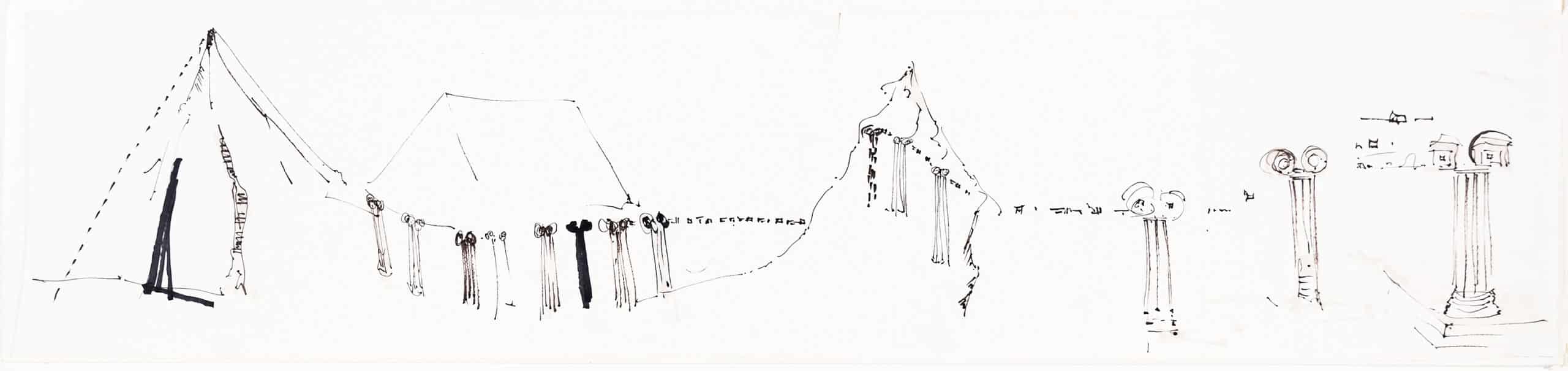
Finlay’s work is rich in references to the history of art and architecture, especially to the classics, to the eighteenth century preoccupation with the ancient world, to the movements of high modernism, particularly Cubism and Suprematism, to the constructive destructiveness of Dada, to the formal directness of Minimalism, to the territorial ambitions of Land Art, and to the play of signs and symbols in postmodernism. The collection at Drawing Matter offers an opportunity to examine his work in the context of this history through the archives of several of Finlay’s closest collaborators, and to consider more broadly the interrelation of poetry and architecture. – Michael Archer
Michael Archer is a writer on modern and contemporary art, lecturer and curator. His books include Art Since 1960 (Thames & Hudson, third edition 2006) and, most recently, Composition (Ilex, 2023). He has written numerous catalogue essays and, as well as articles and reviews for other national and international publications, he has served as Assistant Editor at Art Monthly, Editor at Artscribe, and as a London critic for Artforum. In the 1980s and early 1990s he collaborated and exhibited as half of Audio Arts. He has also curated exhibitions at the Hayward Gallery and elsewhere.
He is Professor Emeritus, Goldsmiths College, University of London where, between 2009-2021 he was Programme Leader, BA Fine Art. Prior to that he had been Senior Lecturer at Chelsea College of Art and Design and then Tutor and subsequently Head of School at the Ruskin School of Art, University of Oxford.
Drawing Matter’s public programme offers the public opportunities to experience our drawings collection, which is usually only open to researchers by appointment and for student/practice workshops. Events take the form of talks at the archive, workshops by practitioners and open weekends.
To be notified of future events, subscribe to our newsletter and follow us on Instagram.
