Hans Döllgast: Drawing Transformations – Talk, 14 May 2026
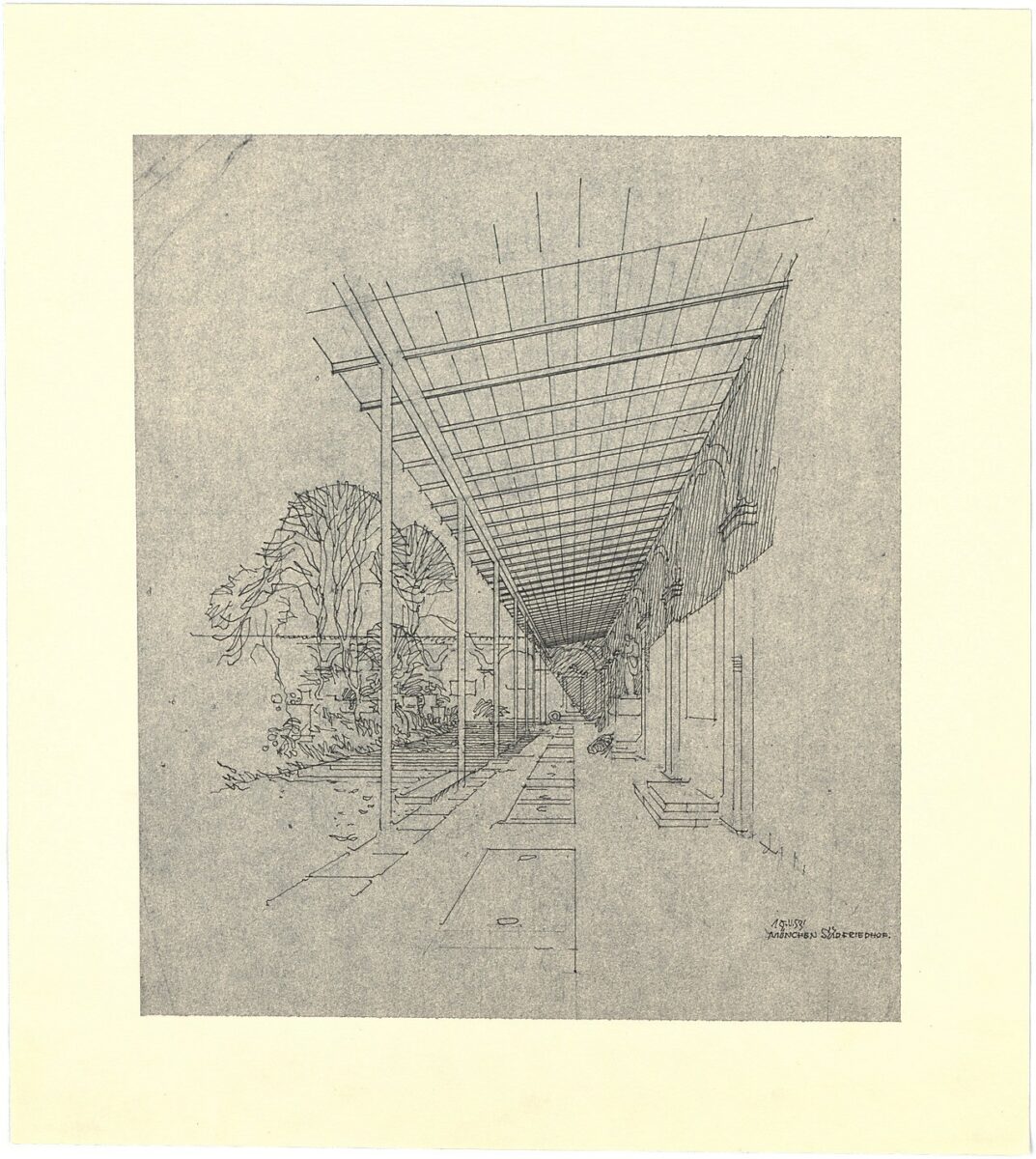
Uta Graff, William Mann and Maximilian Sternberg will be discussing the work of Hans Dollgast, particularly in relation to his drawings. We are really delighted that they have chosen the Drawing Matter space in Covent Garden as the venue for such a stimulating evening.
Thursday 14 May
18.30–20.00
The talk will start at 18:30 so please arrive from 18:00.
Tickets are available here.
Hans Döllgast (1891-1974) has achieved belated international recognition through his postwar reconstructions of war damaged historic monuments in 1950s Munich. Over the past 30 years, the 9H Gallery in London as well as the 20C Society have celebrated Döllgast’s work on the Alte Pinakothek art gallery. This event will focus on Döllgast’s extensive drawing practice and on projects that have received less international attention than the Pinakothek. One of the most gifted draughtsmen of his generation of German architects, Döllgast not only personally produced detailed drawings for his 70 or so executed works from the 1920s to the 1970s, but he also left a vast archive of diverse architectural studies, plans for unrealised projects, book illustrations and watercolours (held in Architecture Museum of the Technical University of Munich). Moreover, Döllgast taught a variety of drawing classes at the Technical University of Munich over his 30-year career as a revered pedagogue, also publishing several books based on his seminal lecture courses, which exerted a strong influence on the TUM’s architectural faculty years after his death.
Focussing on two key case studies, his repair on the heavily war damaged Alte Südfriedhof (Old South cemetery) and St Bonifaz abbey church in the late 1940s and early 1950s, Graff, Mann and Sternberg interrogate Döllgast’s drawings from the perspective of research in architectural history, studio teaching and practice. We reflect on how producing plans, maps and typology studies can support analysis of the evolution and urban context of Döllgast’s complex interventions and examine how Döllgast’s evocative and often ambiguous drawings shed light on his design thinking. We ask how his drawings help us read the inimitable spaces he created through his interventions and what they reveal about the ongoing challenge of working with existing buildings. Döllgast cared deeply not only for the fabric and urban impact of the nineteenth century buildings he repaired, but he was also deeply knowledgeable about the architectural drawing conventions that informed their original designs. Just as he irrevocably transformed the buildings through their rescue, he reinterpreted the modern architectural drawing culture he had inherited from the long nineteenth century.
Uta Graff is Professor of Architectural Design and Conception at the Technical University of Munich TUM. In terms of subject matter and teaching space, it is the chair that Hans Döllgast held until his retirement in 1956 with the title ‘Architectural Drawing and Spatial Art’. In her teaching and research, she emphasises the processes of architectural design as systematic approaches to knowledge generation, highlighting methodological approaches that are characteristic of the discipline of architecture. Analogue representation techniques and architectural freehand drawing are essential tools in her teaching.
William Mann is a director of Witherford Watson Mann Architects, London. The studio’s work focuses on the physical continuity of buildings, and the social evolution of cities and institutions. Their projects of transformation include a house within the ruins of the twelfth-century Astley Castle, for which they won the RIBA Stirling Prize 2013, and Walthamstow Wetlands nature reserve, East London, 2017. He has written for a variety of architectural publications including Casabella and The Architectural Review on the transformation of the city, and on the friction of time in the building process.
Maximilian Sternberg is Professor of History and Theory of Architecture at the Department of Architecture in Cambridge University. His research interests include modern European architecture, medieval architecture, medievalism in modern architecture, and the politics of heritage. He has previously served as the Chief Executive of the Society of Architectural Historians of Great Britain. His publications include Modern Architecture and the Sacred (2020) and Phenomenologies of the City (2015). His monograph on Hans Döllgast is coming out in September 2026, published by Lund Humphries. He is fellow of Pembroke College, Cambridge.
