Aleks Catina: The Pillars of Uncertainty
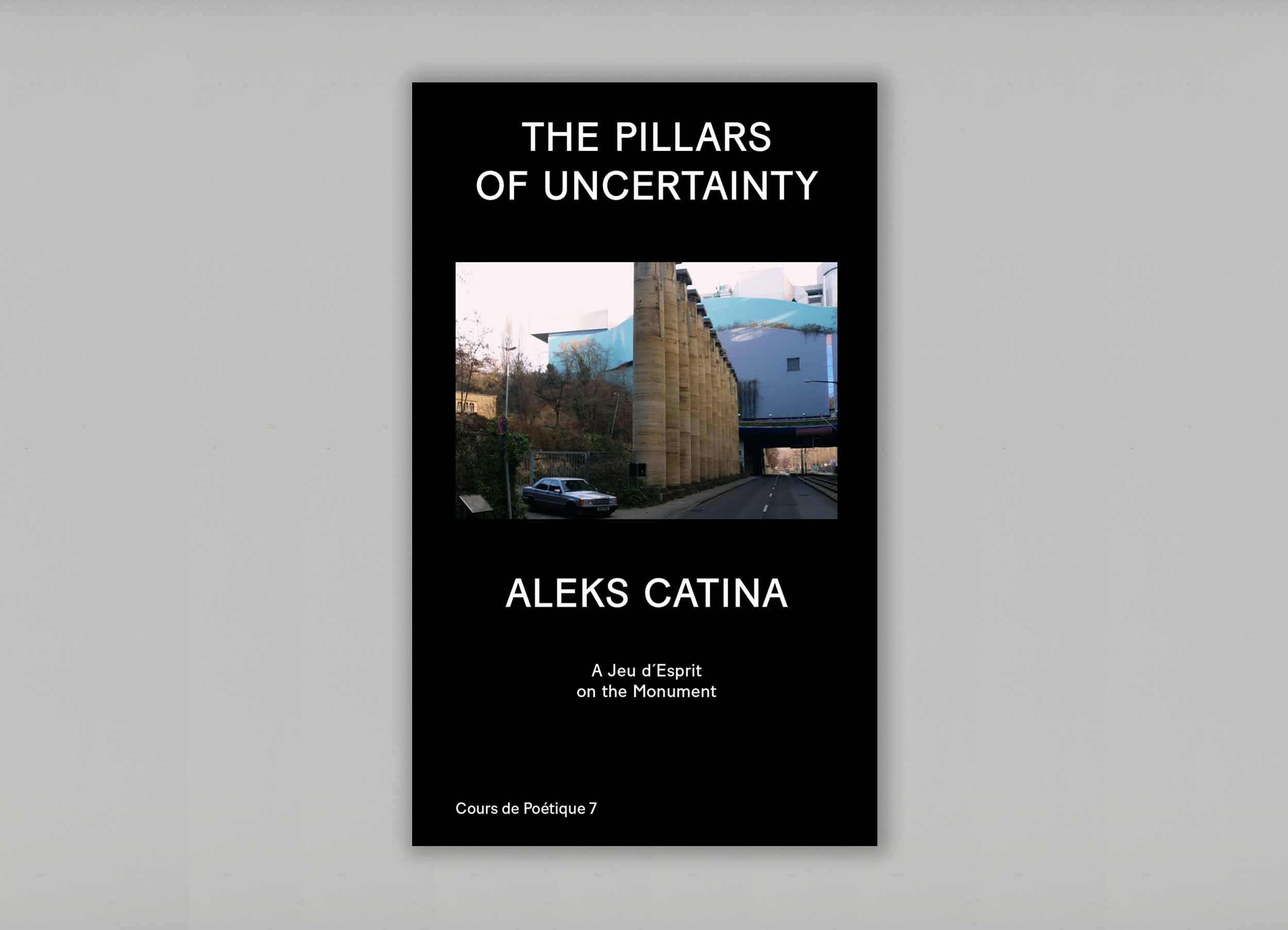
On his Instagram page, Aleks Catina declares that The Pillars of Uncertainty was ten years in the making, so begun in 2016. Joseph Kohlmaier had encouraged Catina to develop one of his seminars, called ‘The Problem of Irony’; and Kohlmaier designed and published the resulting attractive book (‘Preamble’, 11). Catina, Kohlmaier and Ektoras Arkomanis, who wrote the ‘Prelude’ for Pillars, were intelligent and creative colleagues of mine at London Metropolitan University. 2016 was also the year that the competition was launched for the variously-named (e.g. Museum of the 20th Century, Berlin Modern) New-New National Museum on the Kulturforum, Berlin, occupying the poignant gap between Scharoun’s Philharmonie (1963) and the Neue Nationalgalerie of Mies (1968).[1] The official competition winner, by Herzog & de Meuron, is still under construction, but Pillars offers an alternative museum apparently duplicating the Neue Nationalgalerie.
Inspired by Søren Kierkegaard’s early book, Repetition: A Venture in Experimental Psychology, authored pseudonymously by a Constantin Constantius,[2] Catina divides himself, and his book, into two adversarial pseudonyms.[3] The first of these is a Ramses Kiesele, whose etymology includes ‘pebble’ and points to obduracy; the name is derived from the putative grandfather of Catina,[4] Gerhardt Kiesele, a possible Mitläufer (passive ‘fellow traveller’ with the Nazi regime), who carved his name and that of his sweetheart into one of the Travertinsäulen (‘travertine columns’) in Stuttgart that are central to Catina’s tale. Kiesele has a historical and poetic imagination, largely centred on German Romanticism, and he teaches architectural history and theory. The second pseudonym is an M. H. Obrasnič (from Romanian obraznic, ‘cheeky’ or ‘naughty’), a pseudonym shared with Catina’s father, Mihai, with whom the alternative museum was designed, drawn and modelled. Obrasnič authors the essay framing the alternative project (pp. 35-86), in German (‘Die Neue Nationalgalerie als Wiederholung’) and, on facing pages, in English (‘The Repeated Museum’), although the translation is not repetition but involves different emphases and meanings. Kiesele accuses Obrasnič of plagiarism (a form of repetition) and of misunderstanding what he has plagiarised to the point of mockery (pp. 32-33); and Pillars purports to bring together the Obrasnič essay with Kiesele’s observations or reflections on the topics raised in the essay, in the form of twenty-two ‘Fragments’ divided into three categories (‘Trials’, ‘Precedents’, ‘Repetitions’) whose numbering indicates substantial gaps (pp. 87-276). Three women, who may be one according to the logic of dream or fiction, make occasional but prominent appearances as the debate unfolds: Maraike, Gerhardt Kiesele’s sweetheart; Heather, Ramses Kiesele’s cheerful and helpful local librarian; and Ezra, Ramses Kiesele’s Muslim student from Darfur who utters the insight which caused him to rethink everything (pp. 99, 100): ‘Conflict is the relationship of things that belong together’ (an astute reframing of Heidegger’s ‘strife’ or ‘striving’ [streben] of earth and world, in ‘The Origin of the Work of Art’[5]).
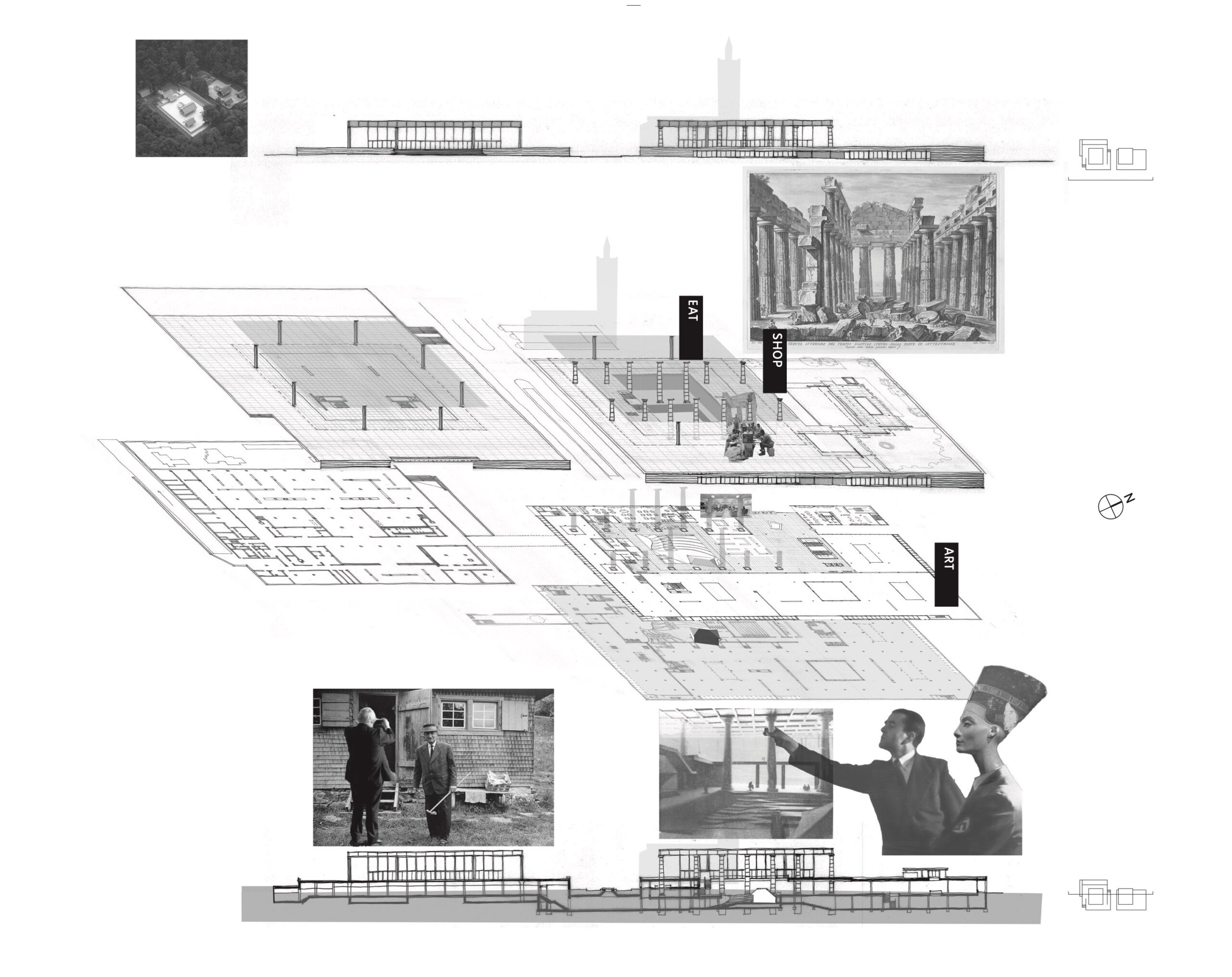
The putative topic of the alternative Kulturforum museum by Obrasnič [father and son] is 20th Century art, as understood in Germany, and in Berlin particularly. The proposed museum is presented in a fine set of drawings, views and collages, of which the iconographic isometric on pp. 82-83 will serve here as a guide. From the outside, the building purports to be a duplicate, or repetition, of the Mies Neue Nationalgalerie to which the replica is connected by a short tunnel, as is the Herzog & de Meuron edifice. Accordingly, the first icon is an aerial view of the Amaterasu-ōmikami Shrine at Ise during rebuilding, when the same exact building exists as a double (p. 168). The temple-like qualities of the Mies building remain an enigmatic embodiment of the secular-sacred; but the Obrasnič alternative is less neutral iconographically. The great canopy has acquired Classical coffering and is supported by the fourteen five-storey high[6] Travertinsäulen from Stuttgart, where they were originally quarried and carved.[7] Albert Speer had ordered these singularly ugly columns for a never-completed monument to Mussolini rising from the centre of a proposed circular platz as part of his new Berlin.[8] Although the columns are Tuscan, both Obrasnič and Kiesele believe they are a legacy of European architecture’s reaction to the Doric found in the three temples at Paestum; and so the next icon on the isometric is the painting by the vedutista Antonio Joli of the Temple of Neptune,[9] done about twenty years before Piranesi’s famous drawings and prints of the site. Much of Kiesele’s ‘Fragments’ are taken up with the history of what is termed, ‘the Paestum Column’,[10] from Piranesi through the likely collaboration of Brogniart and Ledoux at Maupertuis, to Gilly at the Rue des Colonnes to Stirling’s museum at Stuttgart, with excursions along the way. The Travertinsäulen frame a large central pit in the Obrasnič museum, which holds a full-scale replica hillside from Todtnauberg (‘dead meadow hill’) including a repetition of Heidegger’s ski hut; and a third icon on the isometric depicts Heidegger in a hat outside his hut, from the Marcovicz series,[11] with Boris Johnson[?] dropped into the foreground. In this arrangement, Building and Thinking—about the origin of the work of art—are explicit; Dwelling is the conditional term.[12] Obrasnič calls the museum a ‘cenotaph for Martin Heidegger, at the centre of a Temple to Forlorn Authenticity’ (p. 59).[13] The last icon has Albert Speer reaching out to suggestively grasp one of his Travertinsäulen with the bust of Nefertiti beside him. His image has been extracted from a 1937 photograph of Speer showing Hitler a model of the German pavilion for the Paris World’s Fair; but the juxtaposition with the bust (located in Berlin) suggests we are to read Nefertiti, wife of the monotheist Akhenaten, as Nefertari, wife of the later Rameses II, played here by Speer, in order to indicate the Ozymandian motives behind the production of monuments (p. 97). Like a huge Freudian slip, the Obrasnič museum is haunted by 1930s Germany; and a contemporary Percy Bysshe Shelley could plausibly ‘despair’ that this mighty work is in fact a ‘colossal Wreck’… and not limited to Germany.
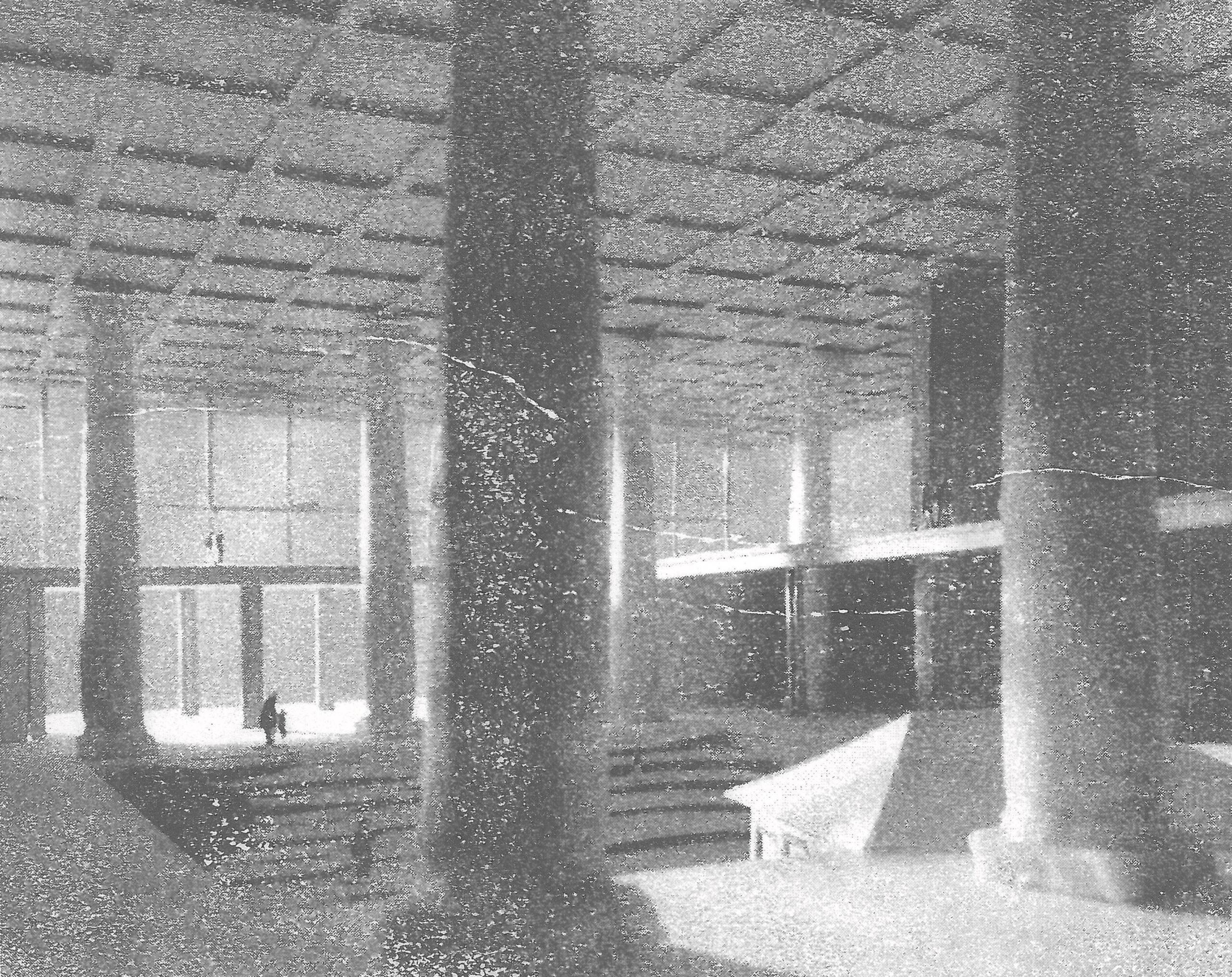
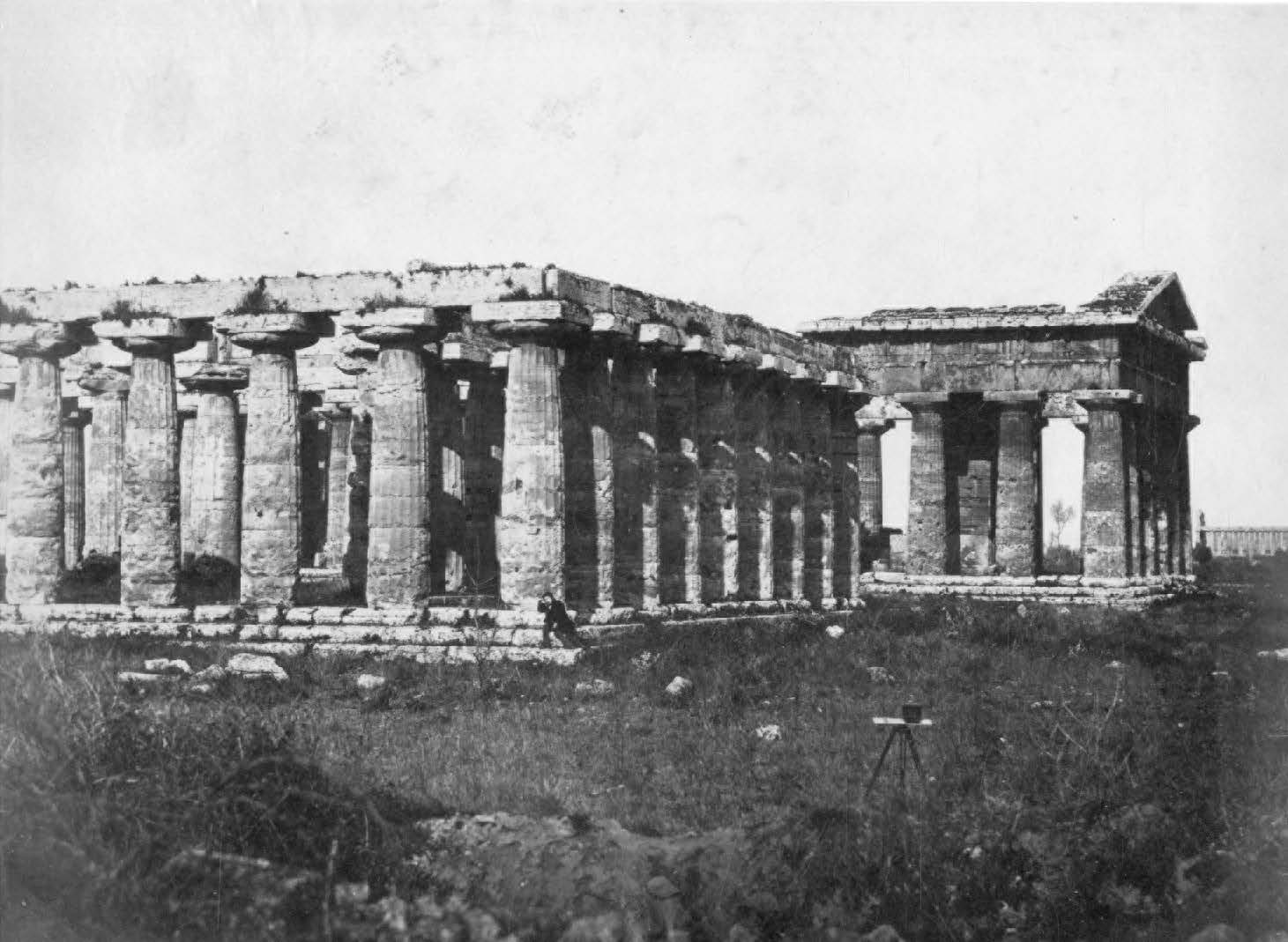
The reader is regularly encouraged to read this grand museum afflicted with a guilty conscience—embodying the ‘uncertainty’ of the title—according to the modalities of irony, elaborating the Ruskinian insight that the imagination, free of objective or practical obligations, finds itself negotiating truth and deception (pp. 120 ff.). Certainly the motif of duplication deprives any work of the originality sought by most contemporary architects (amply visible in the official competition entries), although of course the similarity among Greek temples (like temples in most traditional cultures) was quite the point. It appears Obrasnič and Kiesele represent complementary sides of irony: Obrasnič exhibits the irony that leans towards parody or satire, aiming to wound an ‘opponent’, whereas Kiesele (whose Fragments recall those of Friedrich Schlegel) adheres to the Romantic notion of irony or wit (Witz) as a flash of insight, derived from the poetic understanding of metaphor, with occasional cosmic or universal overtones.[14] Following the conventions of Attic Comedy, I adopted the view that Catina plays the role of the eiron, who, like Socrates, adopts a feigned ignorance in order to subvert the arrogant boastfulness of the alazon. Identifying who and/or what plays the role of alazon in this schema is more obscure. In accordance with the dictum of the ‘Preamble’ that ‘the monumental expresses the ethos of power’ (p. 15), tyrants with Ozymandian fantasies are likely candidates.[15] Other candidates might include the monumental ambitions disguised in the ‘Mannerist modesty’ of the Herzog & de Meuron scheme (pp. 37-43) conforming to the postmodern commitment to ‘deceit for deceit’s sake’ (pp. 138-9), or all the spectacle-merchants since the Crystal Palace (pp. 143 ff.). Given the tragic cast of this particular museum, however, and noting that the associated texts and images lie between the mid-eighteenth century and the present, the most likely alazon is the culture arising from the Romantic reaction to the Enlightenment.[16] This phenomenon saw the great multiplication of museums, establishing the contemplative relation to cultural artefacts and its vast attendant literature. It also saw Victor Hugo’s prediction that buildings would be killed by books (pp. 107-8, 112 ff.), aggravated recently by the innumerable social media posts and the plurality of discourses arising from individual freedom: ‘in the communication age, ambiguity has become futile’ (p. 79), inciting a possible third ironic stance, that of apathy.
Pillars enthusiastically and skilfully embraces this plurality of discourses: across the rhetorical spectrum from erudition to contemporary vernacular, we encounter Reddit chains and emails, postcards and letters, drama, fiction and dream, poetry and prose with footnotes, preaching and seminars, philosophy, architectural theory and history, pronouncements from esteemed thinkers, off-hand remarks, insights and jokes, memoirs and self-critique, as well as captioned images. Observing that architectural audiences are easily hoodwinked ‘because they love to think they understand “architecture”… like gods understand galaxies’ (p. 140), Kiesele’s effort to find truth in irony arrives to the tension between wit and tragedy (p. 153 ff.) which asks how the opposing moods or decorum [17] have their common appeal to fundamental cultural assumptions. Something similar pertains to the mystery of how words and architecture arose within the common imagination to attain Hugo’s state of aggression. The learned dérive in pursuit of the ‘Paestum column’ (allowing us to visit, inter alia, Arc-et-Senans, the Théâtre Feydeau, the Leeds Flax Mill, and the Belgrade Post Office) is conducted within the aesthetic experience that made the museum such a prominent institution.[18] It is indeed ironic that, from Goethe at Paestum to the Greek temple in Heidegger’s ‘Origin of the Work of Art’, the ancient temples and their columns are extracted from their original culture, and the fragments are then recycled to speculate about culture (typically with lessons for the interpreter’s period). Obeying Catina’s open structure which ‘aims to emulate gameplay’ (p. 12),[19] these themes are distributed among the several voices as fragment-threads woven through the brief chapters, the notes and the images, requiring agile fingers or slips of paper to keep track of where the story is unfolding. In the words of Joyce, Pillars is ‘a polyhedron of scripture’.[20]
One’s initial impression is that Pillars reacts against the earnest monotones of architectural theory by adopting the form of a self-consuming (like the Obrasnič museum) polyglot collage, as if to embed us in the cultural context which promotes concepts [words] over the embodying conditions [architecture], leading to intellectual and moral disorientation. However, it very accurately characterises the several ways we are with architecture, indeed with reality in general (approximate, metaphorical, laden with associations and concerns); and there are many wise observations along the way. In striving to establish a genealogy reaching back to a Heideggerian pre-Socratic Paestum, Kiesele immures the Obrasnič museum in equivocations and partial understandings as well as common sense and genuine insights… whether or not the book could redeem the repressed guilt. The moral ambivalence at the heart of irony points to the place where choices are made, between seeking a truth within the prevailing ironies or joining the ironic jeu d’esprit as a cultural praxis determined to sublimate one’s accountability to the darkness. As our culture is absorbed in the homogenising and untrustworthy algorithms of AI, it is a relief to discover the spirited riposte of Pillars—a witty, thoughtful, provocative, even poignant ‘monument’ to contemporary conditions.
*
Notes
- The comprehensive website on this project includes documentation of all the schemes of the competition, at https://www.berlinmodern.org/wettbewerb/wettbewerbsverfahren/zeitplan
- Copenhagen, 1843, published on the same date as the less ludic Fear and Trembling and Three Edifying Discourses. Repetition is often published together with Philosophical Crumbs, 1844, such as the edition cited by Catina, note 3, p. 17. Structured around an intricate ironic analysis of frustrated love and playing with Platonic anamnesis (from his Meno) between simple recollection and how the eternal is embodied in temporal difference, Constantius discovers that repetition of pleasurable experiences is impossible, including life itself (one death)—a psychological fatalism (Job is regularly invoked), the recto of the coin on whose verso will later be stamped Huysmans’ À rebours (1884).
- Arkomanis’ ‘Prelude’ supplies additional, or alternative, details of the Obrasnič-Kiesele relationship.
- Gerhardt Kiesele is a fictional character and bears no relation to the author’s paternal grandfather, Stelian Catina (1917–1984), a Romanian architect.
- In Poetry, Language, Thought, trans. by Albert Hofstader (New York: Harper Colophon, 1975), pp. 15-87 (originally 1937, revised 1950 and 1960).
- The canopy of the Obrasnič museum is made to match the height of the Mies canopy by setting the Travertinsäulen well below the level of Mies’ podium.
- They are currently surrounded by a gigantic recycling plant, which replaced the stone working company, Lauster, who quarried and carved the columns, and who set them up as ornament or advertisement after the war—https://materialarchiv.ch/de/ma:referenceobject_f349f002-1942-4f98-86f8-3e50a7b6e2ed?type=all
- For this scheme and its context, see the immer modern! website: https://immermodern.de/strassen-von-heute/westachse.
- Greek Poseidon, after whom the town was named—Poseidonia, renamed Paestum by the Romans. The eighteenth-century Neptune is now designated Hera II with Poseidon possibly sharing worship; Hera and Poseidon were both children of the Titans Rhea and Cronos.
- The so-called ‘Paestum Column‘ generously includes fluted and unfluted Doric and Tuscan columns with and without bases, not to mention the great fluted stumps without capitals in the Belgrade Post Office entrance (p. 215, j). Additional material on the reception of the Paestum temples, including the possible dependence of the Temple of Neptune upon the Temple of Solomon, is succinctly treated, with useful bibliography, by Sigrid de Jong at: https://journal.eahn.org/article/id/7511/.
- Digne Meller Marovicz, Martin Heidegger, photos 23 September 1966/17+18 Juni 1968, Stuttgart, Fey Verlag GmBH, 1976, p. 71. Heidegger also gave lectures in his ski clothes and skis lean against the wall in the background of the famous photograph of Heidegger and Cassirer in Davos (a debate prefiguring many of Catina’s themes).
- In light of Heidegger’s hut and of Kierkegaard’s lengthy analysis of theatrical farce in Repetition, it is amusing to note that Joli, who was also a set-designer trained with the Bibiena, ornamented the mansion (the entrance parlour of 4 Maids of Honour Row, Richmond) of John James Heidegger, promoter of risqué masquerades in the Haymarket Theatre, satirised by Hogarth in a famous print (https://www.britishmuseum.org/collection/object/P_1868-0808-3470).
- The Travertinsäulen discretely miss the structural lines of the coffering, presumably alluding to a more general instability.
- Modernist irony, now almost a default position (outside architectural theory or scientific writing), has its literary origins in Romanticism (with nods to, e.g., Aristophanes, Cervantes) and in the visual arts in Duchamp. Manfred Frank reads Romantic Witz in terms of its requirement for philosophy: ‘Irony is that which refers “allegorically” to the infinite… the tendency toward the Absolute amidst the finite itself’, The Philosophical Foundations of Early Romanticism, trans. by Elizabeth Millán-Zeibert (Albany: SUNY Press, 2004), pp. 180, 205. Kiesele bases his readings in Kierkegaard, Schelling and Friedrich Schlegel, which preserve ethical concerns, as against the more recent interests in the ambiguities arising from linguistic and rhetorical complexity. Catina provides several useful references on this topic, to which could be added the curious history of humour in philosophy by John Morreall: https://plato.stanford.edu/entries/humor/.
- Note, in a related vein, Martin Heidegger, The Will to Power as Art, Vol. 1 of Nietzsche, trans. by David Farrell Krell (New York: Harper & Row, 1979) (orig. 1961). Nietzsche and Hölderlin were his reciprocal preoccupations during the war years after he stepped down from the Rectorate.
- Isaiah Berlin makes clear the dependence of Romanticism upon the Enlightenment, despite the ‘gigantic and radical transformation’, whose extravagantly diverse and contradictory character he spends his first chapter trying to identify, in The Roots of Romanticism (Princeton: Princeton U.P., 1999).
- As enshrined in Hellenistic theatre conventions whereby the Tragic and Comic sets answer to nature in the Satyric set, according to the Aristotelian reciprocity of nomos [custom, convention, law]and physis [nature] (Vitruvius, De architectura, V.6.9 and Aristotle, Nicomachean Ethics, 1134b18 ff.)
- Sometimes thought of as secular ‘temples’ (to art), Catina doubtless appreciates the irony of the great compilation of religious objects in, for example, the British Museum, organised to promote any manner of personal reaction except worship.
- Presumably non-linear or open-world computer games are meant (a genre whose technical virtuosity is inversely related to narrative quality), but recent experiments with scrambling categories in museums also come to mind.
- Finnegans Wake (New York: Viking Press, 1967 [1939]), p. 107.
Peter Carl received his MArch from Princeton in 1971 and the Prix de Rome in 1974. He has taught design and graduate research at the University of Kentucky (for 3 years), the University of Cambridge (for 30 years), and London Metropolitan University (for 7 years), and has held visiting positions at Rice University, University of Pennsylvania, Cornell University, and Harvard Graduate School of Design. He is currently studying metaphor and embodiment as the basis for the architectural poetics by which situations are reconciled with technology, ethics, mood, reference, etc.
