Provenance in Architecture, A Dictionary: Photography
The following text is one of the entries included in the recently published book Provenance in Architecture, A Dictionary (Berlin: Hatje Cantz Verlag, 2025) edited by Uwe Fleckner and Mari Lending. The book, presented in the form of a dictionary, examines architectural provenance across 101 key concepts, from acquisition to will. Each entry provides a new way of writing architectural history, highlighting how architecture moves, is destroyed, survives and is transformed.
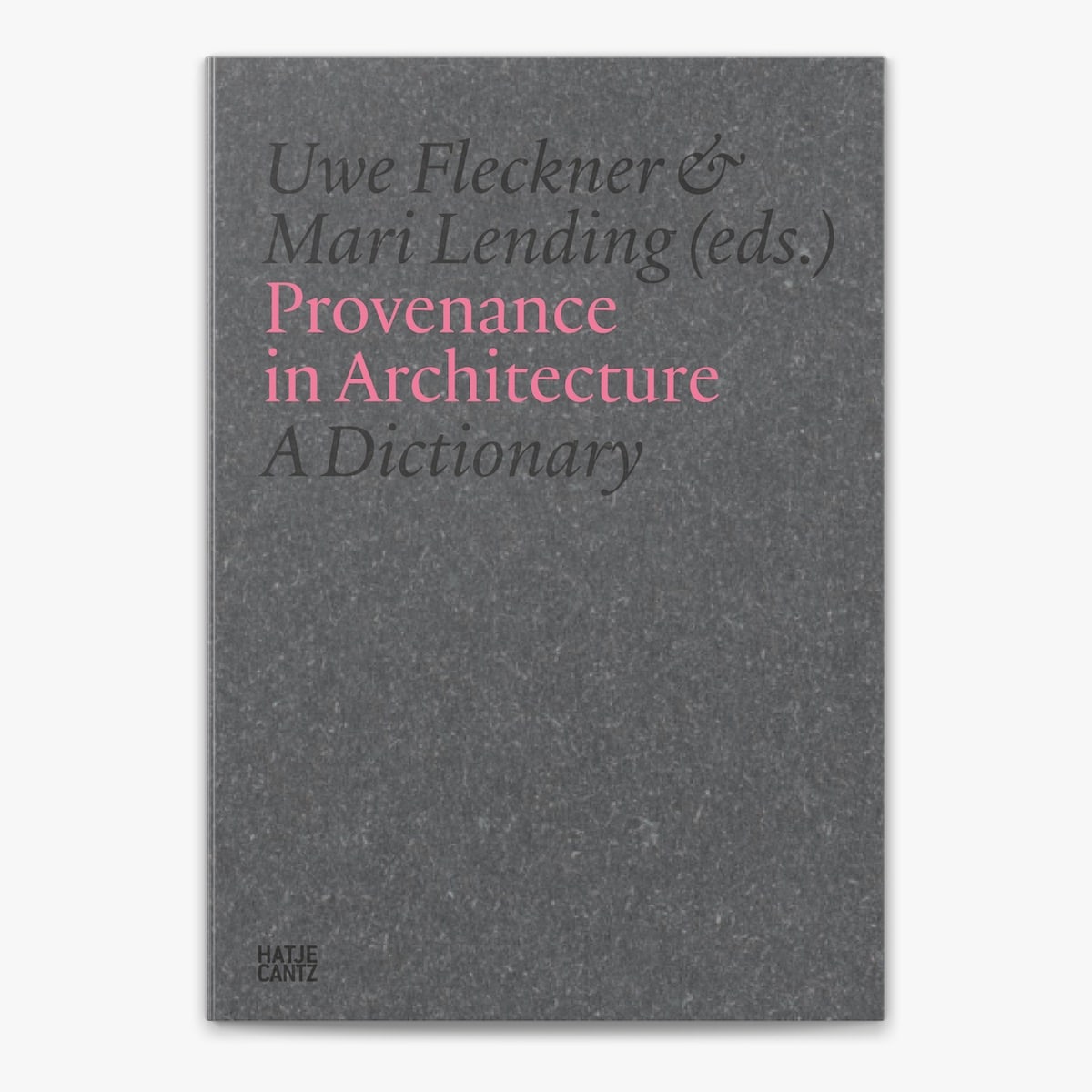
Each highlighted word in the text below is also a separate entry in the book.
*
In April 1890, Dramatiken in Christiania (Oslo) was advertised for demolition. The auctioneer Richard Andersen begun the sale of the theatre in situ at 10 am, 29 April, and in the following days building elements were sold to the highest bidder for reuse: ‘double and single doors, windows, mirrors and glass panes, panels, floors, stairs, brick and roof tiles, gutters, stoves, a skylight, beams, gas and water pipes, etc.’, as advertised on April 28, 1890 in the newspaper Dagbladet.
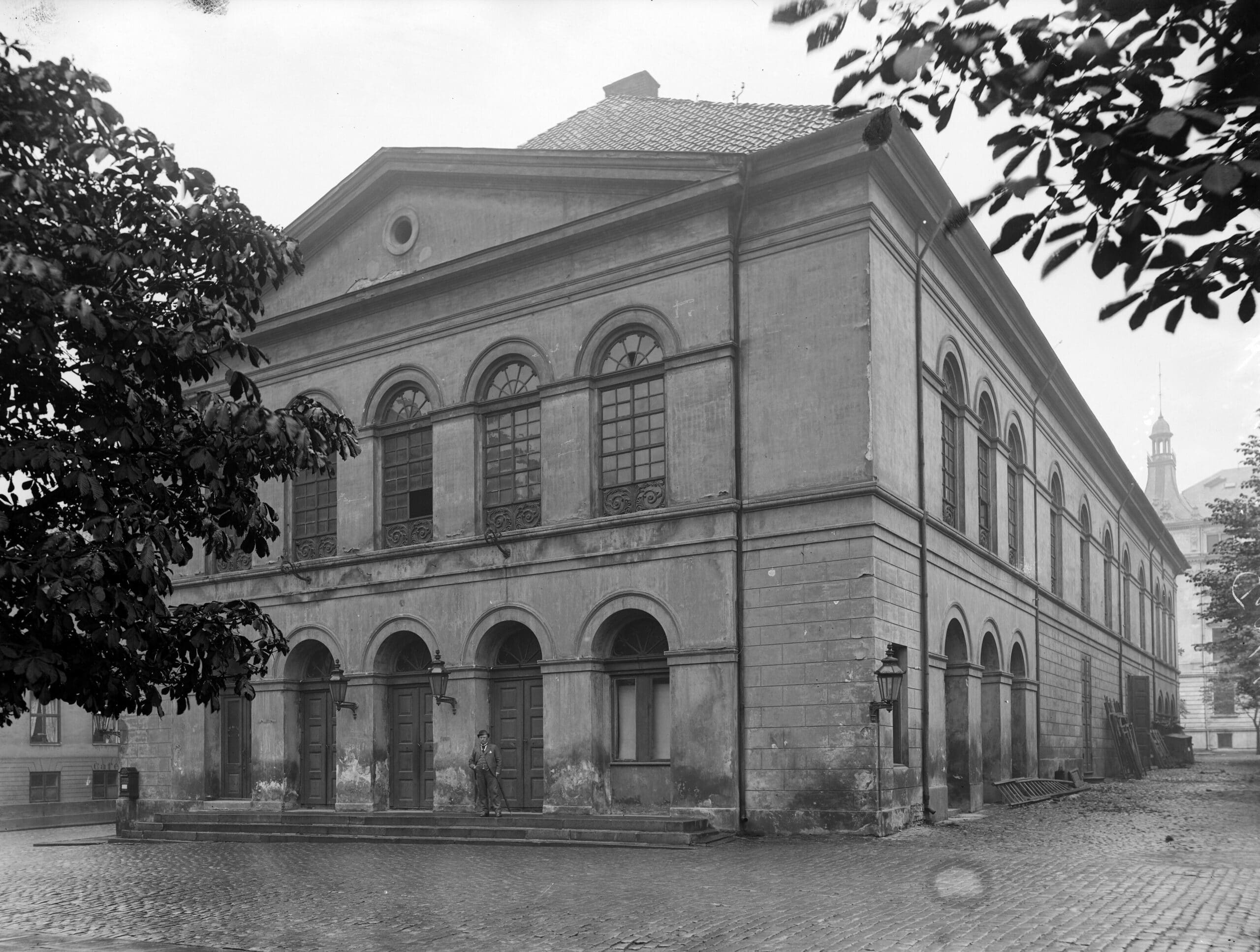
Dramatiken was established in 1760 when Christiania patricians played amateur theatre in a private orangerie that was soon transformed into a proper theatre building, a concert hall and a ballroom in an urban garden (transformation). It is still operating under the name Centralteateret with an eighteenth- century columned hall in the rear, an auditorium from the late 1890s, and a 1934 modernist concrete facade towards the street designed for the projection of moving images. At least six top Norwegian architects and a bewildering cast of owners have contributed to this three-dimensional palimpsest across centuries. With most of the many drawing sets lost, the demolition sale of 1890 provides one important source for the reconstruction of some of its former iterations and their provenance: the skylight sold in April 1890 was, for instance, an 1871 intervention by Georg Andreas Bull when the theatre for a period functioned as an exhibition hall for architecture and craft.
Richard Andersen, who established his auction house in 1874 and conducted demolition auctions for the municipality, was also a pioneering photographer and preservationist of sorts (preservation). Between the mid-1880s and 1913, he had hundreds of the buildings he auctioned for demolition photographed, with himself discreetly present in the picture, equipped with a hat and a cane. In a 1913 interview, he explained the importance of documenting buildings that are sacrificed in the face of progress. Asked why he decided to ‘act as a self- appointed city preservationist’, he replied that he regarded each and every photograph as ‘a small memorial’ to the vanishing buildings and explained that his working principle was to record structure by structure to save them from oblivion. He regretted that he didn’t start documenting ‘the homes of those who played their part in the city’s modernisation’ earlier, he told a journalist from the newspaper Tidens Tegn, June 22, 1913.
Almost without exception, Richard Andersen’s collection records streetscapes with facades. The building that is about to disappear makes the main motif. The auctioneer’s archival project provides unique insight into a vanishing urban physiognomy (archive). The pictures bring to mind the work of a contemporary, kindred spirit, the French photographer Eugène Atget’s paradigmatic photographs of the buildings and deserted streets of Paris. In A little history of photography (1931), Walter Benjamin described Atget’s empty Paris photos as crime scenes, documenting ‘what was unremarked, forgotten, cast adrift’.[1] Similar to Atget, Andersen, the preservationist-demolisher, was less interested in great sights, landmarks or monuments, but rather in depicting ‘the conspicuous spot where in the immediacy of that long-forgotten moment the future nests so eloquently that we, looking back, may rediscover it.’[2]
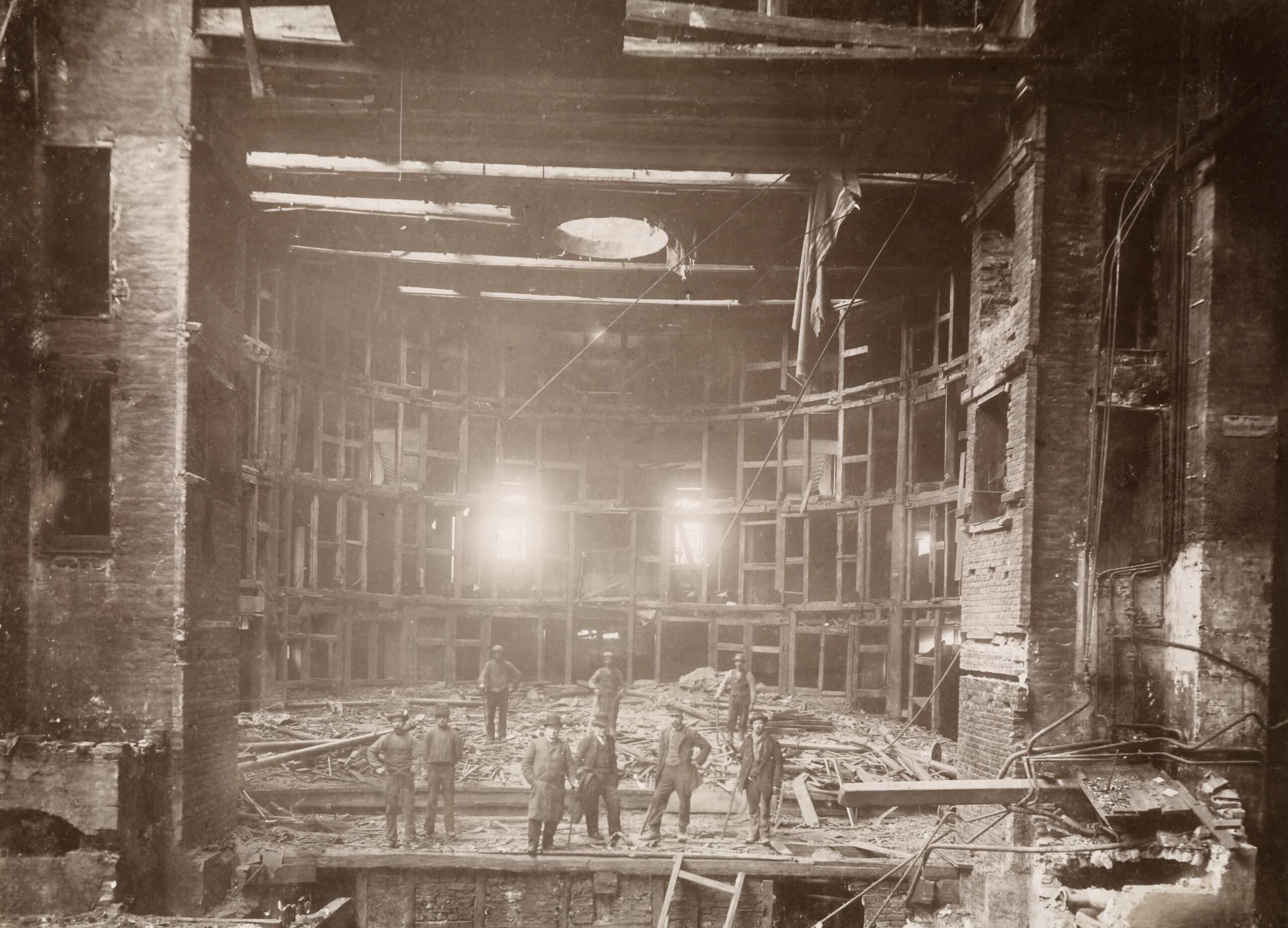
Richard Andersen entrusted hundreds of photos of the buildings he helped dismantle to the Foreningen det gamle Kristiania (Society of Old Kristiania), founded in 1905 by the architect Fritz Holland, the founder of Oslo Museum. A selection was shown at the museum’s inaugural exhibition at the manor Frogner Hovedgård in August 1909. In 1913, Andersen handed over his remaining archive to the museum. If Dramatiken was documented the day before the auction in April 1890, that photograph is lost. However, in October 1899, Andersen carried out the demolition auction of Christian Heinrich Grosch’s Christiania Theatre from 1836, where also the interior was documented while being torn apart, piece by piece.
Notes
- Walter Benjamin, ‘Little History of Photography’ [1931], in Michael W. Jennings et al. (eds.), Walter Benjamin, Selected Writings, vol.2, part 2 (1931–1934) (Cambridge, MA: The Belknap Press of Harvard University Press, 1999), 510–521 (518).
- Benjamin, 510.
*
Mari Lending is a professor of architectural theory and history at the Oslo School of Architecture and Design, and a founding member of OCCAS (the Oslo Centre for Critical Architectural Studies). Among her books are Plaster Monuments. Architecture and the Power of Reproduction (Princeton University Press, 2017); with Peter Zumthor, A Feeling of History (Scheidegger & Spiess, 2018); with Erik Langdalen, Sverre Fehn, Nordic Pavilion, Venice; Voices from the Archives (Lars Müller Publishers, 2021); and Warburg Models: Buildings as Bilderfahrzeuge, with Tim Anstey (Hatje Cantz, 2023). She is the director of the international research project Provenance Projected: Architecture Past and Future in the Era of Circularity, and is presently working on the monograph Auctioning Architecture.

– Fabrizio Gallanti