Uncommon References: Le Corbusier, the Primal and the Flesh of Matter
– João Miguel Couto Duarte and Maria João Moreira Soares
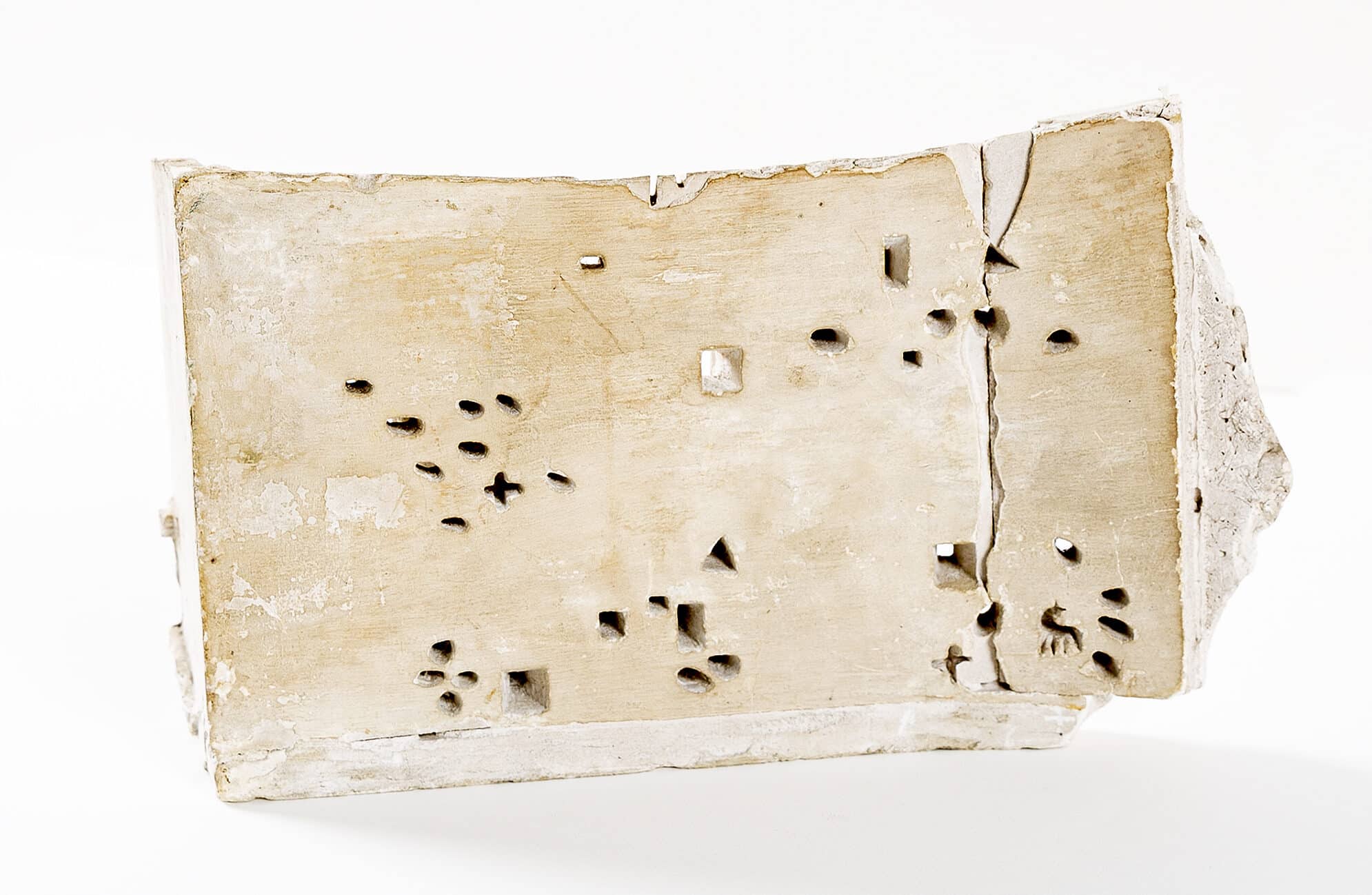
In 1950, Le Corbusier began designing the Chapel of Notre-Dame du Haut in Ronchamp. Le Corbusier wrote that it represented ‘Liberté’ (freedom).[1] Totally free architecture. A veritable phenomenon of visual acoustics. That freedom affected one visitor in 1955: ‘the sacred building stood in the landscape like an extraterrestrial object, leaving the viewer unsure if its form emanated from the future or from the archaic past’.[2] The chapel was received with apprehension by the Roman Catholic Church. It became a controversial work to the extent that believers were not advised to visit. There was a feeling of two-fold sacrilege in relation to the chapel. Niklas Maak writes that the pilgrimage to the chapel was
‘an affront to the traditions of the church, but also to the dogmatists of an architectural rationalism that cemented Le Corbusier’s bon mot of the house as a ‘machine for living’ with buildings that were becoming ever more apparatus-like in character.’[3]
In its final look, the chapel evokes Le Corbusier’s travels to ‘less appropriate’ places around the world as a Christian image. The truth is that previous experiences with the famous south wall were more outrageous. The world is there in the wall that was built. And the world that is there is essentially a primal one, an archaic past. It is a world not alien to a certain sense of good abandonment that pervades Le Corbusier’s later works, such as the Chapel of Notre-Dame du Haut. This fascination with the primal can be seen more emphatically in the fenestration study carried out in 1950–51 in a plaster model for the south wall of the chapel, where minute perforations transpire in a huge mass of matter.[4] A ‘pagan’ constellation marked by a small bull-shaped orifice. A cavernous, throbbing thing. Flesh.
*
DM Editors: It appears that the model for the south wall in the Drawing Matter Collection might be the only record of this emphatically ‘primal’ fenestration. It may have been cut from the plaster model made to abate the anxieties of the Catholic Church, shown to the Archbishop of Besançon in November 1950, or modelled earlier in the design process. (See Robin Evans, ‘Comic Lines’, in The Projective Cast (Cambridge, MA: MIT Press, 1995), 303.)
*
Excerpted from Maria João Moreira Soares and João Miguel Couto Duarte, ‘Uncommon References: Le Corbusier, the Primal and the Flesh of Matter’ in (Un)common Precedents in Architectural Design, ed. by Federica Goffi, Isabel Potworowski and Kristin Washco (Abingdon: Routledge, 2026), 90–102 (94–5).
Notes
- Le Corbusier, Textes et dessins pour Ronchamp, ed. by Jean Petit (Geneva: Association œuvre de Notre-Dame du Haut, 1990), n.p.
- Niklas Maak, ‘The Beaches of Modernity: Le Corbusier, Ronchamp and the “objet à réaction poétique”’, in Le Corbusier: The Art of Architecture, ed. by Alexander von Vegesack, Stanislaus von Moos, Arthur Rüegg and Mateo Kries (Weil am Rhein: Vitra Design Museum, 2007), 299.
- Ibid., 302
- The eastern wall of the chapel confirms Le Corbusier’s fascination with the primal, with 15 points of light arranged like stars around an image of the Virgin Mary. Marcia F. Feuerstein, ‘”In the sky with diamonds” of Ronchamp’s East Wall: Constellations of Thought.’ Montreal Architectural Review 6: 29–43.
