Cartographies of Attunement and Rupture
For over a decade, I have taught architectural drawing—guiding students through the full arc of their studies, from the first hesitant lines to final major projects. At architecture schools across Australia, I have stood beside students as they learn to see and to draw space. In the earliest weeks of their education—often on the very first day—we place into their hands a particular way of seeing: the Cartesian model. We teach them to imagine space not as something felt or lived, but as something measurable, divisible, and exact. Through orthographic projection, they learn to render the world through right angles and parallel lines, to flatten, measure, and fix objects within a uniform grid. It is a sober, abstract initiation—space reduced to coordinates, clarity prized over complexity.
This model is not just a tool; it becomes a lens, a habit of mind. It threads through every stage of the degree, structuring how space is conceived, represented, designed within, and ultimately built. Even as students develop more sophisticated design languages, this foundational mode of thought—this imagined neutral space—persists, quietly shaping the way they engage with the world and with architecture itself. Around it has grown an entire apparatus: T-squares, adjustable set squares, clutch pencils and the speciality sharpeners that bring them to needle point, scale rulers, technical pens, drafting software, 3D modelling programmes—a world of tools engineered to refine this precision, and grant a certain kind of freedom within its bounds.
Likewise, when I began studying neuroscience, I was met with a familiar foundation—the body and nervous system rendered through plans, sections, and detailed diagrams. Once again, the same lens of abstraction was at play, structuring how we come to understand our own form and its functioning. Again, a world of tools engineered for this purpose—CT scanners, fMRI, EEG—all miraculous drawing machines, all designed to segment the nervous system and represent it within this same model of Cartesian space. This parallel gave me pause. I began to wonder: what kinds of practices of inquiry, representation, and design process, what expressions, built forms, and spatial intelligence might emerge if we were to begin elsewhere—with an entirely different mode of spatial representation altogether?
*
During my doctorate, which investigates the neurophenomenological conditions that make spatial perception possible, I was faced with a simple difficulty: the world appears through the shifting lens of attention and perception, yet our mapping tools freeze it into form. They give us clarity, yes—but only by quieting the tremor and contingency of lived perception.
Against this backdrop, a new practice begins to take shape, one that treats drawing as a perceptual prosthesis and positions attention as the very material through which spatial experience is generated. This mapping practice develops into what Deleuze and Guattari call an ‘abstract machine’: a diagrammatic engine that organises how perceptual events, bodily capacities, and temporal rhythms are coordinated.[1] This abstract machine gathers years of research into the plasticity of multisensory perception and makes visible the groundless ground—from which all meaningful spatial experiences emerge.
In constructing this machine, I develop an alternative drawing space, one that considers the shifting, relational nature of spatial perception. A comparable operation can be found in Michael Webb’s Temple Island drawings. In these works, Webb constructs and draws within perspectival space rather than orthographic space.[2] Similarly, I develop and work within a distinct drawing space—a space that is perspectival, but not solely in relation to vision. Instead, it is multisensory and mnemonic, reflecting the temporal and embodied nature of perceptual experience itself.
Rather than stabilising perception and mapping the world within an everywhere, this alternative operates as an everywhen—a temporal field in which multiple modes of knowing, sensing, and inhabiting can coexist, overlap, and reconfigure one another. The abstract machine, therefore, becomes a site where alternate ways-of-perceiving—and alternate ways-of-being—can take shape.
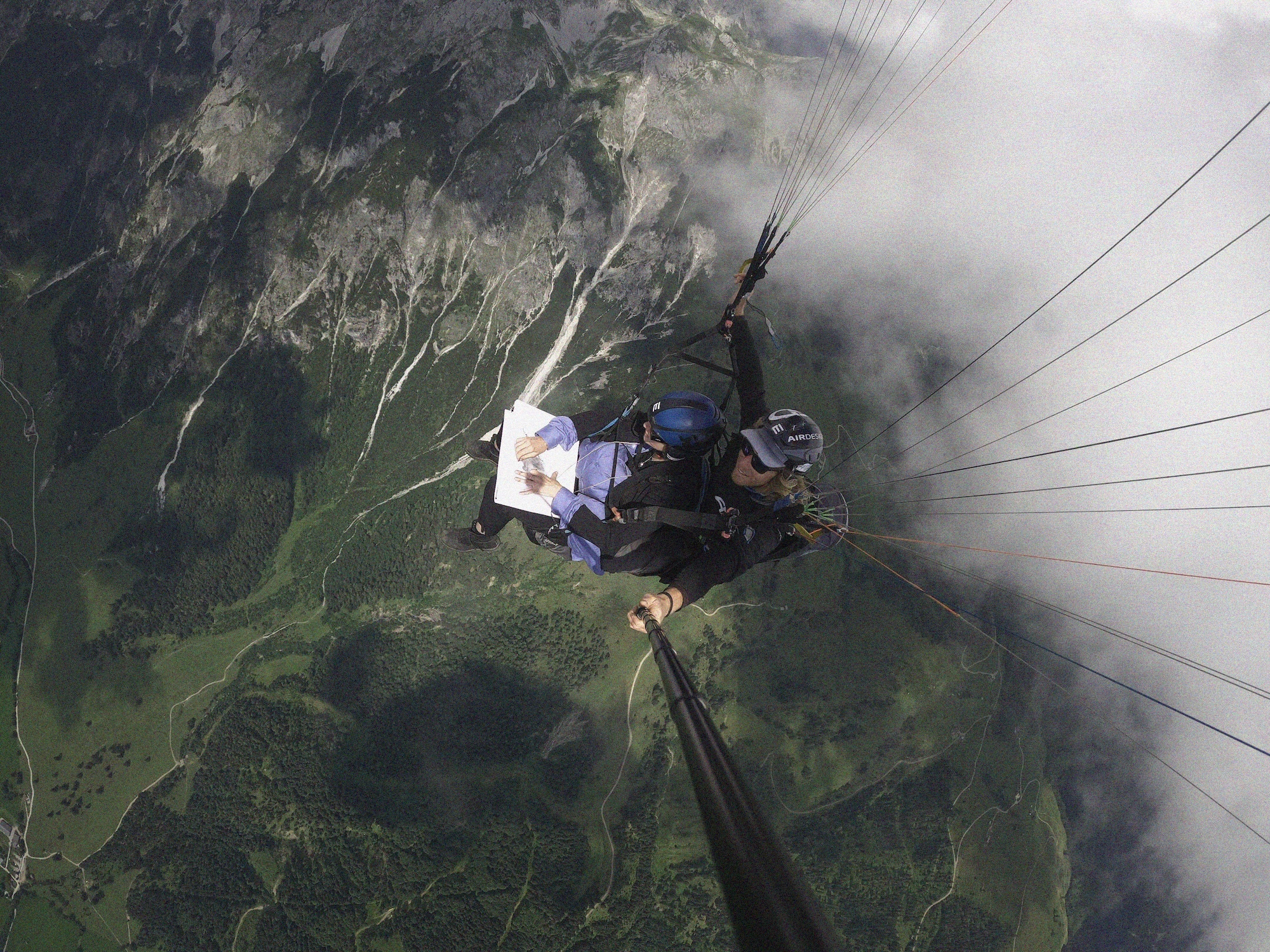
When developing this space, I designed and enacted a series of practices that Erin Manning might call ‘technologies of lived abstraction.’[3] Each is an active practice of aesthetic attention that is used to analyse our varied mechanisms for perceiving space. One such practice—The Enactive Dérive —was used to explore how we bring forth the limits of our immediate perceptual surround. Paragliding was used here, to enact a very different kind of dérive from that proposed by Debord.[4] With this practice, I investigated the Lived Place—a co-constituted field in which body, action, and environment mutually inform one another.
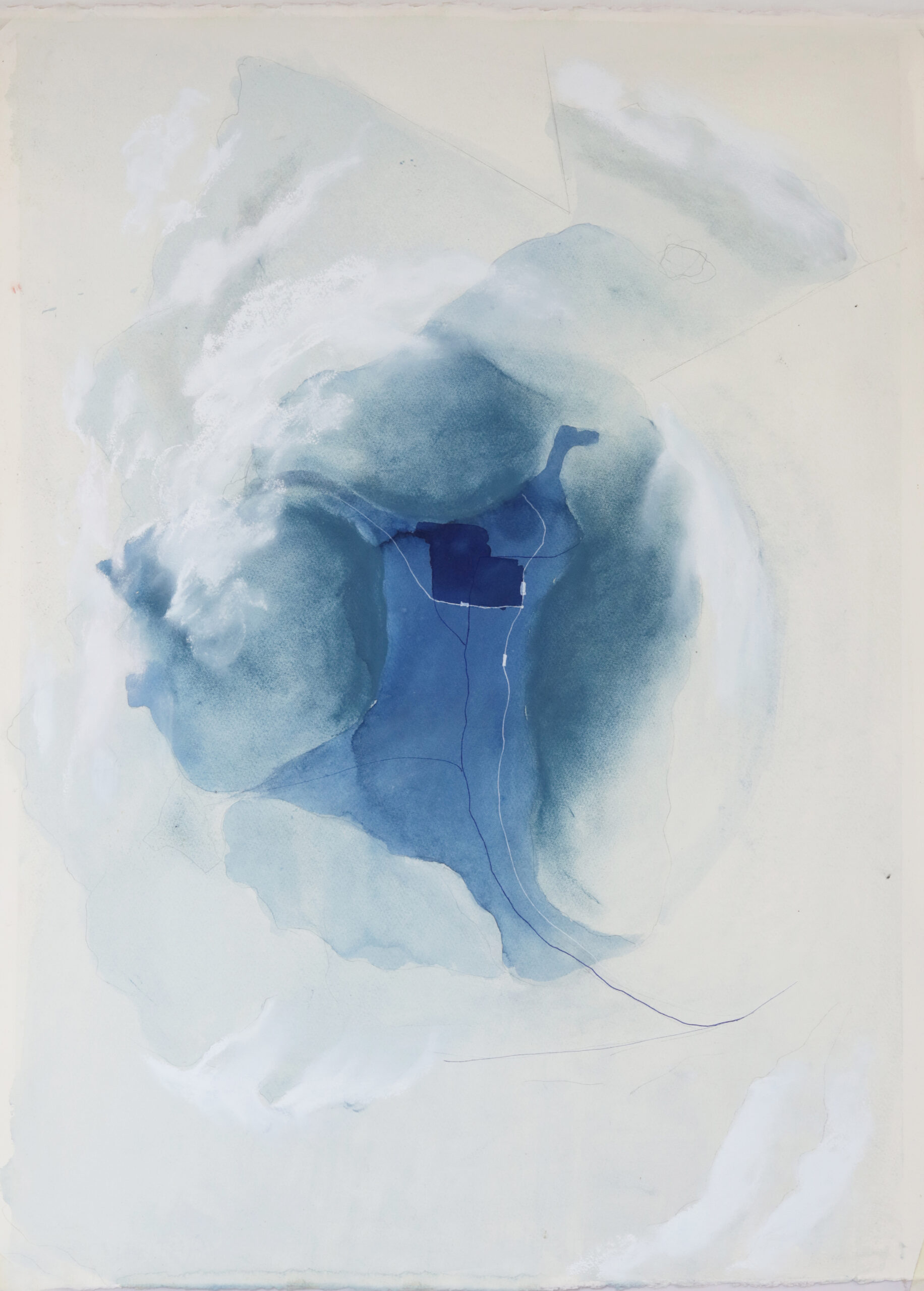
Fig.2 captures the layered shifts in my spatial perception that emerged as I gradually learned to fly—held in the air, watching the world gather itself around me. Birds spiralling, leaves fluttering, clouds forming, the quiet mountain: each pressed in on me and became a means of navigating my new surroundings. The space around them was never neutral, but a living field—that flexed, thickened, or thinned in response to every movement, binding my perception to the shifting currents of air.
In constructing this drawing, I observed how the immediate-perceptual-surround emerges from a continual oscillation between egocentric and allocentric processing. This oscillation, mediated by the hippocampal system, draws on both semantic and procedural memory to give the field its meaningful form—enacting both a background to our surround and an extended, felt, orientation field—both of which are composed moment-by-moment. This drawing was instrumental to the construction of the abstract machine. It calls for a new drawing space—one that charts the Lived Place and cultivates a layered spatial intelligence through enactive practices that attune us to the world as it coheres around us—revealing that it might just take shape otherwise…
Notes
- Gilles Deleuze and Félix Guattari, A Thousand Plateaus: Capitalism and Schizophrenia (Minneapolis: University of Minnesota Press, 1987).
- Michael Webb and Mark Dorrian, ‘Drawing, Movement and Medium: Mark Dorrian in Conversation with Michael Webb, Episode 3’ Drawing Matter, 22 November 2017.
- Technologies of Lived Abstraction is the book series co-edited by Erin Manning and Brian Massumi.
- Guy Debord, ‘Theory of the Dérive’, Les Lèvres Nues, no. 9 (November 1956).
*
Emerald Wise is a creative practitioner, academic, and educator, in the expanded field of architecture, whose work revolves around ways of looking at the world and embodied processes for enacting knowledge. She is a Research Tutor at the Royal College of Art. She co-founded UNMAKE studio, and the architectural practice Whispering Smith—which she left in 2018—and maintains a collaborative drawing practice with Dr Beth George.
This text is one of the selected responses to the second category of the Open Call 2025: Visibility, and the Unseen—a series of short contributions that either bring to the surface the unseen drawings within the Drawing Matter Collection (I. In the Archive) or explore original architectural drawings, created by the author(s) of the contribution, which make visible the unseen (II. In Practice).
