Massinissa Selmani
The nomination of the Algerian artist Massinissa Selmani for the 2023 Prix Marcel Duchamp was an official acknowledgement that a practice grounded primarily in pencil drawing on paper on a modest scale can constitute a major contribution to contemporary art.[1] In Selmani’s abbreviated aesthetic, weighty ideas are carried by the barest of means, and always with a light touch. A few cursory lines in chalk denoting a cloud, the outline of a figure carrying a blank flag, a portion of a monumental statue held aloft by a fluttering bird, a section of a miniature barrier embedded in a rock: whether in drawings, animated films or sculptures, the significance of these motifs hangs suspended. An atmosphere of quiet uncertainty is characteristic of his practice. The finely measured pencil-drawn images float on an empty expanse of white paper, usually with no hint of a setting in a particular location; they exist outside historical time and geographical space—yet those constraining conditions of human life are precisely their subject.
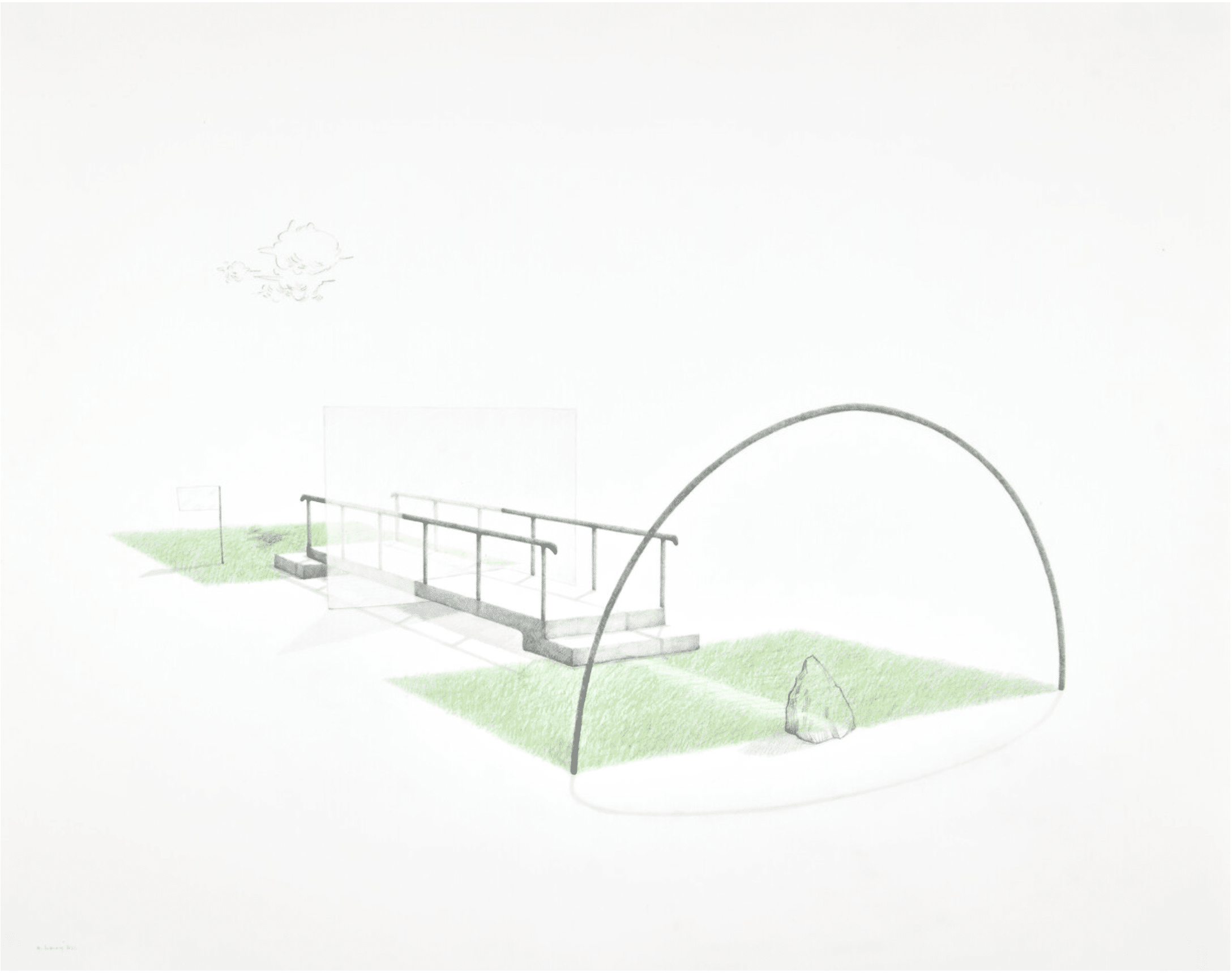
Shadows often play a defining role in Selmani’s images. Ephemeral and immaterial in themselves, they give substance to depicted phenomena and mark the passage of time. In drawings where spare delineation is the means of representing people and things, a lightly drawn shadow is often deployed to anchor an object, conjuring three-dimensional space without superfluous elaboration. In a recent drawing, Une profondeur de ciel et de chemins #3, the shadows are distinctly present under the bridge and the flag—and there is a rock, insubstantial, in fact a mere outline, transparent against the grass yet grounded by a solid shadow.
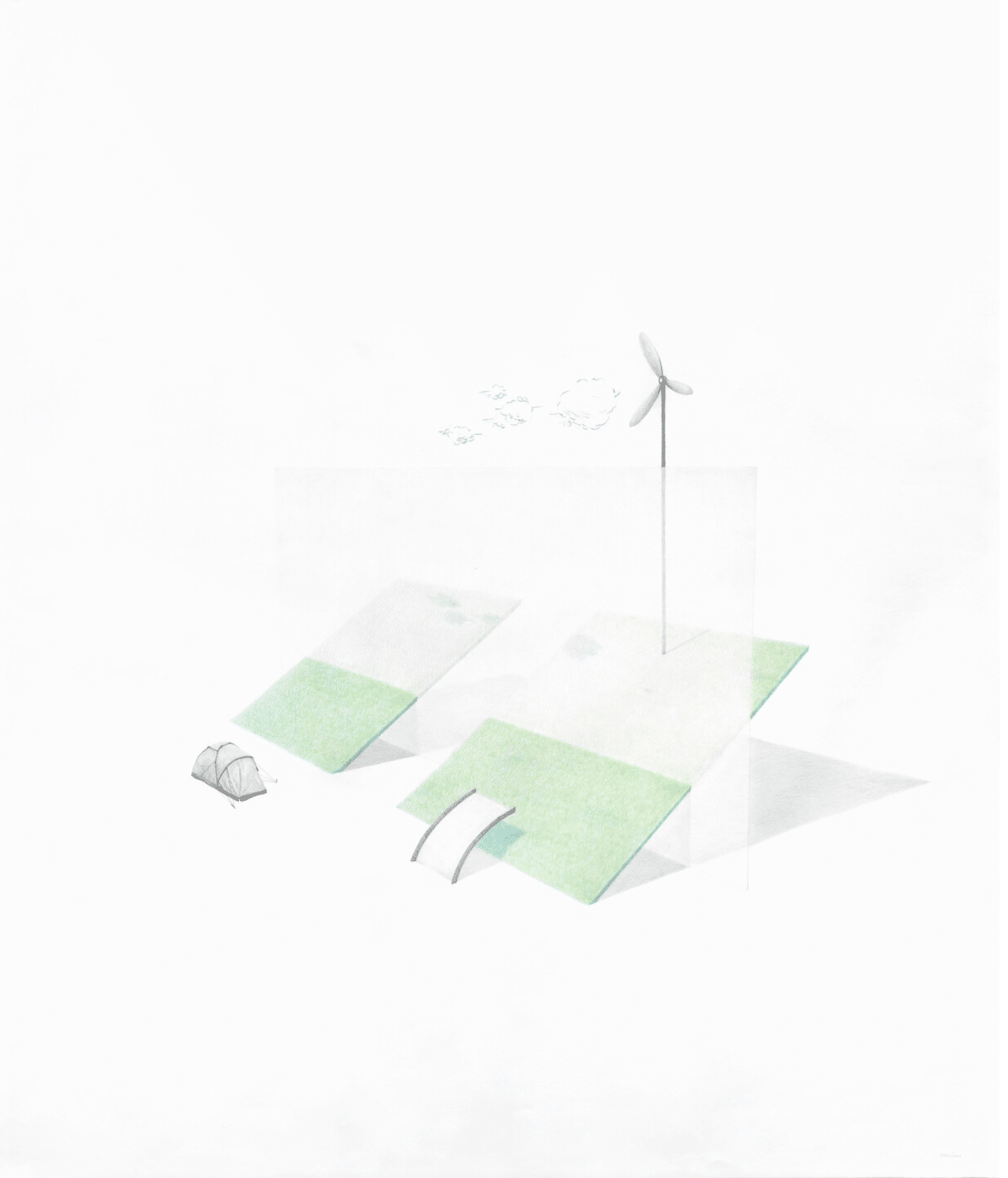
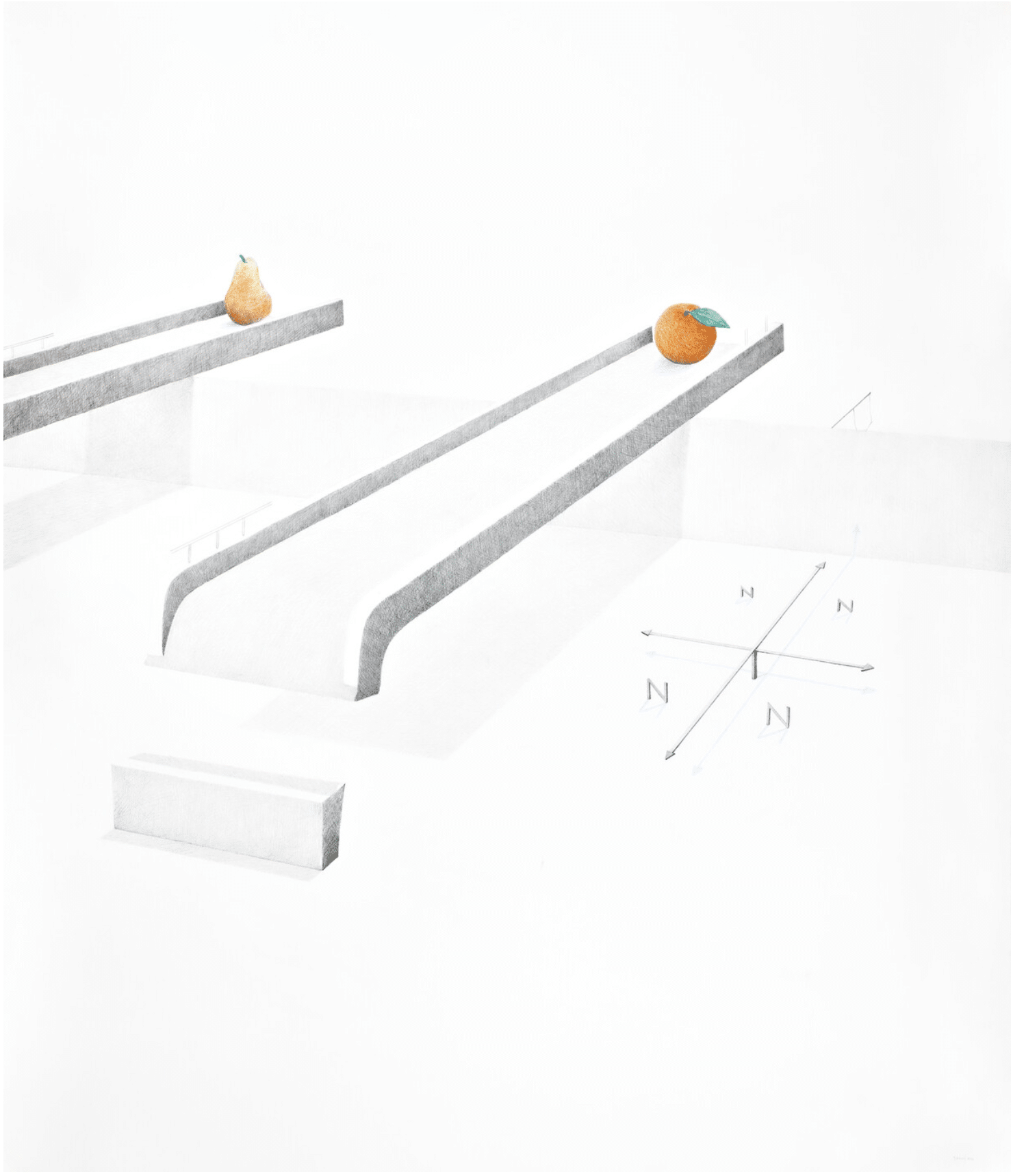
The artist’s delight in graphic games of illusionism can be traced to his early love of cartoons and to The New Yorker’s illustrator Saul Steinberg’s paradoxical play with pictorial space. That Selmani remains committed in his drawings to the humble media of pencil on paper or tracing paper may be taken as evidence of his allegiance to those graphic traditions. He can say everything he needs to say with these simple tools. The precision with which he constructs his images, his paring down of each motif to the minimum, gives them a clarity and resonance that exceed their modest size and seeming reticence. They are as concise and exactly placed as a poem on the page.
Many of Selmani’s images are derived from documentary sources, situating them decisively in the realm of fact, of everyday reality and events in the world. Figures traced in outline from newspaper photos, extracted from their context and without captions that would explain their actions, nevertheless retain their potency as evocations of human effort, struggle or resistance. Yet they are disconcertingly ambiguous and elusive.
Among the artist’s extensive body of drawings, collages, sculptures and animations, there is one archival research project that exemplifies his method of navigating between fact and fiction. It is worth considering it in some detail because his approach there provides a key to his wider concerns and overall strategy. In it, drawing plays a pivotal role as a metaphorical tool of research, a way of interpreting history ‘subjectively’, not to elicit objective facts but to open up meanings that might otherwise not come to light.
In 2015 the curator Okwui Enwezor invited Selmani to participate in his exhibition ‘All the World’s Futures’ in the Venice Biennale. One of the projects the artist presented, 1000 Villages, explored a period in Algeria’s post-independence history when, following the nationalisation and redistribution of land, the socialist government embarked on an integrated programme of agrarian reform. To improve rural living standards, 1000 Socialist Villages were to be constructed across Algeria, with modern amenities—running water, plumbing and electricity—and facilities including schools, health clinics and mosques. These utopian villages were partly modelled on Soviet cooperatives and were intended to engender a spirit of social solidarity. The first was inaugurated in 1972 and the plan was to complete 1000 within a decade. However, by 1981 only 171 had been completed, with a further 300 under construction, and the programme petered out.[2]
As a social experiment, the model was flawed in a number of ways: the imposition of standardised urban designs made little allowance for peasant household lifestyles; kitchens were designed for cooking standing at a stove, when traditionally women sat to cook; the floors were laid in unforgiving concrete and the walls constructed of breeze blocks, whereas earth floors and mud walls were cool in the summer and retained warmth in winter; the small interior courtyards provided no space for cooking outdoors or keeping livestock; windows opened onto the streets, with no allowance for privacy. So much seemed poorly conceived, without sufficient consultation with the rural population they were intended to serve. Over the following years—during which Algeria experienced a fierce civil war—this ambitious programme of social reform was quietly forgotten.[3]
Selmani recalls hearing about the 1000 Socialist Villages project when he was growing up, but never saw any evidence of it. He asked his father about it after reading an article in the Algerian newspaper El Watan. ‘Both intrigued and amused by my question, he replied that he remembered the Agrarian Revolution very well, but the 1000 villages echoed like an old rumour in his memory. His answer motivated me to dedicate a body of work to the project; it was obvious that I had to sound out this “rumour”.’[4] This is exactly the kind of elusive history, hovering between vague, unsubstantiated recollection and an official version of the facts fabricated to cast the government in the best possible light, that appeals to Selmani’s ironic sense of the impossibility of recovering the truth about the past.
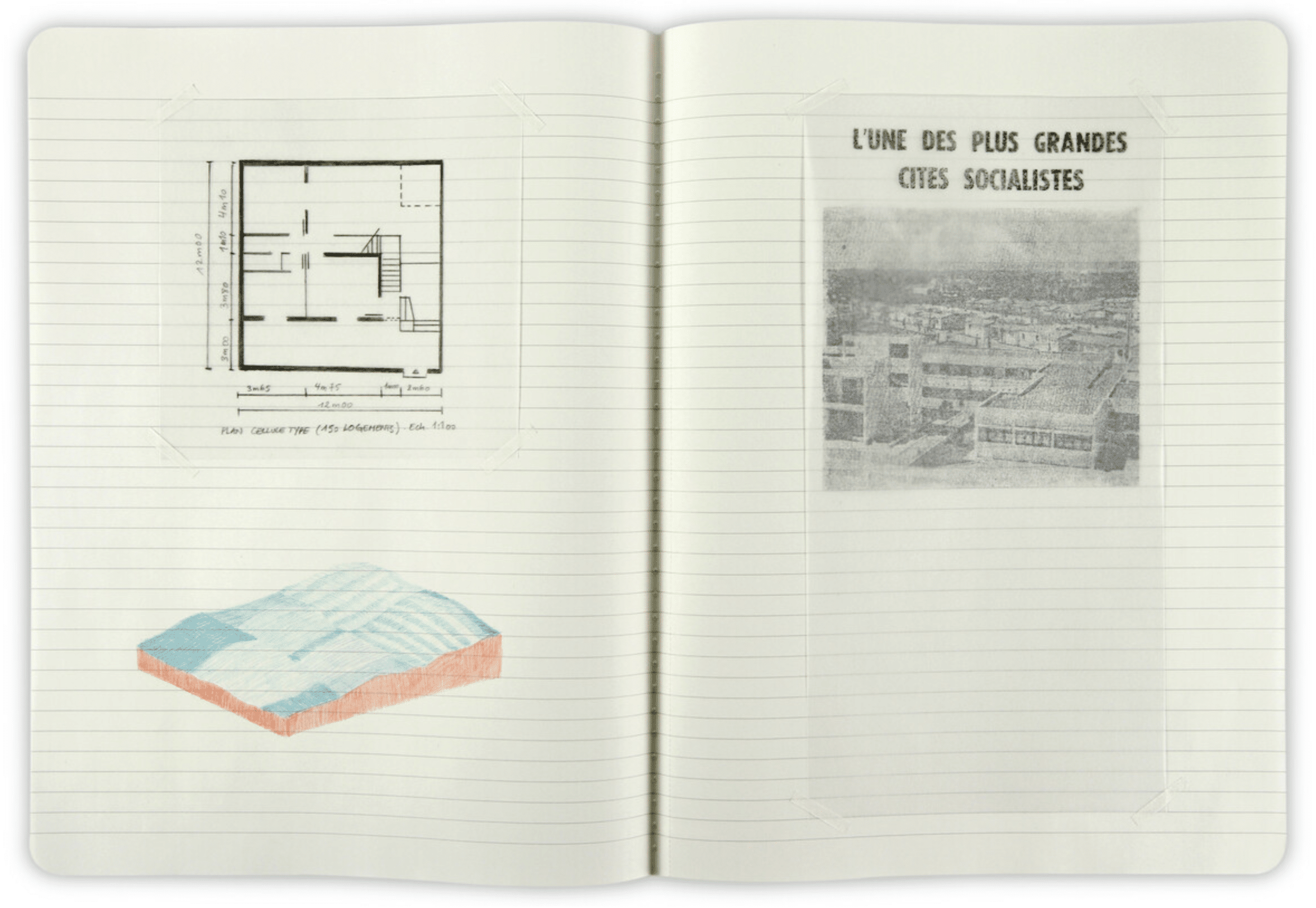
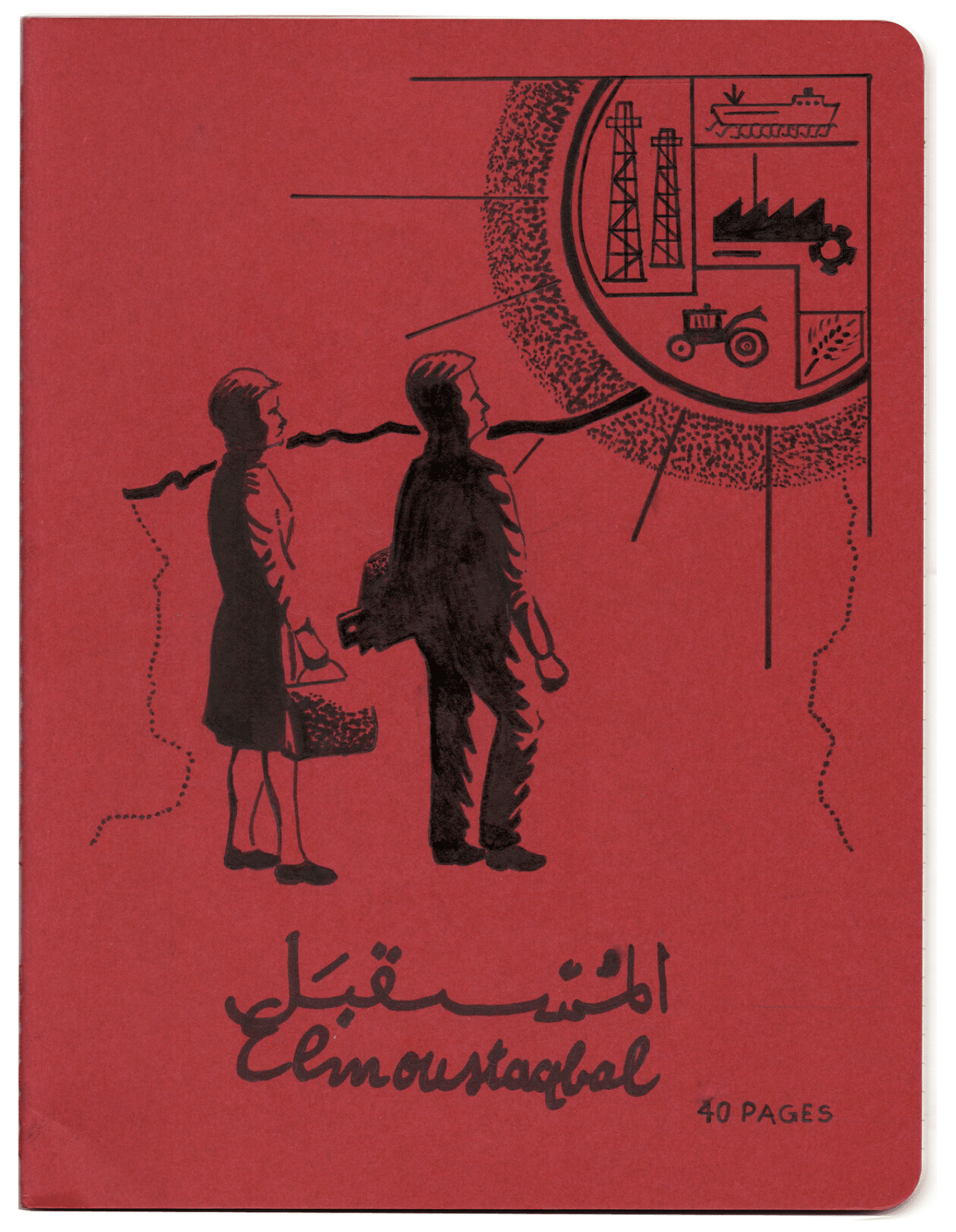
In the course of his research into the Socialist Villages, Selmani met an architect, urban planner and sociologist, Djaffar Lesbet, who had worked on the project as a young man and had subsequently written his PhD on it. He shared his archive of press cuttings, mostly photocopies, and other printed material with the artist, who used them to construct his visual narrative. The photocopies were degraded to various degrees, some so faded that the image had almost vanished, leaving only the caption legible. This seemed to epitomise the phantasmic nature of the subject, and Selmani organised his display of photocopied archival material so that the photographs progressively faded into obscurity. He drew on the pages of a school exercise book modified to look like the kind that he himself remembers using as a child, with an illustration on the cover of an archetypal couple looking optimistically towards a sun emblazoned with symbolic images of progress in industry, agriculture and trade, captioned with the words, ‘The Future’. On each of twenty loose-leafed double-page spreads, on the left he drew one of the floor plans of the houses provided by Lesbet and published in his book, and below it he drew his own ‘fictional topographical sketch’ in coloured pencil of a section of landscape or a farmyard animal. Opposite, he laid out photocopied images of the villages taken from newspaper articles, transferred with their captions to tracing paper, laid over the lined paper of the notebook. The caption of the final image, faded to a ghostly trace, reads: ‘Towards a new life.’
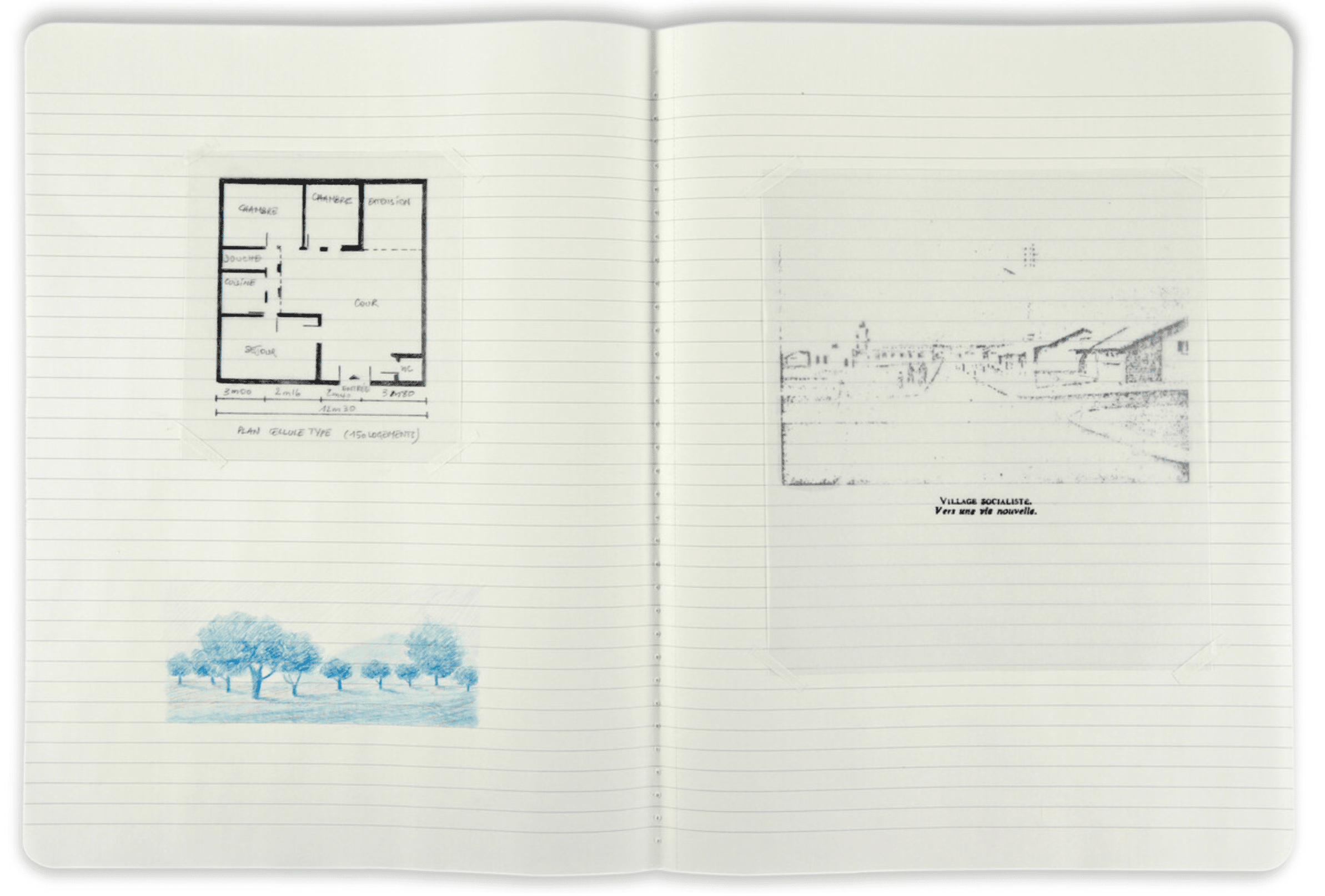
Selmani has continued to pursue research into the Socialist Villages, in collaboration with the Swedish curator and writer Natasha Marie Llorens. The relation of actual historical research and documentation to Selmani’s artistic project is oblique. His purpose is to create an allusive imaginative zone where politics and poetics coalesce. His drawings of imaginary portions of landscape—hillsides, valleys, woodlands or desert—become the basis for a recurring motif in his subsequent work: the unidentified patch of terrain.
The sense of flux in his provisional method of display—drawings on tracing paper fixed to the wall with masking tape, for example—has been a deliberate ploy to unsettle the assumption of a fixed and stable meaning. ‘I am neither a historian nor a researcher’, Selmani has declared.
‘I did not intend to remind or educate people about the historical facts. That is not my role. I try instead to show the unfathomable, to build a network of associations between ideas and forms, and to think of art for what it does to us rather than what it tells us. As an artist, part of my work revolves around the question of how to think through these problems. It’s about taking a step back; subjects are only a pretext for drawing. Drawing helped me first to get out of my surroundings and then later to understand them. This way of working is linked to a set of practices I developed over the past few years around drawn forms that fall between comic and tragic registers, and around drawing as a documentary form. I was a teenager in the 1990s during the Black Decade when the front page of Algerian newspapers was often very difficult to look at. My first instinct, like many Algerians at the time, was to flip the newspaper over and skip to the cartoon section. I was very impressed by the cartoon, and I used to say that it really is the birth of a lot of things for me. Have a good laugh first, then come back to face the sensationalism of the front page and the horrific content of the inner pages. This early encounter shaped my way of working. I have a strong aversion to spectacular, overly explanatory forms. Those kinds of images give me the feeling that after the first sensation has passed there is nothing left to read or understand.’[5]
Notes
- The Prix Marcel Duchamp, often described as the French equivalent of the Turner Prize, is funded by a group of collectors, the Association for the International Diffusion of French art. Four artists are nominated each year and share an exhibition at the Centre Pompidou. The laureate receives a grant of €35,000. The 2023 nominees were Bertille Bak, Bouchra Khalili, Tarik Kiswanson and Massinissa Selmani.
- Keith Sutton, ‘Algeria’s Socialist Villages – A Reassessment’, The Journal of Modern African Studies, Vol. 22 (1984), 223–48.
- Natasha Marie Llorens, ‘Make Me a Picture of the Future: Massinissa Selmani’s 1000 Socialist Villages(2015)’, ARTMargins, Vol. 13, Issue 1(2024), 40–61.
- Massinissa Selmani, unpublished statement.
- Ibid.
Roger Malbert is a writer on contemporary art and an exhibition curator, and former Head of Hayward Gallery Touring at the Southbank Centre, London.
*
This article is an edited version of a longer text first published in Burlington Contemporary Journal 8 (June 2023)—a special issue dedicated to drawing, available at: https://contemporary.burlington.org.uk/journal/journal/massinissa-selmani.
The exhibition Massinissa Selmani: L’attente au bord du cercle is on display at Galerie Anne-Sarah Bénichou until 16th March 2026. Find more information here.

– Stefan Davidovici