Rewriting Eisenman
In his new book Rewriting Alberti, Peter Eisenman applies the ‘most important lesson in architecture’ that he ever received to a study of the origin of the discipline in the Western tradition.[1] Standing at the fount of that tradition is the fifteenth-century Florentine scholar and architect Leon Battista Alberti.[2]
From his reading of Alberti, Eisenman takes architecture to be made up of two components. The first is what he calls ‘heterogenous space.’ In the eponymous opening essay of Rewriting Alberti (which also features essays from Mario Carpo, Daniel Sherer, and Pier Vittorio Aureli), Eisenman identifies the birth of heterogenous space with the Florentine sculptor and architect Filippo Brunelleschi. Brunelleschi was a generation older than Alberti; he had introduced monocular perspective into architecture as a method for representing actual or ‘real space’ through a geometric translation of the experience of a ‘seeing subject.’[3]
It was Alberti, however, not Brunelleschi, who would articulate the theoretical implications of monocular perspective—or rather, those of a representational method as such that could be further codified into a language for architecture. The result was his ten-book treatise, De re aedificatoria (On the Art of Building, c. 1452).
Any representational method in architecture, according to Eisenman, presupposes a ‘virtual/real dialectic.’[4] Such a dialectic negotiates between a physical thing—such as a column or a wall—and the representation of the thing, which describes it in terms other than its literal being. The existence of both real and virtual space in a building as the ‘thing plus a suggestion of something other’ produces a heterogenous condition.[5]
That condition allows for the manifestation of what Eisenman takes to be the second component of architecture—what he calls the ‘unmotivated sign.’ Unmotivating the architectural sign means consciously investing it with an idea other than that of either its literal or ‘narrative’ being as tied to any ‘external referent’ in real space.[6] The ‘trace’ or ‘fragment’ of that additional ‘something other,’ to borrow from the deconstructive patois that peppers Eisenman’s discourse, refers to an idea which, at most, is only possibly suggested by the physical thing. (What is present in real space is limited to the literal being of the physical thing.) An added virtual layer as the suggestion of ‘something other’ than the virtual counterpart to the physical thing produces a ‘virtuel’ condition.[7] For Eisenman, architecture is thus the manifestation of virtuelity with respect to building. It expressively affirms the present absence, paradoxically, of heterogenous space, which he observes in Alberti’s five projects.
Eisenman begins his analysis, though, not with Alberti, but with Brunelleschi’s projects for the basilicas of Santo Spirito and San Lorenzo, both in Florence. Eisenman’s analytical drawings of the perspectival conditions along the main axes of the naves of both basilicas demonstrate virtuelity.
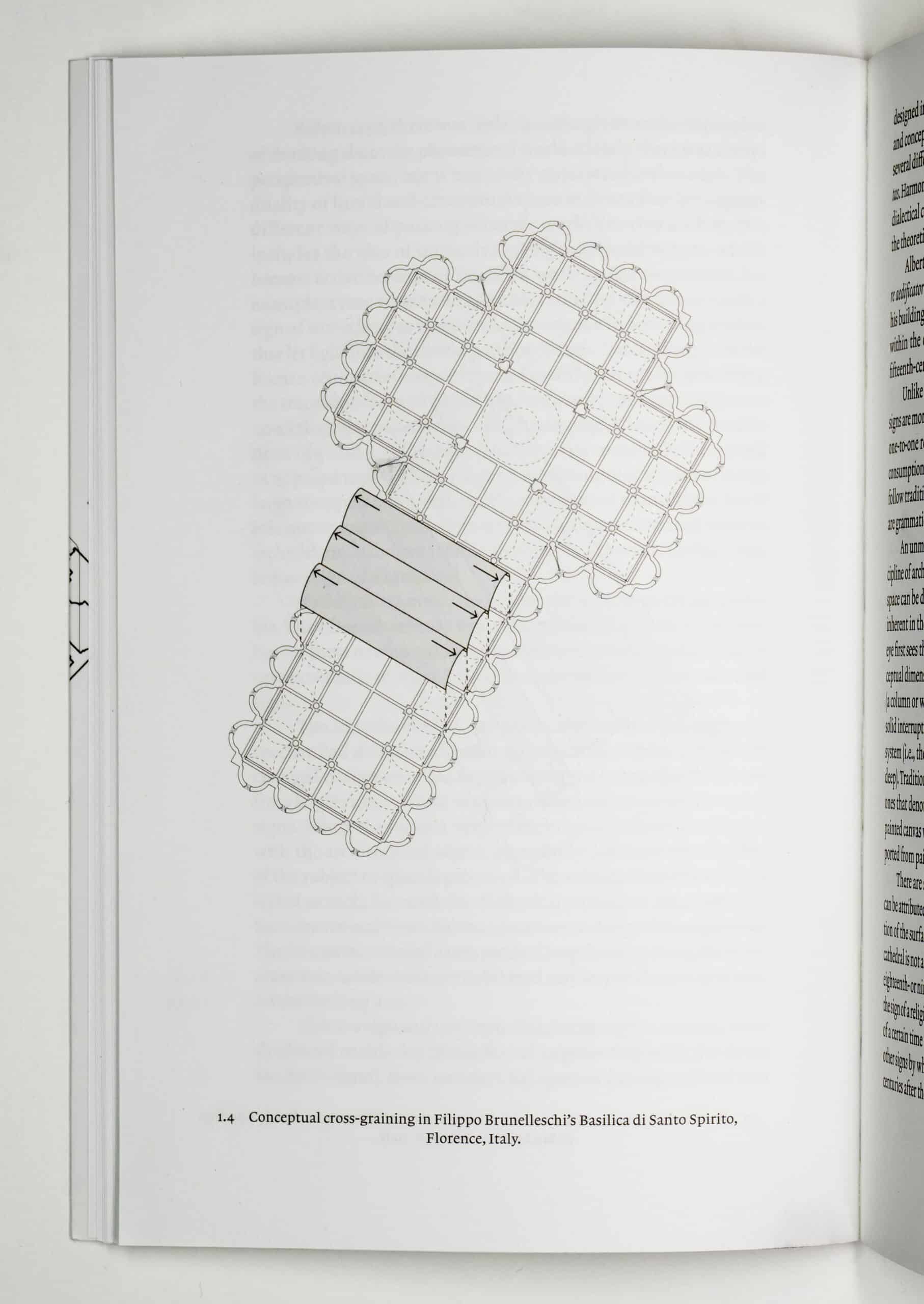
In Santo Spirito, each pair of aligned side aisle chapels across the nave is connected by an imagined barrel vault (as Eisenman illustrates in his drawings), which is rotated in perpendicular relation to the main axis of the nave (Fig. 1). (The physical presence of the vault is denied within the area of the nave itself.) Santo Spirito thereby implies ‘a conceptual cross-graining’ that effects a compressed perspectival impression.[8]
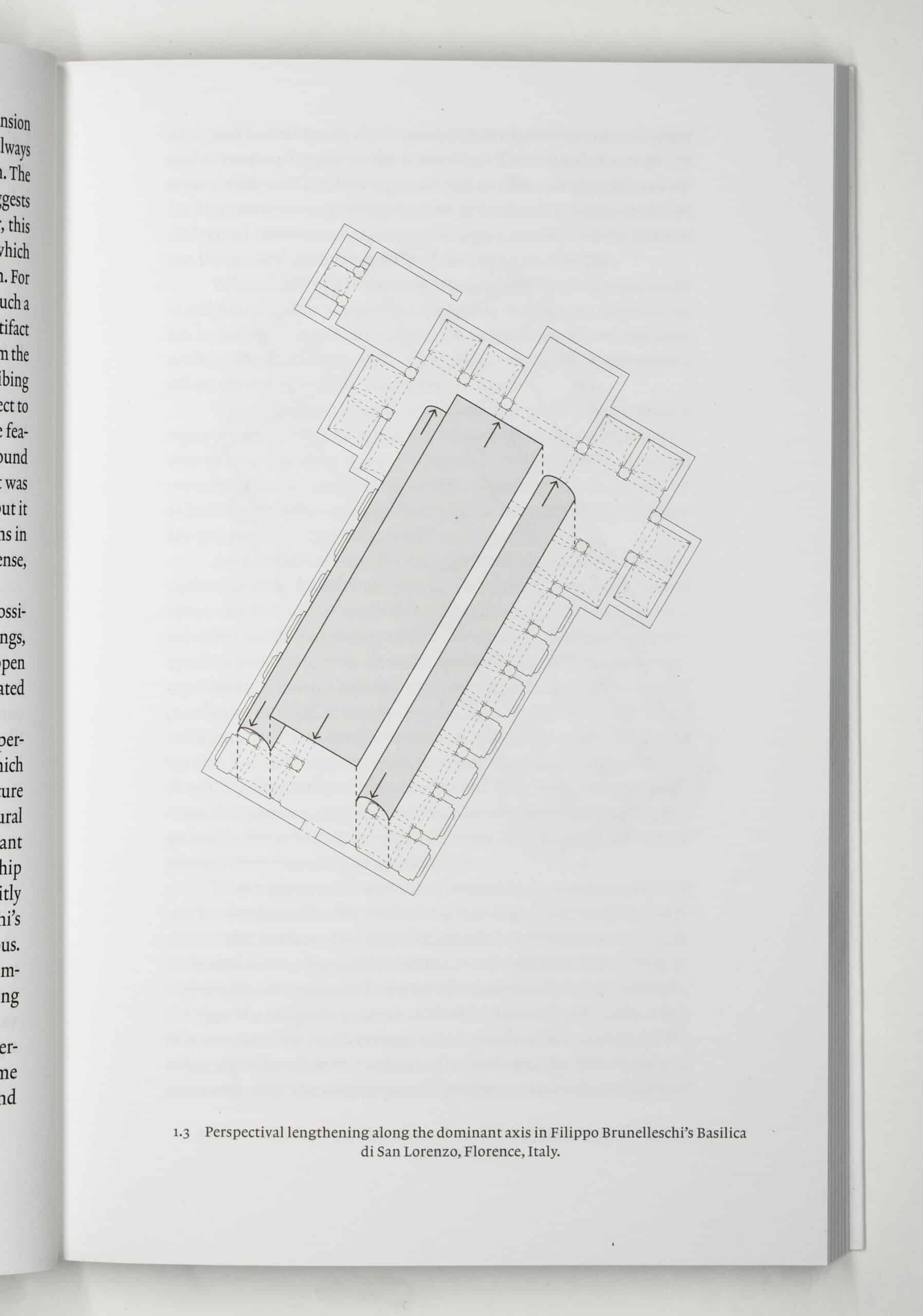
San Lorenzo has the opposite effect. An imagined barrel vault connects the chapels of the aisles in a row. (The physical presence of the vault is denied by the arches between each contiguous pair of chapels.) San Lorenzo thereby implies a lengthened or tensioned perspectival impression (Fig. 2). Both basilicas thus suggest, respectively, ideas about spatial compression and tension.
Another example of virtuelity in San Lorenzo (which Eisenman omits in his analysis) can be detected in Brunelleschi’s design for the Sagrestia Vecchia (‘Old Sacristy’)—particularly, in his treatment of the Corinthian pilasters (Fig. 3). (That treatment prefigures what Eisenman has elsewhere similarly observed in Donato Bramante’s design of the corner detail in the cloister cortile of the Chiesa di Santa Maria della Pace in Rome from the turn of the fifteenth century.[9])
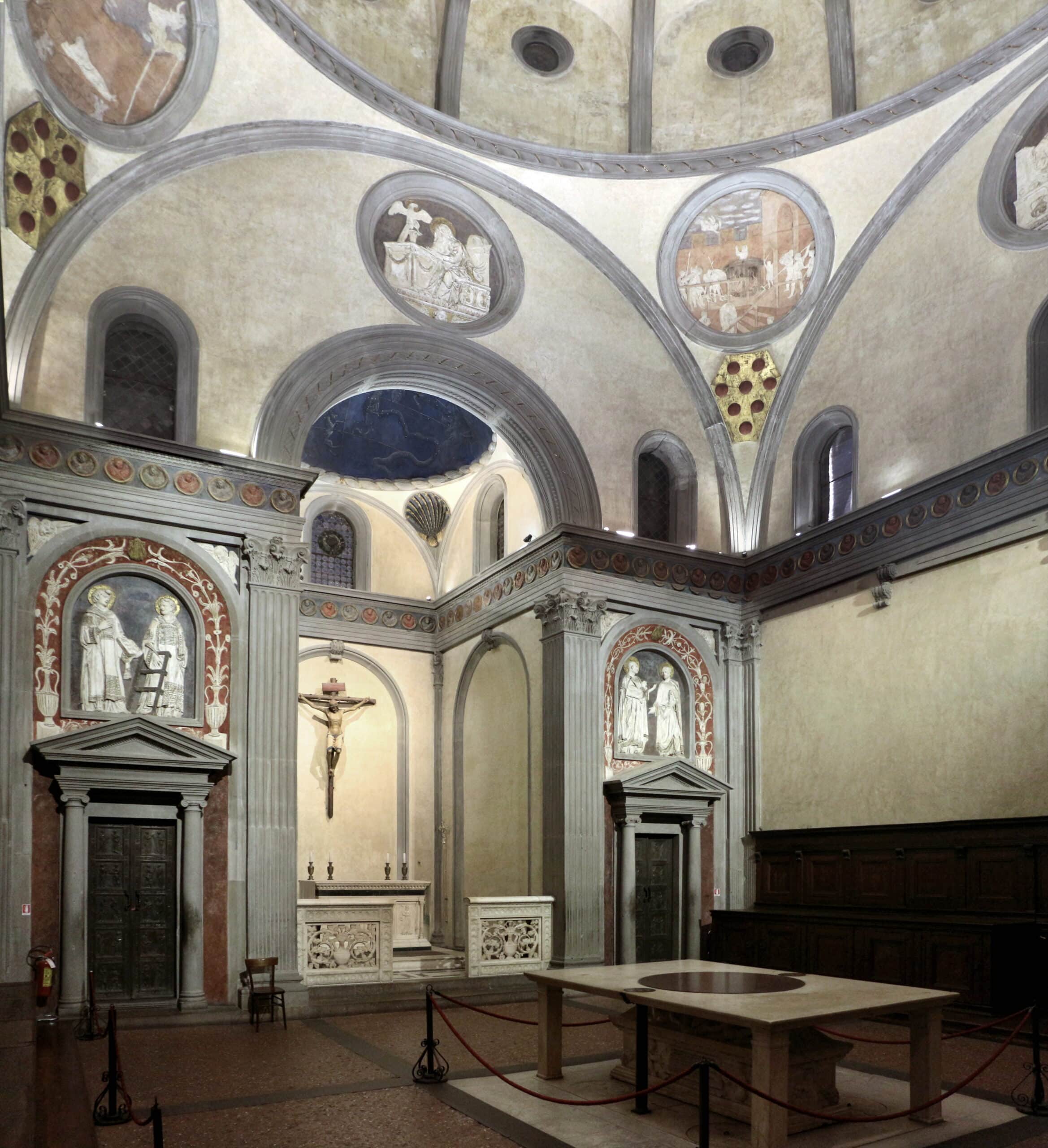
Brunelleschi designed the Old Sacristy as a Gothic ribbed cupola on pendentives, placed atop a cubic volume. The meeting between the two is marked by a classical entablature motif, which designates the springing line of the triumphal arch motif that frames the scarsella on the southern end. Wrapping around the top of the cubic volume, the entablature provides a conceptual base, not only for the arch, but also for the pendentives. The inboard corner pilasters optically draw the courses of the pendentives down to the actual ground, thereby unifying the entire space.
Brunelleschi furthermore designed those pilasters as the physical remainder of a virtual intersection of repeated spatial modules, rather than as points of an actual structural load. Each module is two-braccia in dimension, which is reflected in the width between the inlaid marble courses in the floor. Together, those courses depict a nine-square grid in plan, in the centre of which is placed the sarcophagus of the Medici family that funded the construction of the Old Sacristy. The language of the classical (all’antica) thus becomes unmotivated through a play of real and virtual space.
The redundancy of the signs of structural elements in the Old Sacristy prefigures, yet again, the subject of Rewriting Alberti. For example, in the Palazzo Rucellai in Florence, which Eisenman describes as ‘Alberti’s most linguistically pure project,’ the outlines of the signs of structural elements belonging to different structural systems appear in the rustication (bugnato) of the façade (Fig. 4).[10] Those signs include arches with Gothic tracery, pilasters, and solid masonry infill.
The Palazzo Rucellai evinces the idea of a ‘fragment,’ which Eisenman directly references in connection to Jacques Derrida.[11] Rather than being a supplement to an original whole in real space, or the remainder of one in virtual space (as with the inboard corner pilasters in the Old Sacristy), a fragment questions the idea of a whole altogether, and thus of a part-to-whole harmony. It is the idea of harmony that Alberti introduced in his treatise (which he wrote around the same time that he was working on the Palazzo Rucellai) through the term concinnitas. The destabilization of concinnitas that Eisenman observes in Alberti’s five projects (which also include the Basilica di Santa Maria Novella, the Chiesa di San Sebastiano, the Basilica di Sant’Andrea, and the Tempio Malatestiano), as opposed to Alberti’s writings, makes the former’s book a rewriting of the latter.
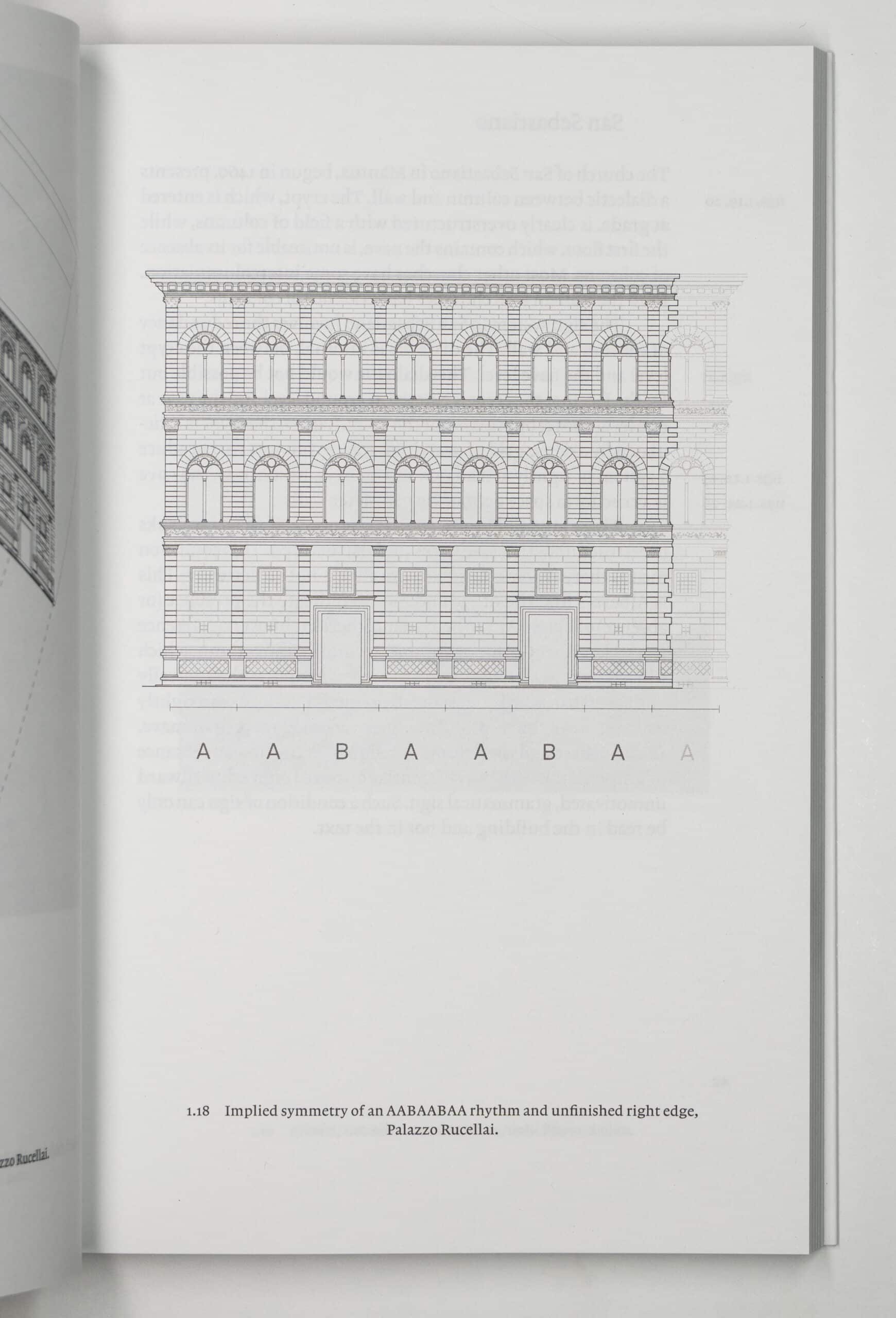
The Palazzo Rucellai manifests a seven-bay vertical scheme with an incomplete eighth bay, as implied by the quoining on the right edge the façade (which looks like a literal fragment). It also manifests a three-bay horizontal scheme or three stories. Each vertical bay is separated by a row of pilasters, and each story by an entablature motif. Several elements on the façade indicate diverging compositions of what might have been the original or intended overall scheme. The main portal door into the courtyard of the Palazzo is placed at the ground level of the third vertical bay. That door, together with the Rucellai family crest moulded above the window arch on the second story or piano nobile where the keystone should be (which is also larger on that story), marks a differential bay from the first two. A ‘dummy door’ at the ground level of the sixth vertical bay and repeated Rucellai crest above a larger window arch on the piano nobile marks another differential bay, thereby creating an asymmetrical AABAABA rhythm on the façade.[12] The intended overall scheme might have had five-bays with a central bay (AABAA) before two extra bays were added, or eight-bays (AABAABAA), as implied by the quoining. Alberti’s treatment of the sixth bay, particularly with the dummy door, frustrates either alternative. Compositionally, it indicates the primacy of the eight-bay scheme, and functionally, that of the five-bay scheme.
The façade of Palazzo Rucellai thus suggests ideas about completeness and incompleteness, as well as symmetry and asymmetry, centrality and peripherality. Other ‘pairs of spatial entities’ that refer inwardly to the architectural discipline when activated within the design of a building as conceptual propositions about architectural space, according to Eisenman, and, whose further unmotivation beyond any ‘external referent’ in real space can suggest other possible ideas, include: ‘figure/frame, figure/ground, gridded/smooth, additive/subtractive, dense/sparse, and tension/compression.'[13] Throughout his analyses of Alberti’s four other projects, Eisenman examines the fragments that oscillate between multiple possible wholes within a single building as a manifestation of virtuelity that expressively affirms the present absence of heterogenous space.
The enduring relevance of heterogenous space is that even today, architects primarily manipulate the signs of building elements in virtual space, rather than their physical counterparts in real space. The origin of that basic practice as constitutive to the architectural discipline in the Western tradition is found in Alberti’s treatise. It was his distinction between lineamenta (lineaments), or the precise outlines of building elements as geometric figures in virtual space, and structura (structure) as those elements themselves in real space, from which the ‘virtual/real dialectic’ originates—a dialectic through which the architect manipulates all ‘pairs of spatial entities.’[14]
Learning to see virtuelity was the ‘most important lesson in architecture’ Eisenman claims he had ever received in the course of his long career. That lesson came when he was a PhD student at Cambridge in the early 1960s. Eisenman recalls that he and his mentor at the time, Colin Rowe, had visited the town of Montagnana during their travels together through the Veneto region in Italy during the summer of 1962. There, they came across Andrea Palladio’s Villa Pisani from the mid-sixteenth century. Eisenman remembers that it was
the first time I saw a Palladian villa…It was hot, probably ninety-six or ninety-seven degrees, and humid, and Colin said, ‘Sit in front of that facade until you can tell me something that you can’t see. In other words, I don’t want to know about the rustication, I don’t want to know about the proportion of the windows, I don’t want to know about the ABA symmetries, or any of those things that [Rudolf] Wittkower talks about. I want you to tell me something that is implied in the facade.’ I remember this moment as if it were yesterday. This is how Colin began to teach me to see as an architect. Anyone can look at window-to-wall relationships, but can anyone see edge stress, the fact that the Venetian windows are moved outboard from the centre to create a blank space—a void between the windows—which acts as a negative energy? Such ideas are not found in any books. They are found in seeing architecture.[15]
In Rewriting Alberti, Eisenman winds the paradigm of virtuelity that Rowe had initially got him to see with Palladio (the subject of Eisenman’s previous book, 2015), back to the origin of the Western architectural discipline. Eisenman advances that paradigm as the origin of the discipline itself. It thus follows that the expressive affirmation of heterogenous space in a building as a manifestation of virtuelity marks the architectural act tout court.
Eisenman has previously argued, in his analysis of Le Corbusier’s Maison Dom-ino (1914), that it is precisely that affirmation that distinguishes itself from ‘the four-hundred-year-old tradition of Western humanist architecture.’[16] In lieu of reconstructing his previous analysis, what is important to mention here is that Eisenman, in his essay, ‘Aspects of Modernism: Maison Dom-ino and the Self-Referential Sign’ (1979), sought to demonstrate that Le Corbusier’s project marks a self-referential condition with respect to the architectural discipline. Whether an added virtual layer marks the act of superseding the literal being of building elements (which Eisenman had observed with the Maison Dom-ino), or, furthermore, the suggestion of any other possible ideas beyond the sheer act of superseding, is irrelevant. Eisenman took that marking as such to be the basis of (twentieth-century) modernism.
We learn from him now that such a marking is the basis of the (Renaissance) Albertian tradition. What then, would constitute ‘a true and seminal break’?[17] Not that an architectural project might destabilize conncinitas, but that it might destabilize the very possibility or source of that destabilization. What Eisenman had failed to see in his previous analysis is that the Maison Dom-ino, instead, destabilizes lineamenta.
In the first volume of his Œuvre complète (1930), Le Corbusier specifies that inhabitants, rather than the architect, would determine the arrangement of building elements in the project.[18] As different inhabitants would produce different designs (and thereby different sets of lineamenta), the heterogeneity of space in the Maison Dom-ino would manifest through mutually incongruous real spaces within a single project, rather than as virtuel spaces within a single building.[19] (Those real spaces would be the actual ‘Many Mansions’ of the project, as Eisenman has metaphorically characterized the work of John Hejduk.[20])
The break that the Maison Dom-ino represents is that of the deferral of virtuelity (or actuelity)—beyond the Renaissance ideal of the architect. As a proponent of architecture to be the act of superseding the literal being of building elements (and their virtual counterparts) through the suggestion of ‘something other’—a suggestion that only the architect can possibly make—Eisenman places himself at the tail end of the tradition that he now rewrites in its full historical scope.[21] Eisenman, upon his own construction, reveals himself to be a late Renaissance, and not a late modernist, architect and theorist.
Notes
- ‘Interview with Peter Eisenman: The Last Grand Tourist: Travels with Colin Rowe,’ Perspecta 41 (2008): 133.
- I would like to express my gratitude toward the commentators of this text: Christopher Long, Danilo Udovički-Selb, Miriam Sadowska, Patricia Semeniuk, and Melanie R. Ball.
- Peter Eisenman, Rewriting Alberti (Cambridge: MIT Press, 2025), 2.
- Ibid.
- Ibid., 12.
- Ibid., 30.
- See Peter Eisenman, Palladio Virtuel (New Haven: Yale University Press, 2015).
- Eisenman, Rewriting Alberti, 18.
- See Peter Eisenman, ‘There Are No Corners After Derrida,’ Log, no. 15 (2009): 111-119.
- Eisenman, Rewriting Alberti, 32.
- Ibid., 70-71.
- Ibid., 36.
- Ibid., 32.
- Leon Battista Alberti, On the Art of Building in Ten Books, trans. by Joseph Rykwert, Neil Leach, & Robert Tavenor (Cambridge: MIT Press, 1988), 7.
- ‘Interview with Peter Eisenman,’ 133.
- Peter Eisenman, ‘Aspects of Modernism: Maison Dom‑ino and the Self‑Referential Sign,’ in Eisenman Inside Out: Selected Writings, 1963-1988 (New Haven: Yale University Press, 2004), 120. Eisenman’s text was reprinted in Log, no. 30 (2014), on the centennial anniversary of the Maison Dom-ino.
- Ibid.
- See Le Corbusier, ‘Les Maison Dom‑ino,’ in Œuvre complète, Volume 1: 1910–1929, ed. by Willy Boesiger & Oscar Stonorov (Basel: Birkhäuser, 1995), 26.
- See my own analysis of the Maison Dom-ino: ‘Building as New Beginning: The Absolute Negativity of the Maison Dom-ino,’ in Finishing in Architecture: Polishing, Completing, Ending, ed. by Paul Emmons, Marcia Feuerstein, & Negar Goljan (London: Routledge, 2025), 131-138.
- See Peter Eisenman, ‘In My Father’s House Are Many Mansions,’ in Eisenman Inside Out, 121-132.
- In his previous writings, Eisenman has alternatively referred to virtuelity as ‘presentness,’ which unmotivates the architectural sign from its ‘presence’ in real space: See Peter Eisenman, ‘Presentness and the “Being-Only-Once” of Architecture,’ in Deconstruction Is/In America: A New Sense of the Political, ed. by Anselm Haverkamp (New York City: New York University Press, 1995), 134-146.
*
Alexander Bala is a Polish-American architectural historian and theorist. He is currently a PhD Candidate in Architectural History at the University of Texas at Austin, and is based in Warsaw, Poland.

– Peter Eisenman