The Principle of ‘Reach’
In the home economics theory of domestic space, a necessary and pivotal condition allowing the homemaker to work out and practice more ‘efficient’ routines, and thereby decrease her domestic drudgery, was the design of home interior. This included the arrangement of the objects of daily use. Conceptualising the space as a derivative of the above-described working body and its movements, in their design ideas home economists privileged the key category of ‘reach,’ understood primarily as the distance at which the homemaker had to stretch out her arm to grasp needed objects.
‘Reach’ was the principle spatial category determining the design of the domestic ‘working areas.’ For home economists nowhere was it more important than in the design of kitchens, the room where most of the household labour took place. Frequently referring to the kitchen as ‘workshop’ or ‘laboratory,’ home economists emphatically conveyed that they addressed the kitchen primarily as a space of labour, a space that should be modern, efficient, research-derived both in its design and in the activities that took place in it. They believed that prioritising the category of ‘reach” was a means to arrive at such a design.
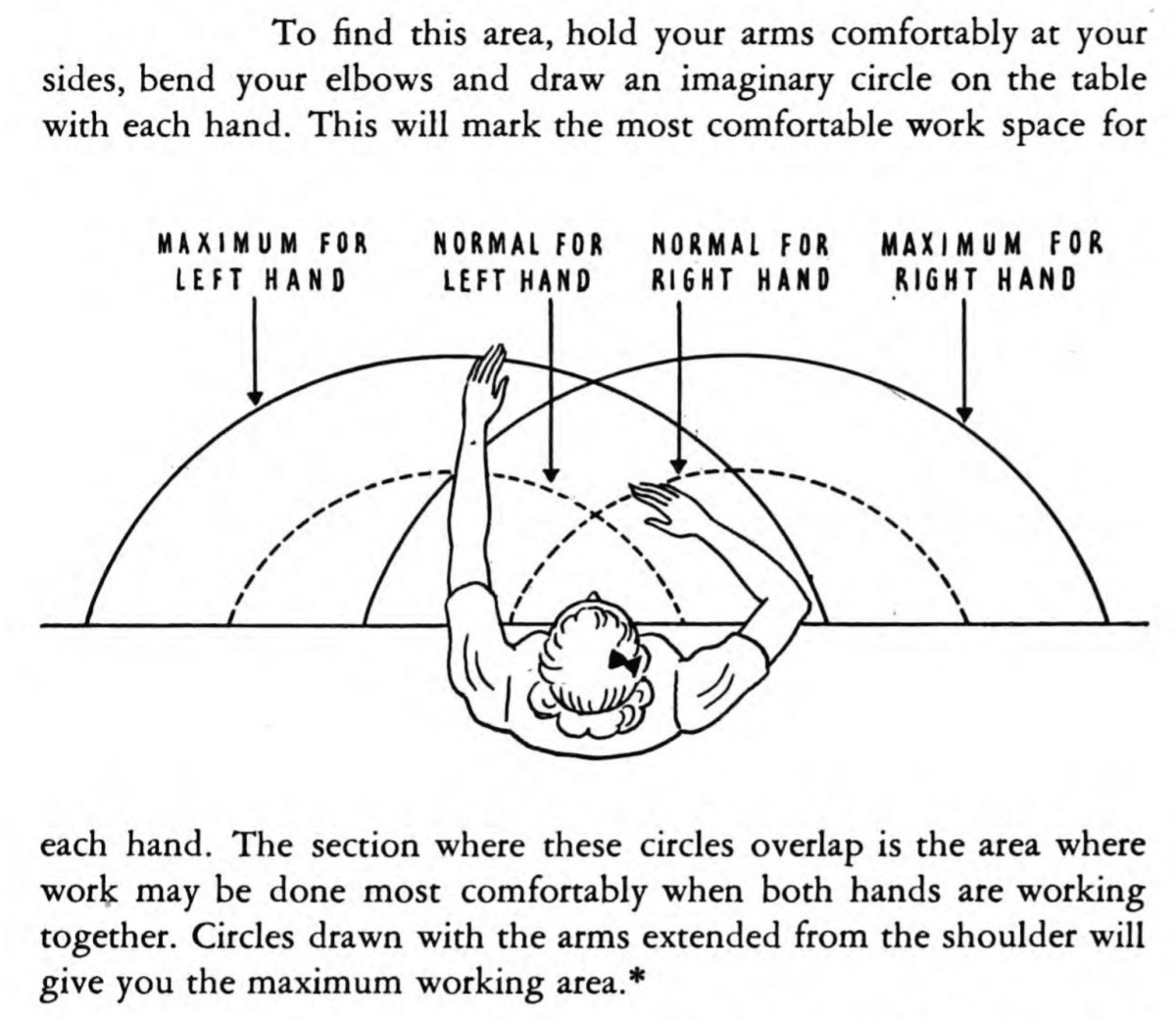
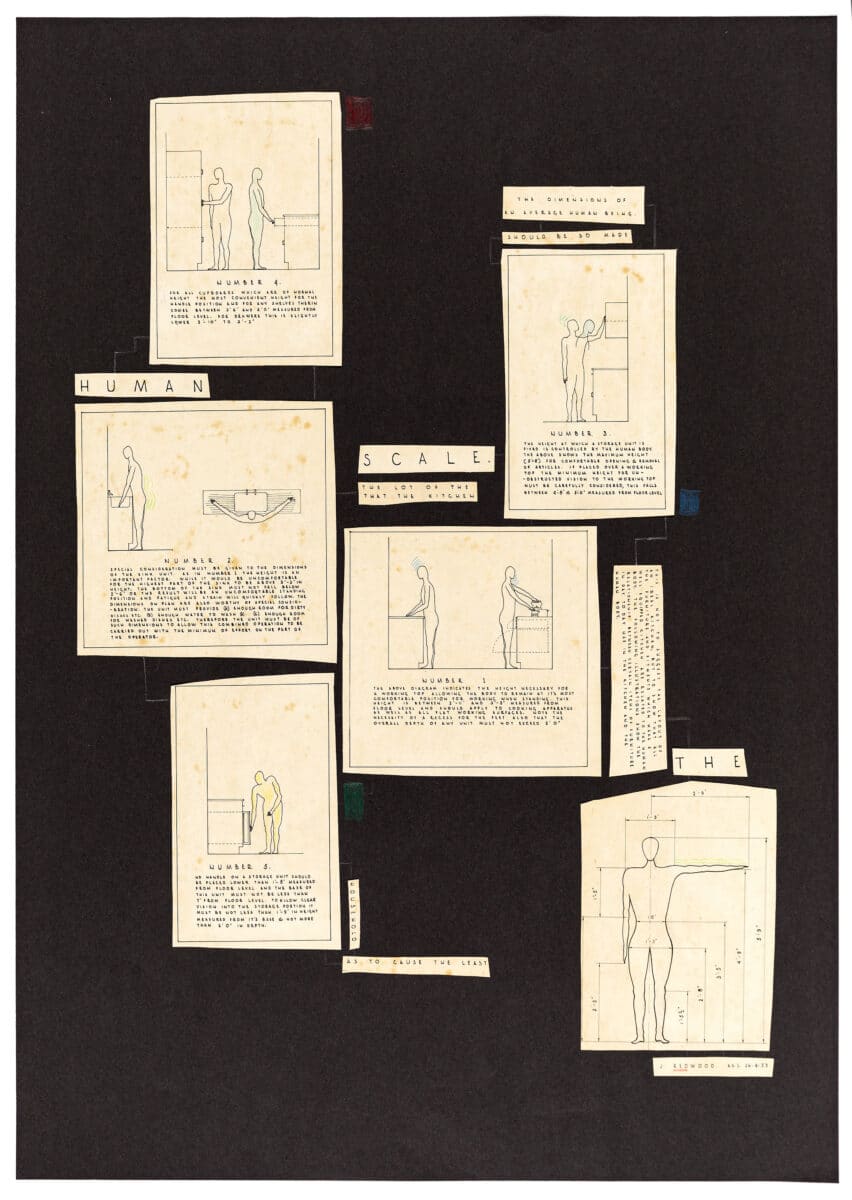
Appearing in numerous versions in home economics brochures and leaflets, diagrams, and accompanying descriptions instructed the homemaker how to delineate the most comfortable working area by testing her reach. To find this area on a horizontal plane, the homemaker was encouraged to sit at a table. While holding her arms and bending elbows in a relaxed way, she was advised to draw imaginary curves on the table’s surface with each of her hands. Each of the two resulting half-circles indicated the outer rim of the most comfortable, called ‘normal,’ work area for each hand. To find the ‘maximum’ limits of her working area, she drew the imaginary curves again, but with her arms stretched out. To find the optimal working area on a vertical plane, the homemaker was advised to perform a similar operation while standing: the ‘comfortable’ extension of her arms delineated the limits of her ‘easy reach’ for each hand and hence demarcated the boundaries of her optimal working areas, whereas the stretched-out arms marked the limits of her ‘maximum reach.’
In their publications, home economists recommended that the principle of reach guide the design of kitchen cabinets. This diagram also illustrates their preoccupation with yet another category related to ‘reach,’ namely that of ‘(working) heights,’ understood as the height of surfaces such as tabletops, counters, etc., at which the homemaker performs domestic activities. As in the discussion concerning ‘reach,’ home economists stressed the importance of optimal ‘working heights’ because they found them crucial for maximising the homemaker’s comfort. Above all, the issue of ‘working heights’ was about the ‘right’ posture: a working surface that is at the optimal height was believed to eliminate or prevent any unnecessary fatigue resulting from the homemaker’s bodily strain, in particular back strain. As the image below on the right shows, and the image’s description explicitly states, the main criterion in the assessment of the accuracy of the working height was tactile and in the realm of cheirotics: ‘The work surface area should be high enough for the palms of your hands to rest comfortably when placed flat upon it.’[1]
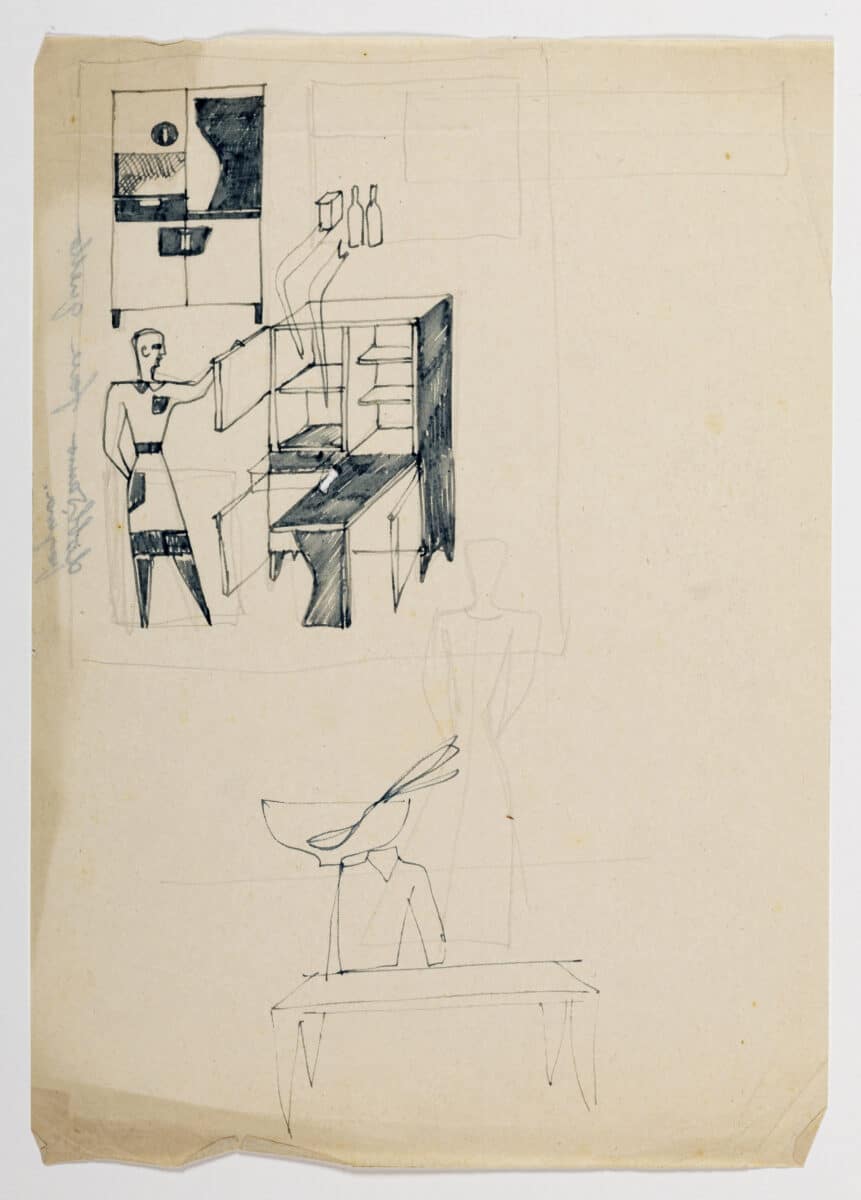
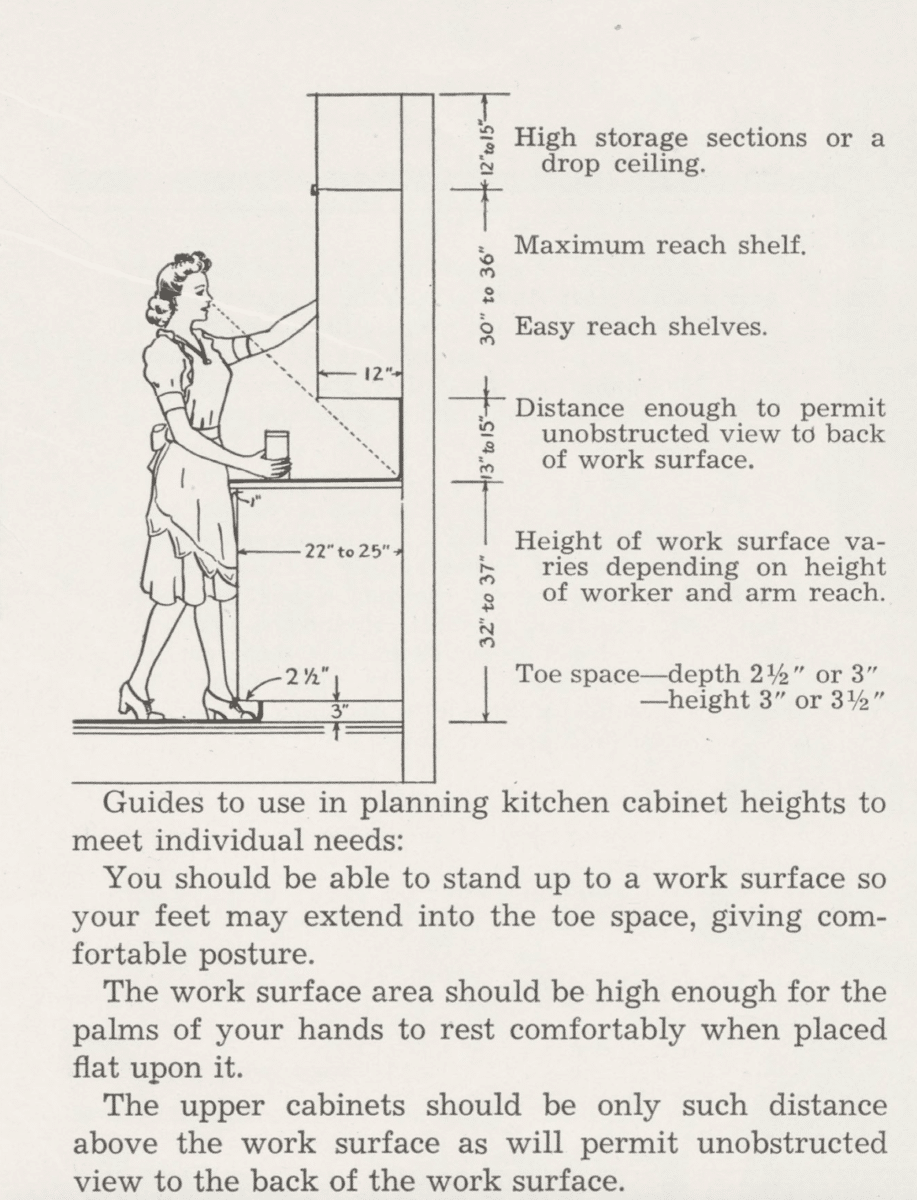
This tactile, physical ‘testing,’ ‘feeling out’ of the comfort of working heights and ‘reaches’ was pivotal to home economists as they believed that the spatial parameters of comfort found through this kind of bodily experience were a sound, solid basis on which the improved household they conceptualised can be realised, a household that fits the homemaker and derives from her specific perception of what she considers comfortable. Since domestic space in this conception was so highly adjusted to the individual homemaker and so heavily based on her subjective perception, it was crucial that the homemaker not only participated directly and actively, physically and mentally, in the process of delineating the comfortable zones of work for herself, but also was given the right to the ultimate assessment of this space.
Stressing that the best way for each homemaker to find her optimal spatial configuration was through direct and physical trying it out, home economists were reluctant to rely on pure measurements, formulas, and mathematical data when searching for improved spatial solutions. They used measurements and numerical data abundantly for descriptive reasons—for example, to communicate with exactness the distance, reach, or working height a concrete homemaker found accurate for herself in her testing practice, or to criticise a specific range of distances as dysfunctional based on the tests carried out by homemakers—but steered away from numerical prescription. They vehemently resisted a firm declaration of a specific distance as optimal for a user if the user did not validate the distance as such via her own testing experience. This approach is manifested, for example, in one of home economics bulletins, in which its author Marion C. Bell presents a kind of algorithm for finding the optimal height for the bottom of the sink, but, having presented it, immediately underscores that the homemaker needs to take time to repeatedly test the height’s accuracy:
Stand erect. Rest the arms comfortably against the side of the body, making a right angle at the elbow. Now measure from the floor to the elbow at its lowest point. Subtract 6 inches to allow for a drop from the elbow to the hand. This slant of the arm will allow one to wash dishes in comfort. When the measure has been found, the housewife should devote a few days to testing accuracy for herself.[2]
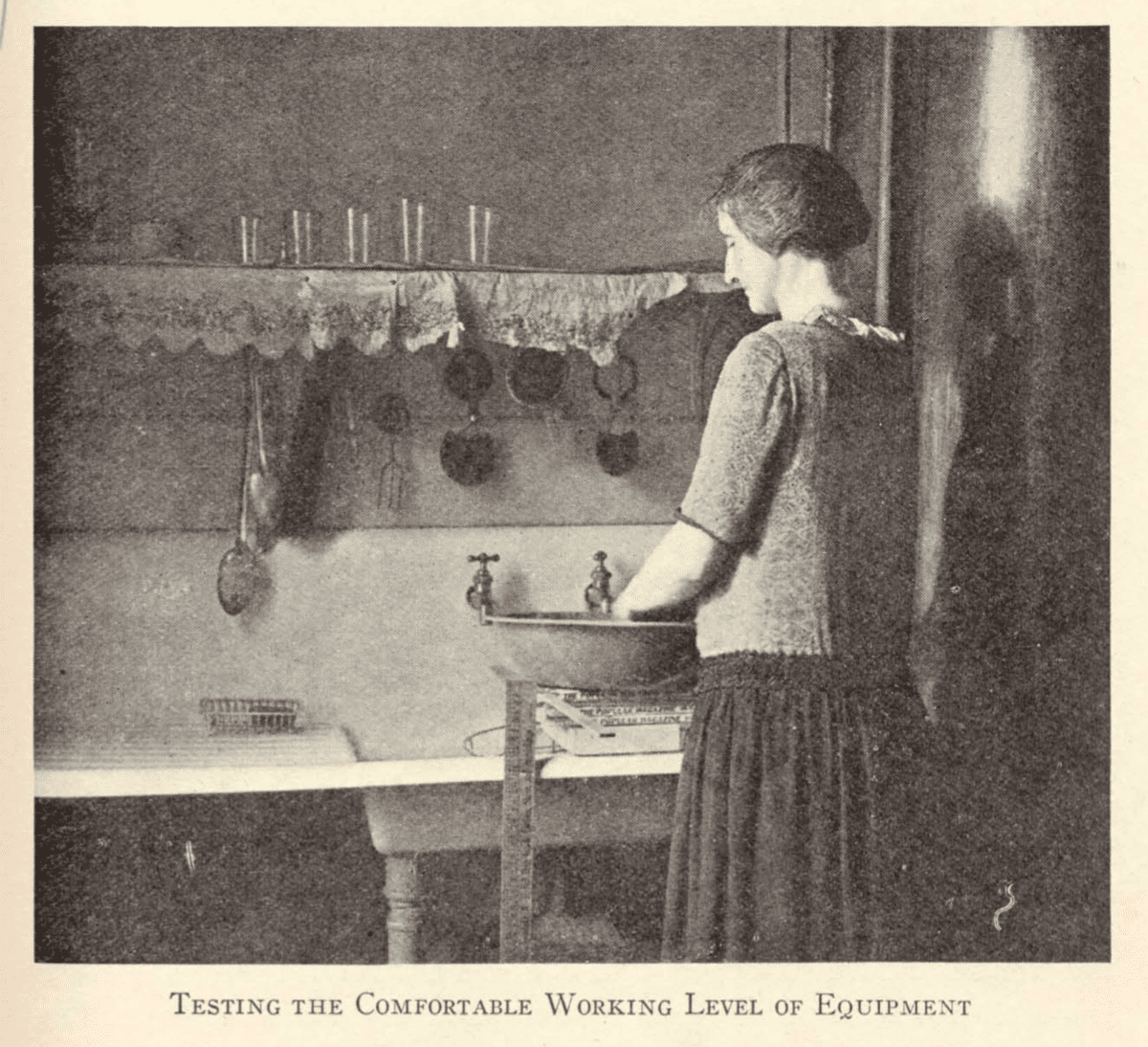
The fact that the bulletin’s both scarcely illustrated editions (from 1927 and 1930) feature a photograph showing a female figure engaged in a ‘try-out’ to determine the ultimate working height further demonstrates the strong emphasis home economists placed on such an immersive testing experience. Depicting a ruler that indicates the height between the floor and the bowl in the sink, and a stack underneath the bowl that raises the bowl to the level that allows the woman to handle objects inside it without stooping, the image and its caption underscore the importance of the bodily experience for finding optimal measurements.
A very similar approach to measurements can be found in home economics materials coming from the decades preceding the bulletin’s editions and following it. For example, when Christine Frederick in The New Housekeeping, published in 1913, shares her list of the optimal ‘working heights’ for ‘any given height of women,’ she underscores that the findings are based on ‘careful tests on women of different heights,’ but even these test-supported results were not meant to be absolute: the author qualifies the heights as ‘approximate.’[3] The emphasis on the value of bodily experience in finding the optimal height is perhaps most explicitly expressed in this statement from the middle of the 1940s:
Formulas for comfortable work levels for women of different heights are of little help to homemakers because of differences in other body dimensions … eyesight, and the like play as important a role as does body height. To accommodate the height of work surface for a particular task or set of tasks, to these individual requirements, the most satisfactory recommendation to date seems to be for each worker to experiment until she finds the height most comfortable for her.[4]
Experiencing the space was understood as experimentation with space in a direct, physical way. The physicality of this spatial experience meant above all that it involved the engagement of the entire body in a working process in a specific three-dimensional arrangement. The bodily response to that arrangement—where the response is placed on the fatiguing–comfortable scale—was crucial for home economists to devising a ‘comfortable’ spatial arrangement for housework.
It is also noteworthy that the home economists’ understanding of ‘working heights’ was not limited to flat surfaces, but included levels at which different kinds of domestic mechanical equipment, such as electric ovens, are placed. The suggested process of establishing these heights also involved an individual homemaker’s direct bodily participation, and accounted for the specificity of her physical dimensions and preferences.
Notes
- Muriel Smith, ‘New Views in Cupboards.’ Extension Service Agricultural College. (Lincoln, NE: University of Nebraska, 1946), 3.
- Marion C. Bell, ‘The A.B.C. of Kitchen Arrangement’ Extension Bulletin 65. New Jersey State College of Agriculture and Agricultural Experiment Station (New Brunswick, NJ: Rutgers University Press, May 1930).
- Christine Frederick, The New Housekeeping: Efficiency Studies in Home Management (Garden City, NY: Doubleday, Page & Company, 1913), 25–7.
- ‘Comfortable Heights of Work Surfaces in Homes’ [typescript, dated 11/27/45]. Department of Economics of the Household and Household Management, New York State College of Home Economics at Cornell University, Ithaca, New York, 1. Division of Rare and Manuscript Collections, Cornell University Library.
*
Anna Myjak-Pycia is a senior researcher at the Institute for the History and Theory of Architecture (gta), ETH Zürich.
This chapter appears in Anna Myjak-Pycia’s publication Another Modernism: Home Economics and the Design of Domestic Space in the US, 1900–1960 (Bloomsbury, London, 2025). For more information about the publication see here. Additional illustrations have been added from the Drawing Matter Collection.
