DMJ – Show
Going to dark bed there was a square round Sinbad the Sailor roc’s auk’s egg in the night of the bed of all the auks of the rocs of Darkinbad the Brightdayler.
Where?
James Joyce, Ulysses 17.2328-32 [1]
Night-time on Eccles Street. Someone is half-dreaming of a mythical bird—a roc—in the Arabian Nights, or an extinct flightless bird—an auk—in a Dublin pantomime. Laying the egg squares the circle, a geometric impossibility representing the limits of human understanding: a four-cornered earth, a heaven with no beginning, no end. The large full stop ends the single day of Joyce’s Ulysses, closing the penultimate chapter, maybe the novel itself: it precedes Molly Bloom’s thoughts in the early hours of the next day, in the same bed, an unpunctuated sea of words, or perhaps masses of them, defined by eight gaps. Her pure telling follows a showing: the apparently methodical inspection of the house and her husband’s most intimate thoughts by a nameless inquisitor, who seeks mostly what and lastly where. The full stop either answers this final question, like a location pinned on a map, or reflects a no-place like the vanishing point of mathematical perspective, the closest approximation to seeing that architectural drawing offers and a fiction in our embodied world. But is this the narrator’s thinking, or ours? Is Leopold Bloom speaking these words in a sleepy haze—and did Molly hear him talking about breakfast?[2] Joyce’s experiments in fiction, truth, and place led the novel everywhere and nowhere, to ‘the last word in stolentelling’[3]: the endless recircling recycling of Finnegans Wake, a text which I could not read, only say aloud to myself every night for eleven months. But Joyce also asked typesetters for that dot to be as big as possible: its size directs us to the page and our own hands. It’s the fin-again: we’re back in the room where we sit holding the book itself.
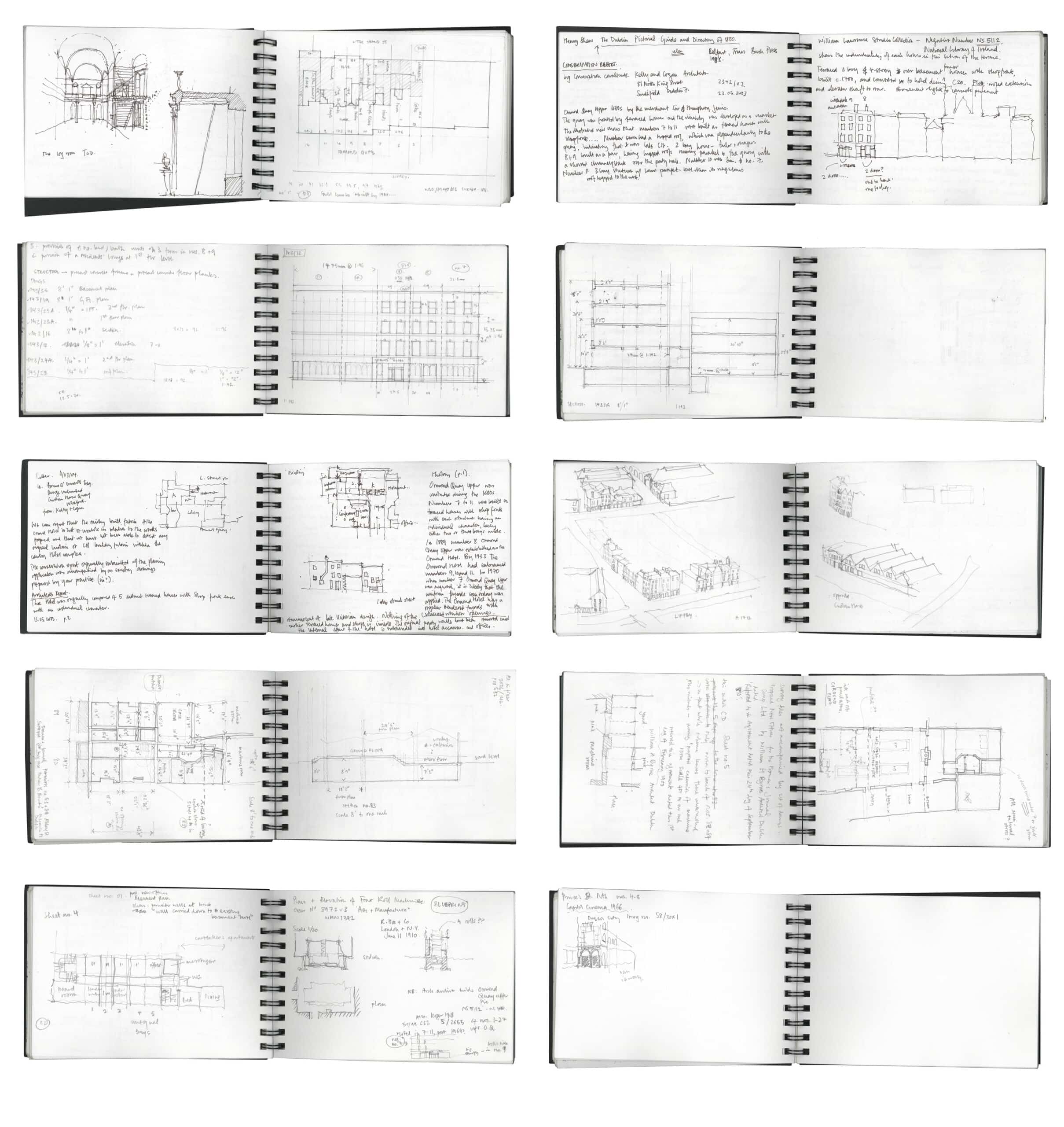
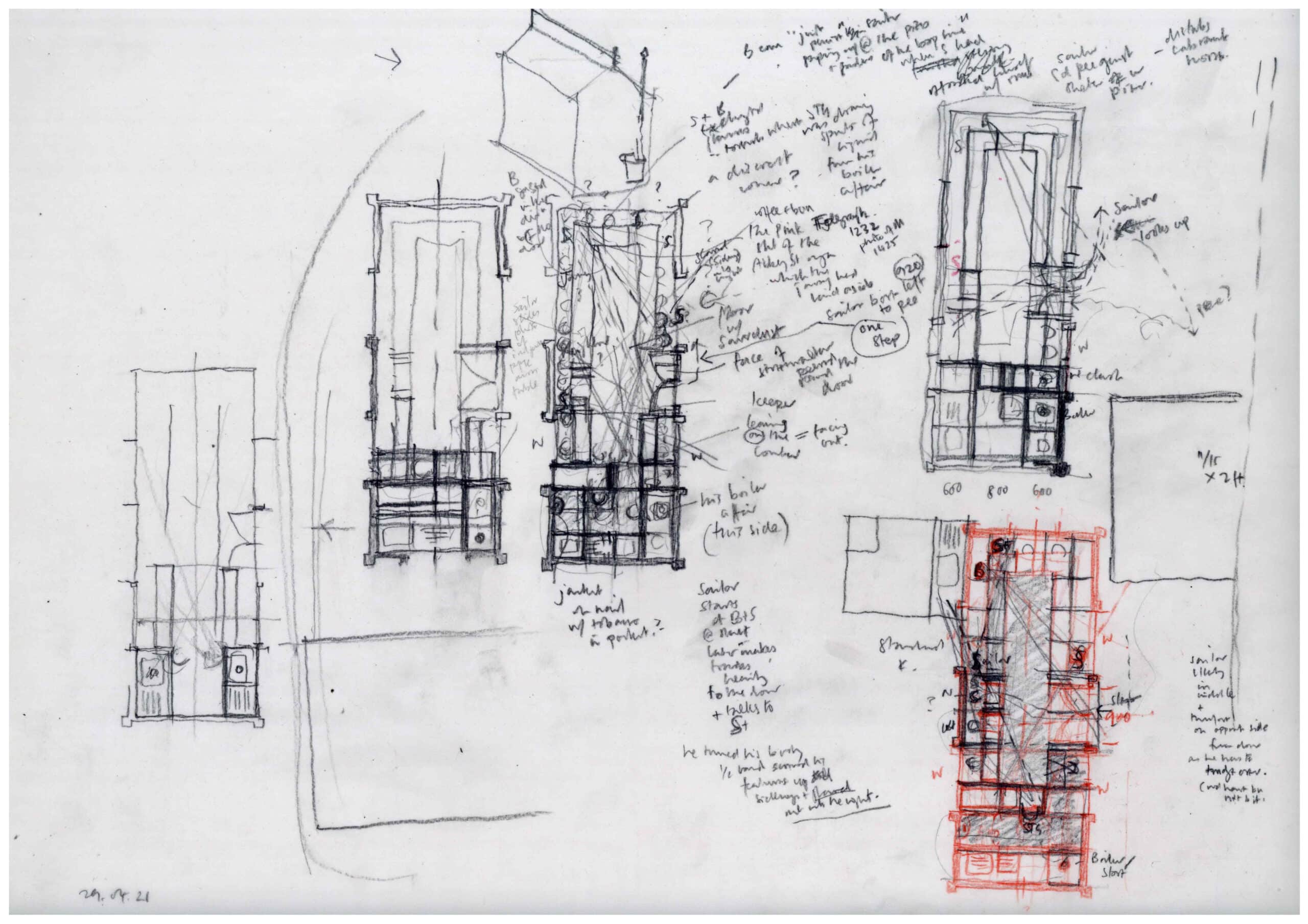
I write this by a stack of boxes containing at least 437 drawings made since 2004 in response to Ulysses. A quarter-century spans all my work in architecture so far, and my parallel experience of Joyce’s books. The recurrences of the Wake—his final work which, like music, played itself through me—anticipated many returns to Ulysses, first in drawings, then in words. I first finished Ulysses around Joyce’s age on 16 June 1904, when the novel is set, and after we had moved from Greece to England. Elsewhere, I read Molly’s soliloquy in transit, feeling that here was something essential to understanding architecture. This rendering of life included so much that design left out; Ulysses scaled the conceptual heights of the European canon even as it dug deep into the ordinary places we take for granted. The book’s dogged literal-mindedness, where everything is located in a real corner of the Irish capital, seemed impossibly overlaid onto its conceptual pyrotechnics and the idea that the story re-tells an ancient myth, compressed into 18 hours, translated from Greek to Hiberno-English and from speaking to writing. Writing out each reference to a place in Joyce’s novel, from a whole country to a desk, brought home something else to me. Joyce claimed that the city could be rebuilt from Ulysses if it were to vanish, yet Dublin is not described, is never sublimated into words: each reader constructs their own version from disconnected facts. This extraordinary vanishing act—a world of gaps—ushers in what we have lived and thought already. It was an invitation to find out what those buildings were like, and to ask how buildings relate to human life, even thinking. The bed at 7 Eccles Street, we are told, lies ‘N.W. by W.’, ‘S.E. by E.’: how the house appears on a map of Dublin, but also a set of ‘directions’, for Bloom and Molly are top-to-toe, ‘forward and rereward’, experiencing ‘the proper perpetual motion of the earth’. It is ‘the bed of conception and of birth, of consummation of marriage and of breach of marriage, of sleep and of death’; later it points more simply ‘westward’.[4] West and east, sunset and sunrise, death and rebirth: the conventional orientation of churches, now in a back room of a Georgian house, probably first laid out for dining. If none of this thinking is determined by buildings, and the buildings are never noticed, then what is the purpose of design?
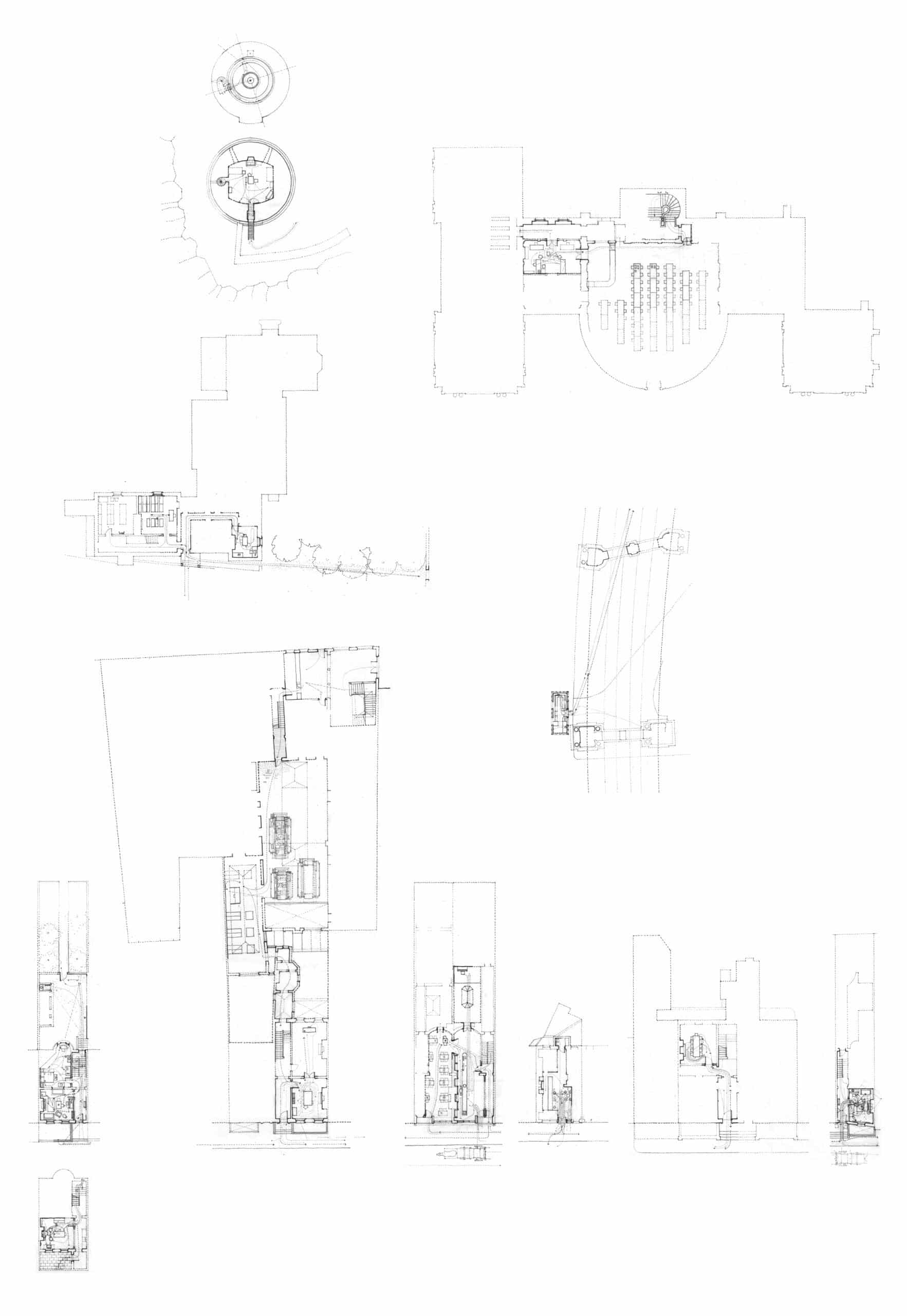
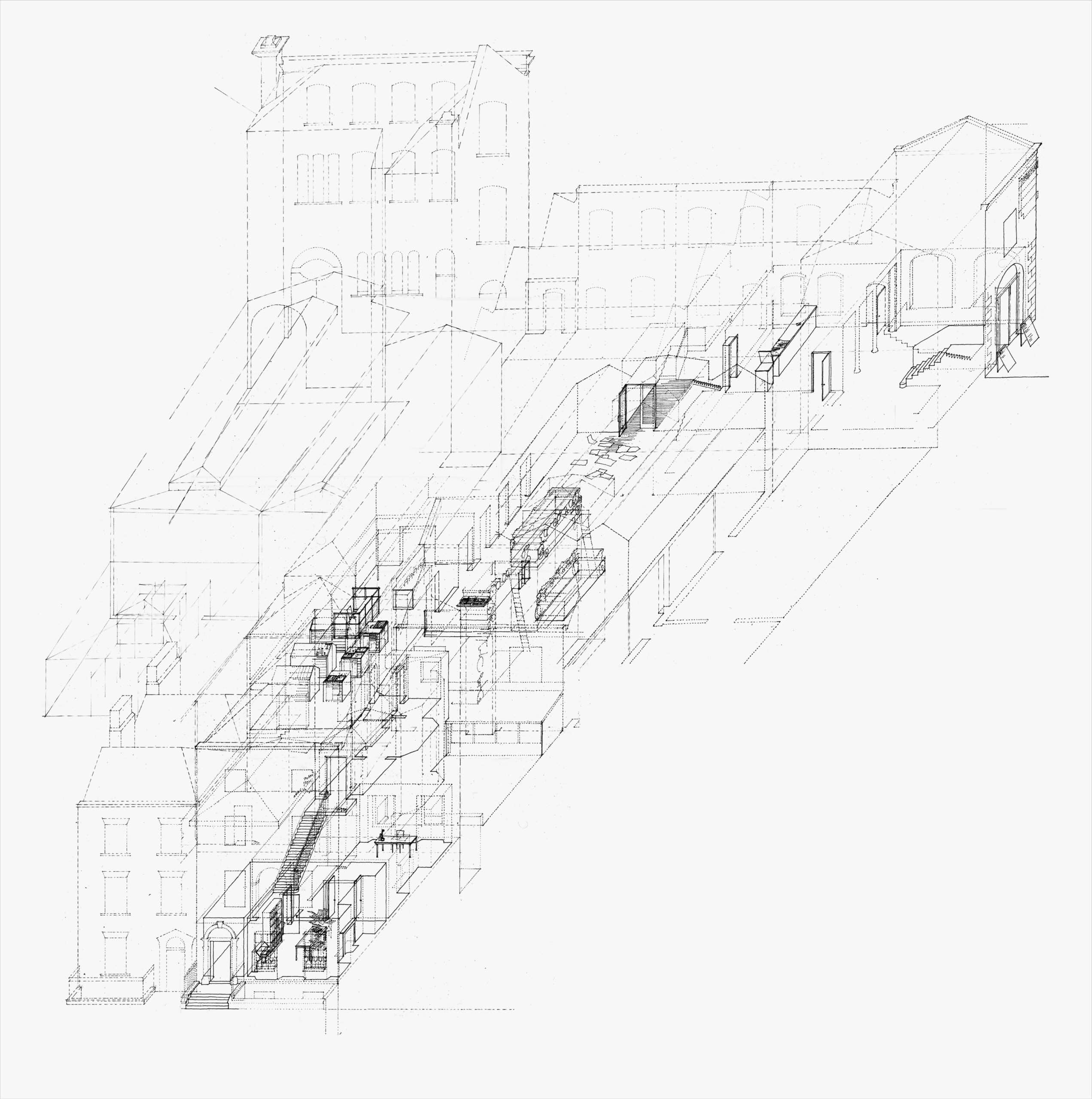
When I started working on Ulysses, Joyce experts had investigated early 20th-century Dublin to demonstrate the realism of the book, scouring the directory for addresses and filling in missing facts: tram routes, tidal charts, points on maps. Yet gaps remained, and the inquisitor’s questions about Bloom’s house—the dimensions of the front lightwell, the placement of the furniture, the route of the water supply—which superficially resemble those of an architect or planner, were confined to one chapter. Fact-checking was being emphasised at the expense of other aspects, and Dublin was treated largely as a cartographic prop for Joyce’s story. Other ways of understanding a city, which architectural training provides, were absent: the city as a constellation of settings, a topography. In response, I drew the novel as places, to make analogues for Joyce’s writing of the city, following his actors and respecting his gaps. Strangeness would emerge from focusing on each thing he mentioned. The resulting topographic drawing presents each scene in central Dublin without illustrating the book; overlaying all actions and recollections of each place, it is true but unreadable, non-narrative, as Joyce is non-visual. Its principal companions—ten oblique projection drawings of the main buildings in Ulysses—are also partial, reflecting only where Joyce’s characters go and omitting the rest. And they are stage sets: the actors are mostly absent but each object they interact with is shown; often these are the main conduit to understanding the rooms from the text, since we must work outwards from what characters touch and see towards the architectural background.
These ten ‘portraits’ of buildings belong to the project’s penultimate phase, when another oversight in how Joyce’s city was often treated had occurred to me. Joyce could see so much happening, unremarked, under our very noses, that he spent three decades writing a single day and a single night. He had to find new ways of putting together the English language to expose the subtext with the surface, the collective background which makes it possible to think and—even—understand. He highlighted what takes place every day in ordinary buildings: collective structures of meaning returning in individual experience, a continuous, oneiric cycle. The backgrounds of Ulysses, where this process takes place—many buildings sharing the same plan and yet different themes—are not neutral. Typical and recurring, the same and yet different, they are not the melody of life but its rhythm. All the extraordinary possibilities of a human mind in which Ulysses rejoices depend on the most basic conditions of inhabitation: what architects think about so that no one else has to. Those elsewheres—the Odyssey, Hamlet, Exodus—were always, perhaps, already there: we cannot conceive of other worlds without the here and now, the typical, recurring situations that we take for granted. And then, only through frameworks like narrative, myth and architecture can the remarkable layers of ordinary life that pass unobserved be brought to visibility.
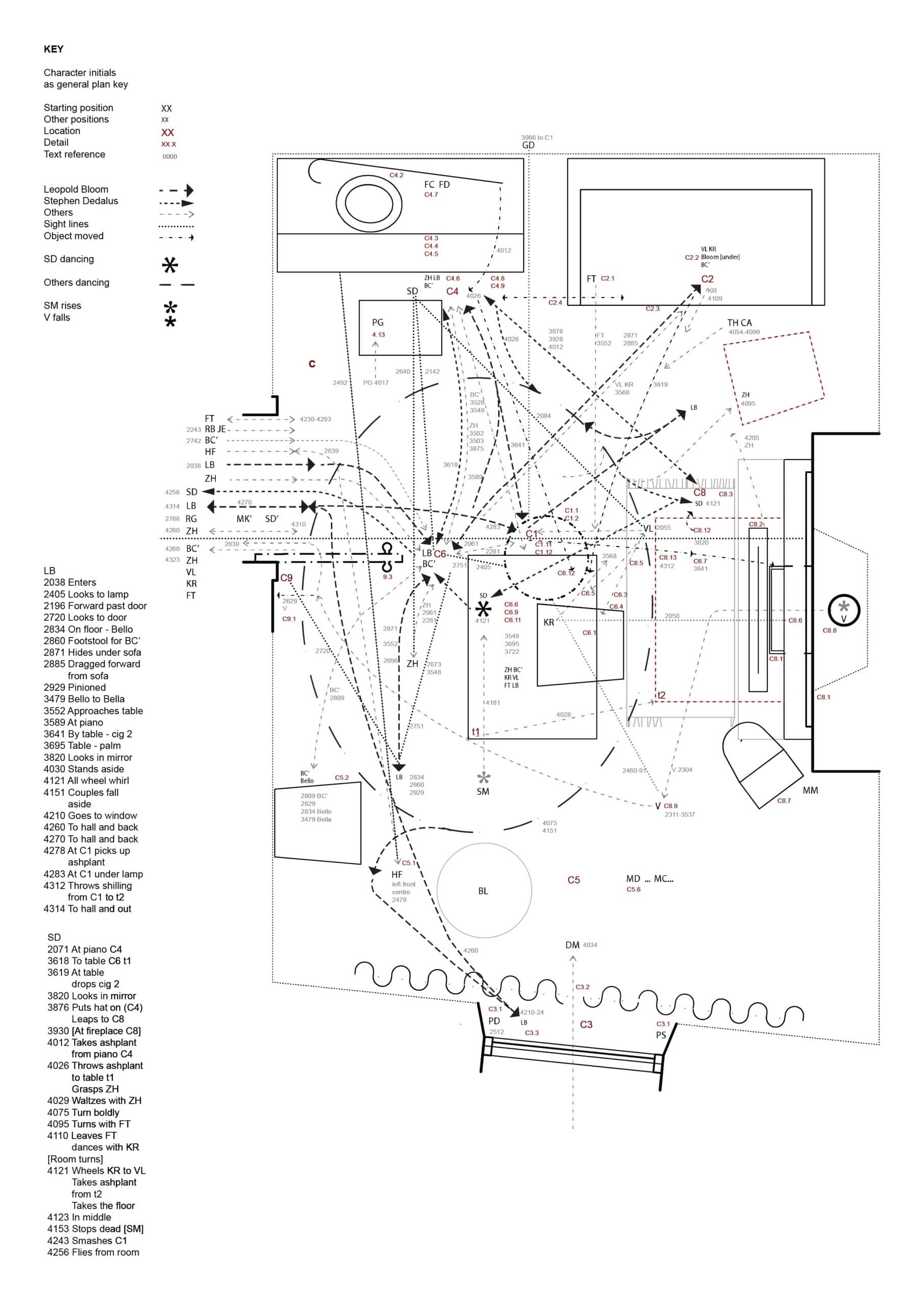
As Samuel Beckett observed, Joyce’s writing was not ‘about’ anything: it was ‘that something itself’.[5] So too an architect’s way of studying the background—the most basic drawings for making a building—is a unique mode of paying attention, a form of analogical thinking which is routinely overlooked. The drawings for Ulysses needed to become even more literal, not only to bring out what Joyce had done but to show architecture: the design itself, measured drawings not meant to be seen. For all their elisions and omissions, even the moments where they disintegrate into marks on paper—like Joyce’s full stop—the building portraits were drawn at scale with the most basic means. And for all the day drawings—made to consolidate and clarify—there had to be night drawings: messy, sketchy and mostly wrong, the material that most architects throw in the bin, equivalent to the scraps from which Joyce rebuilt his Dublin while moving around Europe (train tickets, newspaper clippings, discarded tins). These were sites of activity, my hand moving across the miniaturised building plot and trying to make the setting plausible with the available facts, as though it were a commission and I were trying to adapt the type, or the building, for the use it had when Joyce’s characters encountered it. This was not really about Joyce: it simply was Ulysses and it was architecture, not because I was trying to turn architecture into text or derive a formula for making it meaningful from a novel, but because both ways of knowing are adventures in real metaphor.
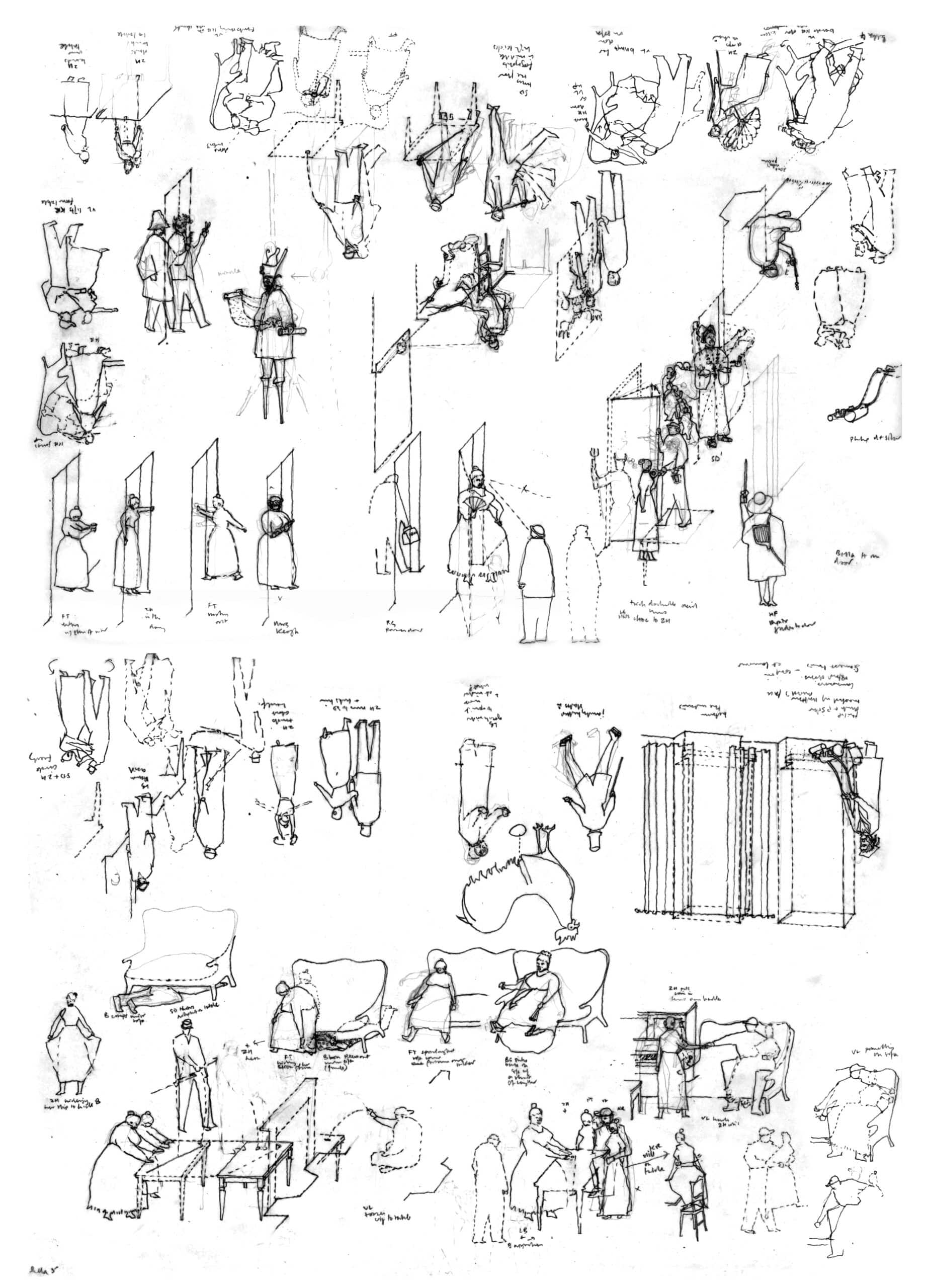
To explain this would mean showing you the whole book that I finished on 16 June 2024: all the drawings, all 200,000 words of the project’s final stage, which span telling and showing, building history and literary analysis, and my own experience. What made the book impossible to explain along the way makes it like a work of architecture, not an essay with a predetermined research target. It is its own evidence: how it is made and what it represents, its shape and its ideas, are the same. How tempting it is to separate these when thinking about architecture: high-level ambitions—social or conceptual—which render the plan a technicality, or close attention to ‘pure’ material construction, which can’t exist in architecture any more than pure body versus pure thought can cohere into a person. Surely everything is an idea and everything is embodied, a condition of perpetual becoming, being moved from one place to another. Joyce, writes Umberto Eco, moved from an early idea of epiphany ‘in which something shows itself’ to being ‘the artist who shows something’.[6] I am not an artist, not a novelist; only an architect could have approached Joyce as I did, with all the strengths and weaknesses that entails. Words follow designs where possible or take off where design cannot go. But I could not have done this by building something, then writing about it. In Ulysses, I found, the themes become denser as the architecture becomes simpler, to the point where you can no longer name rooms or say what they are for: yet a specific structure of differences remains. Indeed, architects operate within an extraordinary paradox: the more carefully we define a building not through use but through embodied conditions, the more freedom we give for people to appropriate it, for life and thought to take over. It is a constant renegotiation that resists definition; it can only be played out through design. And that too is a way of life, for it takes a thousand sketches to make one building, as my mother told me early on. How and what, she added, always come together: ‘architects don’t talk – they draw’.[7] So much of what is important in life cannot be planned or verbalised; so much of what Joyce shows can be easily designed out; so many words are needed to express those gaps. The discipline of thinking a building through making, with intentions that go beyond what you can explain, is a heightened version of what people do all the time, an enduring human, cultural activity. When that is absent from the creation of the design, it shows. The simplest drawings for a building are silent, not thoughtless: not pictures, information or ‘intelligence’. In them, the architect has vanished and is ever present. Anticipating and recollecting life, they belong with its most profound experiences: this ‘passing show’.[8]
Notes
- As is customary in Joyce scholarship, the numbers denote chapter and lines, referring to the standard edition of James Joyce, Ulysses, ed. Hans Walter Gabler with Wolfhard Steppe and Claus Melchior (New York: Random House; London: Bodley Head, 1986).
- Ibid., 18.1–4.
- James Joyce, Finnegans Wake (Penguin Modern Classics, 2000), 424, ln.35.
- All quotations are from Joyce, Ulysses, op. cit., 17.2119–2121 and 17.2302–9.
- Samuel Beckett: ‘Dante… Bruno. Vico.. Joyce’, in Our Exagmination Round His Factification For Incamination of Work in Progress (Paris: Shakespeare and Company, 1929), 1–22 (14). Italics in original.
- Umberto Eco, The Middle Ages of James Joyce: The Aesthetics of Chaosmos, trans. Ellen Esrock (London: Hutchinson Radius 1989), 26. Italics in original.
- Ο αρχιτέκτονας δεν μιλάει, σχεδιάζει. The word σχέδιο is commonly used for design drawings and carries a double meaning similar to the English word ‘plan’, an intention for something to be realised in future. An architectural ‘project’, by contrast, is a μελέτη: not ‘research’ but ‘study’.
- Joyce, Ulysses, op. cit., 14.440.
*
Born in Athens, to Greek and British parents, Freddie Phillipson studied architecture at the University of Cambridge and MIT. As Associate Director at Witherford Watson Mann Architects, he was project architect for Astley Castle, awarded the RIBA Stirling Prize in 2013. Freddie’s own practice was selected as one of the Architects’ Journal’s 40 best architects under 40 in 2020 and published in the Architecture Foundation’s survey of the best recent UK practices, New Architects 4. His drawn research on James Joyce’s Dublin was exhibited at the Irish Architectural Archive in 2022. He is currently a Design Teaching Fellow at Cambridge.
The article is included in the third issue of DMJournal, Storytelling.
