Engraving Shadows
In all relief printmaking techniques such as woodcut (in which cuts are made along the plank of a smooth piece of wood) and linocut (involving, like woodcuts, steel gouges with U- and V-shaped cutting tips), as well as wood engraving and even the humble potato-cut, what you leave uncut on a block’s smooth surface is the part that is inked and printed. All the cut parts become the print’s paper-white areas. So, when creating a relief print, you are usually cutting an image’s light-filled areas, and what is left behind, uncut, comprises its darker parts—and shadows.
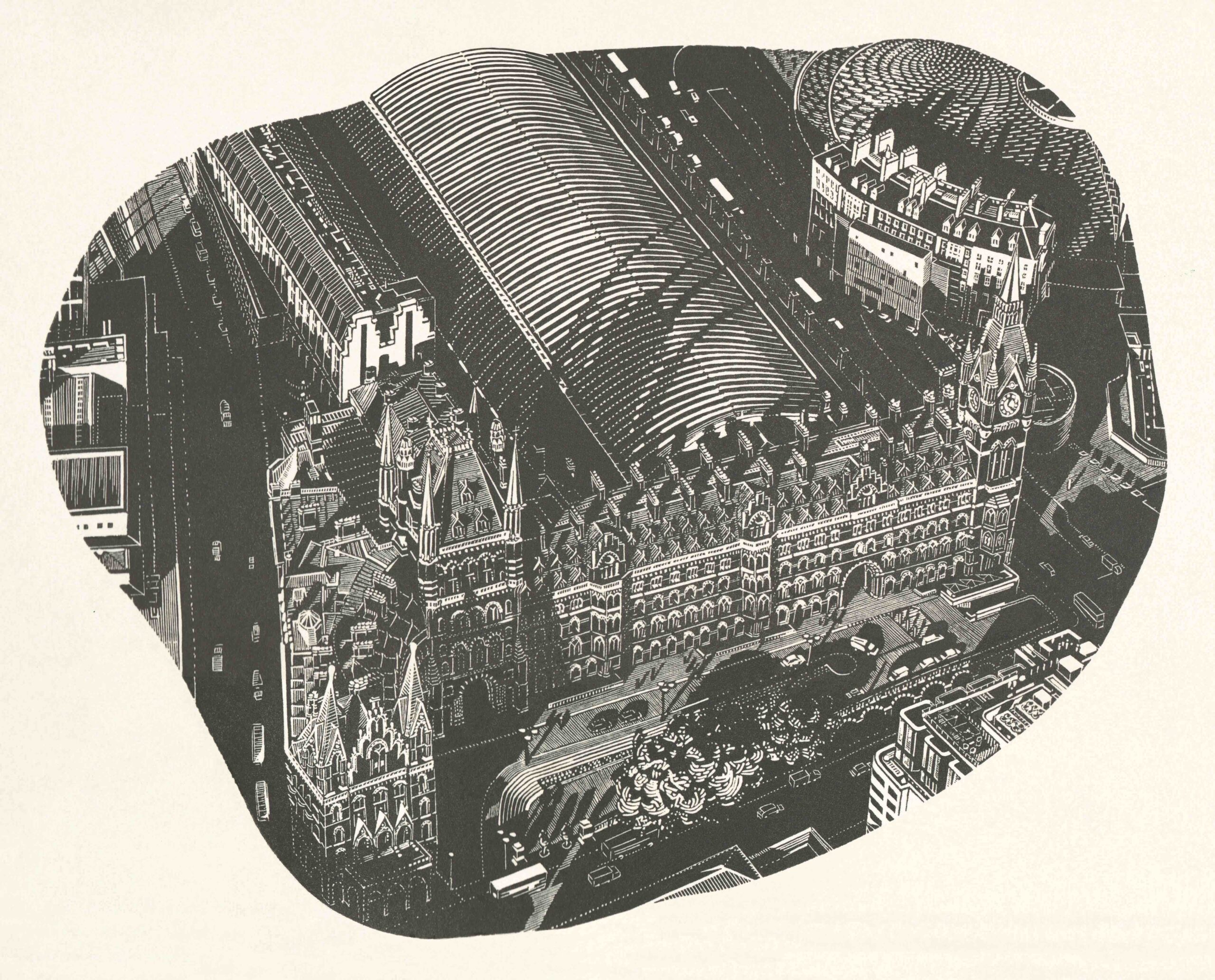
Wood engraving involves steel burins with sharp cutting tips (like those used for metal engraving). Tonal ranges can be created via infinitely varied patterns of narrower or wider engraved (white) lines: straight or curving, close together or far apart—and in innumerable combinations of differently sized and spaced dots and dashes using many subtly variant tools.
Wood engravings are cut on the cross-grain (aka end-grain) rather than along the plank, so woodgrain direction plays no part in how an engraving is cut. What is more important is that the tree’s rings are tightly and evenly spaced (from a slow-growing tree such as boxwood) and that the wood is receptive to intricate, precise cutting. On the ideal block, the artist can cut easily and crisply in any direction on its smooth surface, like a skater creating perfect loops on a frozen lake. It’s an excellent medium for detailed architectural imagery.
The origins of wood engraving are unknown. Fabric printing, using carved end-grain woodblocks, has been practised in India for centuries, and other examples of end-grain woodblock printing exist prior to the life of Thomas Bewick (1754–1828), a Newcastle-born engraver of primarily rural subjects. However, it was Bewick’s work that raised the medium to hitherto unknown finesse, such that he is often erroneously credited with its invention.
Bewick’s engravings were the earliest to explore the medium’s white-line possibilities: images that at first sight resemble pen drawings but which, on closer inspection, reveal inventive white-on-black tonal cutting rather than mere efforts at reproducing the black lines of pen drawings. To make such revolutionary images, artists needed to create images in light, which required a thinking process like that of drawing dappled sunlight seen through trees in white chalk on black paper.
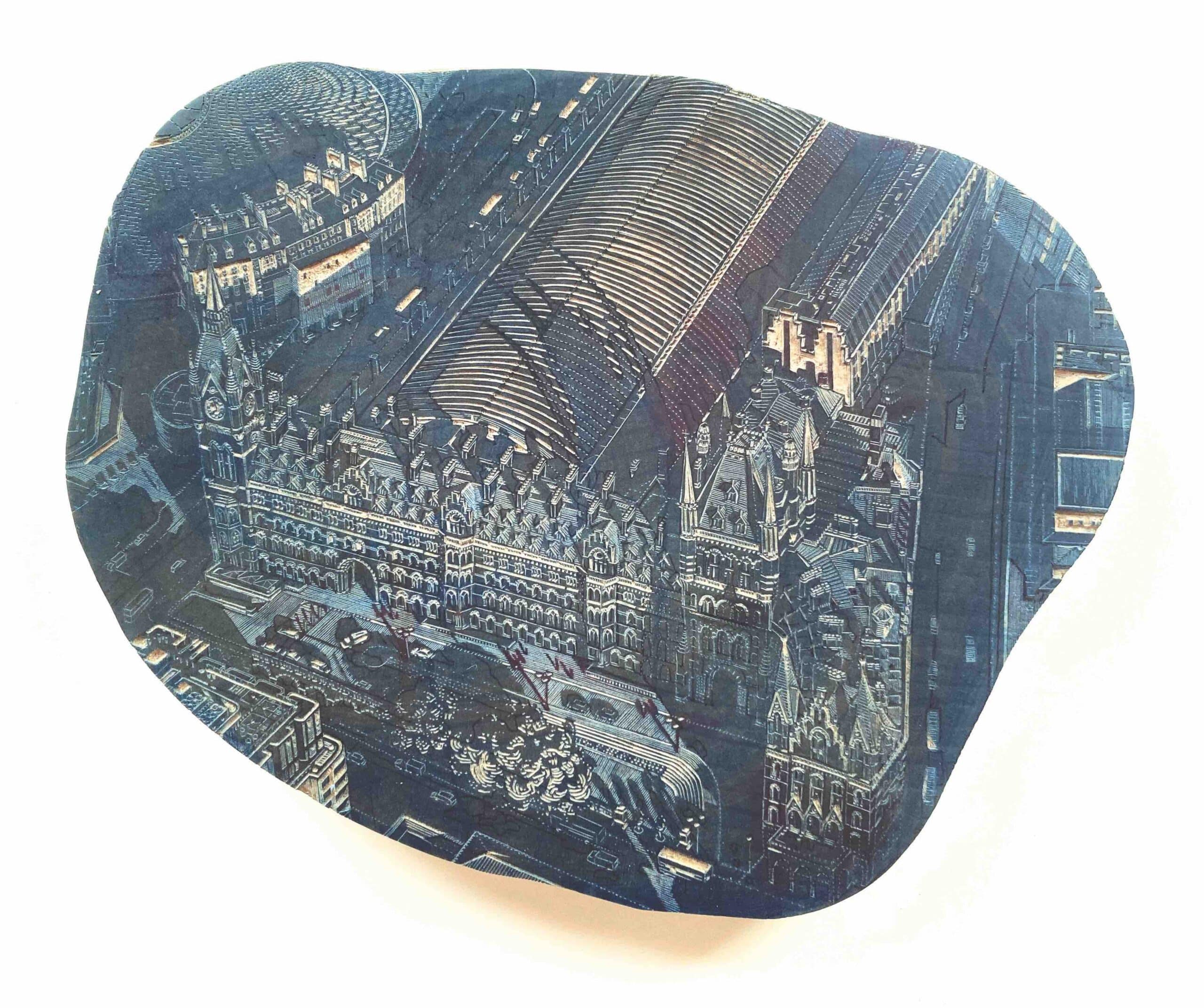
To best facilitate working in light, I begin by staining each block’s smooth surface a dark blue before drawing an outline image (as a cutting guide) on it in black pen. Tool-cuts show as pale marks on the darkened surface enabling me to see clearly how the block will look when printed. The finished print is a mirror image of the design on the block yet the balance of light and shade looks the same in both print and block.
*
Anne Desmet gained a BA & MA at the Ruskin School of Art, Oxford University, and a Postgraduate Diploma in Printmaking at the Central School of Art and Design, London. She has taught wood engraving widely, including at the RA Schools, British Museum and Middlesex University. In 2011, Desmet was elected a member of the Royal Academy of Arts and is only the third wood engraver ever elected to the RA in its entire history. She is also a Fellow of the Royal Society of Painter-Printmakers (RE) and the Society of Wood Engravers (SWE).
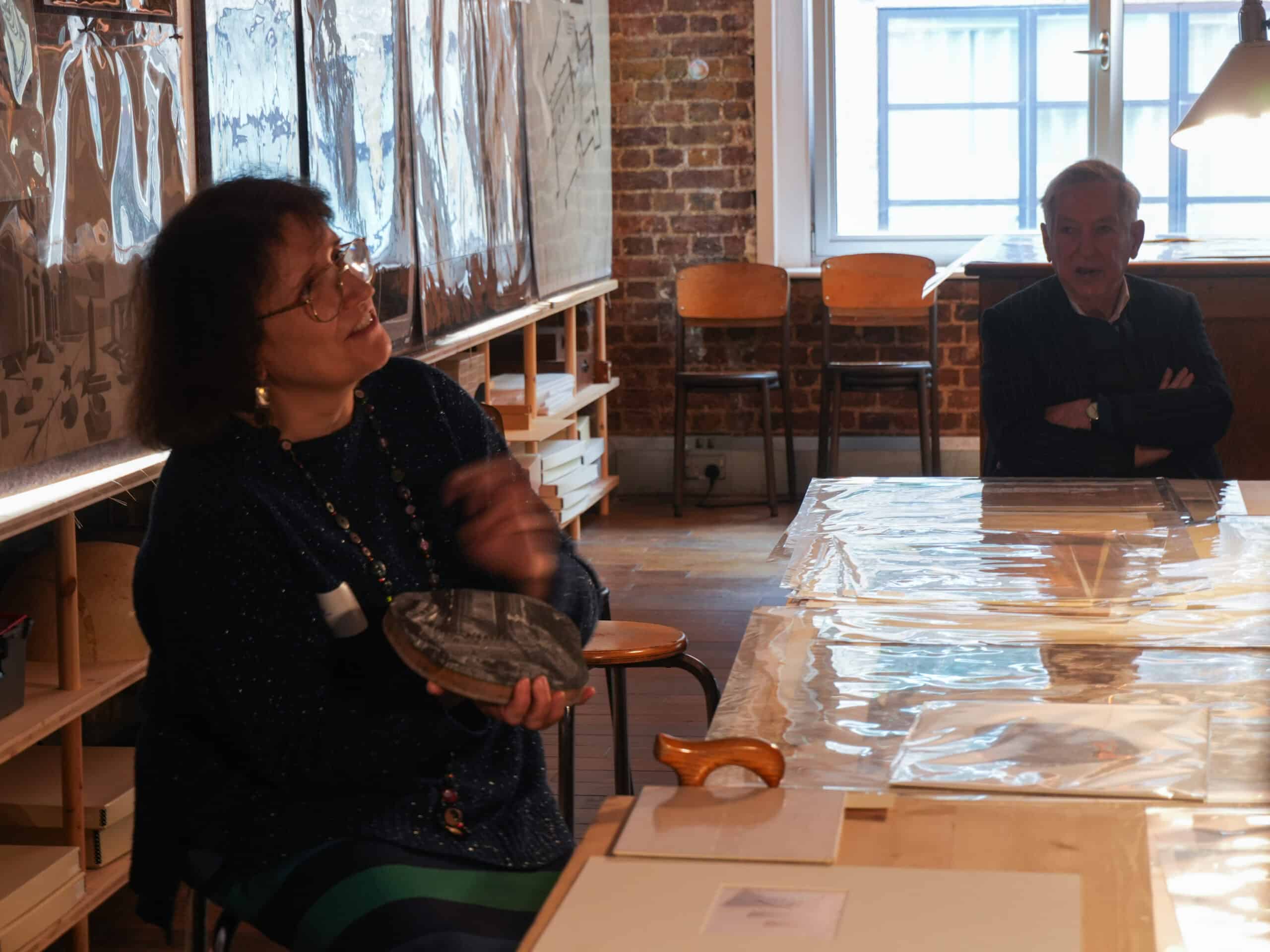
This short text offers an insight into Anne Desmet’s invited contribution in the third colloquium event ‘Tracing Shadows’ led by Professor Mark Dorrian and hosted by the RIBA, V&A Drawings Collections and Drawing Matter in January 2026—a day of conversations, gathered around original drawings and photographs, in which participants examined the presence (and absence) of shadows in the representation of architecture.
