New Views on Vanbrugh and his Drawings
This text is published to mark the opening of John Vanbrugh: The Drama of Architecture at Sir John Soane’s Museum (4 March–28 June 2026), co-curated by Charles Saumarez Smith and Roz Barr. More information about the exhibition can be found here.
In the summer of 1982, when I was at the end of the third year of a research fellowship at Christ’s College, Cambridge and when I should really have been writing up my research on Castle Howard, I spent time in the Department of Manuscripts at the British Museum studying Vanbrugh’s correspondence relating to Blenheim which was available for the first time since it had been transferred to the British Museum in 1976.[1] In those pre-digital days, one was required to write one’s name in the front of the bound volumes of manuscripts as a record of having consulted them and I remember the strange sensation of finding that in many cases I was nearly the first, if not the first, person to go through this material, maybe because so much of it had already been published as an Appendix to Geoffrey Webb’s admirable 1928 edition of Vanbrugh’s correspondence.
I was left with an abiding impression of Vanbrugh’s involvement in every aspect of the construction of Blenheim, his care and concern about the progress of works, and most especially about the supply of stone, in nearly constant correspondence with Henry Joynes, who had been appointed as Clerk of Works in May 1705 by Lord Godolphin, the first Lord of the Treasury who took ultimate responsibility for the management and oversight of the project on behalf of Queen Anne. There was very little reference, if any, to Hawksmoor’s role, although Hawksmoor himself was separately in correspondence with Joynes.
I felt at the time, and I have not seen anything to change my mind ever since, that the tone of these letters, in some ways just the volume of them, daily, weekly, asking for information, giving instructions, making sure that the progress of work was in order, contradicted the idea of Vanbrugh as being somehow lightweight—an amateur, not a proper professional, and mildly frivolous in his approach to the task of design, and so necessarily dependent on Hawksmoor who was more experienced, better trained and worked out the detail of Vanbrugh’s superficial ideas in more detailed instructions to the builders and contractors through his drawings.
The exhibition John Vanbrugh: The Drama of Architecture which opens at Sir John Soane’s Museum on 3 March 2026, looks at this aspect of his career, which was not, when I started working on him again, at the heart of my interest in him, but which I have increasingly realised is essential to any interpretation of him: that is, his attitude towards and use of drawing as part of the process of imagining and describing his buildings.
On Christmas Day 1699, Vanbrugh wrote a long and friendly letter to the Earl of Manchester who was the British ambassador in Paris, a friend (and cousin) of Vanbrugh’s close friend, Peregrine Bertie, with whom he shared lodgings in Whitehall. After a long description of affairs in parliament and problems at the theatre in Lincoln’s Inn Fields, he describes the trip he had taken in the summer staying in a number of country houses, including the Earl of Nottingham’s at Burley-on-the-Hill and the Duke of Leeds’s at Kiveton, ending up at Chatsworth where he had stayed for four or five days. They had discussed the designs that Vanbrugh had made for Castle Howard:
I shew’d him all my Lord Carlisle’s designs, which he said was quite another thing than what he imagined from the character your Lordship gave him on’t. He absolutely approved the whole design, particularly the low Wings, which he said wou’d have an admirable effect without doors as well as within, being adorn’d with those Ornaments of Pilasters and Urns, wch he never thought of, but concluded ‘t was to be a plain low building like an orange-house. There has been a great many critics consulted upon it since, and no one objection being made to it, the stone is raising and the foundation will be laid in the spring.[2]
There is no sense whatever that Vanbrugh did not regard himself as single-handedly responsible for these designs. Indeed, the tone is one that one comes to recognise in his later correspondence: slightly show-off, brimming with an occasionally cocky, possibly misplaced, belief in his own abilities.
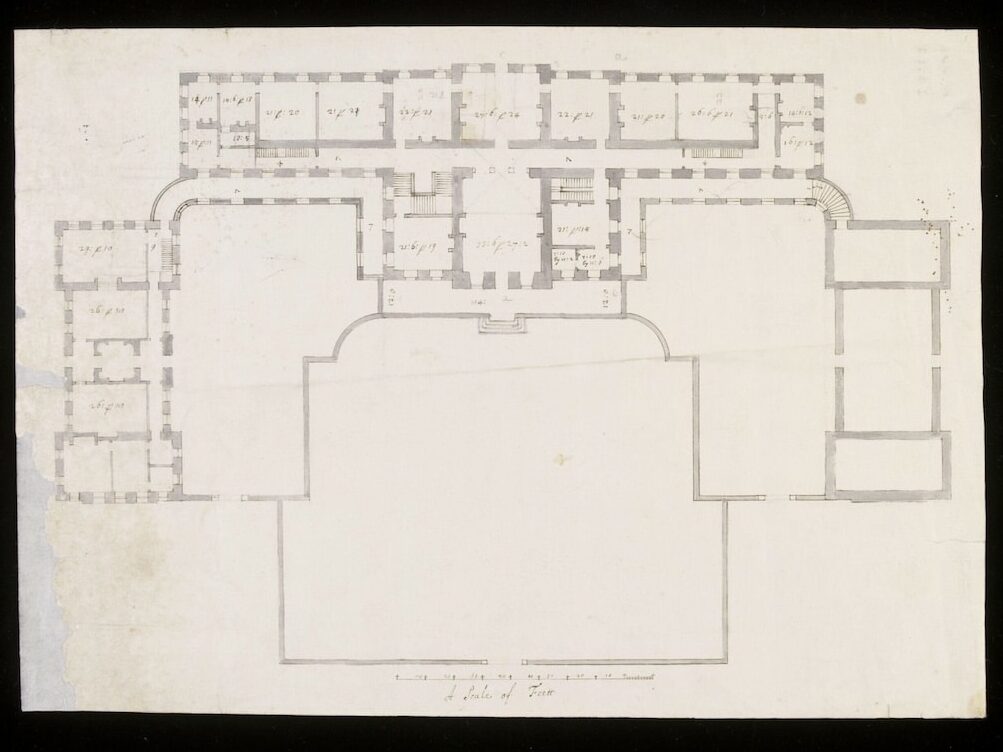
If one looks at the early drawings for Castle Howard in the collection if the V&A, the majority of them are labelled as being by Vanbrugh and Hawksmoor, although looking at them they do not seem necessarily to be in more than one hand and I suspect it was a way for those who catalogued the drawings in 1996, after the acquisition of the Elton Hall album in 1992, of hedging their bets, knowing that both architects were involved in the design of Castle Howard and Kerry Downes not being willing to be definitive on their attribution on grounds of either handwriting or drawing style. What seem to be the first drawings of this group are large-scale presentation drawings. They don’t seem to be beyond the competence of Vanbrugh on his own and would fit the description of the design at this early stage in 1699, before there is any documented evidence of Hawksmoor being involved.


(See larger images here)
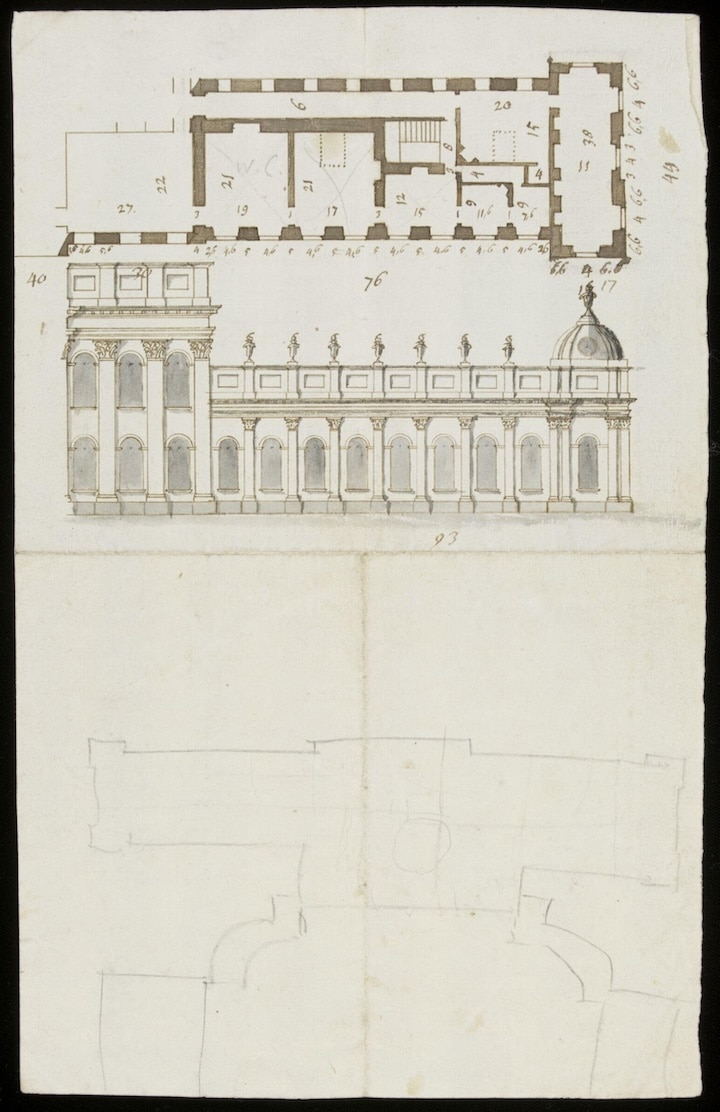
Interestingly, there are also two drawings which surfaced at Christie’s in 1995, which are labelled unequivocally as by Vanbrugh on his own. They came from the same collection, the Marquis of Bute’s, as the large group of drawings acquired in 1951, but must for some reason have been kept back from the previous sale and, as a result, did not form part of Laurence Whistler’s early work on these drawings, nor were they included in Kerry Downes’s two monographs on Vanbrugh. The first shows Vanbrugh thinking in a bit more detail about the garden façade. It shows him working out the details of the façade, adding a small dome to the room on the end and urns on the balustrade. It is not a particularly brilliant drawing, but it does demonstrate that Vanbrugh was interested in working out architectural details on his own.
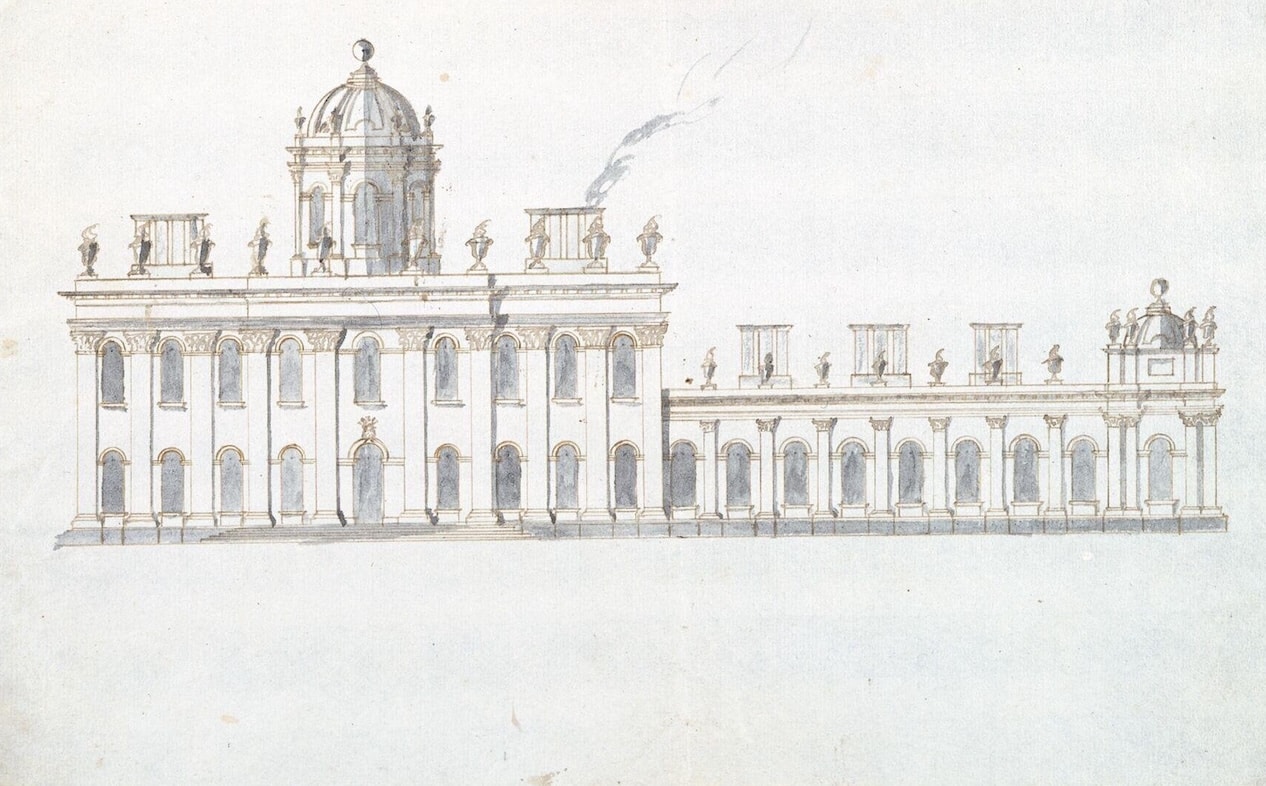
There is a second slightly more elaborate drawing which shows the addition of the dome which gives height to the entrance hall and is such a feature of the house, even after the disastrous fire of 1940.
There is a third drawing which belongs probably fairly late on in the process of design, a curious and unusual small-scale drawing in which whoever drew it—and, since it belongs to a substantial group of other drawings by Vanbrugh, I see no reason to think that it is not by him—which shows Castle Howard seen from above, a bird’s eye view, like an engraving by Kip and Knyff.

When, four years later, the Duke of Newcastle, another early member of the Kit-Cat Club, wanted to reconstruct his house at Welbeck Abbey, Vanbrugh told him to go and have a good look at Castle Howard and that he would be able to show him ‘all the drawings that have been made for the carrying on that building’.[3] These detailed working drawings do not survive. Three years later, he asked Henry Joynes, the Clerk of Works at Blenheim, to send him drawings he had in a shed of the two main fronts at Castle Howard so that they could be made into engravings:
If you have with you my Lord Carlisle’s Papers, You’ll oblige me to draw the two Fronts, pretty exact they being for the Engraver to work from; As for the Ornaments on the Top, with the Chimneys on the Main Pile, and the Cupola, I’ll get Mr Hawksmoor to Add them here, for I believe you have not the last Designs of ‘em. Pray send ‘em as soon as conveniently you can.[4]
What you can see in these early documentary sources is that Vanbrugh took drawing seriously as part of the process of design from when he started being involved in designing houses for his friends. He got Hawksmoor to make adjustments to the set of drawings which for some reason were being kept in a shed in Blenheim. Hawksmoor may well have been better and more skilful at drawing, but this didn’t mean that Vanbrugh couldn’t himself draw, nor that he entrusted Hawksmoor to do a lot of the detailed design: it just meant that he had sensibly employed a very experienced assistant whose skills he used when it was convenient to do so.
So far as I know, no drawing survives of what Vanbrugh planned to do at Welbeck. But a single letter from Vanbrugh to the Duke of Newcastle, dated 15 June 1703, does survive which gives a good idea of his working methods.
The Duke had asked to see the drawings which Vanbrugh had prepared for him. Vanbrugh replied:
I don’t remember that I had those Design’s your Grace mentions; only the great front which was left to be drawn over again with the Addition of Dorique Pillasters upon the two Circular Corridores, and the two Pavillions with the round Caps that join to ‘em.[5]
Vanbrugh had obviously drawn up plans for a house consisting of a central block flanked by two pavilions, connected by circular corridors, as at Castle Howard. He had also drawn up designs ‘one of the Gardenside, and tother of the end’, the latter drawing of which he had retained and was able to send to the Duke. These drawings were probably either done by, or with the help of, Hawksmoor, because he thought Hawksmoor might still have the drawing of the garden front in which case ‘I’ll get it from him, but I remember how it was, it was with Dorique Pillasters all along except the two Pavillions wch were Rustick like the rest’. Whether or not Hawksmoor had done the drawings, Vanbrugh took responsibility for its design.
Vanbrugh then goes on to give a description of the difference between thinking about a planned building on the basis of a few drawings and the realities of seeing an existing example of a building which might form an appropriate model of what was proposed:
My Lord there are none of the Designs yet drawn, that do a quarter express what is to be perform’d, there are only generall Draughts to give some Idea of the building, but there go’s a great deal more to explain the perticulars, as your Grace will see if you go to my Lord Carlisle’s this Summer, where I can shew you all the drawings that have been made for the carrying on that building. And your Grace will see, there go’s a little more to the directing true Architecture, than our Common builders have a Notion of.[6]
Vanbrugh thought about the design of a building in terms of its ‘performance’ and regarded his own role as ‘directing true Architecture’, something larger and grander than a common-or-garden builder would be capable of.
Having presented his own designs, Vanbrugh went on to describe the benefits of a good building and the pleasures it might bring, at least the equivalent of ‘Tytles and Blew Garters’ (the Duke was known to have put pressure on William III to make him first a Duke and then Knight of the Garter). As Vanbrugh wrote, it was an appropriate way of demonstrating rank and status:
I believe if your Grace will please to consider of the Intrinsique vallew of Tytles and Blew Graters, and Jewells and Great Tables and Numbers of Servants & in a word all those things that distinguish Great Men from small ones, you will confess to me, that a Good house is at least upon the Levell with the best of ‘em.[7]
The letter ended with a postscript, describing, once again, how the drawings supplied were no more than outline sketches, open to different detailing once the contract had been agreed:
Tho’ I send your Grace this Designe of the end of the house, it is not drawn as I propose it; As to the Design of the house in Generall, I often think of it, and can’t yet find any thing considerable I wou’d alter (at least that can be done without a good deal more expence), but as to perticulars, I am scarce determin’d in any thing; leaving most of those matters to debate when your Grace comes to drawing of Articles.[8]
This brings us to the question of Blenheim which lies at the heart of any discussion of the respective roles of Vanbrugh and Hawksmoor in terms of design. It happens that Blenheim is oddly poorly served in terms of surviving drawings, but exceptionally well documented as regards the chronology of its original design and conception. We know that the Duke of Marlborough had met Vanbrugh at the theatre some time after his return to London as the conquering hero in December 1704 and that the idea of a celebratory palace had already been mooted. The Duchess of Marlborough blamed James Craggs for recommending Vanbrugh as its architect and this is certainly plausible: Craggs had served as Marlborough’s private secretary in the mid-1690s and was now Secretary to the Ordnance, so in charge of supplies to the army. One has to remember that Vanbrugh had himself served in the army in the 1680s and was still sometimes referred to as Captain Vanbrugh, so the idea of appointing an ex-soldier may well have appealed to Marlborough. Besides, he was already at work on the construction of Castle Howard, one of the biggest and grandest country houses of its period.
As soon as Marlborough had been able to arrange a survey of the park at Woodstock, he sent a copy of the plans round to Vanbrugh’s little house at the north end of Whitehall and arranged to meet him the following day. He went round with Sidney Godolphin, his friend, ally and First Lord of the Treasury. They had a look at the model of Castle Howard which Vanbrugh kept at home and told Vanbrugh that they wanted something similar to Castle Howard, but bigger: bigger rooms, a bigger entrance hall, the private apartments accommodated in the main block along the east front and a grand room of parade along the west front. Vanbrugh got to work at once—Marlborough was pretty business-like because he would have known that he could not stay in London for long. He produced a drawing a few days later and took it round to the Marlboroughs’ lodgings in St. James’s Palace where his proposals were apparently ‘viewed and considered…severall times that day, both before and after dinner’, at which point they ‘came to a Resolution to look no farther, but fix on ye design’.[9] The Duke then asked Vanbrugh to prepare a set of more detailed drawings which he, the Duchess and the Earl of Godolphin subjected to very close examination, making sure that it was exactly as they wanted, presumably principally in terms of its lay-out and the proposed use of the rooms. According to the Duchess of Marlborough writing much later, ‘several Draughts more Correct were made, and from time to time shown to his Grace’. In other words, the design was originally worked out in a set of detailed drawings which were approved before they visited the site in late February 1705.[10]
According to Vanbrugh, after they returned to London, following the site visit in February 1705:
After his Graces return to London there were many more Draughts made in Order to carrying on the work, and Constantly shewed to ye Duke, who sometimes approved and sometimes disapproved of the same, tho he consulted his Dutchess, Ld Treasurer Godolphin, the Dukes of Shrewbury and Montagu, and others, in most of ‘em.[11]
In other words, many of the key elements of the design of Blenheim were worked out through a process of repeated revision of plans and detailed drawings in the space of the two months before work started on site in April 1705. There was no mention at any point in the correspondence or later legal proceedings of the involvement of Hawksmoor at this stage of the design. Nor do I think there needed to be, although without the survival of these original drawings, it is impossible to be definitive. But it was Vanbrugh had been recruited as Blenheim’s architect and that was to be his role throughout the process of construction, liaising with the Duke when necessary, appealing to Lord Godolphin to ensure the flow of funds from the Treasury and trying to avoid the incessant and interminable interference by the Duchess, who never trusted Vanbrugh right from the beginning, mainly in terms of his ability and willingness to control the costs.
One may think, and many of his contemporaries certainly did, including Jonathan Swift, that Vanbrugh was slightly ludicrously over-confident and a bit too pleased with himself. He threw himself into the design of Castle Howard after Talman had charged the Earl of Carlisle too much. He offered his services to the Duke of Newcastle to design a new house at Welbeck. Nobody thought it particularly odd that he was recruited as architect at Blenheim, since he had already been Comptroller in the Office of Works for the previous three years, responsible for the control of expenditure on all the crown’s building projects.
At Blenheim, as in Vanbrugh’s other building projects, it was Vanbrugh who was definitely in charge of the project as a whole, including the majority of the overall design and detailed drawings, however much Hawksmoor may have assisted him with some of the project management, the detailed supervision of work, the calculation of costs and, extremely likely, some of the later adjustments to the design and the more complex composition of the roof towers and ornament.
It is the importance of Vanbrugh, his remarkable creative versatility and the wealth of surviving documentation, as well as drawings, that justifies looking at his life and work afresh.
*
At the time that I wrote the above examination of Vanbrugh’s use of drawings early in his career, I was working my way systematically through the documentation of his life, writing the biography now published as John Vanbrugh: The Drama of Architecture. Although I had considered the possibility of an exhibition of his architectural drawings, it was only a couple of months later, in March 2024, that I sat next to Frances Sands, the Curator of Books and Drawings at Sir John Soane’s Museum, at a conference at Hatfield House. She suggested that I should put in an exhibition proposal, which I did nearly the following day. She may already have known that they were due to have a meeting to consider the forthcoming exhibition programme and that there might be a vacant slot in spring 2026 to coincide with the tercentenary of Vanbrugh’s death on 26 March 2026.
Once the plan for the exhibition had been agreed, I needed help on its layout (the display cases and layout of the two upstairs galleries at the Soane Museum are not straightforward), so approached the architect, Roz Barr, who has had a great deal of experience of exhibition design, to see if she would help. She suggested that we should go and look through the drawings at the V&A which form the main substance of the exhibition and a selection of which are illustrated below.
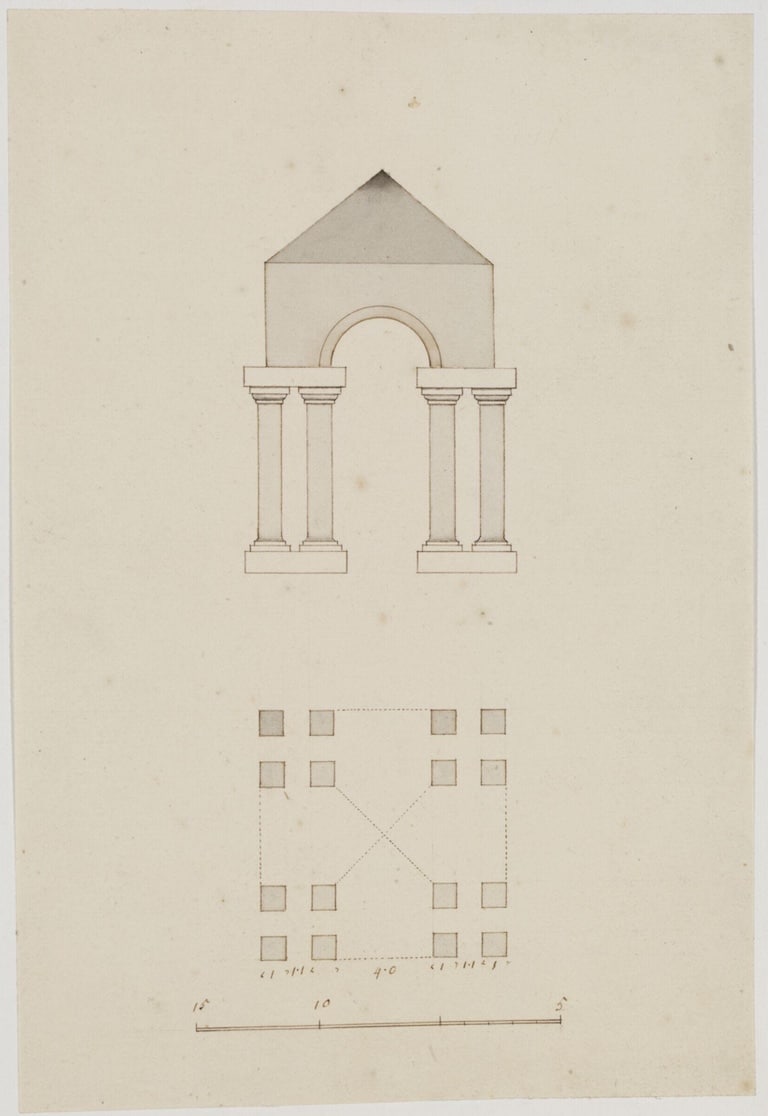
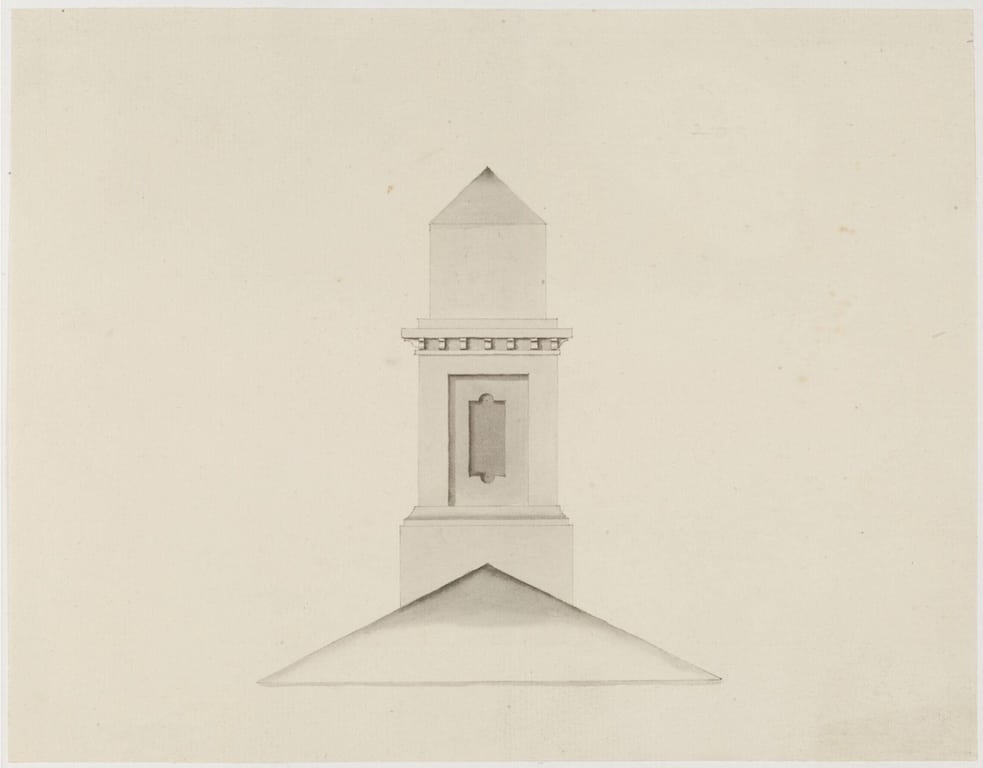
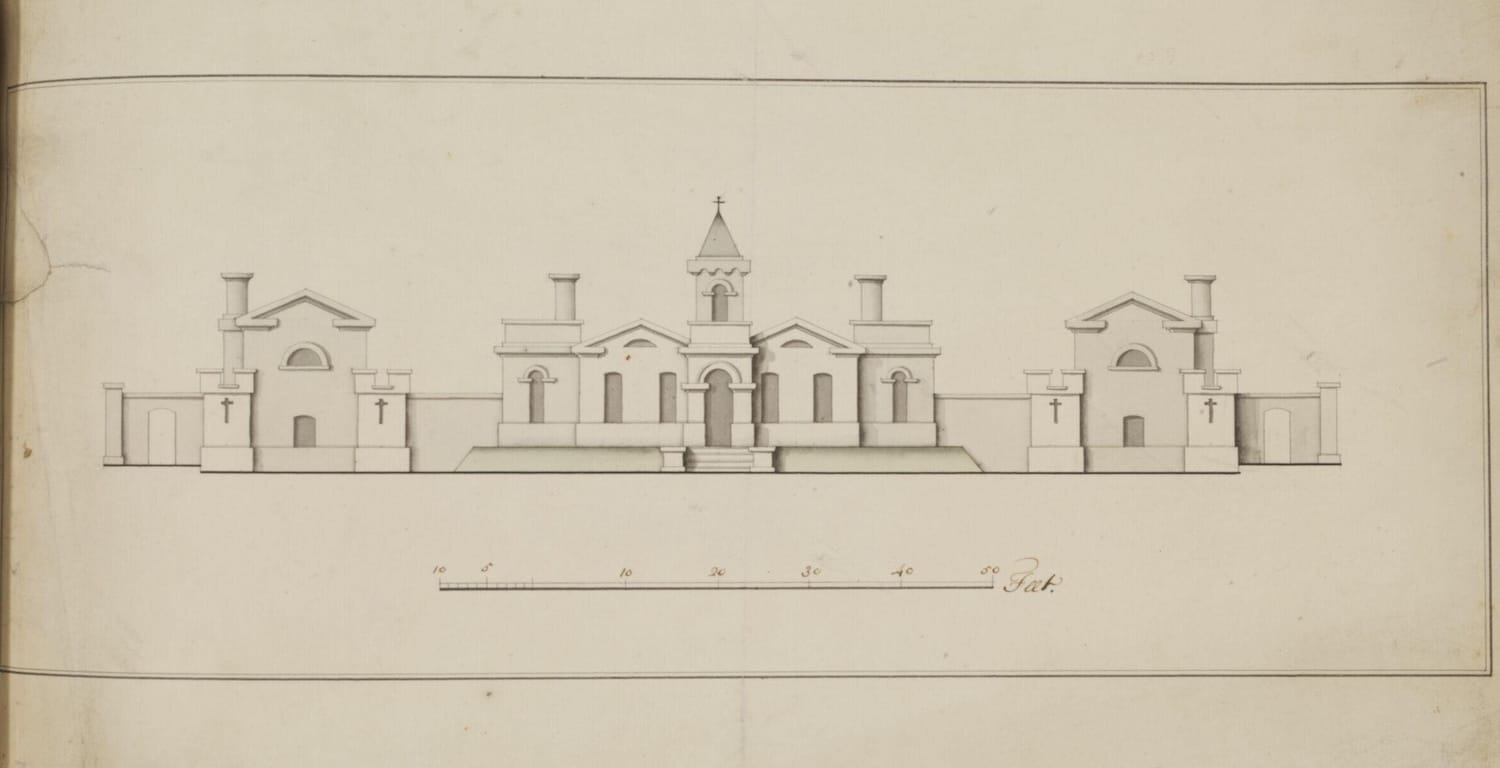
Roz Barr looked at the drawings not as a Vanbrugh scholar, but as a practising architect. She was particularly impressed by the extraordinary range of his later drawings—the abundance of small-scale drawings, ink sketches, in the so-called Vanbrugh Album, acquired by the V&A in 1992 from Elton Hall and bound up into an album, probably in the early 1950s. In these later drawings, done towards the end of Vanbrugh’s life, there is a sense of someone who was fascinated, if not obsessed, by the layout of small houses at the time that he was designing houses not only for himself, but for other members of his family on the land he had bought next door to Greenwich Park where only Vanbrugh Castle survives, an oddity in amongst Edwardian villas.
It was at this point that I twigged: if Vanbrugh liked to draw so freely and energetically late in his life, then he almost certainly had this ability earlier. As I have written in the introduction to my book, people do not learn to draw late in life. It is a skill which people have from childhood which may be developed and can be improved through teaching, but derives from a natural aptitude.
This made me look back at the two ink sketches he had made of Castle Howard which were acquired by the V&A from the Marquis of Bute’s collection only in 1995 (as illustrated above) and the conversations Vanbrugh had had with the Duke of Devonshire in the summer of 1699 about his initial plans for Castle Howard. If he was able to make drawings which were so free and imaginative late in his career, then he must have been able to do so earlier.
These early drawings are not finished drawings. They are what I think of as napkin sketches—the rough sketches which architects use to think through their initial ideas and, as importantly, often use to show their thinking to clients, as Norman Foster and David Chipperfield both do when they make competition presentations. Unfinished sketches are often more persuasive than those that have been worked up by an assistant because they are more personal.
It has always been a mystery as to why the Earl of Carlisle chose Vanbrugh as his architect in 1699. But this felt like a possible solution. Vanbrugh obviously had the gift of the gab, able to talk about architectural projects and ideas with great conviction. But he must also have had an ability to sketch his ideas out on paper and show them to potential clients, including his friends from the Kit-Cat Club, over the dinner table.
The exhibition will give people an opportunity to see his drawings not only for the great houses by which he is remembered, Castle Howard and Blenheim, but the small ones as well, which are much less well known, including as many as possible from the Vanbrugh Album as the V&A has been able to lend. Of course, they have been freely available to study online and were catalogued in the late 1990s, but they have a different impact when you see the real thing, even in desk cases at the Soane Museum.
At the exhibition, visitors, as well as Vanbrugh scholars, can make their own assessment of Vanbrugh’s drawing skills and how far this was one of his multifarious talents which contributed to the design of his buildings.
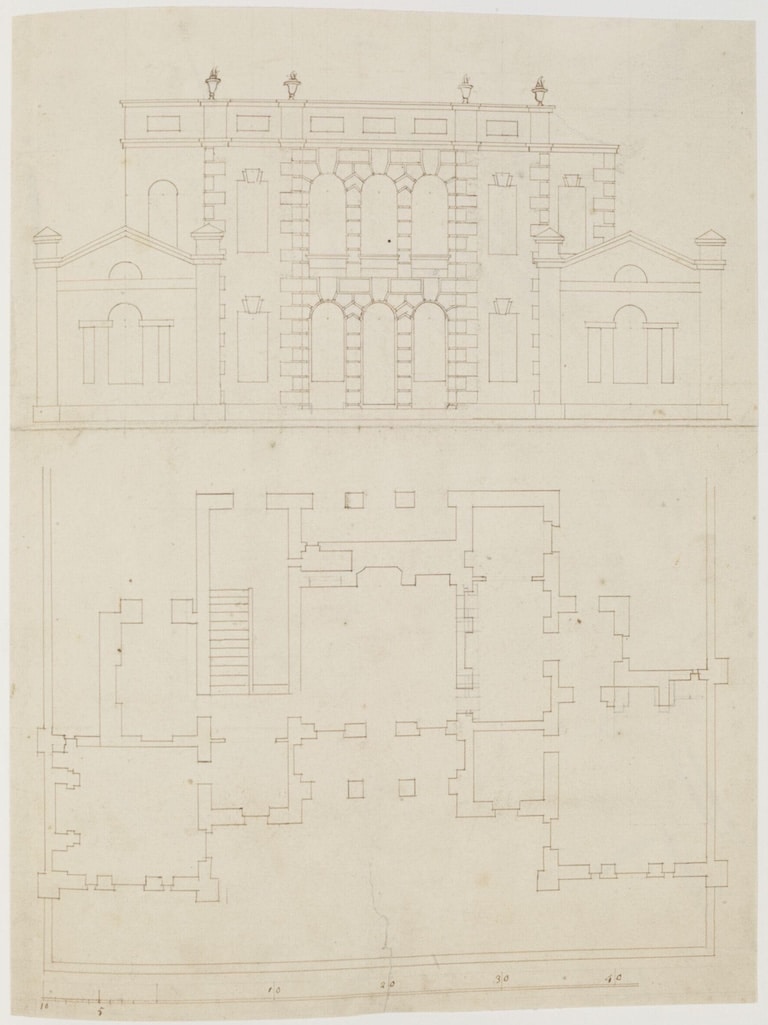
Below are a small number of drawings from the Victoria and Albert Museum’s collection made in the later part of Vanbrugh’s career. The drawings for Kimbolton Castle, Goose-Pie House, and the Temple at Claremont House are included in the exhibition at the Soane Museum.



*
Notes
- This article is an adapted version of a paper given at the New Insights on 16th and 17th Century Architecture in January 2024. I am very grateful to Olivia Horsfall Turner and Jenny Saunt for inviting me to give it, to comments on the paper, particularly those of Gordon Higgott and Elizabeth McKellar, and to much subsequent discussion with Roz Barr, co-curator of the exhibition John Vanbrugh: The Drama of Architecture at Sir John Soane’s Museum.
- Geoffrey Webb, The Complete Works of John Vanbrugh, vol.4, The Letters (London: Nonesuch Press, 1928), 4-5.
- West of Alscot Box 12, cit. Laurence Whistler, The Imagination of Vanbrugh and His Fellow Artists (London: Art and Technics, 1954), 35.
- Webb, Letters, 209.
- Whistler, Imagination of Vanbrugh, 35.
- Whistler, Imagination of Vanbrugh, 35.
- Whistler, Imagination of Vanbrugh, 36.
- Whistler, Imagination of Vanbrugh, 37.
- BL Add. MS 38056, f.101 reprinted in Whistler, The Imagination of Vanbrugh, 85.
- BL Add. MS 38056, f.101.
- Whistler, The Imagination of Vanbrugh, 89.
Charles Saumarez Smith is a freelance writer, curator and architectural historian. He is an author of books and articles, a lecturer, and a former academic. He has been chairman of The Royal Drawing School, and is currently a trustee of the Garden Museum and the Castle Howard Foundation. He is an Emeritus Trustee of ArtUK and Charleston, an Honorary Fellow of Christ’s College, Cambridge and an Honorary Professor in the School of History at Queen Mary University of London. His book, John Vanbrugh: The Drama of Architecture, was published in November 2025.
