Tracing Air with Light
When architects design buildings, they simultaneously construct environments for human habitation and activity. Whether through the warmth emanating from a hearth or the breeze generated by an air-conditioning unit, architecture is always implicated in the modulation of environmental conditions. However, environmental control—along with the elements that it seeks to temper—remains curiously elusive within architectural representations. Specifically, air—the quintessential substance that sustains life and supplies environmental comfort—remains invisible both in reality and in architectural drawings.
How to trace air in the built environment is a recurring question shaping our design practice. The aim is not merely to render air in a tangible form, but to make visible the often-overlooked conditions of architectural environmental control and their implications for spatial justice. It is by means of drawing, sometimes unconventionally, that we set out to investigate the architectural, political, and environmental dimensions of air as a material of design.
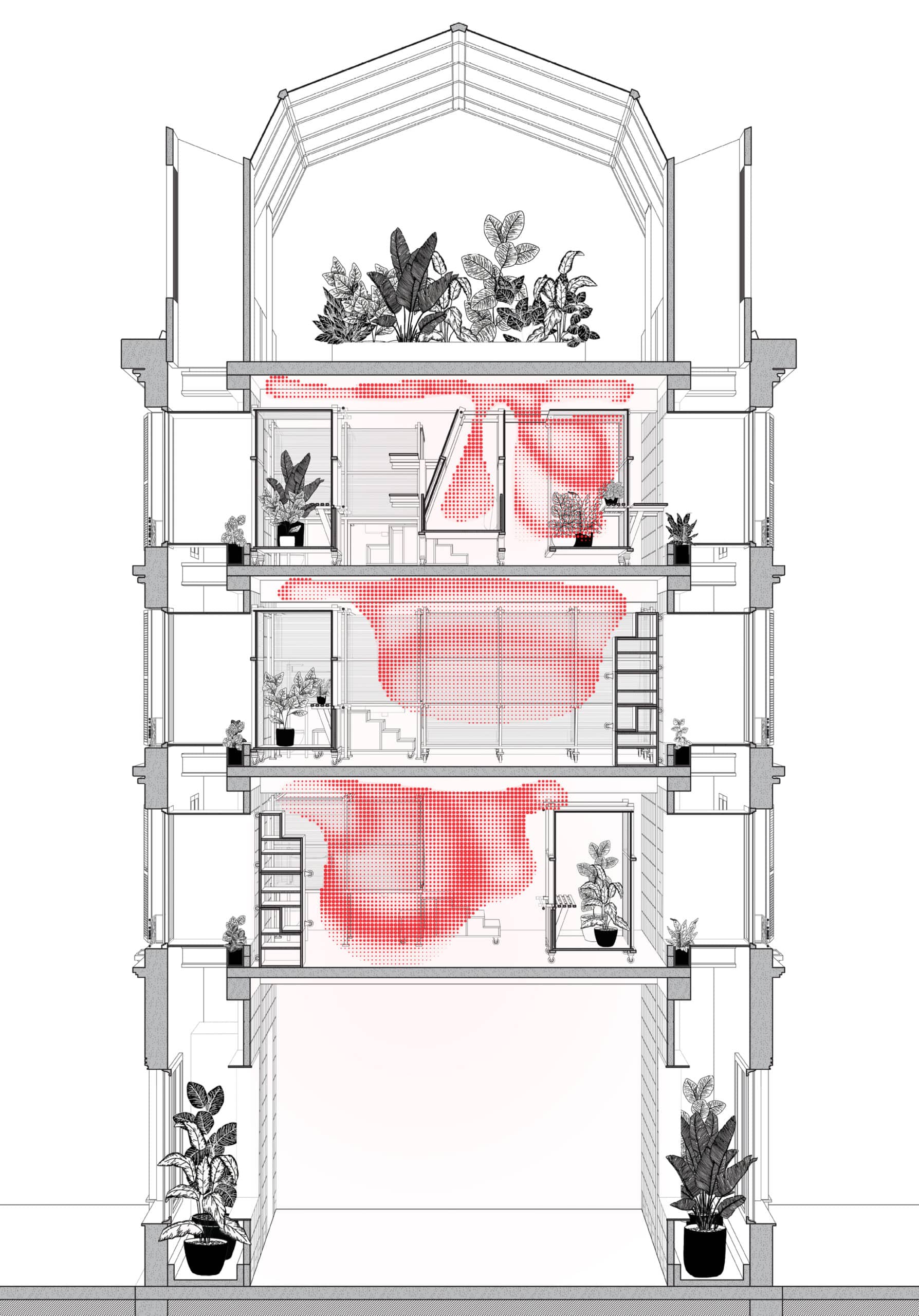
A Newer Domestic Landscape reclaims air from its traditional invisibility and positions its visualisation as a design tool. Seeking to investigate passive strategies of ventilation, the project centres on small-scale interior interventions represented through sectional perspectives. By extrapolating the behaviour of fluids across spaces of varying dimensions and connectivity, airflow is simulated in Grasshopper and subsequently represented through an overlay in the sectional drawings. Sight, a perception shaped by light, hence becomes an operative tool for exploring and communicating the spatial effects of these interventions on environmental design.
In The Weight of Clean Air, a project that interrogates the technologies of air filtration and their uneven global accessibility, the drawing process began with data mapping. Using a Grasshopper script that proportionally translates pollution levels into visual cones of corresponding height, we created a series of infographics that visualises a global survey of air quality.
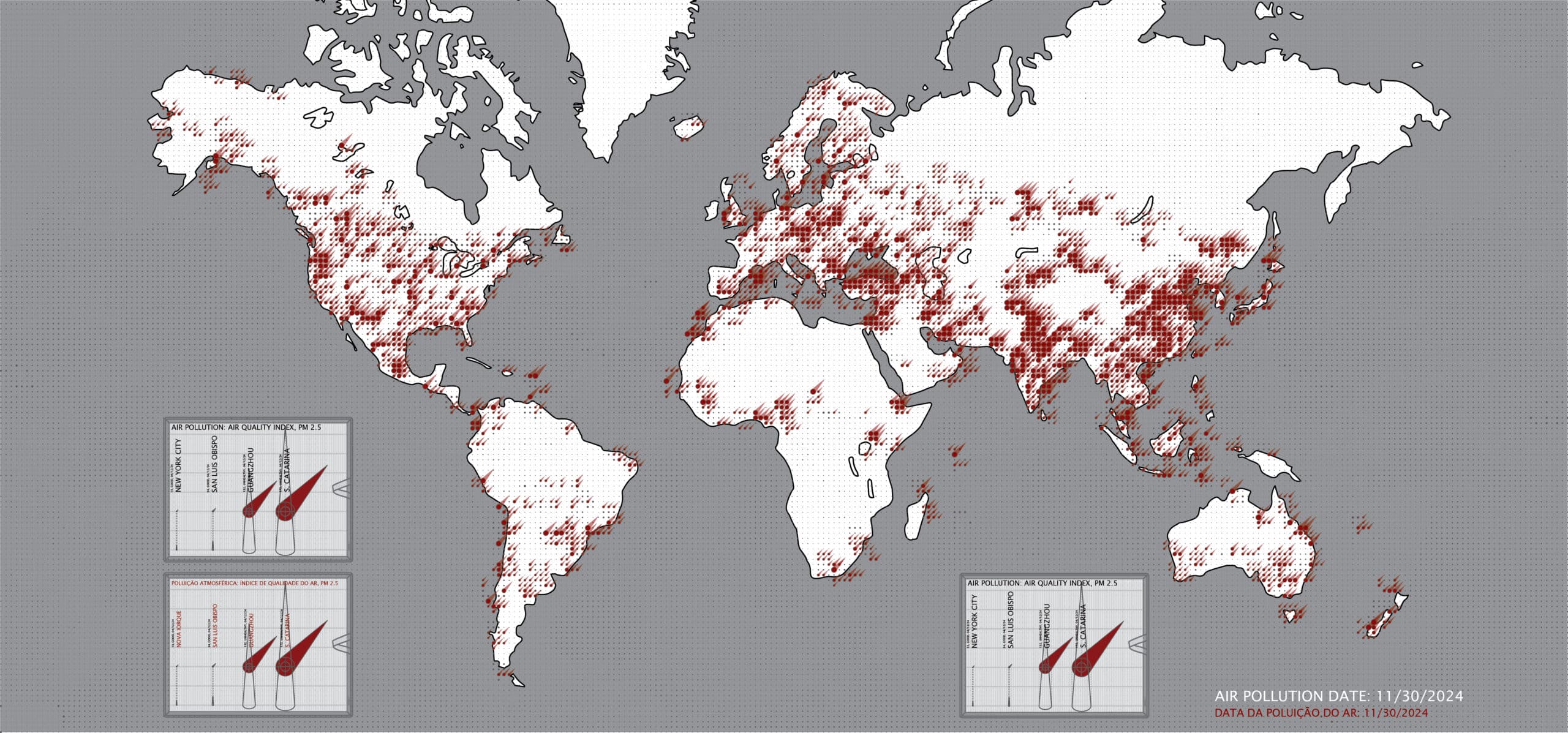
If the survey brings into view the preexisting context in which we build, the project further analyses the application of HEPA filters in creating mechanically tempered modern interiors. HEPA, abbreviation for ‘High Efficiency Particulate Air’ filter, was first envisioned as a military apparatus for protection against chemical and radiological warfare.[1] As the postwar building industry began appropriating it for civilian use, it was often relegated to the unseen domain of climate-control systems, concealed in basements, dropped ceilings, and wall pochés. Only on rare occasions of maintenance is the filter inspected and replaced. One might say that the filter becomes visible only at the end of its life cycle, when its dust-laden membrane reveals air as a physical matter: a substance whose circulation within architecture demands modulation. Given this context, we developed The Weight of Clean Air as a representation system that materialised the intangibility of airflow, visualised the unseen condition of environmental control, and foregrounded the hidden inequalities of material circulation traversing global geographies.
This representation system is grounded in a re-conception of drawing practices. Conventionally, architectural drawings are two-dimensional representations. By means of inscription (of ink or other materials on mediums such as paper), drawings document a stable condition of the proposed or existing environment. They fossilise a fleeting moment within the extended life of a building. However, when thinking of the distribution and circulation of materials such as air in the constructed space, we could not simplify the process into a fixed, singular snapshot. Rather, the process calls for a mode of representation that captures its intangible yet continuous transformation.
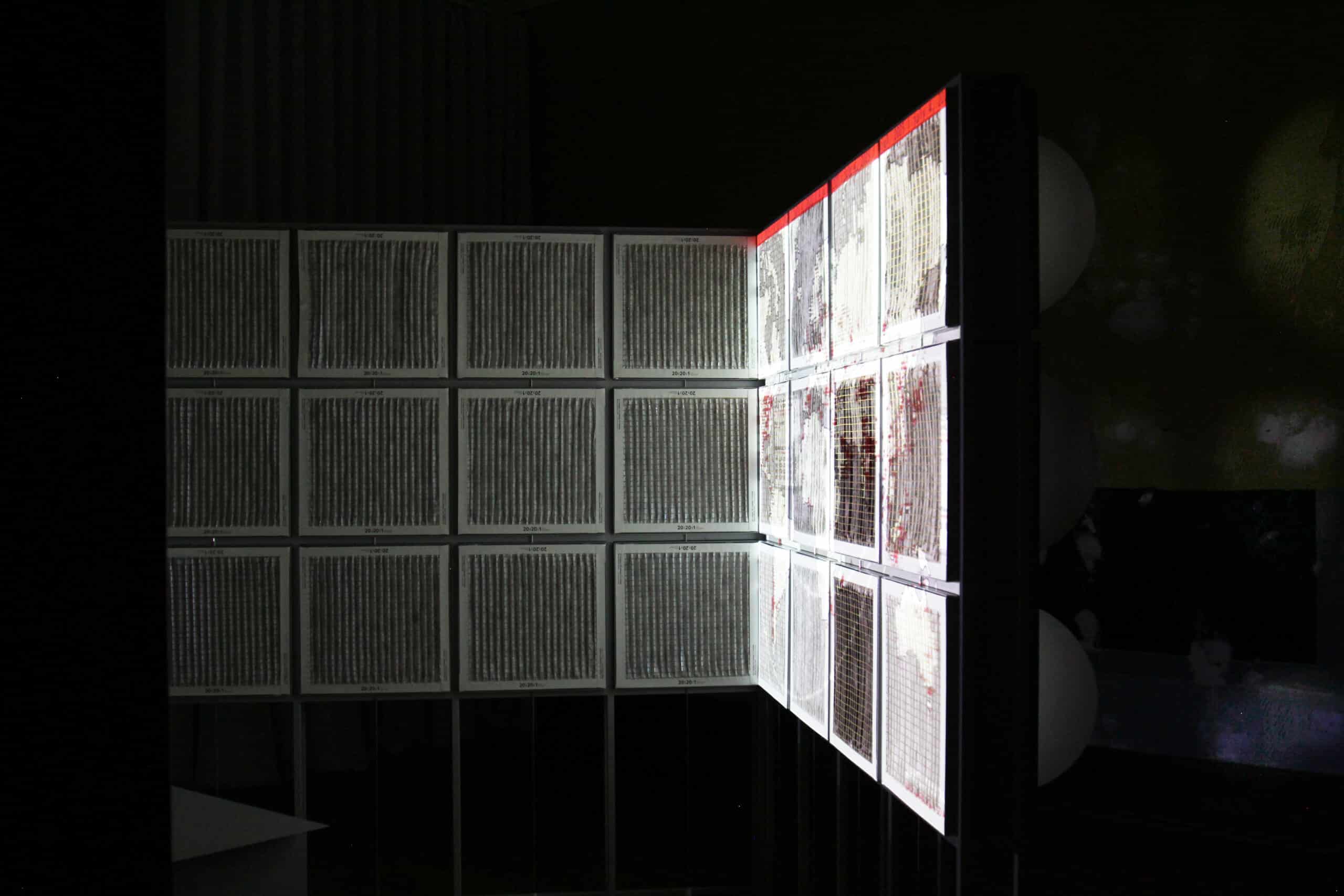
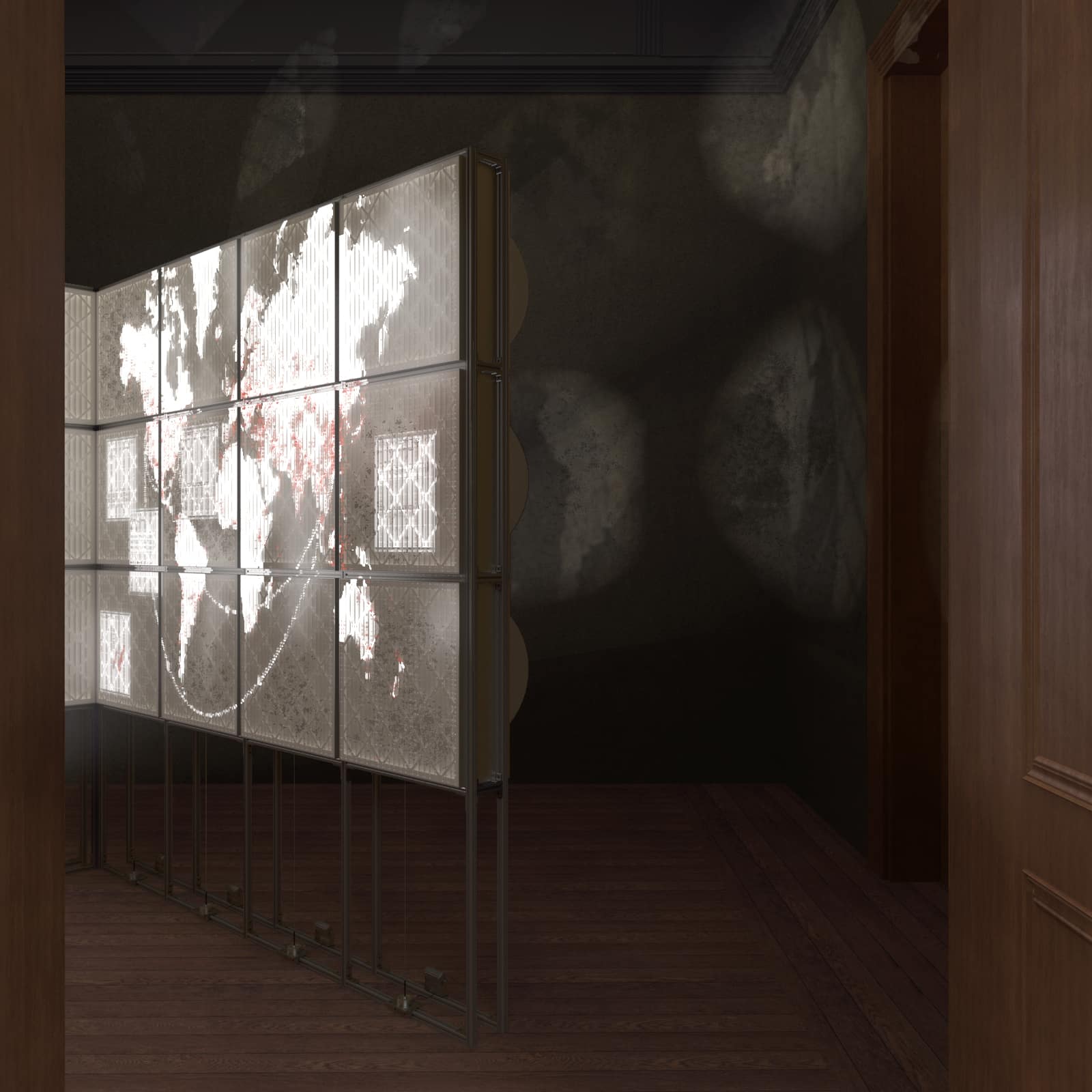
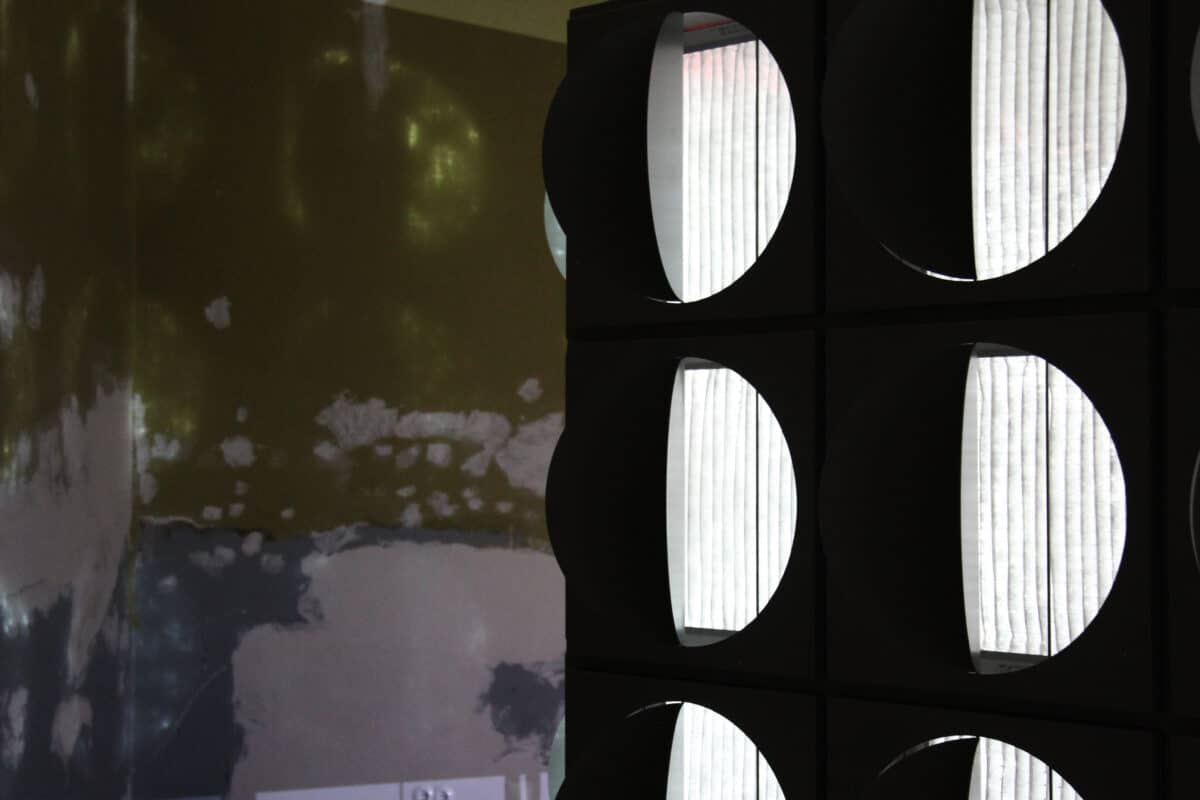
Bruno Latour was enchanted by the construction of linear perspective that—by means of materialising projection—connects two-dimensional figures with three-dimensional objects.[2] Subsequently, he argues that it is in the inscription of sight that mankind attains enlightenment.[3] Following Latour’s observation while activating contemporary technologies, we set out to create three-dimensional drawings that could render air circulation in both dynamic and perceptible forms. We constructed a projection screen through integrating HEPA filters with metal air ducts. Not all filters were new: several were collected from communities worldwide and bore traces of prior use. These filters registered not only particulate matter but also social inequality: the collected pollutants documented air quality along with access to air-handling technologies. A projection system named ‘aerographics’ was then introduced, using the Grasshopper survey as its visual content and the filter screen as its display surface. The system explored the parallel unidirectional movements of air through HVAC structures and of light through projection. It used the filtration of light to visualise the process of air purification. As the projected light passed through filters of varying used conditions, it produced luminous graphics of differing intensities on the gallery wall. This makes perceptible, through light, an atmospheric record of spatial inequities intrinsic to the everyday built environment. In this way, drawing became an operative performance, animating what is otherwise invisible.
‘A Newer Domestic Landscape’ was exhibited at The Biennale d’architecture et de paysage d’Île de France (BAP)! 2025. ‘The Weight of Clean Air’ is an Associated Project as part of the Lisbon Architecture Triennale 2025 – ‘How Heavy is a City’. These projects are designed in collaboration with Serena Liu and Jaehun Woo.
Notes
- Melvin W. First, ‘HEPA FILTERS,’ in Journal of the American Biological Safety Association, 3(1), 33.
- Bruno Latour, ‘Visualization and Cognition: Thinking With Eyes and Hands,’ in Knowledge and Society: Studies in the Sociology of Culture Past and Present, Vol 6 (1986), 1–40.
- Ibid., 7.
*
Xinyu Chen is a MPhil/PhD student investigating the intersection between architecture and digital theories at UCL’s Bartlett School of Architecture. She holds degrees from Princeton University and Rice University, and has taught at Syracuse University, Princeton University, and California Polytechnic State University.
This text is one of the selected responses to the second category of the Open Call 2025: Visibility, and the Unseen—a series of short contributions that either bring to the surface the unseen drawings within the Drawing Matter Collection (I. In the Archive) or explore original architectural drawings, created by the author(s) of the contribution, which make visible the unseen (II. In Practice).
