Drawing Motion as Thought
– MRND
A design (can) begin in the domain of the barely articulate, where drawing operates less as representation than as an instrument for sensing forces that precede form. The early sketches that remain unseen—those made without the burden of explanation—constitute a theoretical ground in which motion is not depicted but pursued. They function as analytic gestures that trace conditions architecture has not yet stabilised: turbulence, drift, hesitation, the minute oscillations of a boundary deciding its future permeability. To draw in this mode is to engage with phenomena that resist the fixity of conventional representation. The line becomes an event rather than a contour, a registration of time rather than of space.
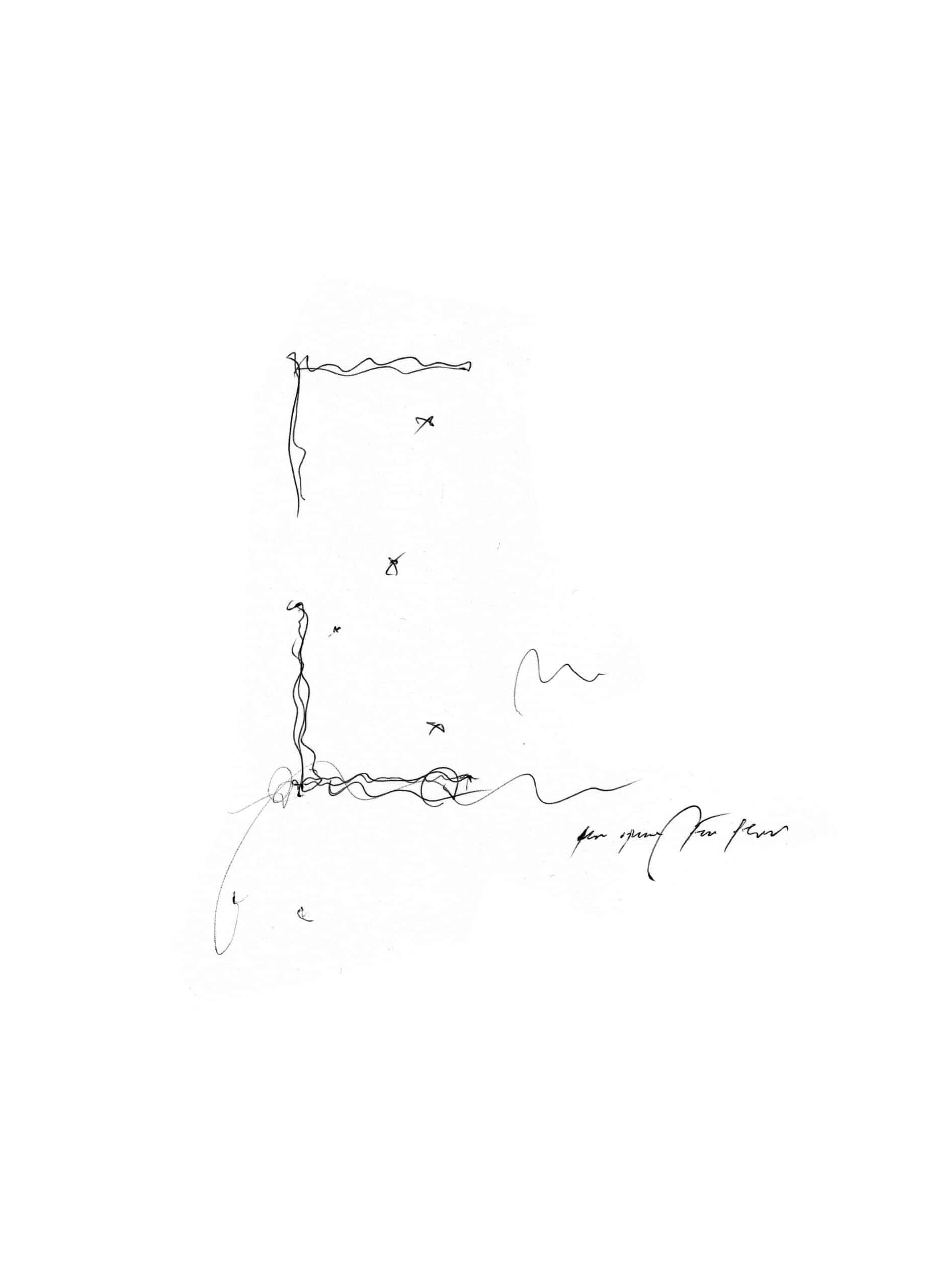
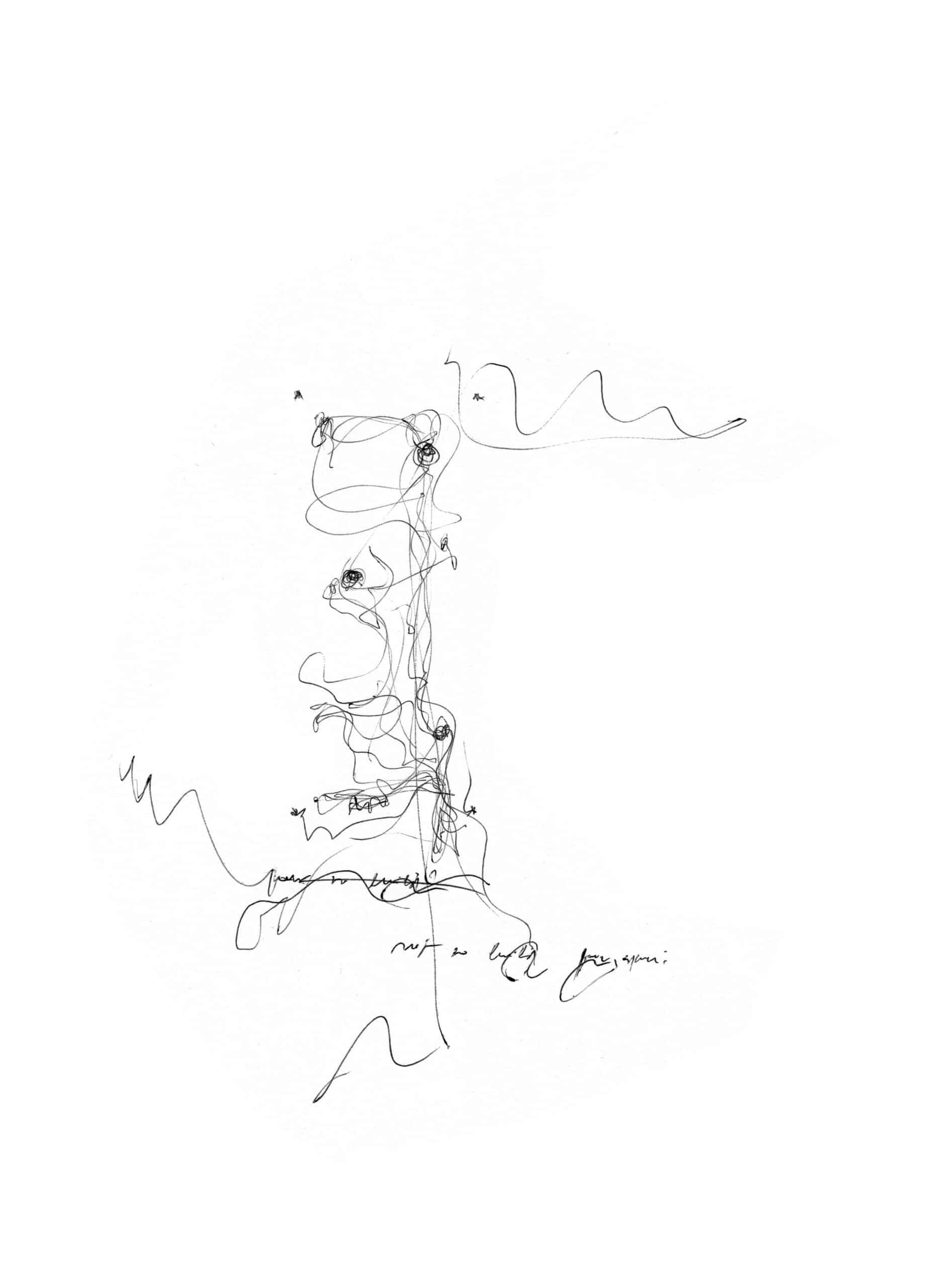
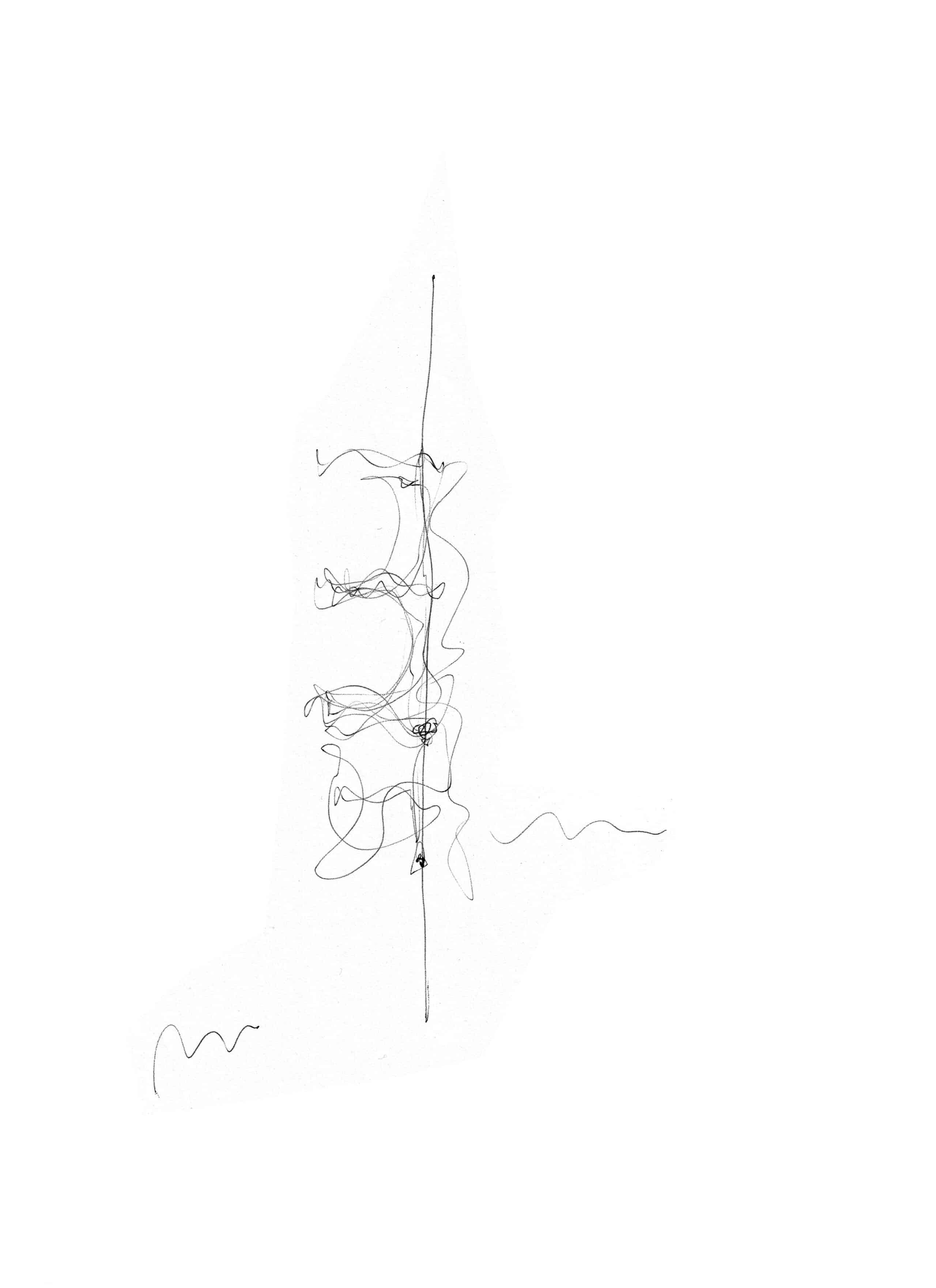
These drawings emerge precisely from this theoretical register. Their marks do not describe objects: they articulate intensities. In one, the line trembles along the edge of an implied frame, refusing to settle into enclosure. In another, movement coils into itself, generating vortices of potential rather than legible shapes. A third drawing traces a vertical pull around which small disturbances gather, forming knots of activity that suggest a choreography rather than a structure. These drawings operate as studies of motion in its (naïvely named) pre-architectural state—notations of forces whose presence precedes any spatial decision (or even their representation). They are concerned less with form than with sensing behaviour.
To draw movement is to acknowledge that a design (or architecture?) is constituted not only by material boundaries but also by temporal fields. Air currents, the pacing of bodies, the slow modulation of light: such elements are not external conditions but intrinsic components of spatial experience. Yet conventional drawings exclude them, privileging static clarity over dynamic complexity. The unseen drawings produced in early design work resist this exclusion by insisting that the intangible is architecturally generative. They treat motion as a legitimate subject of inquiry—a phenomenon with structure, density and direction, even when that structure remains unstable. Their theoretical value arises precisely from this instability: the drawing becomes a site where the imperceptible acquires provisional visibility.
The line tests what cannot yet be measured, cultivating a sensitivity to fluctuations that will later shape the built proposal. These gestures are not preliminary versions of a final image but records of perceptual calibration. They train attention on forces that will determine how a space behaves once it exists—its atmospheres, its thresholds, its capacity to host movement without prescribing it. The design project that follows thus inherits not a fixed form but a set of dynamic tendencies encountered first as marks on paper.
What remains unseen in practice is therefore not peripheral but foundational. These drawings form a critical layer of architectural research, one that operates through temporality, gesture and the pursuit of the inchoate. Their theoretical significance lies in how they expand the remit of drawing beyond depiction, positioning it instead as a medium through which architecture engages with motion as an ontological condition. In the quiet immediacy of these marks, the project begins—not through the definition of space, but through the tracing of forces that ultimately give space its capacity to move and to be moved.
*
MRND is an atelier that aspires to disseminate, represent, and contaminate space, experience, and matter.
This text is one of the selected responses to the second category of the Open Call 2025: Visibility, and the Unseen—a series of short contributions that either bring to the surface the unseen drawings within the Drawing Matter Collection (I. In the Archive) or explore original architectural drawings, created by the author(s) of the contribution, which make visible the unseen (II. In Practice).
