The House Without Character
– Christian Schweitzer and Ryul Song
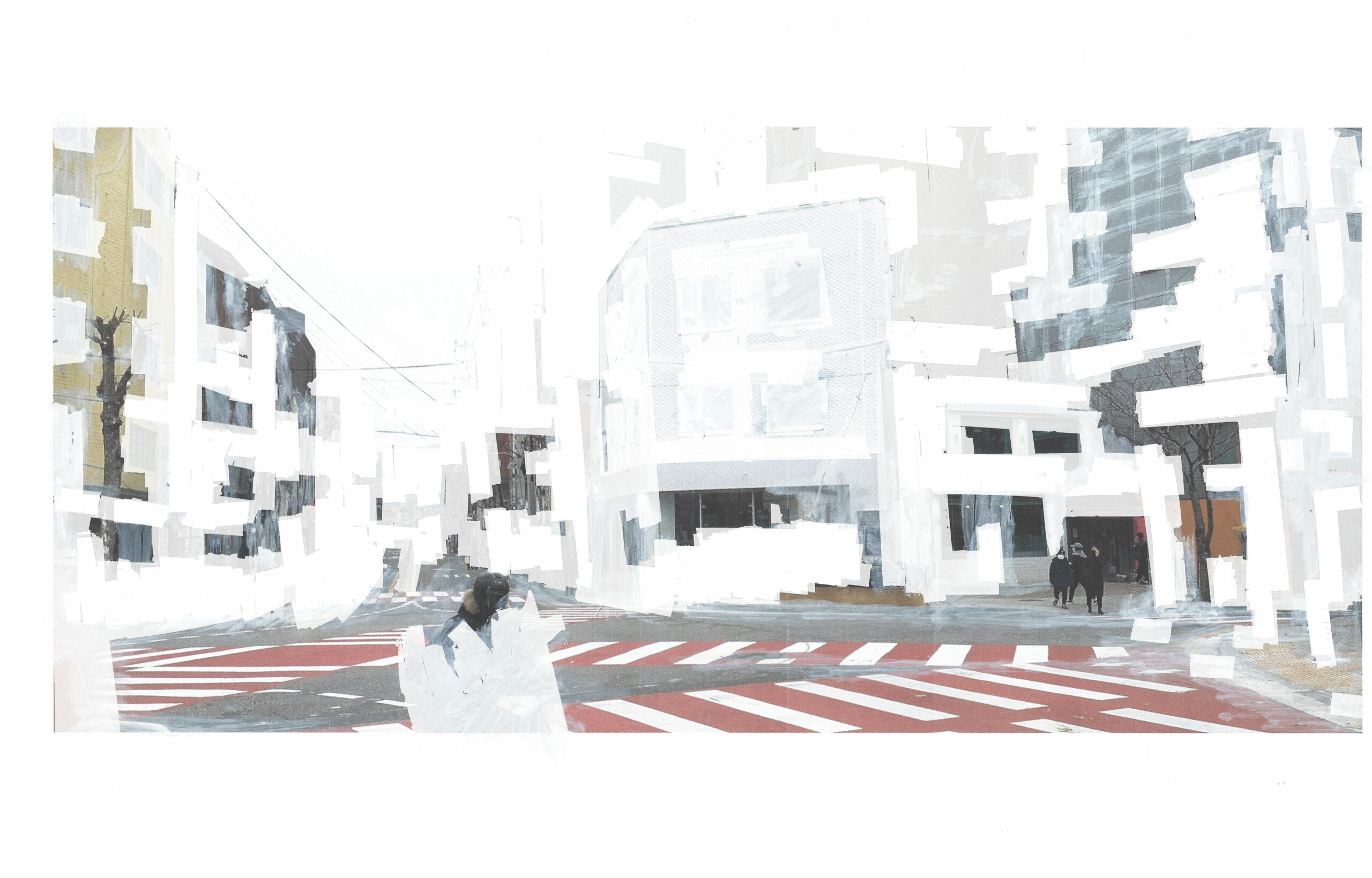
Ever since I first encountered Arnulf Rainer’s Overpaintings in an exhibition, I was captivated by them. In 1954, he started to draw with oil crayons over photographs of himself, directly and spontaneously reacting to his own image. They are extremely powerful and honest, revealing a fundamental truth that photography on its own could never evoke. They come from the deep subconscious, raw emotions captured and visualised.
From early on, we have utilised this potential in our own work by painting over site plans or site photos, spontaneously and without aim, and reacting to what they tell us. This process allows us to discover aspects in a design task that the conscious mind cannot. This result is not coincidence or random: our reactions are informed by our subconscious. Everything that formed us as design personalities is brought to the surface when we respond to the overpainted images in front of us.
When approaching design, architects rely on knowledge, education, experience, research, and our capacity to solve problems. We base our decisions for a specific task on our belief systems, on what is right or wrong, good or bad. The design is formulated on a conscious level, where we rationalise what we are doing. However, not every decision in design can be rationalised; sometimes we just know something is right. Let’s call it a hunch, a feeling, or instinct. This deeper knowledge is formed by socialisation, cultural imprint, past experiences, and knowledge not directly related to architecture—memories, personal preferences, taste. This also works in the other direction: something is missing and we cannot put a finger on what it is; we are unsatisfied with the outcome of a design although all conscious decisions were correct.
These two aspects of the conscious and the subconscious are in constant negotiation during the design process until all the gaps in conscious knowledge are filled with rationalised ‘feeling’, with the subconscious lifted to the fully conscious level. The very last remaining questions are swept away with the argument: ‘because I like it’.
But there is also a deeper aspect of the subconscious, parts of our personality shaped by trauma, anxiety, fears, hurt, desires, sexuality, urges, pathologies; feelings that Arnulf Rainer tapped into but we as architects reject as the basis for design decisions because we consider them too personal. We question their relevance for problem solving, as they cannot be generalised to serve everyone affected by the design outcome. However, through exploring this deeper subconsciousness, we can unveil and acknowledge crucial parts of our design personalities.
The following text is an attempt to describe this very personal architecture. It filters out any aspects of conscious knowledge about architecture, instead dipping into the raw emotion behind how our ideal city, house, space should manifest to counter our anxieties and to give into our desires.
*
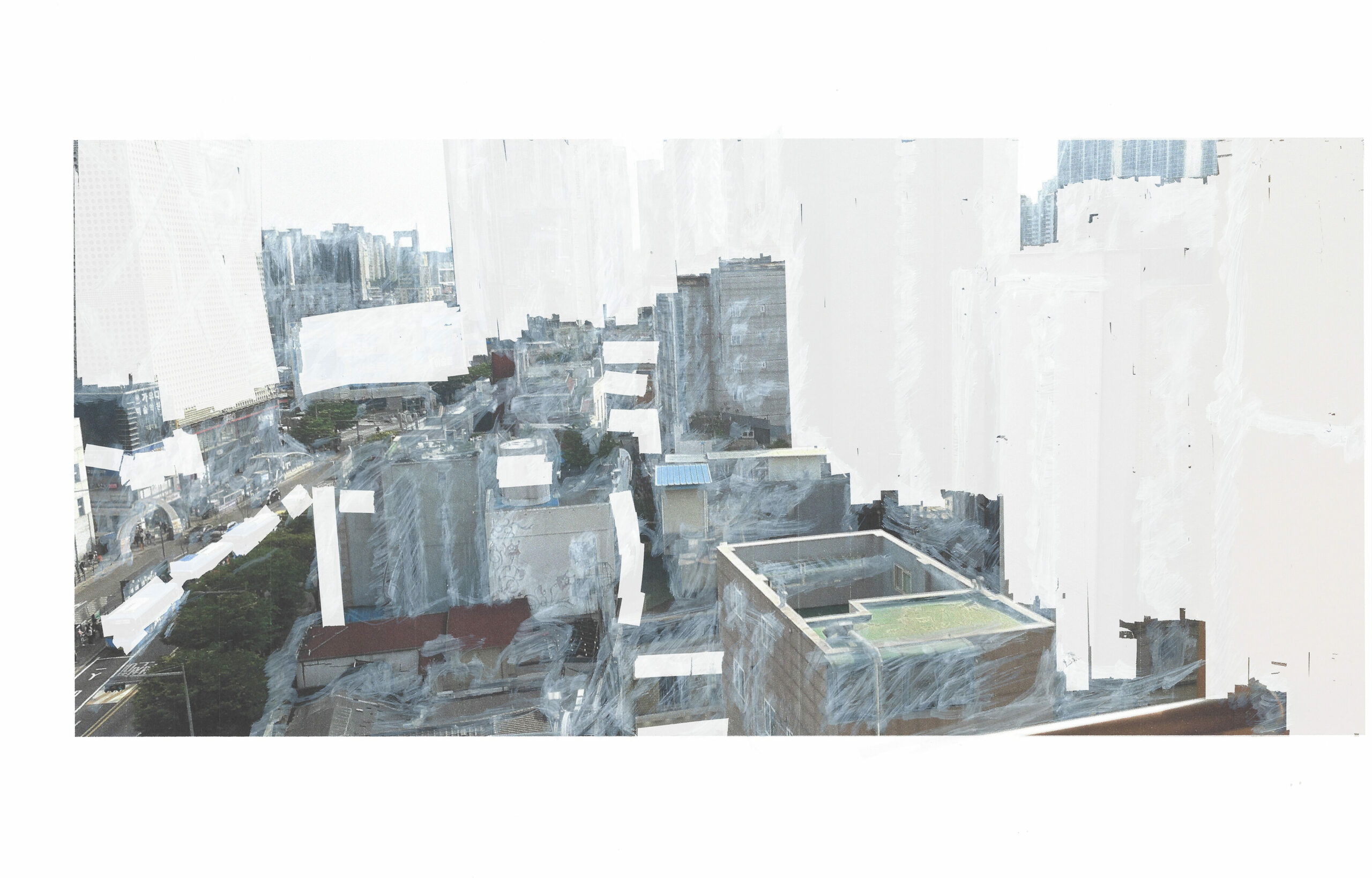
The city screams. It is crazy, I am going crazy. There is clamor in every corner. The sound of cars, motorbikes, and ripping music, billboards, the identical apartments, disorientating roads, garbage, advertisement, acrid air, excessive announcements that make you feel like living in an oppressive state, too much brightness. A city where the lights, the building decorations, the madness, the vulgarity, the wide roads, the shouting, the rudeness, the smell, the crowds, the people roar. So I erase them one by one. I erase them to be able to breathe, the relief I feel when erasing with correction tape and correction fluid.
I want to erase the city, cover up, conceal, wipe out, smudge, paint over, blur out. All the dirt and noise and light, all details and banalities, inconsiderate behavior and reckless conduct. The endless banality, the sameness which is believed to be special. The special, that never wasted a single thought, except on itself. The unremarkable, that never wasted a single thought, not even on itself. I want the city to leave me alone. I don’t want it gone; I need the city to be reminded that I am still alive.
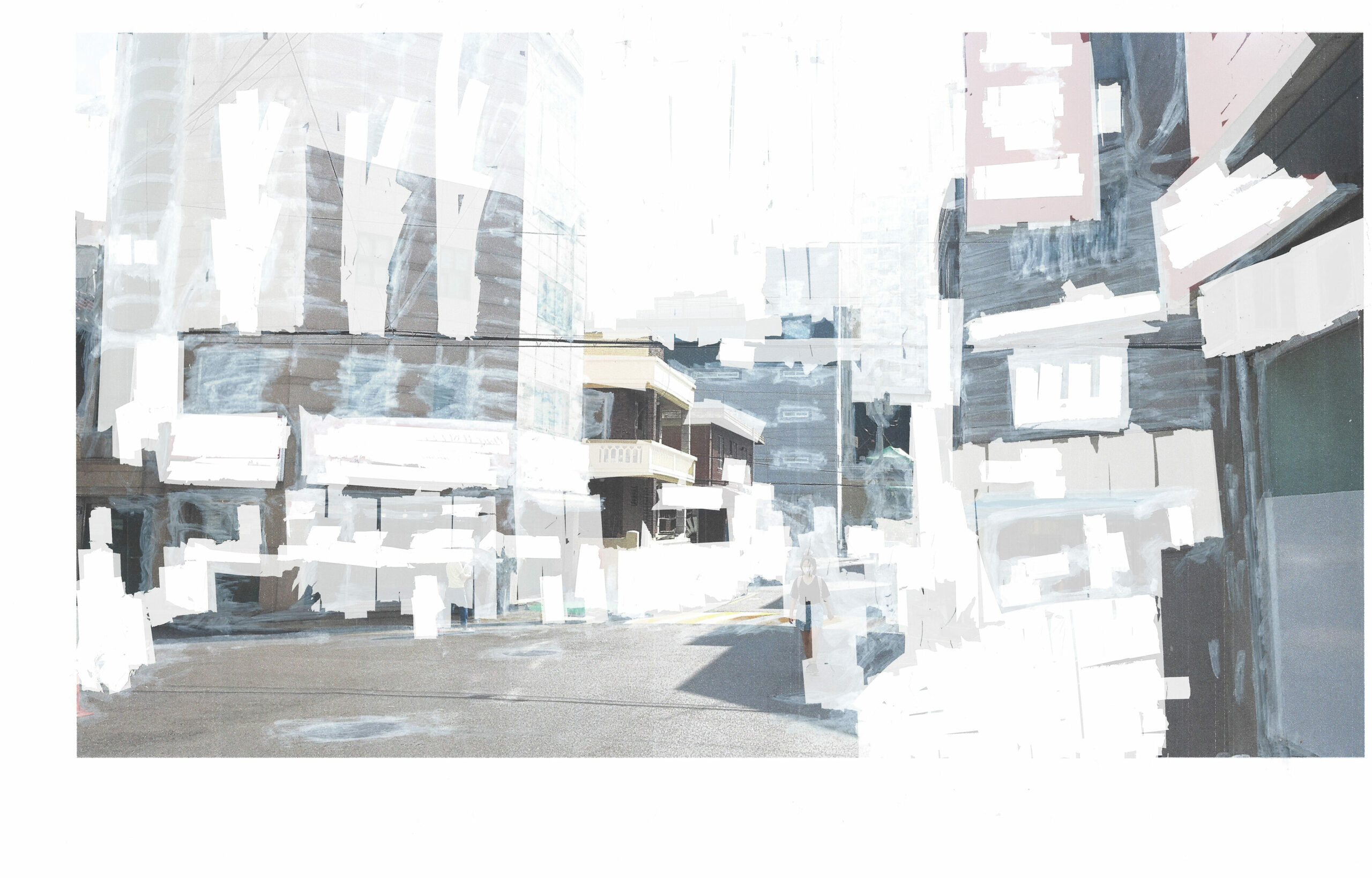
The house of confusion. It is scary to imagine what is going on behind the suspended ceiling; a dead rat might be rotting there. The boiler is leaking, the water pipes freeze, I check the gas switch countless times, the smell of scorching plastic and dust from overheating electrical wiring. The house is full of danger, this is where the red warning light reigns. It won’t be easy to live here without becoming schizophrenic.
I want a house without character in the city I want to erase. Without any qualities, forgettable in an instance, undistinguished. When passing it, one doesn’t realise it’s there, nothing raises the eyes, nothing attracts attention. And if one should by accident glance over it, nothing leaves any impression, it never reaches the consciousness. Later one will not remember that anything was there, nobody ever gets aware of it.
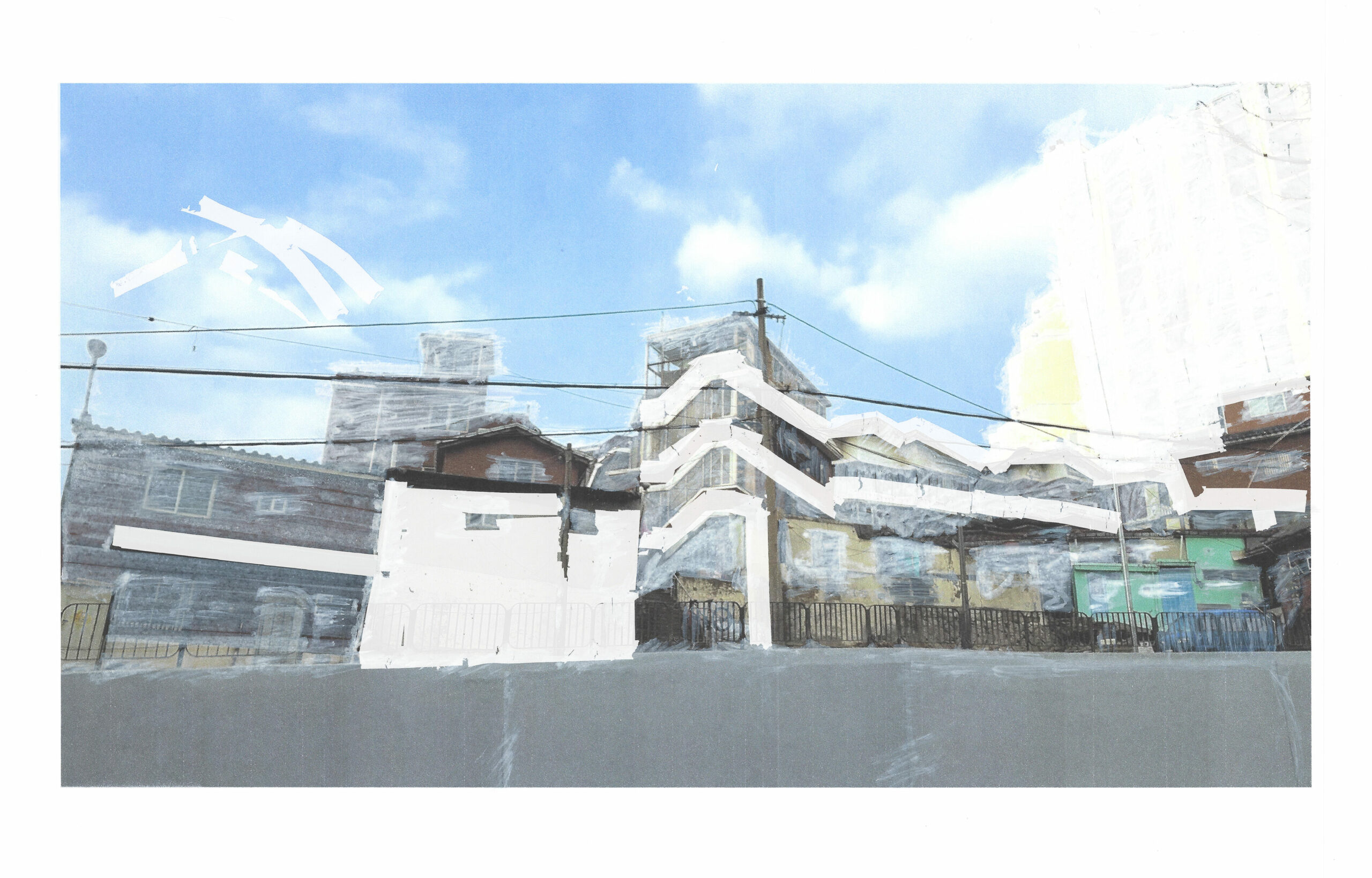
I want a house one cannot focus on, no detail that stands out, blurry, with indistinct outlines, like a fog in the city that soups everything into each other. I want a house that protects me, that secures me my place and cannot become part of the worries. I need it obscured so it cannot be taken away from me.
I want to disappear completely in a house without character in the city I want to erase. With thick soft walls that absorb everything like a sponge that comes from the outside, dirt, noise, obligations, responsibilities, anxiety, the pressure on my chest. I don’t want to hear anything from the city, except its background humming, because I need to know that the city I want to erase is still there.
The rooms in the house without character in the city I want to erase should have no corners that can accumulate dust, no distinction between walls, floors, ceilings. A singular surface that encloses everything. With no joints, no seams, no material change, no layers, no finishing, no paint. Nothing that can peel off, nothing hollow, nothing that has a behind or an in between. Water and heating pipes, electricity cables, downpipes should be visible, so they can be repaired easily without having to touch the house. Nothing that could raise any concern, that can break, that can crack; freestanding, exchangeable, removable without leaving a trace that it was ever there.
I erase the books on the bookshelf because I want to see everything empty. I want a refrigerator that is empty. When the refrigerator is empty, I keep opening and closing the door to see the empty space. I want a dresser that is empty. I keep opening the drawers to see the empty space. I am moved by seeing the drawers empty. Empty drawers convey emptiness much more strongly. I want the house to be empty, so nothing can be taken away from me.
I want to erase my room. I want to be someone who doesn’t need anything. I want to feel the overwhelming joy of being in an empty space after emptying everything. I just wish there was a small empty room that nobody knows about so it cannot be taken away from me. An empty room is absolute relief.
*
Ryul Song and Christian Schweitzer are architects, educators, and writers based in Seoul, Korea. Through their practice, SUPA Song Schweitzer, they work at the intersection of conceptual design, architecture, art, and theory. Song teaches at Korea University, Seoul, and edits SUPTEXT magazine Schweitzer teaches at Hanyang University, Seoul, and co-founded the Ernst May Museum in Frankfurt.
This text is one of the selected responses to the second category of the Open Call 2025: Visibility, and the Unseen—a series of short contributions that either bring to the surface the unseen drawings within the Drawing Matter Collection (I. In the Archive) or explore original architectural drawings, created by the author(s) of the contribution, which make visible the unseen (II. In Practice).
