Thalia & Melpomene
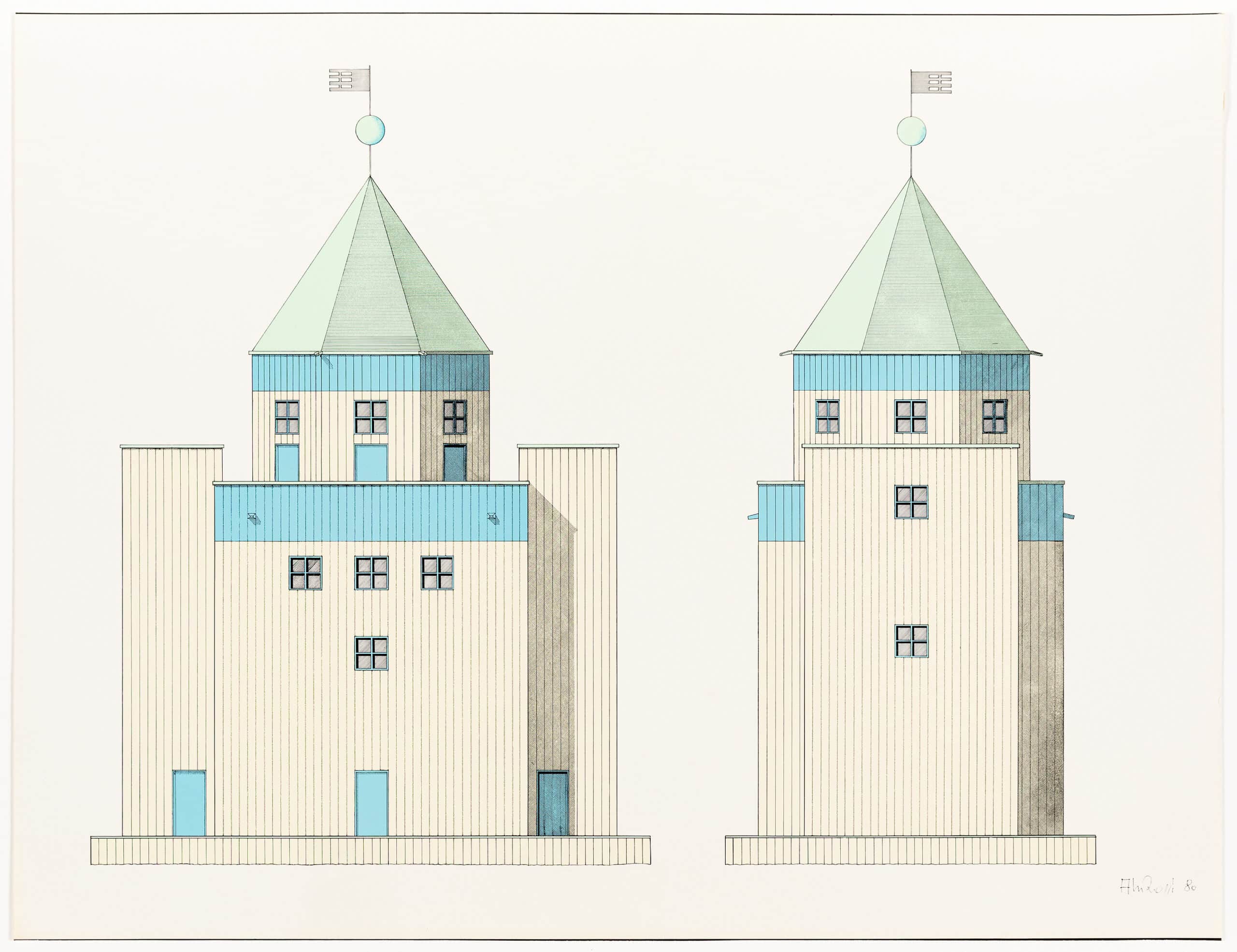
It floats: Amid the haze, like a game or a dream, over an invented geography, toward the Grand Canal, the Po, the Paraná.
Il Teatro del Mondo sways to nature’s rhythm.[1] Square in plan, it recalls both the Venetian carnivals and Shakespeare’s Globe. An entrance door on each side and vaporetti in the windows. Two staircases at its sides and a series of upper galleries rising to an octagonal drum. From the dome one can see Piazza San Marco and Santa Maria della Salute. The horizon too, and San Cataldo.[2] Water as the foundation and destiny of a laconic symmetry.
Four slender legs support a sturdy top. A black-alder tola occupies the centre of the rectangular stage—a market without fruit or a boat without sea.[3] Cigarettes, a coloured pencil, and a small round glass jar filled with caìgo, the lagoon mist.[4] On the left, an almost-blue notebook and two ballpoint pens. On the right, atop a portable hotplate, a portable architecture: a thin golden plinth supports a cylindrical base, silver and gleaming. A barely perceptible line separates it from the rest of the body, slightly taller but of the same diameter. Two appendages: one triangular, the other at a right angle. As a crowning element, poised above a simple cap, a perfect sphere, perhaps the moon.
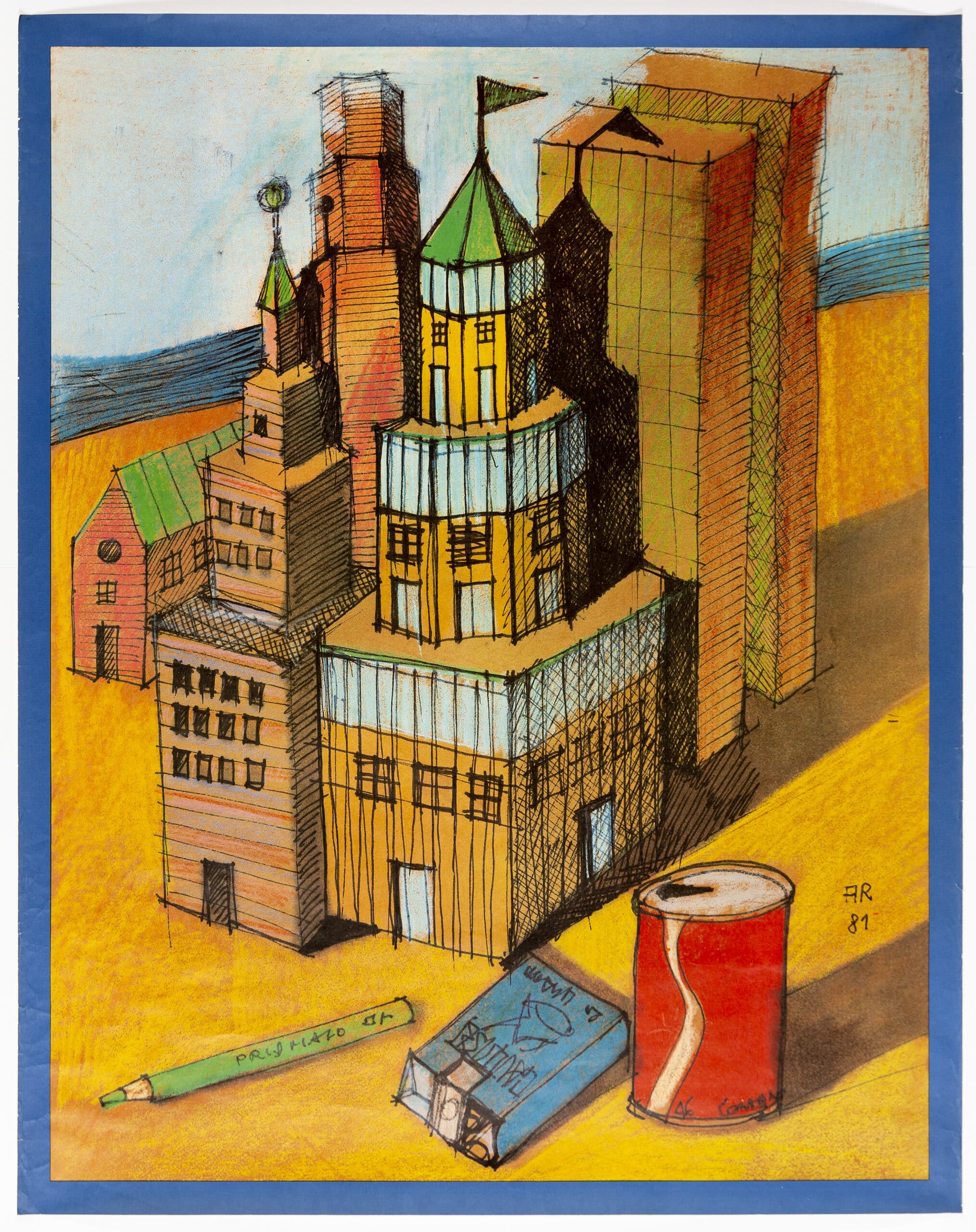
La Conica coffee maker.[5] Alessi, 1984.
Aldo Rossi writes:
November 1978, first trip to Argentina.
Peugeot in ’61.[6]
The Architecture of Buenos Aires.
La Escuelita.[7]
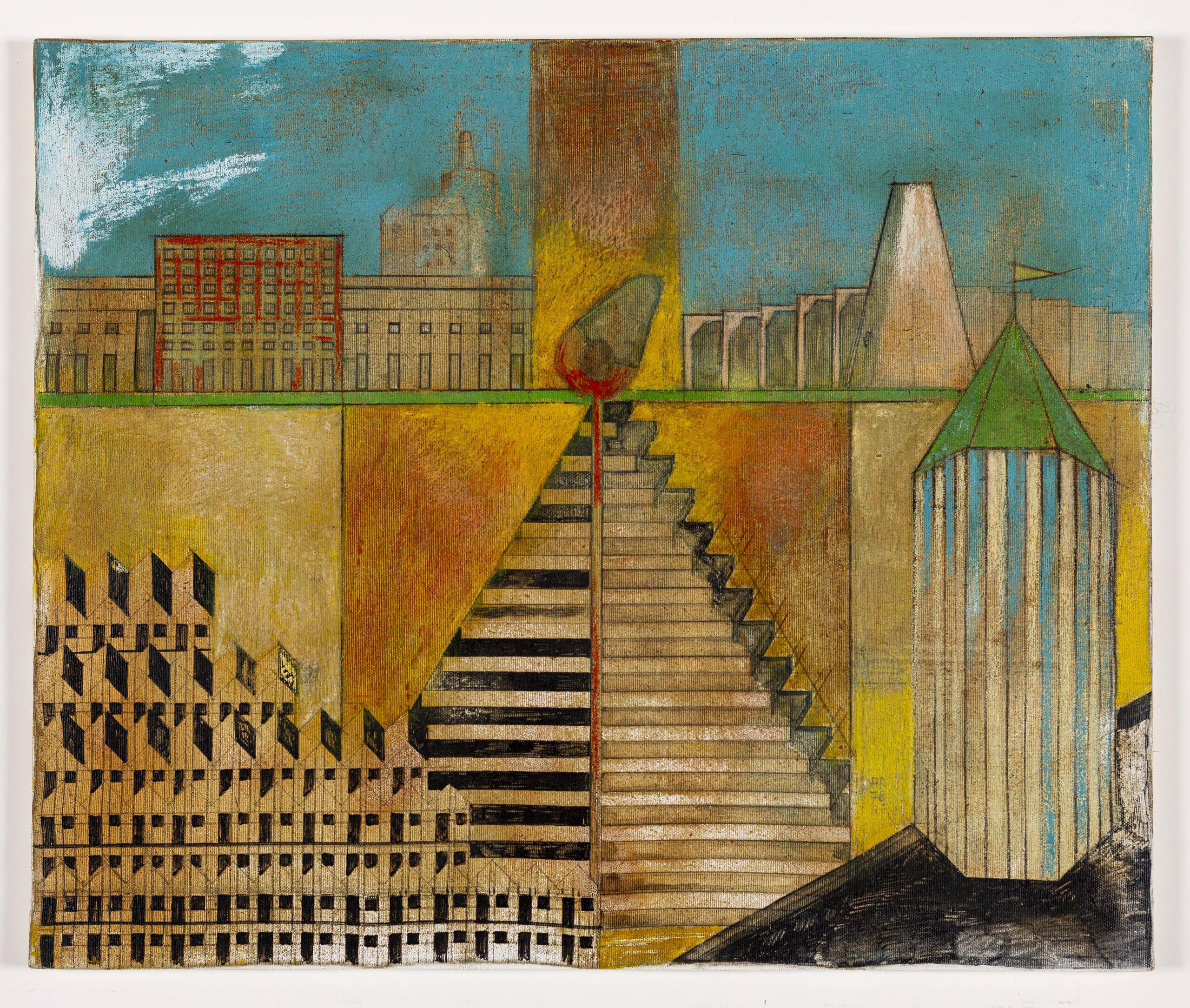
What, then, would a democratic staircase be like?[8]
Paraná Delta, evocation of the Po; heaven and hell.
The room of Lugones, the poet, at El Tropezón, Tigre Delta: the embroidered sheets, the mirror, and the flowers; moving beauty abandoned by life.
Listen: whisky, cyanide, and a gold watch; still life of a death.
Jesuit missions. Ouro Preto. Congonhas.
Above the door hangs a brightly colored Teatrino; its interior reproduces in miniature the scene of its predecessor.[9] A black pennant flutters on its tympanum and, on the front, a tiny hourglass turns: a condemned dune.
Aldo Rossi writes:
October 1982, second trip to Argentina.
La Escuelita.
The Architecture of Córdoba.
Uruguay, Chile & Peru.
Remember ’78.
The masks sway too.[10]
Are they the same force?
The coffee maker has heated up, and a thick liquid begins to spurt from the column, pushing out a faint steam coiled like a snail. He lowers the metal cap and turns off the heat. The aroma takes over the room; it smells of azahar and saffron.
Aldo Rossi writes:
December 1983, third trip to Argentina.
Techint, Santa Catalina. Buenos Aires: an architecture full of quotations.[11]
Complete the cemetery.
Plaza de Mayo, December 9.
Are they the same force?
Upstream, before the Mincio flows into the Po, a limonaia: on stone terraces, a series of pillars protect the lemon crop. From April to October, a colonnade; in November, citrus shelter.
Aldo Rossi writes:
write in order to make architecture.
He has set the pen down on the table and now pours two small cups: one for himself, the other for Rossi. A cloud has formed above the coffee. Both remember the same thing. Scenes from the ’71 accident in Yugoslavia survive: the hospital, the window, and the garden; then the scientific recovery, the journeys, and the little schools. Other scenes supervene, seeming to come from the future: the autostrada north of Milan, the screech of tyres, the wall.[12]
Ten days that seem to float. Coma.
He takes one final sip, then holds the jar in his hands. He opens it with a sharp twist of the wrist, and the mist escapes.
Notes
- Aldo Rossi, Teatro del Mondo, Venice, 1979. Metal scaffolding structure on a floating pontoon, clad in wood, built in a shipyard and towed to Punta della Dogana for the 1979/1980 Biennale. It was later moved to Dubrovnik and dismantled. In 2004, a reconstruction was built in Genoa when the city was European Capital of Culture.
- Modena Cemetery, San Cataldo. Cmpetition won in 1971 together with Gianni Braghieri. The project occupied him until 1984 and was never completed as planned.
- Tola: from the Venetian tola, table (from tavola). Black alder (Alnus glutinosa) is a riparian wood traditionally used for Venice’s pilings because of its resistance to water once submerged.
- Caìgo: from Venetian for lagoon mist.
- La Conica: espresso coffee maker for Alessi. Rossi developed the design between 1980 and 1984, and production began in 1984; it is made of stainless steel with a copper base.
- In 1961, Rossi, together with Vico Magistretti and Gianugo Polesello, entered the International Competition for the Peugeot Skyscraper in Buenos Aires. Promoted by the Foreign Building and Investment Company and organised by the Sociedad Central de Arquitectos—its first international call—it attracted 866 registrants and 226 preliminary designs submitted from 55 countries. The jury comprised Marcel Breuer, Affonso Eduardo Reidy, and Alberto Prebisch. The Brazilian team of Plínio Croce, Roberto Aflalo, and Gian Carlo Gasperini won with a sixty-story tower on Libertador, opposite Retiro, which was never built.
- La Escuelita was an alternative architectural teaching initiative, active from 1976 to 1983, organised in Buenos Aires after the military intervention in the FAU (now FADU). Its organisers included Tony Díaz, Ernesto Katzenstein, Justo Solsona, and Rafael Viñoly; Francisco Liernur and Eduardo Leston led studios. It hosted invited foreign teachers, among them Aldo Rossi, who gave a seminar in November 1978 and returned in October 1982. See La Escuelita 1976–1983, UTDT, Buenos Aires, 2025.
- Rossi’s reply to Marina Waisman (Buenos Aires, 1920–Córdoba, 1997), editor of Summarios, who months earlier had challenged the Rossian conception of type in her journal, pointing to similarities between that architecture and that of totalitarian regimes.
- Aldo Rossi, Teatrino scientifico, 1978. Miniature theatre with an interchangeable stage, made with Gianni Braghieri and Roberto Freno. Wood, metal, and paper, 800 × 675 × 545 mm. Musée National d’art Moderne, Centre Pompidou, Paris; gift of the architect, 1992, inv. AM 1992-1-14.
- Thalia and Melpomene: muses of comedy and tragedy; the masks representing them are the attribute through which they enter the theatrical frontispiece in classical iconography.
- See Aldo Rossi, La memoria de mis proyectos (Barcelona: Puente Editores, 2024).
- Rossi was involved in two car accidents. The first occurred in 1971, on the way to Istanbul: he was then working on his proposal for the Centre Pompidou competition, which the crash prevented him from submitting only weeks before the deadline; he recovered in a small hospital in Slavonski Brod, then in Yugoslavia. From that ground-floor room he remembered a window, the sky, and a small garden. There, while convalescing, he turned to the competition for the extension of San Cataldo Cemetery: ‘Perhaps as a result of this incident, the project for the cemetery at Modena was born in the little hospital of Slawonski Brod, and simultaneously, my youth reached its end’ (Aldo Rossi, A Scientific Autobiography, trans. by Lawrence Venuti (Cambridge, MA: MIT Press, 1981, 11). The second accident occurred twenty-six years later while he was travelling to his country house and cost him his life: he died in Milan on September 4, 1997, after spending ten days in a coma.
*
Roberto Cides, architect, lives and works in Buenos Aires.

– Rosie Ellison-Balaam and Nicholas Olsberg