The ‘Typewriter’ Drawing
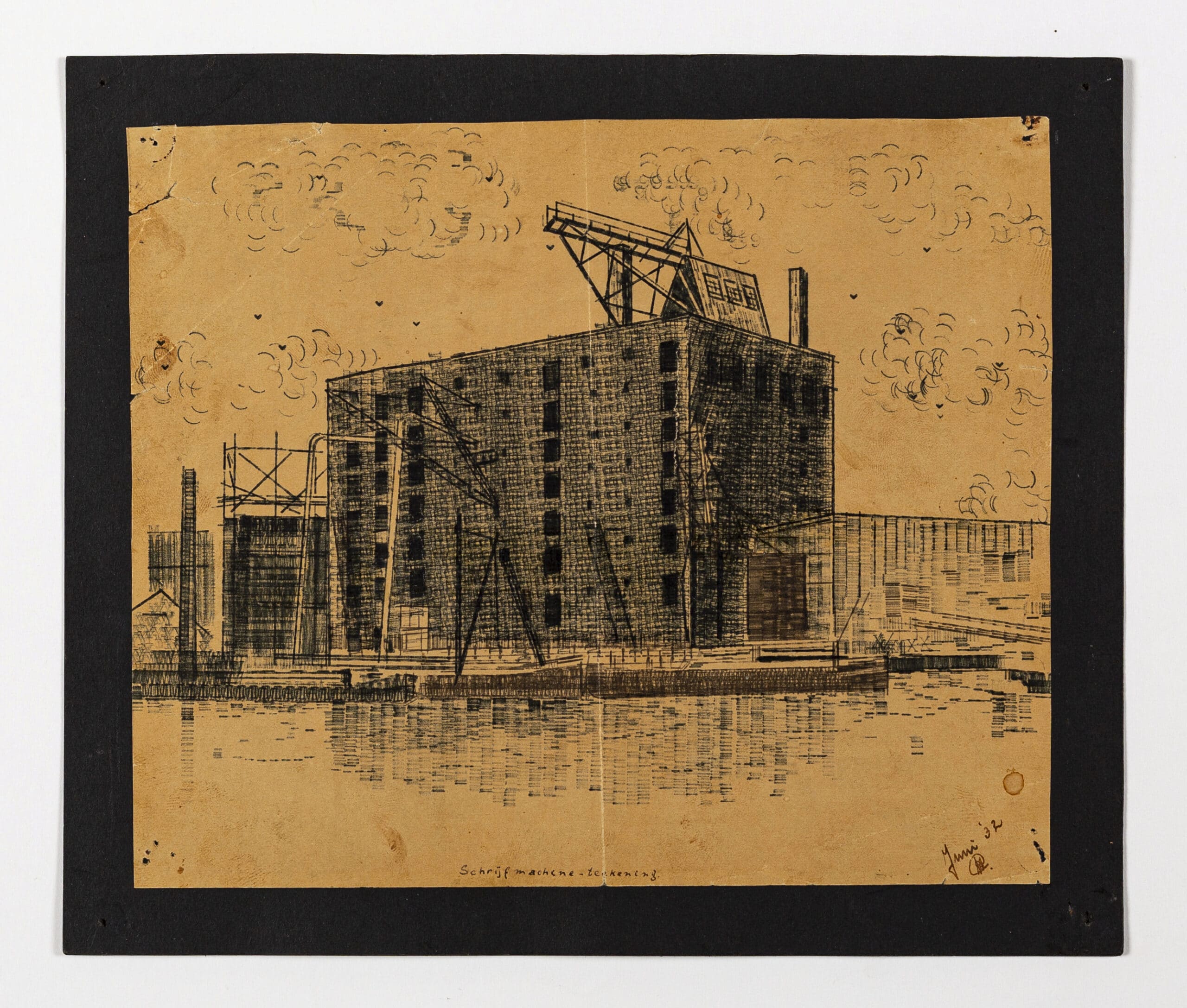
The ‘Typewriter’ drawing is made on brown paper mounted on a black backing, its surface carrying both the mechanical impressions of a typewriter and the analogue traces of a black pen layered above them. But unlike later typewriter drawings, which use typed characters as grids, codes, or proto-digital marks, this one is strikingly pictorial. What should read as standardised typographic elements instead begins to dissolve into a field of analogue inscriptions. Typed ‘xxx’, ‘990’, and ‘(((’ drift into hand-drawn strokes, while typewritten birds and clouds float above firmly delineated cranes and scaffolding. The distinction between machine and hand falters. What should be rigid becomes intuitive; what should be systematic becomes atmospheric. The drawing’s media do not stay in their proper places.
Friedrich Kittler describes the typewriter as an ‘intermediate thing between a tool and a machine’, a device that mechanises writing while still bearing the haptic memory of handwriting.[1] In Gramophone, Film, Typewriter, he argues that the early twentieth century was defined not by the unity of media but by their differentiation: the separation of optical, acoustic, and written data streams. Typewriting, phonography, and cinema each isolated a sensory channel and rendered it technically autonomous. And with that separation, Kittler writes, ‘the dream of a real visible or audible world arising from words has come to an end’.[2] Writing could no longer pretend to embody the world; it became an index of its own technical limitations. The typewriter, as a standardised keyboard and metal striker, separated body from text at the moment of inscription.
Yet what is remarkable about this 1932 drawing is that it does not behave according to this historical logic. Rather than reinforcing the discipline of the machine, its separation, and standardisation, the drawing incorporates the typewriter intuitively. It folds the differentiated media channels back into one another: image into text, mechanical regularity into atmospheric ambiguity. Typed marks behave like pencil shading; pen lines mimic the regularity of type. Instead of illustrating media separation, the drawing exposes its permeability. It is not so much a counter-model as a momentary exception that reveals the instability of the very distinctions he describes. The drawing does not negate media differentiation; it discloses how fragile and historically contingent it actually was.
This is where the drawing becomes unexpectedly contemporary. For Kittler, electric and later electronic media recombined previously separated channels of image, sound, and writing without undoing their historical differentiation. Today, in the age of computation and machine learning, the collapse of sensory channels into a single numerical substrate is complete: ‘all data streams flow into a state of Turing’s universal machine’.[3] In such a regime, infrastructures of perception—such as training data, embeddings, sensory pipelines—operate invisibly, abstractly, without qualities. Contemporary media do not represent the world; they compute it. They generate outputs without the need for optical, acoustic, or written analogical grounding.
From this perspective, the scarcity of drawings that attempt to visualise invisible data infrastructures and their optimisation pipelines is not accidental. Media that have become numerical at their core no longer provide surfaces to be drawn. They generate no pictorial residue. Their operations occur at thresholds that exceed both mechanical inscription and analogue mark-making. They are invisible not because they are hidden, but because they do not appear.
Seen against this backdrop, the typewriter drawing from 1932 becomes a rare artefact in which an older medium strains, whether deliberately or unintentionally, toward representing something that exceeds it. The dockyard it depicts is partly an industrial structure, partly an atmospheric field, partly a machine-world rendered as text. Its hybrid method captures the instability of infrastructure: cranes, scaffolds, and provisional architectures, all rendered through a mechanism already drifting into obsolescence. The drawing becomes a record not only of what it shows but of the technical conditions that made its showing possible.
To read the drawing today is to recognise its double displacement. First, it emerges at the threshold between handwriting and mechanical inscription, when the typewriter was still ‘engulfed by the noise of the real’.[4] Second, it appears now, within an archive that holds very few such works, at a moment when computation has rendered both hand and machine inscription nearly irrelevant to the production of images, infrastructures, and worlds. Its marks are ghosts of a media ecology in which writing still had a body, machines still had signatures, and infrastructures still left visible traces.
Perhaps this is why the drawing feels so strangely alive. It is not simply a hybrid image; it is a medium thinking itself otherwise. It reveals how the rigid, regulated apparatus of the typewriter can be turned analogue again, and how analogue mark-making can borrow the structural insistence of machine logic. In doing so, it sketches the possibility of drawing not only what is seen but what is structurally invisible: the infrastructures, data-flows, and technical atmospheres that determine contemporary life yet rarely enter architectural representation.
Notes
- Kittler, Friedrich A., Gramophone, Film, Typewriter, trans. by Geoffrey Winthrop-Young and Michael Wutz (Stanford: Stanford University Press, 1999), 14.
- Ibid., 14.
- Ibid., 19.
- Ibid., 14.
*
Valeriia Chemerisova is an architectural designer and researcher. She is currently pursuing the MArch Diploma at the Architectural Association School of Architecture in London. Her work explores the intersections of architectural theory, memory, and emerging technologies.
This text is one of the selected responses to the first category of the Open Call 2025: Visibility, and the Unseen—a series of short contributions that either bring to the surface the unseen drawings within the Drawing Matter Collection (I. In the Archive) or explore original architectural drawings, created by the author(s) of the contribution, which make visible the unseen (II. In Practice).
