Collection Guide: John Ruskin
– Editors
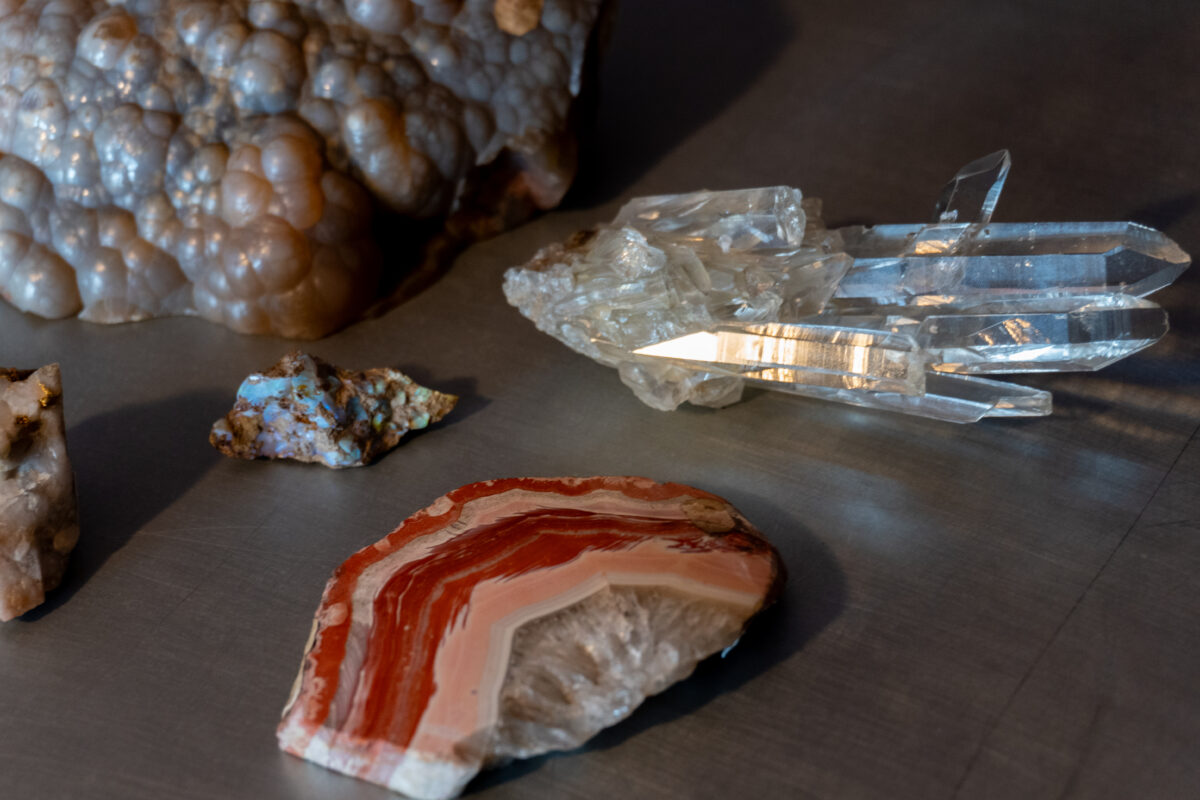
Drawing Matter holds a mineral collection compiled by John Ruskin for the St David’s Boys’ Preparatory School in Reigate, Surrey. The school later relocated to Stone House in Broadstairs and the mineral collection moved with it. Donated in 1883, the specimens were chosen from Ruskin’s personal collection, yet his idea to gift them to the school was part of a larger project to incorporate the study of minerals into primary education in Britain, giving a significant collection to Harrow, and smaller groups to Miss Bell’s School for Girls in Winnington, Cheshire, Whitelands Training College in Chelsea, London, Cork High School for Girls, and Somerville and Balliol Colleges in Oxford. Yet his decision to donate the rocks to St David’s was informed by his personal connections, in particular with the headmaster, Rev. William Henry Churchill (1850-1936), who had married one of Ruskin’s closest female friends, Miss Constance Hilliard (1852-1915) in 1880. The chosen rocks can be seen as a starter pack for young geologists, comprising familiar minerals that are easy to find or affordable to purchase, easy to clean, hard-wearing, and would not pose a risk to students. The collection is also meant to demonstrate the full capabilities of silica, the world’s second most common mineral, from crystalline pure quartz and colourful chalcedony or jasper to dark glassy flint.
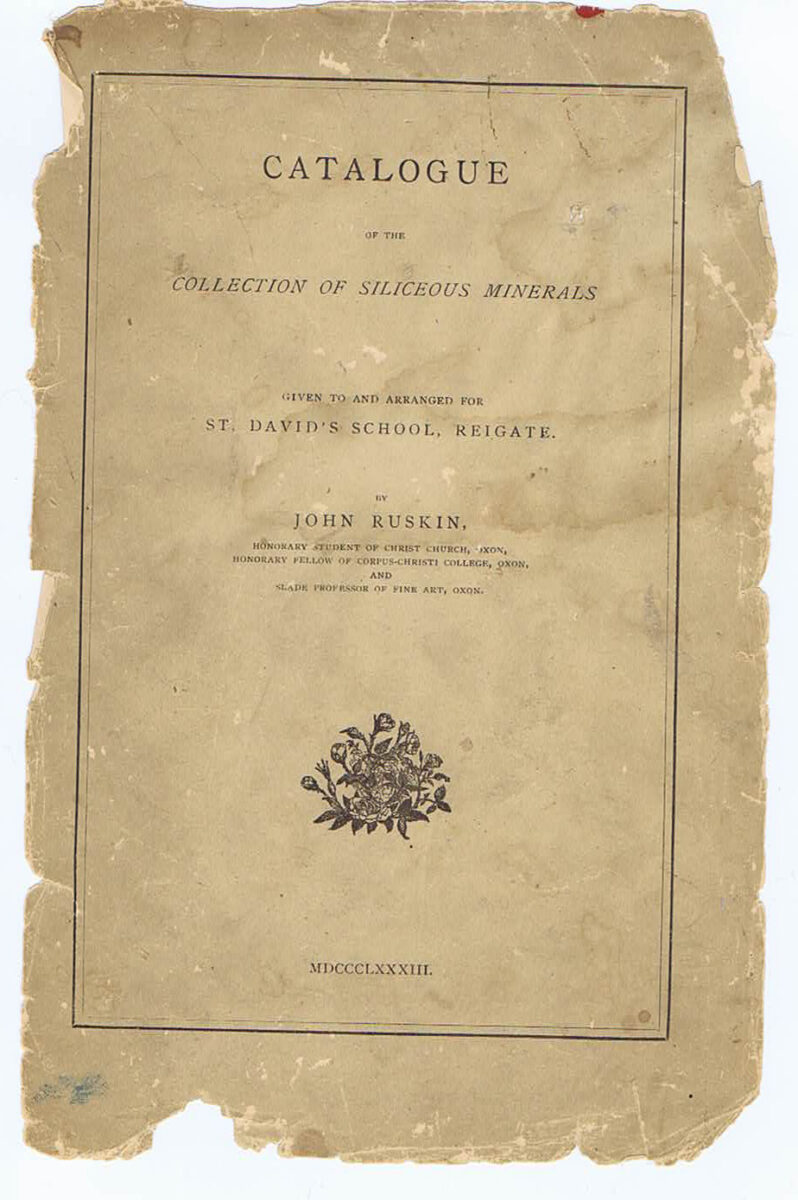
Upon the collection’s donation to St David’s, Ruskin created a catalogue where he detailed each specimen. His entries are short and descriptive, often describing not only the physical traits of the stone but the conditions in which it was purchased or the location of its origin. Of course they do not align with modern geology; his theorising of how forms were constructed often overtaking reason.
Originally 133 specimens were donated to St David’s, although the collection at Drawing Matter only contains 85–certainly the school boys had pocketed a few, although, an extract from Roy Starkey‘s recent publication The Mineral World of John Ruskin (2026) explains more about how the collection moved from the school to the archive,
The collection appeared in a Sotheby’s natural history sale on 4 March 1971, lot 171, described as The property of J. Richardson, Esq. (removed from Stone House School). The collection together with its original printed catalogue, was purchased by a collector called Chris Neame for £140. There was only one fine specimen in the lot, a green fluorite number 69 and for some reason Neame sold that single specimen possibly to Adrian Langton. Perhaps he recouped most of his outlay, but the loss of it rather diminished the value of the rest of the collection.
In the early 1990s Neame decided to sell off parts of his collection. The Ruskin specimens were acquired by London mineral dealer Brian Lloyd, who in 1981 had purchased the long established business of Gregory Bottley to form Gregory Bottley and Lloyd. As part of the stock in trade he had acquired a letter from Ruskin to James Gregory. The letter, together with the specimens and catalogue, was sold to the well-known antiquity and ethnographic dealer John Hewett in January 1991, from whom it was later purchased by Drawing Matter.
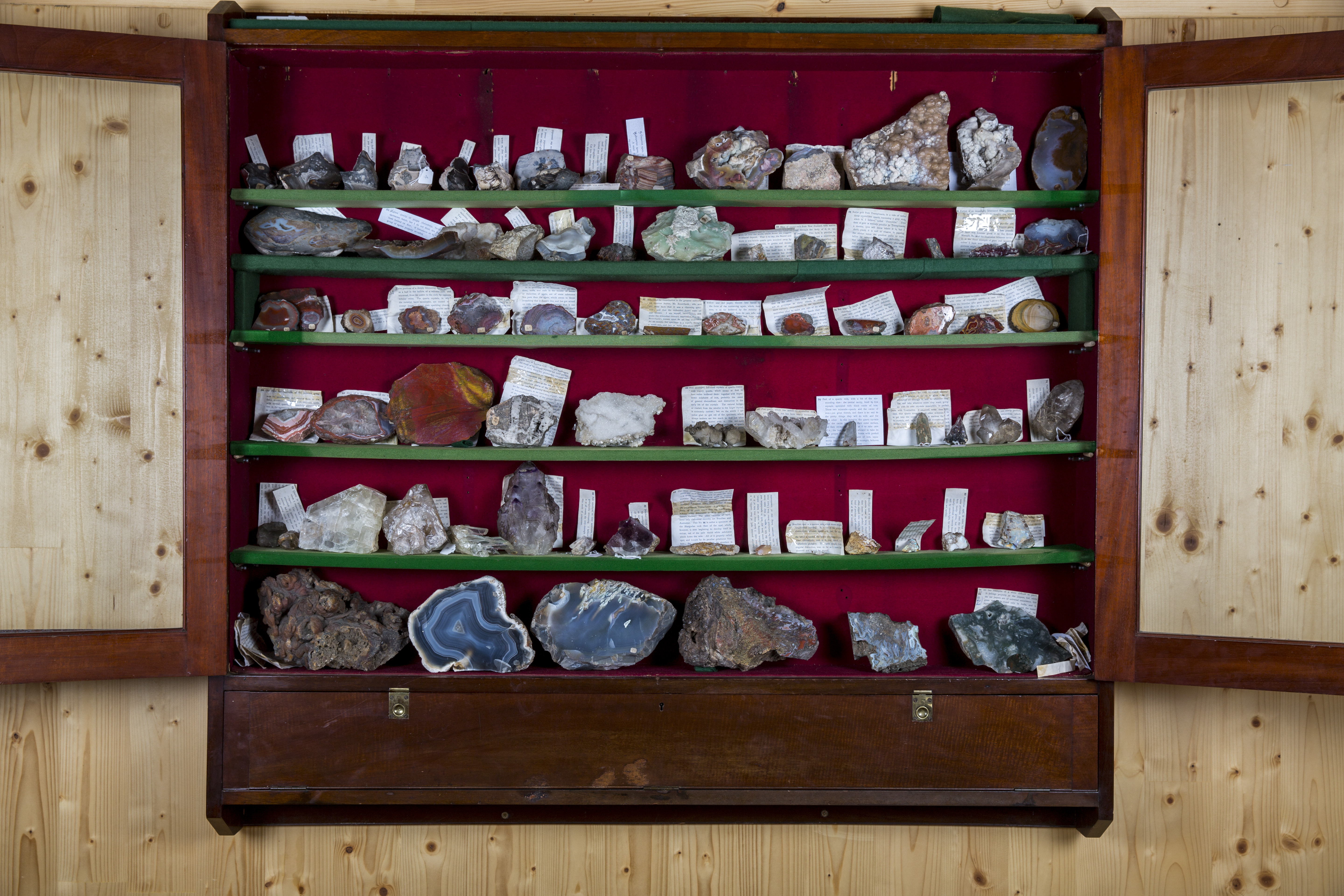
Below, is a constellation of archival material which aims to give an understanding of the minerals in the Drawing Matter Collection. The galleries of stones are accompanied by Ruskin’s comments from the original catalogue.
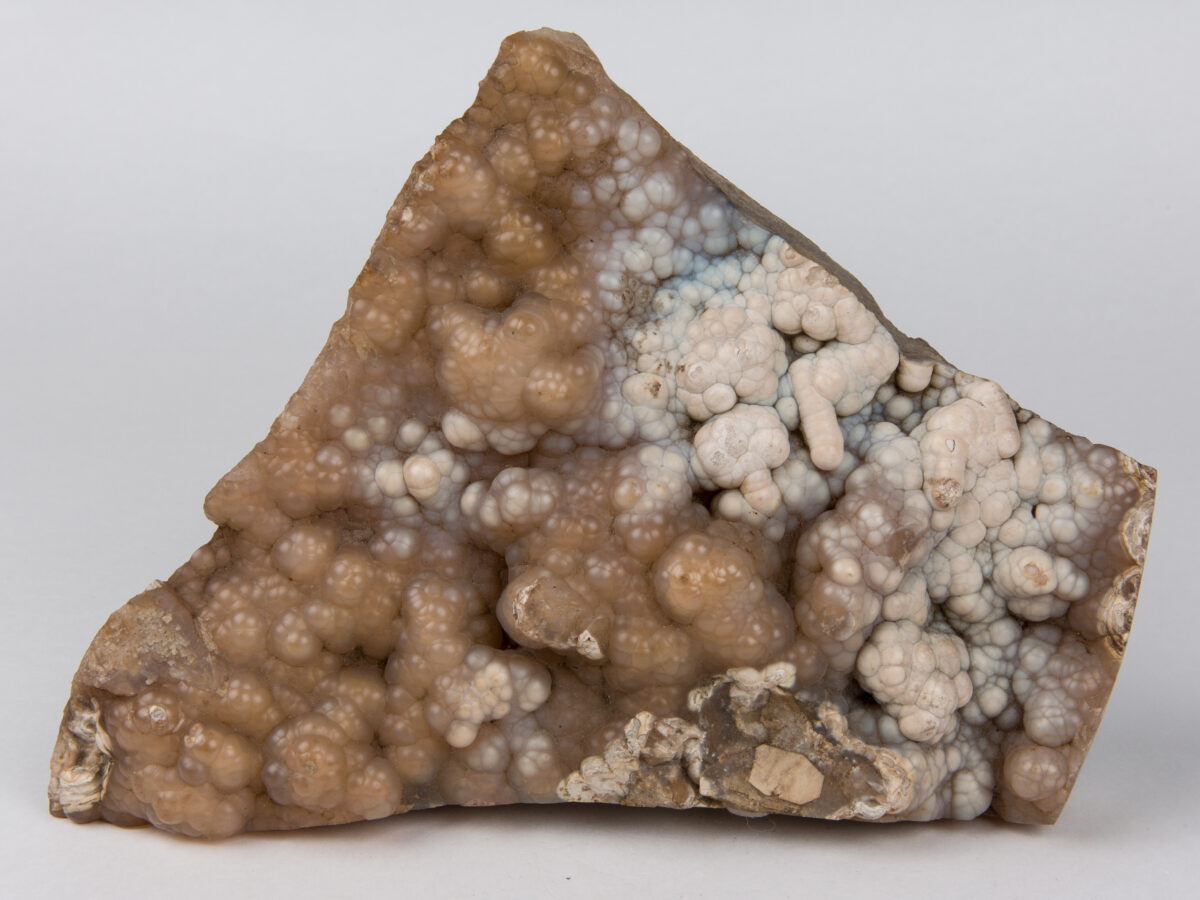
16. Common mossy flint of the south coast, passing into pure chalcedony, in one part showing black arborescences of oxide of iron (rare). No one has yet given any account of the nature of the mossy matrix, which is extremely common, but extremely curious.Compare Nos. 22, 23, and C.1 to 12, page 20, with notes at page 19.Where the chalcedony is white, it begins to throw itself into sausage-forms, which might be mistaken for stalactites, but are nothing of the sort.Their decomposition at the edge into coats (see the shortest polished side) is extremely notable. This piece was originally twice as large and broken; the other half is in my own collection. 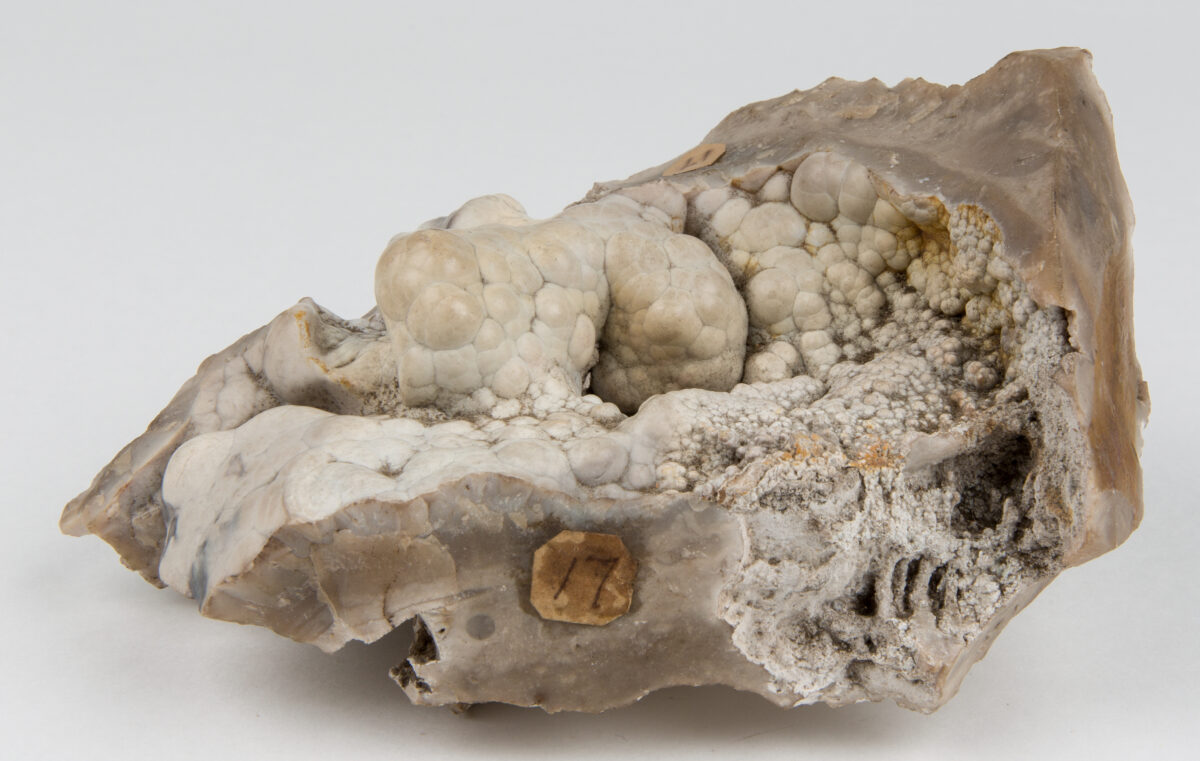
17. Flint chalcedony, making the best it can of itself. It cannot be seen in finer condition, showing the Jasperine, spongy interior, edged with extremely minute sparkling quartz. Examine carefully with lens. I do not know how far these red parts are organic. It is rare to find chalcedony of the two sides of the wall, as here; and still more rare to find it, as on the blue side, with superimposed pseudostalactites, (to my great regret, broken short off.) Reference number in my old collection, 1591. Cut and polished under my own direction. 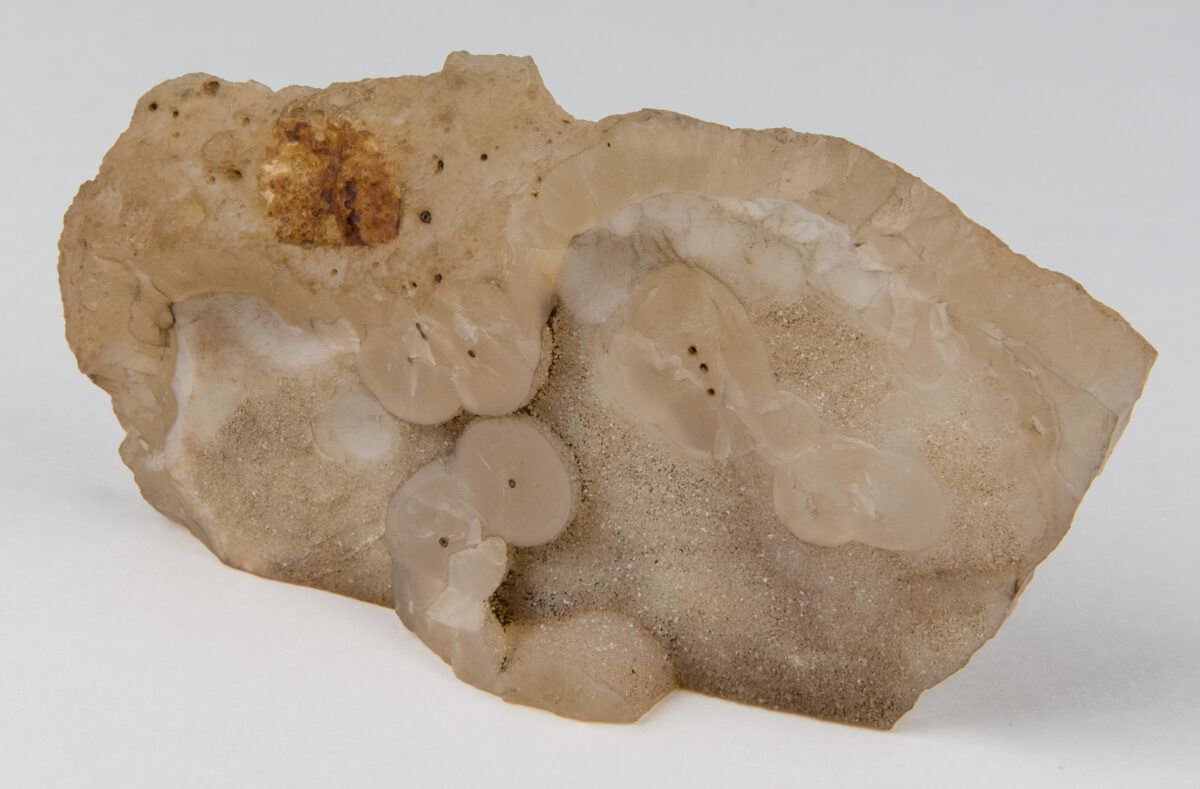
26. Level Icelandic chalcedony, traversed by pseudostalactites, each with its proper rod of nucleus. Two pieces, A and B, cut and polished under my own direction, and extremely instructive, if one could only understand a single word of what they say. Look at them against the light, and take care to keep the two pieces together. 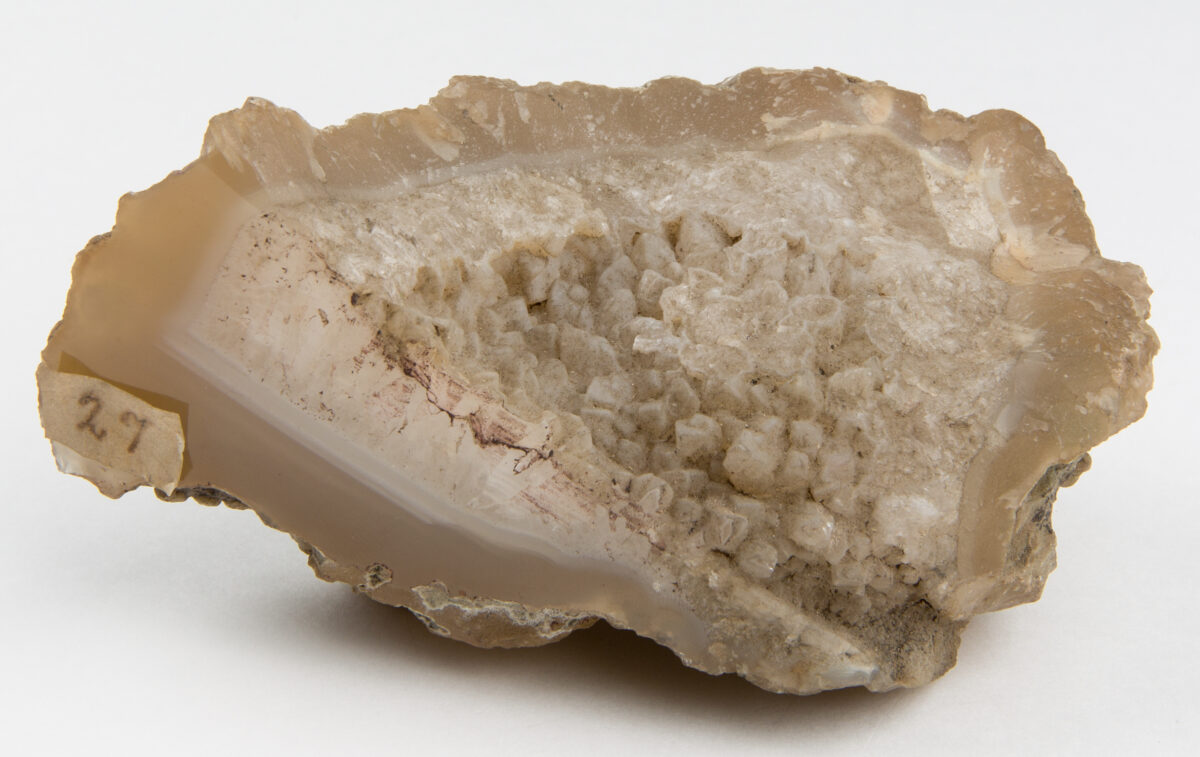
27. Icelandic chalcedony, passing into quartz, which traverses a level lake, in the hollow of the interior, and crystallises, not in the usual form of quartz, but in triangular pyramids. This, like No. 26, is an extremely rare specimen.
68. Compact quartz, vexed quite out of its moral character by sulphuret of iron, with, I think, a little zinc, (the black glittering part at the bottom) and nasty carbonate of iron all over. This specimen is described in the Ethics of the Dust, as illustrative of the temper of minerals that don’t get on together. We will now take up a series of examples showing how quartz gets on with minerals whose company it likes. 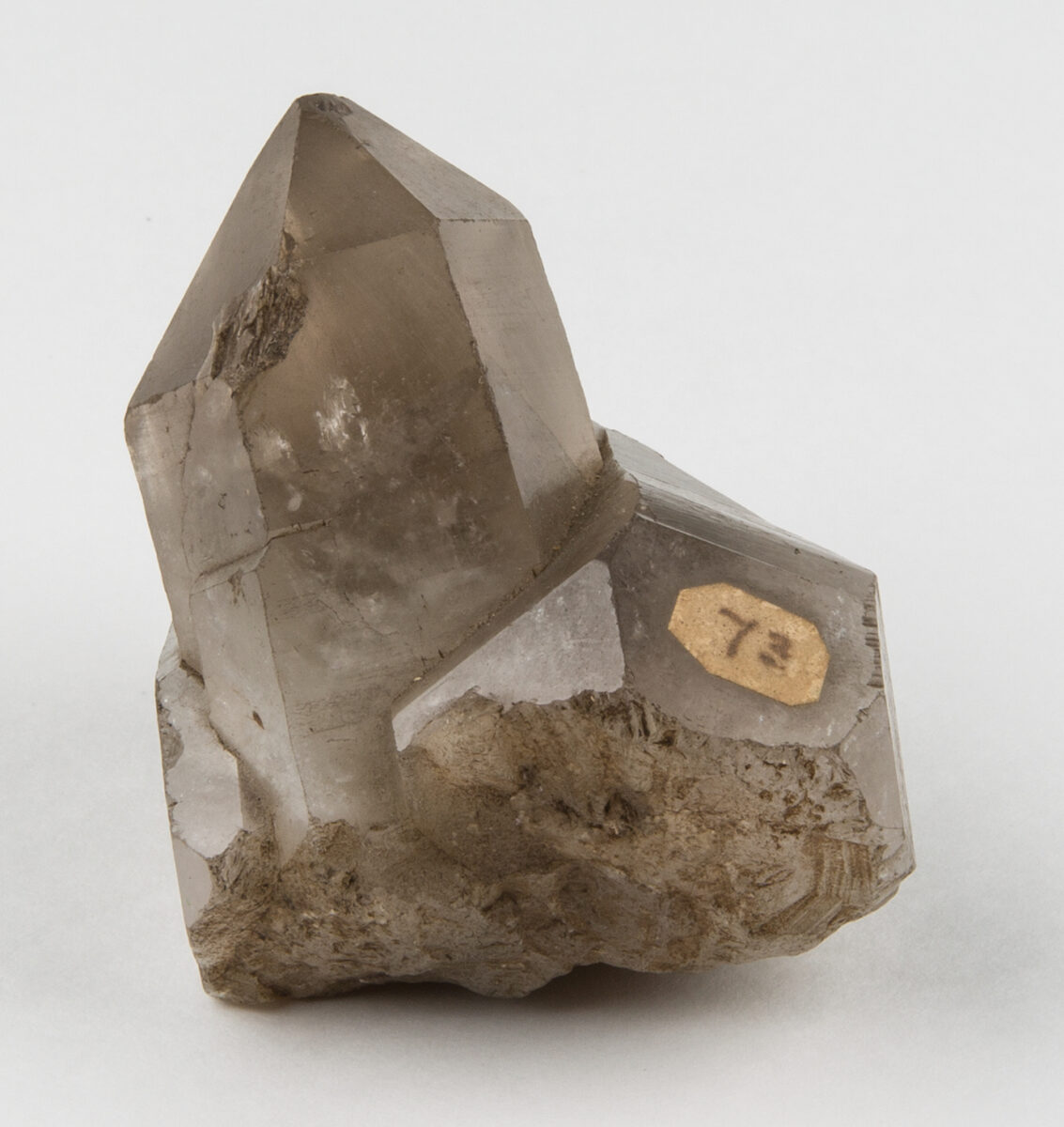
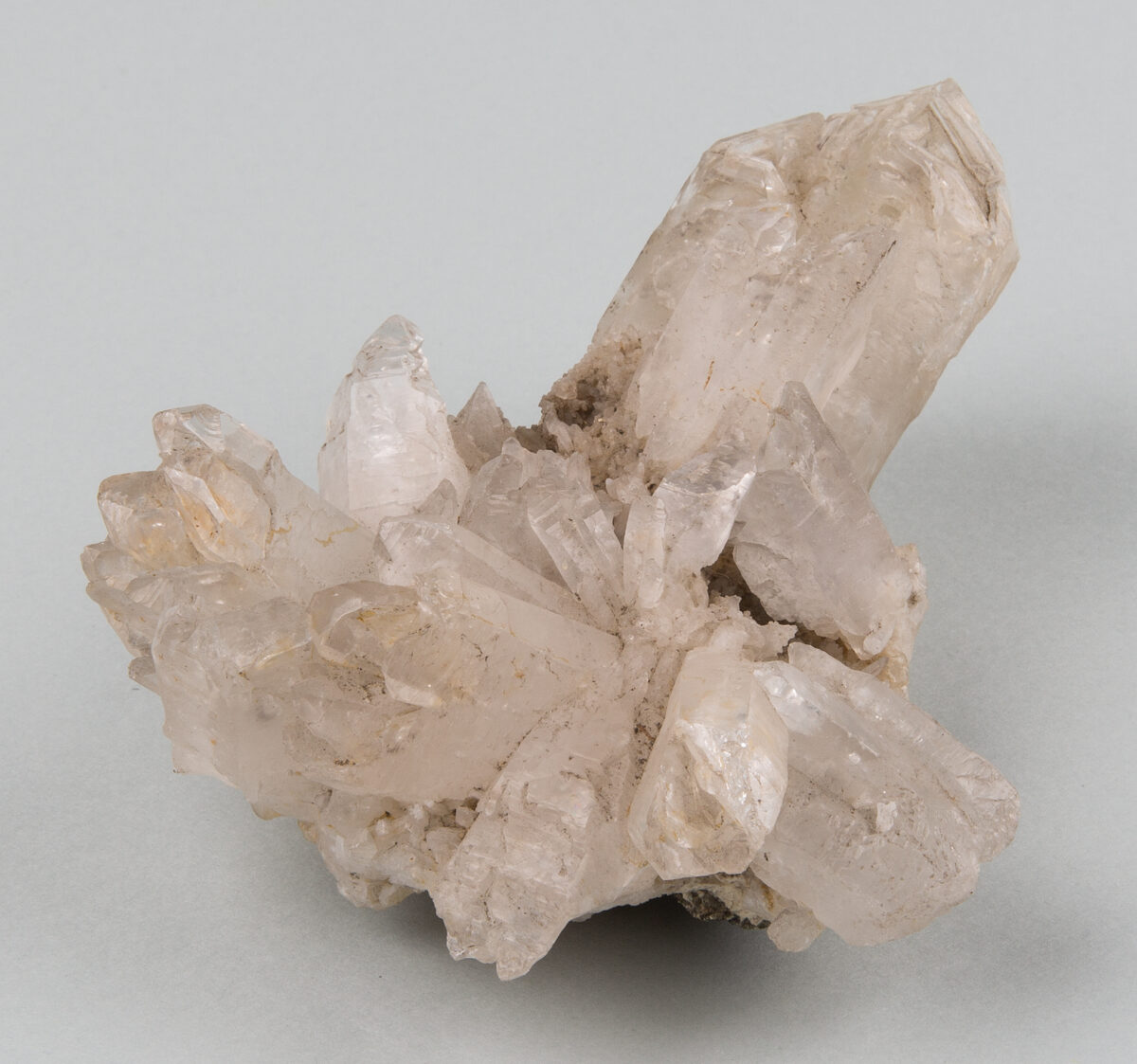
73. Group of three quartz-crystals, one nearly perfect, traversed by straight silky amianthus, which runs straight through the crystals without in the least disturbing them, and seems very neatly coming out the other side. 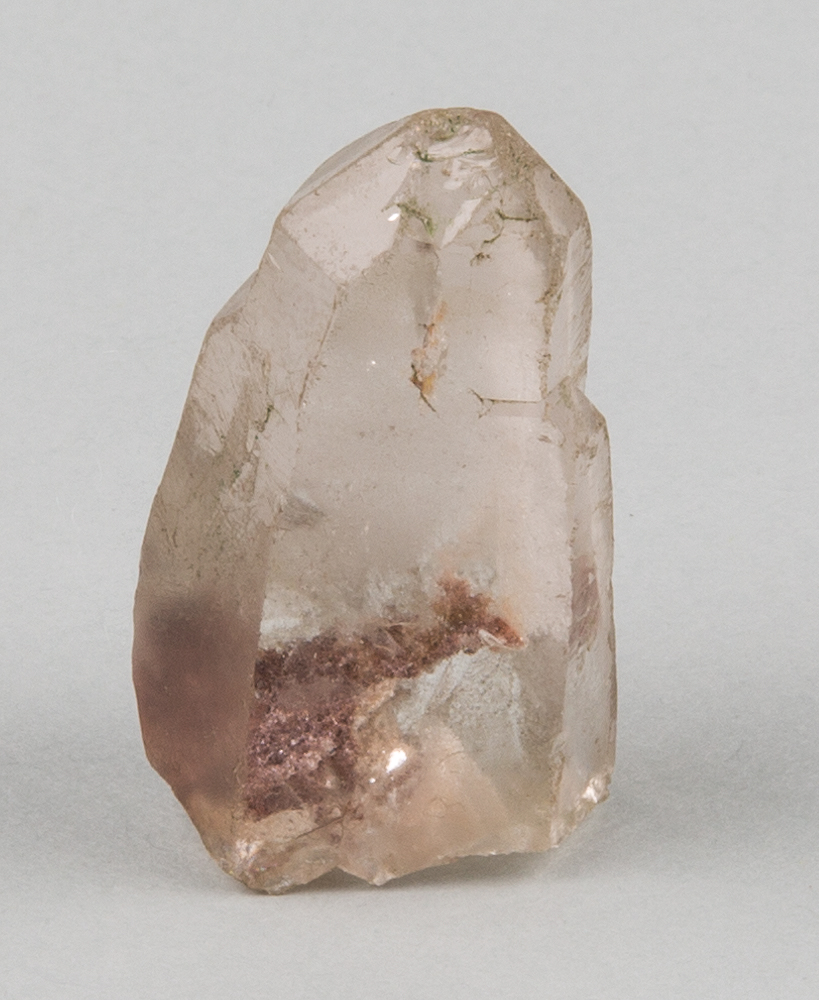
74. Part of a quartz crystal traversed by white amianthus, which begins all of a sudden, before one knows that it has got in, and takes a delicate little curve at its own fancy, wholly careless about the intentions of the crystal. Polished one side, fractured on two, the rest crystalline. 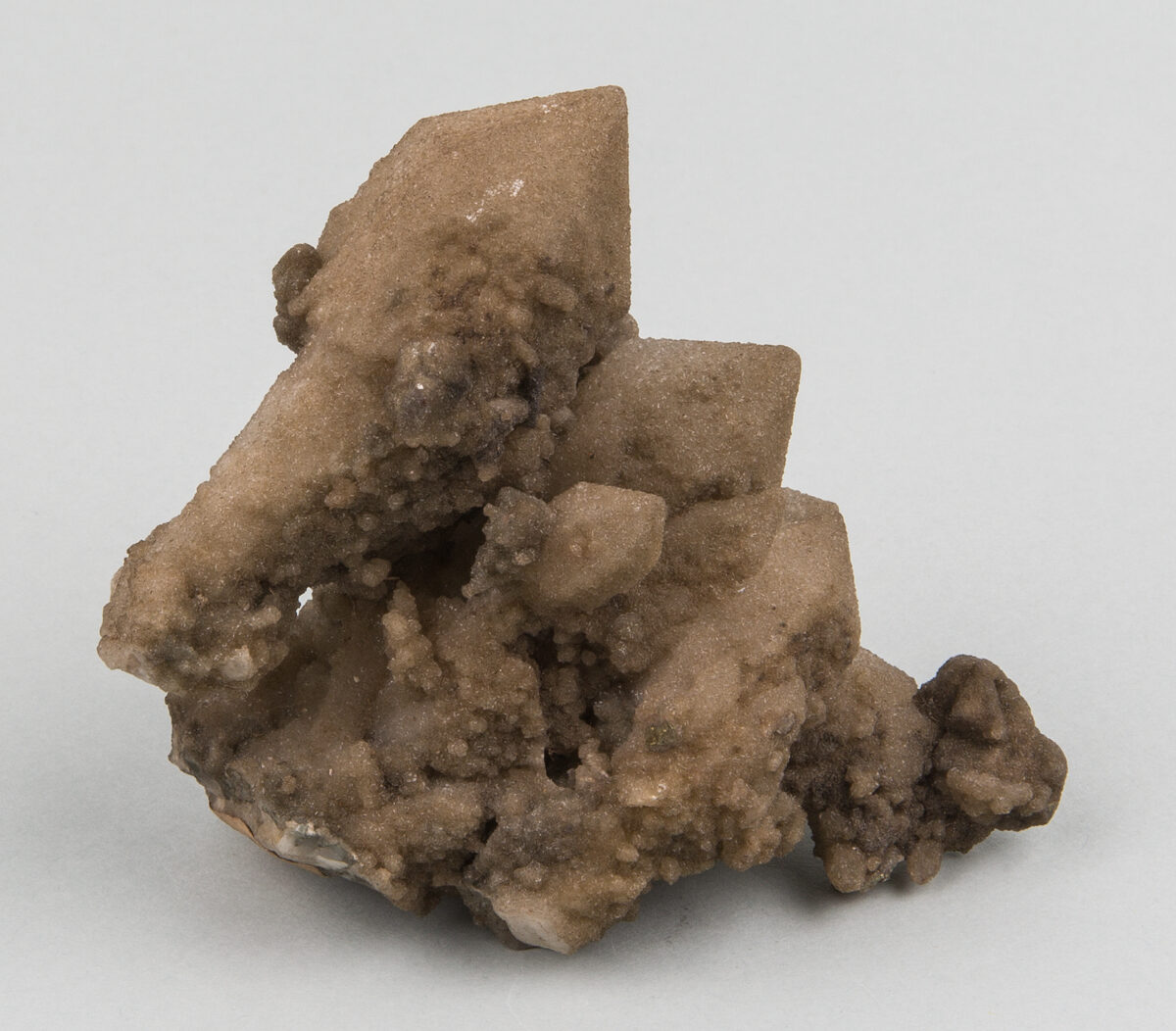
66. Well developed, full-sized crystals of quartz, coated with sugary quartz, which seems at first to have rather bothered them together with impertinent sulphuret of iron, probably the of general discomfiture and distraction in the early life of the crystals. The natural bridge, or viaduct, from the smaller to the larger crystal, is extremely curious; but on the whole I am rather glad to get rid of the specimen, which always bothers me too much to find out what has been the matter with it. The full-sized crystals are extremely good specimens of quartz form, bringing all their sides neatly to the point, which they are very apt to fail of doing, and to look like an ill-cut pencil. 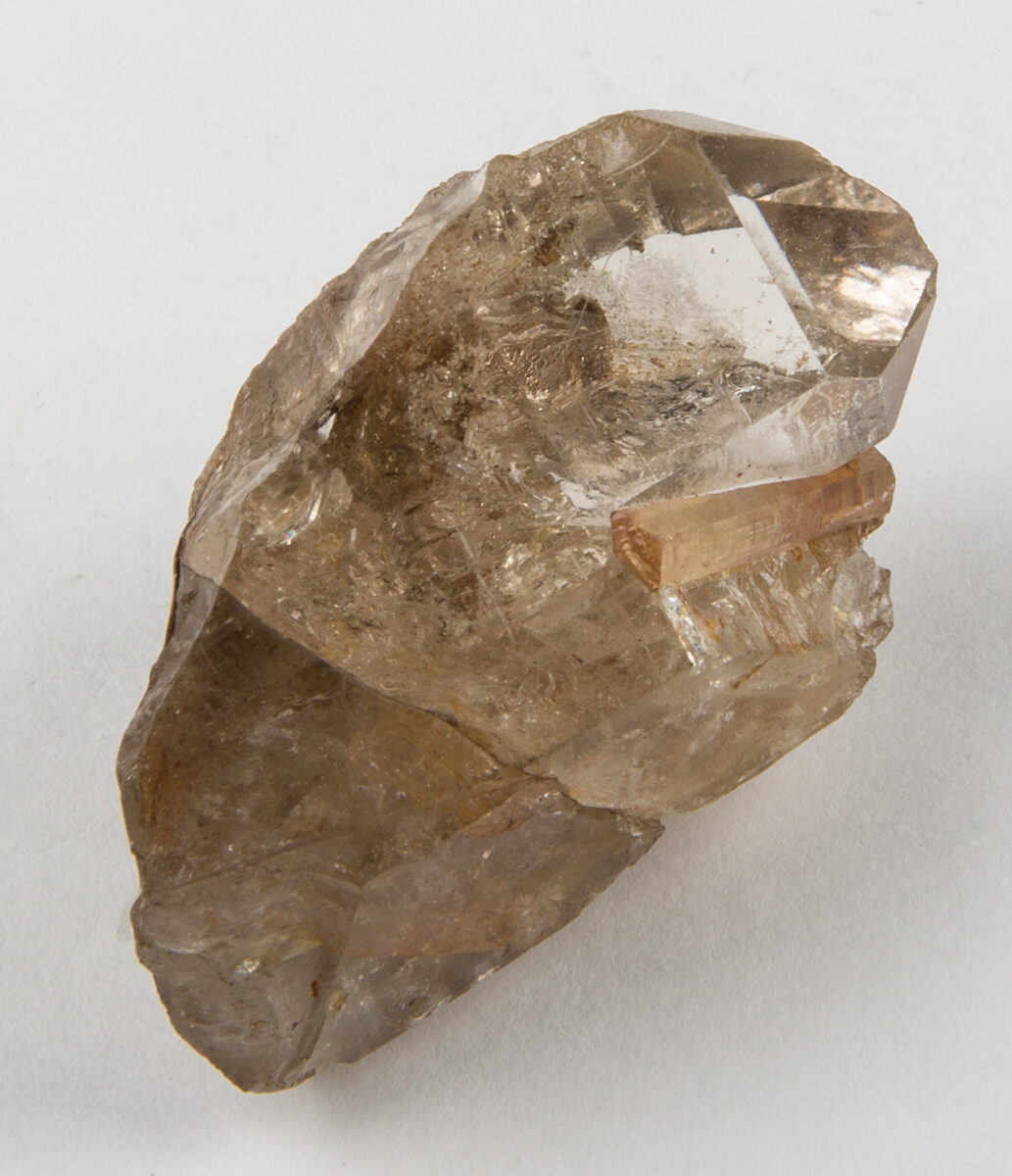
76. Quartz in perfect crystallisation, with a friend whom it respects, but nethertheless keeps outside, topaz. This mineral is found continually embedded in quartz, at the surface, in this manner, but I have never seen a single instance of its getting inside it! 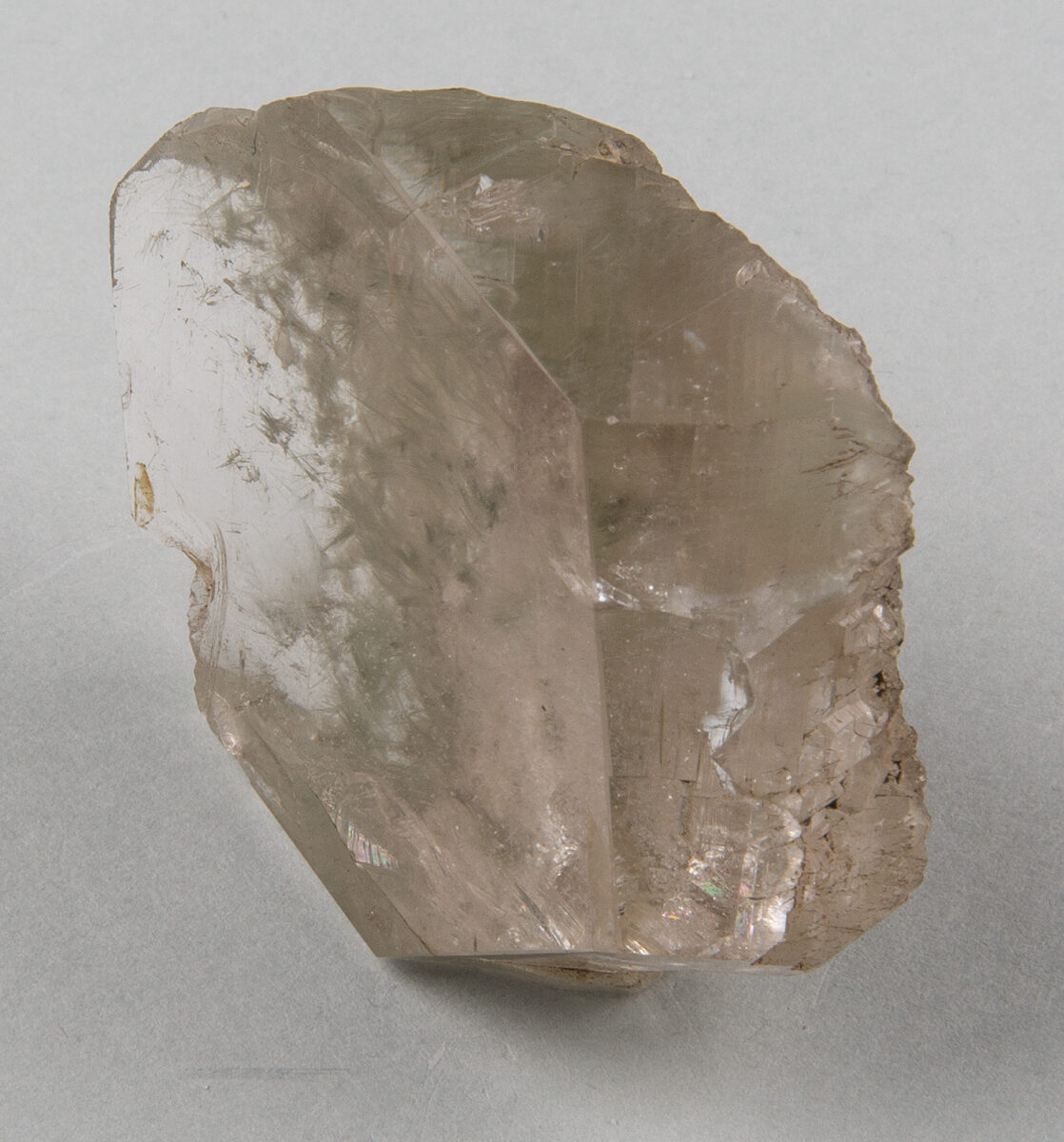
75. Section of a quartz crystal containing white amianthus, which can be seen only in one light.Hold the piece with its rough side to the window, the figures on the ticket upright, and look with a magnifying glass through the polished plane. The threads of amianthus will then be seen on the internal surface, though only one or two are visible on looking through from the outside. Extremely mysterious, and looking like a piece of intended jugglery. 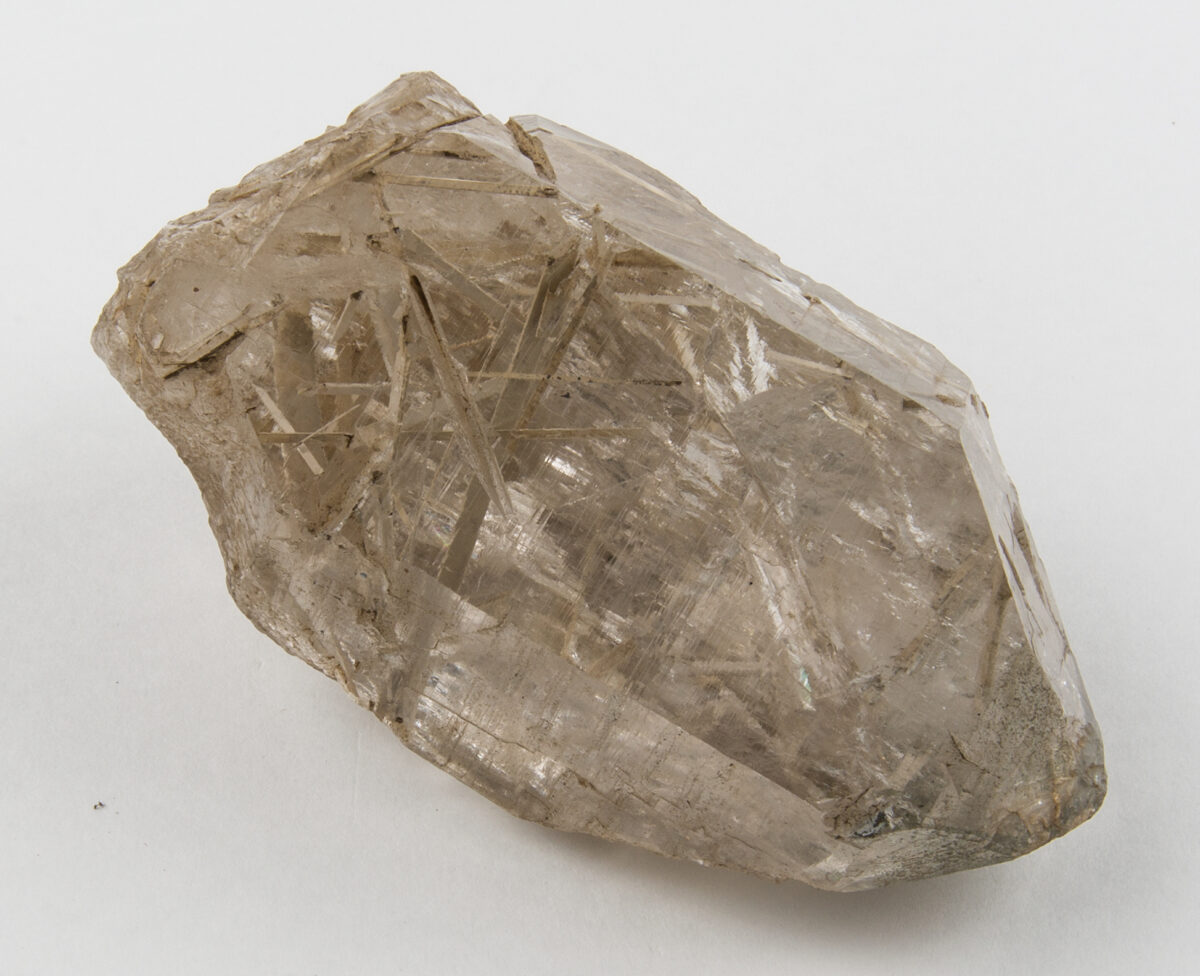
77. Pure quartz crystal, with cavities, left, I believe, by vutile, (oxide of titanium) but I have not the least notion how that mineral got in or out; only quartz is always ready to let it do whatever it likes. 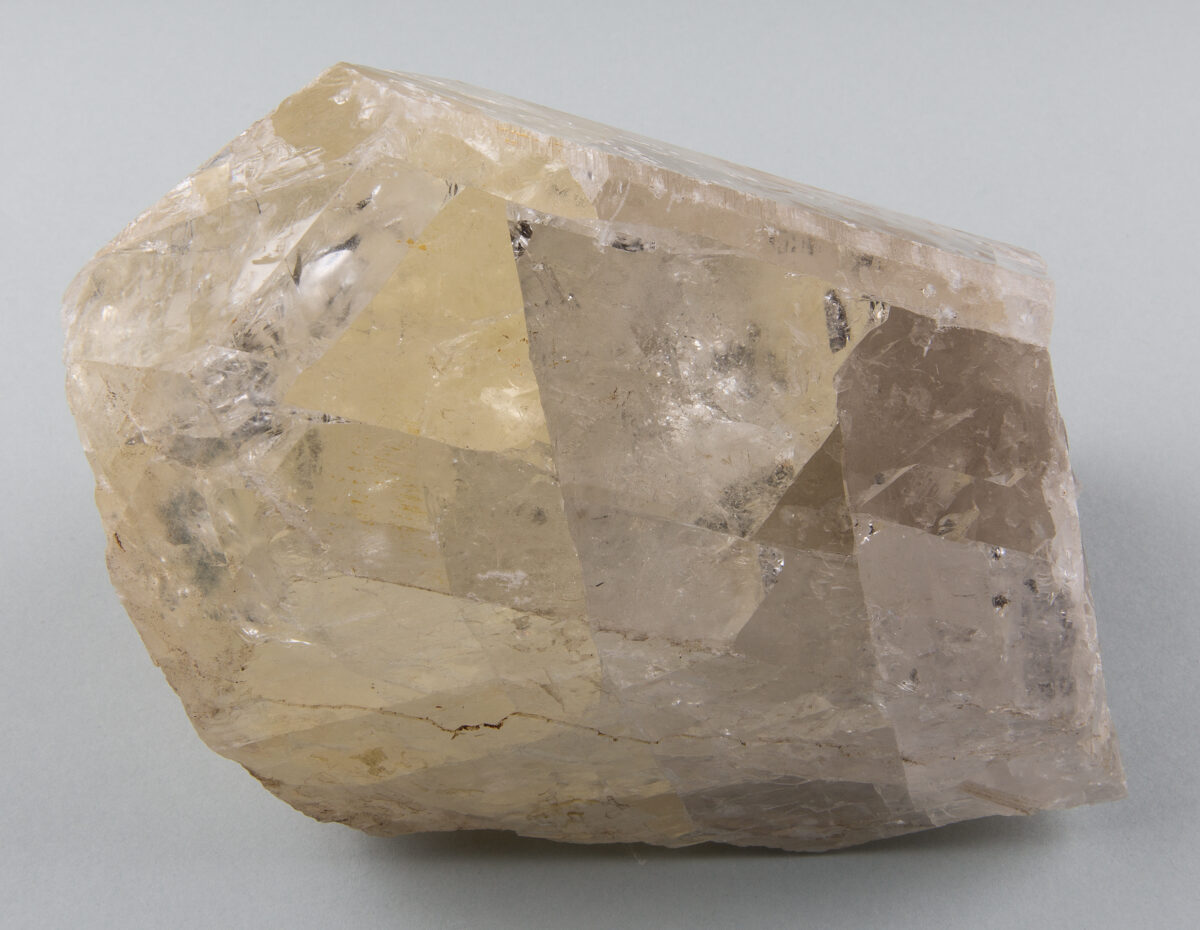
79. Perfect quartz crystal, showing its mode of growth, by the accident of a pause when it had got half way, during which the surface of the then existent crystal was covered with mossy chlorite; all the planes in this specimen are genuine, none is polished, and the example is extremely rare and good. It is most singular that no mineralogist of any country on earth has ever brought up a school of miners to take good crystal when they had got it! This example has originally been as perfect as anything could be, and has only been spoiled, as single crystals always are, by the miner’s throwing it into his bag with the other stones, and banging them about at his leisure. 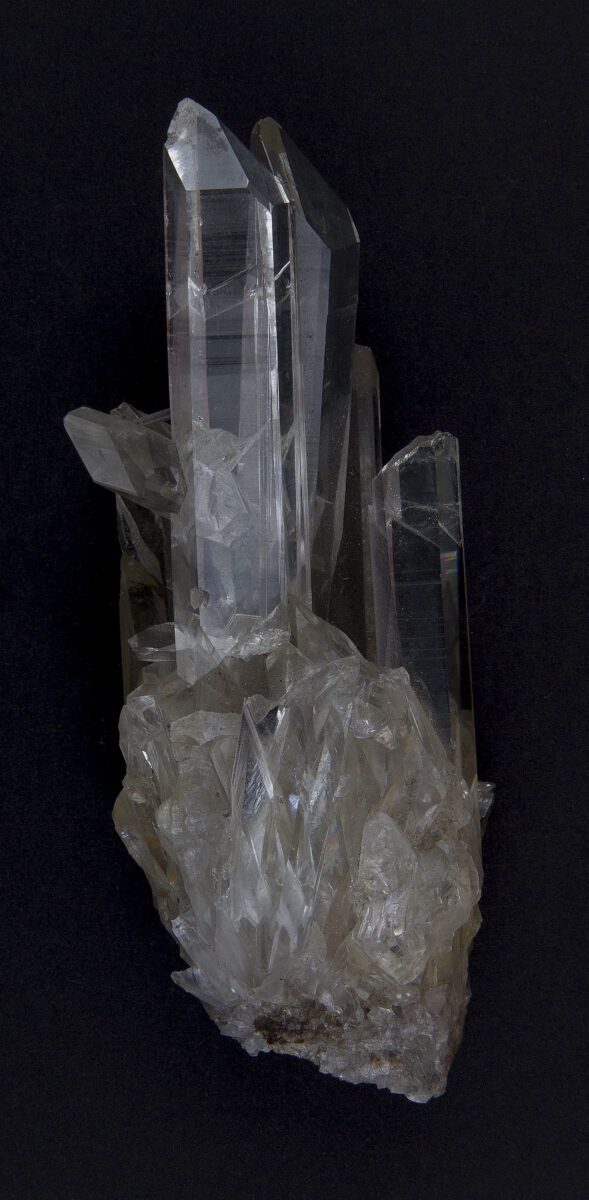
80. Perfect quartz crystal of Dauphiné, as good as well can be, and in the inside of it, fit for spectacles or telescopes or what not, of course a little spoiled at the point in the manner above described, but I have not above four bits in my whole collection that are better, and can’t spare any of them. 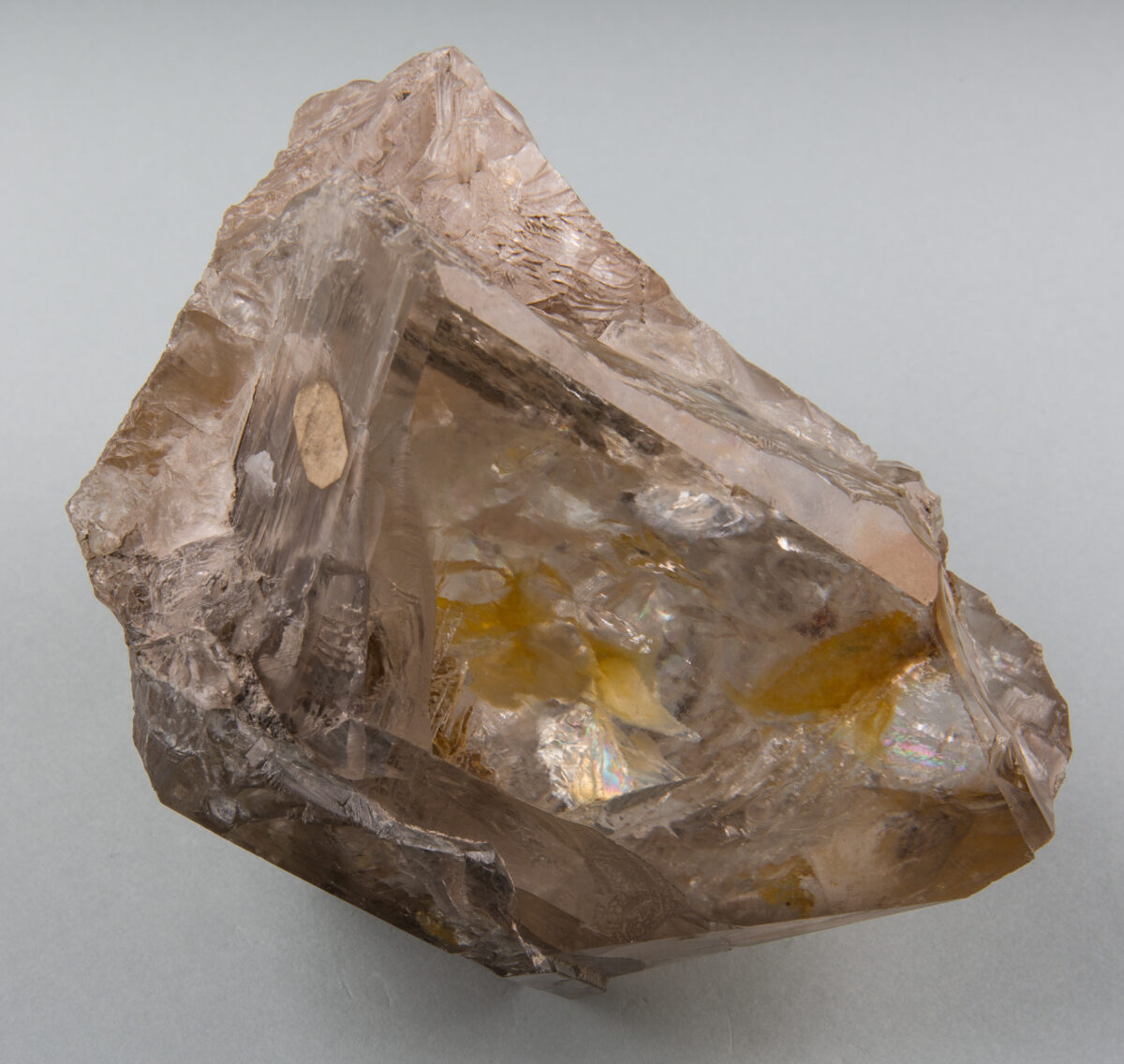
78. Crystal of the purest quartz, a little interrupted by calcareous earth, and showing structural flaws, therefore, of extreme interest and beauty. There is no end to the things that may be found out, and to the other things past finding out, gradually traceable in it.
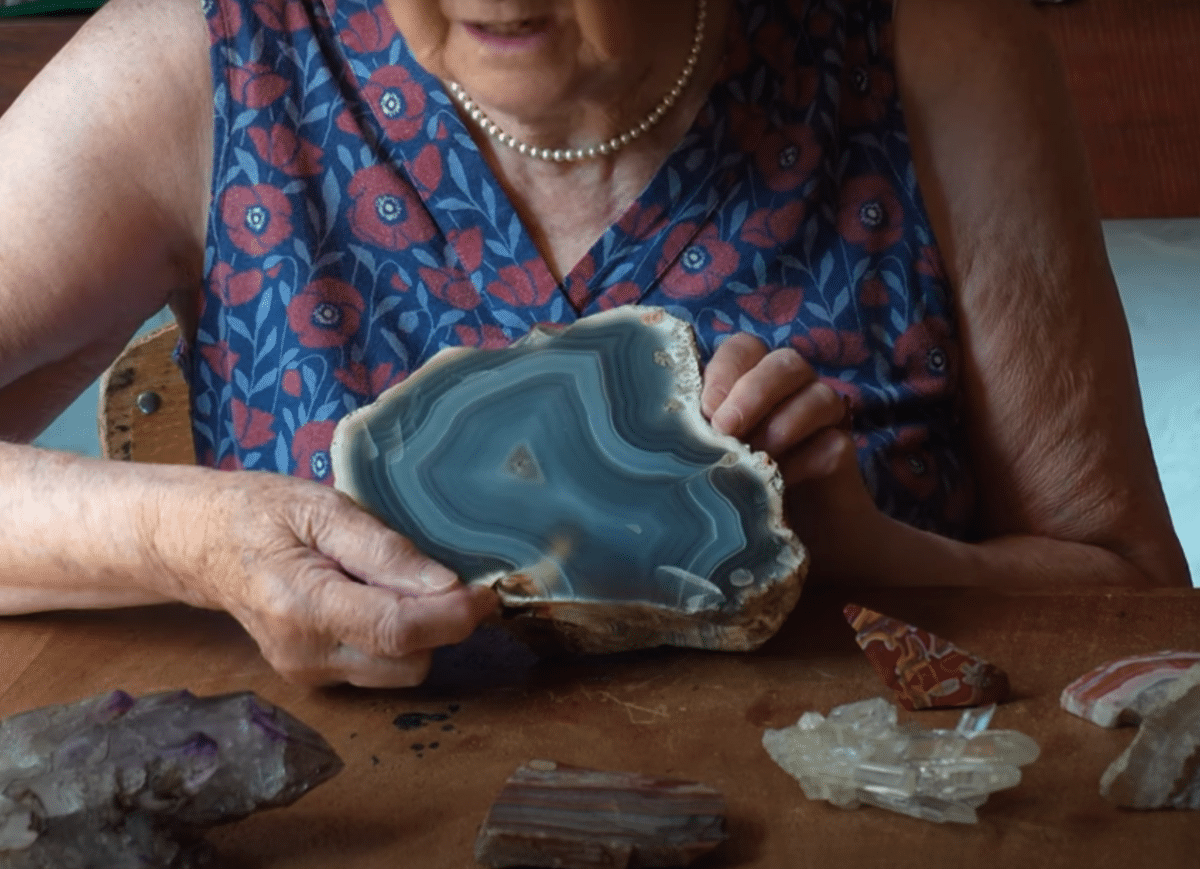
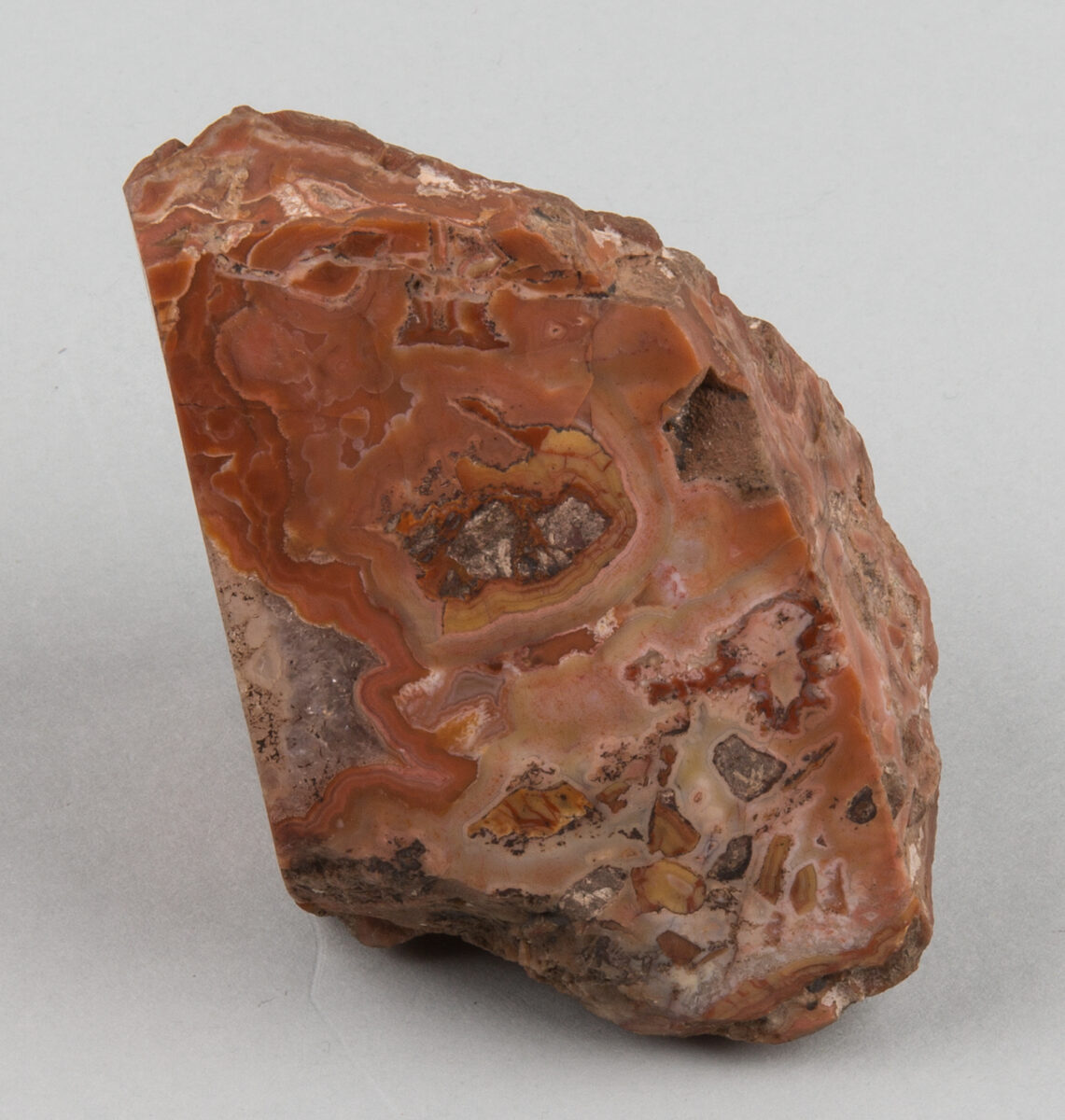
55. Red jasper in bands, some straight, some bent, and some apparently not merely broken, but chopped up; the whole mixed with sandy quartz and gritty earth, in a manner, I believe, which no one could explain but Lord Dundreary. 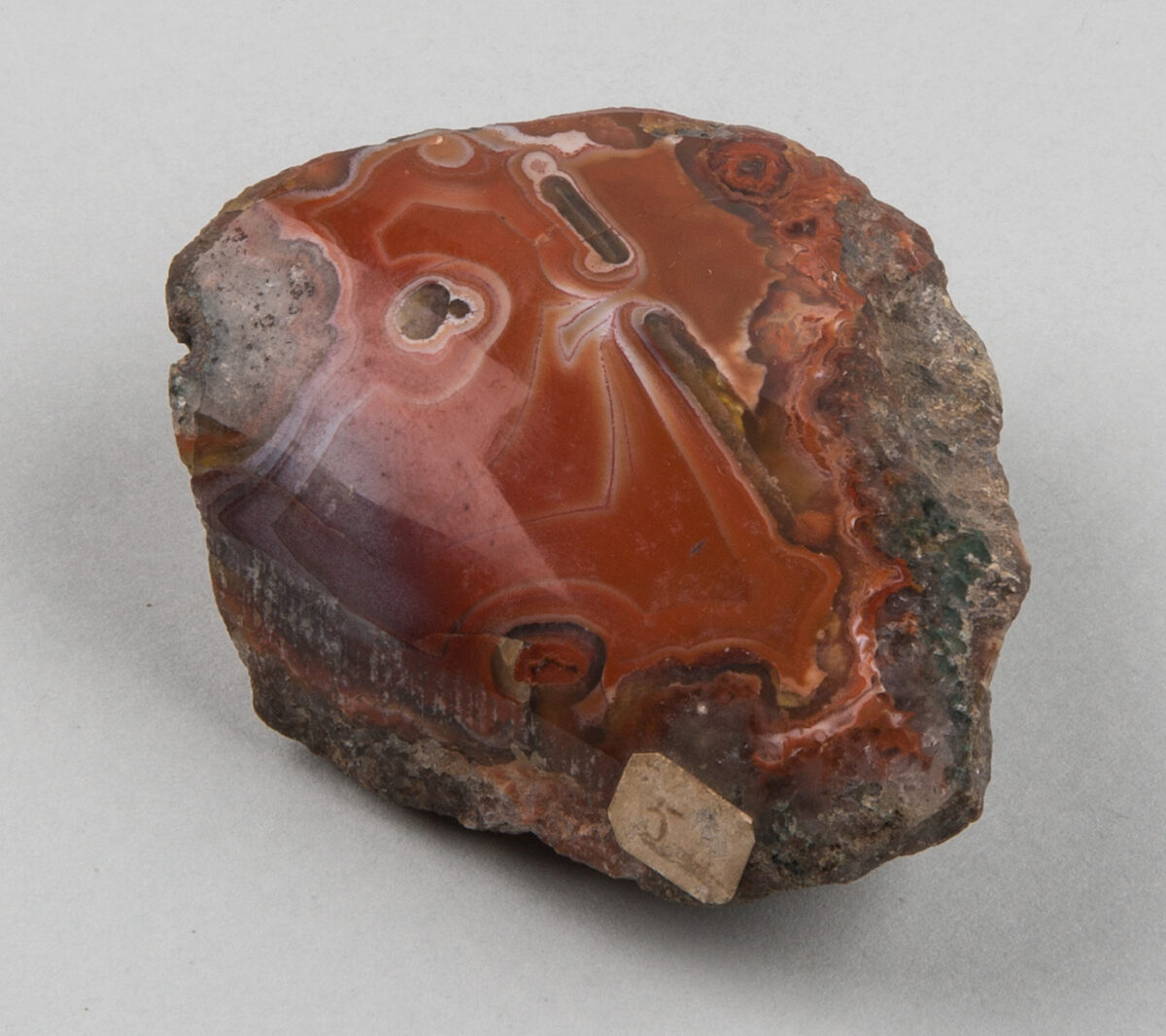
54. Red jasper, in rough grey quartz, with inlets of chalcedony-two of them in perfectly straight lines, with central films, and very definitely unequal in the thickness of external deposit, while the material of the jasper seems to flow in between them, like a tide filling a harbour through a flood-gate. All these appearances of flux, as well as of fracture, in agates, are, I believe, pure and wilful imposture on the part of those unprincipled stones. But as I have never seen one of them making itself, I withhold at present any final expression of opinion. 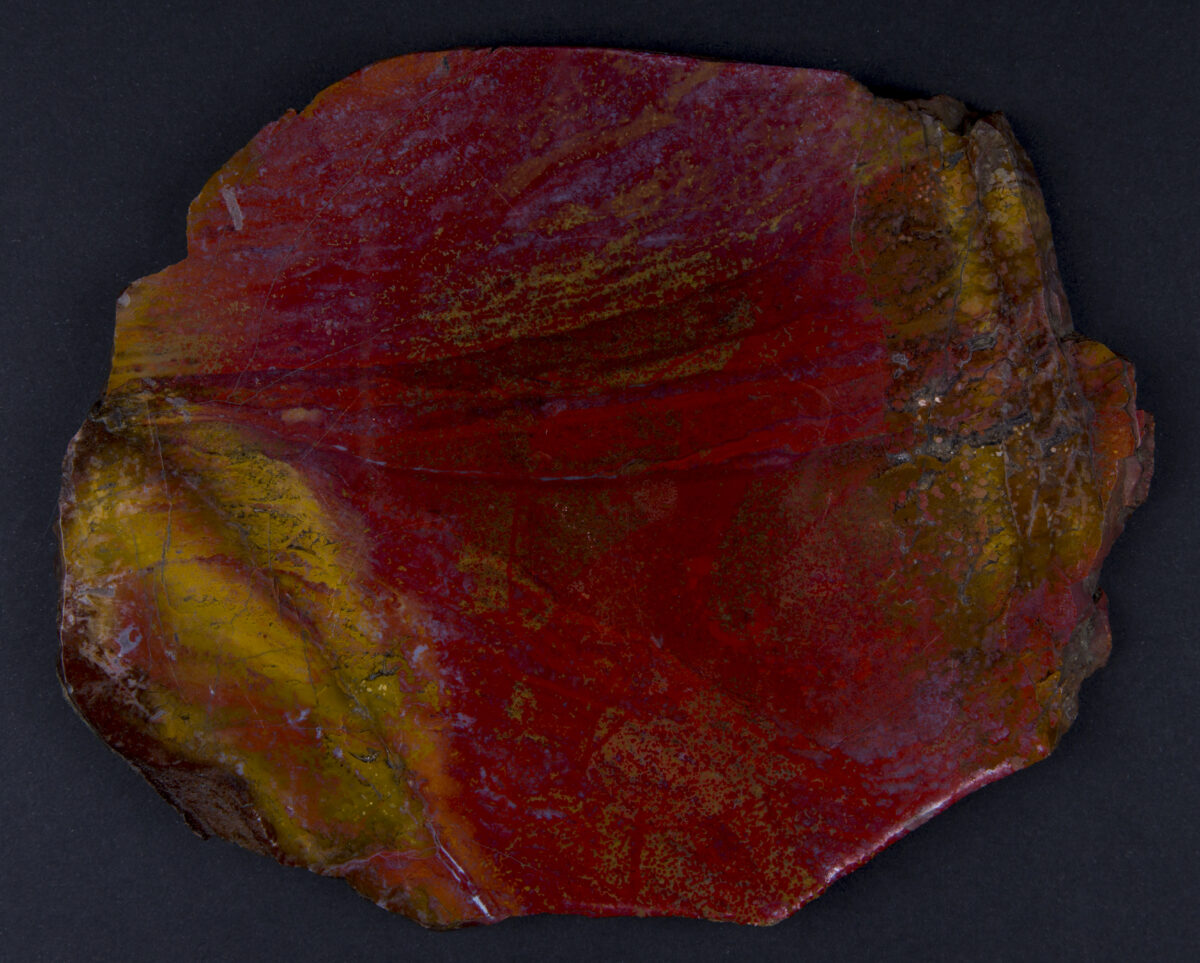
60. Pure scarlet jasper, with lateral yellow zones, entirely representative of the stone in its finest condition, and ordinary flammeate structure. Its scarlet colour under these conditions has through many ages maintained its position as the real representative of that colour among gems, connected always in the minds of the ancients with the more translucent types of the same colour in chalcedony, which we now call carnelian, but they, ‘Sardius’; whence in the Apocalypse, with the intention of describing the most beautiful colour of the immortal body, ‘He that sat was to look upon like a jasper and a sardine Stone’. 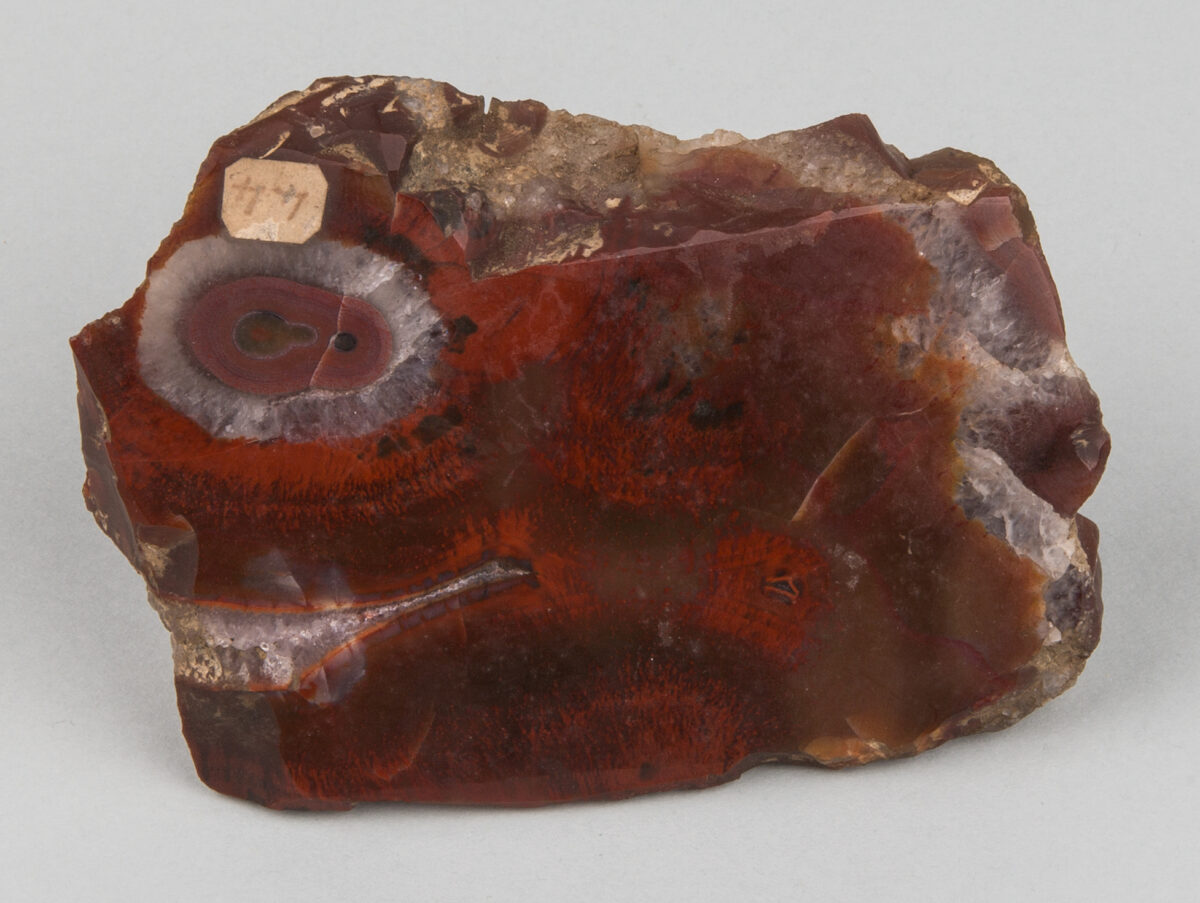
44. Spherical agate in zones of chalcedony, with fillings of quartz, the chalcedony traversed by mossy flakes of fine crimson jasper. On the fracture the stone looks almost like a compact jasper, extremely fine. 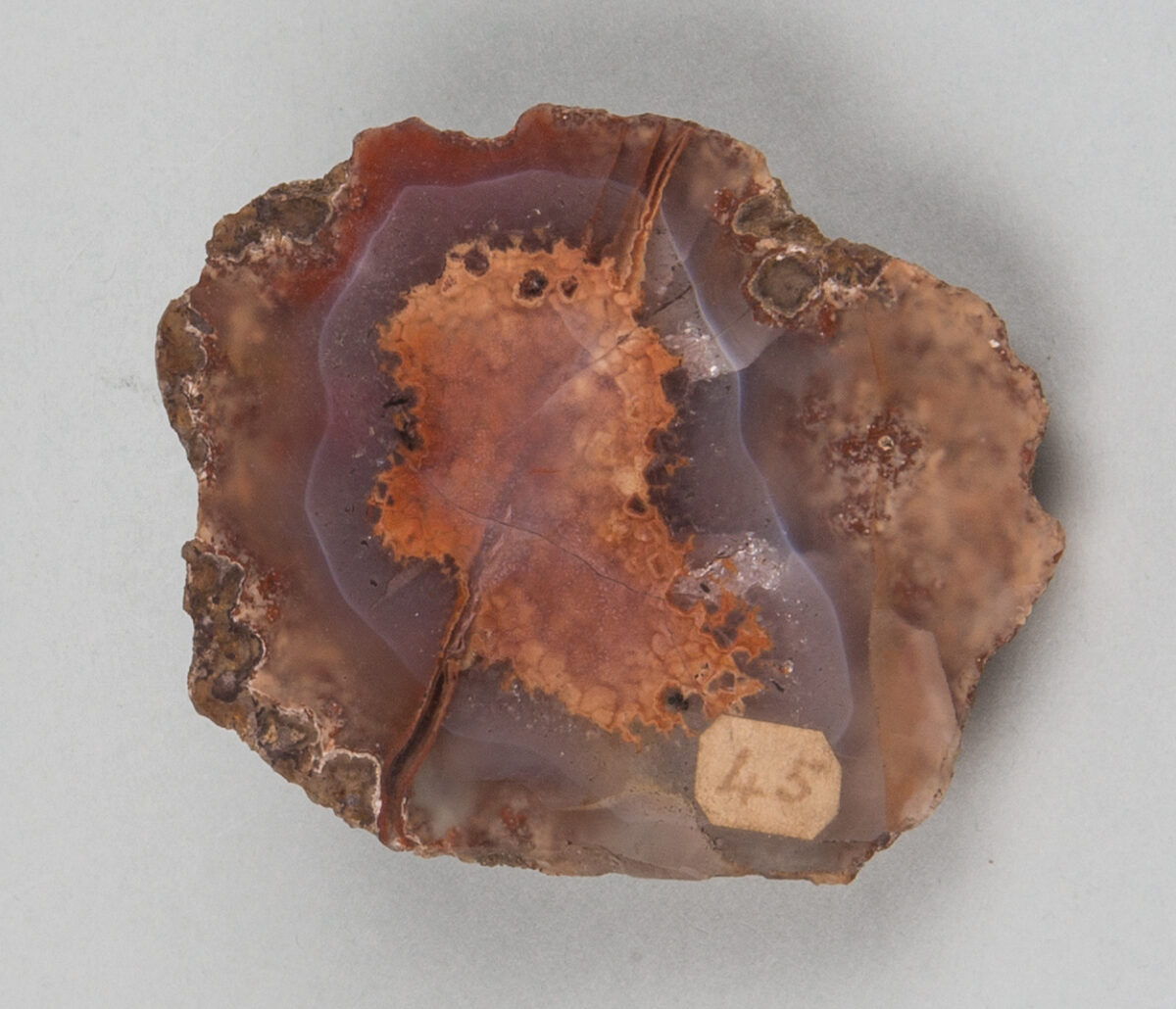
45. Three portions of a deeply interesting agate, formed as a ball in the hollow of a volcanic rock, and traversed, from its centre to the rock, by opposite tubular veins. The quartz crystals, in which the exterior band terminates, are coated with orange jasper. Their own sparkling cleavages seem like a diamond sand on the smaller surface of the middle slice. The whole thing is a trifid lump of wonder, and I wouldn’t give it away, if it didn’t always split my head into three slices to look at it. It is only half of the original. stone after all, but I never had the other half, and found I had quite enough when I cut this into three. 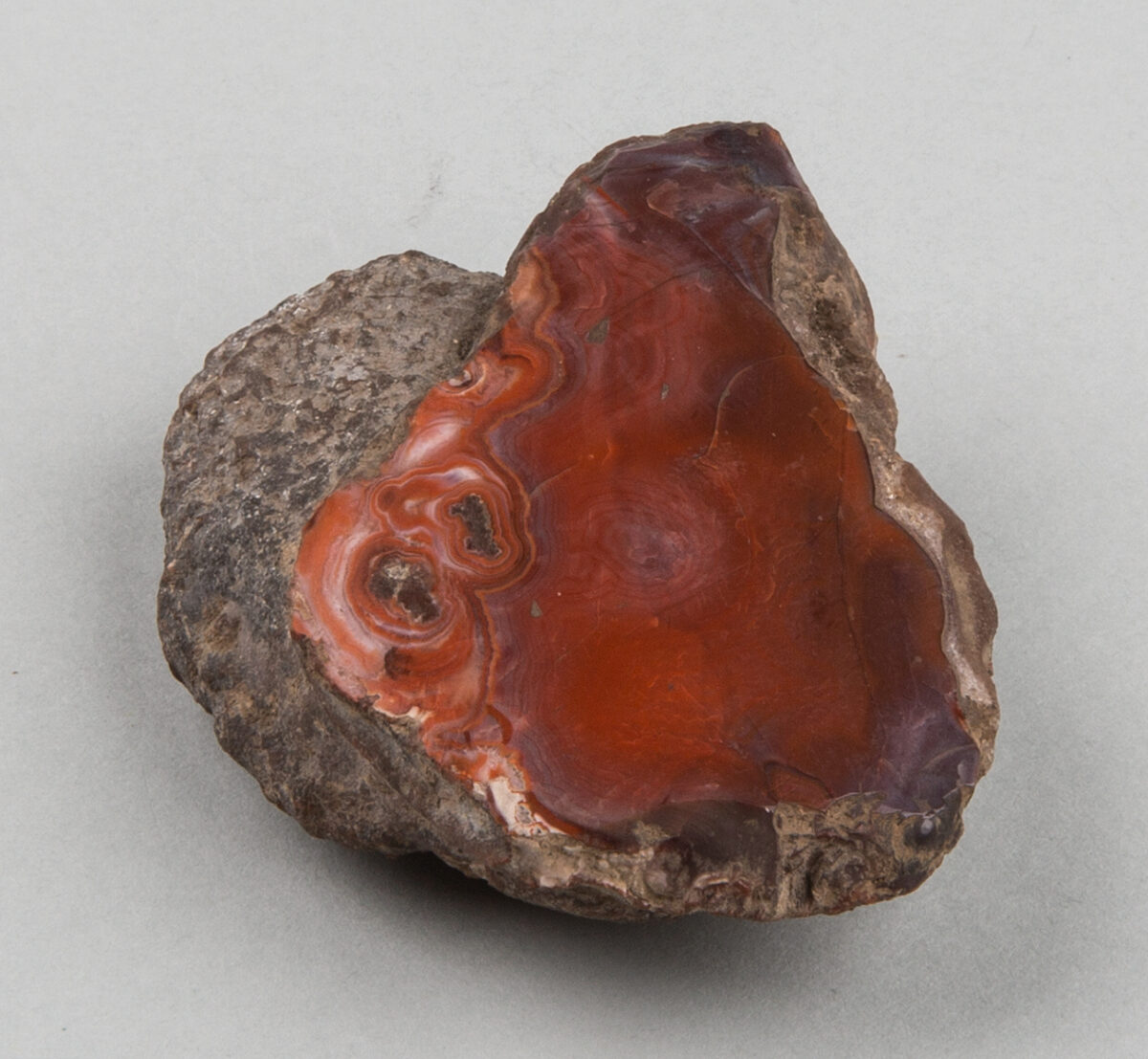
53. Perfect example of what, for distinction’s sake, I have called conchoidal jaspers, exhibiting all the previously described phenomena in perfection, yet with one added circumstance, which must be carefully noted. In all ordinary cases of the formation of rods and bands with earthy centres, the successive deposits or crystallisations on each side of the central film are alike: but in certain cases, not otherwise distinct from these the deposit on one side of the central film is different in number, or in depth, of bands, from that on the other. This little agate, though not so grotesque as many others, is really more curiously unreasonable, in the apparently motiveless effort to make one side of its white promontories always deeper in bands than the other; though the red encircling jasper is practically of the same thickness throughout, except where it clogs up in the bays. The pear-shaped or kite-shaped section of this agate is also extremely unusual, and, as far as my knowledge goes, unaccountable, all the more that the irregular white promontories would seem the result of forces which must also have produced an irregular surface. 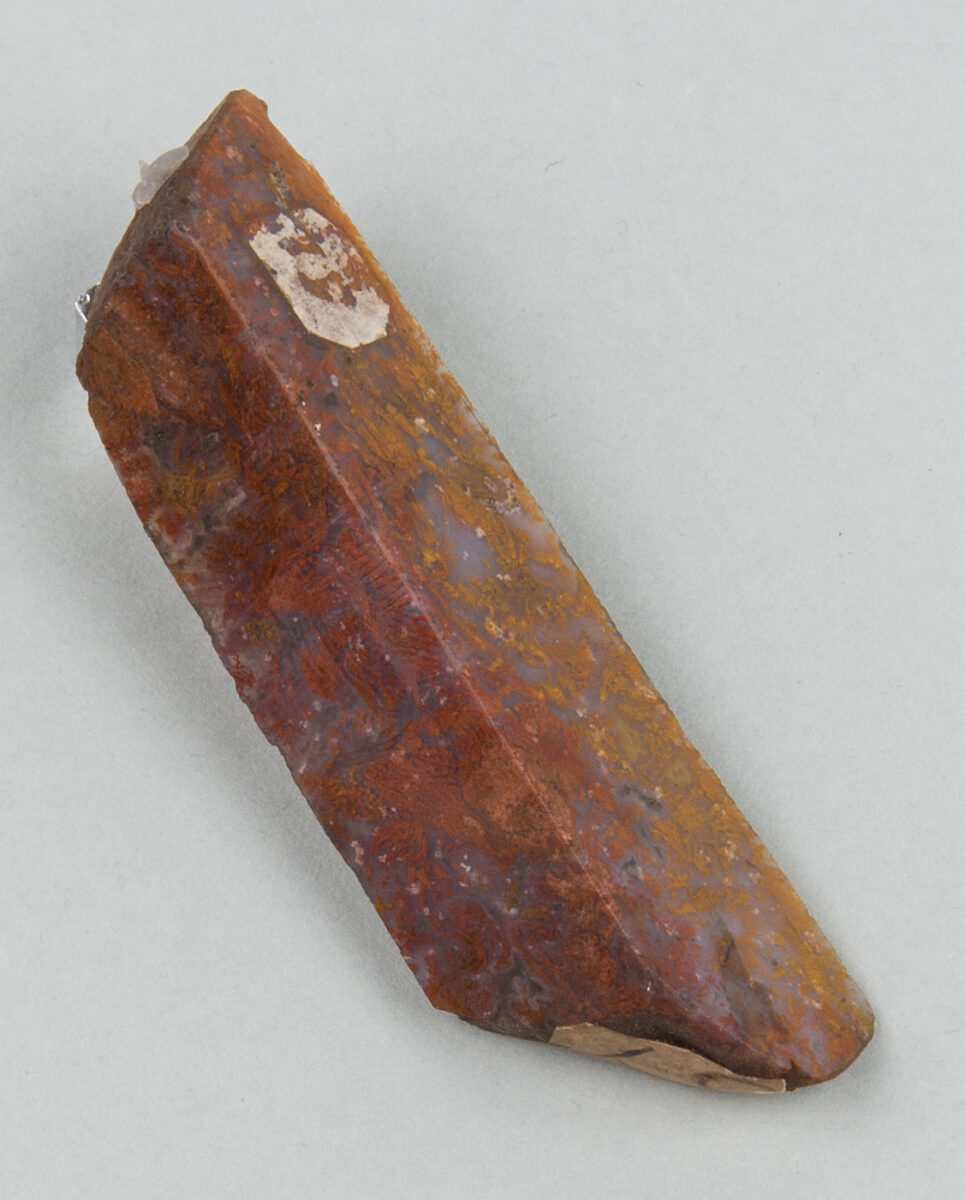
51. Submitted for examination to the greatest authority on muscose matter, Mr. Bowerbank; who sent me word back that it was a charming specimen; and that the embedded forms were all real mosses. I am myself, nevertheless, still under the somewhat contrary impression, that Mr. Bowerbank’s mosses must be all real minerals! At all events, the specimen is a superb, though a small one, and two or three film-slices might be cut for the microscope from its roughest end, without the least injury; and the question finally settled at St. David’s. 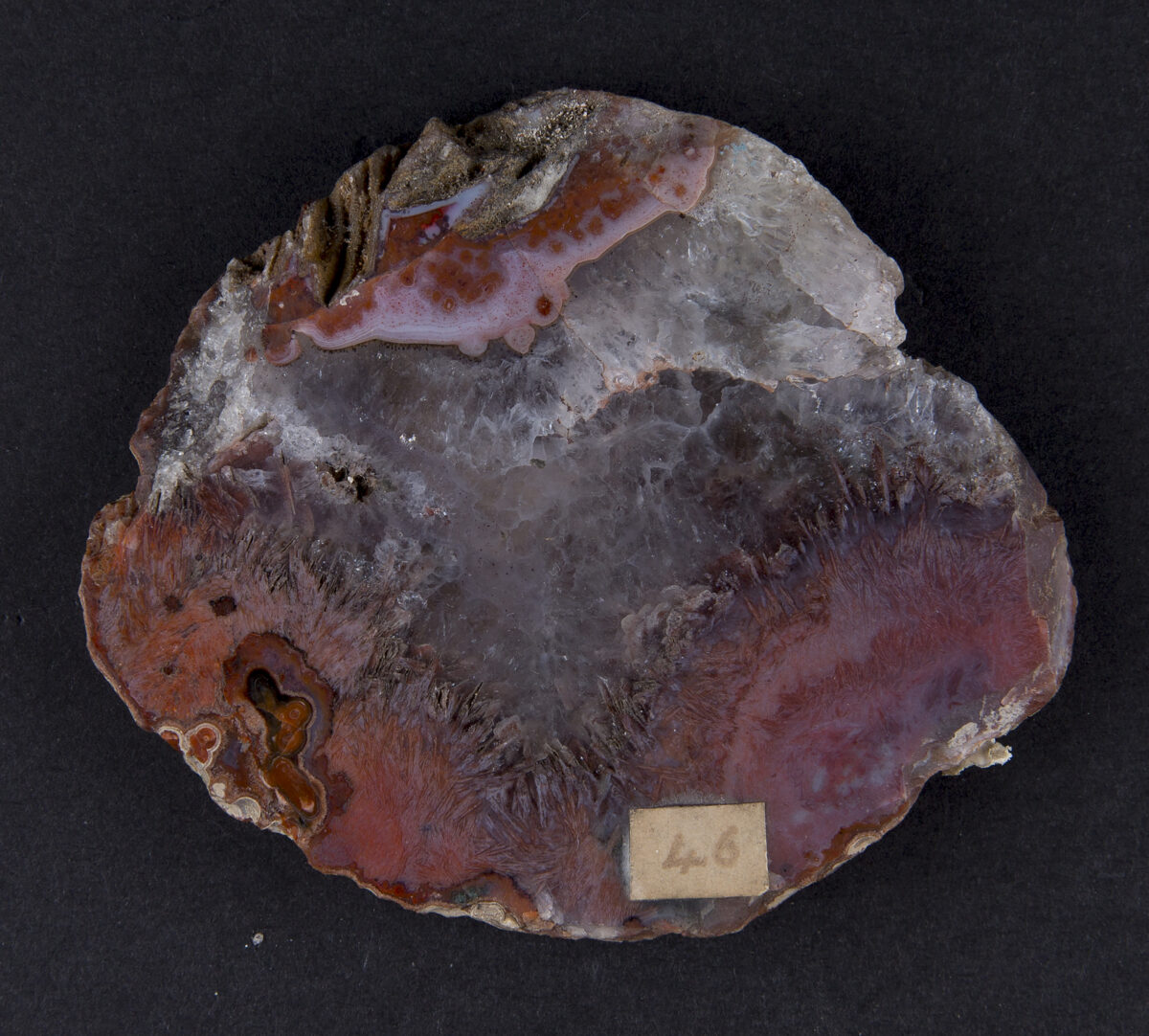
46. Acicular agate passing into jasper. What I mean by acicular agate, you will see by looking at it with a lens, but I don’t in the least know how it came to be like that. I was always afraid of breaking the specimen, but think that a thin slice might be taken off the flat surface, which though broken, would be very marvellous under the microscope. 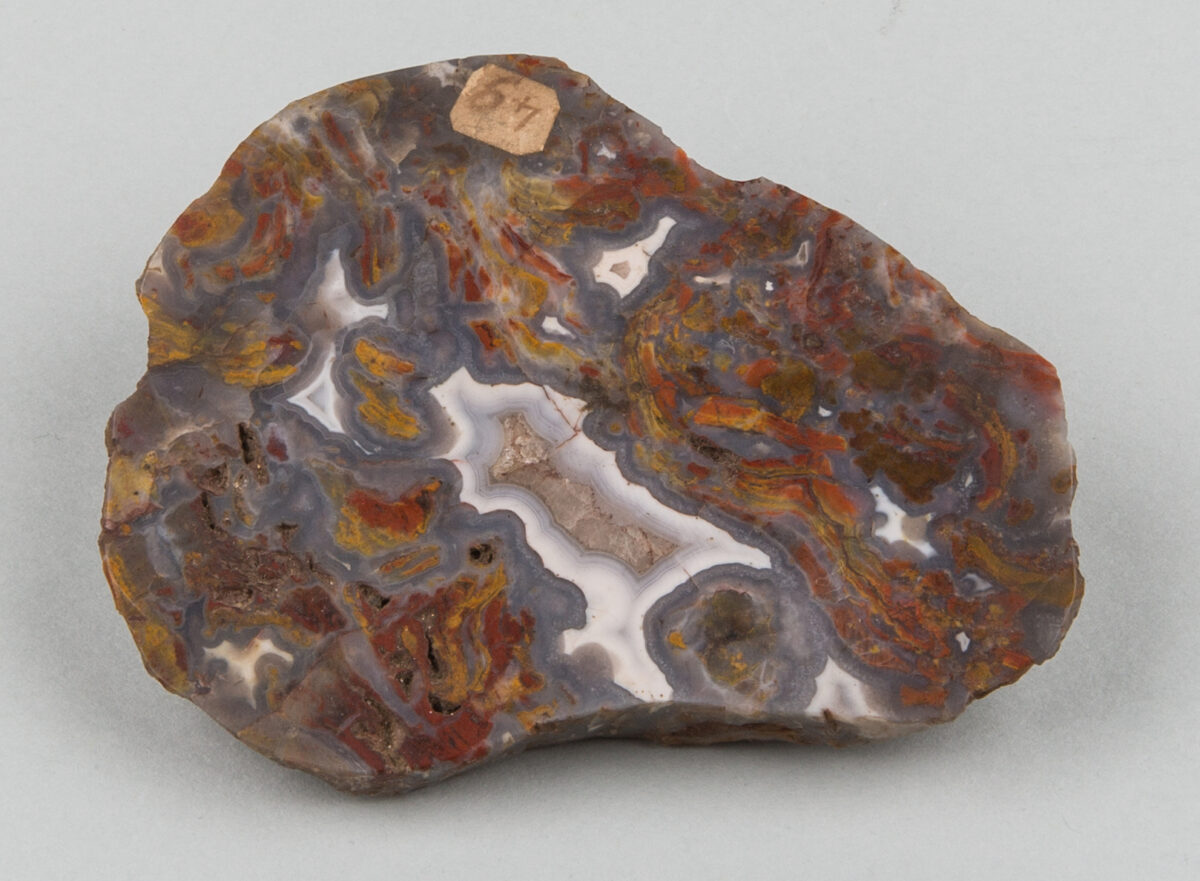
49. Brecciated jasper, in variously interrupted bands apparently floating in grey chalcedony. An example of extreme interest connected with the shell-like jaspers on the one side, and with brecciated agates on the other. 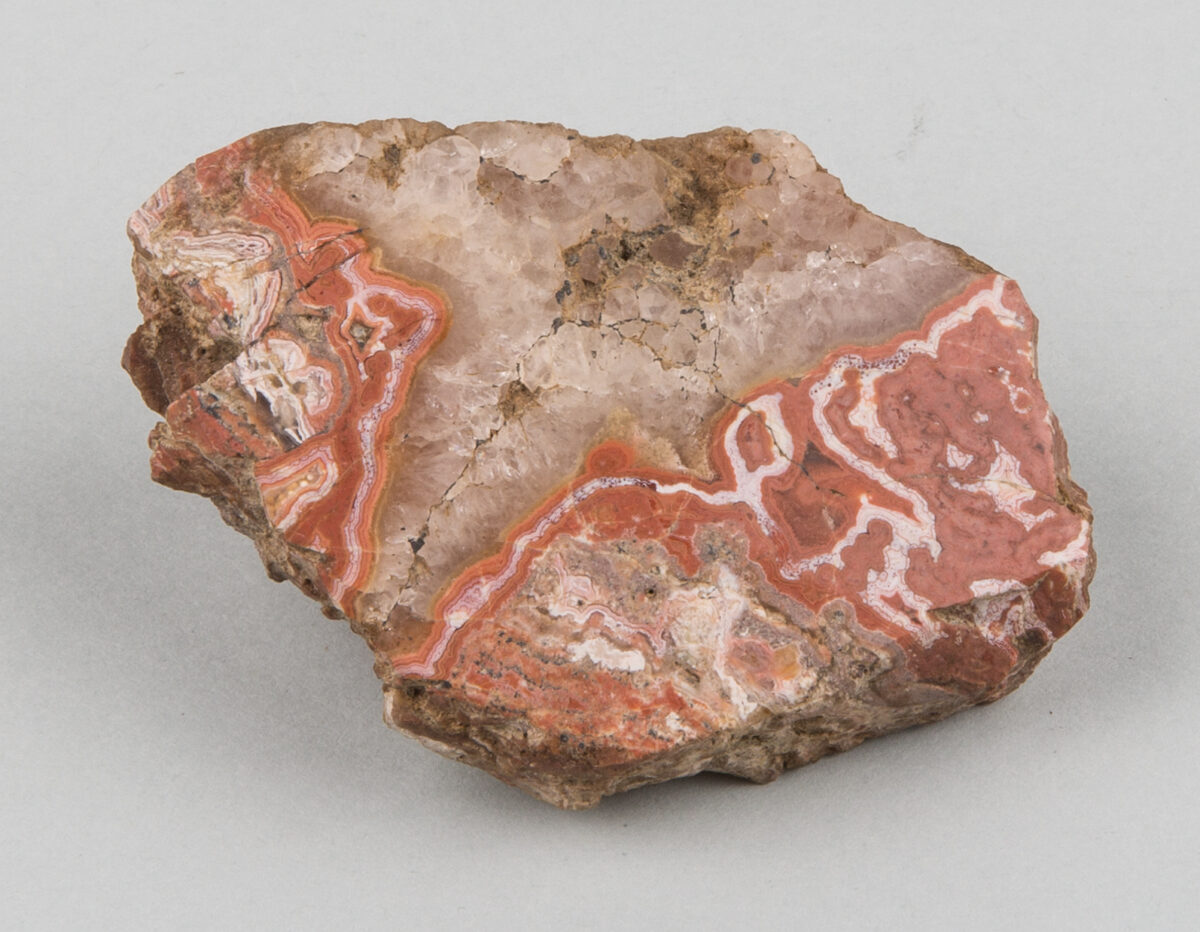
52. Yellow and red jasper, thrown into bands by the force of the continuing agate, which however, is so far bothered by the stolidity of the jasper that it can’t form its own orbs and angles properly; but wriggles and loops itself about, partly in the style of the jasperine vermicelli. Small; but extremely valuable and interesting. 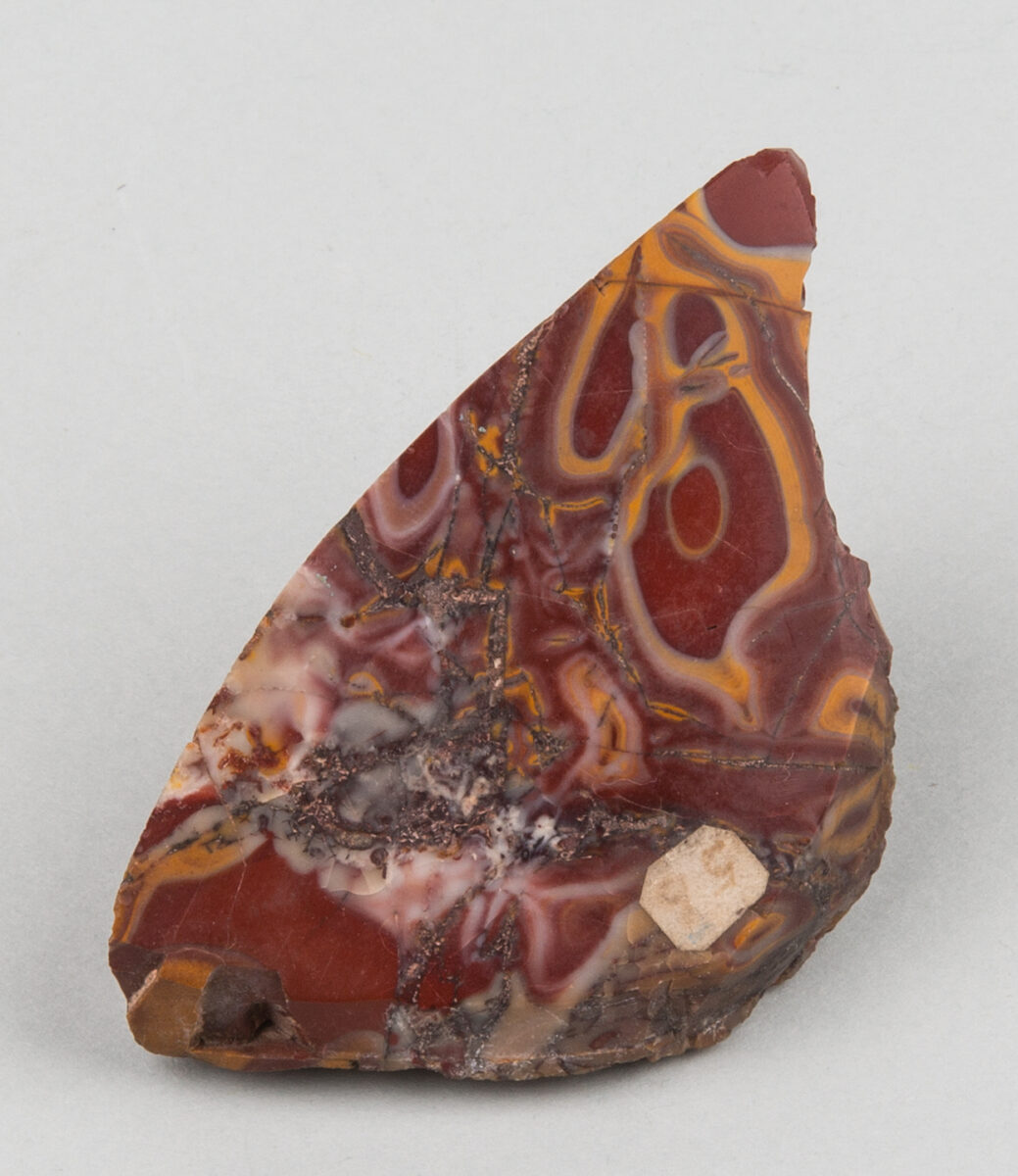
56. Red and yellow jasper variously coiled and squeezed, with veins of imperfect quartz, a rare kind, which the traveller who gave it me told me he had ridden three days in a savage country to get. As I don’t care about savage countries, nor whether a jasper, which one must ride three days to get a bit of, (and can’t make anything of when one has got it,) is to be found in New Guinea (this is, I believe, from New), I have no reluctance in parting with this specimen: but I believe it could not be easily matched. 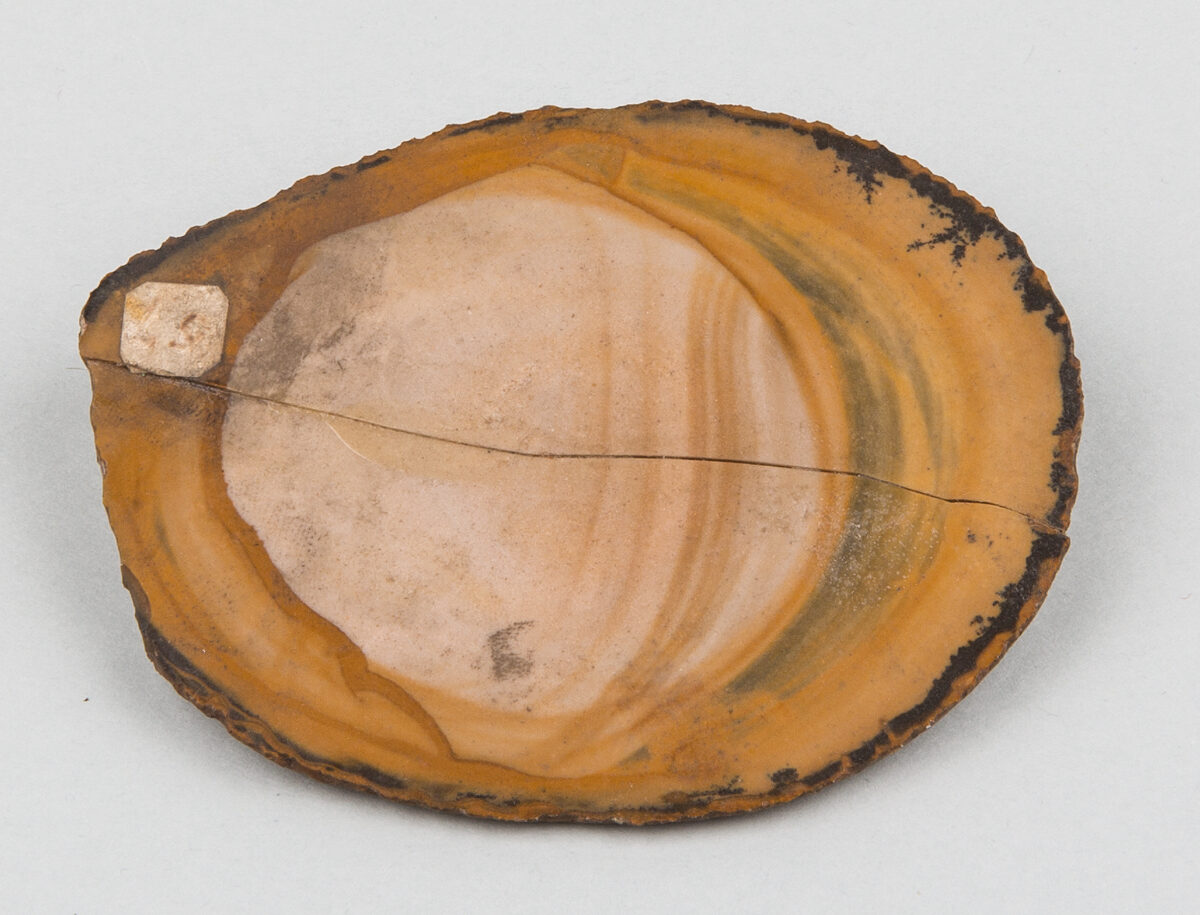
57. We return to the regions of propriety and common sense, in a slice of pebble of the ordinary kind, known as Egyptian jasper. These pebbles are, I believe, found loose in the sand, and I do not find the mineralogists give us any account of where they come from; perhaps, however, the first question ought to be, where the sand they are found in comes from, since we get too easily into the habit of thinking that two-thirds of Arabia and Africa were originally manufactured of sand. The pebble itself is very characteristic in its substance,-jasper properly so-called, without any admixture of chalcedony. Though so thin, it is perfectly opaque, and though apparently containing a considerable proportion of clay or lime, takes a quite lustrous polish. Its bands appear to be the result of the same process which takes place in banded flints.
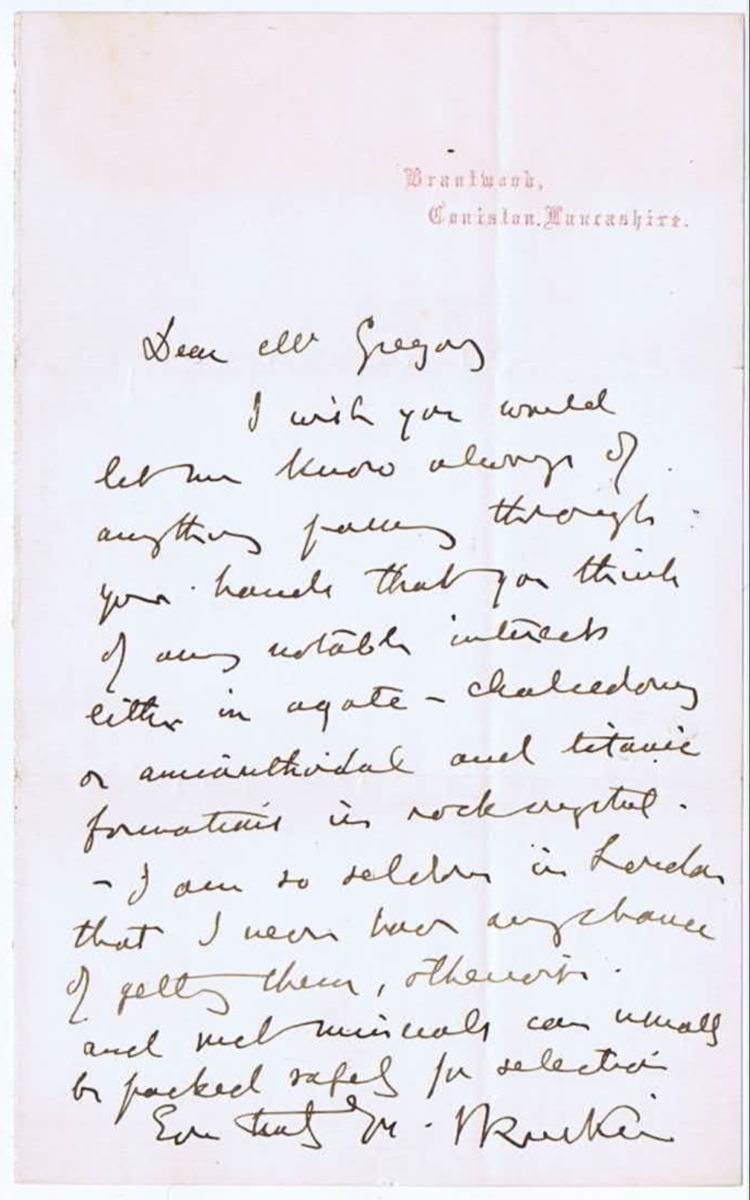
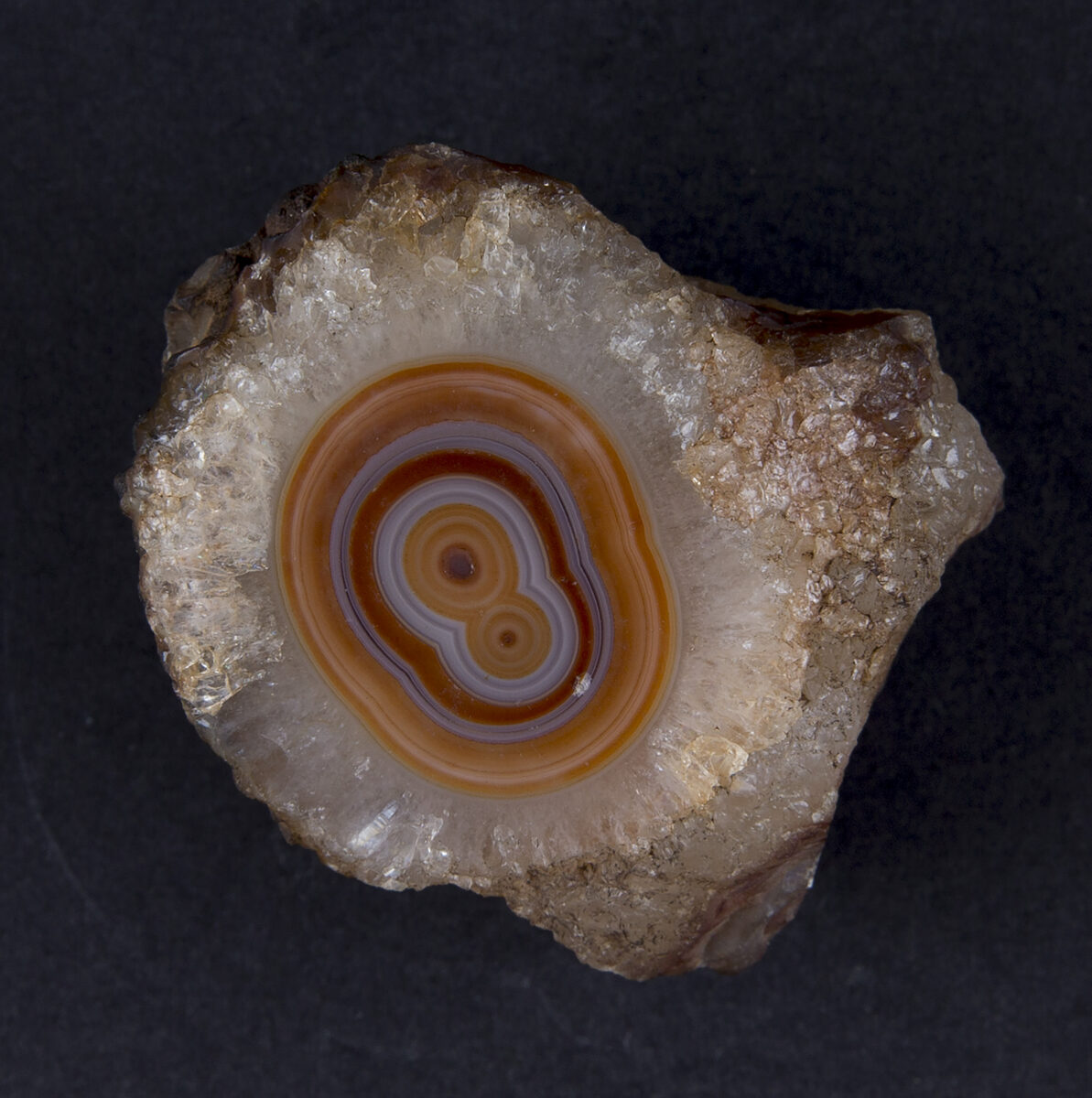
45b. Three portions of a deeply interesting agate, formed as a ball in the hollow of a volcanic rock, and traversed, from its centre to the rock, by opposite tubular veins. The quartz crystals, in which the exterior band terminates, are coated with orange jasper. Their own sparkling cleavages seem like a diamond sand on the smaller surface of the middle slice. The whole thing is a trifid lump of wonder, and I wouldn’t give it away, if it didn’t always split my head into three slices to look at it. It is only half of the original. stone after all, but I never had the other half, and found I had quite enough when I cut this into three. 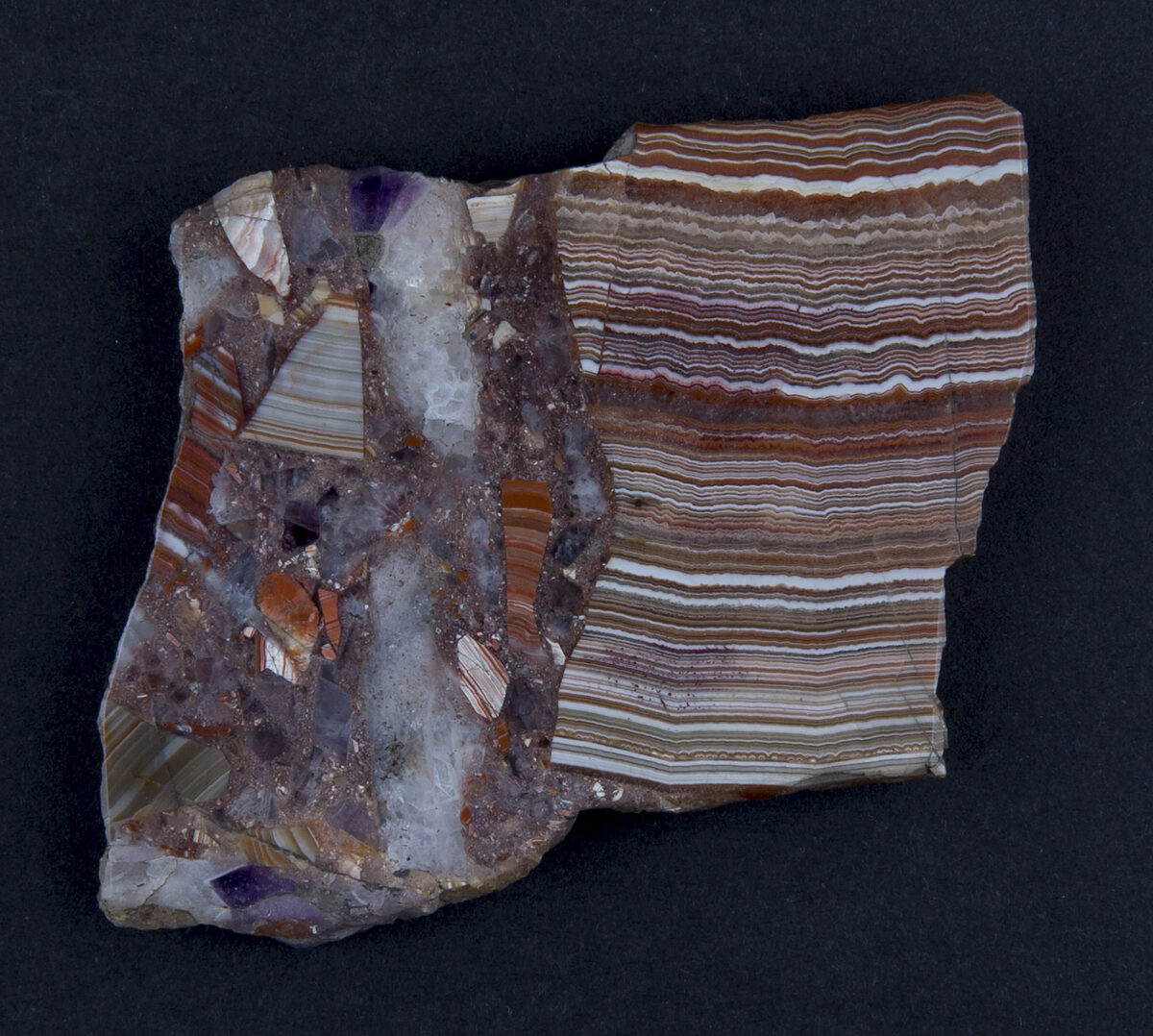
12. Jasperine agate, in perfect brecciation. A small slice off the best piece I have in my own collection. 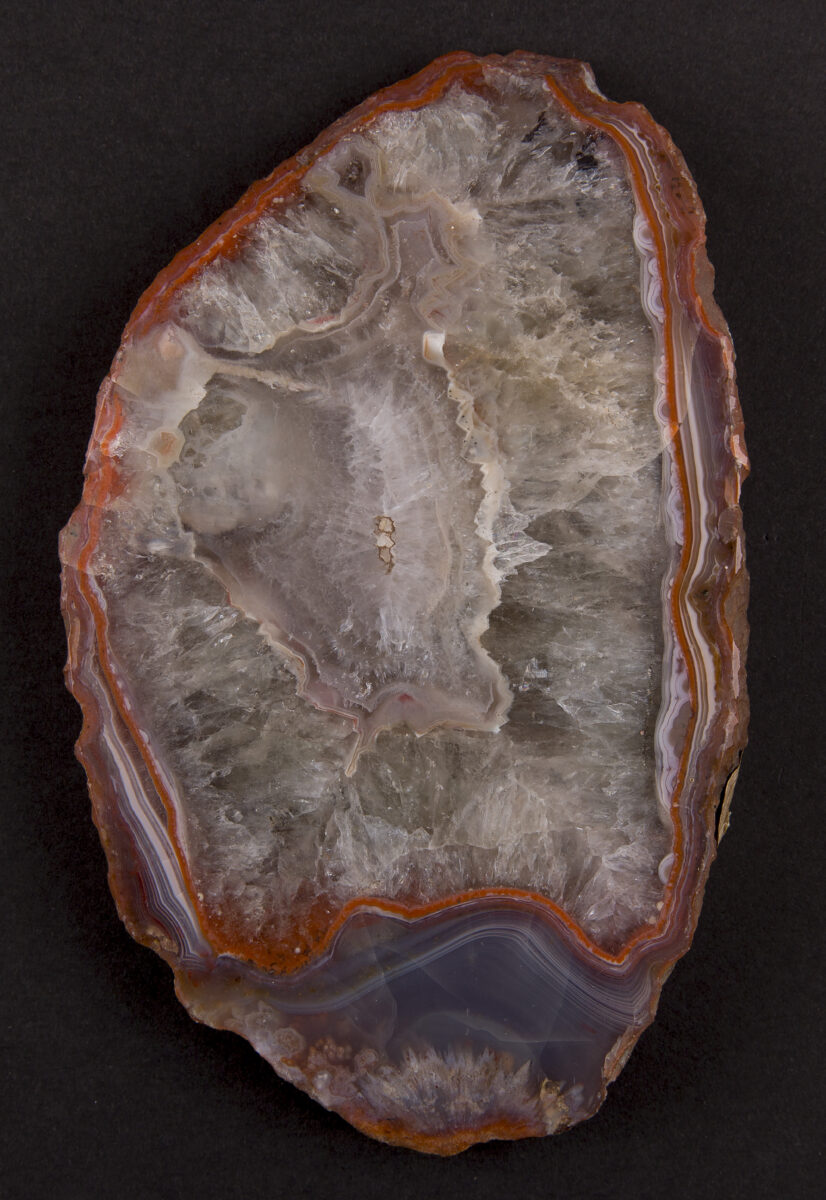
59. Slice of a jasperine agate of the finest quality showing agatescent formation, inside as well outside its quartz. The external bands, variously arbitrary, and unmanaged, or unmanageable, but chiefly notable, because, on the interior of the narrow and consistent band of red jasper, which falls away at one end like the loose thread of a skein, there will be found a series of little circular domes, built into the quartz; white on the surfaces, and cut through into pretty violet white sections, which perfectly illustrate the spots in the two small agates cut into heart shape, Nos. 6 and 7, of the ‘Cross’ series, p. 21. 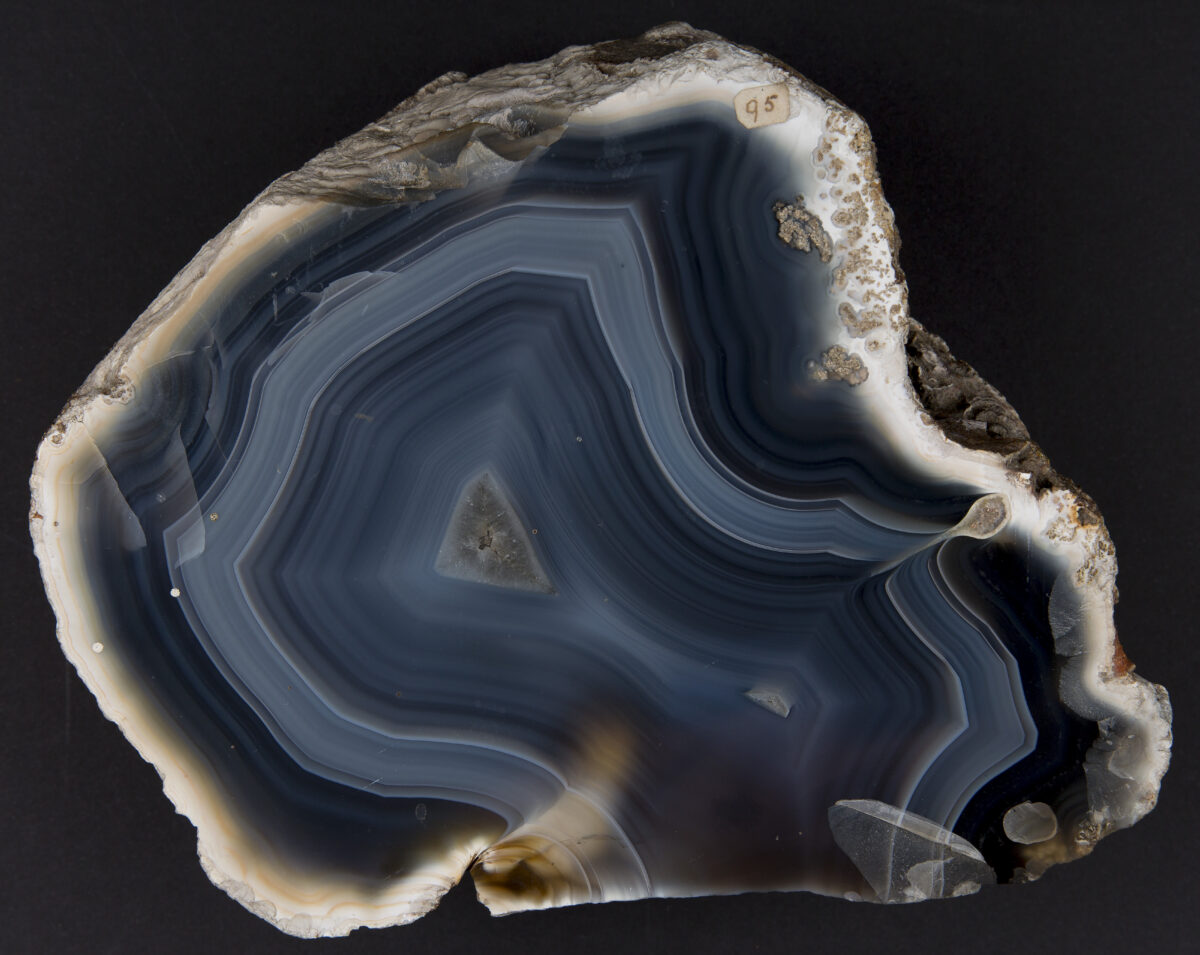
95. No label, no description. 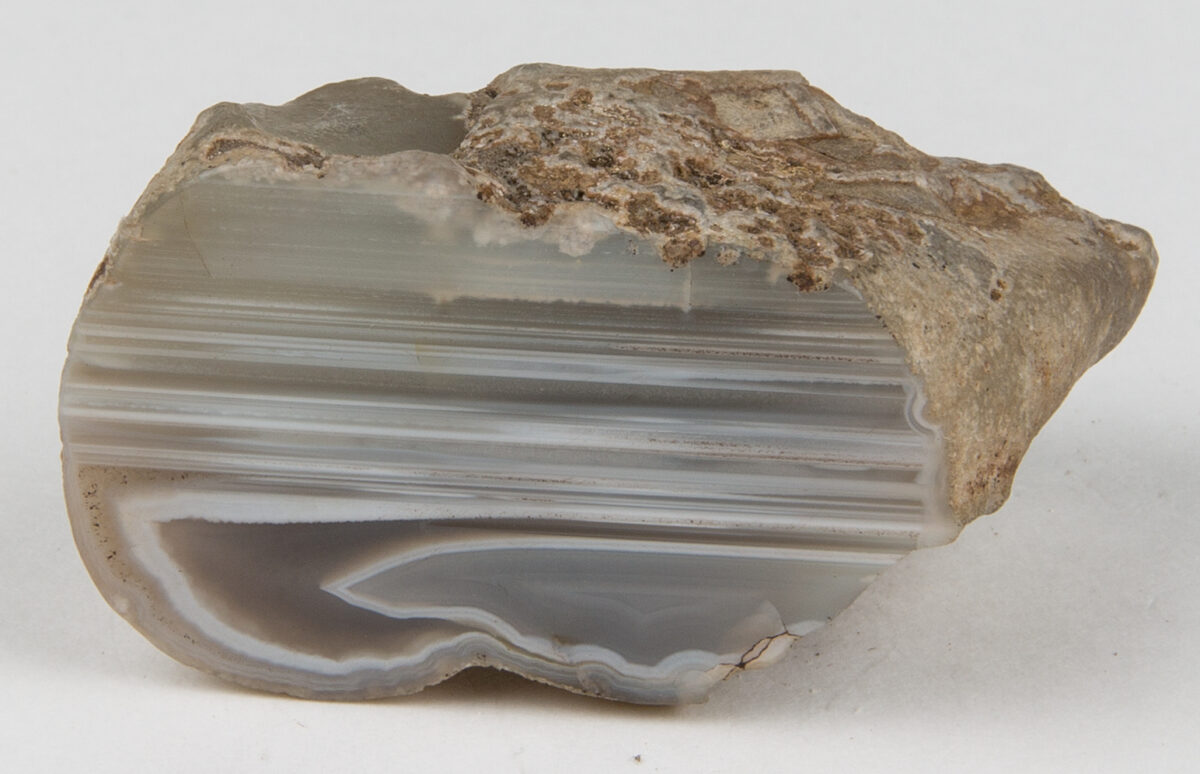
9. Agatescent Chalcedony, (i.e. chalcedony throwing itself into bands,) showing both the straight-levelled and concentric forms. An altogether exquisite example. Cut into four pieces, and polished, under my own direction. 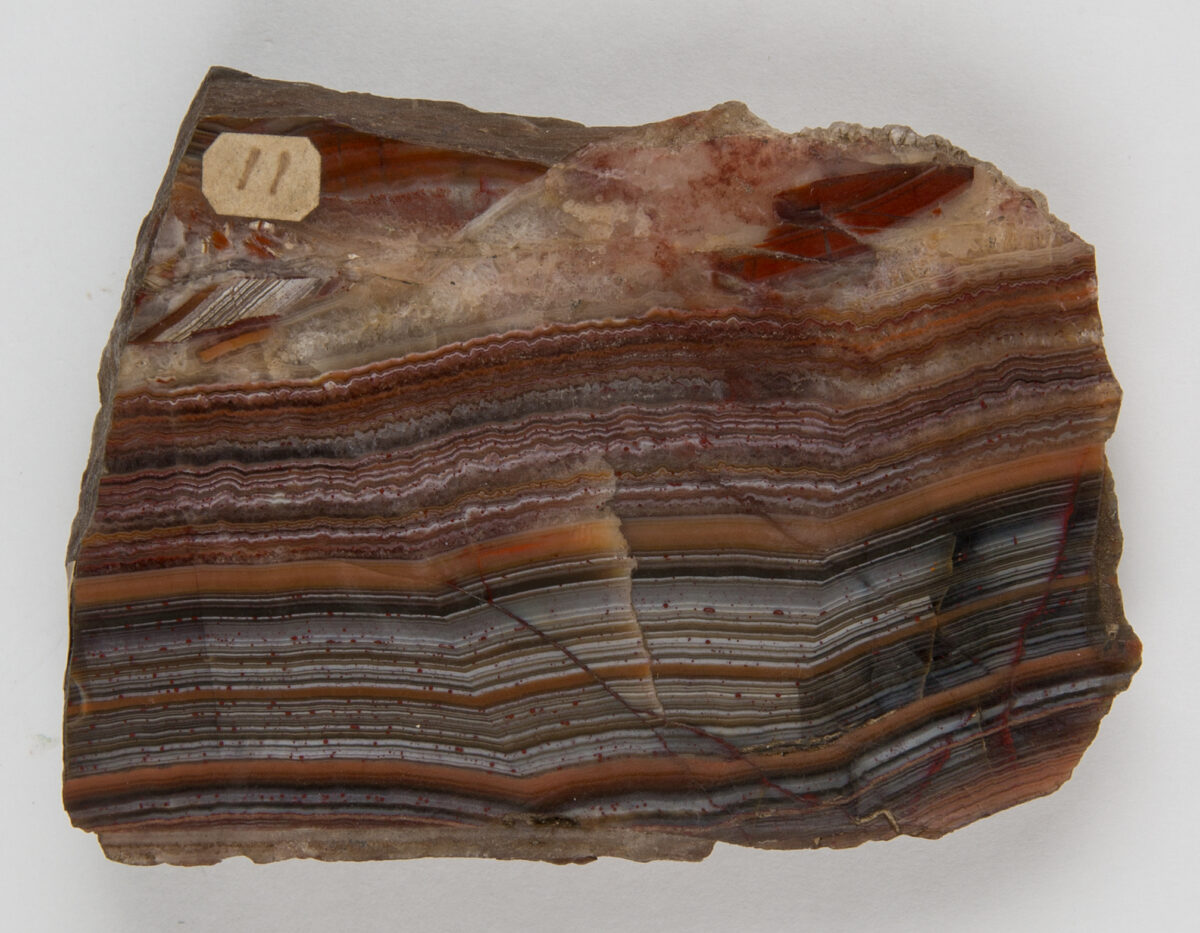
11. Jasperine agate, in developed brecciation. 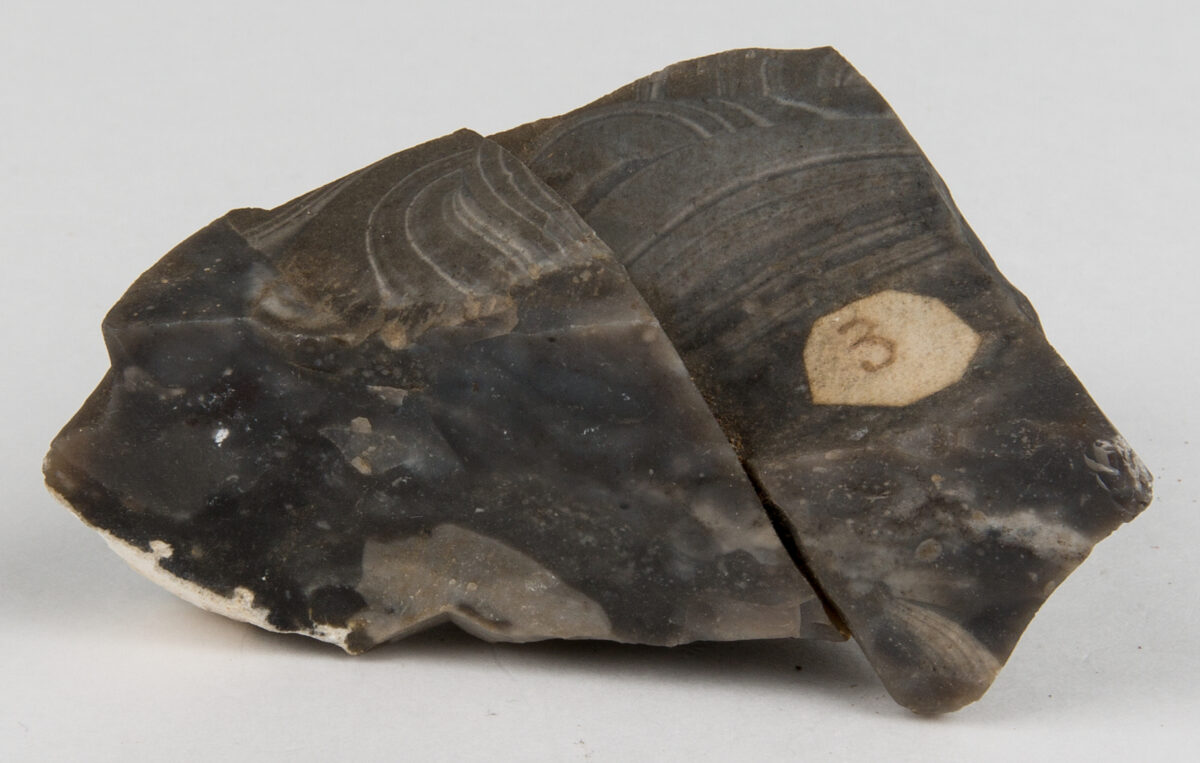
3. Two pieces, a and b, (2070 of my old collection). A superb example of finely delineated and terminated agatescent structure in dark grey flint. 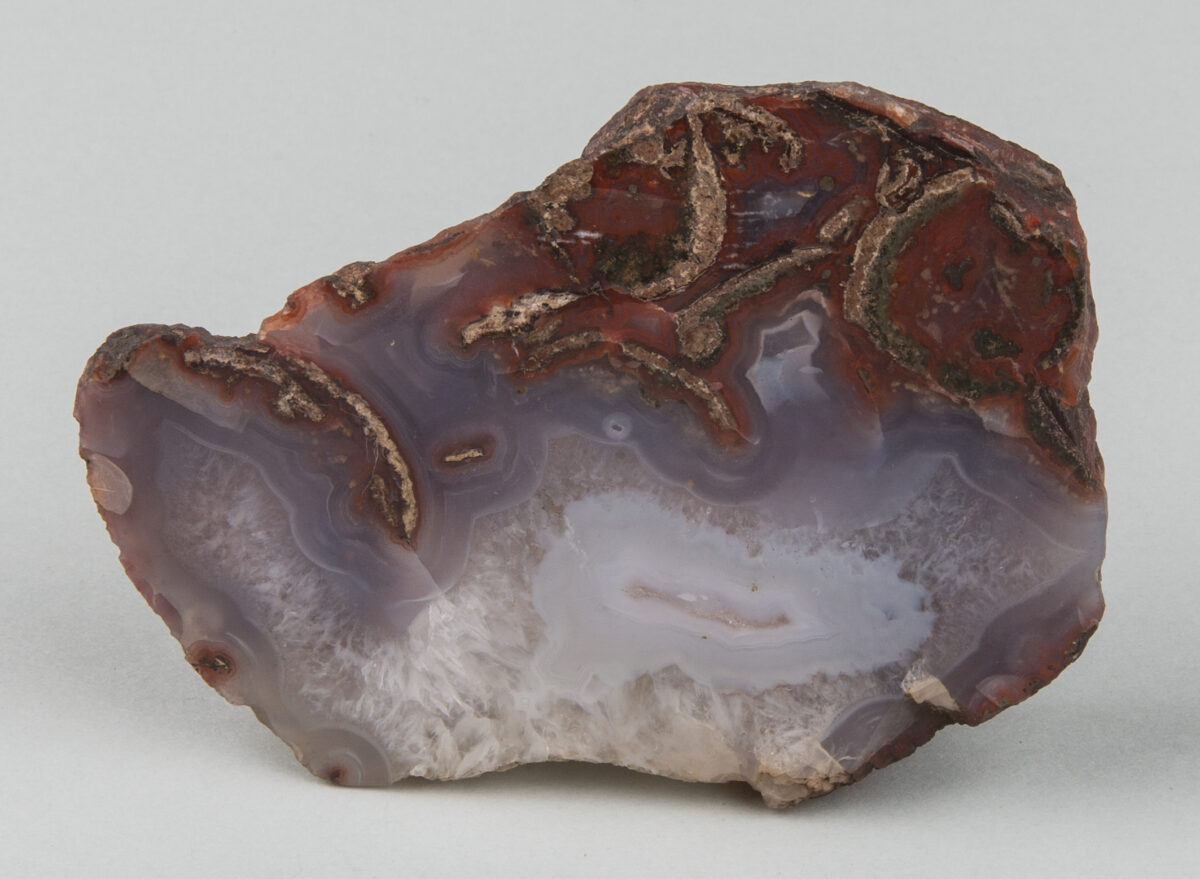
42. Blue agate, surrounded by a coat of scarlet jasper. It will be seen that the globular concretions of the agate are independent of this exterior coat while yet the jasper is itself partly agatescent and both are bent about by a brown concretion at the edge of the stone. The specimen is full of all kinds of puzzling interest. 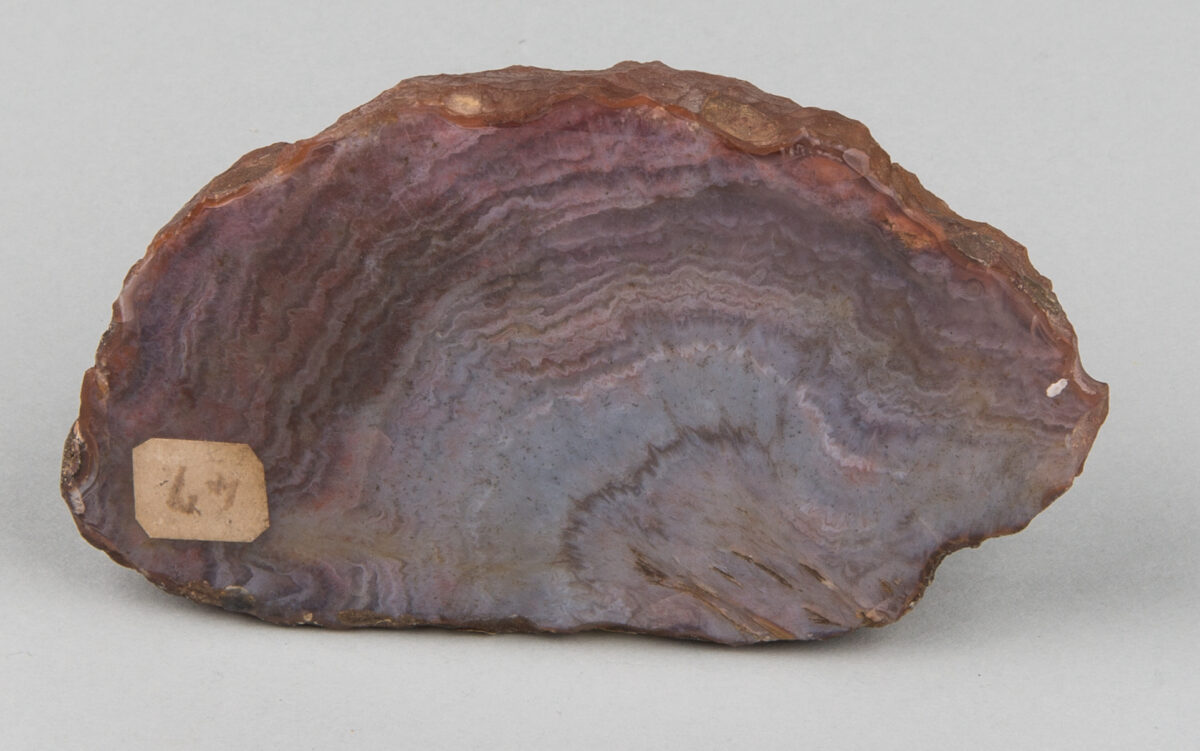
47. Blue and purple agate, partly acicular, partly zoned, partly anyhow, with a jasperine coat; but these examples are all hitherto given for types of colour, and for illustration of the connection. of jasper with agate, rather than for specimens of jasper itself. We shall now pass on to examine the more compact forms of it.

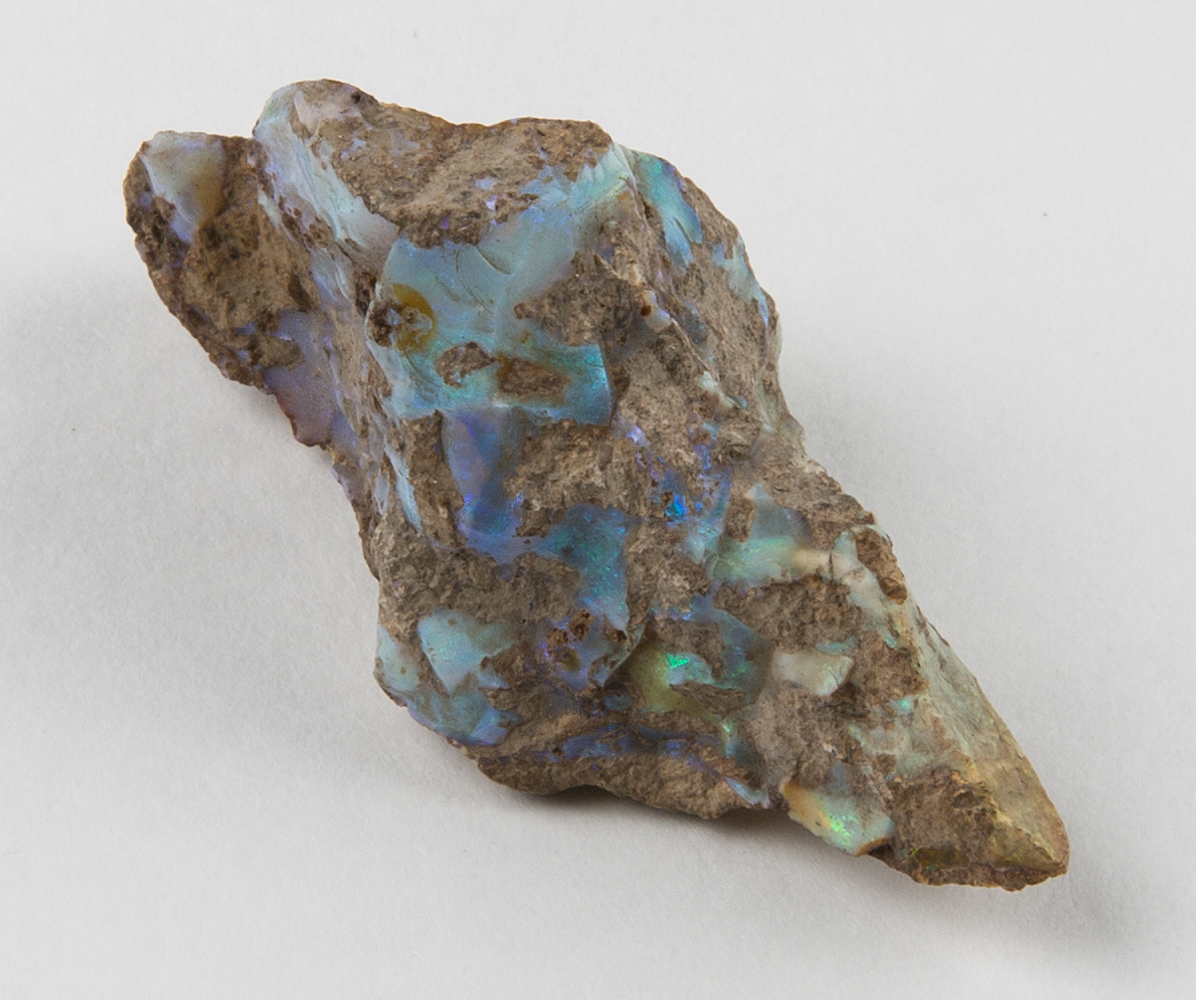
88. Precious opal, Hungarian, the best kind, diffused through the stone, not forming veins in it. The opals used in jewellery are pieces cut, as large as possible, out of this kind of rock and afterwards rounded and polished. I never heard of a rolled opal being found in any stream, or a round pebble of it found in any rock. 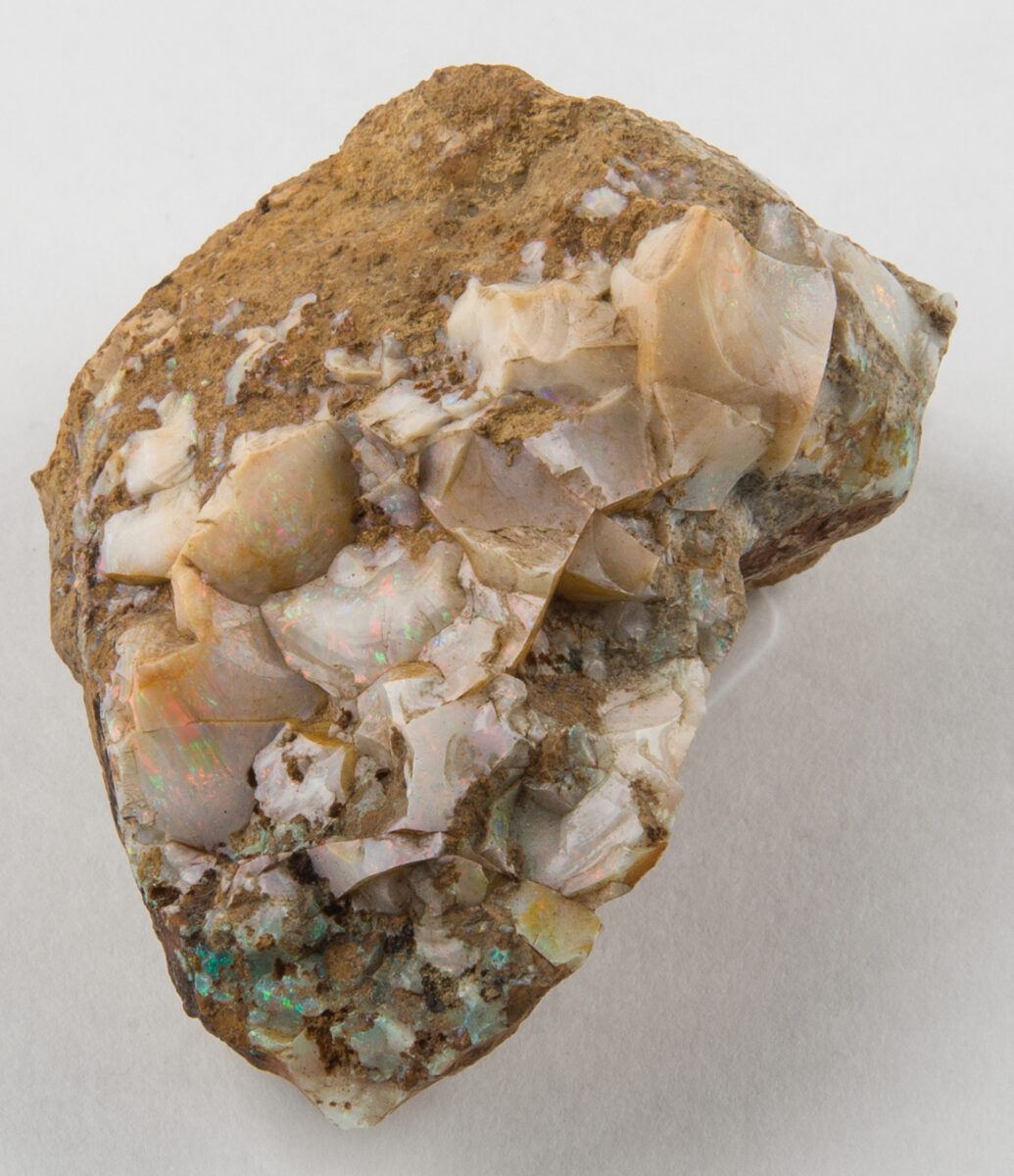
87. Brazilian opal, of the kind called hydrophane, which absorbs water on being dipped into it, and only then shows its perfect colour; it can’t be too often dipped into water, but neither it nor any kind of precious opal should be exposed to strong heat of fire or sunshine. 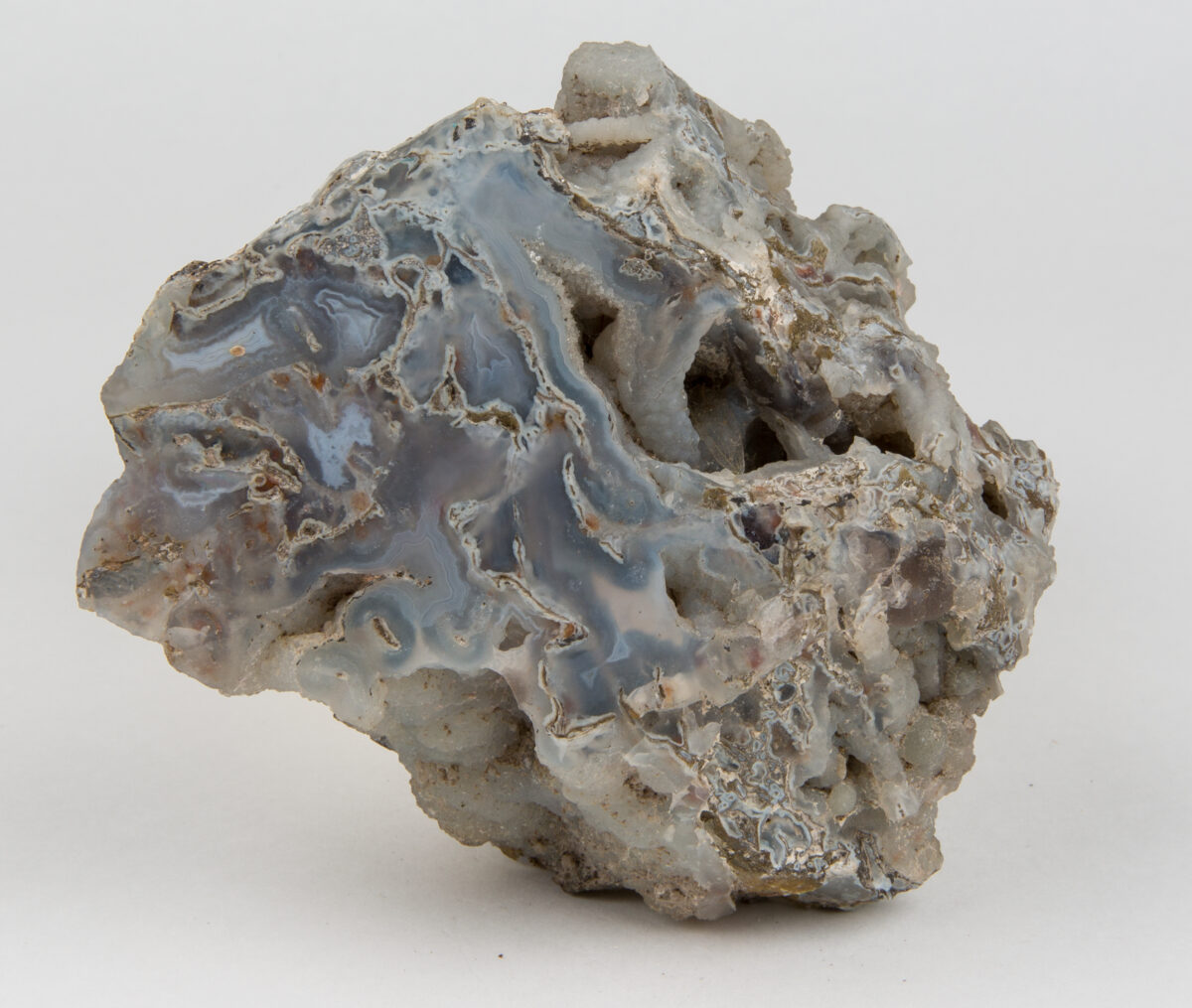
21. Chalcedony on amethyst-quartz. Extremely interesting, both because the points of its pseudostalactites are nearly all perfect, (it is extremely difficult to obtain specimens in which the points have not been knocked off) and also because they show their peculiar difference from real stalactites in dropping, half of them down and half of them up. Modern geology would, of course, not scruple to explain this phenomenon by the theory that the world had been turned upside down in the interval. I prefer, myself, to direct attention simply to the circumstance, and to the farther interesting fact, that one stalactite in the middle dropped sideways. Quite seriously, though there are forms of chalcedony, like those deposited by the Iceland Geysers, which do really drop, and fl ow, no mineralogist has yet explained the intermediate incrustations, of which this is a notable example, whose forms seem to be totally independent of the action of gravity. 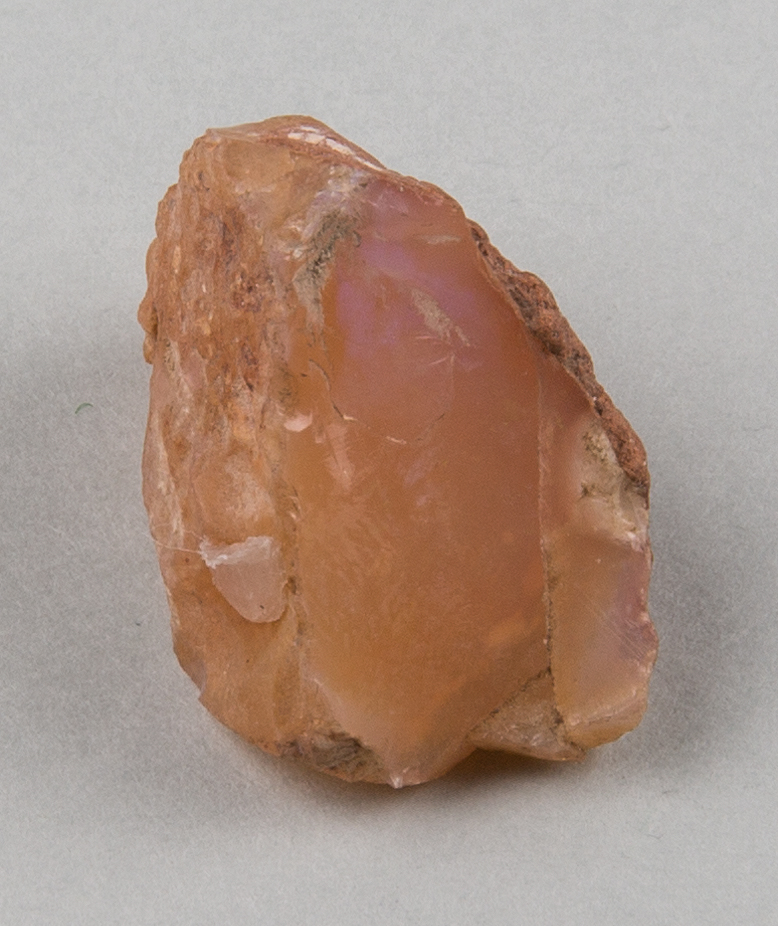
85. Hungarian precious opal, of finer quality, in a thicker vein. I broke away two bits of it on speculation, thinking to come at better colour, but I never have any luck in speculation, and pasted the bits in again. If they come loose they may be reattached better than I have done it, this specimen being one of considerable interest. 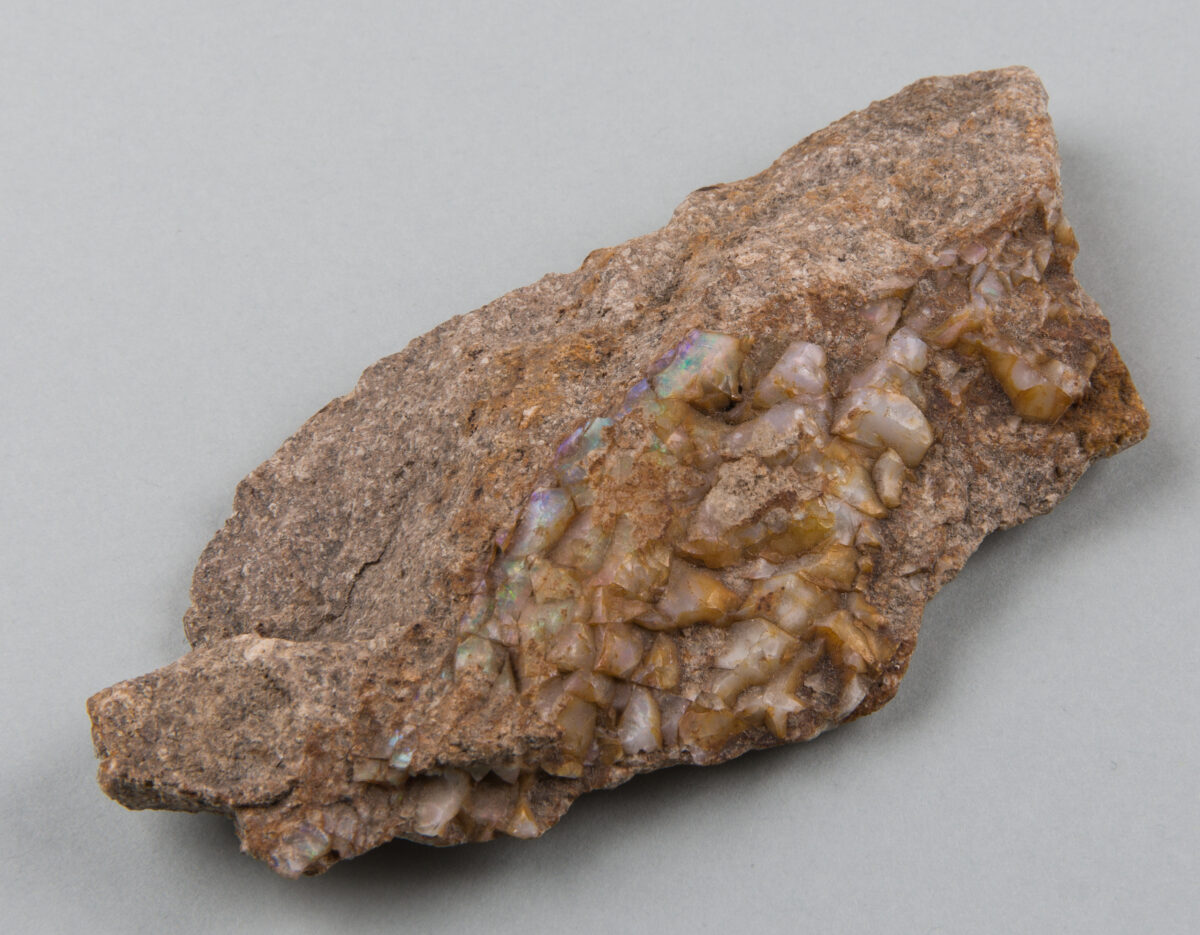
84. The next seven specimens are examples of the rarest and most beautiful form of silica, the opal, a stone, however, belonging more to modern romance than to classic history. The most precious forms of it are found somewhere in Hungary, I suppose under the influence of our old acquaintance, Transylvania. I can’t spell the name of the place where they are found and nobody could pronounce it if I did, and it doesn’t matter. The other varieties of opal, some only discovered recently, are Brazilian and Australian. This No. 84 is rather a specimen of the Hungarian rock than of the opal, which, however, is seen beginning to develop itself in colour, out of the pale bluish white substance which forms the vein. All of it properly called opal, and known by its peculiar gelatinous fracture; the colour comes where its structure is perfectly developed, being dependent on structure only. 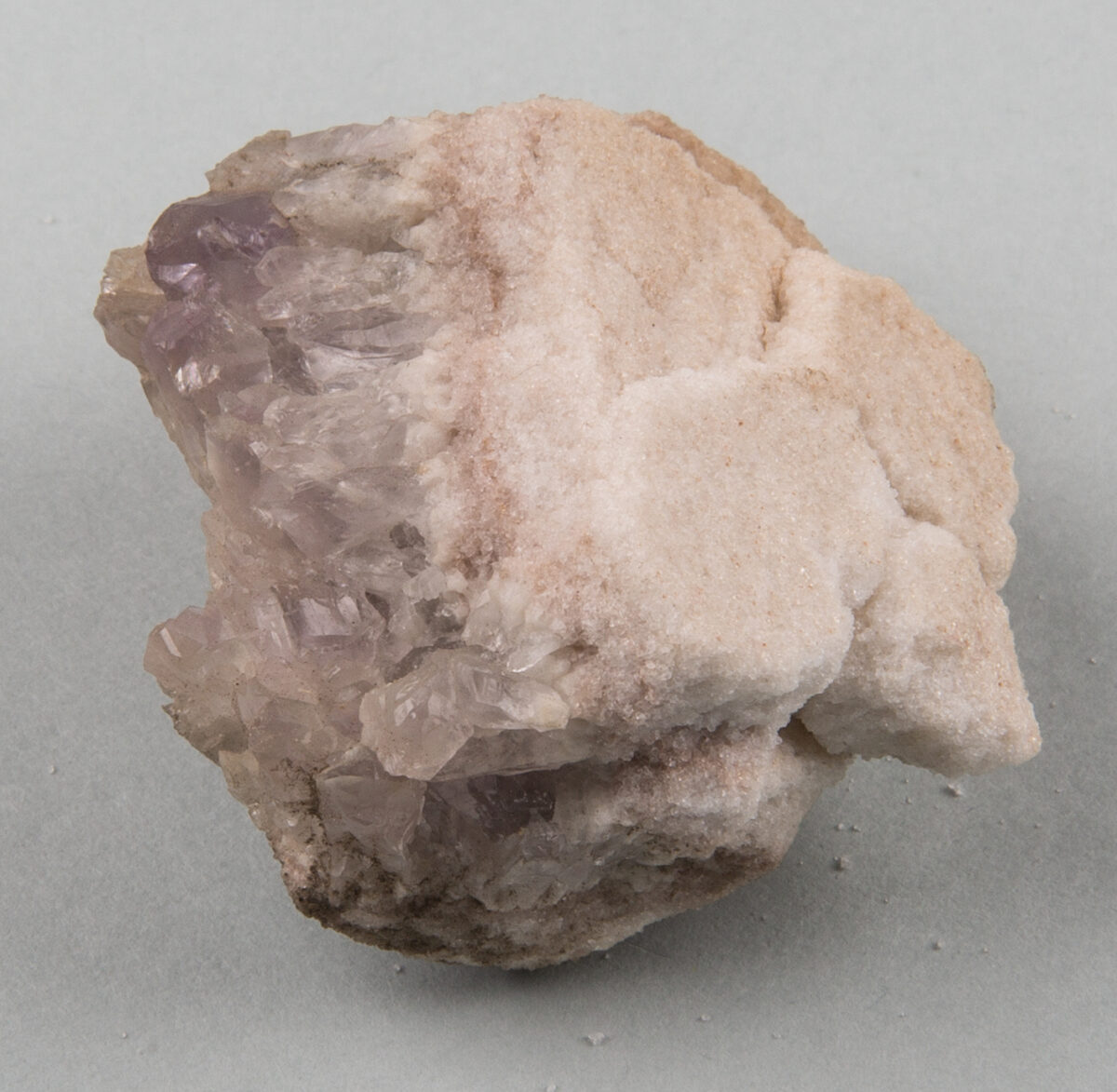
82. Pale amethyst, on slaty sandstone, very pretty, and geologically interesting. I believe also rare: it is at all events the only example I have seen of this mode of occurrence. 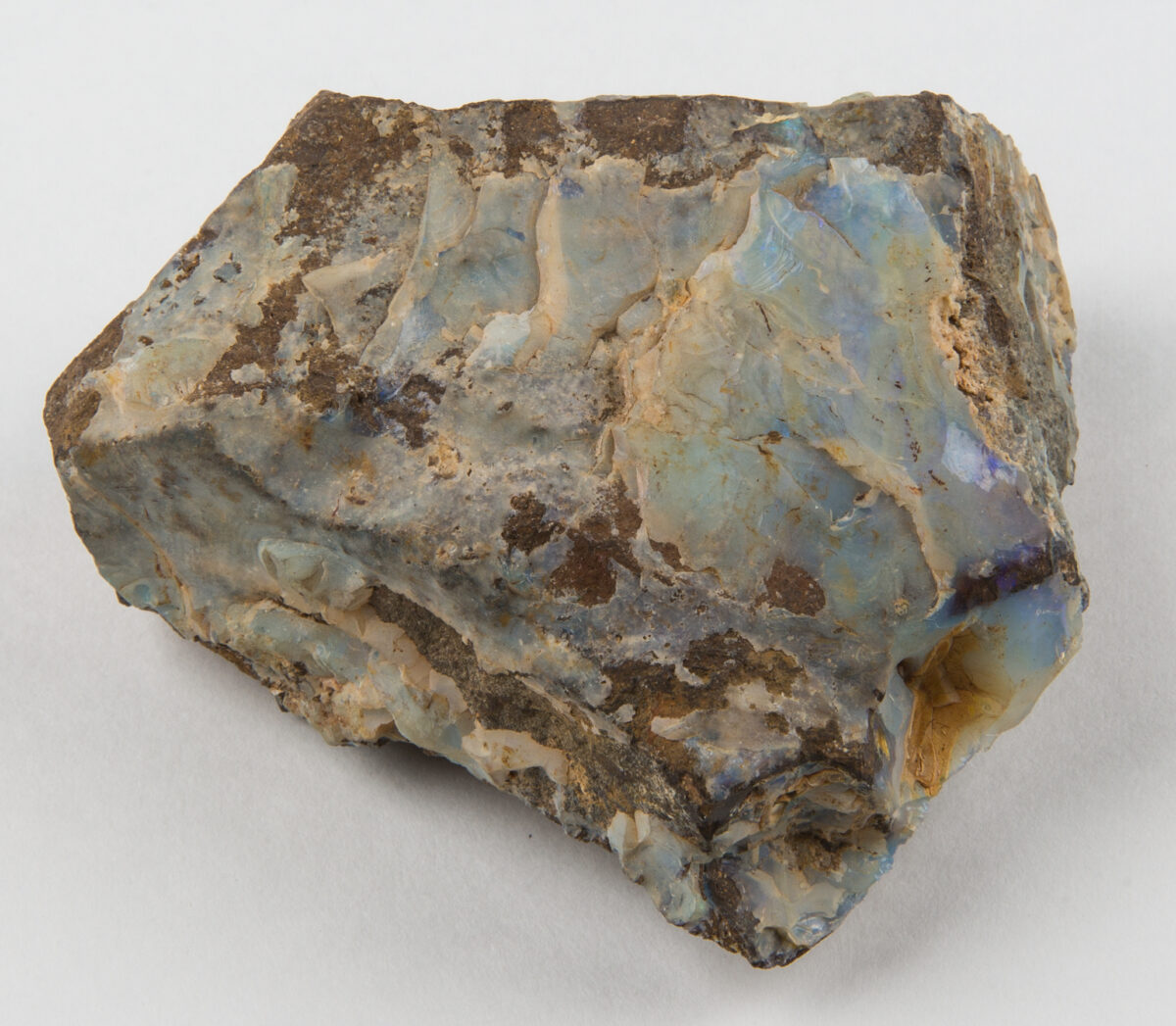
90. Australian opal, diffused through course brown jasper, and itself extremely beautiful and full of colour in the blue tones. It is more rarely found with lights of vivid green, but seldom with red, which is the colour most prized by jewellers. This quality of blue opal, however is gradually establishing itself in commercial esteem, having been only known since the year 1878. 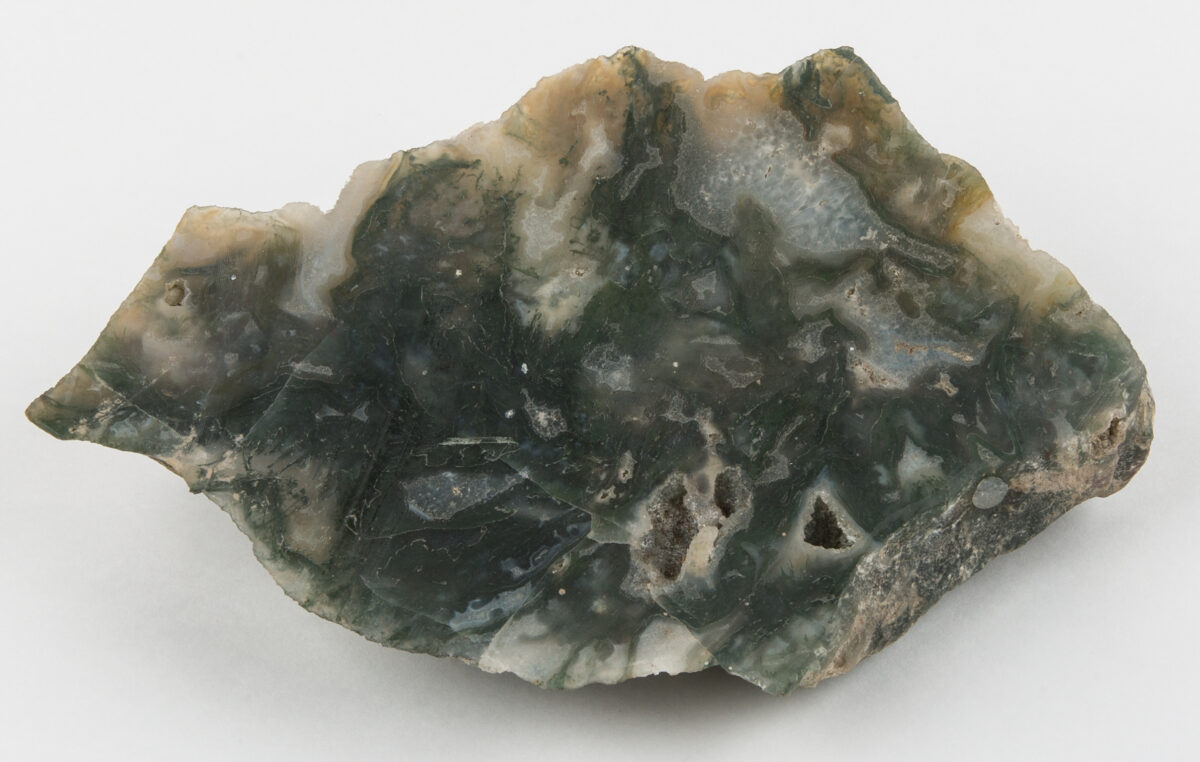
92. It belongs properly to the jaspers, but while the red jaspers are of universal occurrence, this green variety is found only in India, and is highly esteemed in commerce, under the name of blood-stone, very truly descriptive of its character, showing, in fine specimens, spots of it is much deep crimson on a green ground, used for seals, vases, and other such ornamental work, forming a beautiful contrast in its deep green with chalcedony, gold, or any of the brighter gems. Exquisite 15th century vases of it may be seen in the Louvre. 
93. Purple Cornish chalcedony, of the finest kind. This, with the remaining seven large specimens, which complete the collection to the number of a hundred, are examples of the larger and grander forms assumed by siliceous minerals, and all exhibit structural phenomena too complex for description. No. 97 is remarkable for the extreme delicacy of its agate banding, enclosed within a double rank of quartz crystals. No. 98 is an extremely interesting example of earthy stalactites in massive chalcedony; and No. 100, as complete and striking a piece of agate concretion as could be found in any national collection. 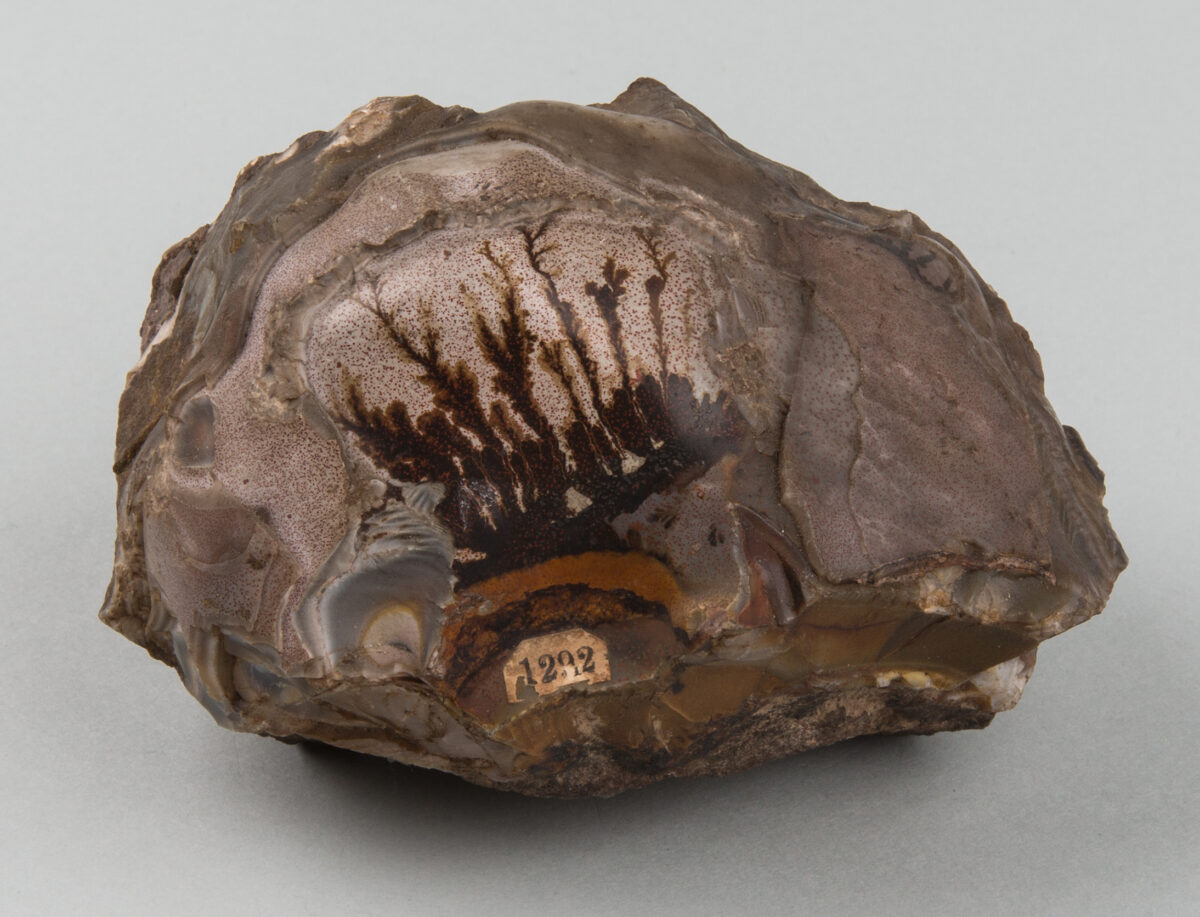
C13. Fine chalcedonic agate, with arborescences and spots, of oxide of iron, running between its zones, the spots being entirely independent of the arborescence. An extremely rare example (for the sake of getting which, and one or two others, I bought a whole collection). I should like the reference to it in my old collection, 1292, preserved in this catalogue. 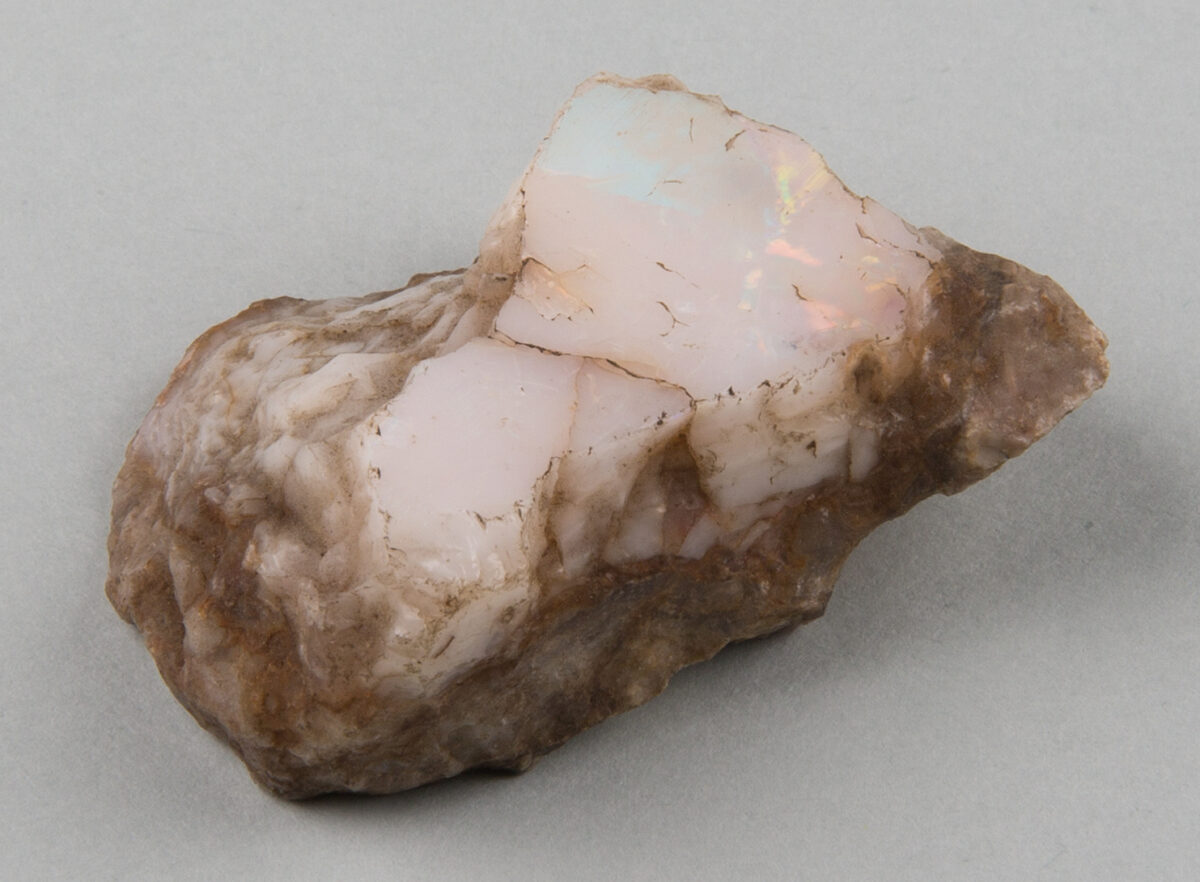
89. Australian opal, in veins, but very lovely. It is more prismatic than the Hungarian, and would form lovely gems, but that its colours are usually confined to narrow bands. It also shows well by candle-light, by which most Hungarian opals are spoiled. 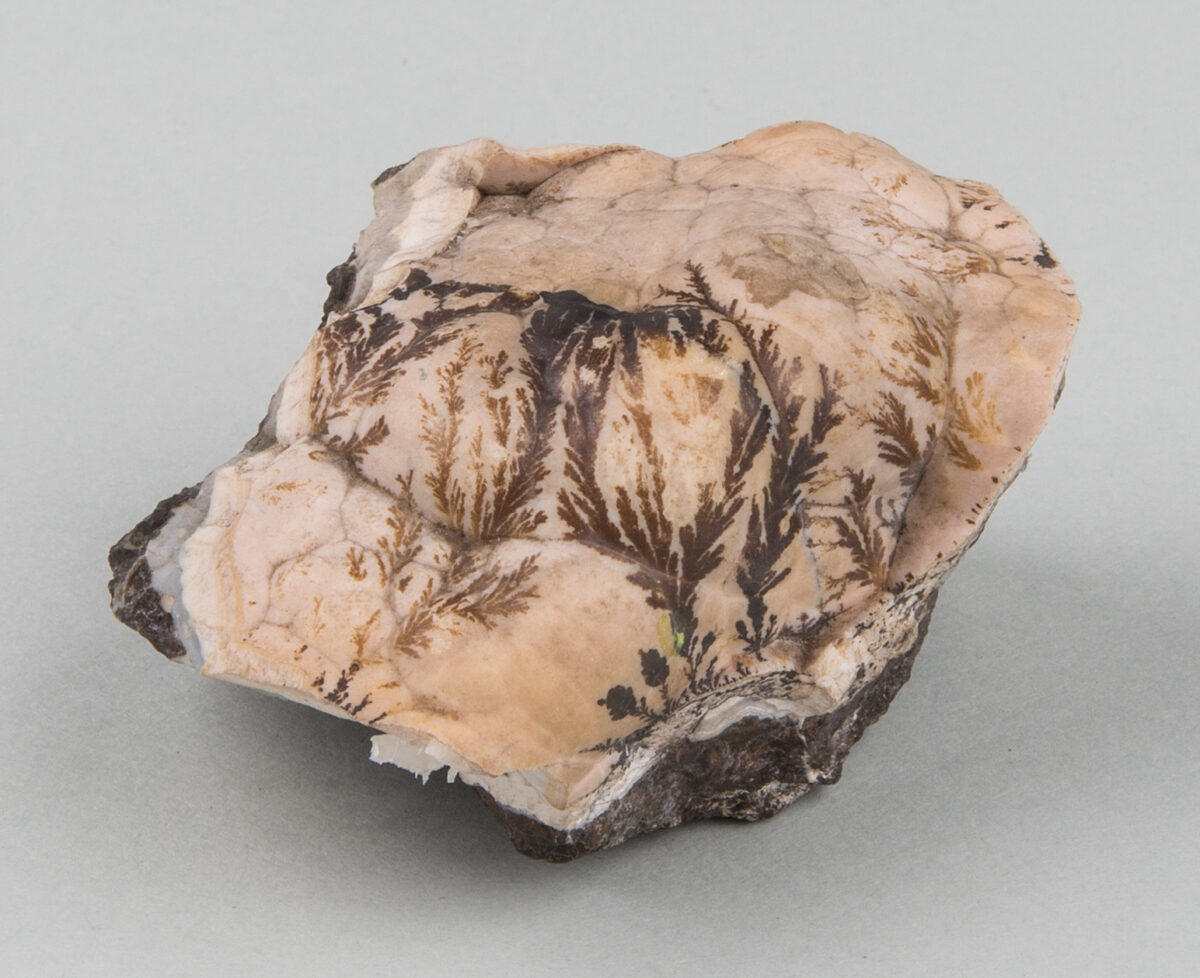
C14. White chalcedony, obscurely agatescent, formed on what I believe to be oxide of manganese with arborescences, which, in that case, would be of manganese, not of iron, and producing themselves, not between its bands, but on the exterior surface. A rare condition. 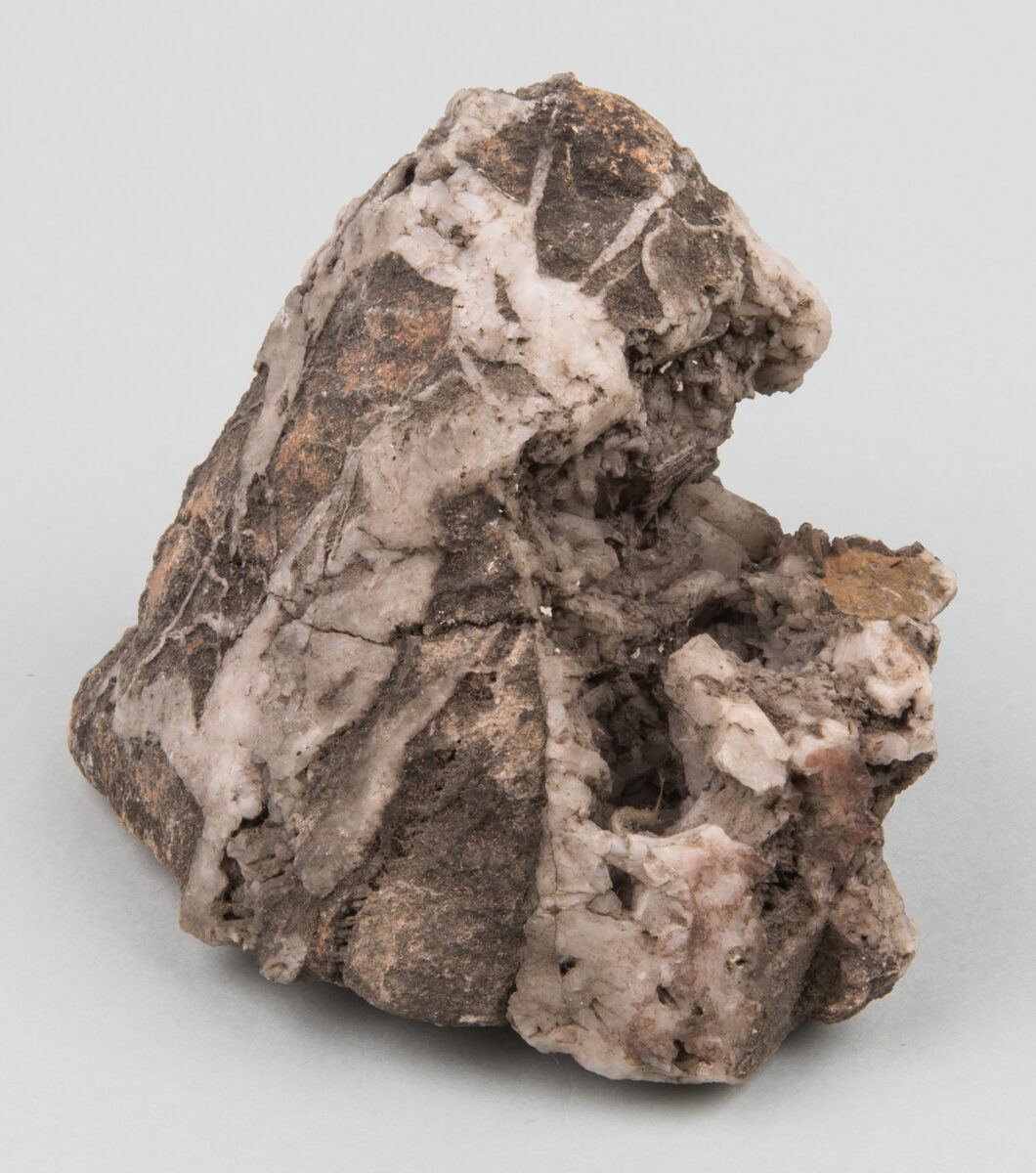
61. Quartz vein in Coniston Grit. We now enter upon the study of the entirely separate and most perfect state of silica, which has permanently retained the German miner’s name of ‘quartz’ As the first essential component part of granite and gneiss, it forms at least a third of the mass of the non- volcanic mountain chains of the world, and the threads or veins of it passing through softer rocks, are the repositories, as we have seen, of gold; and in non-auriferous districts of the greater number of the most interesting metallic minerals. It is to be noticed in passing, that although veins of quartz occur in granite itself, they are usually non-metallic; and that the rich mining districts are all in comparatively softer, and in most cases apparently sedimentary, rock. The condition of quartz in an ordinary vein is mostly that with which we have been made familiar in studying gold; that is to say, solid, and opaque, with occasional cavities towards the centre of the vein, in which it takes more or less crystalline form. This piece of the rock on which the house of Brantwood is built, is a perfectly characteristic example of this general structure. The quartz is secreted out of a grey sandstone passing into slate, and is itself somewhat coarse and impure, so that in its cavities the forms of the crystals are still rude, but extremely illustrative of the first development of crystalline force. 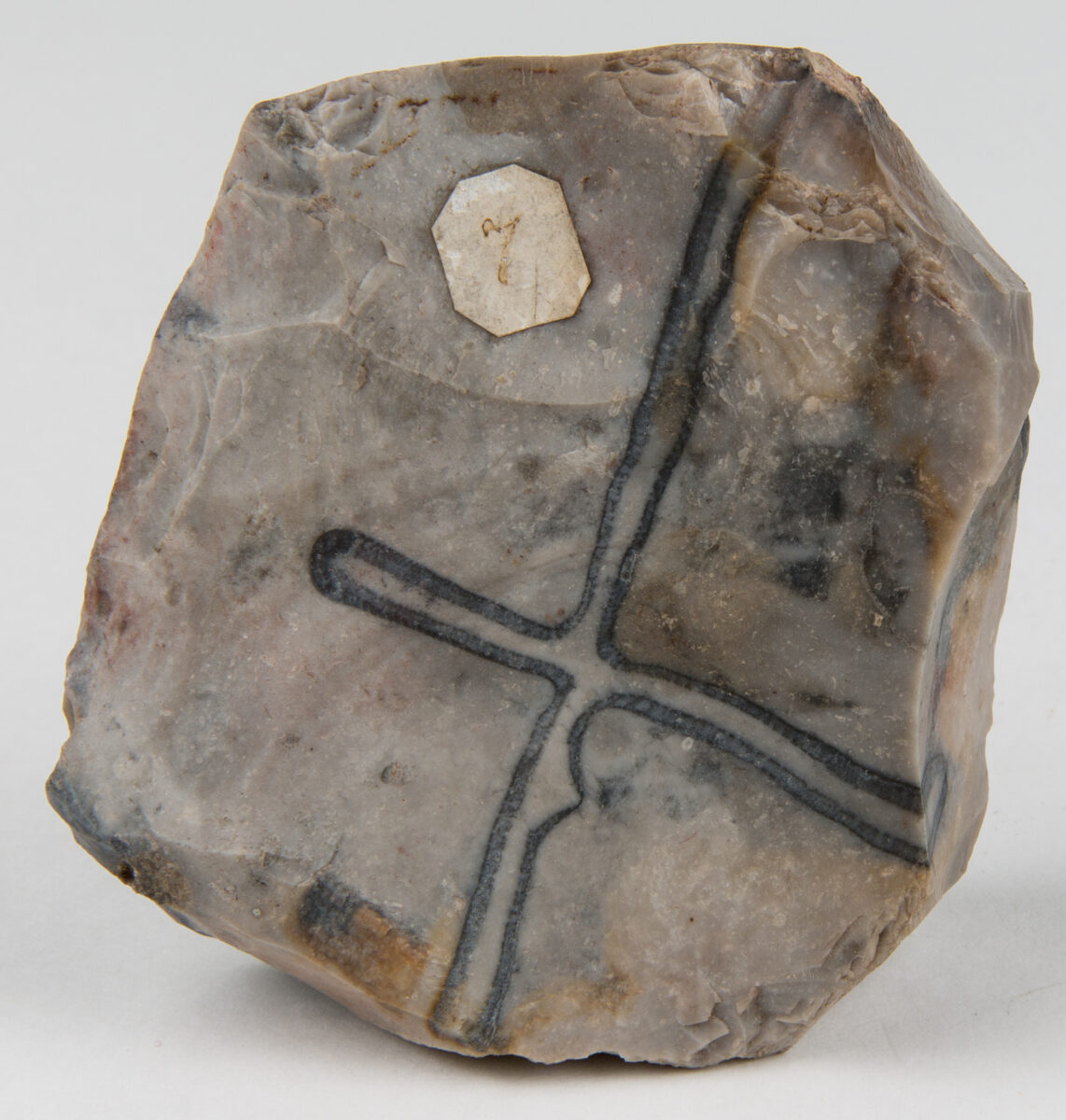
7. Grey flint, with many enclosed organisms, one cruciform, going through; the cross on one side diminishing to a quatrefoil round a small cavity on the other. Ground down and polished on the quatrefoil side. Extremely rare and fine.
Additions and amendments are welcomed at editors@drawingmatter.org
