Shadows in the work of Canaletto
Canaletto used a camera obscura to trace the architecture of Venice on site.[1] He used the camera sketches in turn to produce finished drawings and paintings. Fig.1 reproduces two pages from Canaletto’s sketchbook, his quaderno, now in the Accademia Galleries in Venice. They show the Campo and Church of SS Giovanni e Paolo. Fig.2 shows the finished painting. The sketches relate to the right-hand half of the painting. Canaletto indicates the boundaries of shadows on the church by diagonal lines and follows these indications in the painting. This is unusual for him. There are no other shadows marked in his Venetian camera sketches. He adds shadows in paint once he is back in the studio.
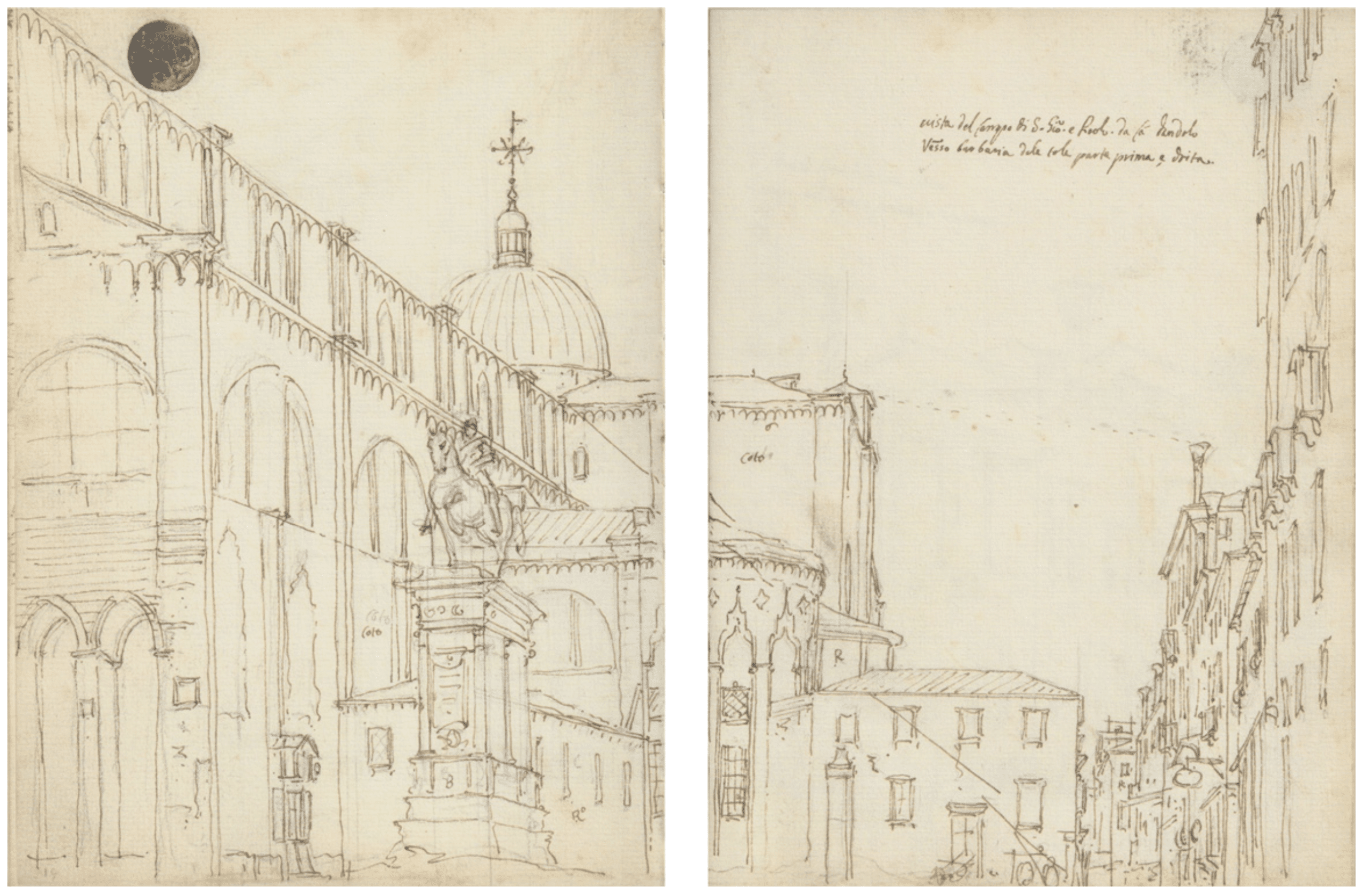
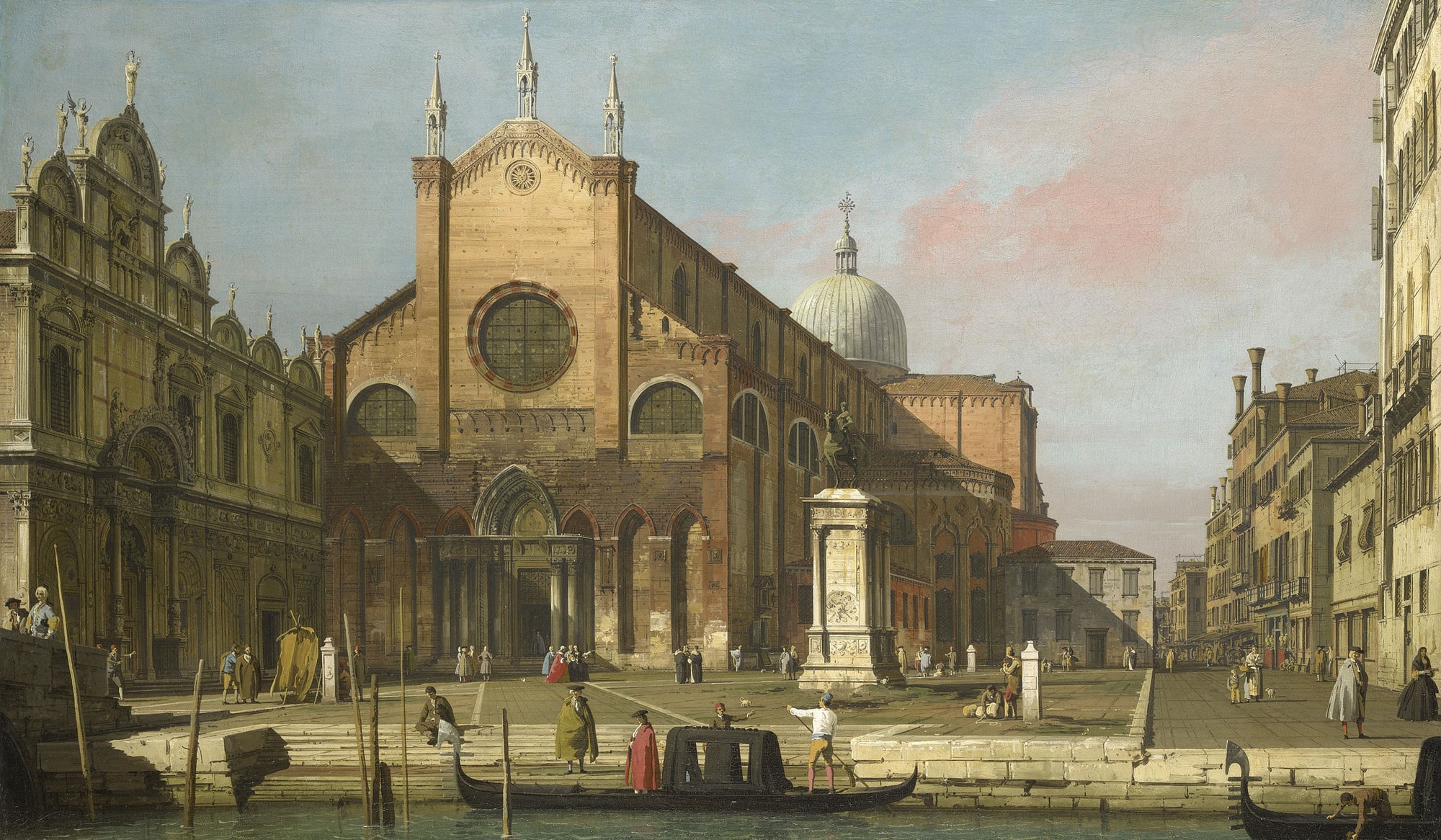
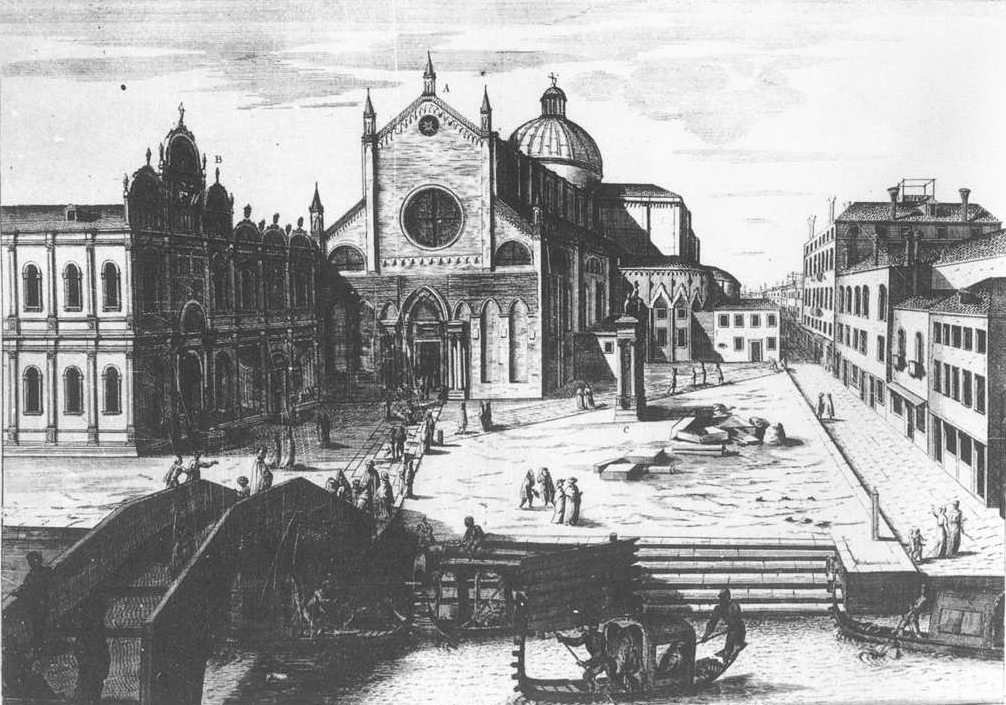
As several critics have pointed out, the shadows in this painting of SS Giovanni e Paolo imply that the sun is high in the north, which never happens.[2] Canaletto cannot have drawn the shadows from life. It looks as though he might have copied them from an engraving of the scene by another artist, Domenico Lovisa (Fig.3). Canaletto’s and Lovisa’s shadow patterns are very similar. There is another engraving of this scene by the older view painter Luca Carlevarijs, in which the lighting is realistic, but the west front of the church is in deep shadow. One can see why Canaletto would have wanted to avoid this.
Canaletto adds shadows in his Venice paintings using rules of thumb. Maarten Wijntjes, Huib de Ridder and Casper Erkelens have studied his typical practice.[3] It is his habit to have shadows fall across the picture, from the left or from the right, parallel to the picture plane, at an angle of around 45 degrees. Material analysis of the canvases shows that he paints the buildings in detail in one layer, and then adds shadows in another layer of translucent glaze. Fig.4 shows a detail of a painting of the Piazza of San Marco, seen from the Piazzetta, the smaller open space that adjoins the Piazza. At the right is the Doge’s Palace, in the centre is the front of the Basilica of San Marco, and at the left is the Clock Tower. The shadow of the Palace falls from the right at roughly 45 degrees, so that the shadow it casts on the ground is about as wide as the building is tall. Those figures who are in the sun also cast shadows on the ground to the left, again roughly equal to their height.
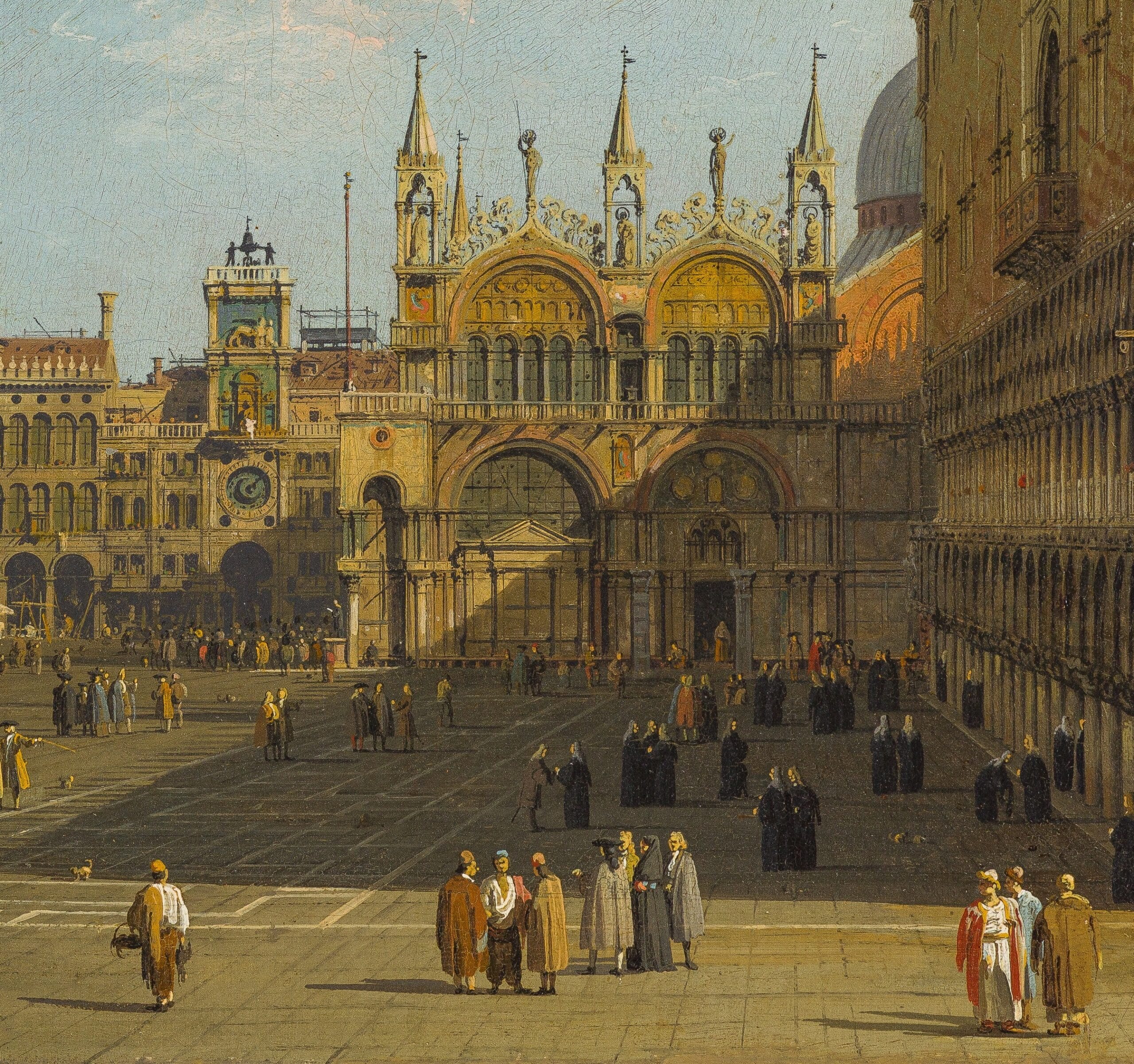
It might seem counterintuitive that the people within the shadow of the Palace should cast shadows on the ground to their right. I think Canaletto has in mind that they are illuminated by the sky from the left. But if the shadows are not cast directly by the sun, then they ought to be more diffuse and spread out. The assumed direction of the sun is again impossible here: it is high in the sky to the east. Sometimes, Canaletto has the sun shining in different directions in the same painting. He uses shadow and sun to draw our attention away from some buildings and towards others that are more important to the composition.
Ernst Gombrich wrote a short essay about Shadows in painting for an exhibition at the National Gallery in 1995.[4] He talks about how there was a general preference in Western landscape art up to the seventeenth century for diffuse lighting from the sky, and no very strong cast shadows; but how painters in the 18th century, and in particular the view painters like Canaletto, reintroduced strong shadowing. Their subjects were buildings, and bright lighting could contribute to modelling and the effect of depth, and in Canaletto’s case, to the impression of perpetual sunshine in which he bathes the city of Venice.
As mentioned, all the drawings in the quaderno are confined to outlines only, and any indication of shadows is very rare. However, Canaletto made a handful of other sketches that look to me very much as though they are camera drawings, but with shading and shadows rendered in tonal washes. Fig.5 is an example: a drawing of buildings outside a window of Canaletto’s house in the district of San Lio, including the church of Santa Maria della Fava with its flattened dome. The Canaletto scholar J G Links has a daydream that the artist might have made this, and another similar drawing, to pass the time when he was ill and confined to his bedroom.[5]
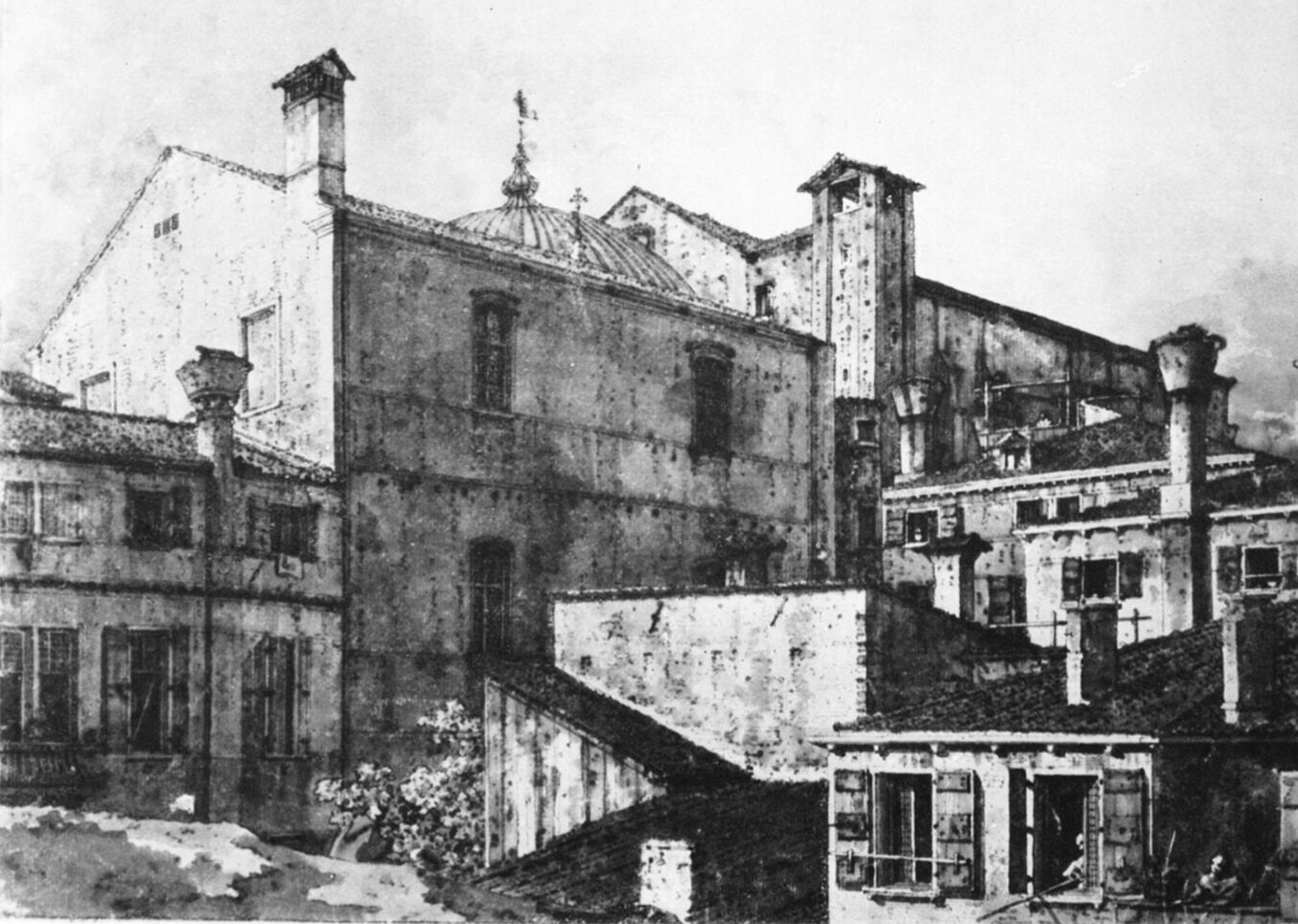
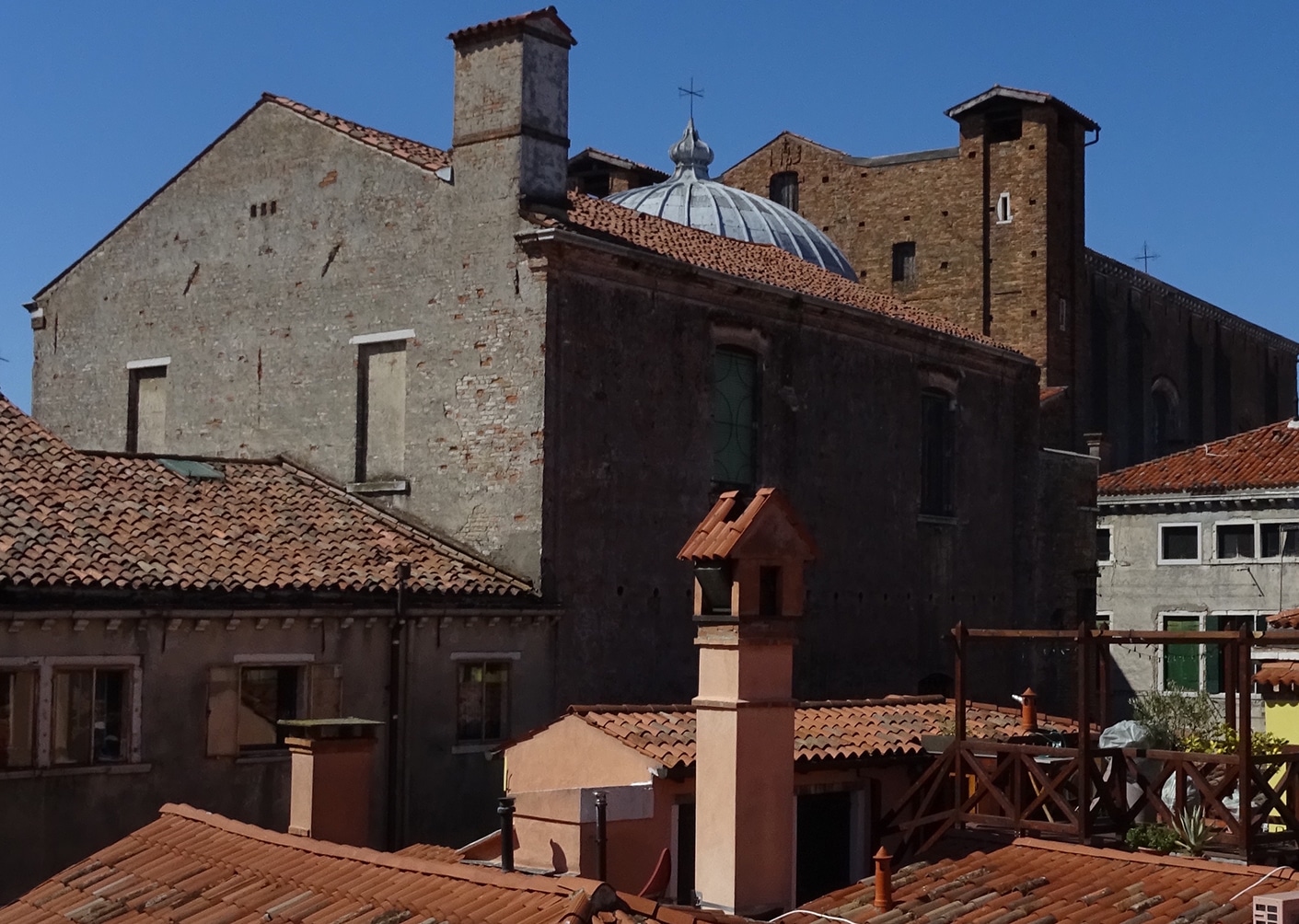
My colleague Gregorio Astengo was able to take a photograph from a position near Canaletto’s viewpoint (Fig.6). Some buildings have been altered. But the photo serves to indicate the accuracy of the drawing. Here, the shadows—for example, those cast by the eaves of the roofs—appear to be observed, not constructed by rule. The single tree is rendered with patches of light and shade, rather than with the looping outlines that Canaletto otherwise uses to indicate foliage in sketches.
Canaletto made at least one comparable drawing while in England. Fig.7 is a long view of Whitehall in London seen from Richmond House, a study for a painting of around 1747. The drawing is large, 27 by 75 centimetres, in brown ink with grey washes. According to John Hayes, ‘The topographical detail, so far as one can check its accuracy, appears to be exceptionally reliable,’ although becoming ‘generalised’ in the far distance.[6] This is unlike most of Canaletto’s finished drawings and looks to me as though it might have been made directly using a camera.
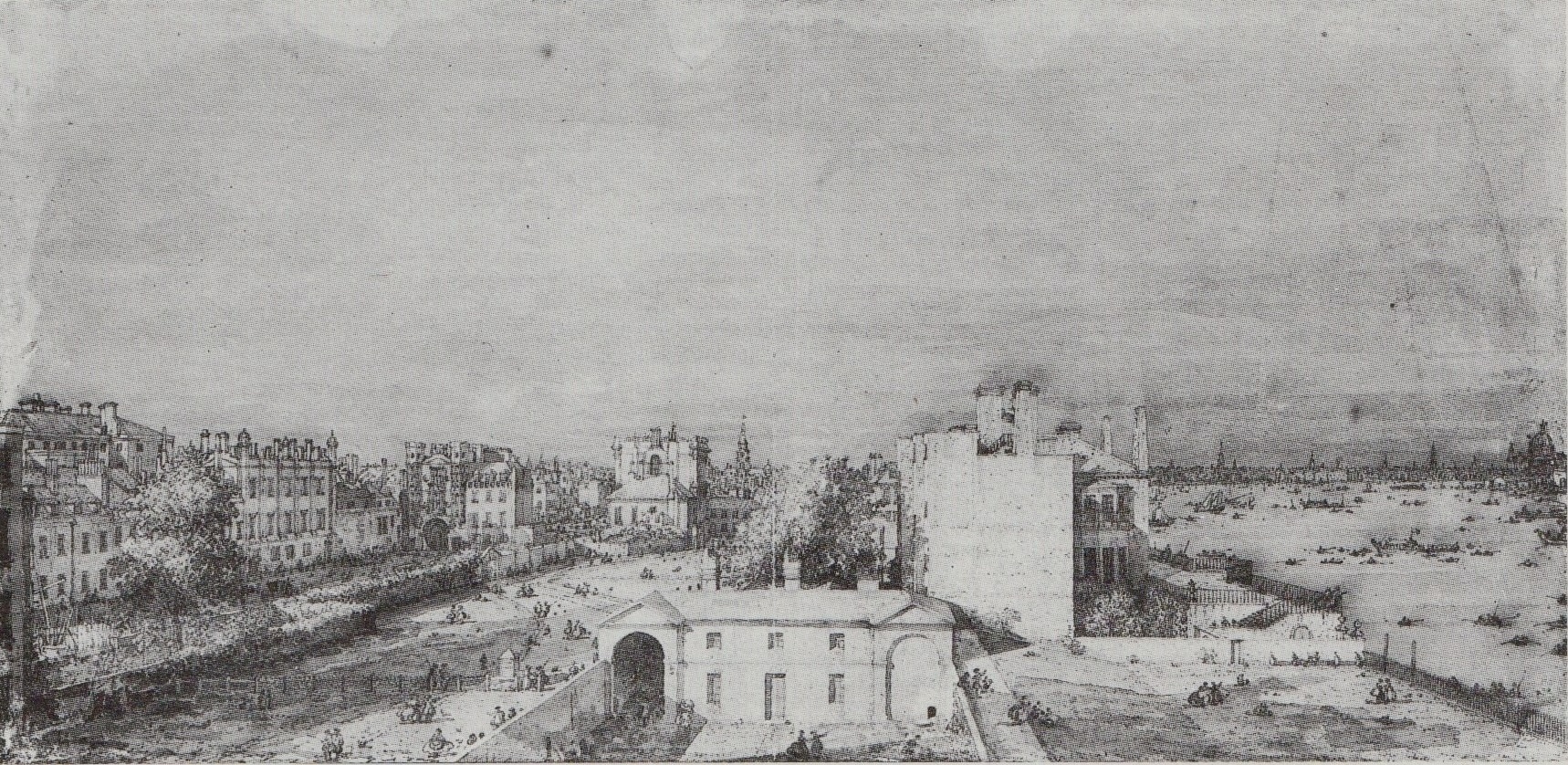
The drawing from Canaletto’s bedroom, and this view down Whitehall (Figs.5 and 7), both have a ‘photographic’ quality. Might it have been possible for him to have matched tonal values working inside the camera? The problem with this idea is that, using a tent or booth-type camera, the artist is enclosed and is in semi-darkness. This makes it tricky to judge the tones of pigments. A painter colleague, James Lloyd and I have tried making tonal drawings in charcoal inside a booth camera. It is feasible to pick out areas of deep darkness and strong light, but we have found it harder to match intermediate tones in the way that Canaletto does. The obvious alternative method would be to make outline drawings in the camera and then add shading and shadows looking directly at the subject.
In Venice, most of Canaletto’s viewpoints are in the open (sometimes on boats), although there are a few cases where he finds a convenient window or balcony. It is striking that in England he works much more often from inside buildings. The drawing and painting of Whitehall were made from a first-floor window in Richmond House, and another picture was taken in the same direction from a window in a nearby house owned by the Earl of Loudoun. A painting of the west front of Westminster Abbey was taken from a building opposite. A very wide panorama of ‘Chelsea from the Thames at Battersea Reach’ (now cut into two parts) could have been made from a window of a notorious pub, the Red House, on the opposite bank. Canaletto made a painting of Windsor Castle from ‘the window of the small cottage at the end of the Inclosure next Mr Crowle’s garden.’[7]
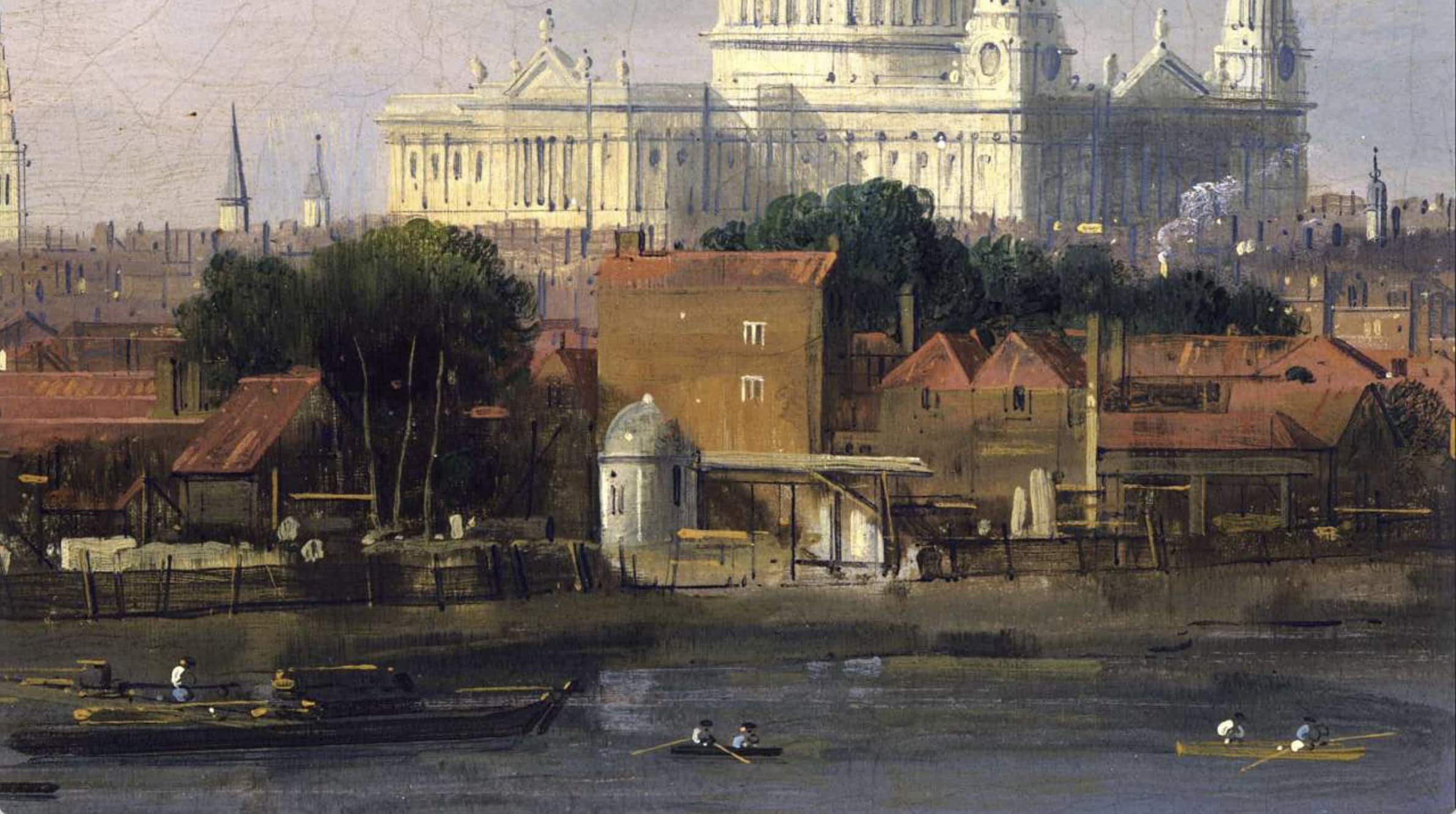
In all these cases, it would have been possible for Canaletto to turn the whole room in question into a large camera by blacking it out and putting a lens in a hole in a window blind. This would have allowed him to project a very large image, the size of a painting. This is very speculative, but perhaps this would have let him see the image and his paints in low light and add tonal washes. I plan to test these ideas out with colleagues. Fig.8 is a detail from another painting with a viewpoint again on an upper floor of Richmond House, this time looking in a different direction, across the Thames towards St Paul’s Cathedral. Here are complex shadows on buildings, trees and quayside paraphernalia, quite unlike the mechanical shadowing of the Venetian paintings. Has Canaletto been using tonal information recorded in a camera drawing and transferring it into paint?
Notes
- Decio Gioseffi, Canaletto: Il Quaderno delle Gallerie Veneziane e l’Impiego della Camera Ottica, no.9 (Università degli Studi di Trieste, Istituto di Storia Dell’Arte Antica e Moderna, 1959); and Philip Steadman, Canaletto’s Camera (London: UCL Press, 2025).
- For example, J G Links, Canaletto (Oxford: Phaidon, 1982), 91.
- Maarten Wijntjes and Huib de Ridder, ‘Shading and shadowing on Canaletto’s Piazza San Marco’, Proceedings of SPIE – The International Society for Optical Engineering 9014, March 2014; and Casper Erkelens, ‘Perspective in Canaletto’s paintings of Piazza San Marco in Venice’, Art and Perception, Vol.8 (2020), 49–67.
- Ernst Hans Gombrich, Shadows: The Depiction of Cast Shadows in Western Art (London: National Gallery Publications, 1995).
- J G Links, ‘Canaletto at home’, The Burlington Magazine, Vol.115 (1973), 390–393.
- John Hayes, ‘Parliament Street and Canaletto’s view of Whitehall’, The Burlington Magazine, Vol.100 (1958), 341–347, 342, 349.
- As described in a handwritten note on the frame of the painting: see Philip Steadman, ‘Canaletto, the Sandbys, and “Mr Crowle”’, British Art Journal, Vol. XXV, No 2 (2025), n.p.
*
Philip Steadman is Emeritus Professor of Urban and Built Form Studies at University College London. He trained as an architect and has taught at Cambridge University and the Open University. In the 1960s, he co-edited and published Form, a quarterly magazine of the arts. He has contributed to numerous exhibitions, films, and books on perspective geometry and the history of art. In 2022 he was awarded an Emeritus Fellowship by the Leverhulme Trust for a project on Canaletto and the camera obscura. His most recent book, Canaletto’s Camera, was published in 2025.
This short text offers an insight into Philip Steadman’s invited contribution in the third colloquium event ‘Tracing Shadows’ led by Professor Mark Dorrian and hosted by the RIBA, V&A Drawings Collections and Drawing Matter in January 2026—a day of conversations, gathered around original drawings and photographs, in which participants examined the presence (and absence) of shadows in the representation of architecture.
