The Creative Potential of Archival Boundaries
This unknown eighteenth-century French textile sample pattern book is an intriguing addition to the Drawing Matter collection. Is it architecture, or is it here through a taxonomic error? Either way, how should we approach reading it within this architectural context?
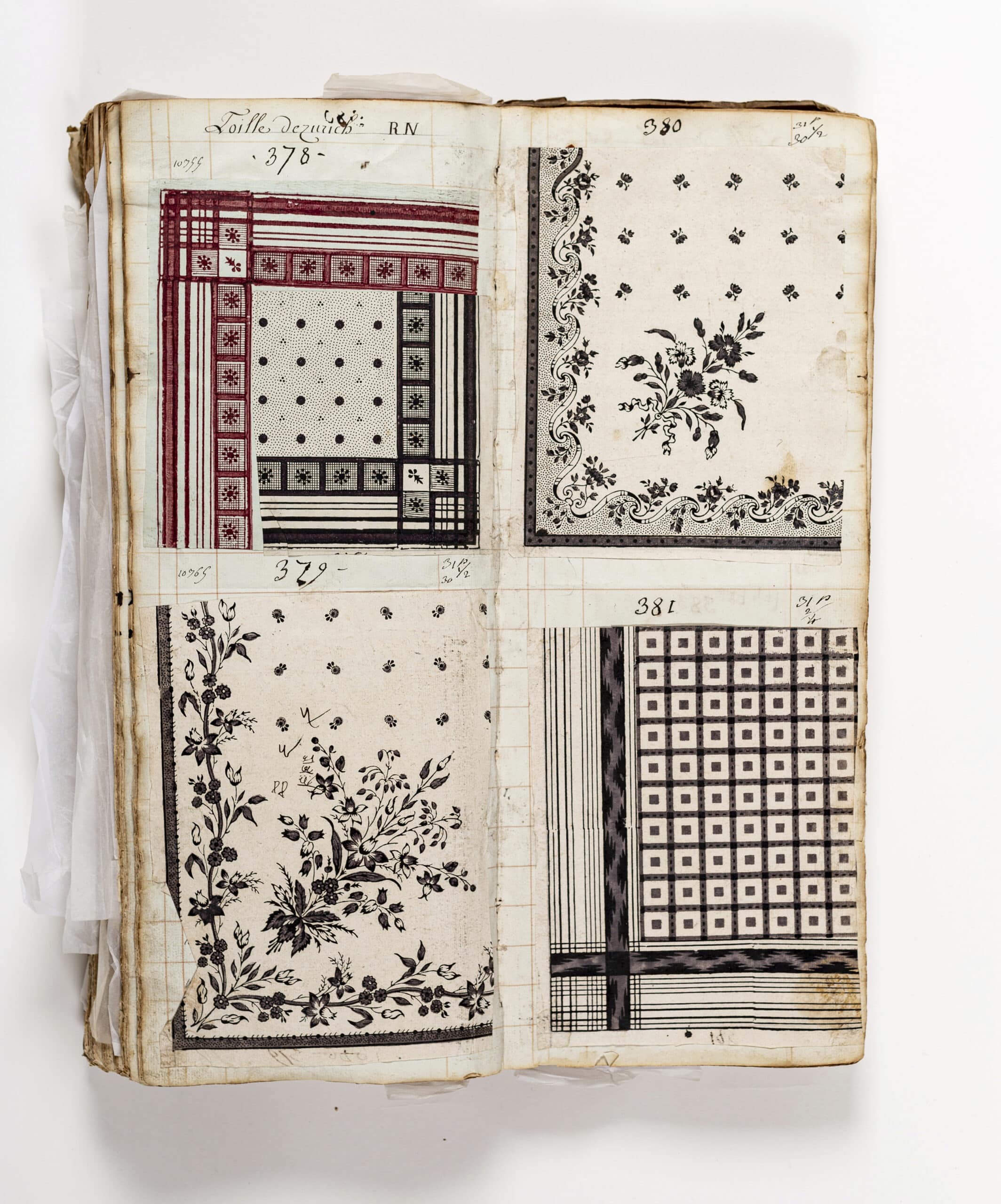
The book opens to roughly A3 in format, and each spread is composed of collage: often triangular fragments of fabric, dominated by a strong cochineal red. Grids of different scales collide and become activated when sliced at an angle, anticipating later Modernist road plans and their pictorial equivalents in the paintings of De Stijl. When read as city plans, the negative spaces between the scraps become boulevards, rivers, or other large urban divisions. I can envisage the spreads being scanned, extruded and modelled in CAD, with novel parks and planting systems imagined as instructions latent within the volume. Actively (mis)reading the artefact in this way—as an architectural plan—reveals its generative potential.
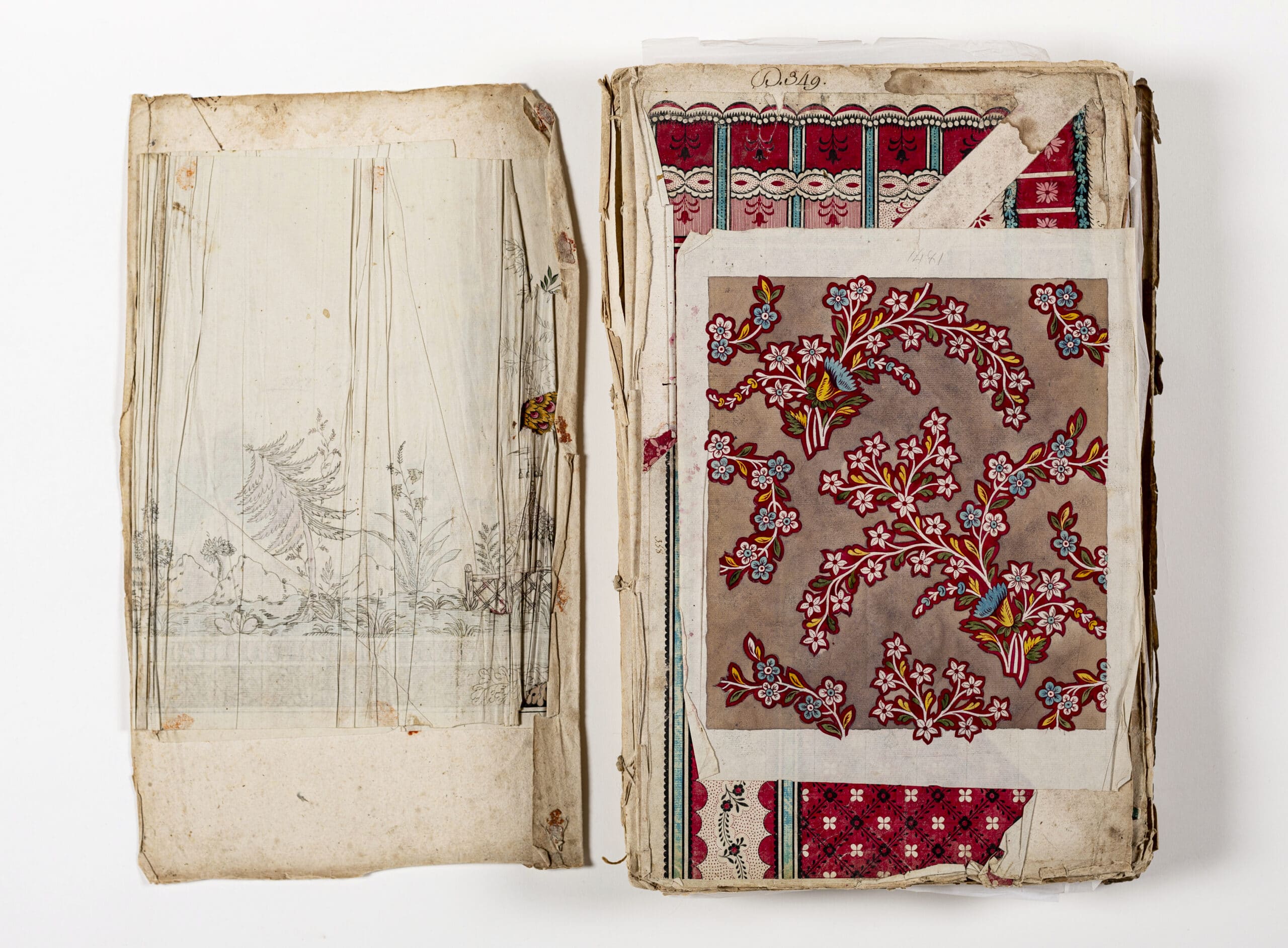
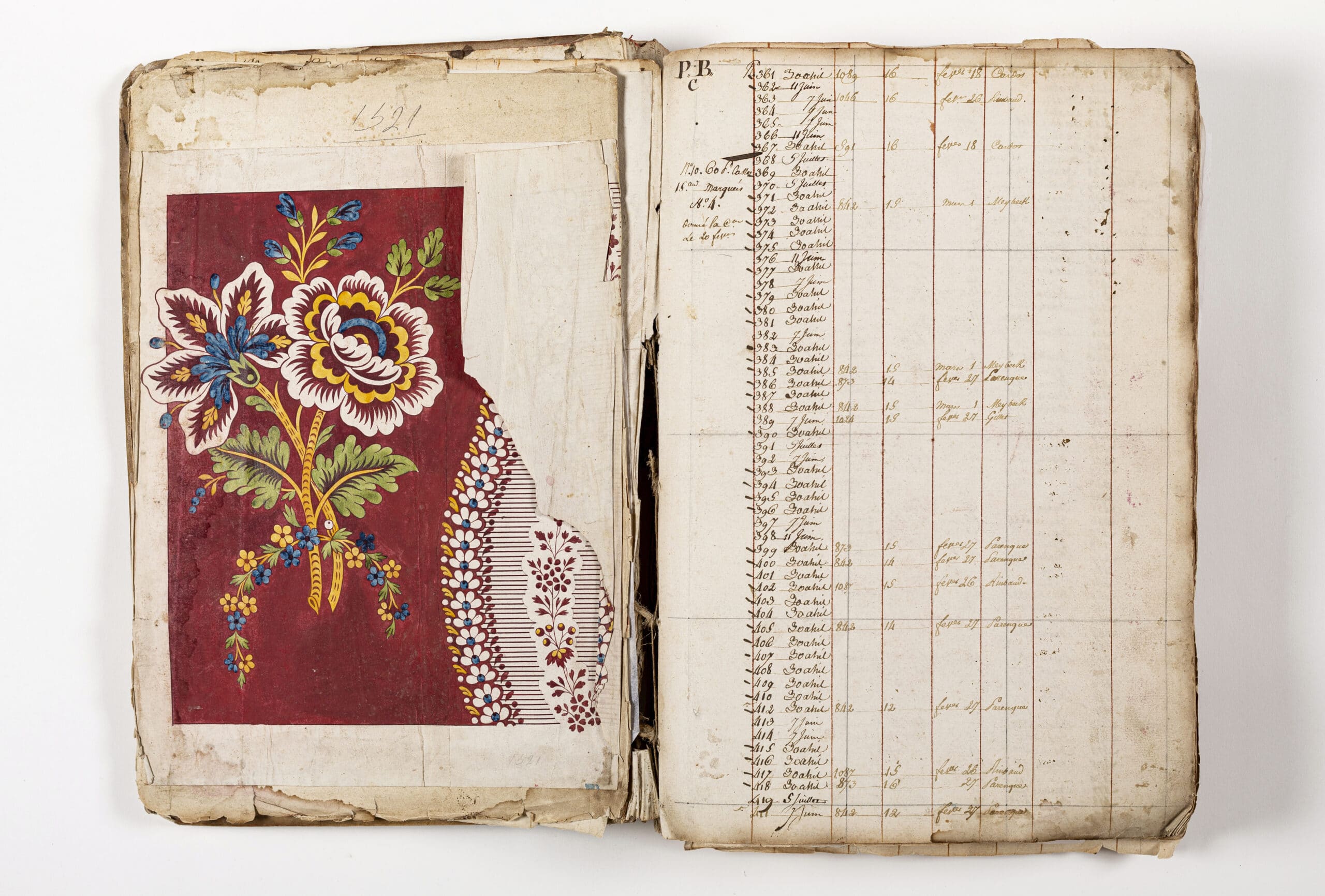
Such an approach requires allowing a slippage in taxonomic terms, and it is here that the boundary paradox becomes most productive. This small sample book shares characteristics with much larger volumes in the Register of Designs Collection held at the National Archives in Kew. In both contexts, what George Kubler refers to as ‘the taxonomy of meaning’ comes into play: the classificatory grid through which we stabilise objects, and through which they gain, or lose, visibility.[1]
Taxonomy, however, is an artifice of human mental organisation: a contingent structure rather than a neutral container. It shapes what can be seen, known, or meaningfully connected, but it can also be reorganised to produce different outcomes. Reclassification can become a creative act. Karen Barad’s agential realism is helpful here, positioning categories not as fixed descriptors but as intra-active effects of practice—boundary-drawing gestures that can always be redrawn.[2] To rethink the taxonomy of an archive is therefore to remake its possibilities, to activate new affordances and allow dormant patterns to surface as knowledge.
My encounter with the Drawing Matter collection is informed by a larger interest in archives and their function as repositories of recessive memes that wait for the right author, environment, or historical context in which to be ‘turned on.’ The textile book becomes a site where misclassification is not a mistake but an opportunity—an invitation to work at the edge of categories. Charles Jencks’s notion of adhocism is instructive here. In Adhocism he argues that ‘Instead of an art of cosy, floating surfaces that denies the realities of problems, we can have an art of jagged, articulated cataclysms that shouts at the problem from every corner.’[3] Approaching the archive through the boundary paradox is precisely such an adhocist manoeuvre: a willingness to engage the object on its own terms, to let contradictions remain jagged, and to treat misreadings as engines of invention.
Notes
- George Kubler, The Shape of Time (New Haven: Yale University Press, 2008).
- Karen Barad, Meeting the Universe Halfway: Quantum Physics and the Entanglement of Matter and Meaning (Durham, N.C.: Duke University Press, 2007).
- Charles Jencks and Nathan Silver, Adhocism, expanded and updated edition (Cambridge, MA: MIT Press, 2013), 79.
*
Dr John Walter is a visual artist and lecturer in Fine Art and Design, currently Associate Lecturer at Cambridge School of Art, Anglia Ruskin University. For more information visit his website: https://www.johnwalter.net/
This text is one of the selected responses to the first category of the Open Call 2025: Visibility, and the Unseen—a series of short contributions that either bring to the surface the unseen drawings within the Drawing Matter Collection (I. In the Archive) or explore original architectural drawings, created by the author(s) of the contribution, which make visible the unseen (II. In Practice).

– Marco Moro