The Analogous City: Panel
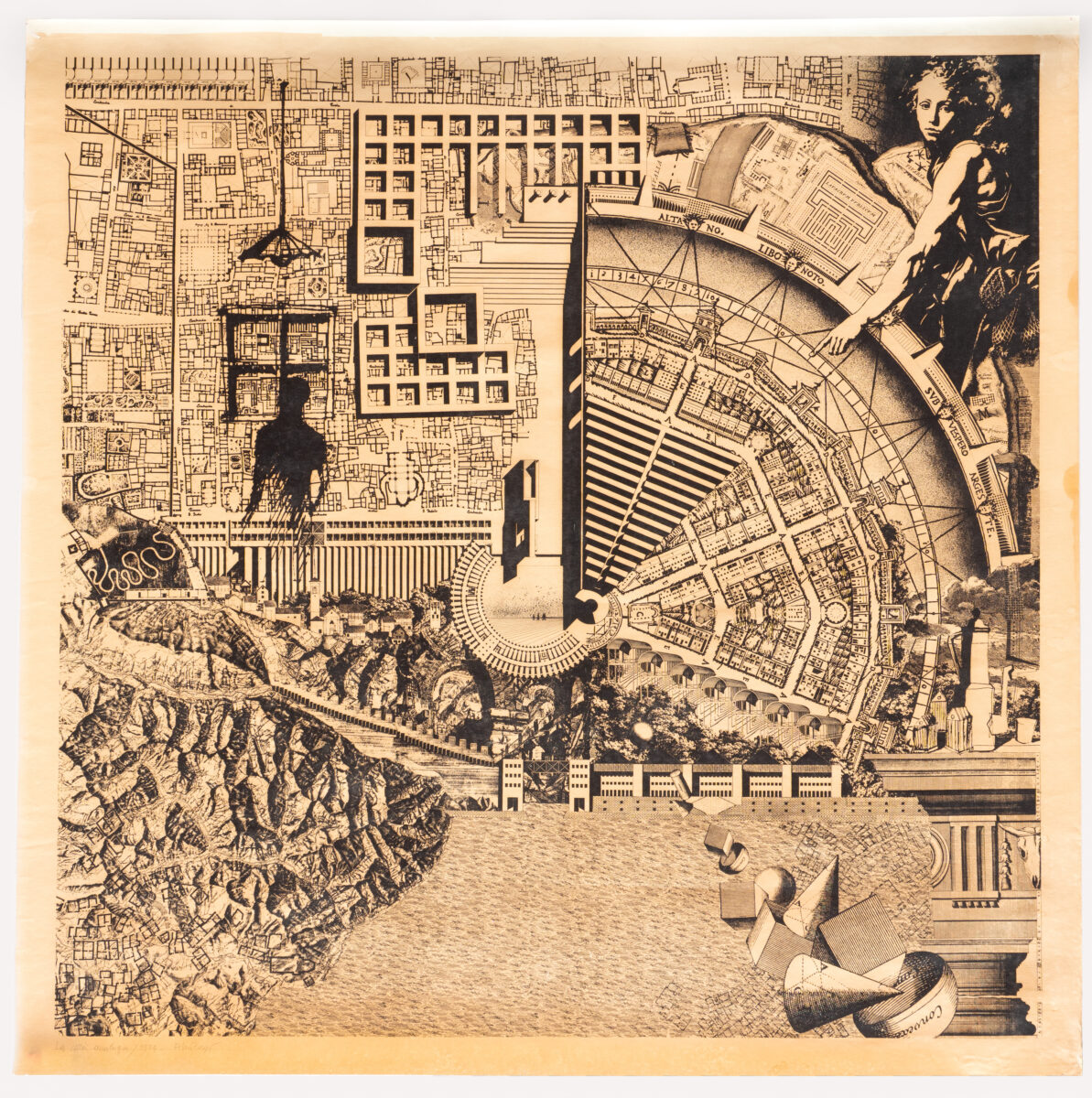
Having been asked to write about the panel exhibited at the Venice Biennale—entitled The analogous city, a joint work carried out with my friends Eraldo Consolascio, Bruno Reichlin and Fabio Reinhart—it is worthwhile, I feel, posing a few general questions that arise prior to experiments or results of this kind.
I do this not so much for criticism or the critics, whose freedom is irreplaceable both in the exploration and in the comprehension of things and, as unfortunately occurs especially in the Italian tradition, with pleasantly D’Annunzian verbal exercises, but rather for the sake of explaining a certain type of progressive culture which raises concrete problems in which I still believe.
Now, the answer contained in the theme of the analogous city, in a broader way, of course, than can be expressed in the panel, concerns the relation between reality and imagination. And I should like to set forth a number of comments on this subject.
The last few years have witnessed various different proposals concerning the city and in particular the historic centre. Due to an objective situation these recommendations, which are at times completed works or projects or programmes, belong for the most part to government officials or economists or politicians on the one hand and to town council or state officers (Council for Public Monuments) on the other.
All things considered this is not a bad thing. The fact that architects, engineers and surveyors, the true servants of speculation in the literal sense of the word, are beginning to take their hands off the city fills one with satisfaction as a citizen. Besides destroying, they have left us the face of the Christian Democrat city and of the centre-left city in a more cumbersome state as far as volume, good business and stupidity are concerned, than that of the Fascist cities.
After the impulse of the early postwar years and a few good suburban districts of Rome and Milan, very few healthy propositions have actually come from architects: and there have been absolutely none from the theorists and critics. Certainly, there has been no lack of appeals, that have been at once sentimental and energetic, on the part of the defenders of our bel paese. Alas, the effects of these appeals are known to all.
At this point matters are reversed but not solved. When I wrote that the problem lay in the re-use of the historic centre and that the latter should continue to exist as a residential area, and when we took over Milan’s old houses we did not foresee what would happen. But right here in Milan, I believe, is where the ‘anger’ of the homeless—immigrants and others—has exploded; and they have begun to occupy the empty houses both on the outskirts and in the historic centre. At the same time the left wing local government councils were beginning to think that the building of cheap housing (the famous piani 167) could also be applied in the historic centre. Bologna became an emblematic case in point. On the other front the Fine Arts people were beginning to impose restrictions. Having remained absolutely absent, as it were, before the worst, business-inspired destructions of the centre-left triumphant-sounding period, they began in fact to call a halt and to restrict. This operation, too, was conducted ambiguously and was even degrading for the face of the city, in their claim to impose not a style but a a new kind of folklore. En passant, one only has to think of cream-coloured plasterwork and the natural wood door and window frames hitherto quite unknown to the Italian and European tradition. However, this is really only relatively important. I think that the Fine Arts officials will find the right road. What is important to us is that they apply the means at their disposal.
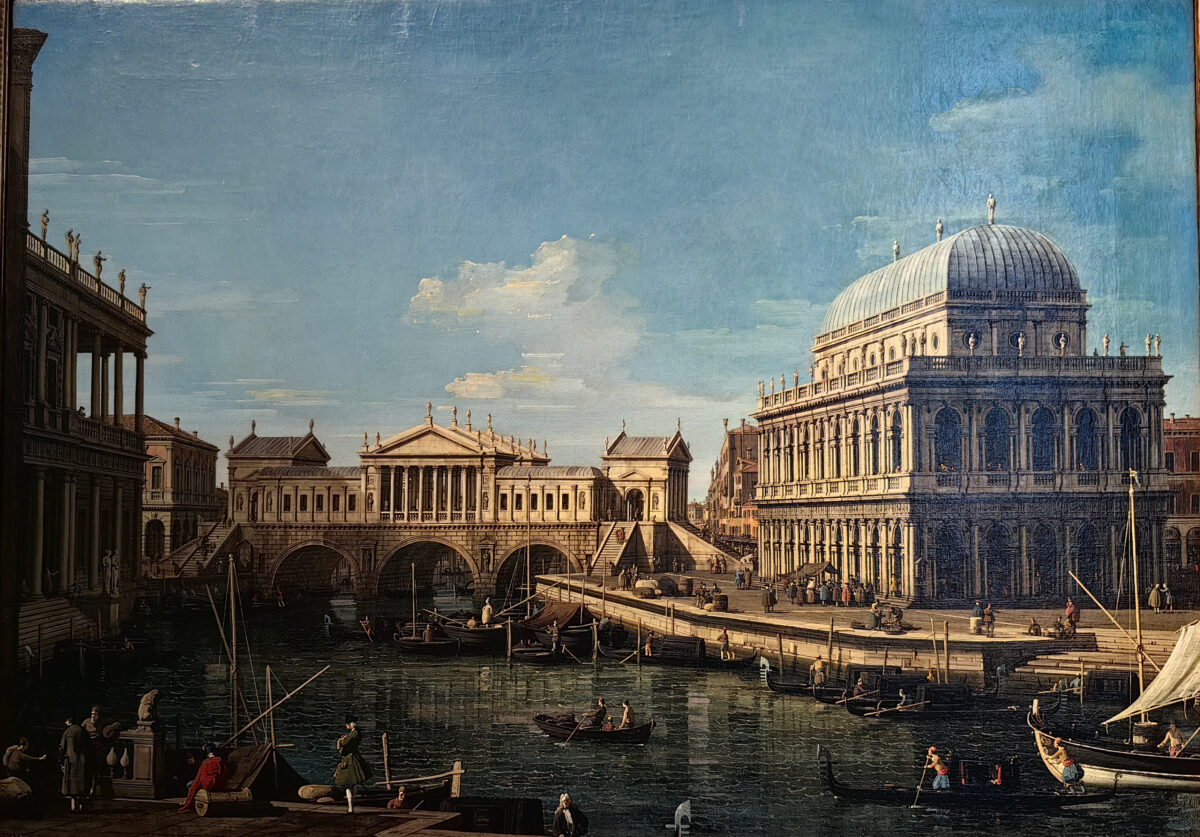
Why have I sketched this rough outline of the urban situation? Because if I must talk about architecture today, be it mine or other people’s, I maintain that it is important to illuminate the threads that lead imagination back to reality, and both of these back to freedom. There is no invention, complexity or even irrationality that is not seen from the side of reason, or at least, from the side of the dialectics of the concrete. And I believe in the capacity of imagination as a concrete thing. The definition ‘analogous city’ originated from a re-reading of my book L’architettura della città. In the preface to the second edition, written some years later, it seemed to me that description and knowledge should give rise to a further stage: the capacity of the imagination born from the concrete. In this respect I stressed Canaletto’s painting where, through a most remarkable collage, an imaginary Venice is built on top of the real one. And this construction takes place by means of projects and things, invented or real, quoted and put together, thus proposing, an alternative within reality. In my opinion this painting has a major historical and political significance, and it is a progressive significance. Venice is shown as the analogous city of the Venetian republic and of a broader modern nation. Everybody can rediscover himself in fixed and rational elements, in his own history, and accentuate the peculiar character of a place, a landscape or moment. This was far that matter, to be the fate of Palladian architecture. They were to be the attempts of the best interpreters of modern architecture. Without the capacity to imagine the future there can be no solution to the city as an essentially social fact.
In November 1975 the Turin magazine Nuova Società introduced a debate under the motion of ‘How beautiful the city is’. The article by Saverio Vertone which opened the debate remains, in my opinion, one of the decisive contributions to the issue, by showing how the crisis springs from a lack of mental indications and from an insufficiency of projects. Moreover, not afraid to be scandalous, Saverio Vertone talks, too, about the beauty of the city. Although I don’t tike quoting I must quote him in full here because one so seldom reads a clear, unconventional and constructive page like this one that it is worth while repeating it to the letter.
‘And there is the problem of beauty, fundamental and unknown. Can a person, a thing or a city be beautiful if it signifies only itself, or rather its own use? ls not beauty the place where different substances and meanings meet; is it not the point where they fuse, a kind of coincidence of opposites? And can there be room far beauty wherever everything falls back upon itself, where objects do not perform their purposes but describe them, where tautology rules undisputed? It is not scandalous to concern oneself with these things. Beauty is useful.’
Beauty is useful, and urban beauty is what most annoys the truculent, business-minded or bureaucratic operators. Apart from anything else it is a nuisance and a complication, seeing that functionalism has explained that a thing means its own use. I repeat that technological systems are not the modern city’s future, even if they are the condition far a more civilised life in that city; and certainly in a country like ours it is right to put minimum objectives in the foreground when it only takes a few days rain to cause disasters. But a standard, destined to improve with time, cannot substitute a political cultural perspective. The argument has remained the same from Marinetti’s exaltation of Milanese trams, in which he saw the future and futurist Milan (and which today are antiquated contrivances without even the patina of sentiment), up to the filling-station monuments of the present. Machines, be they bachelor or not, are still machines and only the occasional clever artist can use them to render the sense of a biographic and civil solitude. And hence to deny them.
At the last Venice Biennale I in fact exhibited a large panel entitled ‘La città analoga’, which was, as I have said, a collective work. This work is not the explanation of the analogous city because we do not believe that explanations exist. Furthermore, every work and every object—if it is not to be squashed on the image of its own use, as my friend Saverio Vertone says—is self-sufficient and develops a life of its own.
It seems to me clear, however, that the panel suggests in a fairly plastic way the image of the different meaning which distinct projects produce through a relatively arbitrary editing; to remove all mechanical or mechanistic values from this construction its designers, to a varyingly automatic extent, introduced things, objects and memories while trying to express a dimension of surroundings and of the memory.
I had something of the sort in mind when I did the film Ornamento e Delitto for the Milan Triennale. I feel increasingly that techniques or disciplines in themselves, once established, tend to gel reshuffled, and thus the time of a cinema film becomes an element of greater importance than a strictly architectonic element. Conversely, in the fast great film that I saw, Andrej Rubilëv I rediscovered an interest in architecture in itself which I believed I had long since lost.
Clearly, this panel showed a number of aspects of the memory, a memory circumscribed to a certain territory, or better, to a country northern Lombardy, Lake Maggiore and the Canton Ticino with its signs and its emblems. History and geography are merged in Tanzio da Varallo’s painting and in the stone houses and inside them projects are situated and arranged. There can be no doubt that quite a private life runs through the places and gives a sense to architecture, and perhaps it is precisely in this alone that the humanity of architecture lies.
The dimension of a place and of a country is a condition laid down in the study of cities and of architecture, and this too shifts the problem of the nuisance caused by protection and restoration, as though the defence of a city or place were a matter for the place. The question must be viewed in a much more complex light. In other words, I find it very hard to picture today the defence, or rather the planning, seen in itself, shall we say, of a city in the Po Valley or in central Switzerland. I believe the problem is to get to know the meaning of the Po Valley civilisation and of its image, and also far the contrasting Gothic image.
But why, all the beginning of this article, did I want to relate the analogous city theme to the concrete and political truth of our situation? Because I believe that the technical man and/or artist must offer alternatives to the growth of cities so that these alternatives can be discussed, understood and hence either accepted or rejected by the people who live in those cities. Gone are the days of urban models and with them also has gone the age of urban techniques, self-description, and functions passed off as solutions.
The city must be dealt with each time, by gathering and developing its contradictions, day by day, directly. The much-discussed Piani Regolatori (planning schemes) would be ridiculous if they were not so tragic in their results; always a failure, never carried into effect, destined to perform a sort of penitential function through a zoning that has in any case never been seriously carried out.
The same goes for the contrasting of the historic centre and the suburb, in its present form of canonisation. Cities today have a face characterised by new and old facts; the great urban suburbs belong to urban history and constitute their most authentic face. The city by parts is certainly no academic definition; it expresses the city’s way of life, its articulation and also its face. This is why it will be a very good thing if a new urban planning system can be introduced through district councils, local committees fighting for that particular house or that particular nursery school, for one clearly-defined piece of land which actually constitutes the city.
Concrete opportunities can provide the reference to another solution; and upon a concrete opportunity different solutions can be checked and worked out. Precisely because I do not believe that an aesthetic and functional model can be supplied for new cities, I think it is important to furnish hypotheses: modern architecture, or the modern city, which is in any case the same thing, does not exist as a category. What do exist are the problems with which to make our comparisons.
At this juncture I believe that the problem of history, as a subject of architecture and not as an aesthetising digression, is neither an academic nor a paranoic one. Understanding the beauty of Prato della Valle al Padua means seeing it at a particular moment in the history of Venice, the joint penetration of town and country into the construction of remarkable associations. To understand monuments also as pieces of cities, sedimentations of materials, that can be transformed, adapted and arranged for a fresh life, does not mean a cultural adventure but a great project for the principal nations of Europe. This to some extent happened, and often catastrophically, during the Napoleonic era and after the Unification of Italy, but, despite the way in which it was carried out, it constituted a progressive fact. Today this analysis can and must be carried out upon the city’s outskirts, too. There are factories, farms and suburbs that need to be used not simply in terms of re-use, but through a plan.
Let me close by going back to my opening lines of argument, also because I started out from them to speak of the analogous city. For it seems to me important that reality and imagination make up the two terms of a civilised progress or at any rate of an improvement of the city. I was not concerned about presenting the analogous city almost as if it had been reduced or could be reduced to a drawn panel, even though I could talk at length about this panel drawing just as I could about other projects of mine. What matters to me is to restate the sense of freedom of the things we do; a freedom which is all the greater when tied by concrete truth or when it springs creatively from it. Thus to measure one’s own projects and other people’s within a single main project is, I think, an important thing to do today. One of the few things I have built, the residential unit al the Quartiere Gallaratese in Milan, is to my eyes enriched by the presence of Carlo Aymonino’s architecture or the mixture with it. But I don’t believe this is just an impression of mine but rather an objective fact. It is again an instance, almost unexpected in its formal clash, of the importance of associations or analogies.
By pursuing this course architecture, too, can build up a plan of the future and envisage it against those who are afraid of the future; by accepting, for example, the partly changed or improved conditions, at least in our hopes, for proposing and speeding up developments. Between past and present, reality and imagination, the analogous city is perhaps simply the city to be designed day by day, tackling problems and overcoming them, with a reasonable certainty that things will ultimately be better.
*
Reproduced from ‘La città analoga: tavola / The Analogous City: Panel’, Lotus 13 (1976), 4-9.
