And in the shadows, the section fades
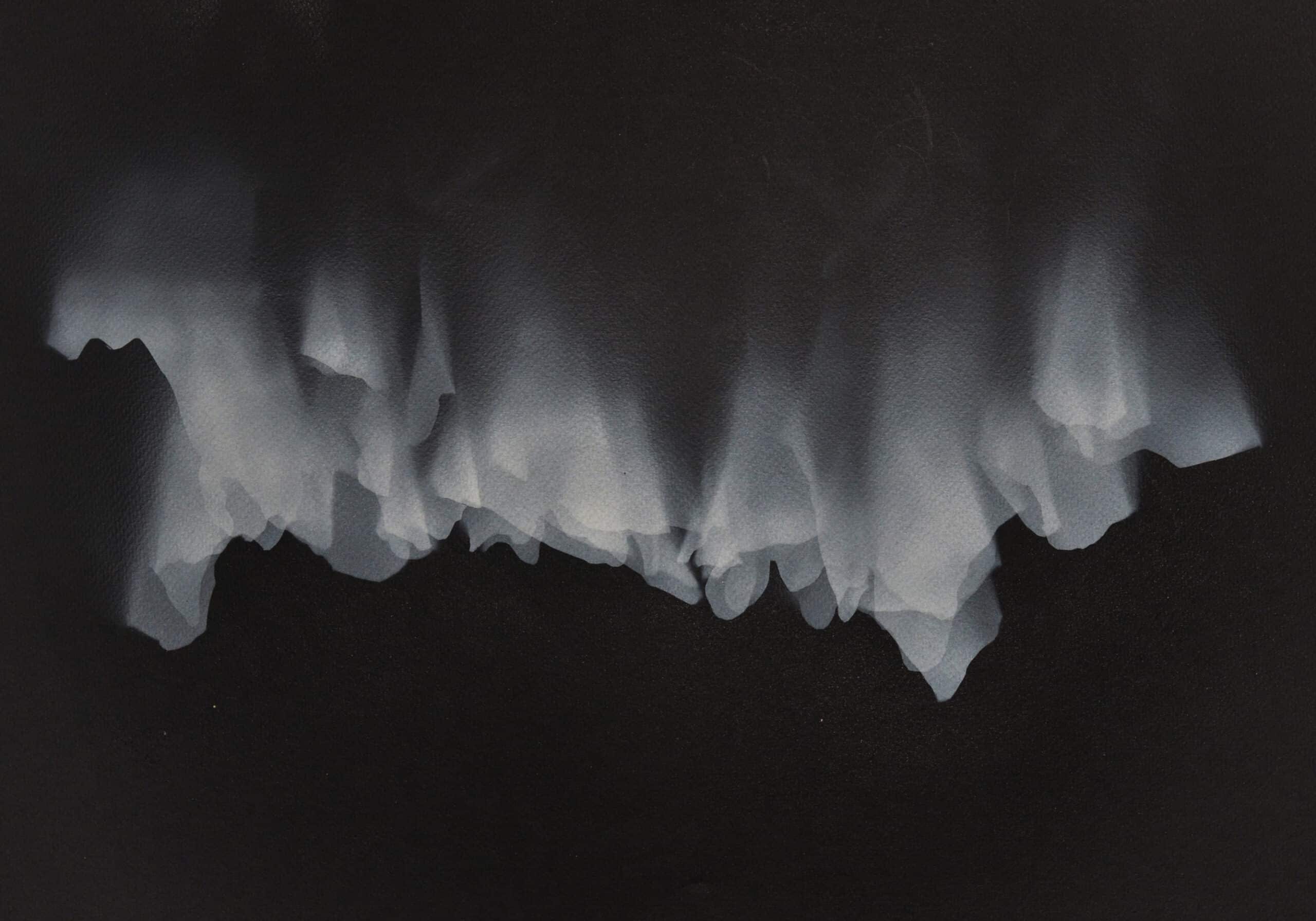
On the black cartridge, a veil of pigments builds up, articulates an edge and fades into the depth. And yet it is the edge that meets me first, together with all the other edges that are layered upon each other. Cascading contrasts of white and black. Or: of brightness and darkness.
Now that my airbrush droplets have settled on the paper, they are carving out from the black a gradient of white. What we don’t see are those ideas that are embedded, that are open to gradual unravelling, that invite re-imagining the spatiality of the drawing by uncovering a process of its production, but more importantly, through the ideas that layer up alike the way the drawing intensifies with the stratified residues.
Immersing in the drawing, I find certainty in the edges and uncertainty in the gradients as they fade and blur. With the residues layered as such, a fog-like realm accentuates contours while approaching, and edges are distinguished in the clearing.
There is certainty inherent in the notion of sectioning. It sits within the concept of projective drawing, in the idea of an abstract plane that intersects the object and defines the cut. Through the notion of this cutting plane, the intersected geometry projects, articulated as a line, into the drawing. The common practice is to indicate the cut by a thick line, continuous and closed, perhaps with a solid filling known as poché.
In the terminology of topographical maps, the section appears in the figure of the contour line. Here, it describes points on the surface of equal height, or in other words: an intersection of a horizontal cutting plane with the landscape. In the layering of contour lines with equal contour intervals, differences in the sloping of the terrain become visible in the manner of a map that features the relief of a landscape. In bathymetric maps, the contour can be found in the outline of colour fillings of different gradients that display the depth of a water body in a colour scale from light to deep blue. The darker the colour the deeper the depth, as if gradually carving out the depth of the water from the drawing surface by omitting lucency.
I see the airbrushed edges and gradient layers as contours of a map. Do I look from above? Or can I imagine the space by projecting myself into it, taking as a position a viewpoint from where I envision the curvatures and folds described by the layered edges? Trying to follow the figure of the sections, thinking them as a landscape, I begin imagining the undulation of folds in front of me.
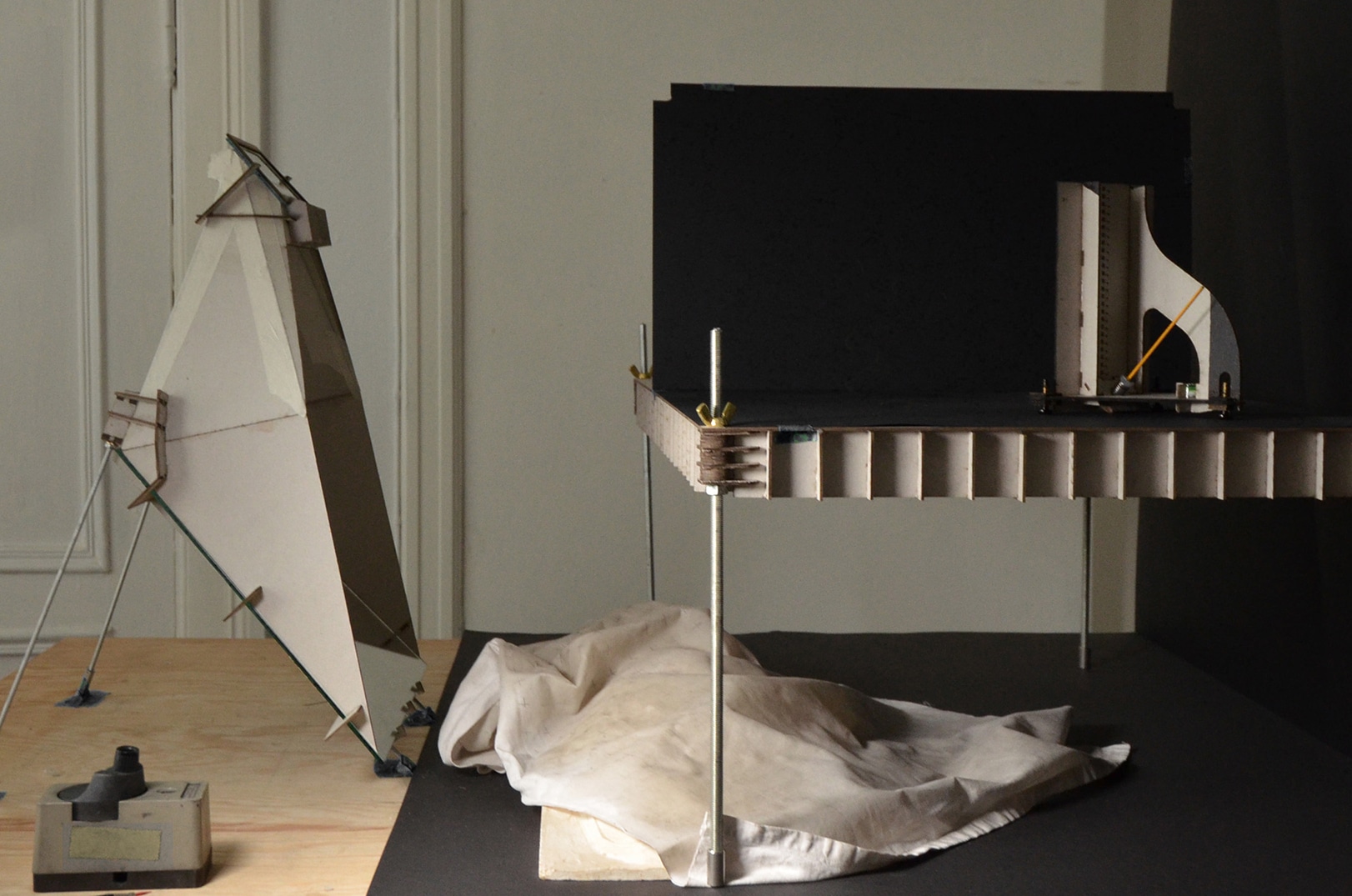
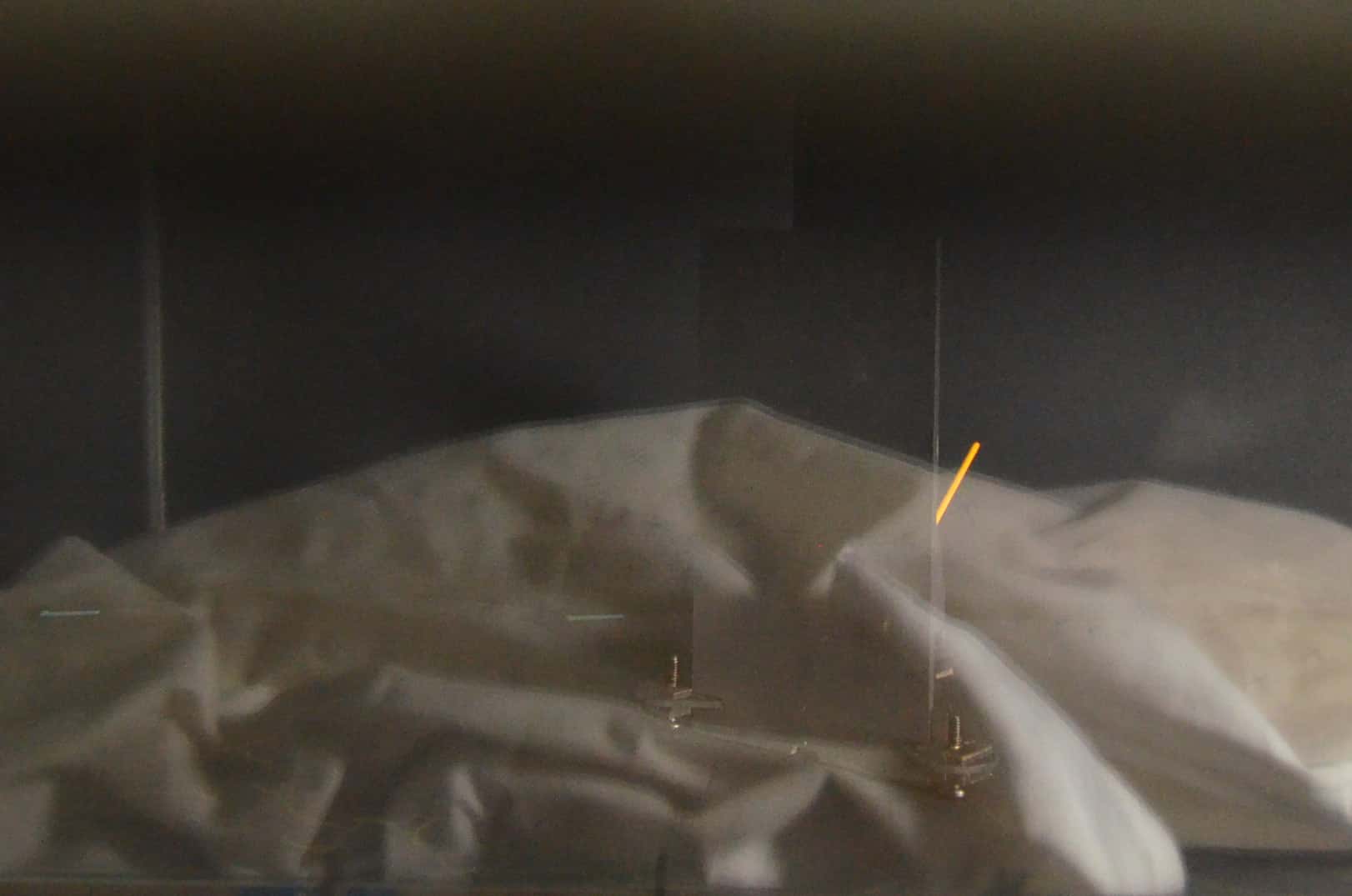
In the making of this drawing, there is a camera involved. Its design is inspired by William Hyde Wollaston’s camera lucida and Edouard Deville’s stereoscope, developed for photographic surveying and based on a Wheatstone Stereoscope.[1] The specificity of my camera is that it displaces an image—alike the camera lucida—into the drawing space. The image one sees through it is similar to a fully three-dimensional stereogram and therefore directly traceable along horizontal planes. These tracings render contour lines on the horizontal drawing sheet with the use of a marker that has a pen attached to project the lines down onto the paper.[2]
The drawing evolves as a consequence of a working process. As I trace, I follow the imaginary plane, that is the section plane, aiming to align the marker with the surface. It is not the edges that I trace or lines or folds. It is the meeting of this horizontal plane that my marker moves within, with a vague tactility that anticipates a ghostly surface, one without substance.
The lines are traced this way, owing to my sectioned surface being only a double reflection of my cloth, which is located in its physical condition elsewhere. Its reflection consists purely of light, and where light fades, there is a gradual dissolving into a void. This nothingness does not have a surface as it is empty of light, of matter, of substance. The surface is not more than an image, and yet it is full of deep, tacitly perceivable space.
As my pencil traces the contour, I arrive in the shadow. Now I need to interrupt. There is no longer perceptible depth in the darkness as the cloth does not reflect any light, and the image has no substance. Another time, the line gets lost as the surface of the cloth disappears in the fold. Where it is hidden from my view. My sections are thus not compatible with a geometrical idea of sectioning only. My traced sections are dependent on my position. What is hidden, they do not trace. In the instances of such occurrences, the section becomes problematic to trace, as what cannot be located cannot be traced. What I perceive as depth becomes vague and uncertain.
Notes
- Edouard Deville, ‘On the use of Wheatstone Stereoscope’, in Photographic Surveying, Proceedings and Transactions of the Royal Society of Canada, Second Series: Vol.VIII (1902), 63–69.
- Charlotte Erckrath, ‘Ambiguity and the Agency of Drawing Tools’, in In Drawing. Inquiry, Time, Dialogue and Materiality, ed. by Thomas-Bernard Kenniff and Carole Lévesque (Montréal: Bureau d’étude de pratiques indisciplinées, 2024).
*
Charlotte Erckrath graduated from The Bartlett School of Architecture, University College London, where she completed a Master’s in Advanced Architectural Studies. From 2017–25, she held a position as Associate Professor at the Bergen School of Architecture, and has now joined the KU Leuven, Faculty of Architecture as a PhD candidate.
This text is one of the selected responses to the second category of the Open Call 2025: Visibility, and the Unseen—a series of short contributions that either bring to the surface the unseen drawings within the Drawing Matter Collection (I. In the Archive) or explore original architectural drawings, created by the author(s) of the contribution, which make visible the unseen (II. In Practice).
