Baroqsysms
Are architects wired to interpret reality flattened into two dimensions, with the third hovering somewhere nearby like an amputated ghost limb? Can short-form video animations, generated by Artificial Intelligence, scratch that phantom itch between two and three dimensions that we, survivors of this mental re-ordering, suffer from? I started thinking about these questions when I placed a drawing from 1683 and a photograph from 2022 as the beginning and ending frames in an Artificial Intelligence (AI) prompt window. Both images depict the church of San Carlo alle Quattro Fontane: the first an engraved elevation by G.F. Venturini and the second a personal holiday snap taken whilst standing next to the goddess Giunone’s fountain across the Via Quirinale. The façade drawing (Fig.1)—part of a guidebook on Roman architecture by Giovanni Giacomo de Rossi—published seventeen years after the death of the architect of the church, Francesco Borromini, studiously records the building façade and cupola above in two dimensions, but cannot quite reify its depth, standing inertly on the page, especially the verve of its famous serpentine cornices, framing the sky when seen from below.
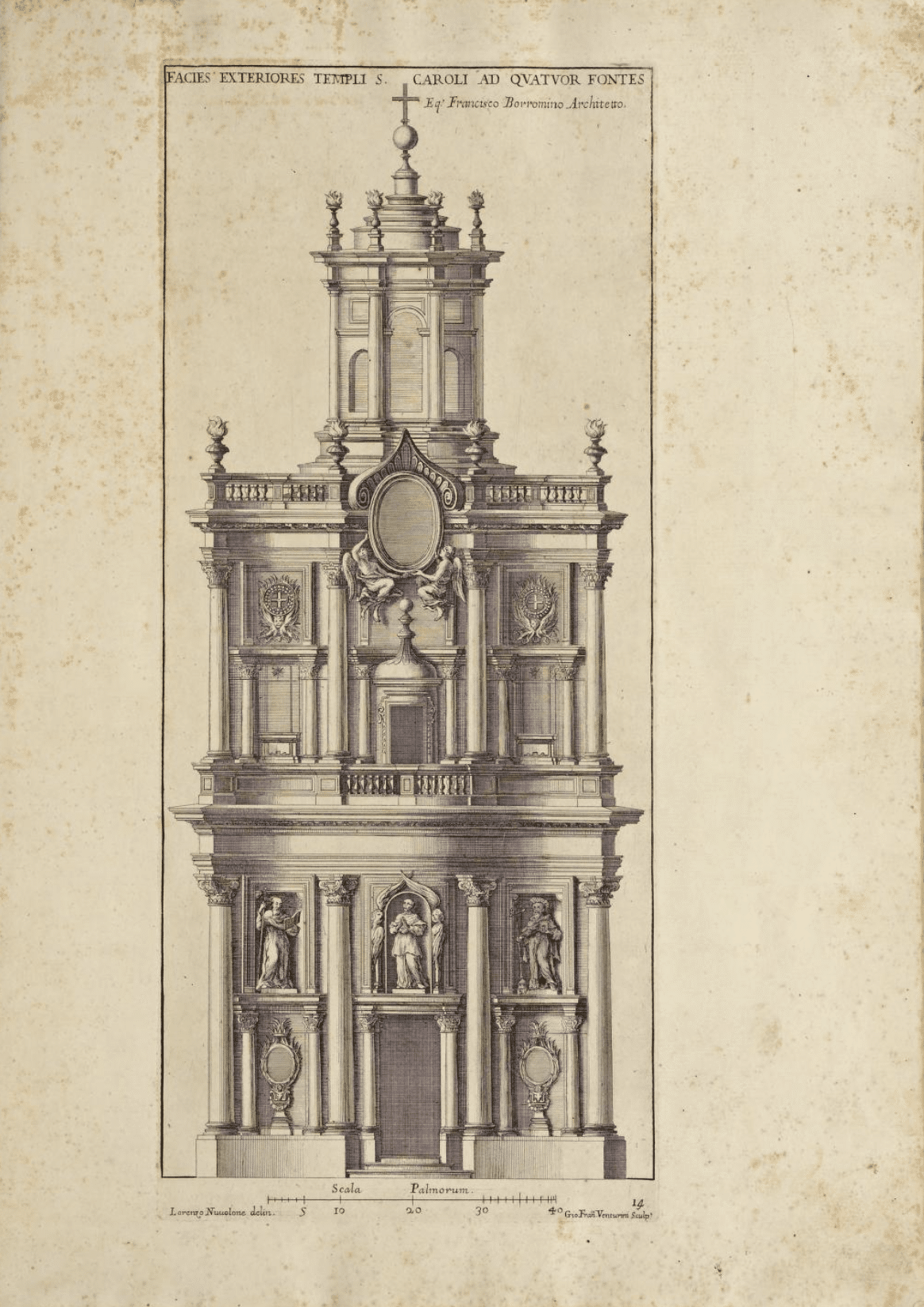
What animates the façade is the third dimension that Borromini had indicated in plan, rendered in two dimensions by Venturini with fastidious tonal-gradient cross-hatching along the curvatures. But recumbent elevations cannot do justice to this architecture—hence scholars’ general indifference to them, obsessing for generations over planimetric, geometrical analyses of these buildings. After a minute of the AI’s processing, the bursting-forth effect in the resulting animation (Fig. 2), which interpolates smoothly between the drawing and the perspectival photograph, set off a tingling sensation. In my enraptured mind, the animation mirrored the ecstatic vision of Borromini, efflorescing on the computer screen, adding a spatial dimension to the elevation through temporal animation frames. The little jolt of pleasure—a mini paroxysm, a ‘baroqsysm’,—seemed to emanate from the leap between dimensions, the arresting surge the finest baroque architecture strives to provoke.
*
Some brief observations on how the AI operates. If there is enough recognisable visual information between two images, whereby linkages are recognised, the first picture can be made to interpolate, or morph into the second. In true Benjaminian fashion, there is no final, penultimate version from the AI, merely alternatives, as many as one wants to generate, with different parameters one chooses. Frustratingly, many of these alternatives are not good. Glitches in transitioning, misinterpretations, extraneous additions: birds flying, wrongly scaled people, random vehicles driving past, garbled text, the oft-cited ‘hallucinations’ AI is prone to, mar the results. None are perfect and the level of control is weak. However, the blending when interpolated correctly is quite smooth, although fast, on the order of a single second, out of a five-second video.
*
The façade of S. Maria Assunta at Messina, Sicily (1660) that Guarino Guarini was asked to fuse onto an older church from 1197 is here reanimated from two surviving photographs and the elevation engraving from Guarini’s Architettura civile.[1] In his study, H. A. Meek helpfully describes,
‘the façade may be read as a flat version of the characteristic Guarinian telescopic development of three-dimensional space […] The façade is dished inwards […] with a counter-movement in the convex central feature at plinth level’[2]
This description does not immediately emerge from Guarini’s elevation and plan, as engraved on the page of his treatise. Because the AI can convincingly interpolate between two- and three-dimensional images, it becomes possible to acquire a richer understanding of this now-lost façade—a projection of the elevation into a virtual bas-relief, viewable from multiple angles. We can discern where the engraver misinterpreted Guarini’s pilasters as columns on the second level; some subtleties of curvature at the side brackets; the revised blind window placement; some ornamental value engineering; and identify the areas of damage caused by earthquakes before the church finally collapsed in 1908. Most importantly, we gain a fully three-dimensional view of concavity and counter-concavity that Meek speaks of, which evokes Guarini’s better-known church interiors in Turin.
In Martin Jay’s formulation, seventeenth-century architects were attempting to forge a new scopic regime, loosely aligned with the Counter-Reformation, designed to convey explosive, dazzling, disorienting, and ecstatic visual effects, with figurative and projective extensions towards and around the body of the observer.[3] To conceive an architecture of embrace and corporeal convergence, they needed to extend the use of certain drawing tools to articulate this ambition. Alberti’s picture plane and Brunelleschi’s perspectival system were already at their disposal.
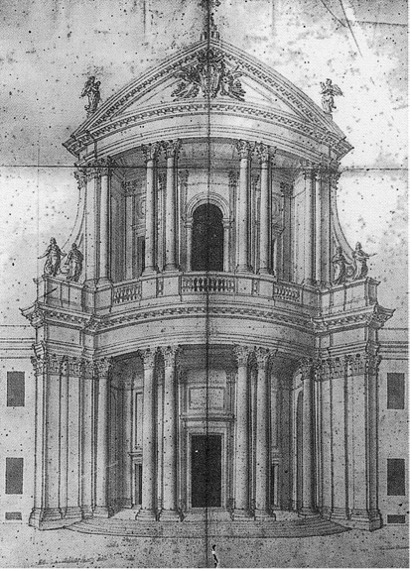
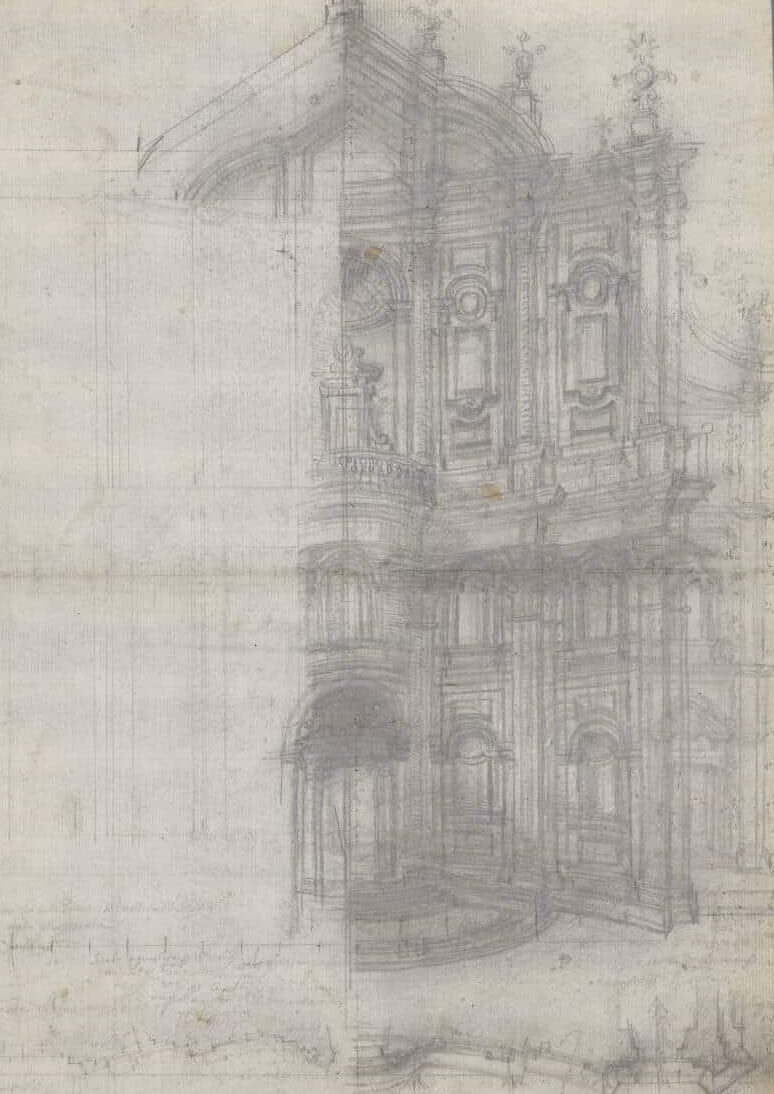
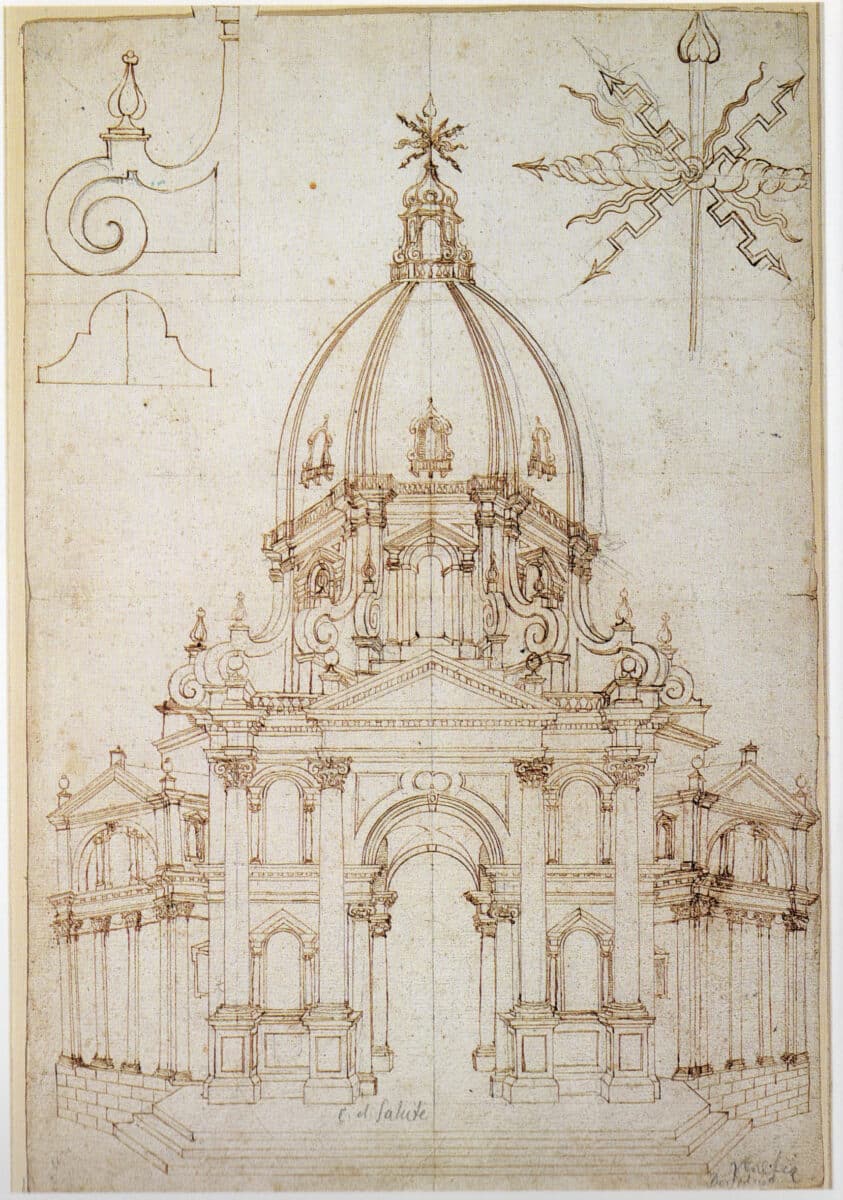
They also had an extended drawing method that could suit their needs better, one capable of meeting their intention of projecting building elements such as cornices and pilasters outwards to both embrace around and protrude into the space in front of the picture plane/window/paper surface, in addition to receding backwards into shallow depth. The result was a hybrid drawing: a two-dimensional elevation or section, animated by oblique elements that recede inward or extend outward from the picture plane, symmetrically along a central vertical axis. True perspectival depth is at most implied, but largely absent, hovering in the zone of shallow bas-relief as opposed to deep Cartesian space. This was by design, as oblique drawings do not privilege a singular, monocular point of view, locking the observer into position as the perspective demands. Architects such as Bernini, Borromini, Longhena, Rainaldi, and da Cortona employed this pop-up/pop-down drawing technique—what I’m calling the ‘pushograph’ (Figs 4,5,6).
In his version, Borromini would use the novel graphite pencil to create chiaroscuro depth and, occasionally, overlay the elements he wanted to pop off the picture plane towards the viewer with ink or heavier lines—much like the mechanisms of a modern children’s pop-up book.[4] By the eighteenth century, the ‘pushograph’ had evaporated as later baroque architects such as Piranesi, the Bibiena family, Juvarra, and Vittone became more enamoured of perspective’s capacity to extend laterally and backwards into the paper’s space. Passing beyond trabeated framing elements, their drawings suggested larger world(s) beyond the immediate scene, aided by the image compression offered by perspective.[5]
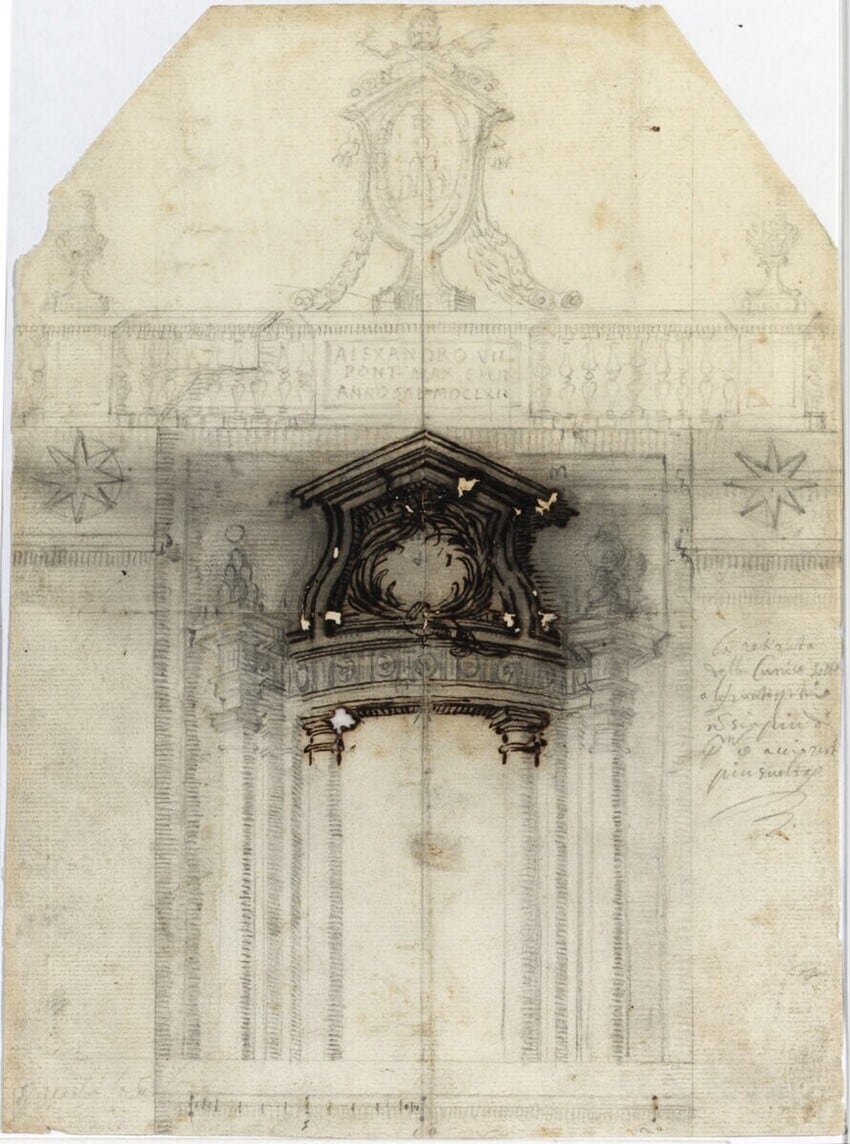
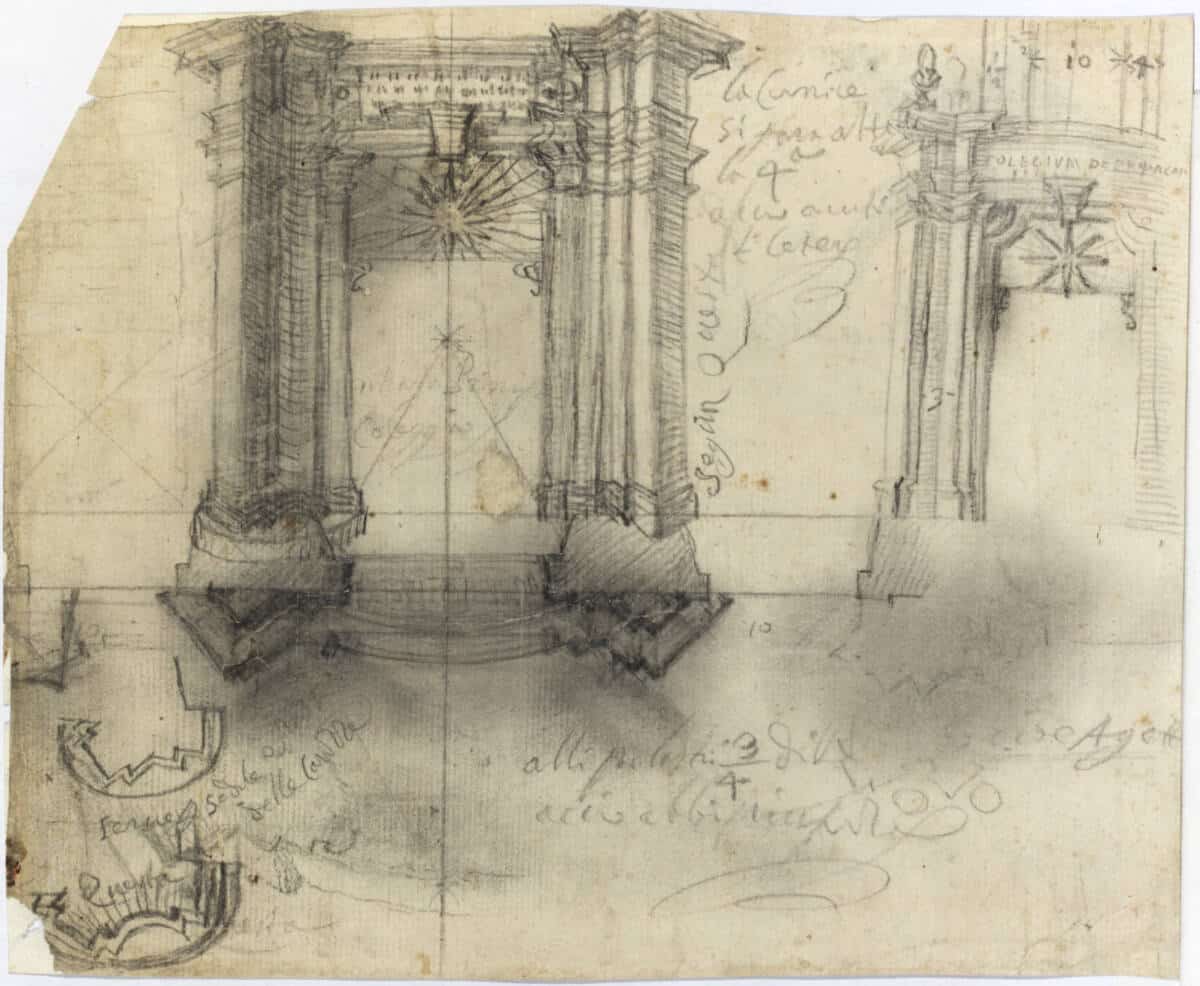
When the AI is prompted to create a video of a seventeenth-century ‘pushograph’ morphing into a photograph of the built façade, there’s a strong coherence that the Intelligence can find and a corresponding frisson generated by the ‘camera’s’ movement and the rubbery feel of the façade as it conforms to its shape (Figs 9, 10). While video cannot ‘pop out’ of the picture plane/screen as a ‘pushograph’ does on a physical drawing, the oblique dimensionality of the original drawing is complemented by the perspectival depth of the photographic frames as viewed in sequence.
Some may object to considering ‘Baroqsysm’ as some sort of analytical technique. The amount of hallucination encountered almost always compromises the integrity of the original images, at least at this point. It is more challenging to train the AI to recognise the coherence between a building’s plan, as opposed to its elevation, and a photograph of its façade—although I have no doubt it will be possible with carefully crafted prompts and transitional elements. But is video a medium that can serve as a way to analyse and research architecture within? No precision can be traced or derived from moving images, and they may ultimately be more entertaining than explicative. It also raises a critical question: does this technique deaden or diminish the frisson of encountering the real architecture? Or does it create a lasting analogue for the real thing, as perspective did originally, compacting the visual image (or building façade, in this case) into something portable, sharable, and commodifiable (or, in this case, translatable into a video)?
Notes
- Guarino Guarini, Architettura civile, del padre d. Guarino Guarini cherico regolare: opera postuma (Turin, 1637).
- Harold Alan Meek, Guarino Guarini and his Architecture (New Haven and London: Yale University Press, 1988), 18–20.
- Martin Jay, ‘Scopic Regimes of Modernity,’ in Discussions in Contemporary Culture, Vol. 2, ed. by Hal Foster (Seattle: Bay Press, 1988), 3-23.
- Jonathan Foote, ‘Borromini’s Smudge’, DMJournal–Architecture and Representation, No.2 Drawing Instruments/Instrumental Drawings.
- For a description of this idea, see Julian Bicknell, Bernardo Vittone: Architect of the Transcendental, (Amazon Press 2021),107-117.
*
Edgar Papazian is an architect in New York. He is also a professor at NYIT SoAD, Old Westbury.


– Jonathan Foote