Blow Up: Dante Bini and His House for a Film Director
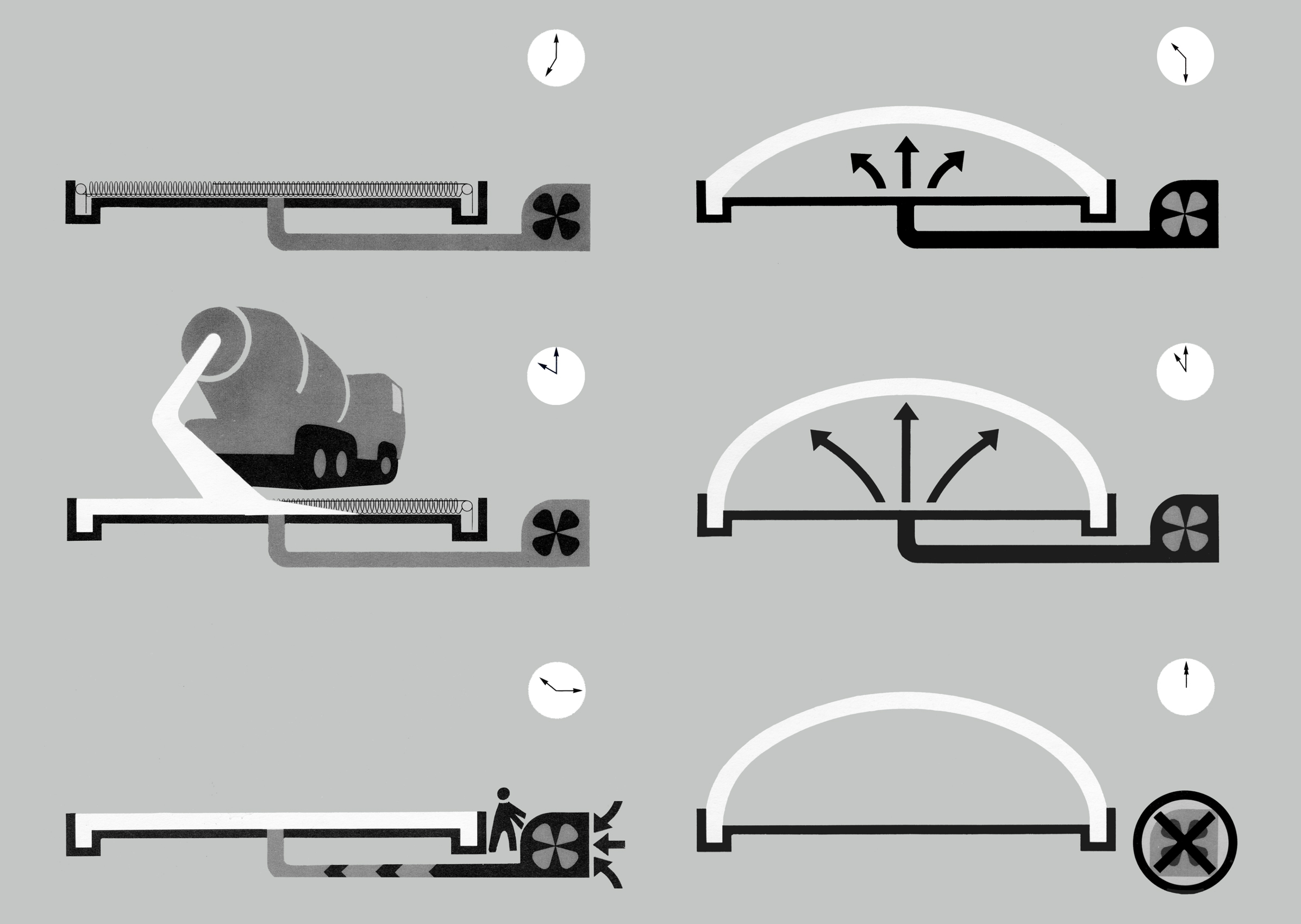
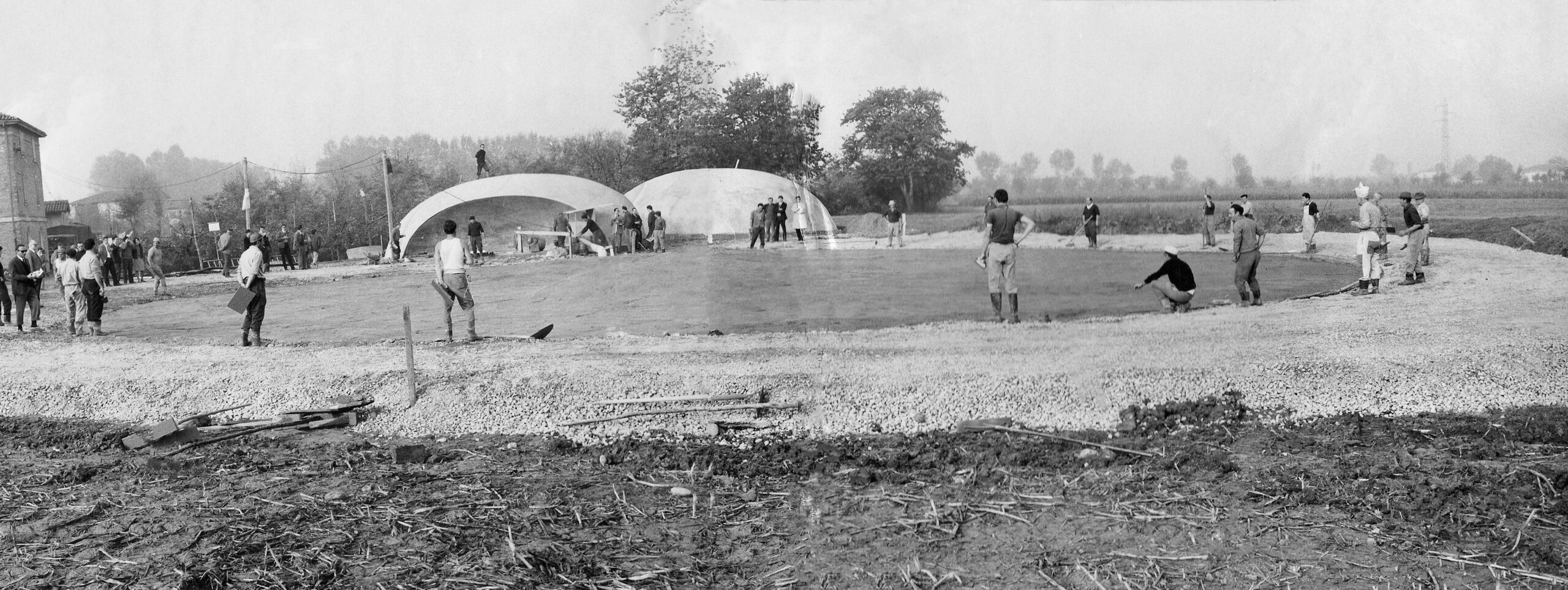
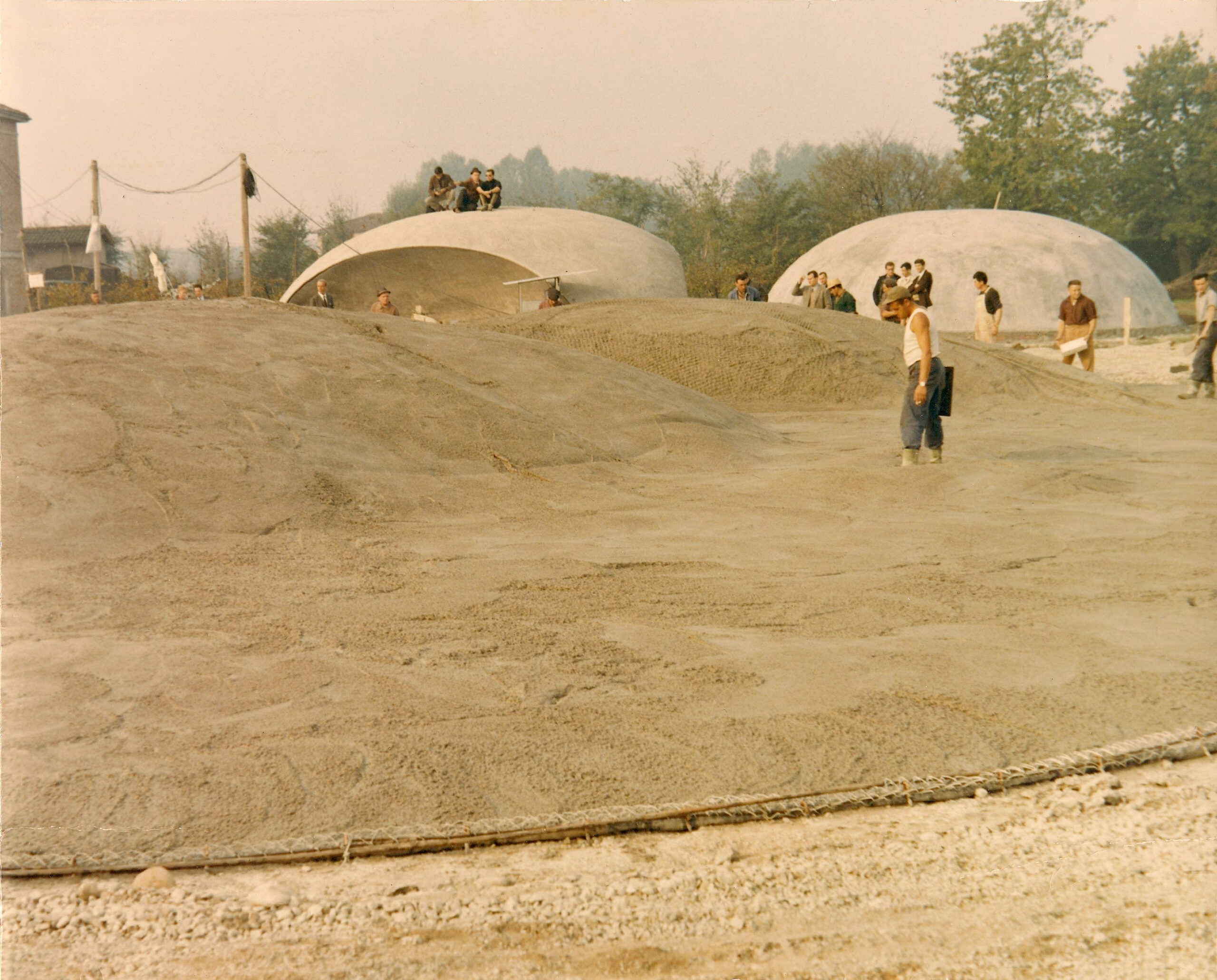
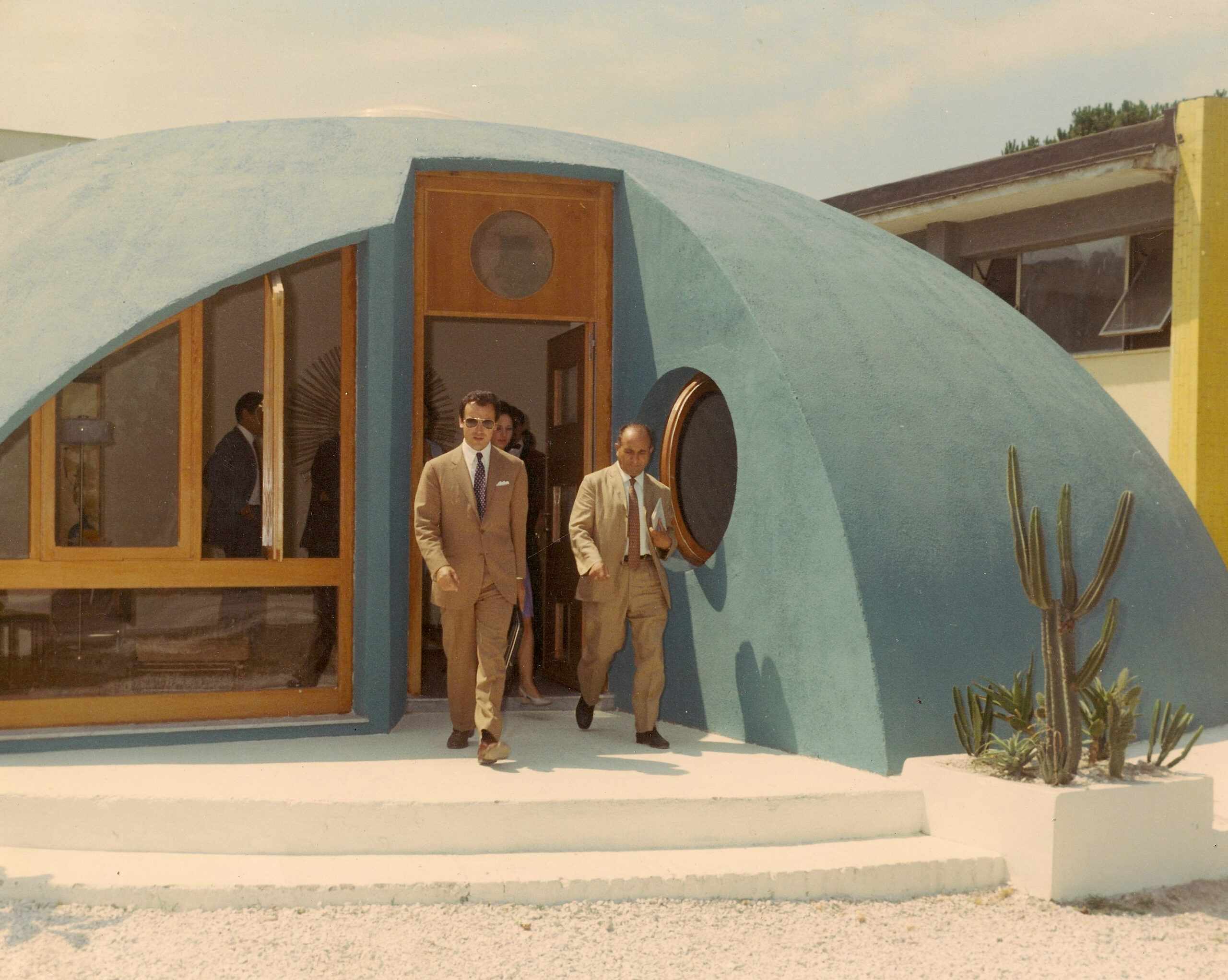
On July 4th, 1964, in Crespellano on the outskirts of Bologna, Italian architect Dante Bini successfully constructed (in less than three hours) a 12m diameter, 6m high, hemispherical reinforced concrete shell structure using the unique pneumatic formwork of a giant balloon. As a student, Dante Bini had studied and admired the thin-shell concrete domes of Adalberto Libera, Pier Luigi Nervi and Heinz Isler, but he was also struck by the huge amount of labour and time it took to build the complex formwork, which was subsequently binned. Bini tells a great story of playing a very long and competitive game of tennis under an air-supported tennis court cover. On emerging from the covered court after several hours, he realised that a huge amount of snow had fallen on the thin membrane and, with his technical interest, knew how much it might weigh but wondered how on earth such a thin inflated skin could support the weight of the snow—he was inspired. By using a low-pressure inflatable membrane, Bini could both lift and form concrete, and entirely obviate the need for complex and expensive timber formwork. This prototype did, however, have some teething problems, in particular, the uneven distribution of the wet concrete caused by an unpredictable (asymmetric) inflation. Improvements were made, and subsequent iterations adopted an elliptical cross-section for the domes and an improved and highly innovative system of steel reinforcement. The Binishell company was quickly established, and he systematised the process to mass produce domes used as sports halls, swimming pool enclosures, industrial storage facilities and school buildings. In 1993, Bini calculated that he had constructed 1,600 Binishell projects in 23 countries.
In 1968, the Binishell offices were transferred to Milan, and a new management system was imposed by the financial group Cappellini & Torniamenti. Following a trip promoting Binishells in the Middle East, Dante Bini returned to Italy to find that he had been sidelined in the Binishells company as a result of a hostile takeover and his position was limited to a consulting role. Despite this blow to his ego and being largely removed from the construction company which he had established and that still bore his name, he was typically phlegmatic and quickly re-established himself as an independent architect. From 1969 to 1971, Bini travelled the world lecturing about his new construction technology and operating from his new architectural office (housed in the first Binishell in Crespellano) he directed the design and construction of several villas and dome complexes. On reflection, the corporate meltdown which led to Bini’s reinvention might be viewed as a blessing which refocused Dante’s creative energies and led to the production of houses for Sergio Vacchi, Letizia Balboni and Luisa Spagnoli; the holiday village on the island of Cappuccini and his most celebrated design, the house for Michelangelo Antonioni and Monica Vitti at Costa Paradiso, Sardinia.
Whilst the numerous Binishells constructed since their invention in 1964 all contain the DNA or essence of Bini’s original design invention—a very few have become exemplars of his structural and aesthetic art. His house at Costa Paradiso in Sardinia, for Michelangelo Antonioni and Monica Vitti, is perhaps the place where his construction system is deployed to the most artful effect. The Villa Antonioni is certainly a Binishell, elliptical in cross-section, but it is also a thin carapace whose symmetrical extent is skillfully perforated, a house for artists, built as a work of art and embedded with the crushed rock of the il deserto rosso and with local camomile implanted into the terrazzo floor. At the centre of the plan is a ‘pantheon-like’ oculus, not to view but to hear and smell the sea, and the sensory qualities of the house extend to its ‘tuned’ cantilevered stone stairs, the top side of which is polished, the underside left roughly hewn. All other openings for windows and doors are trapezoidal with rounded corners, and consistent with its experiential qualities—the internal plan form is more Frederick Kiesler than Pier Luigi Nervi. The Villa Antonioni was an unusual commission which Bini undertook under the strict understanding that its provenance, whereabouts, or even existence would be kept secret whilst his clients were still alive. This promise was kept, and it is only recently that this one-off (albeit a one-off which utilised a 30m diameter Binishell) has now been rediscovered and co-opted into architectural history.
Dante Bini was approached by the film director Michelangelo Antonioni in 1969 and was commissioned to build a villa at Costa Paradiso on the Island of Sardinia. The architect and town planner Lucio Fontana writing in Building with Air explains that Antonioni was in Sardinia in 1969 when ‘he chose Costa Paradiso as the place where he would build his holiday home, a place where he could hide away, and he chose the architect Dante Bini to build the house that he already had ‘in mind’ (the idea was already formed a priori).’[1] Fontana also explains that at the time the villa was commissioned by Antonioni, the Binishell Domes of Dante Bini were already well known, so that Antonioni knew he was employing the ‘dome architect’. Fontana also makes clear that the resultant design is anything but a ‘standardised form of construction’ and whilst the hermetic, circular plan, elliptical cross-sectioned outline of the Binishell is extant, this highly wrought ancestor is so attuned to its landscape, ecology, and clients as to almost emerge out of the landscape.[2] Famously, Antonioni had filmed Monica Vitti in Il Deserto Rosso in Sardinia in 1964 on a private beach owned by the Milanese building contractor Pierino Tizzoni, and it was during filming that Tizzoni had taken Antonioni to another part of the island and had invited him to pick a site for a future house, which he gifted to Antonioni.
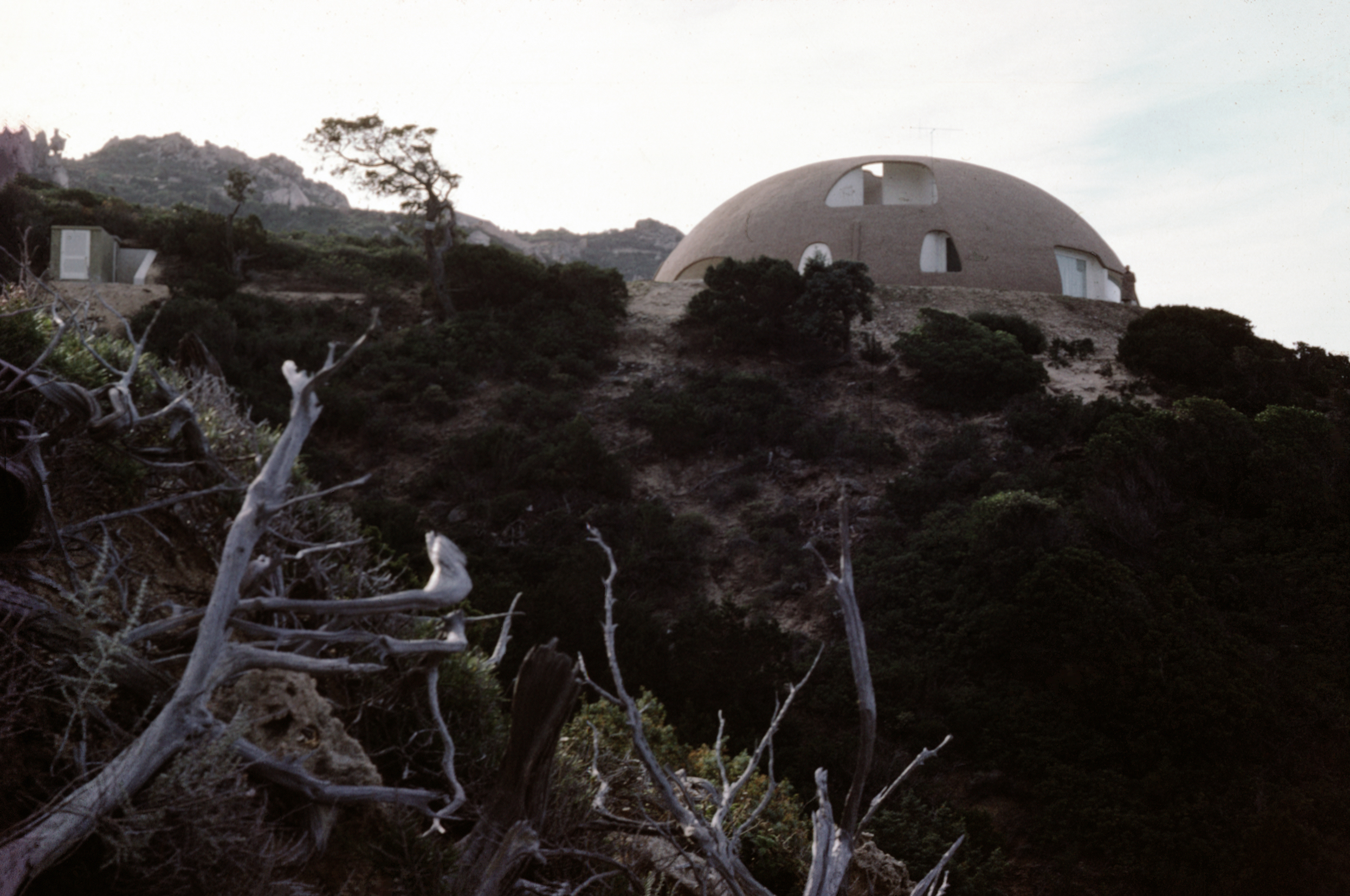
The Villa was designed by Dante Bini, working with his associates, the husband-and-wife team of Eros Parmeggiani and Maria Miniero, on drawings and construction supervision. The contractor was Impresa Aldo Pola of Trinita’ d’Agulta, and the villa was built on land owned by building contractor Pierino Tizzoni, with the dome itself built by Binishells of Milano. The construction of the villa was complicated due to its remote location in an as yet undeveloped area of the island at that time, with limited site access and no permanent power supply. The villa is multi-levelled, opening up towards the sea frontage. The main entrance to the house enters the dome at high level and your drop down a series of half levels and terraces to the main living space. The central stairway is formed with large slabs of local ‘pink’ granite selected from a nearby quarry by Bini and Antonioni. The ‘tuned’ slabs (each with its own resonant frequency) are cut and polished on the upper surface with roughly hewn undersides. Bini explained that during a visit to the quarry, Antonioni had made Bini inhale the fragrance of freshly cut stone to experience the history of the site.
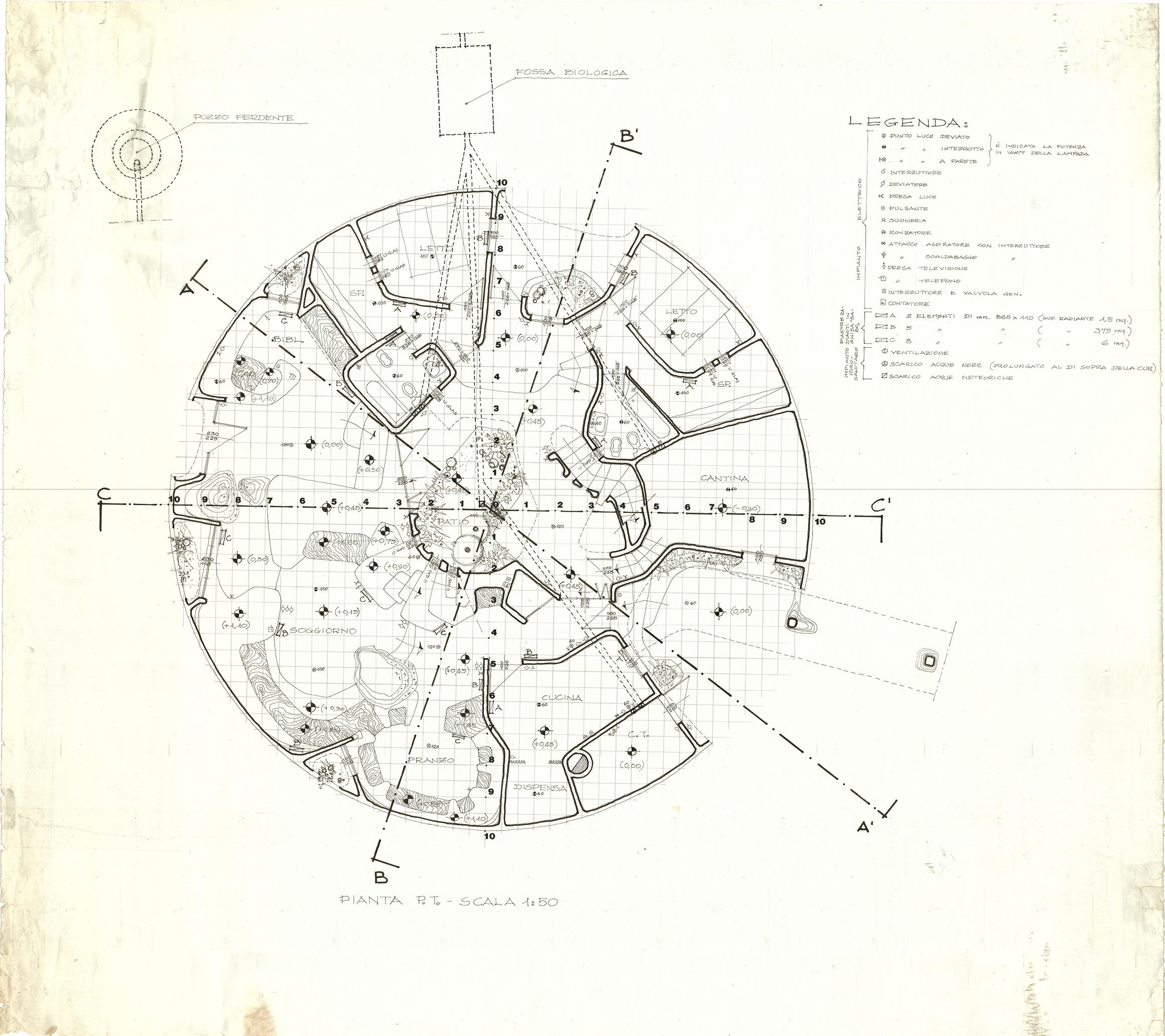
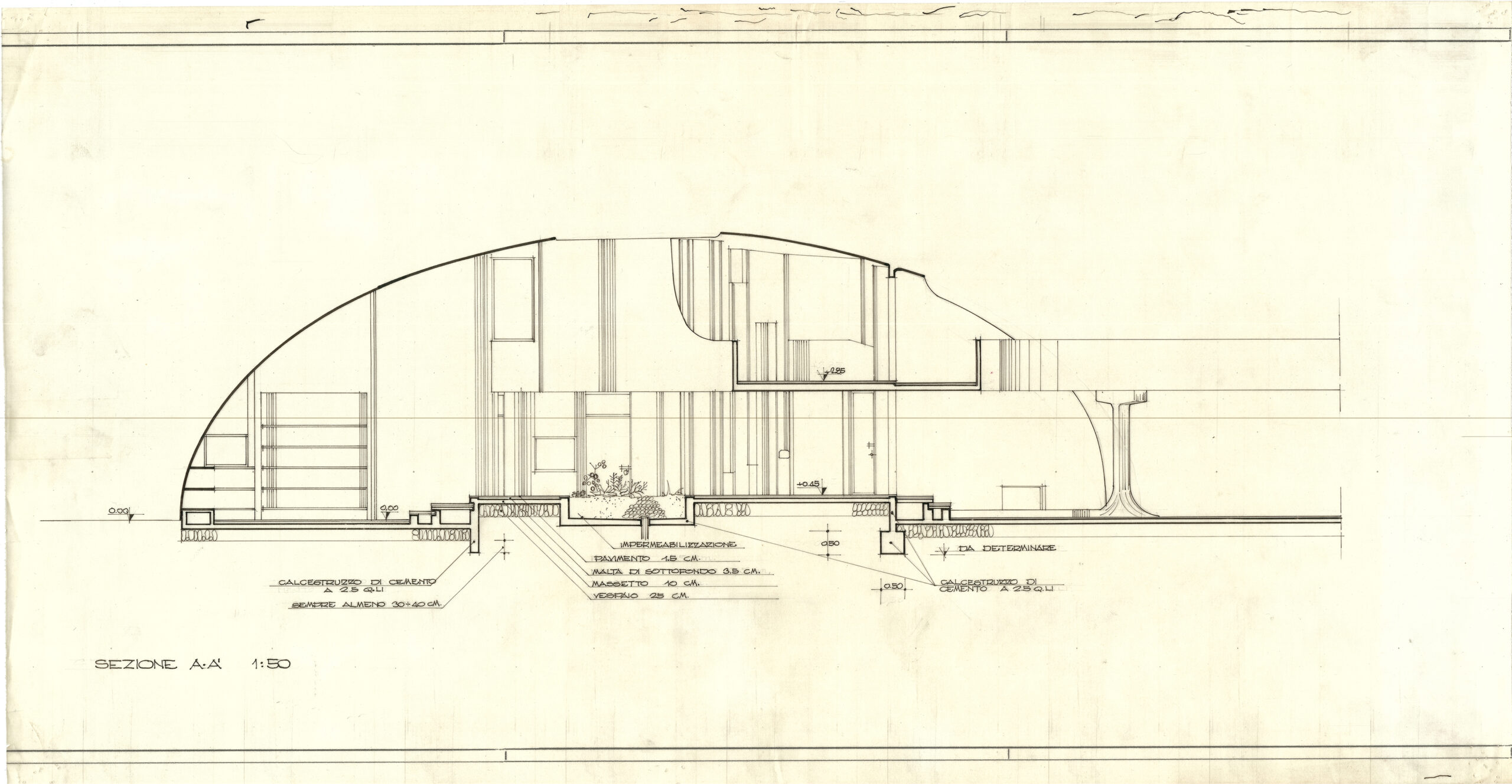
A highly specific pattern of cutouts punctures the outer skin of the villa, relating to specific views and programmatic requirements. Window and door openings are recessed so as not to interrupt the line of the extrados, and a long and low curved glass window forms the primary waterside lookout. Smaller window openings at ground level are formed by holes punched in the surface of the dome, with window framing pulled back into ‘eye socket’ like recesses with mini garden planters set within the curtilage of the building. The house was originally built around a central open courtyard garden, within which to capture the sounds of the sea and bring light and life into the deep plan. The central garden was linked through a series of passages at ground level like an elegantly designed sequence of ancient ‘cave like’ excavations. The sheer visceral and experiential qualities of the building are established with the surface treatment of the dome which is embedded with a crushed aggregate of the local pink granite. This mineral screed has the effect of lifting the ground level of the local landscape and welding this elegant (but distinctly alien) limpet firmly to the rugged landscape.
Notes
- Dante Bini, Building with Air (London: Bibliotheque McLean, 2014), 149.
- Ibid., 150.
*
Dr Will McLean is Reader in Regenerative Structures & Materials at the School of Architecture and Cities at the University of Westminster. McLean writes about architecture and technology, and he has co-authored six books with colleague Pete Silver, including Structural Engineering for Architects: A Handbook (2014), Introduction to Architectural Technology (2021), The Environmental Design Sourcebook (2021) and Sustainable & Regenerative Materials for Architecture (2025). In 2008, he established the architectural imprint Bibliotheque McLean, publishing titles including Sabbioneta: Cryptic City by James Madge (2011), Quik Build: Adam Kalkin’s ABC of Container Architecture (2008) and Building with Air (2014), the first English-language book on the work of Italian architect and construction innovator Dante Bini.
Volker Sattel’s film La Cupola (The Dome, 2016) focuses on architect Dante Bini’s Sardinian villa commissioned by Michelangelo Antonioni and Monica Vitti.
