Desire and Pain: John Hejduk’s Thirteen Watchtowers of Cannaregio
– Mehrshad Atashi and Lida Badafareh
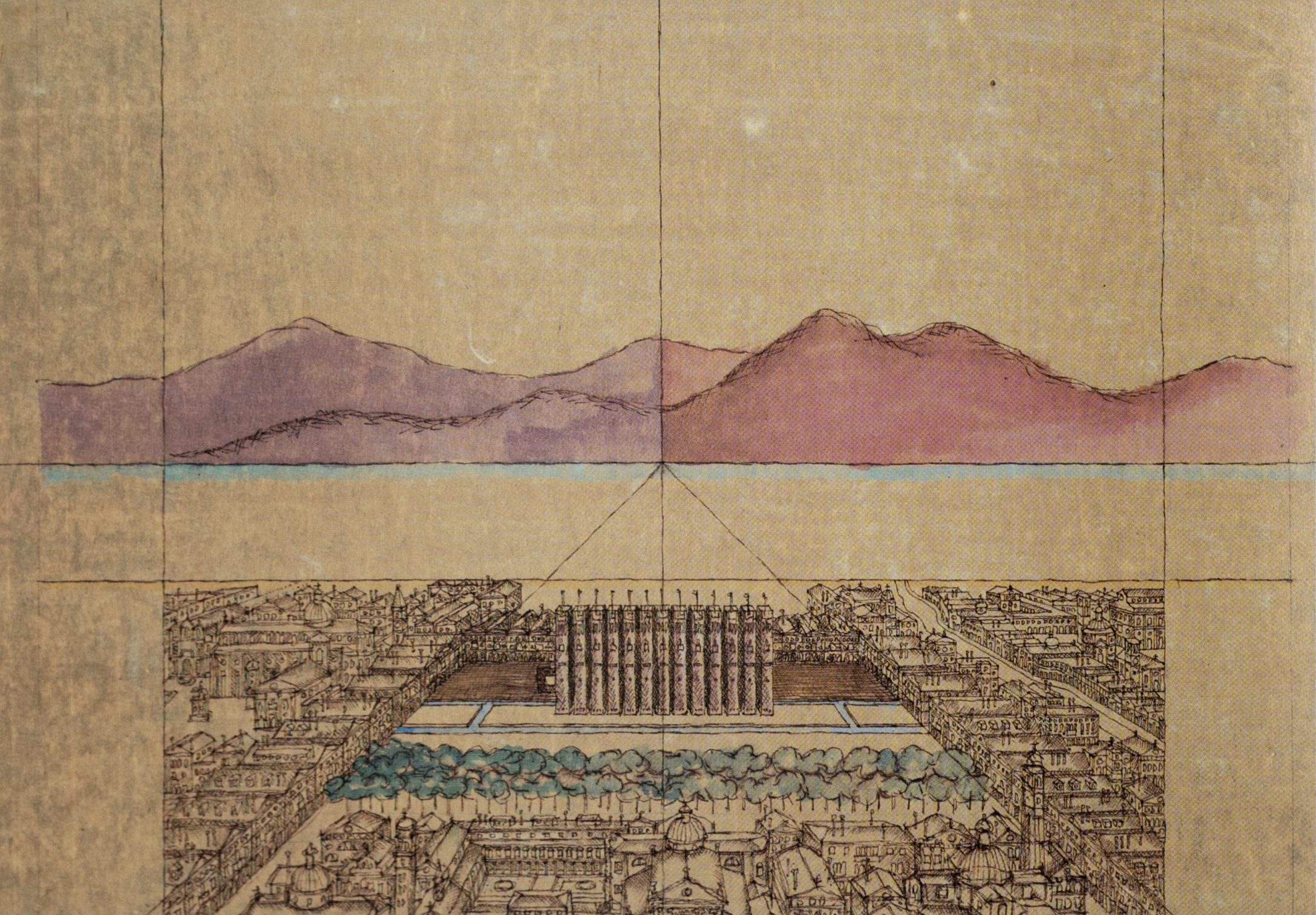
In his conversation with Don Wall in Mask of Medusa, John Hejduk recalls the programme of the Schatzalp sanatorium in Thomas Mann’s The Magic Mountain.
‘[…] the hero is going up the mountain in a carriage in the deep snow, he sees the dead bodies of those who had died in the sanatorium coming down. In order to get the bodies from the mountain, they couldn’t use a carriage, so they arranged a pulley system, from the top of the mountain down to the bottom, and they would put the black shrouded bodies on sleds attached to the pulleys. Just after this scene Mann gives you the image of the sanatorium itself: clean, snow white and antiseptic.’[1]
In Mann’s novel, the Schatzalp sanatorium is a double house: one stages the promise of healing, grand vistas, fresh alpine air, sunlight, and an extravagant sense of joy; the other is filled with dread, hopelessness, and suffering. Here, the dual narratives of life and death run in parallel, as tuberculosis patients lived in separation about fifty meters above Davos Dorf on the mountain, inhabiting at once hope and despair, longing and pain. This simultaneous presence of contradictory moods parallels what Hejduk sees in the urban spaces of the Middle Ages. In medieval cities, contrasting places—sacred and profane, protected and exposed, celestial and terrestrial—coexisted in tension, mutual encounters, and in continuous interaction.[2] Hejduk describes, ‘In the Middle Ages, there were programs of optimism, but at the same time there were programs of pessimism; the simultaneous existence of both conditions provoked a certain argumentation.’[3]
With the Venice Trilogy (1974–1979) and the Cannaregio projects (1978–1979), Hejduk’s architecture shifted from the ‘Architecture of Optimism’ to what he calls the ‘Architecture of Pessimism’.[4] However, rather than one dominating the other, his work became a manifestation of the coexistence of contradictory and complementary conditions. In these Venice projects, he focused particularly on balancing pessimism and optimism, contrasting the American spirit with the European condition. For example, he set in conflict ‘abstraction and historicism; the individual and the collective; freedom and totalitarianism; the literal and the ambiguous; narrative and poetry’.[5]
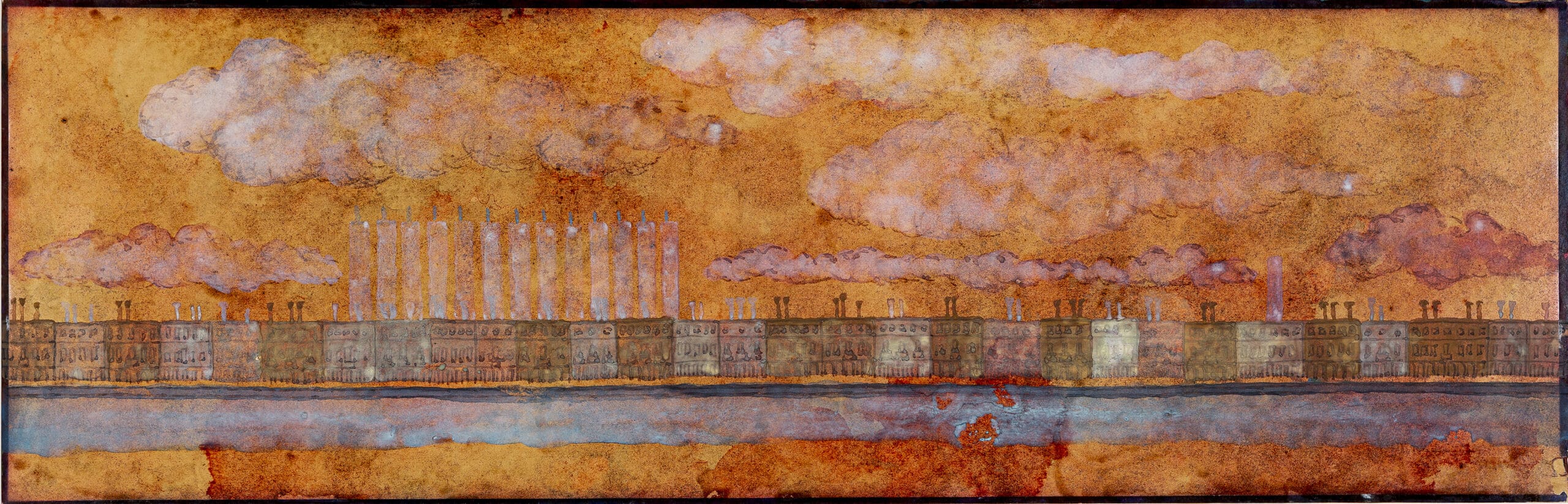
As part of the Cannaregio projects, in The Thirteen Watchtowers of Cannaregio, Hejduk juxtaposed the American phenomenon, which he defined as ‘separation, isolation, and breaking down [architecture] into units’, with European architecture, which he characterised by ‘interweaving of volumes and interlocking elements.’[6]
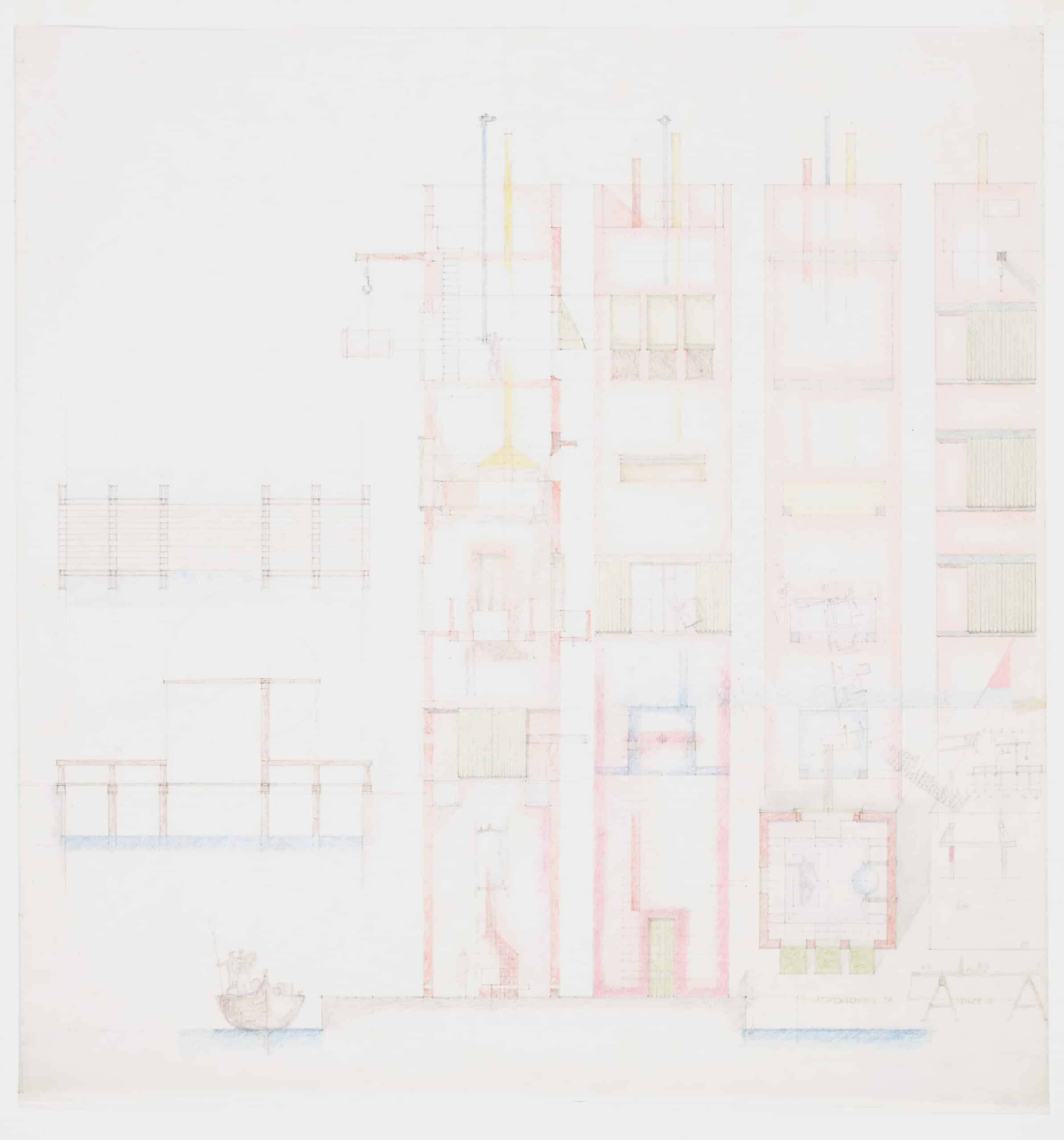
The Thirteen Watchtowers of Cannaregio consists of thirteen narrow watchtowers standing in a row on an empty lot surrounded by canals, rendering themselves in complete detachment from the city. Each tower is occupied by a sole inhabitant, desiring to spend the rest of their life in separation and isolation, only to overlook Cannaregio and Venice.[7] Each floor in the tower is a unit dedicated to a distinctive act. The entrance is equipped with a fireplace that serves as a hearth. The first floor is designated for bathing, followed by a sleeping room above. The fourth level serves as the eating area. The fifth is a living room equipped with a periscope for a flattened view and a ladder that leads up to an outdoor terrace for an overall view of the city. At the top, just outside the living room, a pulley system hangs from the towers, facing a large campo on the opposite side of the wide canal.
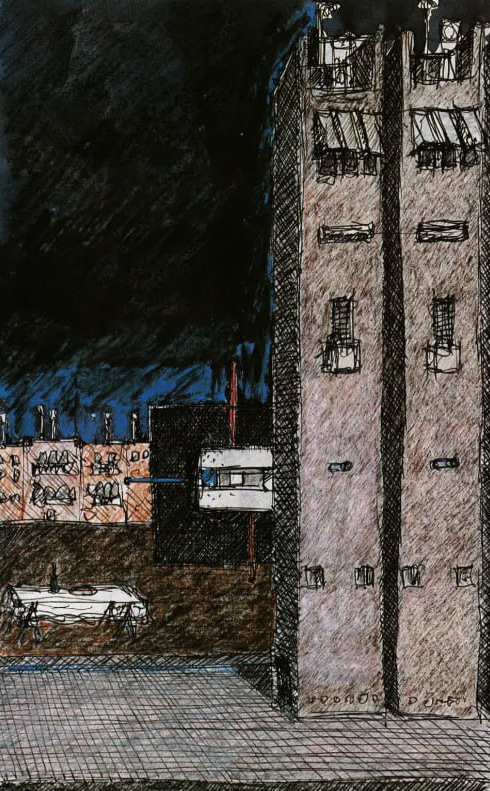
The campo stands between the city and the watchtowers, marking the encounter between the collective life unfolding in Venice and the solitary life within the towers. It is imbued with a sense of anticipation, embodying the cycle of time, the ritual of waiting, and the desire to reside in the towers. The campo is covered with one thousand and seventy-nine stone slabs marking the number of years, and with the passing of each year, one slab is added.[8] On the campo, there is a small white house and a long wooden table for the fourteenth citizen to keep the time and watch the towers. Every day, the sole inhabitant of the Campo House comes out, sets the table, lays a white tablecloth over it, and moves it in front of the following watchtowers.[9] When he reaches the thirteenth tower, he puts a new cycle into motion. He spends each day waiting for the moment when the pulley system, like the bobsleds for the dead in The Magic Mountain, lowers the deceased body of one of the watchtowers’ occupants. Then he knows that his time has come to cross the water and live in isolation until his own death arrives, and the cycle continues—life and death, observing and being observed, desire and pain.
Notes
- John Hejduk, Mask of Medusa (New York: Rizzoli International, 1985), 91.
- In ‘Of Other Spaces: Utopias and Heterotopias’, Michel Foucault describes medieval spaces as an ensemble of contrary places. ‘One could say, by way of retracing this history of space very roughly, that in the Middle Ages there was a hierarchic ensemble of places: sacred places and profane places: protected places and open, exposed places: urban places and rural places (all these concern the real life of men). In cosmological theory, there were the supercelestial places as opposed to the celestial, and the celestial place was in its turn opposed to the terrestrial place[…] It was this complete hierarchy, this opposition, this intersection of places that constituted what could very roughly be called medieval space […]’ Michel Foucault, ‘Of Other Spaces: Utopias and Heterotopias’ in Architecture/ Continuité, October, 1984. trans. by Jay Miskowiec (Diacritics 16, no. 1, 1986), 22–27.
- Hejduk sets the urban spaces of the Middle Ages against the period of the Modern Movement, which he considers having only ‘programs of optimism’, with no counterforce. John Hejduk, Mask of Medusa, 90.
- In the Mask of Medusa, Hejduk notes, ‘Since 1974 Venice has preoccupied the nature of my work. … I suspect in these past four years my architecture has moved from the “Architecture of Optimism” to what I call the “Architecture of Pessimism”.’ Ibid., 83.
- Hejduk describes, ‘[Venice] is a forum of my inner arguments. The thoughts have to do with Europe and America; abstraction and historicism; the individual and the collective; freedom and totalitarianism; the colors black, white, grey; silence and speech; the literal and the ambiguous; narrative and poetry; the observer and the observed. I am in debt to Italy and to the City of Venice for provoking the impetus for my investigations.’ Ibid., 83.
- Ibid., 90, 63.
- Hejduk notes, ‘The city of Venice selects thirteen men, one for each tower for life-long residency. One man lives in one tower, and only he is permitted to inhabit and enter this tower.’ Ibid., 82.
- Ibid.
- Ibid.
*
Lida Badafareh and Mehrshad Atashi are founding partners of mershandlee, an architecture and design studio based in Vienna. Lida and Mehrshad both hold a Master of Arts in Architecture from Städelschule in Frankfurt and a doctorate in architecture from the University of Innsbruck. They currently teach at the Department for Architecture Theory and Philosophy of Technics at TU Wien and have previously taught at the Institut Raum und Gestalt at TU Graz, the University of Innsbruck, and the RaumKlasse at UdK Berlin.
