Drawing of a Cause
The following text is based on an excerpt from Lost Causes: Possibilidade e Política em Concursos de Habitação (Porto: Circo de Ideias, 2025), edited by João Manuel Miranda and Tiago Antero. The book presents the results of ‘Lost Causes’, a research project that aims to promote critical reflection on unbuilt projects and architectural competitions from multiple perspectives.
*
‘Each drawing seeks to capture, with the greatest possible precision, a concrete moment of a fleeting image with all its nuances. To the extent that this elusive quality of reality can be recognised, the drawing will emerge more or less clearly, and appear all the more vulnerable the more correct it seems.’ — Álvaro Siza [1]

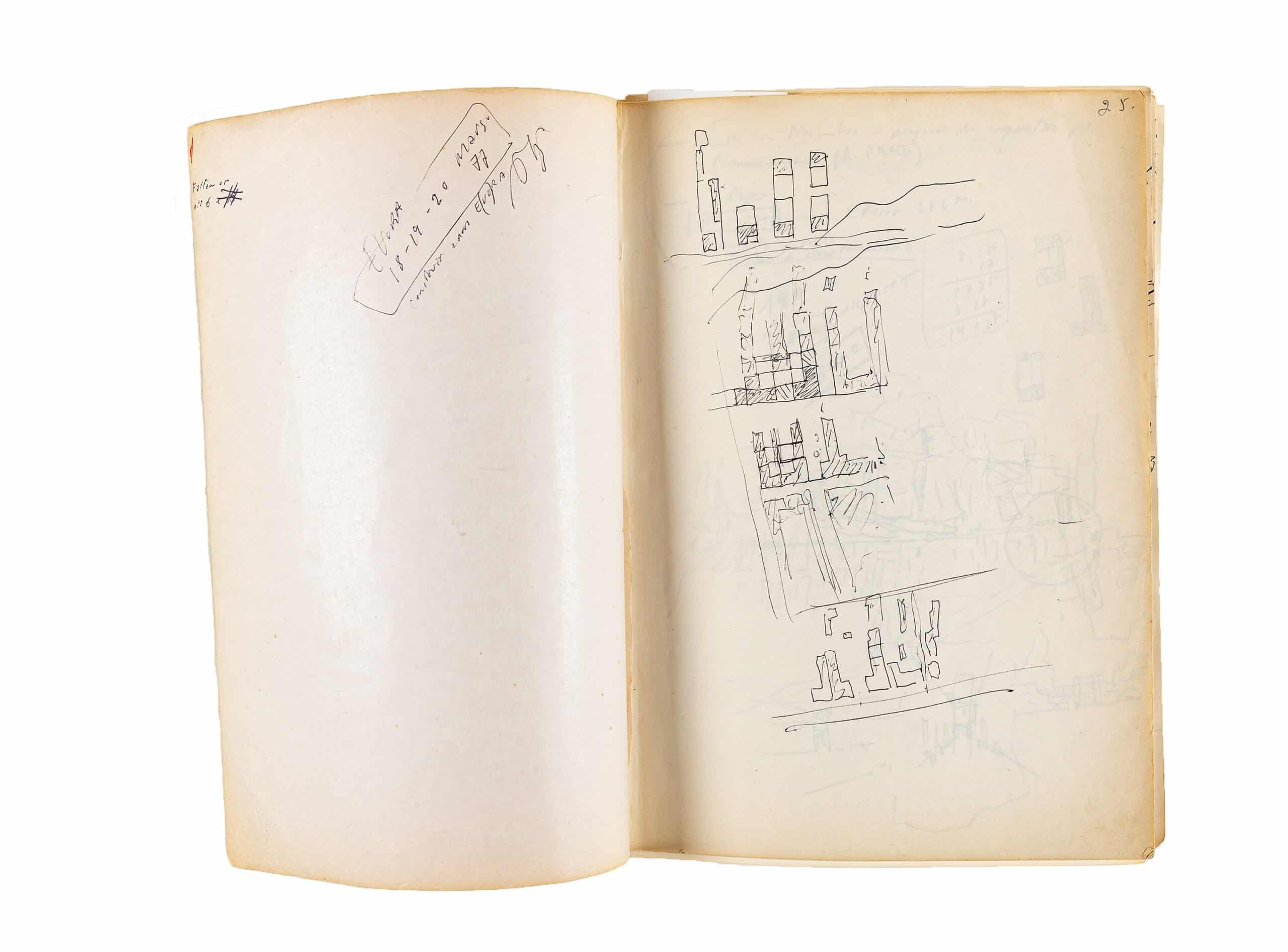
The quote above belongs to a text written in the late 1970s, when the architect Álvaro Siza already had around twenty-five years of professional experience. The point of departure is precisely the recognition that much of this trajectory consisted of projects that never came to be built—that is, never reached completion. He writes:
‘Most of my projects have never been realised. Some of those that were carried out were only partially completed, and others were profoundly altered or even ruined. It is something one must expect. An architectural proposal that aims to engage fully with existing innovative tendencies, with the conflicts and tensions that shape reality; a proposal that seeks to represent more than a passive materialisation, refusing to reduce that reality and analysing all its aspects one by one; a proposal of this kind cannot rely on a fixed image, nor can it follow a linear evolution. In any case, and for the same reasons, such a proposal cannot be ambiguous, nor can it be reduced to a disciplinary discourse, however correct that may appear.’
In an architectural project, drawing operates through a language that, within this domain, communicates intentions and structures design thinking: drawing seeks the intelligibility of concept and idea. Bearing in mind the symbolic, grammatical and semantic implications of this particular linguistic system, drawing has been granted a centrality grounded in two premises: 1. drawing as synthesis—empirical, spontaneous, and free from digital tools—enabling crucial information for the design process to be extracted, (re)organised and generated; 2. drawing as a playful form of experimentation through which a mental construction is transferred to the physical support of paper, in symbiosis with the corporeality of its author(s) and the friction of the surrounding context. This distillation of thought (across the entire sheet) in search of the ‘fleeting image’ or the ‘transient quality of reality’ subsequently becomes the document and eikón of a cause: a ‘synthesis without synthesis’—an open, inquisitive and unstable language—movement and dialectic.
Lost Causes generates a trajectory that inevitably compels epistemological reflection within the discipline of Architecture, while also considering contributions from various fields of knowledge from a problematising standpoint. Accordingly, it was understood that the construction of discourse requires a terminological and conceptual clarification that weighs and relates words carrying a certain academic tradition. One asks, for example, what it means to attribute to drawing the status of a document. Is it appropriate to employ a historiographically inclined vocabulary such as ‘legacy’, ‘collection’, ‘holding’, or ‘archive’? To what extent—and how—may these categories be mobilised? And in what ways might a holding, collection, or archive be produced that can be activated disciplinarily with a contemporary programmatic purpose? What is its pertinence, and what does it contribute to the framework of contemporary architectural reflection?
Notes
- See, on this subject, the text written in Porto in May 1979 by Álvaro Siza and published in 1983, entitled ‘La major part dels meus projectes no han estat mai realitzats…‘, Quaderns d’arquitectura i urbanisme, no. 159 (1983), 58–59.
*
João Manuel Miranda is an architect and founder of his own practice. His work has been awarded, exhibited and published nationally and internationally. He is currently a doctoral candidate in the PhD programme in Contemporary Architecture at the Universidade Autónoma de Lisboa (UAL) and a researcher affiliated with the Centre for Studies in Architecture, City and Territory (CEACT/UAL). He was awarded a Doctoral Research Scholarship by the Fundação para a Ciência e a Tecnologia (FCT), which funds his doctoral research. Previously, he was granted a fully funded doctoral scholarship by the Universidade Autónoma de Lisboa (UAL).

– Manuel Montenegro