Franco Purini: Drawings of Imagination
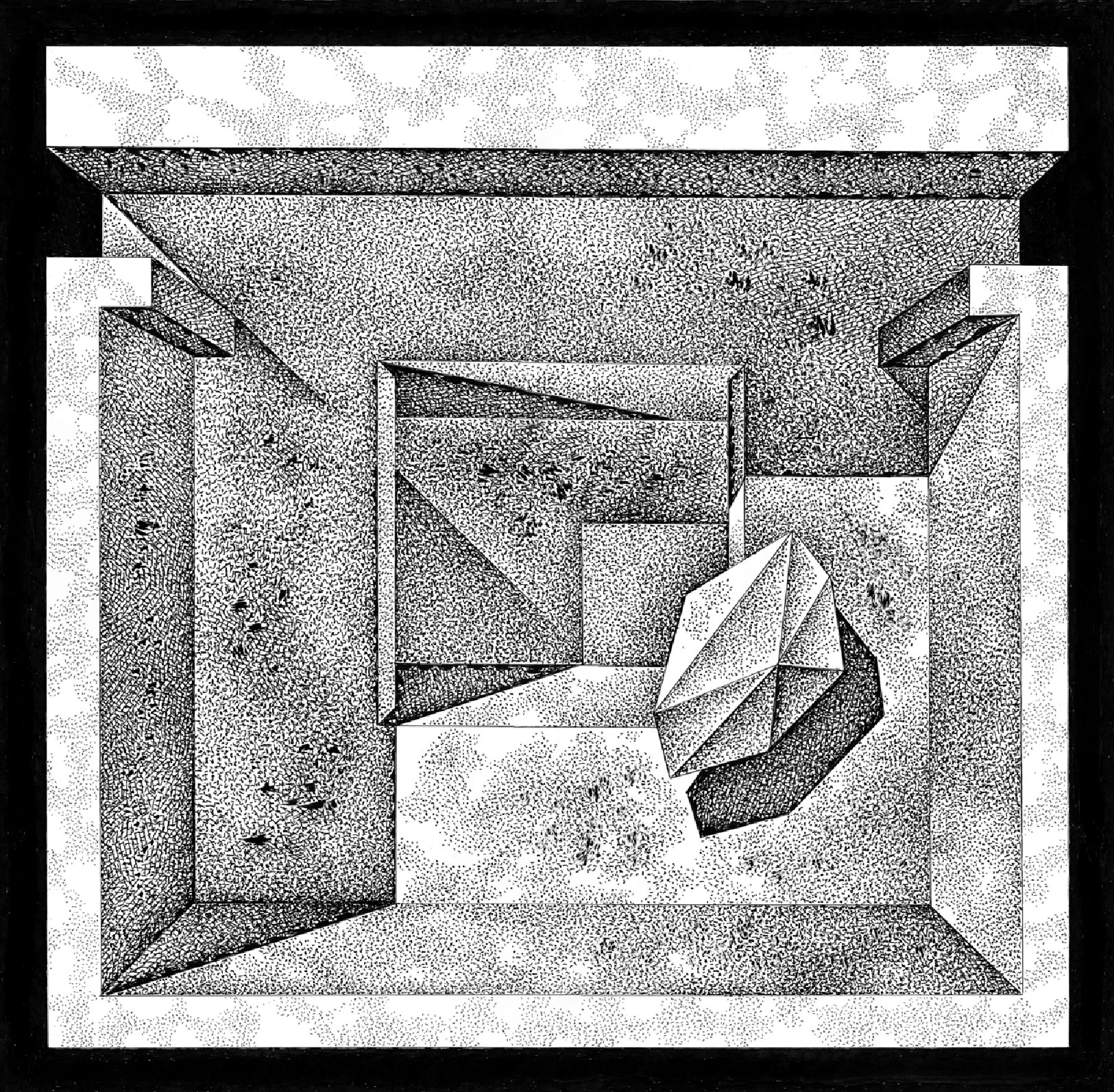
‘The drawing represents the medianic exploration of the shaded side of reason and, contradictorily, the scene of an ideal landscape in which the architect believes he will be happy. As the place of theoretical truth, the drawing institutes itself independently of architecture. Superior to architecture by the fact that it is a fiction, the drawing presents itself as the theatre of the apparition of language.'[1]
Franco Purini—an influential Italian architect, professor, and intellectual—is widely recognised for treating drawing as an independent mode of thought, with a particular emphasis on architectural education and the theoretical dimensions of design. A key figure in the architettura disegnata movement—alongside architects such as Aldo Rossi, Arduino Cantafora, Massimo Scolari, Maurizio Sacripanti, and Carlo Aymonino—Purini regards drawing as the starting point of architectural language. For him, drawing is an ongoing, demanding process of experimentation that leads to carefully crafted, masterfully executed compositions.
Purini’s work as a draughtsman has recently been the subject of meticulous archival research by Olga Starodubova, a PhD candidate at Sapienza University of Rome. This systematic work involved the cataloguing, analysis, and close examination of his drawings. In a substantial and elegantly designed volume, Starodubova presents the complete collection of Franco Purini’s original drawings, comprising approximately 1,600 drawings created over a period of sixty years.
The title of the book, Franco Purini. Disegni di Invenzione (Drawings of Imagination) 1964–2024, directly references Carceri di invenzione, the renowned series of engravings by Giovanni Battista Piranesi, whose work Purini extensively studied as a scholar. The drawings are beautifully reproduced, often with an entire page devoted to each work and without accompanying text, allowing them to speak for themselves. These are not sketches but highly elaborate plates that reveal what Purini describes as ‘theoretical landscapes’, where past and future converge between archaeology and prophecy.
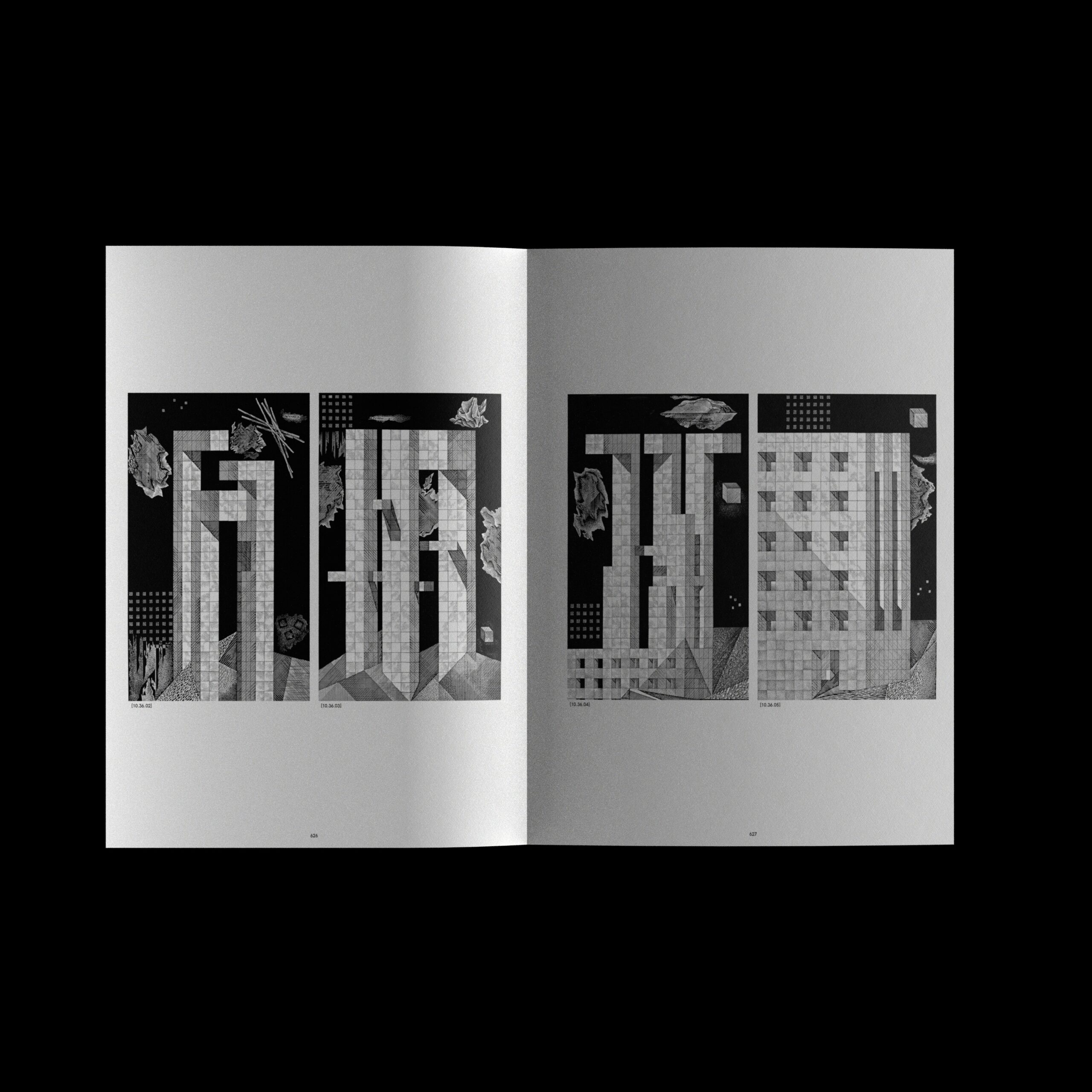
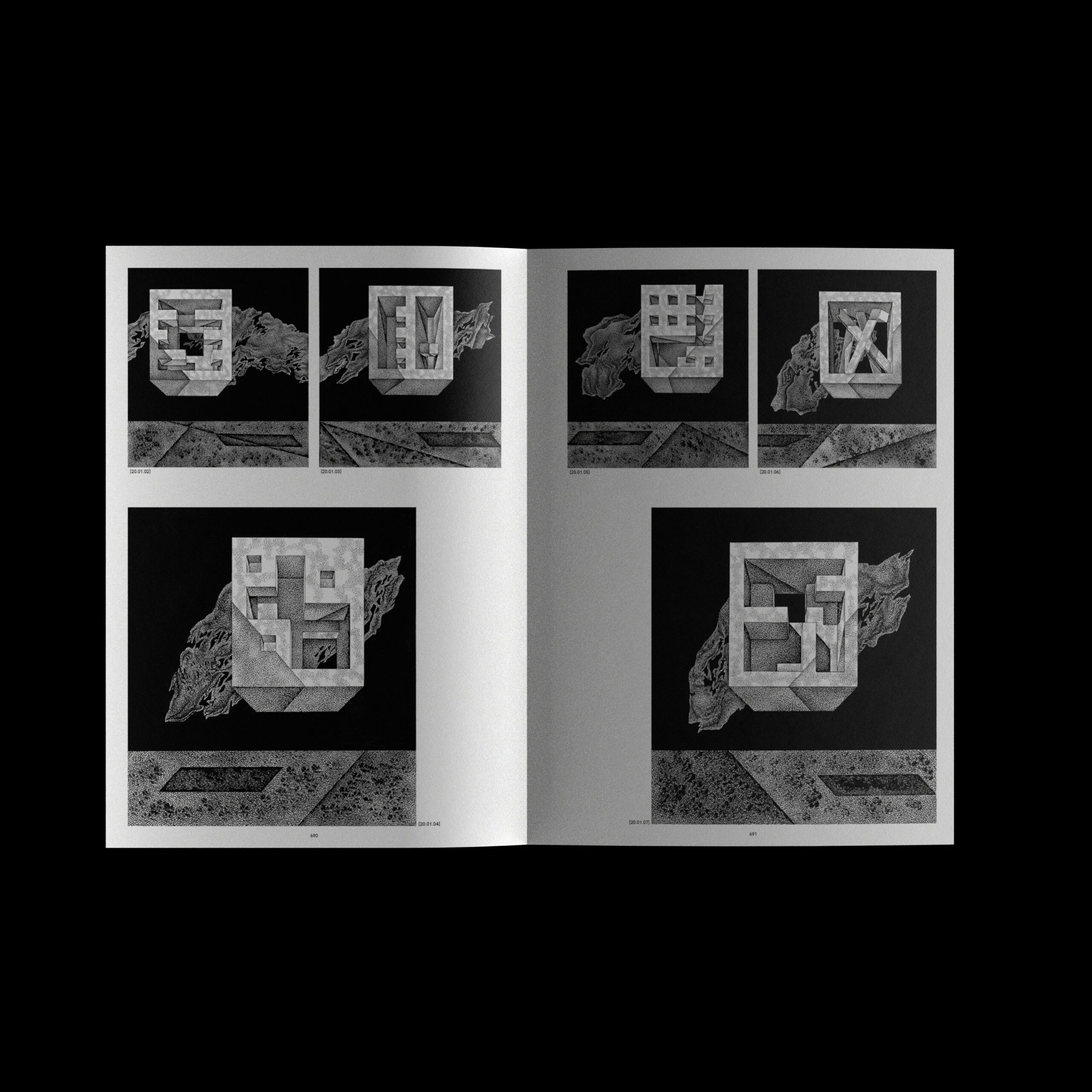
The entire body of graphic work is presented in chronological order; the volume can therefore be read as a catalogue that also includes a list of the exhibitions in which the Roman master has participated over the years. Published by Schwarzraum Books, the volume is further enriched by essays by the architectural historian Marco Biraghi and the art historian Gianni Contessi, which complement the insightful texts by the curator and by Purini himself.
His imaginative drawings outline the trajectory of his career, which began at the age of 23, when he joined Maurizio Sacripanti as a draughtsman to create the famous perspective rendering for the 1968 Italian Pavilion design at the Osaka Expo. During these early years, he also saw the creation of important drawings, such as the Classificazione per sezioni di situazioni spaziali (Classification of Spatial Situations by Sections) (1968), described by Marco Biraghi as a ‘precious “Rosetta Stone” containing his main “hieroglyphs,”.’ While still a student, Purini moved to Milan to work in Vittorio Gregotti’s studio. After graduating in Rome in 1971 under Ludovico Quaroni, he began to undertake a wide range of commissions, while exhibiting his drawings and works in Italy and abroad. His international presence was further established through his participation in the 1980 Venice Biennale, The Presence of the Past, curated by Paolo Portoghesi, followed by his solo exhibition Around the Shadow Line. Beyond Urban Architecture at the Architectural Association in London in 1984.
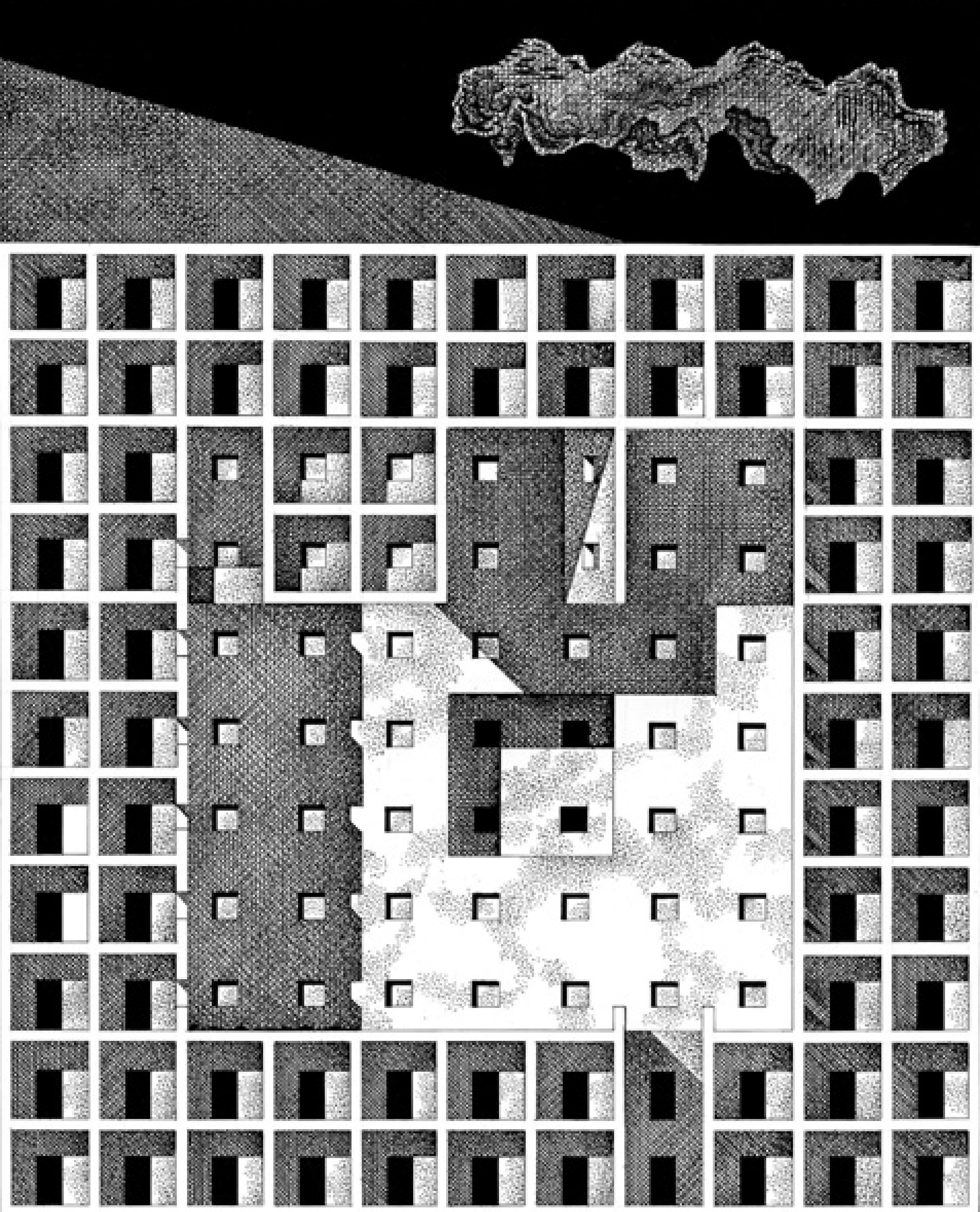
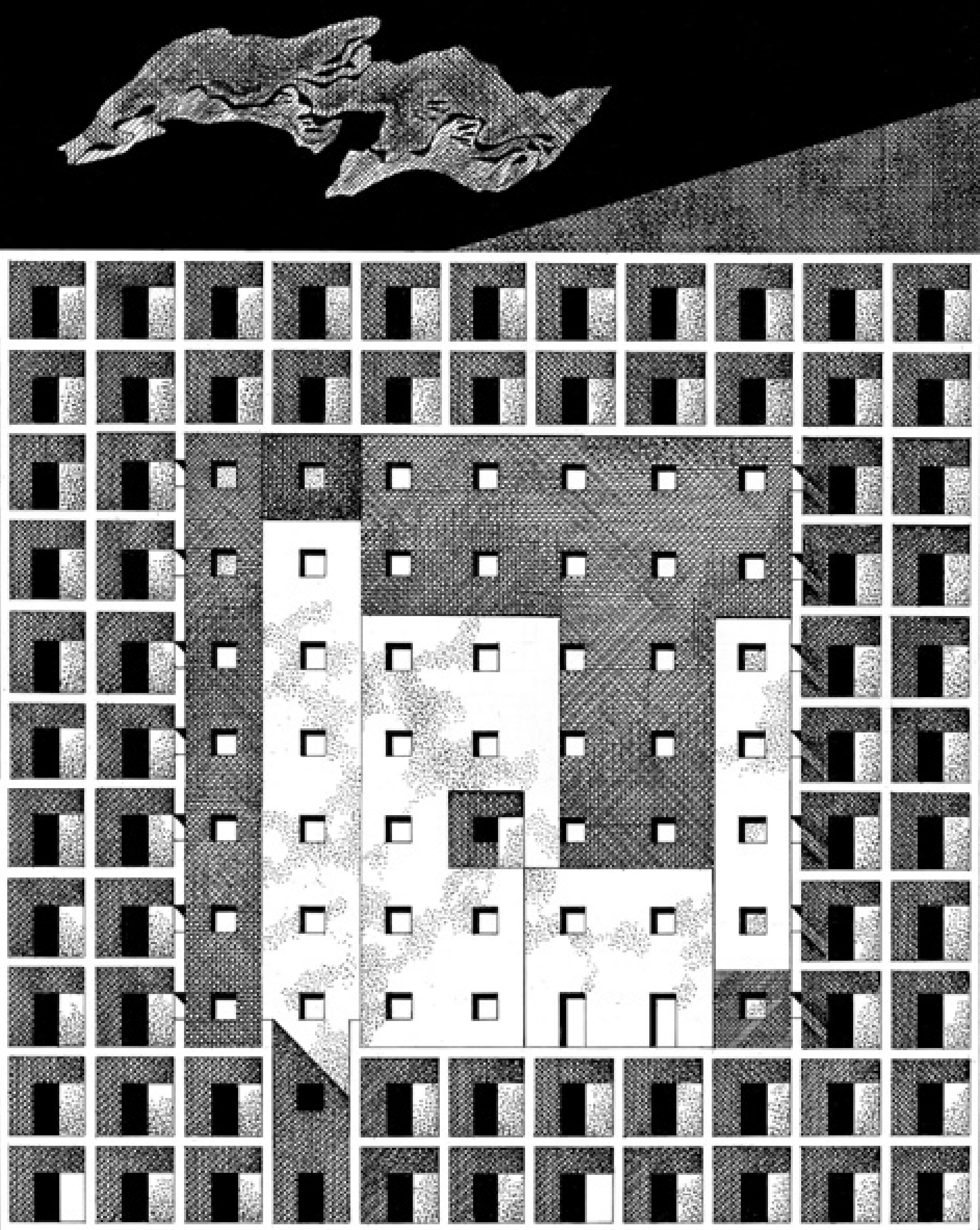
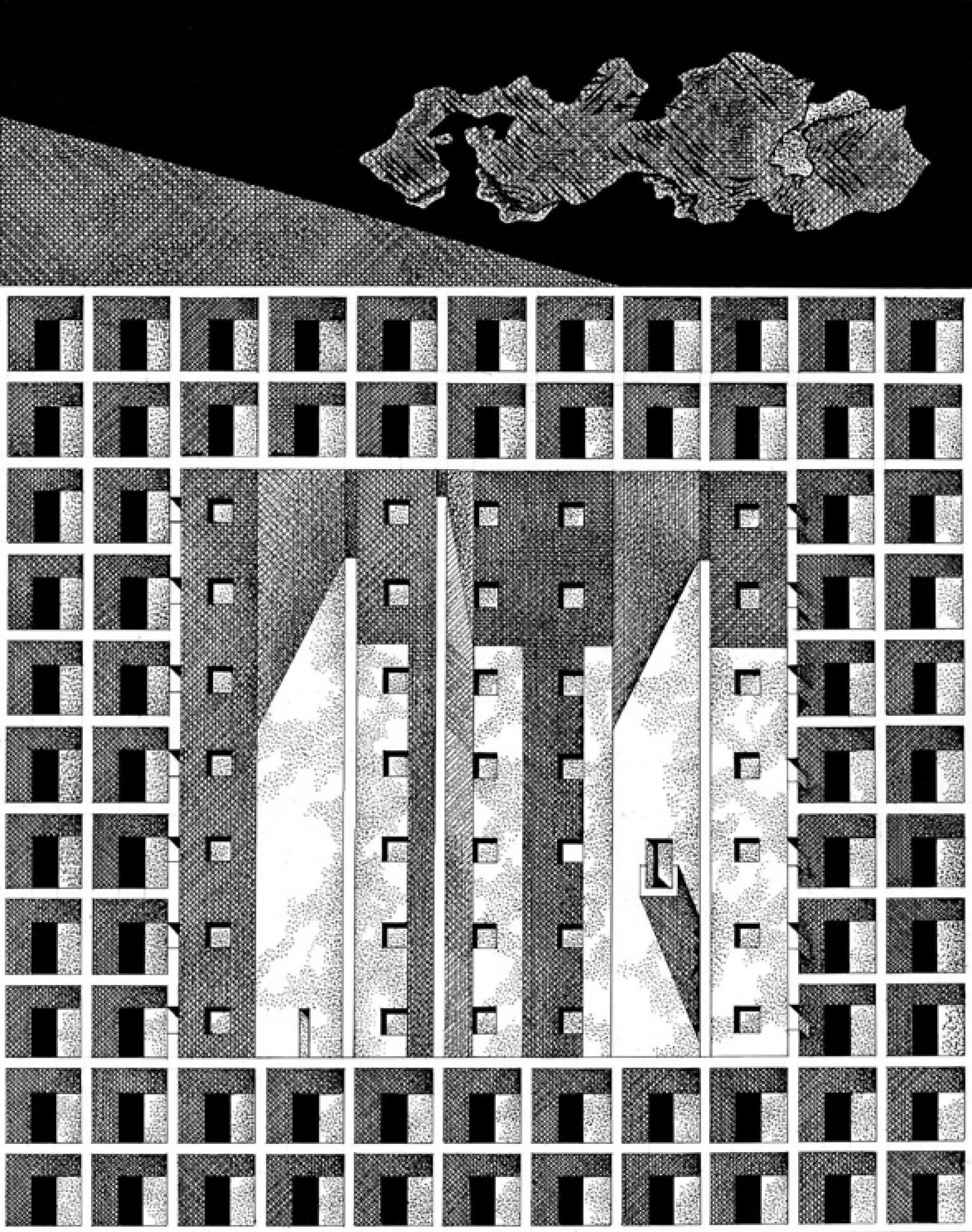
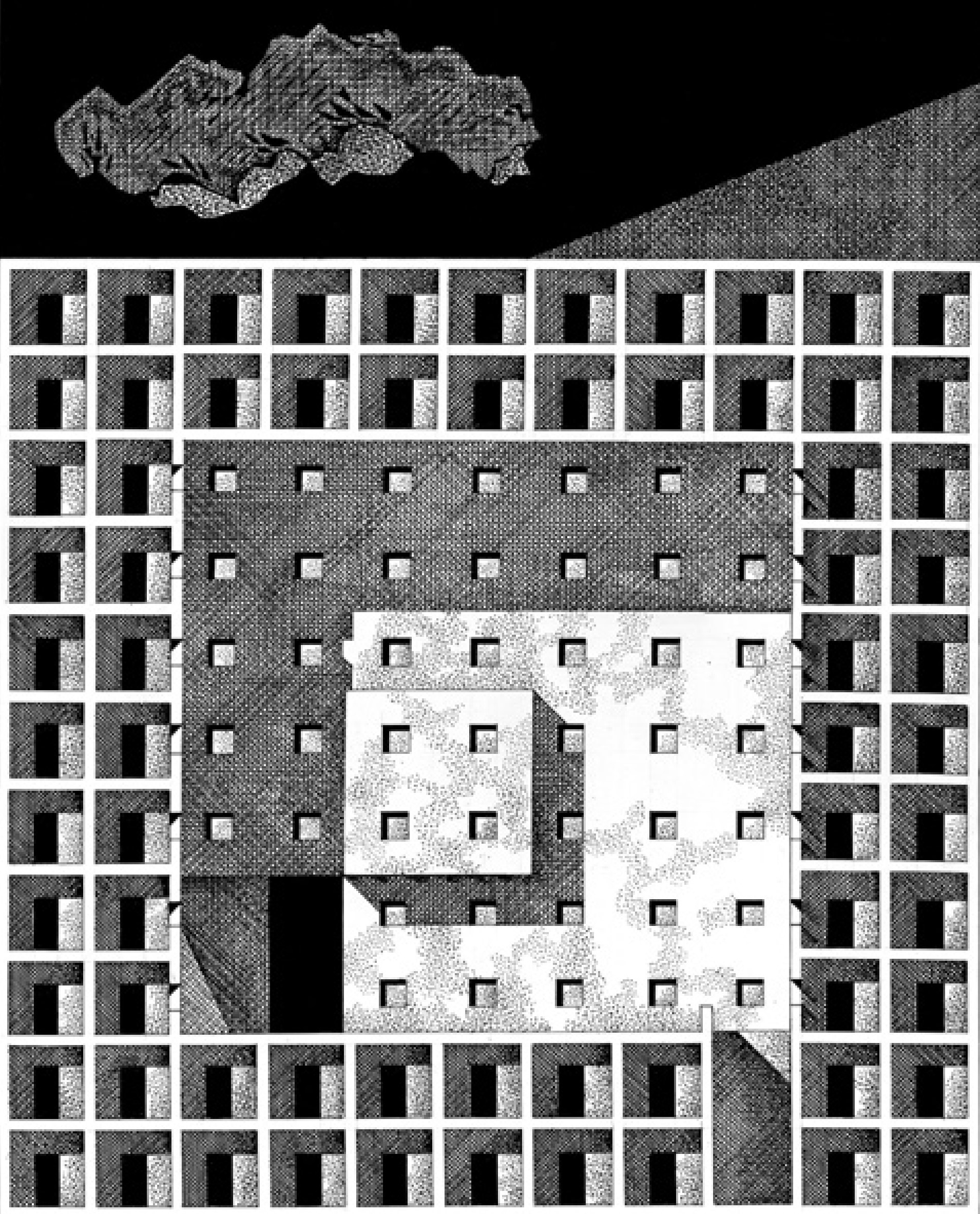
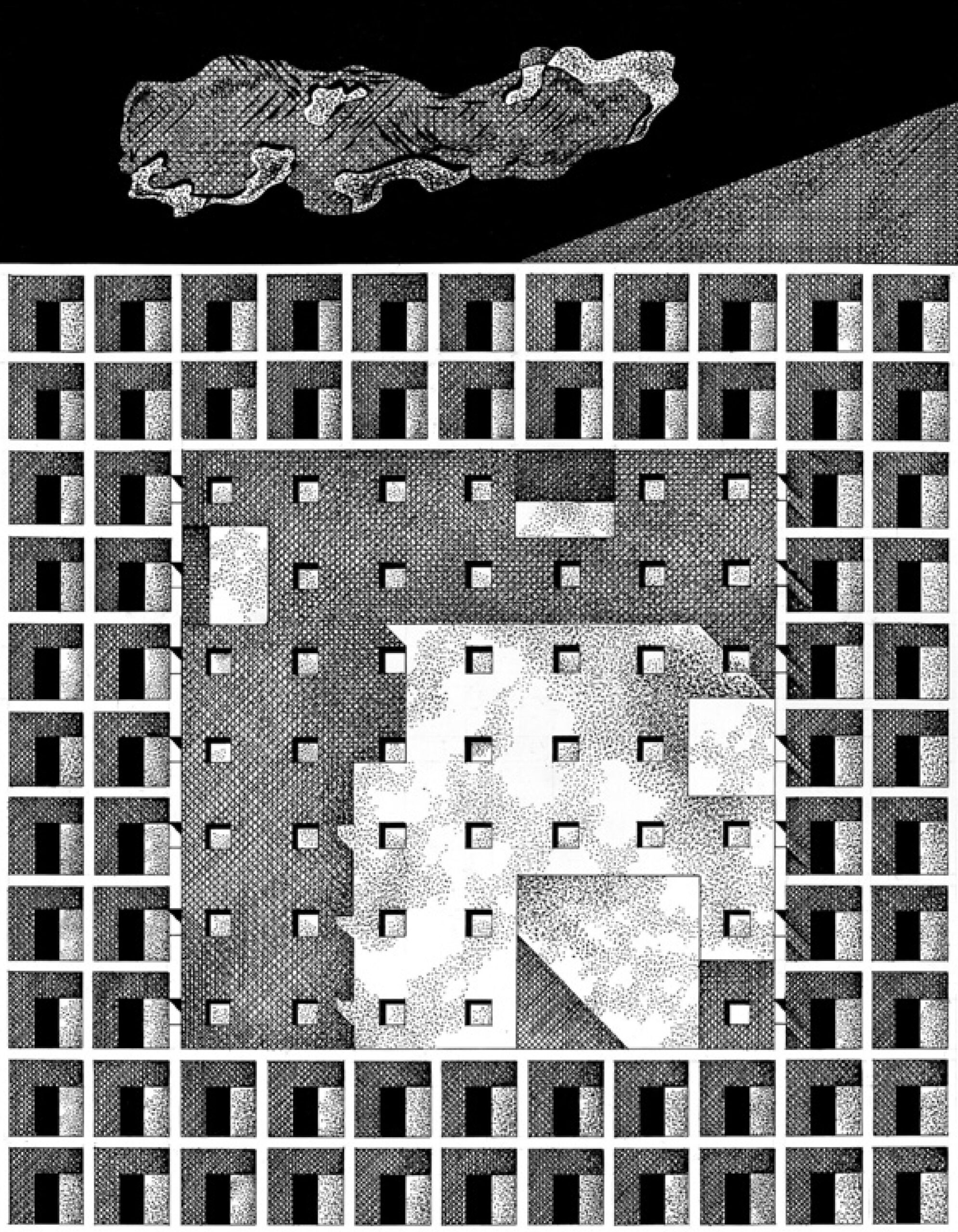
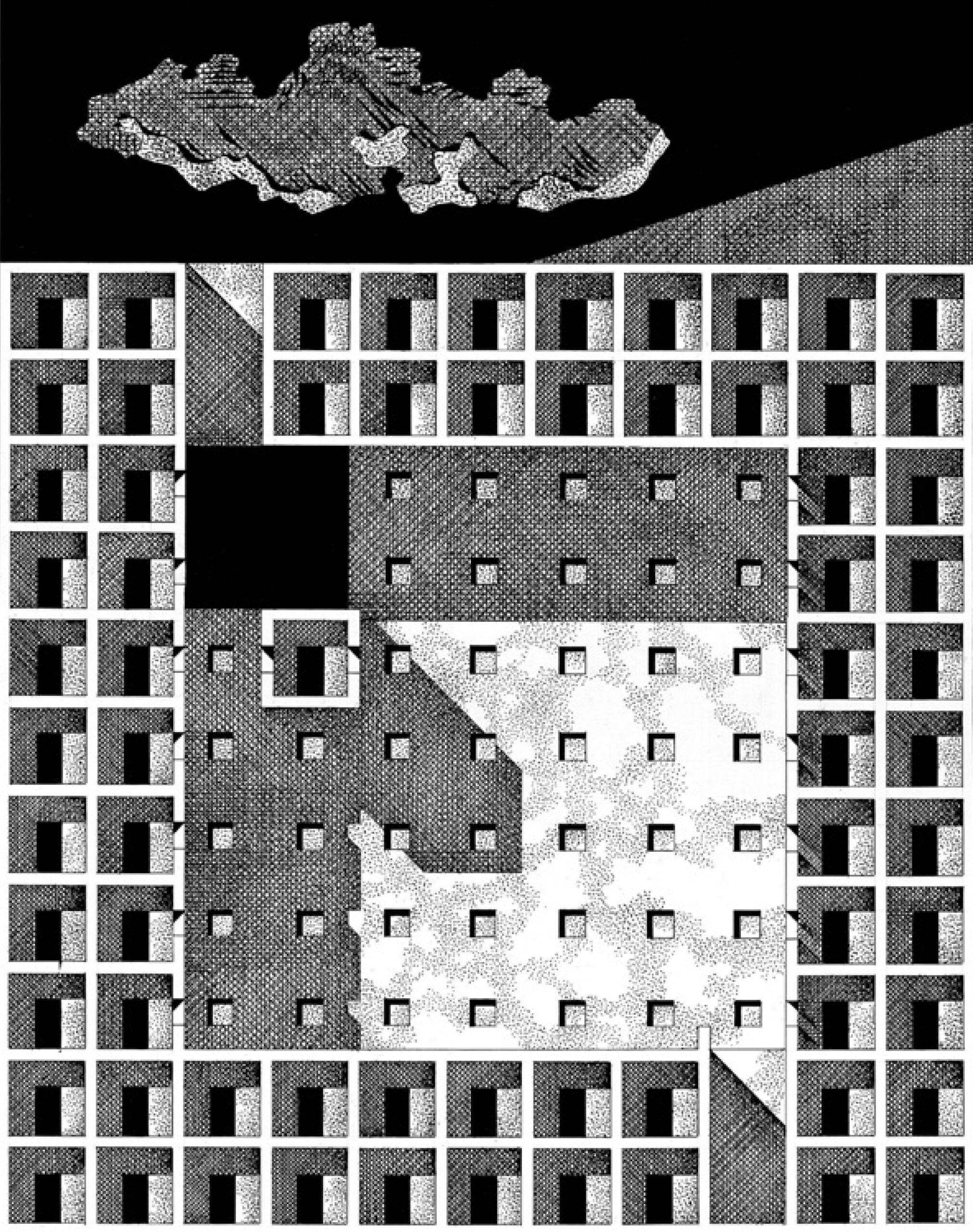
During these years and those that followed, Purini produced a number of significant series of drawings, including Sette paesaggi (Seven Landscapes, 1989) and Come si agisce Dentro l’architettura (How to Act Within Architecture, 1993), as well as books such as Comporre l’Architettura (Composing Architecture, 2000). He also realised a series of buildings whose compositional themes derive directly from his drawings—from the Kubo Building in Ravenna, characterised by deliberate breaches of architectural rules, to the absolute space of the Church of St. John the Baptist in Lecce. The series Scritture (Writings, 2006), Codici (Codes, 2007), and Scritture veneziane (Venetian Writings, 2009) followed in the 2000s, leading to the series Esercizi di claustrofobia (Claustrophobia Exercises, 2018), exhibited at the School of Architecture at Cooper Union in New York in 2021.
Purini’s drawings reveal some of the central themes of his artistic vision, which he pursued with remarkable consistency throughout his life: the syntax of mass and weight, expressed through highly refined chiaroscuro effects; the absoluteness of form, which underlies every project and is never compromised; and the rationality of a compositional approach governed by rules and characterised by minimal, carefully calibrated deviations. Yet each drawing has the ability to present itself as an open and elusive hermeneutic field—a system of traces yet to be deciphered, a substance dense with mystery. This substantiality, often embodied by enveloping fields of colour, at times assumes a timbral, enigmatic quality. In fact, every drawing holds a mystery, which is protected, in Purini’s words, by a custode—a guardian.
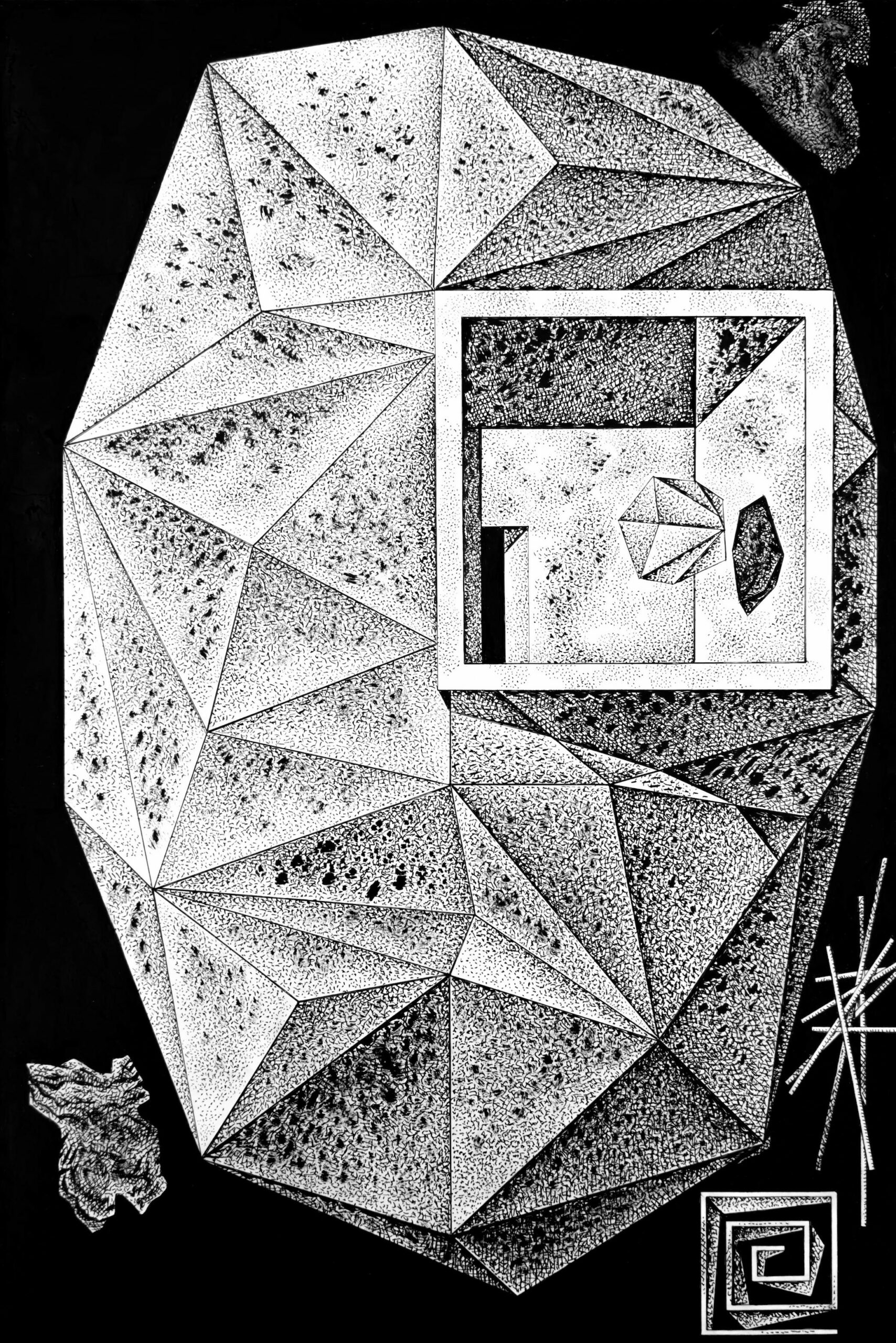
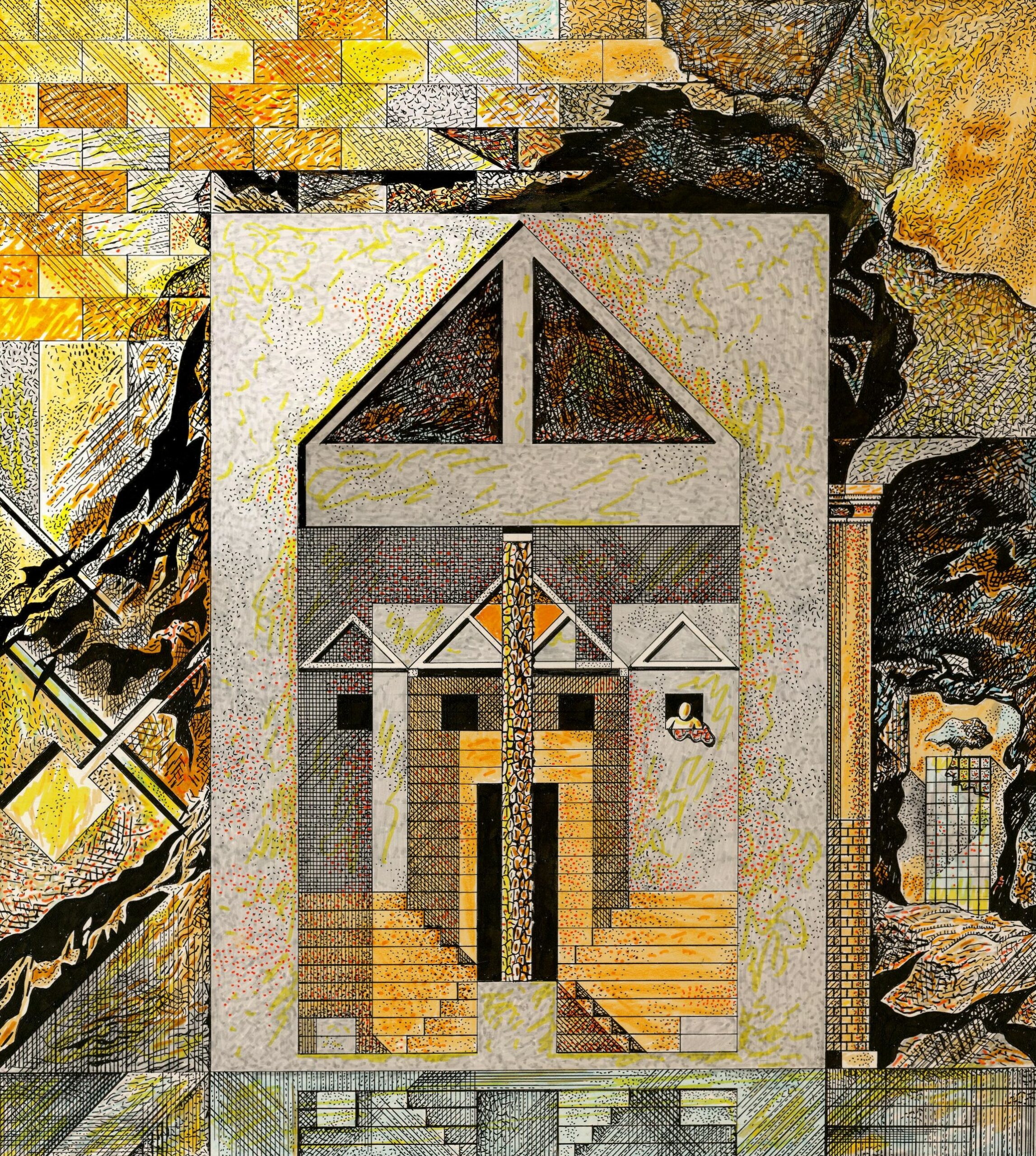
The guardian is a muse who jealously defends the author’s syntax from approximate or superficial interpretations. Like Sebastiano Serlio in his Extraordinario Libro, Franco Purini conceals the essence of form within a shell that is difficult to penetrate. The tension between interiority and exteriority, between truth and appearance, runs throughout Serlio’s book, whose drawings of rustic portals can be understood through the metaphor of the Greek statuettes of the Silenus, as suggested in Mario Carpo’s reading. A closer examination reveals that even Vitruvius’ treatise contained deliberate obscurities, designed to prevent the uninitiated from accessing its deeper meaning. The guardian is therefore the artist himself, who builds a mechanism of defence and protection around his own work.
Comprehending Franco Purini’s drawings requires a process of investigative decryption, since every single trace—every morpheme—can lead, along unexpected or winding paths, towards an understanding, as in a painting by Giorgio De Chirico, of the reasons underlying form. As in a detective novel, the clues always lead to dark, secret places. This dark, empty space captures the sign at the moment of its emergence, thrusting it into a parallel world—perhaps that of the past or the subconscious. Although time appears suspended here, it nevertheless offers a fleeting glimpse of the future. Any narrative element, however, is excluded from Purini’s drawings: they constitute a hermetic space populated by signs to be interpreted in the absence of captions. As Marco Biraghi writes, ‘Purini’s work alludes to something more profound: something that, rather than simply allowing itself to be “explained”, mysteriously questions us.’
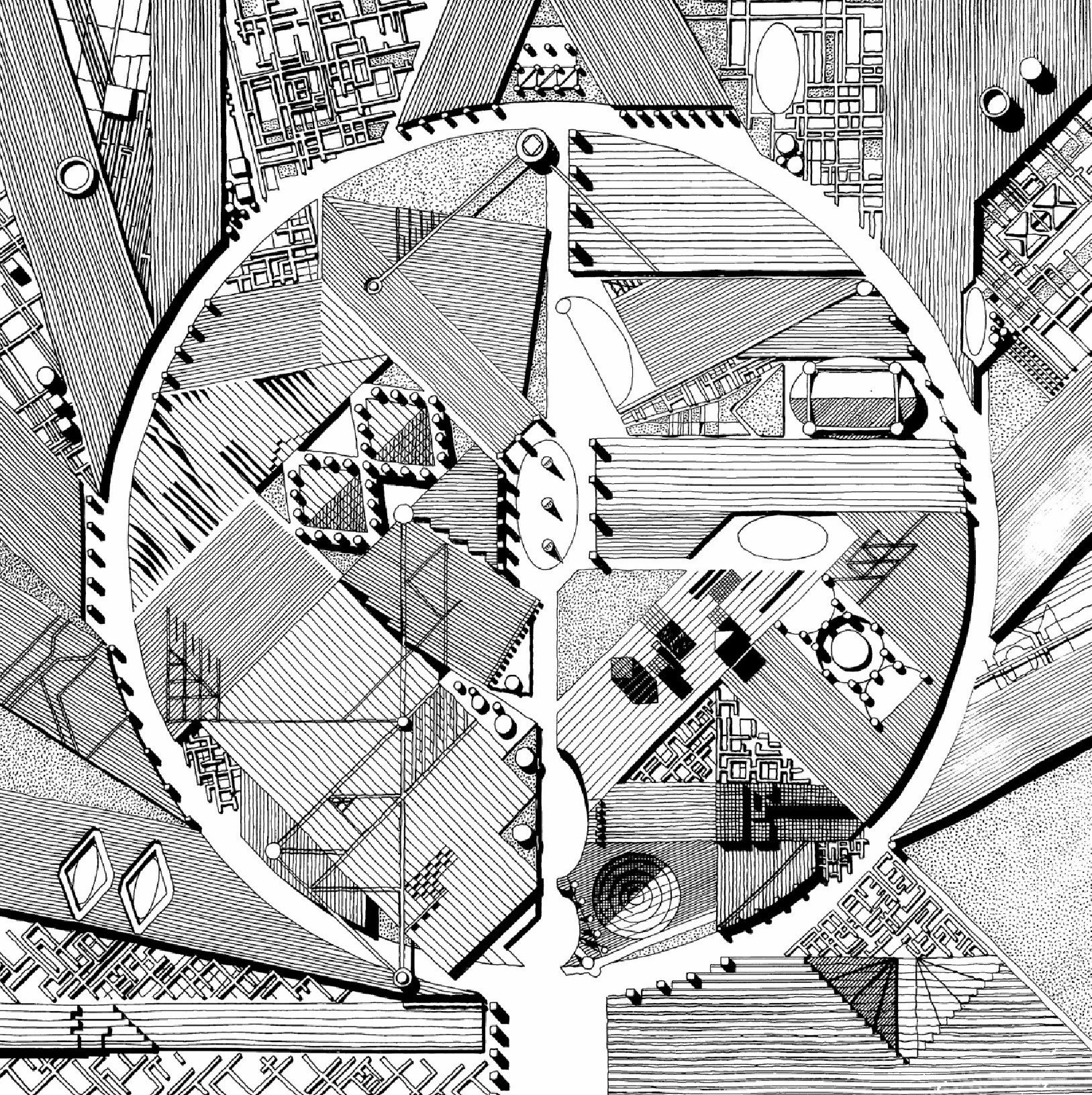
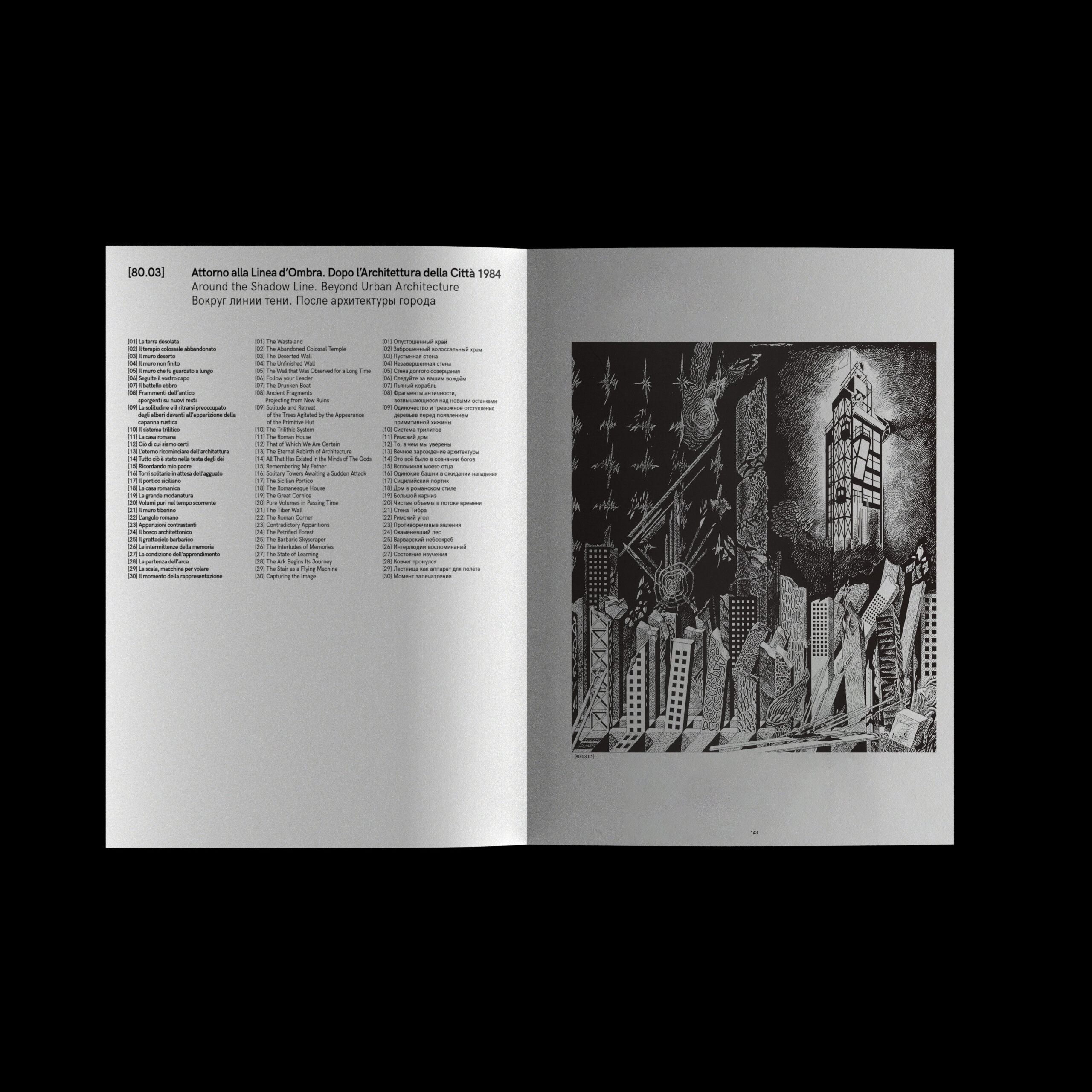
Flipping through the pages of this book cannot leave you indifferent. On the contrary, unfolding the drawings, page after page, exerts an almost hallucinatory or hypnotic effect. Accumulation, layering, and relentless pace are interspersed with moments of slowing down and the dissipation of the forces at play, only to suddenly give way to floating bodies, suspended rocks, and irregular pieces of kryptonite from unknown worlds, set in tension against rigorous geometric structures… The curse, therefore, lingers, holding the viewer prisoner under Medusa’s watchful gaze.
Notes
- Franco Purini, Sette paesaggi / Seven Landscapes (Milano, Italy: Electa, 1989), 12.
*
Lina Malfona is an Associate Professor in Architecture, founder and director of the research lab Polit(t)ico at the University of Pisa. She studied Architecture under Franco Purini at Sapienza University in Rome, earned a PhD in Architectural and Urban Design and was the recipient of many fellowships, from the Canadian Centre for Architecture (CCA) to the Getty Research Institute (GRI) and the Fulbright Program. Her publications include essays on the history, theory and criticism of architecture, and the relationship between architectural form and urban/exurban space. In 2007, she founded Malfona Petrini Architecture.

– Olivier Bellflamme