Hatching Memories
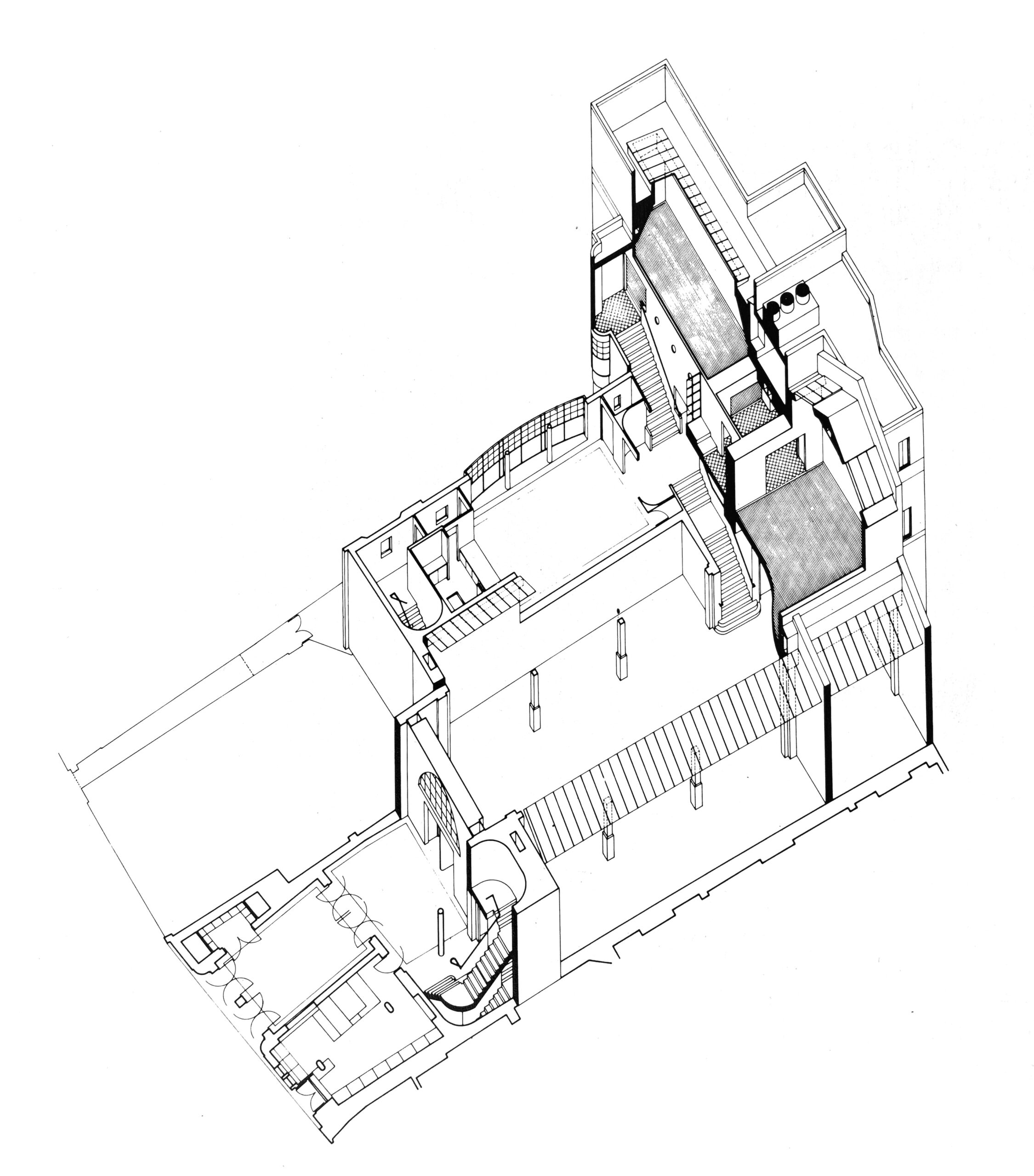
Jeremy Peacock’s revelations (Object of Desire — Haff Cross-Hatch Machine) touched a nerve with this retired designer with a memory of my own early encounter with this now legendary piece of equipment (to my generation at least).
In my case, leaving the RCA and joining Colquhoun & Miller in late 1982 when they were undertaking working drawings for the Whitechapel Art Gallery, I was, as it were, thrown in at the deep end. Building on an office drawing style seemingly personified by fellow designer Graham Smith during his many years at the practice, I drew, detailed, and made regular site visits for the best part of two years during which came the inevitable call for ‘drawings for publication’.
The scheme even at that point had generated quite a few column inches and it was accepted that a decent set of pencil and ink drawings was required, which various members of the office were tasked to produce—Graham included. My contributions included a set of plans and a bird’s-eye cutaway axonometric—a key image in those days—both of which I lovingly laboured over with office encouragement.
Crucial to the understanding of the drawing were of course the cut lines and semi-exposed floor plans, the latter picked out on the upper floor using the practice’s Haff Cross-Hatch Machine.
Applying the ink in a series of tight, 0.1mm lines, the metronomic action however soon began to reveal through the thin, wet ribbons of Rotring in the middle of the new First Floor Gallery a ghostly after-image of my fingertips. Unknowing, I must have lent on the sheet whilst taping it to the board or working up the image, my personal code layering the surface, impervious to the ink being applied.
That the drawing continued to be worked on and eventually published suggests time frames or other office concerns may have trumped my own; it was not redrawn but sent out faults and all.
Looking back, I now see this somewhat differently—though the building itself still stands, crucial pieces have changed, continue to be changed or indeed have been removed altogether. The drawing, by contrast, lives on, unchanged, my fingerprints preserved more or less in various magazines, books and publications, and my memory of their first appearance is still strong after all these years.
*
John Carpenter is a retired designer. He was employed at Colquhoun & Miller, an associate at Colquhoun, Miller & Partners and a partner at John Miller & Partners during which he worked on a number of well-known gallery projects including the Serpentine Gallery, Tate Britain, the Royal Scottish Academy and the National Galleries of Scotland. In 2006 he joined Allies and Morrison Architects, before retiring in 2021.
