Ian Hamilton Finlay’s Cloud Board and the Architectural Drawing
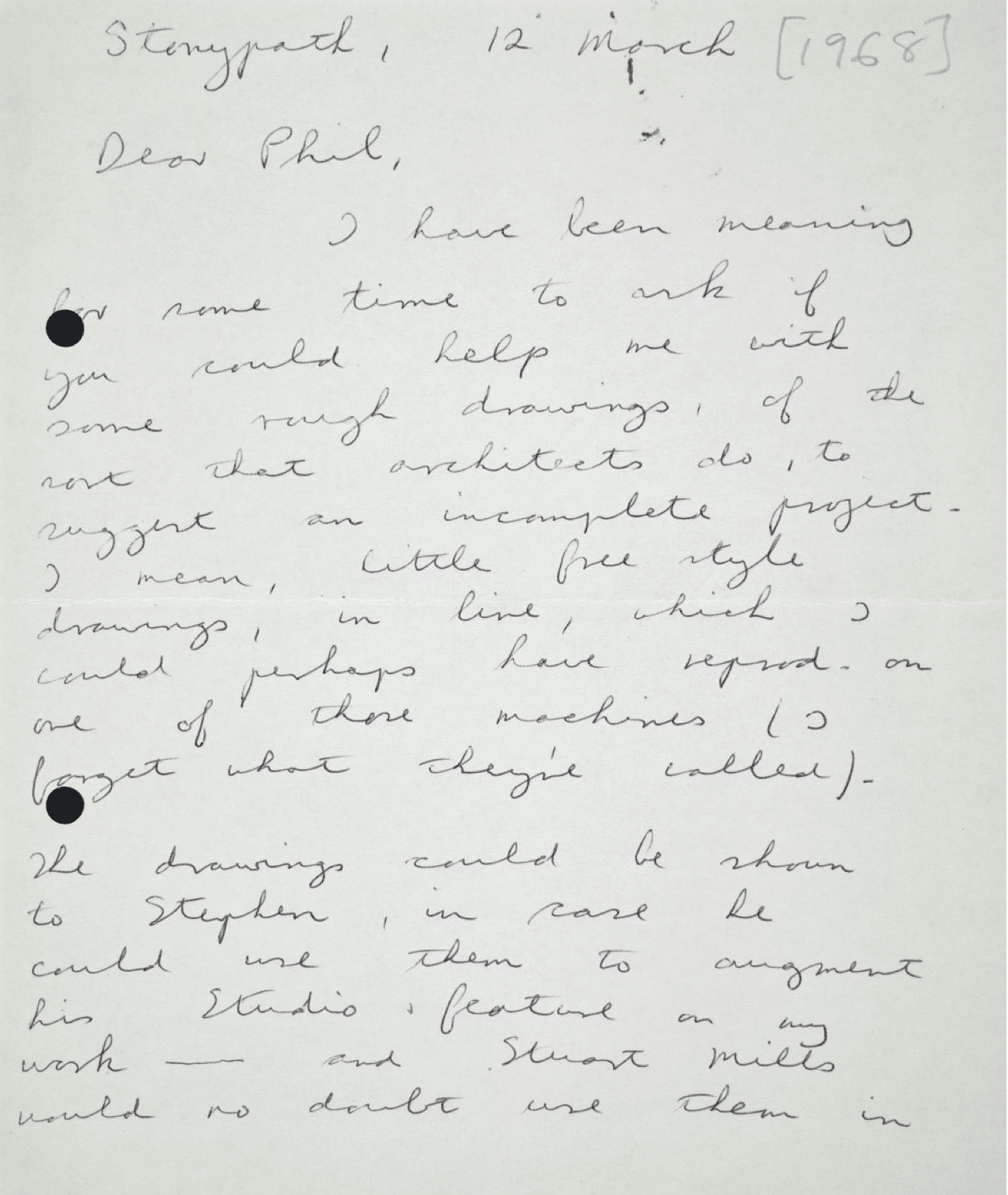
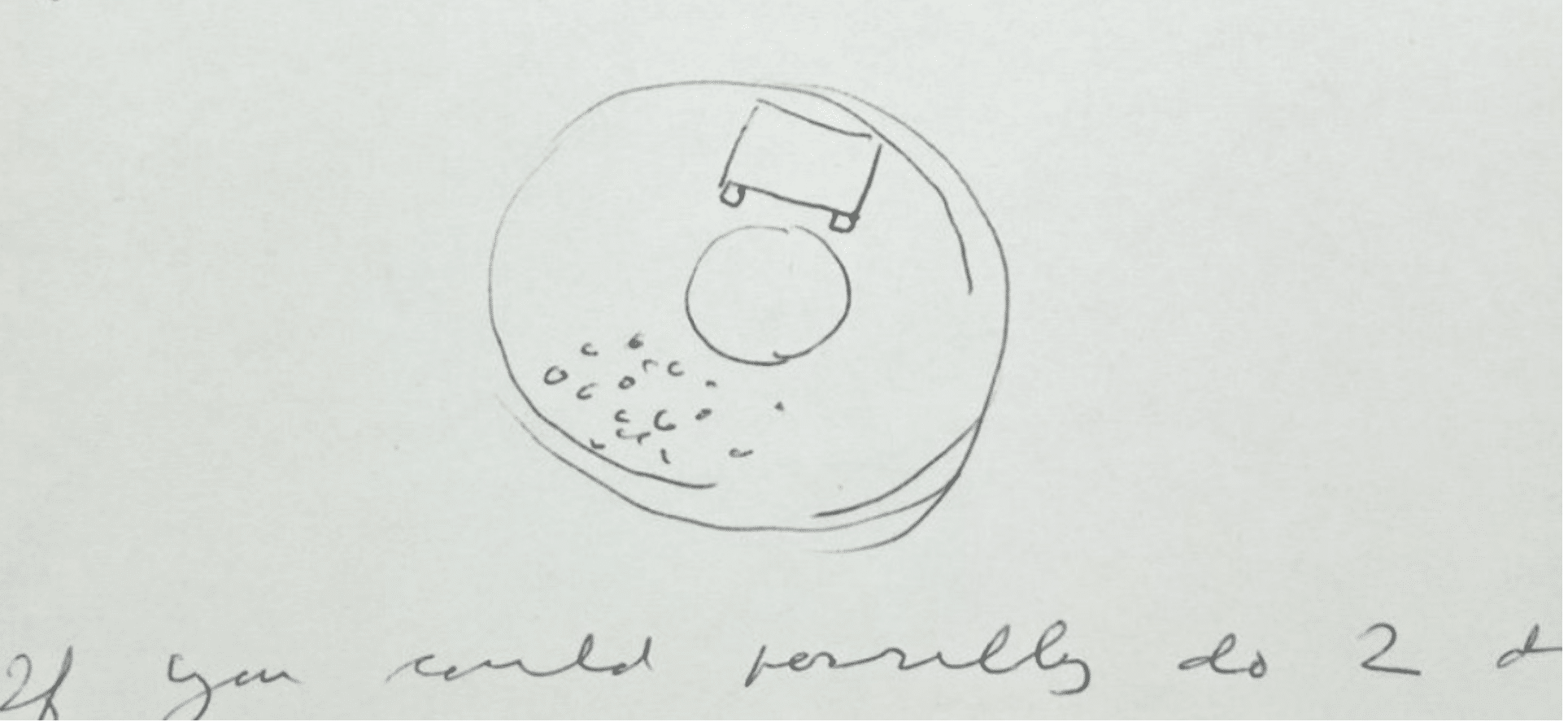
On the 12th of March 1968, Scottish concrete poet Ian Hamilton Finlay wrote, as he did frequently throughout the late 1960s, to friend and architect Philip Steadman. ‘Dear Phil,’ he began, ‘I have been meaning for some time to ask if you could help me with some rough drawings, of the sort that architects do, to suggest an incomplete project. […] The idea is that the drawings should suggest my ‘cloud’ project.’ [1] Though ‘the poem part of this is complete’, he continues, ‘the winter season prevents my photographing the finished thing.’[2]
That these drawings were in the end never completed by Steadman, we know from a subsequent letter in which Finlay clarifies: ‘Phil, I did not “assume” that you would do that wee drawing for me. I hoped you might be able to do it. I wrote to ask you, not to demand anything.’[3] Read through the space between the hypothetical and the constructed, however, the relation established between Finlay’s site-specific concrete ‘realised’ poem Cloud Board (1967)—to use the artist’s own term—and the architectural drawing in this unpublished letter offers ready foundations for a consideration of perpetual and productive incompleteness in poetics more widely.
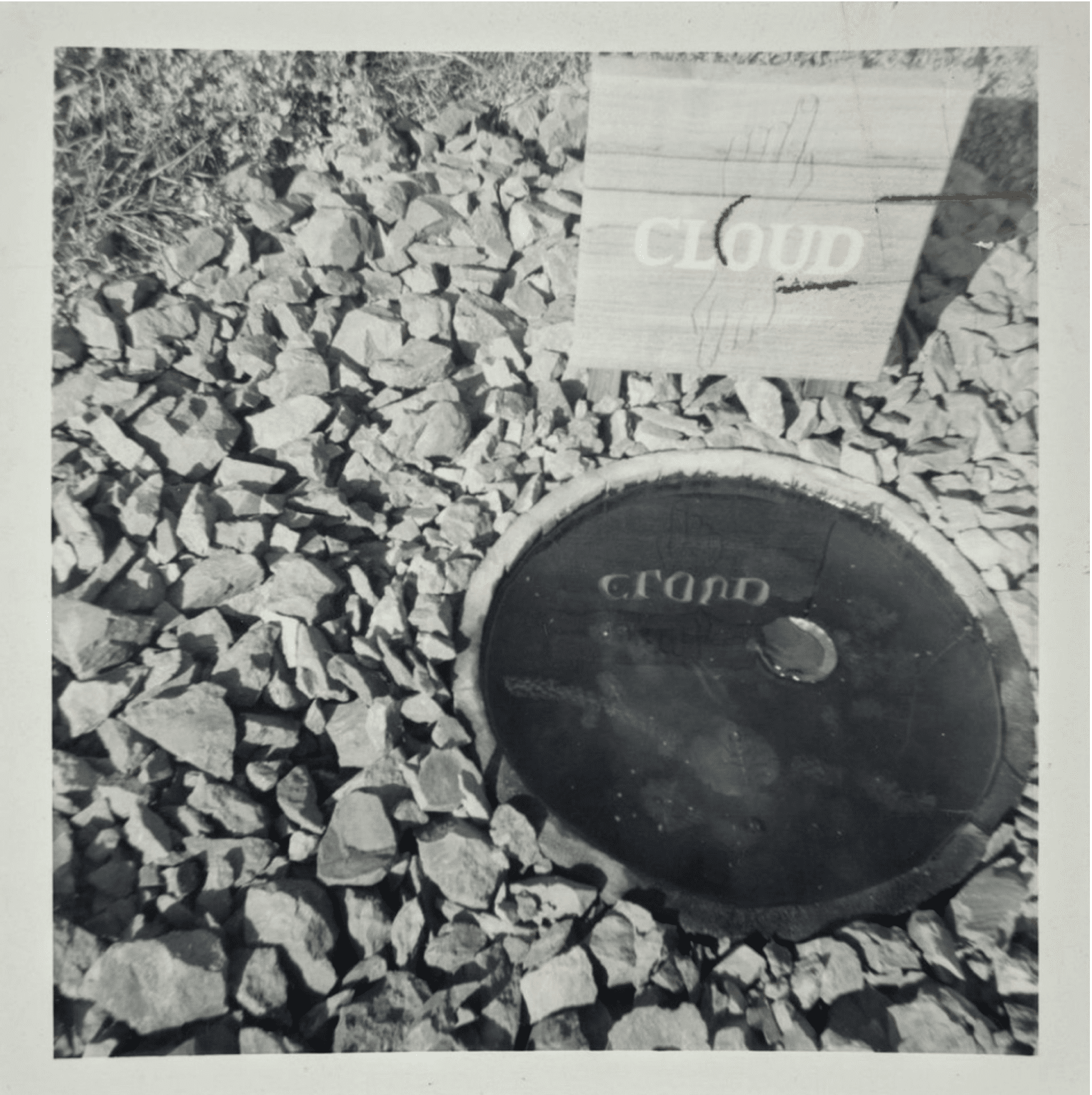
Cloud Board began and ended its life in Little Sparta, the poetic garden Finlay constructed after relocating to the secluded Pentland Hills in South Lanarkshire in 1966 due to his ever-worsening agoraphobia, and where he remained until his death in 2006. Correspondence with Little Sparta’s head gardener, George Gilliland, confirmed that the work no longer exists. Like many of the earlier works in Little Sparta, he explained, its construction was ultimately too fragile and therefore too damaged to display later. The idea of the cloud reflective pool is however revisited and updated in the very final work Finlay planned in the garden, executed from plans after his death; the Hortus Conclusus (2009) takes the form of a circular, slate pool inscribed with the names of the clouds in Latin around its circumference: Cirrus, Astrocumulus, Cirrostratus, Cirrocumulus, and so forth.
As for Cloud Board, the piece was composed of two parts. A teak, rectangular board was fixed into the gravel. On it, the word ‘CLOUD’ appeared in bold, black capitals. Above and below the word, two engraved hands pointed towards the sky and the ground. They were, in Finlay’s own words, ‘in style, somewhere between Rousseau, Cocteau and Magritte.’[4] Below the board was a small, artificial pond which reflected both the sky and the pointing hands. Characteristic of Finlay’s ‘clean’ and precise concrete poetics, what was at first glance compositionally simplistic quickly unfolded into an intricate system of signification. Reminiscent of Ferdinand de Saussure’s dyadic model of the sign or René Magritte’s playful The Treachery of Images, Cloud Board quite literally pointed to the nuances between the signifier word ‘cloud’, the reflected image of the cloud in the pond, and the signified, material cloud in the sky, operating across the interstice between idea and object.
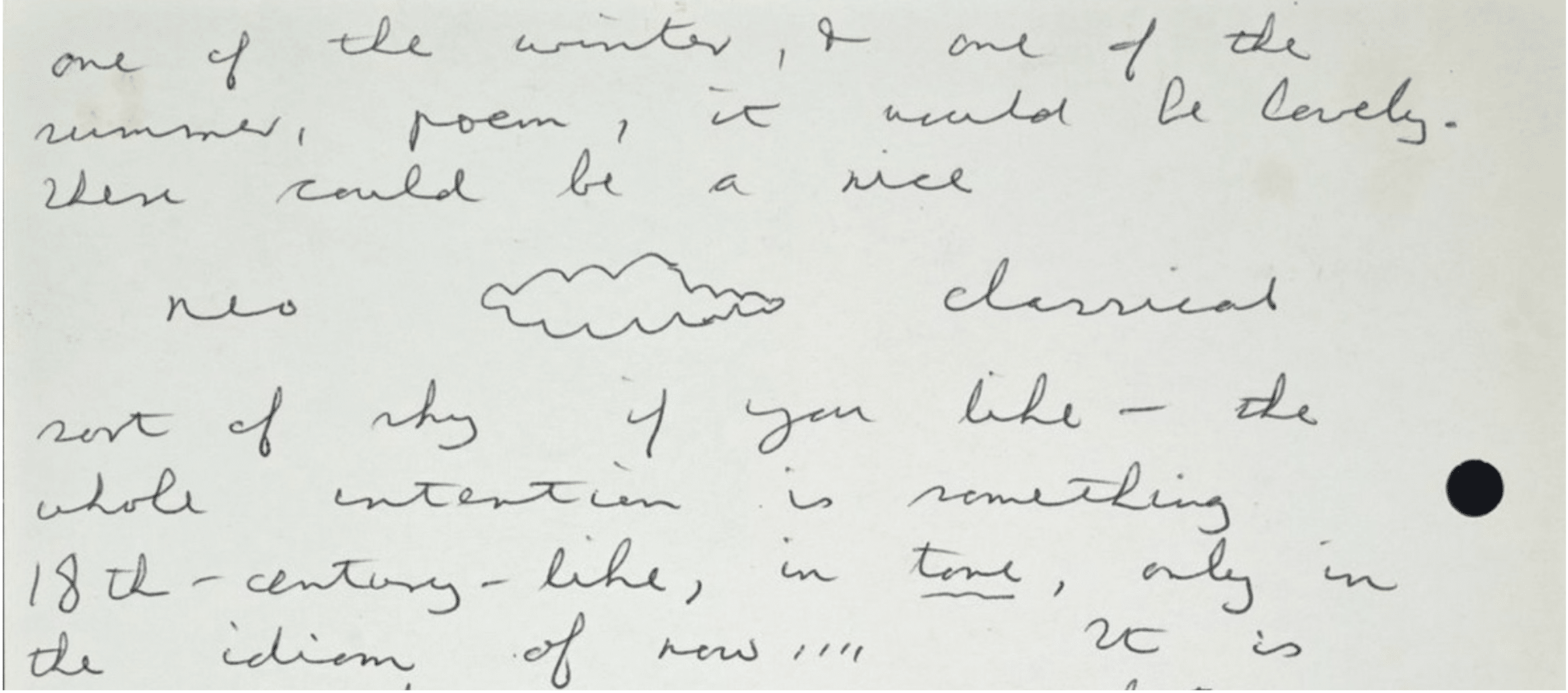
Formal contradictions come into view here, opposing Finlay’s description of the material, three-dimensional piece as the ‘finished thing’ which also appears in the letter to Steadman. The ‘winter poem’, he explains, reveals the word ‘CLOUD’ reflected on the water. ‘In the summer,’ he continues, ‘the waterlily in the pond-tub should give the poem a new ending, by covering the surface with a hort of little flowers, echoing that in the sky’, positioning Cloud Board in a perpetual state of potentiality, simultaneously complete and incomplete.[5]
This intimation of an open-ended, never-quite-complete existence speaks closely to the analogy with architectural drawing. Though Greg Thomas notes the ‘foundational’ influence of ‘modernist architecture in the constructivist tradition on ‘the international concrete poetry movement of the 1950 to 1970s’, no scholarship to date has considered the concrete poem specifically alongside precursory blueprints, drawings and plans on paper.[6] Instead, writing on concrete poetry has largely turned to the analogy of the poem as a completed edifice. Finlay’s three-dimensional poetics provides a distinctive point of entry into this unexplored terrain. Whilst the artist affirms that ‘the poem part’ of Cloud Board ‘is complete’, the desire to turn to a drawing which would ‘suggest an incomplete project’ indicates an inversion of the established linear progression from drawing to building, or plan to material creation.[7] Cloud Board is therefore perhaps not more like an architectural drawing than a complete construction stricto sensu, but rather stimulates an understanding of the poem as a design plan for future creation. In its potential, architectonic permutation, Finlay’s ‘realised’ poem challenges the ontological, material existence of poetics, and, by extension, our involvement as readers in its completion.
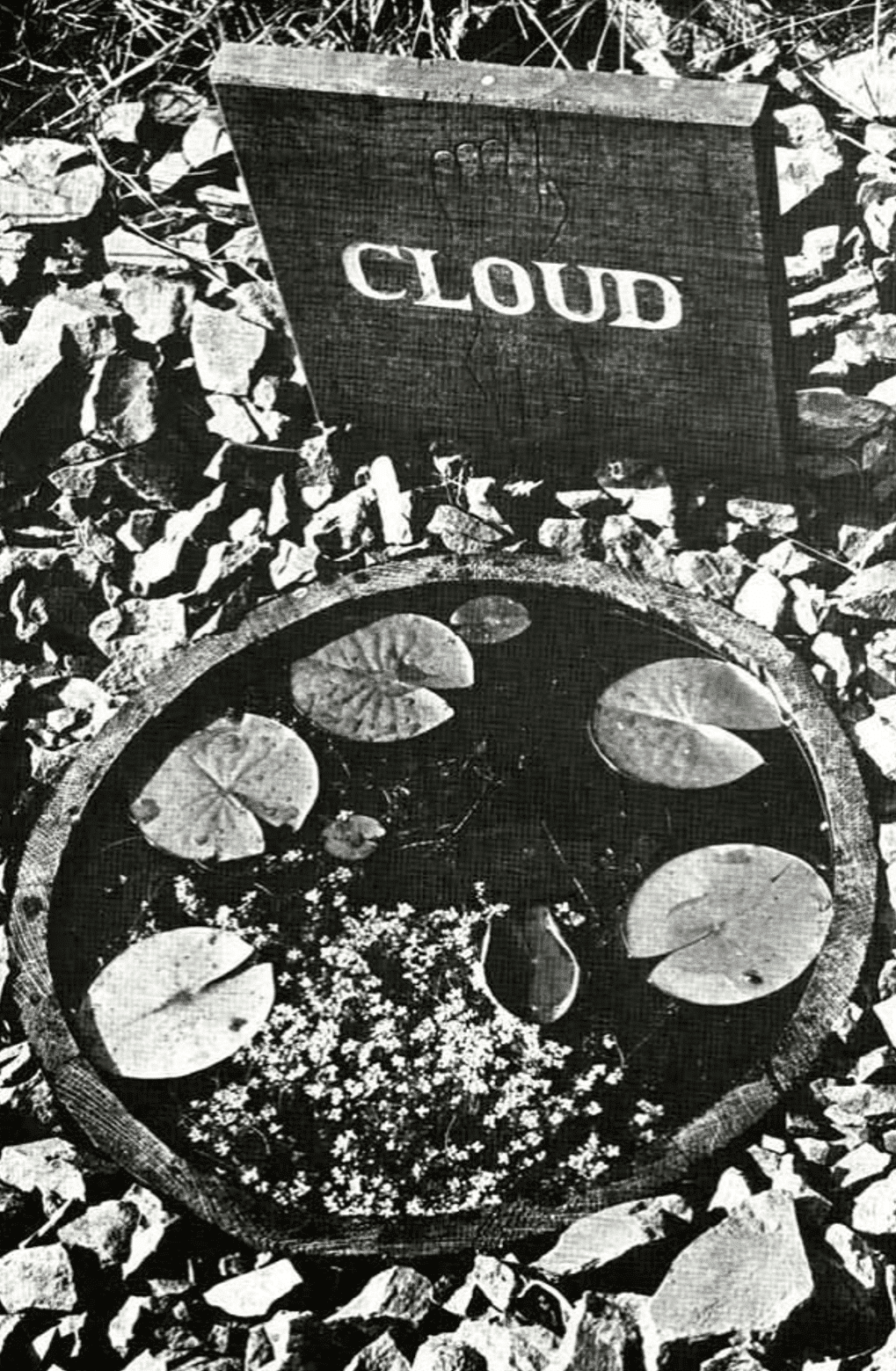
A striking parallel begins to emerge here between Cloud Board and what Umberto Eco would later define as the ‘open text’ in 1979, a polysemous work which remains productively unfinished and stimulates novel interpretative possibilities. The poem’s pond might then be read as a material staging of Eco’s description of the ‘open work’ as one which is forever ‘in movement’.[8] Not only do the growing lilies incorporate a natural cycle of growth and decay, but the water itself leaves the poem in a constant state of flux, as the unending oscillation of the reflected word ‘CLOUD’ gestures towards a wider, unstable or unanchored existence of language which further intersects with Eco’s semiotic investigations.
The pond’s circular shape also plays a role in the material articulation of the interplay between completeness and incompleteness. Though Lyn Hejinian calls upon Eco’s earlier ‘open’ and ‘closed’ metaphors in ‘The Rejection of Closure’ (1983) as a way to think about the role of the reader in the creation of meaning, reading Hejinian’s essay alongside Finlay’s Cloud Board encourages a shift from the metaphorical definition of closure as resolution in narrative to a more literal, architectural definition which pertains to the physical boundaries of a space. ‘Is there something about the world that demands openness?’, Hejinian considers twenty-six years on from her original talk, is there something ‘in language that compels and implements the rejection of closure?’[9]
In keeping with the focus on contradictory positions, though the circular pool might visually suggest closure or literal enclosure, what appears within it speaks to the opposite. As the sky is reflected in the pond, the spatial properties of Cloud Board become more difficult to define, to draw or to enclose. The poem, to paraphrase Maurice Blanchot’s wider definition of the literary text in The Space of Literature (1955), remains open to the infinite.[10] This intimation to an endless beyond gets to the core of what makes this analogy with the architectural drawing particularly generative to explorations of a productive and perpetual incompleteness. The reflection of the cloud itself—a recurring theme in Finlay’s work—emphasises this endless unattainability. Though arguably the most ‘real’ or material permutation of the cloud in Finlay’s semiotic system, it remains both topographically unreachable and materially ungraspable in its reflection in the pond and its existence in the sky; composed of billions of tiny, ephemeral particles of water.
Finlay’s description of the now ironically ‘wee’ drawings similarly renounces claims of definable parameters in the insistence on suggestiveness, whose derivative verb appears four times in the letter.[11] Like the poem itself, the drawings, he asks Steadman, should ‘suggest’ something further, both materially and conceptually. The relation between Cloud Board’s ‘realised’ form and hypothetical architectural drawing therefore seems to comment on its own impossibility of completion or spatial delineation, as the self-reflexive, self-reflective nature of the work, literally represented in the use of reflection, acknowledge its own open workings.
If a productive and perpetual incompleteness underpins the composition of Cloud Board, then where, we might finally ask ourselves, does this leave us as readers? A brief reappraisal of Claude Lévi-Strauss’ 1962 concept of ‘bricolage’ enables us to gain purchase on this question. Though intentionally employed against its intended anthropological use here, Lévi-Strauss’ material metaphor redirects us towards our opening architectural analogy. With no exact translation in English, the bricoleur stems from the French for constructor, handyman or builder and becomes, throughout A Savage Mind (1962), a metaphor for a particular form of knowledge construction. Reconsidering the literal definitions of the bricoleur however bolsters a reading of Cloud Board as its own material staging and site of questioning of Lévi-Strauss’ term, further revealing of the active role that we are invited to play in its completion.
Here too, then, the argument is one of reversal, or rather of an inversion of a hierarchical relationship posited by Lévi-Strauss between the bricoleur, who ‘works with his hands and uses devious means’ to construct something from existing materials, and the more refined ‘engineer’, who employs purpose-built tools for new creations.[12] Exploring Cloud Board in relation to the architectural drawing brings greater nuance to the anthropologist’s dichotomy, positioning the reader somewhere between the bricoleur and the engineer insofar as readers of the poem become constructors who build both from and on the material of language.
Whilst Lévi-Strauss argues that bricoleurs are ‘restricted by the fact that they are drawn from language where they already possess a sense which sets a limit on their freedom of manoeuvre’, Cloud Board’s spatial boundlessness manifestly and materially breaks free from such limitations.[13] The possibility of infinite endings then sheds new, positive light on Lévi-Strauss’ suggestion that ‘the bricoleur may not ever complete his purpose, but he always put something of himself into it’, as the poem’s incompleteness operates as the very thing that prevents the poem from collapsing in on itself.[14] The bricoleur, then, becomes the keeper of potential future life, making something new with each encounter from the tools and plans provided by the poem.
Despite Lévi-Strauss’ portrayal of the bricoleur as a kind of incidental DIY practitioner, his position ultimately aligns with a conception of the text as perpetually potential, requiring active construction and completion from its reader. The bricoleur is ‘transformed into an active participant without even being aware of it. Merely by contemplating it he is, as it were, put in possession of other possible forms of the same work […] he feels himself to be their creator’.[15] Inverting the passivity of Lévi-Strauss’ bricoleur, Cloud Board therefore brings awareness to our role as constructor, drawing attention to the poem’s productive incompleteness and, by extension, its infinite potential completions.
The use of reflection in the realised poem comes to play yet another role here. Staging a materialisation of both Lévi-Strauss’ argument that the bricoleur ‘always puts something of himself into’ a construction and the transformation into an ‘active participant’, the winter poem’s reflecting back of our own viewing of the work enables us to become, in the end, literally part of its composition.[16] In reflecting back onto us, the work engenders both a compositional accountability and responsibility. It asks something of us, or, perhaps more accurately, it shows us asking something of ourselves.
Reading Finlay’s Cloud Board via architectural analogy ultimately begs the question of how an architectonic, critical paradigm might develop laterally into further applications. A broader picture begins to appear here of a critical tool in which reading material poetics—and perhaps by extension all literature—through other three-dimensional forms might illuminate them in ways which reveal their inherent incompleteness and subsequent endless plurality. Aren’t all poetic encounters, we might ultimately ask, founded upon a process of making new from tools or construction plans the text gives us? This critical framework is, in parallel to how Eco characterises the open text, not only now a work in progress, but fated to remain one; perpetually and productively incomplete, awaiting to be built both up and on, just like the architectural drawing.
Notes
- ‘Letter from Ian Hamilton Finlay to Philip Steadman, 12 March 1968’, ‘Form’ Magazine Editorial Archives, 1966-1969, Princeton University Library Archive, New Jersey, C1489 B1, F14. All further references to C1489 are from this letter.
- Ibid.
- Ibid.
- Ibid.
- Ibid.
- Greg Thomas, ‘The Tower of Babel: Concrete Poetry and Architecture in Britain and Beyond’ in Spatial Perspectives: Essays on Literature and Architecture, ed. by Terri Mulholland and Nicole Sierra (Peter Lang, 2015), 161–188 (161).
- Finlay, C1489, B1, F43.
- Umberto Eco, The Open Work, trans. by Anna Cancogni, with an introduction by David Robey (Harvard University Press, 1989), 12–13.
- Lyn Hejinian, ‘The Rejection of Closure’, Poetry Foundation, 13 October 2009, <https://www.poetryfoundation.org/articles/69401/the-rejection-of-closure> [accessed 20 December 2025].
- Maurice Blanchot, The Space of Literature, trans. by Ann Smock (University of Nebraska Press, 2015), 21.
- Finlay, C1489, B1, F43.
- Claude Levi-Strauss, The Savage Mind, trans by George Weidenfeld and Nicolson Ltd (Weidenfeld and Nicolson, 1966), 6-17.
- Ibid., 19.
- Ibid., 21.
- Ibid., 25.
- Ibid., 21, 25.
Every effort has been made to obtain permission to reproduce the visual material included in this post.
*
Lola Gabellini-Fava is working towards a PhD on the relationship between asemic writing and critical metaphors at University College London. She holds a joint honours undergraduate degree from the University of Oxford and an MPhil in English Studies from the University of Cambridge, where her dissertation focused on the relationship between concrete poetry and architectural diagrams.

– Matt Page