The Architectural Competition: Shopfront to ‘The Trade’
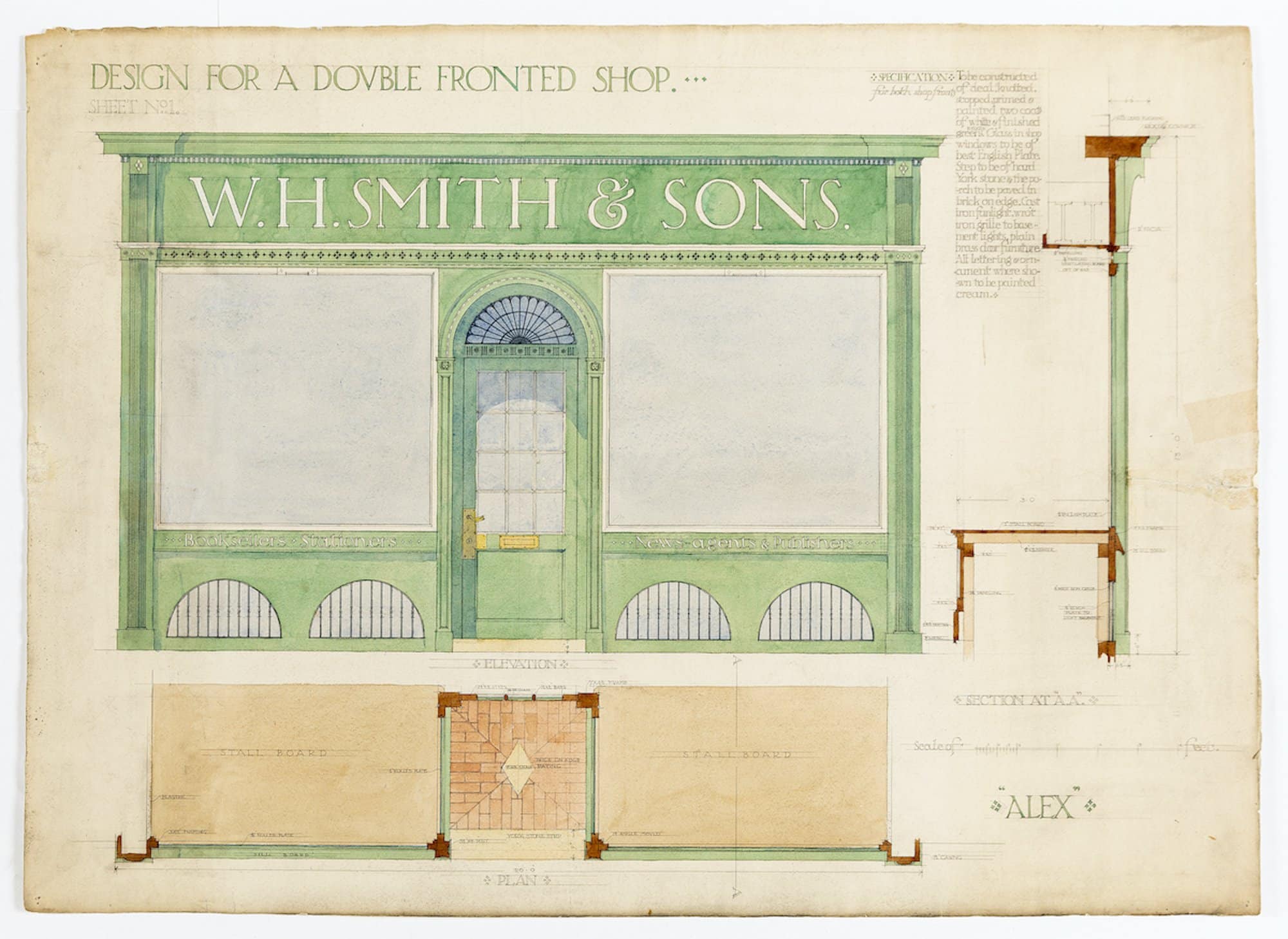
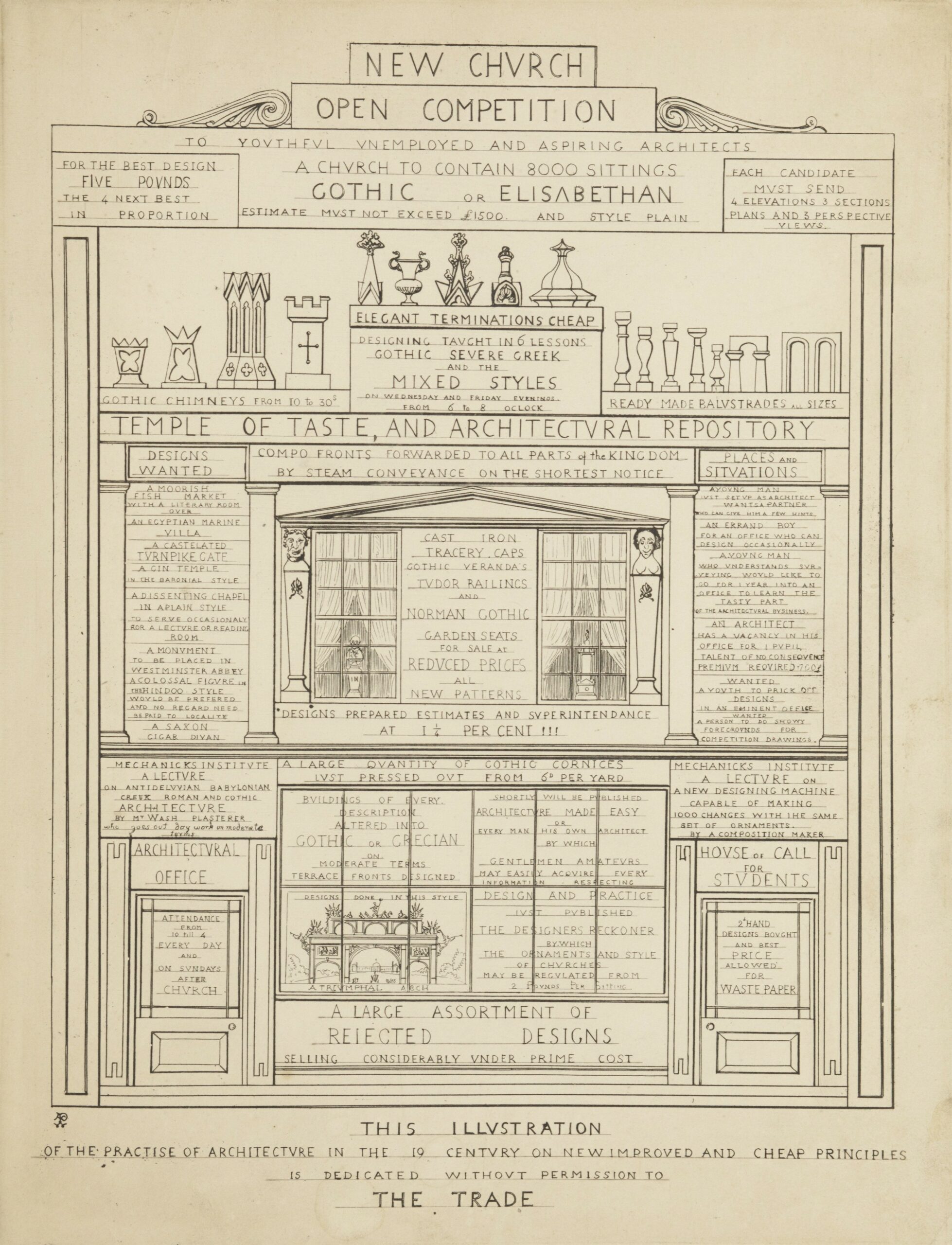
Alexander Scott Carter’s winning designs for single and double-fronted W.H. Smith shopfronts form a remote bookend to a troubled time for architectural competitions in Britain. The other arrived approximately 75 years earlier in the form of a satirical drawing produced to open Augustus Pugin’s Contrasts (1836). It too was a shopfront, its window exhibiting ‘the practice of architecture in the 19th century on new improved and cheap principles’, its façade adorned with ironic inscriptions, ascribing to it a visual quality akin to that of a headstone, which Pugin dedicated to ‘The Trade’ of architecture.[1] Purveying an assortment of ready-made building components, the mock poster announced a ‘New Church Open Competition’—for ‘youthful, unemployed, and aspiring architects’—and invited designs in the Gothic or Elizabethan traditions, a swipe at the stylistic restrictions imposed by the contemporary Houses of Parliament competition. In essence, Pugin’s dystopian shopfront remarked upon the prostituted state of the architectural profession at a time when competition, in life and in trade, had become institutionalised in British thinking,[2] contributing not a little to the low repute of architects.[3]
However, despite Pugin highlighting architects’ exploitation through competitions, said to possess ‘all the attendant evils of the lottery system’,[4] from the release of Contrasts to Carter’s winning design the format remained widespread as a method for commissioning building projects in Britain, announced at an estimated rate of at least one per week,[5] with small competitions, like that for a W.H. Smith shopfront, one of the most characteristic features of the Victorian architectural scene.[6] By the time Carter’s winning drawings were produced, Smith’s had established over 1,000 locations offering standardised products and prices, meaning the company’s new shopfronts had to adopt a readily recognisable appearance. In this case, Carter’s design likely found favour through its careful execution of Arts and Crafts principles, which were adopted by Frank C. Bayliss as the house style for Smith’s early high street shopfronts.[7] Although Smith’s prioritised adapting to their environs, Carter’s competition drawings capture the craft-forward elements—solid oak display windows, arched fanlights with matching grilles, and cream Roman sign writing—that hallmarked Smith’s shopfronts through to the mid-1930s.[8]
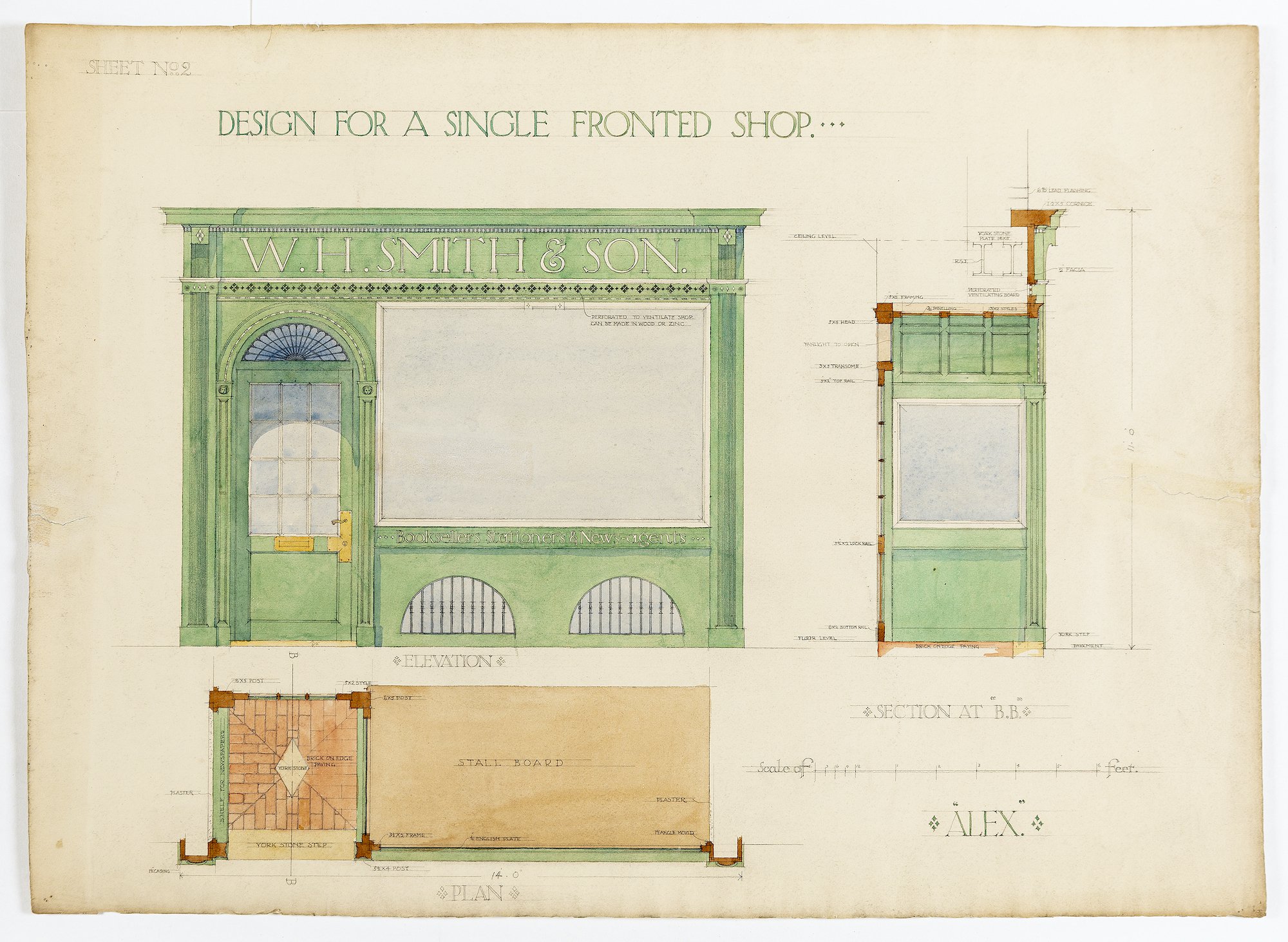
Carter’s drawings, however, are equally marked by their absences. They allude to the real purpose of competition drawing as a form of rhetoric: non-committal, invitational, and optimised to win.[9] The elevations are intentionally open-ended, allowing assessors to contribute by imagining within them: a bust of Shakespeare, a hand-wrought hanging lamp, or an enamelled Smith’s Newsboy sign. In this sense, Carter’s competition drawings can be seen to reveal unique insights into the thinking, tactics, and abilities of the architect—a shopfront to the trade.
Notes
- Augustus W. Pugin, Contrasts, or, A Parallel Between the Noble Edifices of the Fourteenth and Fifteenth Centuries, and Similar Buildings of the Present Day (Pugin, 1836).
- This period was characterised by Charles Darwin’s Origin of Species (1859) and the formulation of the principles of ‘natural selection’, later reinforced by Herbert Spencer’s conception of the ‘survival of the fittest’. See Gertrude Himmelfarb, Victorian Minds (Alfred A. Knopf, 1968), 315.
- Andrew Saint, The Image of the Architect (Yale University Press, 1983), 61.
- Charles Barry, ‘Discussion on Architectural Competitions’, RIBA Transactions, 1881, 270–71.
- A cursory survey suggests that in 1857 alone, a year of economic depression as well as one of professional discouragement over the loudly criticised Government Offices competition, 69 new competitions were announced. See Roger Harper, Victorian Architectural Competitions (Mansell Publishing, 1983), which appends a synthetic introduction to an index of all competitions advertised or discussed in the period’s chief periodical, The Builder.
- Joan Bassin, ‘The Competition System: Architectural Competitions in Nineteenth-Century England’ (PhD diss., Indiana University, 1975), ix.
- Kathryn Morrison, English Shops and Shopping: an Architectural History (Yale University Press, 2003), 201.
- Alan Powers, Shop Fronts (Chatto & Windus, 1989), 26-7 & 92-3.
- See Elisabeth Tostrup, Architecture and Rhetoric: Text and Design in Architectural Competitions (Andreas Papadakis Publisher, 1999).
*
Harry Foley is a Scunthorpe-born architectural designer, educator, and historian. Completing a PhD at The Bartlett School of Architecture, his research explores representations of the unbuilt, twentieth century church interiors, and working-class territories of the built environment.
This text is one of the selected responses to the first category of the Open Call 2025: Visibility, and the Unseen—a series of short contributions that either bring to the surface the unseen drawings within the Drawing Matter Collection (I. In the Archive) or explore original architectural drawings, created by the author(s) of the contribution, which make visible the unseen (II. In Practice).

– Annette Carruthers, Mary Greensted and Barley Roscoe