The Brick Pencil: Analogue Technology in a Digital Age
Part 1: The Brick Pencil
In a colour photograph with the rich saturation of Kodachrome, against an aquamarine background, a manicured hand grips an upright brick. Taped to the brick, tip down, is a pencil. The weight of the brick is palpable. Someone is working hard to write with this thing, to keep the pencil tip from breaking and to make a smooth line. A second image shows a sentence written with the brick pencil next to one written with a regular pencil, no brick attached. The experimental result: a regular pencil writes better, faster, and with less effort than a brick pencil. It is easier to hold and manipulate. For these reasons, it is also easier to think with. We could have guessed this, but, for the purposes of this technical paper (Stanford Research Institute Summary Report AFOSR-3223, October 1962; Air Force Office of Scientific Research Contract AF 49(638)-1024), the author actually performs the experiment.[1]
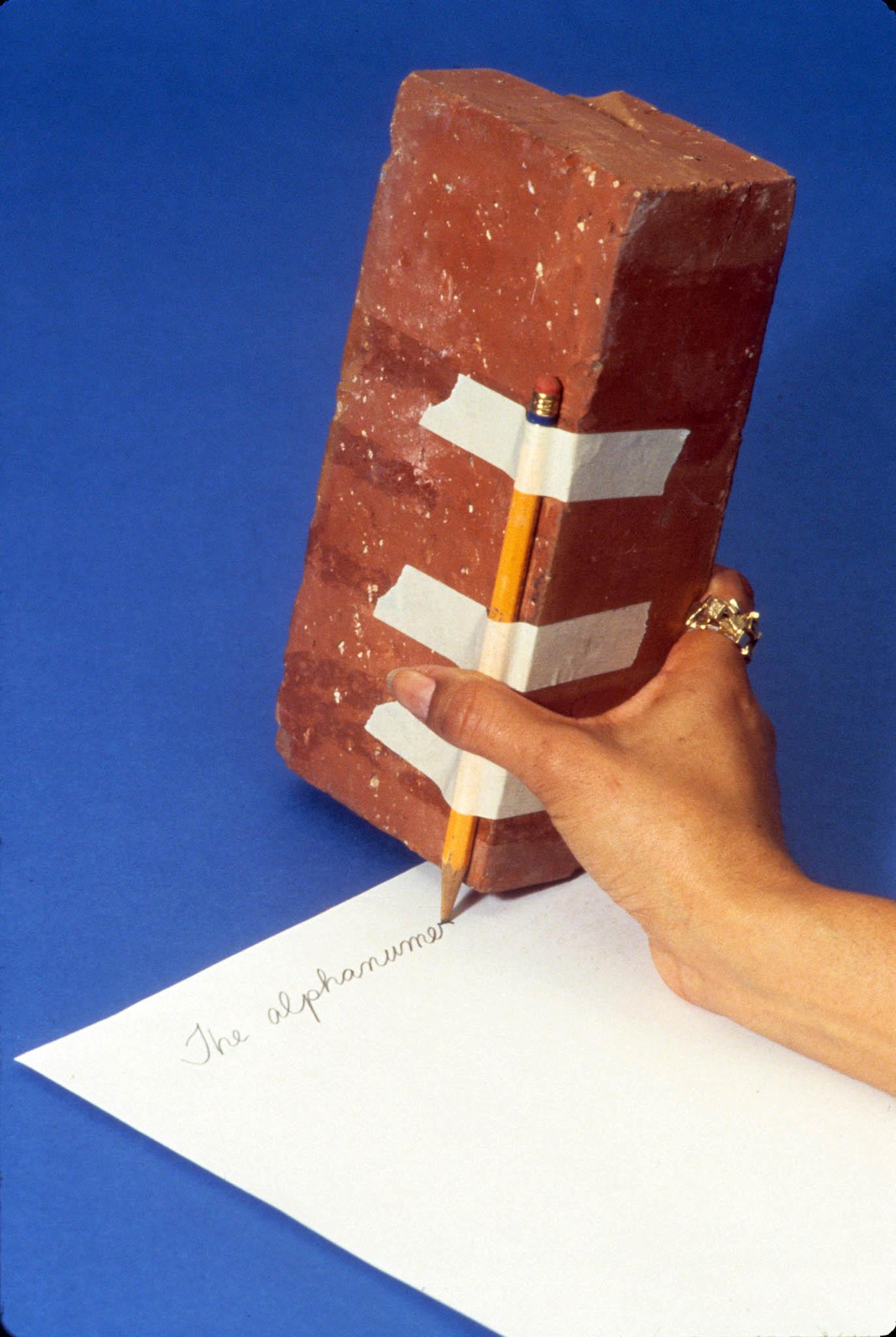
The original account of the brick pencil comes from ‘Augmenting Human Intellect: A Conceptual Framework’ by computer engineer Douglas Engelbart, a paper that would soon become known well beyond the Air Force office that commissioned it. In it, Engelbart lays out a vision for a new easy-to-use graphical computer interface that would provide the groundwork for MacOS and Windows and much of what would happen in interface design in the following half-century. As the paper’s title suggests, Engelbart believed that the digital computer would soon be integrated into everyday life, changing the way people think, allowing them easily to solve difficult problems, and ‘augmenting human intellect.’
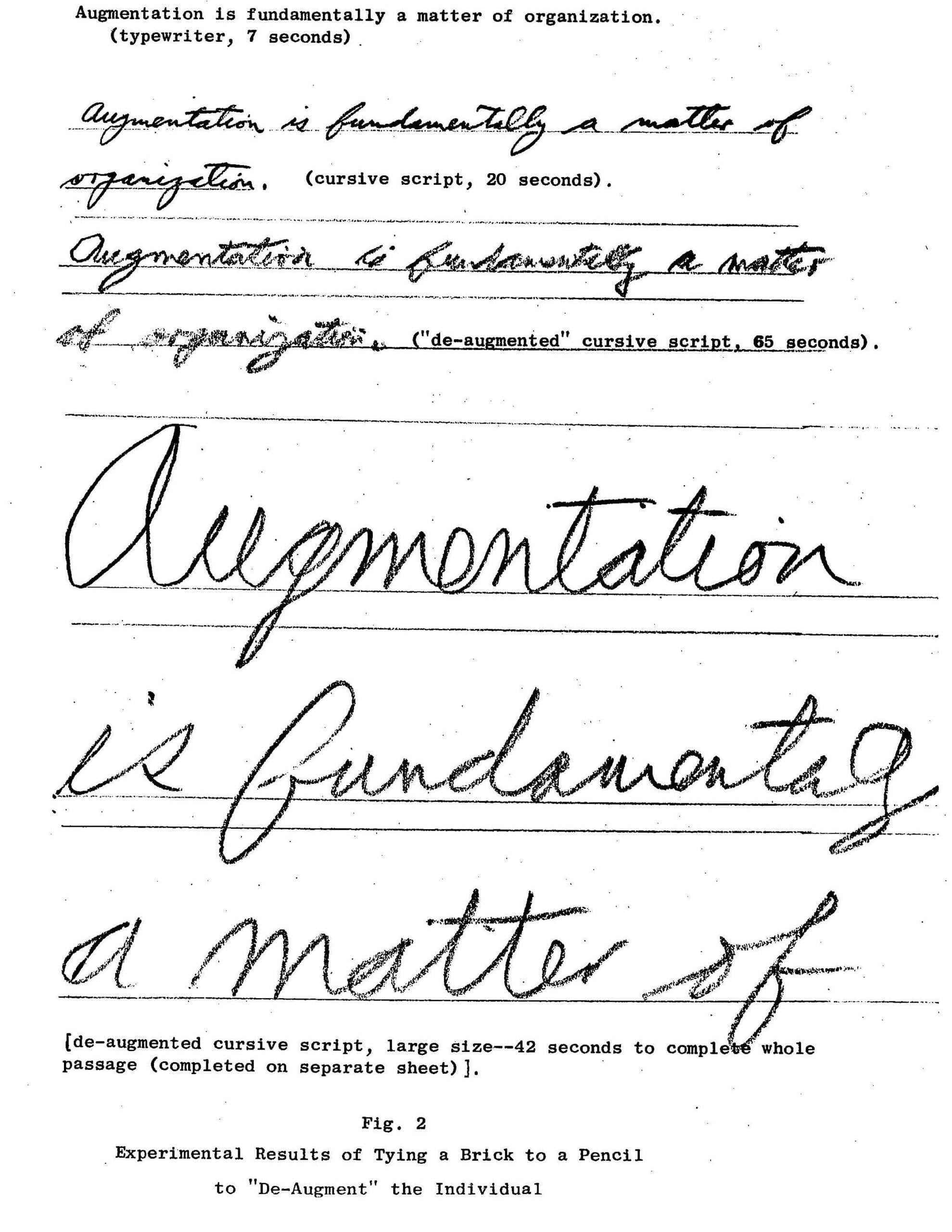
In 1962, however, all this was still in the offing. Computers were expensive and slow. They were as large as rooms if not buildings, and as likely as not, their input and output were mediated by uninviting interfaces such as paper punch cards. It would be Engelbart as much as anyone who would change that, developing the NLS graphical user interface, the computer mouse, and a raft of other interface technologies. Engelbart showed off many of these at the 1968 Fall Joint Computer Conference, a presentation that came to be known as the ‘Mother of All Demos.’ But that was December 1968. In October 1962, NLS did not yet exist. So, for his essay, Engelbart crafted an experimental parable: in it, a pencil stood in for the computer.
*
Part 2: COVID
In March 2020, I taught my first remote class. COVID hit a few weeks earlier, and our university was taking no chances. As luck would have it, I was teaching a course that term on the history of the Internet. Many of my colleagues reported that their first remote classes went poorly. The students were freaked out. The faculty were freaked out. Everyone’s kids were home from school. No one knew how to use the tech. Everyone’s cameras were off.
That wasn’t my experience. At that historical instant, in that strange situation, understanding the Internet and understanding what it meant to be together at a distance mattered a lot to all of us. For my students, studying the history of the Internet was just what the epidemiologist ordered.
Summer came, and I had a new task: to design an interdisciplinary seminar for incoming college students. I already knew that I could teach a great class about distance and technology over Zoom. I wondered whether I could teach a course about presence and materiality in that format, a course that would convey a feeling of togetherness and shared place remotely.
There were several things I wanted out of the course. I wanted students somehow to have a physical experience they could share at a distance. I also wanted them to have a common experience of place and specifically the forests where our university is situated, in the Pacific Northwest, which some of them would be coming to for the first time that term and which others would be experiencing only through pictures and reports. I wanted the course to address a situation in which presence and place were both threatened experiences.
And then I looked down at my desk and saw two pencils.
I had never thought much about graphite pencils, but I always liked them. My mom, who was a mathematician, used pencils because that’s what mathematicians do. And her mom used pencils because she was a bridge player, and that’s what bridge players do. There, on my desk were two pencils, a humble Dixon Ticonderoga like the ones my mother and grandmother favoured, and a shiny white plastic Apple Pencil that I was attempting (and failing) to use to mark up student papers on an iPad.
The idea for the new course came together: it would tell a story that began with the graphite pencil and ended with the Apple Pencil. Along the way, it would examine the rise of capitalism, resource extraction industries, modern industrial design, the history of handwriting, electronic computing, forest ecology, and drawing. Most of all, it would experiment with learning history through the study of a single object. The first premise of the course was that every student would have the same variety of physical pencils in hand when we met.
What followed was a summer of experimenting with pencils—writing, drawing, erasing, and breaking them—looking at their outsides and insides. By Fall, I had a course and packets of selected pencils to send to my students by post so that we could do all of these things together on Zoom. I designed a walking tour so students could locate the fifty-three incense cedars, the principal tree from which modern pencils are made, on our campus, bringing classmates along on their smartphones. I made exercises to engage the future artists, scientists, and teachers in the class, so we could experience together what a pencil does in the different disciplines.
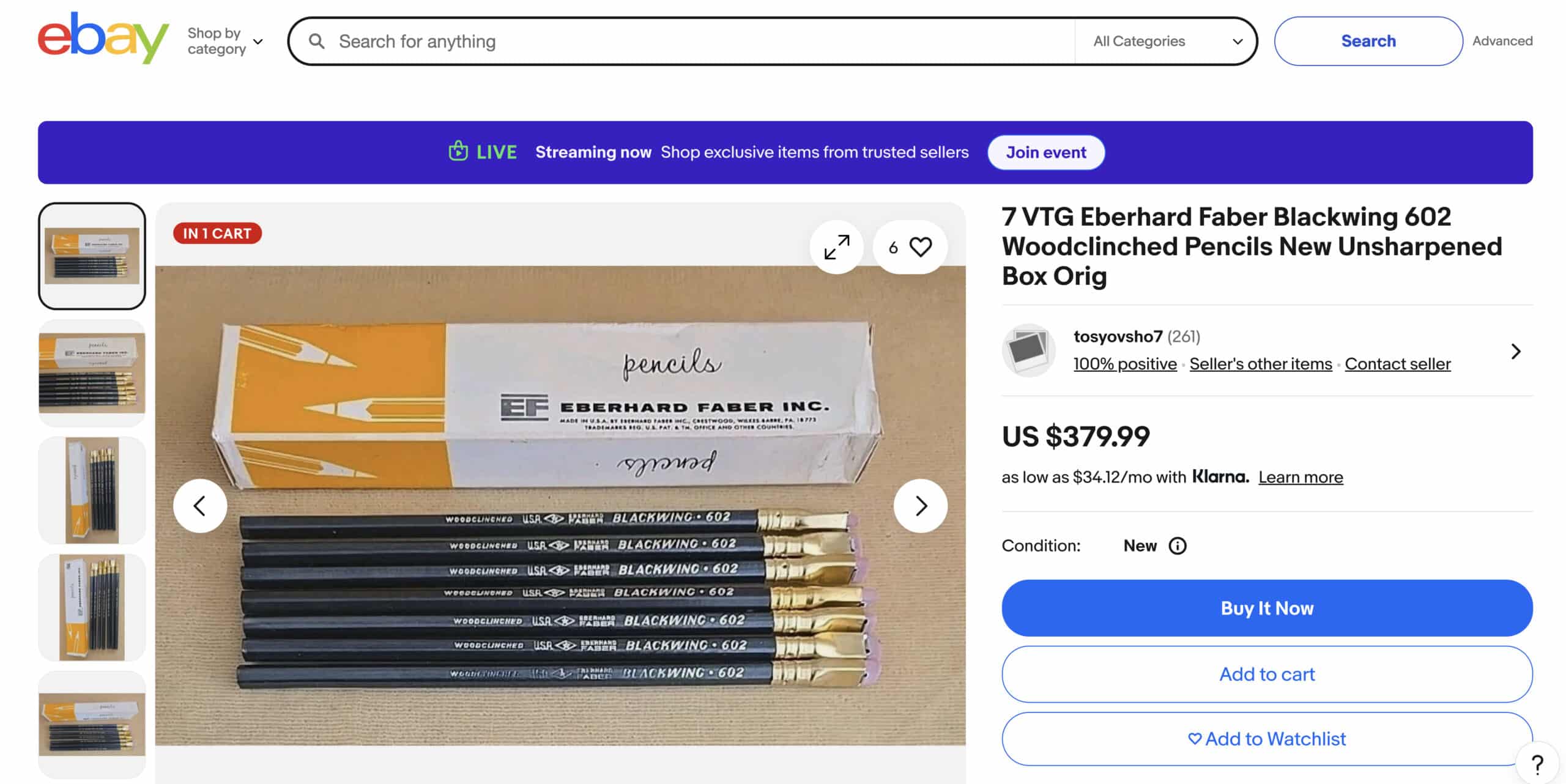
Our pencils came from all over. There were cheap ones from big box stores, including brightly coloured store brands made in Vietnam and melancholy generics from India, some of which barely wrote. There were drawing pencils from England (Derwent) and Germany (Faber-Castell) graded by hardness. And there were three Dixon Ticonderogas, one made in Mexico, another in China, and a third (from boxes I found at a local thrift store) made in the USA before Dixon packed up its machines and sent them abroad. Each envelope also contained a trendy Palomino Blackwing, a tribute to the cultish Eberhard Faber Blackwing 602 that was discontinued in the 1990s amid a flurry of outsourcing.[2]
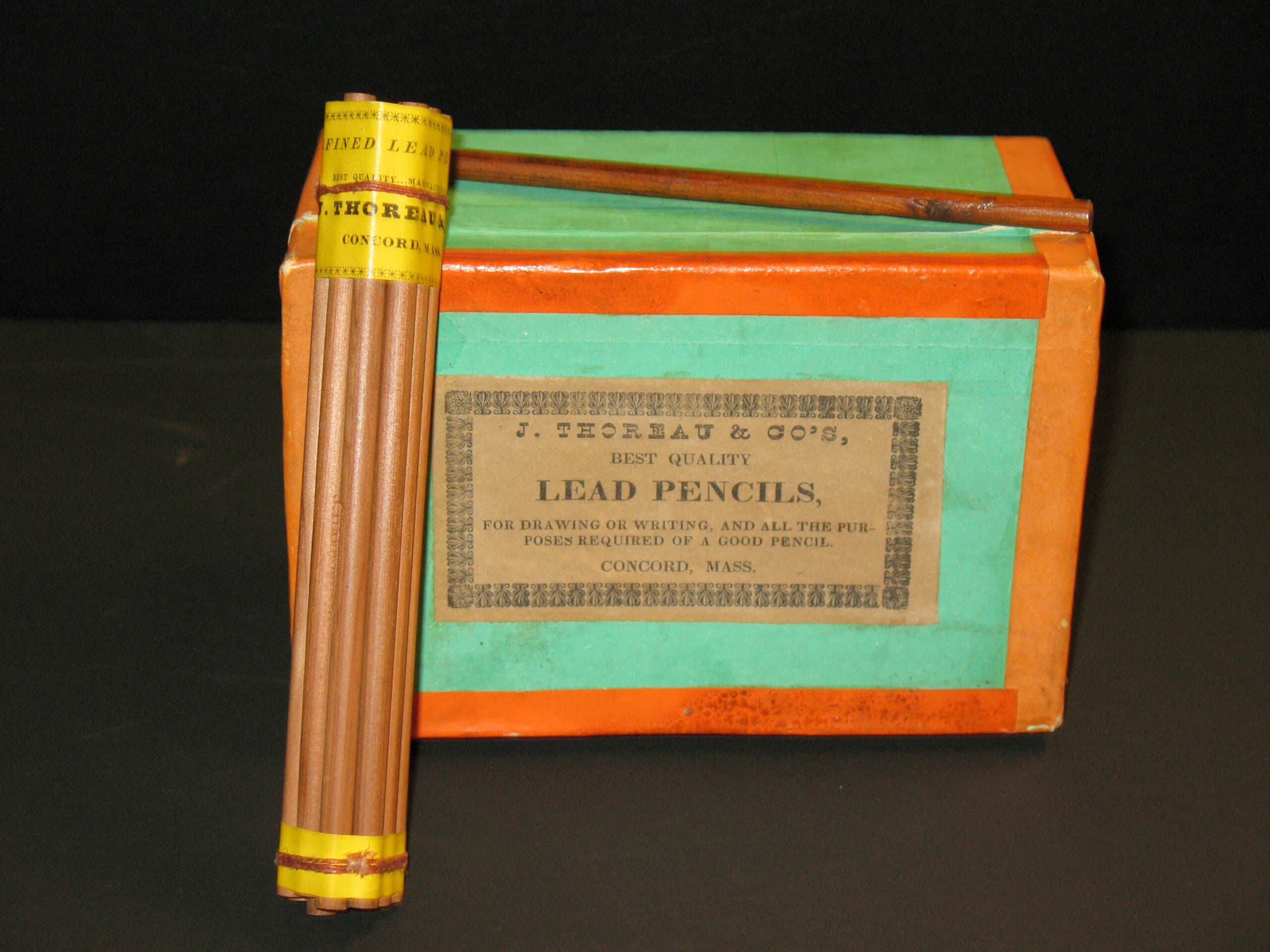
In the course, we would think about writing and drawing implements from a range of theoretical and historical perspectives. We would read scholarship from art history, history of design, history of science, and environmental history, and from the history of business and engineering. A throughline would be provided by Henry David Thoreau, who, in addition to writing philosophy, designed a very good pencil for his father’s company.[3] For us, Thoreau was both a designer and a philosopher of social distancing.
*
Part 3: Borrowdale
Writing and drawing with graphite are surprisingly new. Indeed, the pencil as we know it is a distinctly modern object. The first graphite pencils date to the sixteenth century, coming from Borrowdale in the Lake District in England, where, until it was exhausted in the nineteenth century, very pure graphite was abundant. Essentially, these first pencils were chunks of graphite (or wadd) cut for the purpose, then wrapped in string, cloth, or hide, inserted into a holder, or bound between flat pieces of wood. During the sixteenth century, Borrowdale graphite became known all over Europe.
A graphite pencil was first described by the German writer Konrad Gesner in 1565, but already by the end of the century, such devices were common. In 1675, Friedrich Staedtler established himself as a Bleistiftmacher in Nuremberg, and from 1731, pencil makers there had their own guild. During the eighteenth century, all good European pencils were similar to pencils from Borrowdale, and the best employed Borrowdale wadd. Continental manufacturers who could not find or afford imported graphite achieved a barely passable ersatz by mixing inexpensive graphite powder with sulfur, but no one who could get good Borrowdale graphite found these satisfactory.
During the Napoleonic wars, the situation changed. When trade with England stopped, France lost access to good graphite. In 1794, French Minister of War Lazare Carnot tasked the problem to the soldier, artist, and polymath Nicolas-Jacques Conté. Within a month, Conté had created a method for firing graphite powder together with clay to create a new kind of pencil lead. Thus was born the modern pencil, an artefact not of resource abundance but of scarcity. The Conté method turned out to be more than just a substitute. In the end, it produced a better pencil than the Borrowdale approach. Among other things, it made possible round leads (spaghetti is the term of art) and standardised varieties of hardness, the implications of which were felt throughout the arts and sciences. In Europe and then in America, the new method changed everything. Now, pencil factories could be set up on a modern, industrial basis.
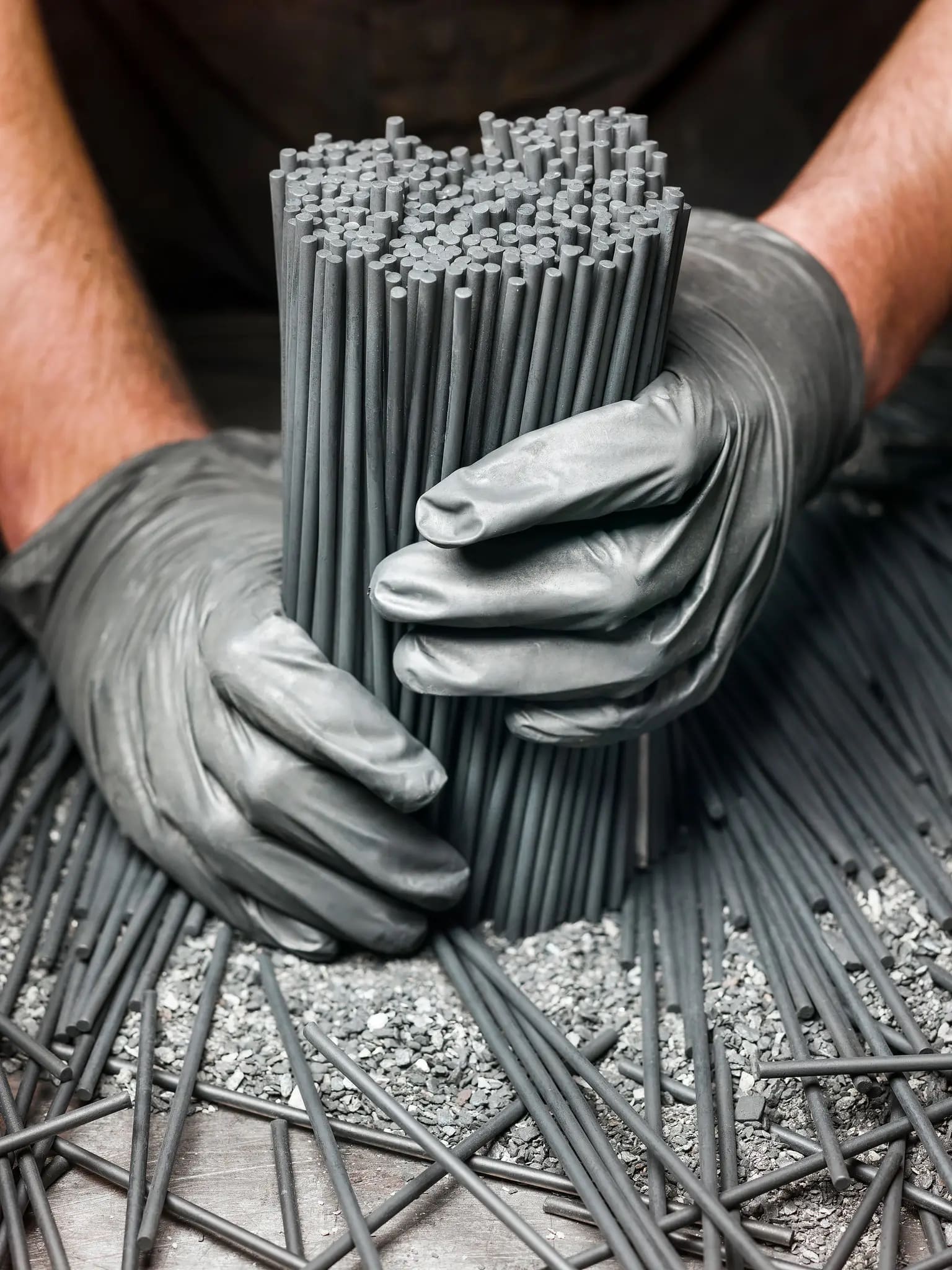
At the same time, global trade made new sources of graphite available. From the 1890s, both Faber and Hardtmuth were making pencils with high-quality Siberian graphite. In the 1920s, the American entrepreneur Armand Hammer would set up a pencil concession with the new Soviet government, employing Siberian lead and engineers bought out from Nuremberg. It was Hardtmuth’s idea to paint his extravagant Koh-I-Noor pencil yellow to signal the fine Siberian graphite it contained. The convention stuck. Though German pencils today are often green or blue and Japanese pencils red, in America, a yellow much like that of the Koh-I-Noor became iconic.
In the Pacific Northwest, our historical connection to pencils is through wood not ore. The early American pencil manufacturers were established on the East Coast, mostly near New York and Boston where John Thoreau, father of Henry David, set up his pencil factory. During this period, the favoured pencil wood was eastern red cedar, which grew in abundance in the southeastern US. Eastern red cedar sharpened well and had a pleasant feel and scent, but by the turn of the century its supply was sufficiently stressed that new wood varieties were sought. Eventually, California incense cedar, which was harvested as far north as Washington State, came to serve as the principal pencil wood in the US and then globally, too. In the early days, a few pencils were even manufactured in the West. There were small factories here and there. Our own city, Eugene, Oregon, was studied as the potential site for a pencil slat factory. But fundamentally, the Western states were the resource frontier.
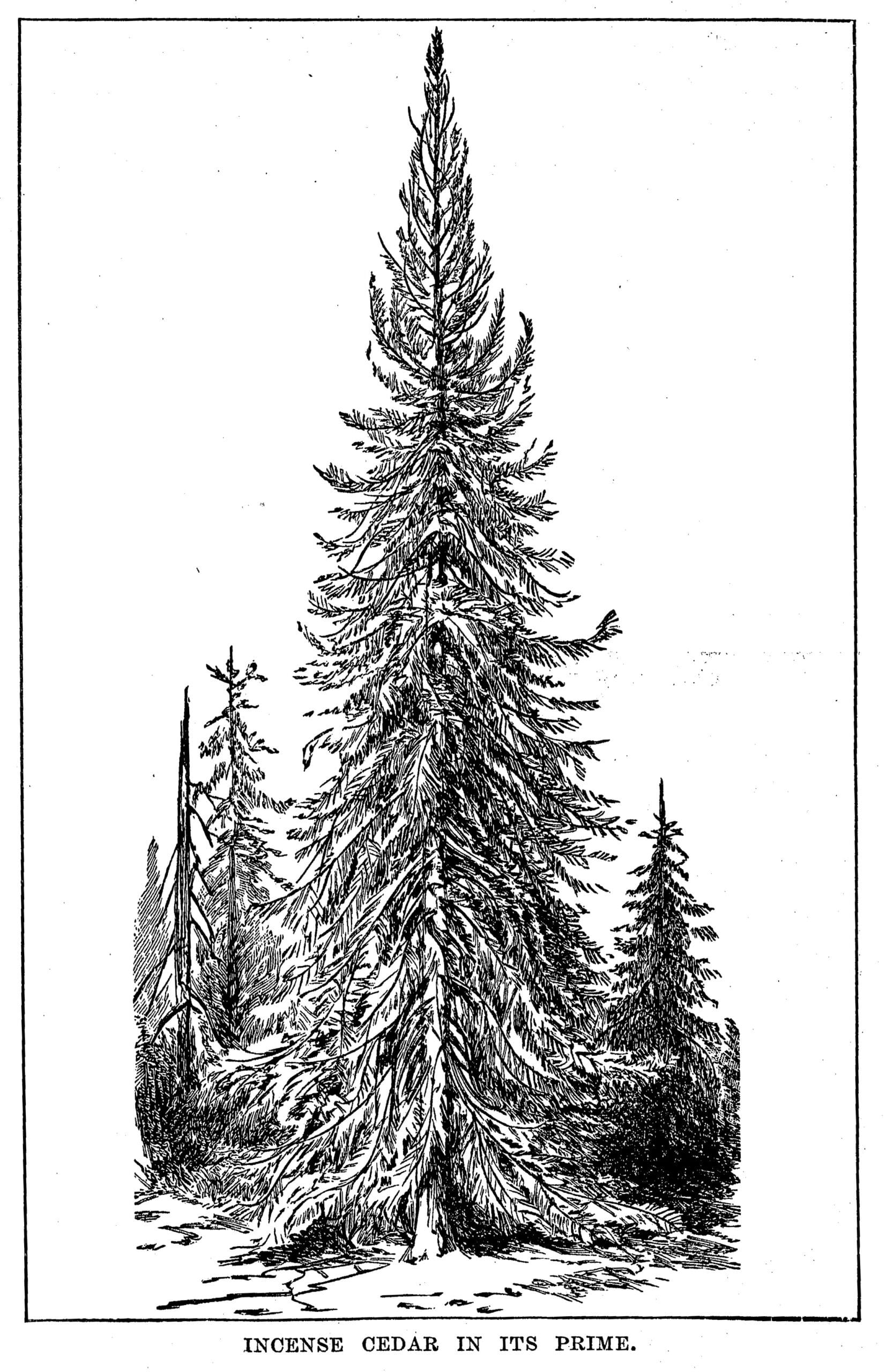
In the US pencil industry, outsourcing happened quickly. Around the start of the twenty-first century, when laws and logistics permitted, whole factories were packed up and moved abroad. These days, very few pencils are manufactured in the US. During the past quarter century, the big companies moved their production abroad, mostly to Mexico, China, and South Asia. Only two important legacy pencil factories still operate in the US: Musgrave Pencil in Shelbyville, Tennessee and General Pencil in Jersey City, New Jersey. Blackwing, created by the head of the Stockton-based CalCedar Corporation and a descendant of one of the original Nuremberg pencil dynasties, uses lumber from California, Oregon, and Washington but has its pencils fabricated in Japan. In this case, the outsourcing is not for cost; rather, it is for tools and skills that have been lost in the US.
In Europe, the story is a bit different. The major German companies, for example, outsourced, but they also maintained production at their old facilities, on the model of the Mittelstand, medium-sized, family-owned enterprises with strong regional ties. When I visited the Faber-Castell and Staedtler factories near Nuremberg in July 2022, the talk was about the war in Ukraine. Russia was threatening to cut supplies of natural gas to Germany. Without natural gas, German companies would no longer be able to fire pencil leads. It made one wonder what a twenty-first-century Conté might come up with.
*
Part 4: Analogue
My students and I were not the first people to consider that the pencil might be an interesting object to think with in digital times. In the second and third decades of the twenty-first century, we discovered that a veritable pencil renaissance was taking place. There were dozens of new books, blogs, brands, and boutiques.[4] The throwback Palomino Blackwing pencil, made to simulate the look and performance of the iconic Eberhard Blackwing 602, was characteristic of the moment. On the one hand, it was a pencil and a good one; on the other, it was a lifestyle proposition. Zeitgeisty in a complementary way was the Musgrave Test-Scoring 100 pencil promoted by standardised-exam coaches for its performance on Scantron-type exams.[5]
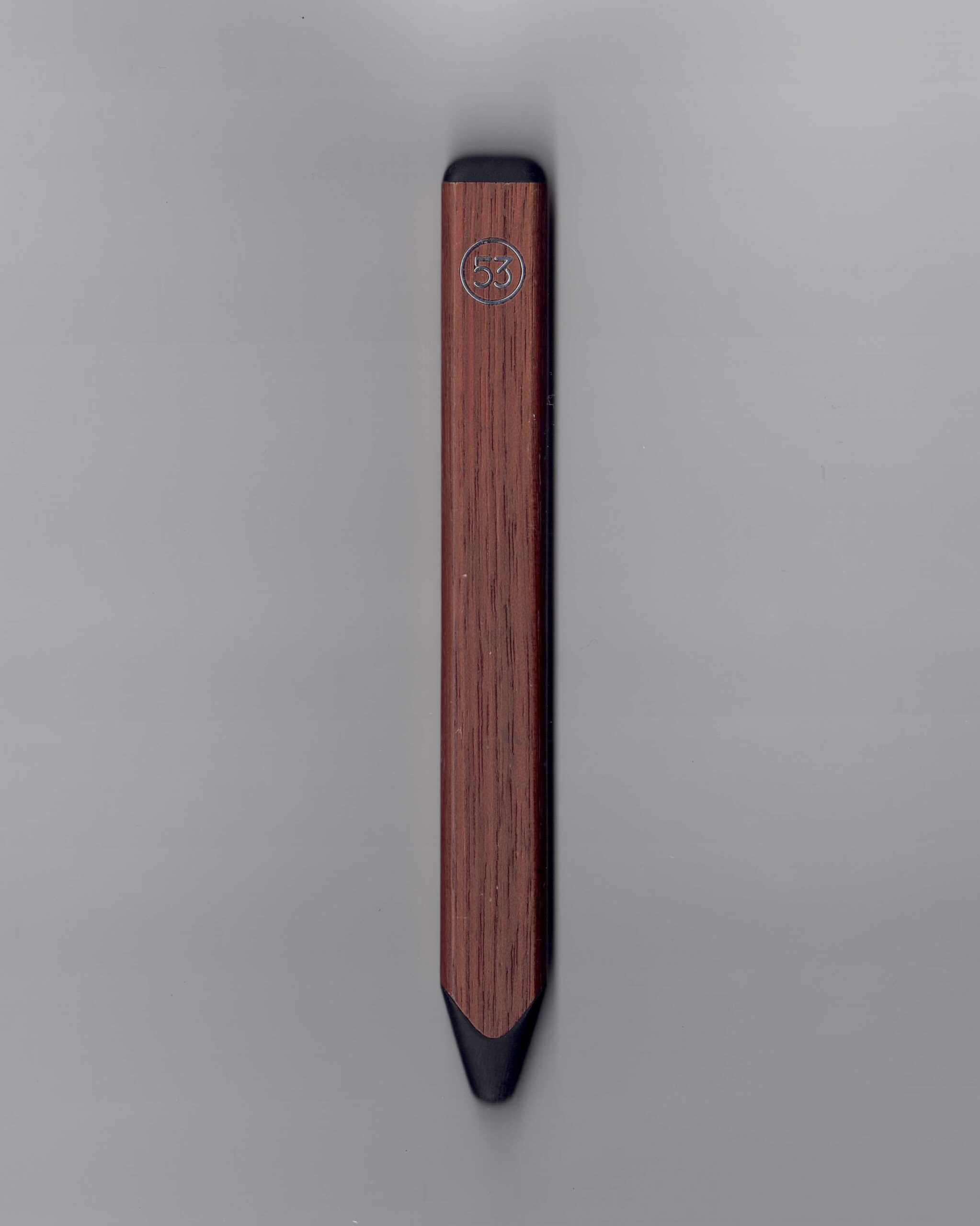
A whole range of related products encouraged users to step back from their keyboards and screens to appreciate the feel of analogue life, even if they were also encouraged to step forward again and tweet about it. Paradoxically, the Apple Pencil and the other electronic pencils that were becoming common at this time drew energy from the same network of sentiment. A compelling example was the FiftyThree Pencil, gorgeously designed with a wood case the shape of a carpenter pencil, which in 2013 took the hipster world by storm. Ads including ‘Think with Your Hands’ and ‘Surface Pressure’ touted its tactile qualities. With these devices, the idea was not to step away from the screen but to interact with it in a way that felt as analogue as possible.
By 2014, Manhattan had a boutique devoted exclusively to pencils. According to its founder, Caroline Weaver, ‘The nature of the world we live in is beginning to encourage us to consider the benefits of using analogue tools as devices for thoughtful communication as well as for the purpose of cognitive experience. What a computer can’t do, a pencil can.’ Each part of the pencil, she argued, stimulates a different sense. The wood smells like the trees it came from. The graphite has a texture you feel when you write and hear scratching across the page in a hushed classroom. ‘A person is completely free to use their pencil in any way possible,’ writes Weaver, ‘after all, it’s erasable.’[6] It’s a telling list of descriptors: the pencil is thoughtful, physical, connected, free.
The irony is that the analogue pencil about which Weaver rhapsodises is itself a decisively modern artefact, the product of international business, resource politics, and war planning. It was a technological solution to longstanding problems. Among the problems the early pencil was made to solve was that of portability. When out and about, a sixteenth-century scribe might employ a portable desk and flask. Even so, ink dripped and blotched. But not graphite. This same quality appealed to NASA, though the prospect of contaminating the environment of a space capsule with particles of graphite and wood gave them pause.
Another advantage: marks from graphite pencils could be kept or erased. Ink kept well. Other media including wax tablets, chalk boards, and the wipe-away notebooks that Shakespeare refers to in his sonnets, erased well.[7] But the pencil combined the two qualities in a single device. Graphite was appealing for both writing and drawing. It was smooth and expressive, and it produced good detail and variation in tone. As carpenters and crossword puzzlers know, it could write well on many different surfaces. Indeed, its first known use for writing was for marking sheep. Graphite had many competitors. Charcoal shaded beautifully, but it was less stable than graphite and not very good for writing. Metalpoint was stable and produced lovely detail but showed best on specially prepared paper and for images that could be carefully worked.[8]
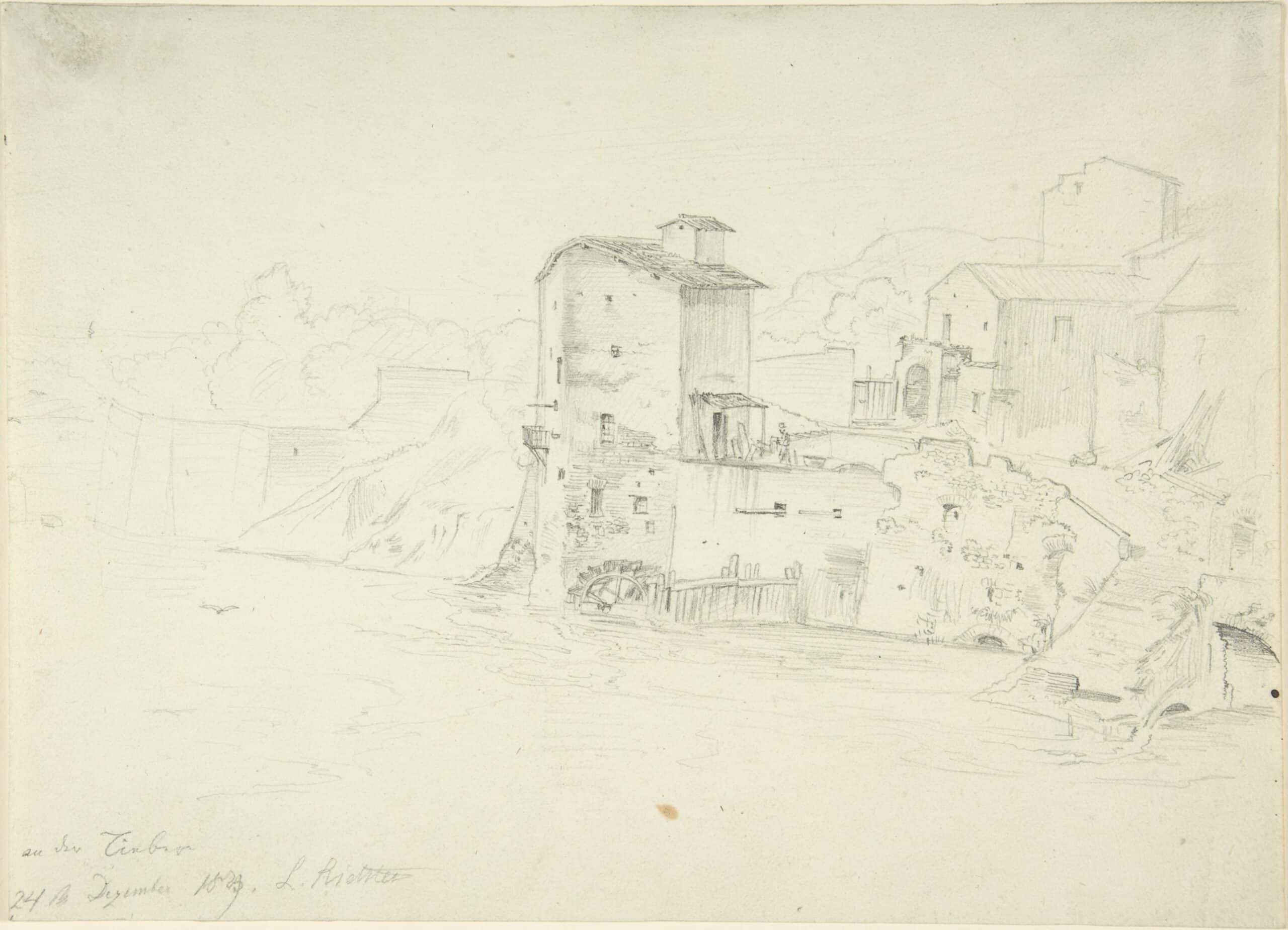
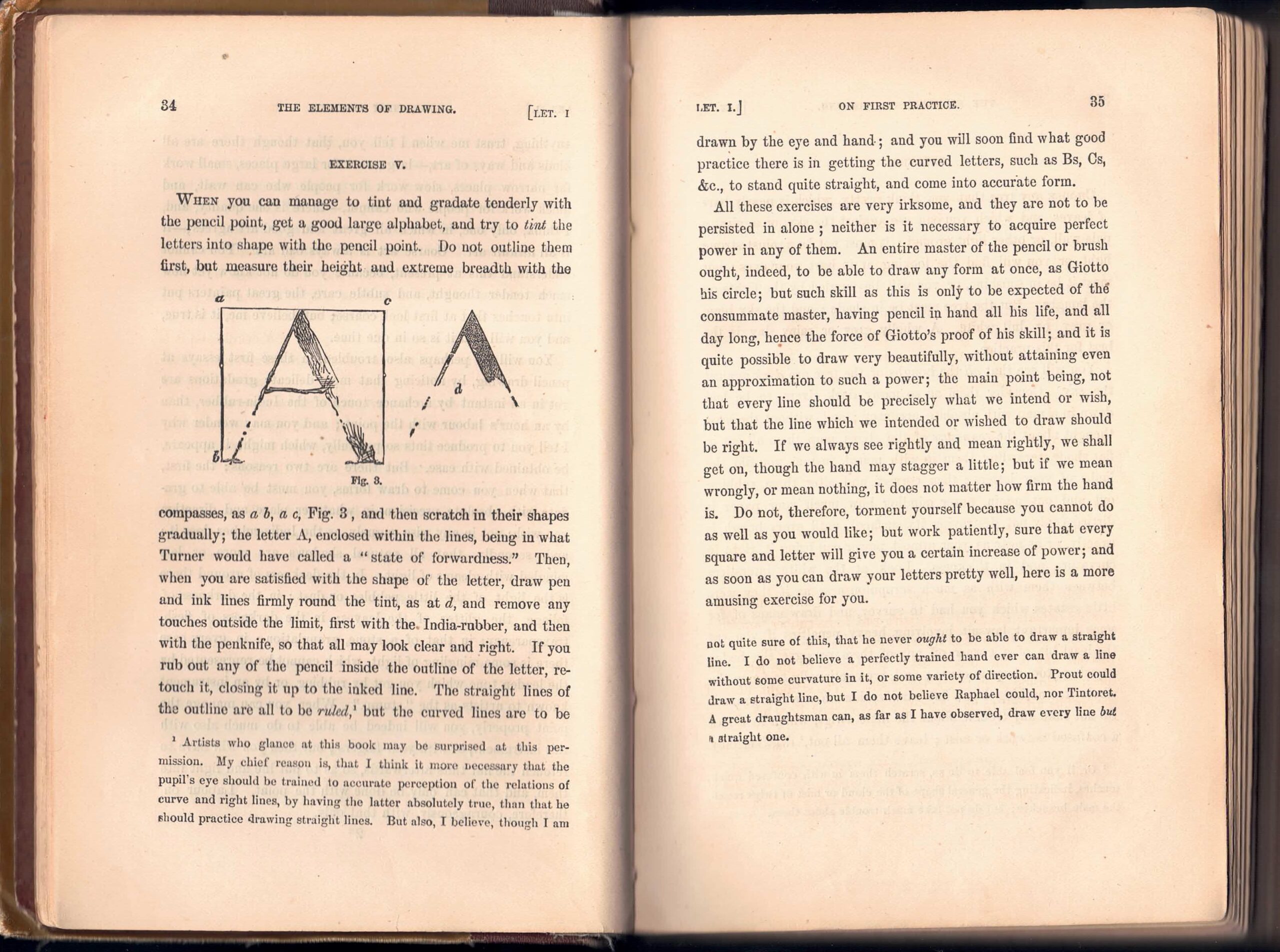
Excellent as it was for writing, it was for drawing that the pencil most impressed early users. From the 1830s to the 1850s, numerous books were published instructing the public on how to use so-called ‘black lead pencils’—which we call ‘graphite pencils’—for drawing.[9] Not least among these was John Ruskin’s 1864 Elements of Drawing, with its detailed instructions for ‘command’ of the hard and the double hard pencil.
From the end of the eighteenth century, the graphite pencil served an important role inspiring a new objectivity among artists and natural historians that set the aesthetic and epistemological stage for the development of photography in the coming decades.
Speaking for his generation of artists, the eighteenth-century German painter Adrian Ludwig Richter wrote, ‘we paid more attention to drawing than to painting. The pencil could not be hard enough for sharp enough to draw the outline firmly and definitely to the very last detail…. We lost ourselves in every blade of grass, every ornamental twig, and wanted to let no part of what attracted us escape…. [I]n short, each was determined to set down everything with the utmost objectivity, as it were in a mirror.’[10]
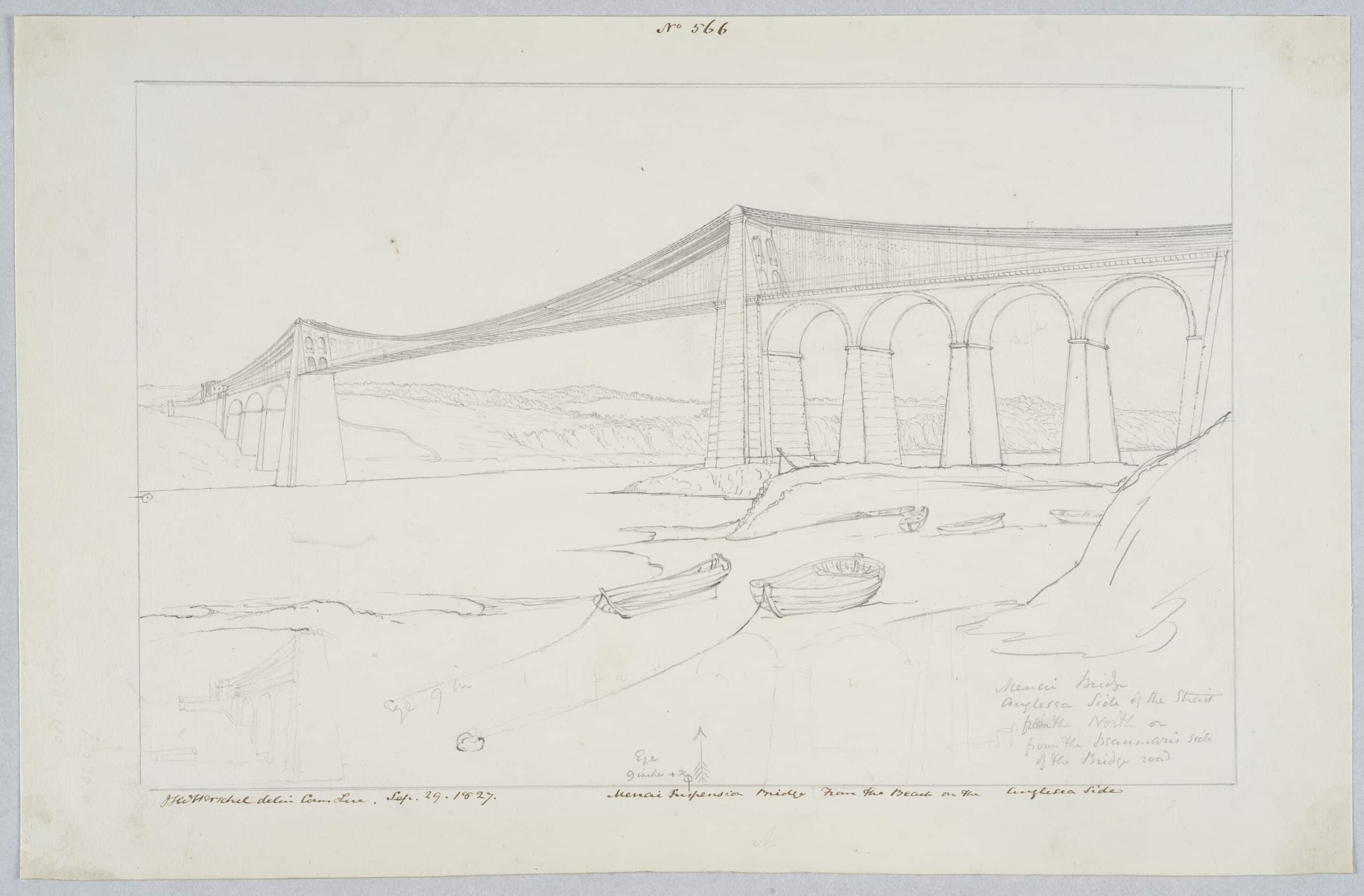
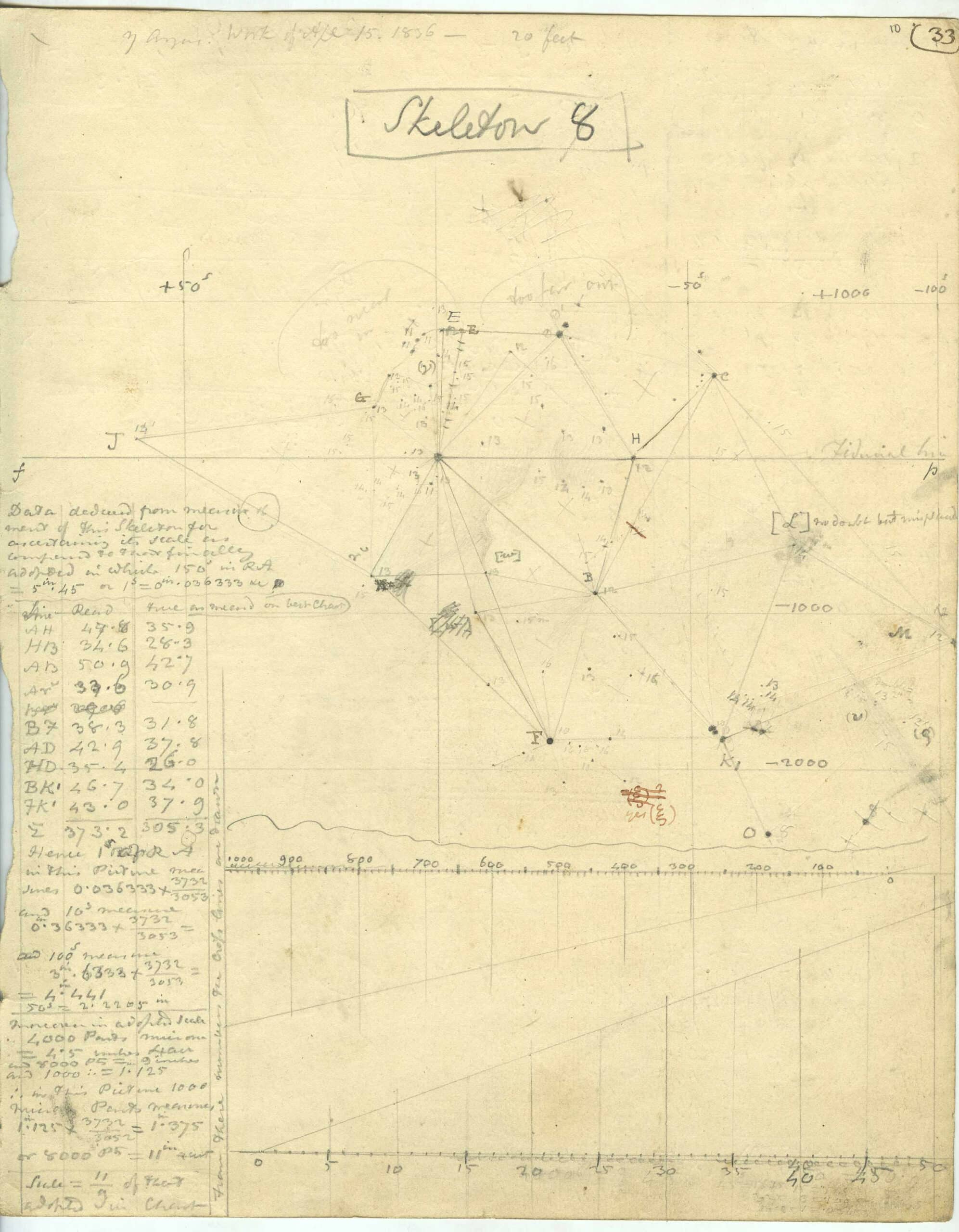
The same characteristics of pencil drawing that inspired artists during this period also inspired natural philosophers such as the English astronomer John Herschel. After successfully making landscape and architectural drawings with graphite pencils and wove paper, Herschel applied the new technology to revolutionary observational drawings of nebulae. Herschel’s fascination with scientific image making led him in 1839 to the invention of one of the first photographic processes. William Henry Fox Talbot’s great book, The Pencil of Nature (1844–6), which introduced photography to the world, resonated with the same sensibility.
*
Part 5: Ubiquity
The pencil was affordable, and the pencil worked. By the middle of the nineteenth century, pencils made by the Conté method were ubiquitous. While pens, even inexpensive ones, remained objects of some reverence, pencils by this time were already thought of as disposable. In fact, this was built into their design. With use, the graphite in a pencil wears down. The wood is shaved away with sharpening. Even when it was bleeding-edge technology, a pencil was nothing to fret over: it was something you expected to use up.
For many early adopters, the appeal of the pencil was its portability. The Romantic poet William Wordsworth, an inveterate walker, liked this quality particularly, though he criticised Walter Scott for his habit of pencilling notes while still out in nature rather than remaining immersed. Another Romantic, Thomas de Quincey, criticised Wordsworth for his timid, penciled marginalia. In the 1790s, an assistant to the inventor James Watt attached a pencil to a piston on one of Watt’s steam engines and put a paper card against its tip. It drew a steam pressure volume diagram. Bedridden in 1832, the computing pioneer Ada Lovelace switched from pen to pencil because the latter allowed her to write more easily while lying down.[11]
By midcentury, the pencil was a common commodity, a fact captured in an 1849 story in the School Gazette written in the voice of a pencil. The pencil says,
‘My first recollection was that of being in a box in a store with a lot of my companions. I stayed there a long time but one day as I was looking about me, I saw a very pretty lady come into the store. She purchased several articles. As she was going out, she happened to spy us pencils & looking at us all, she selected me in preference to any other. I do not know why it was, for we all resembled each other very much, but I was very glad that she chose me. She carried me home & put me in her writing desk for the night, but the next day wishing to write to a friend, she took me & made me say many words which she wished her friend to know. She afterwards used me for drawing. The lady, finding I answered her purpose very well, gives me a great deal to do & although I sometimes feel that I am almost used up, I prefer this life to my former one because I have the satisfaction of knowing I am useful.’[12]
By 1849, the pencil had become, among so many other things, a writing instrument for children.
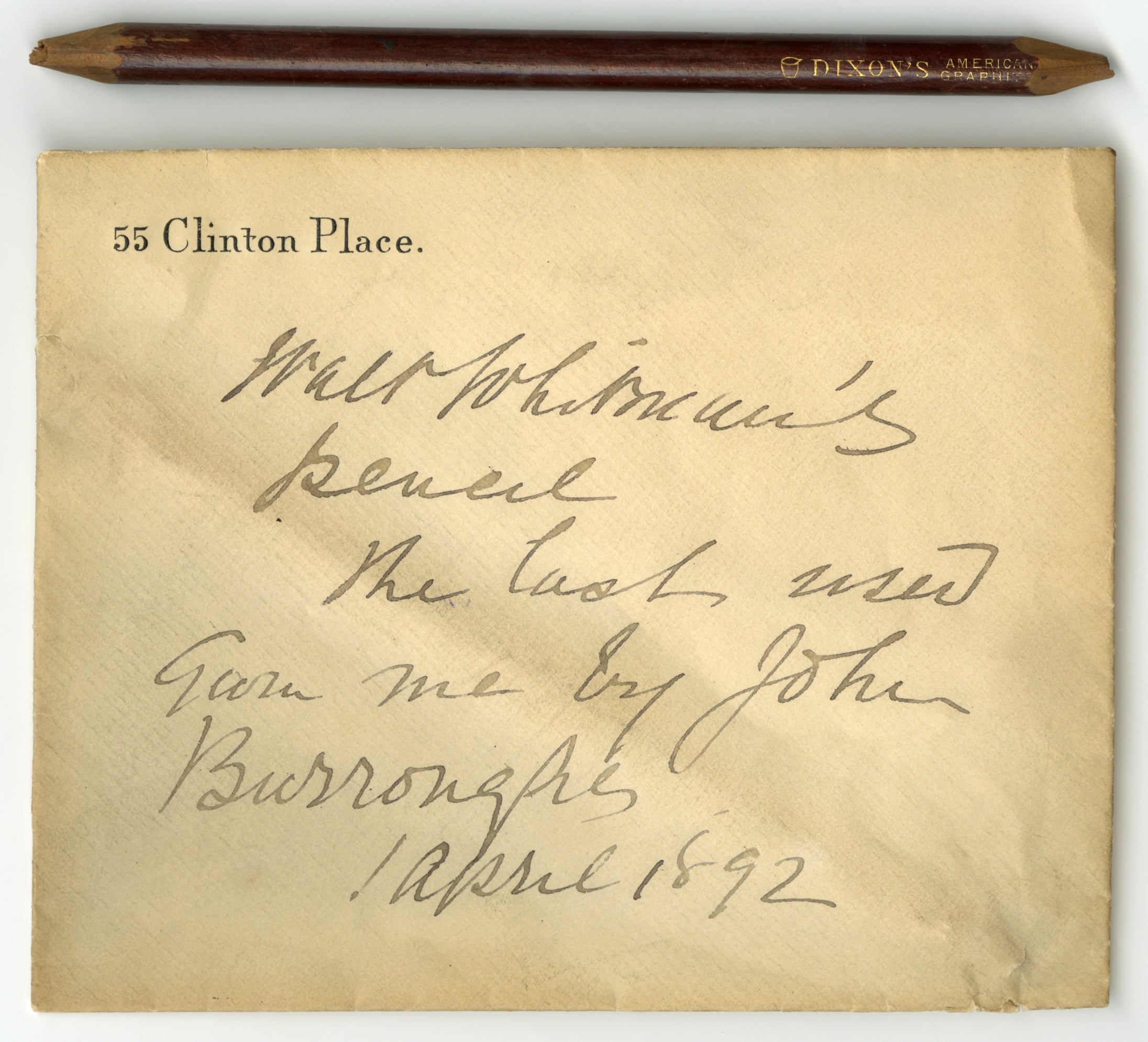
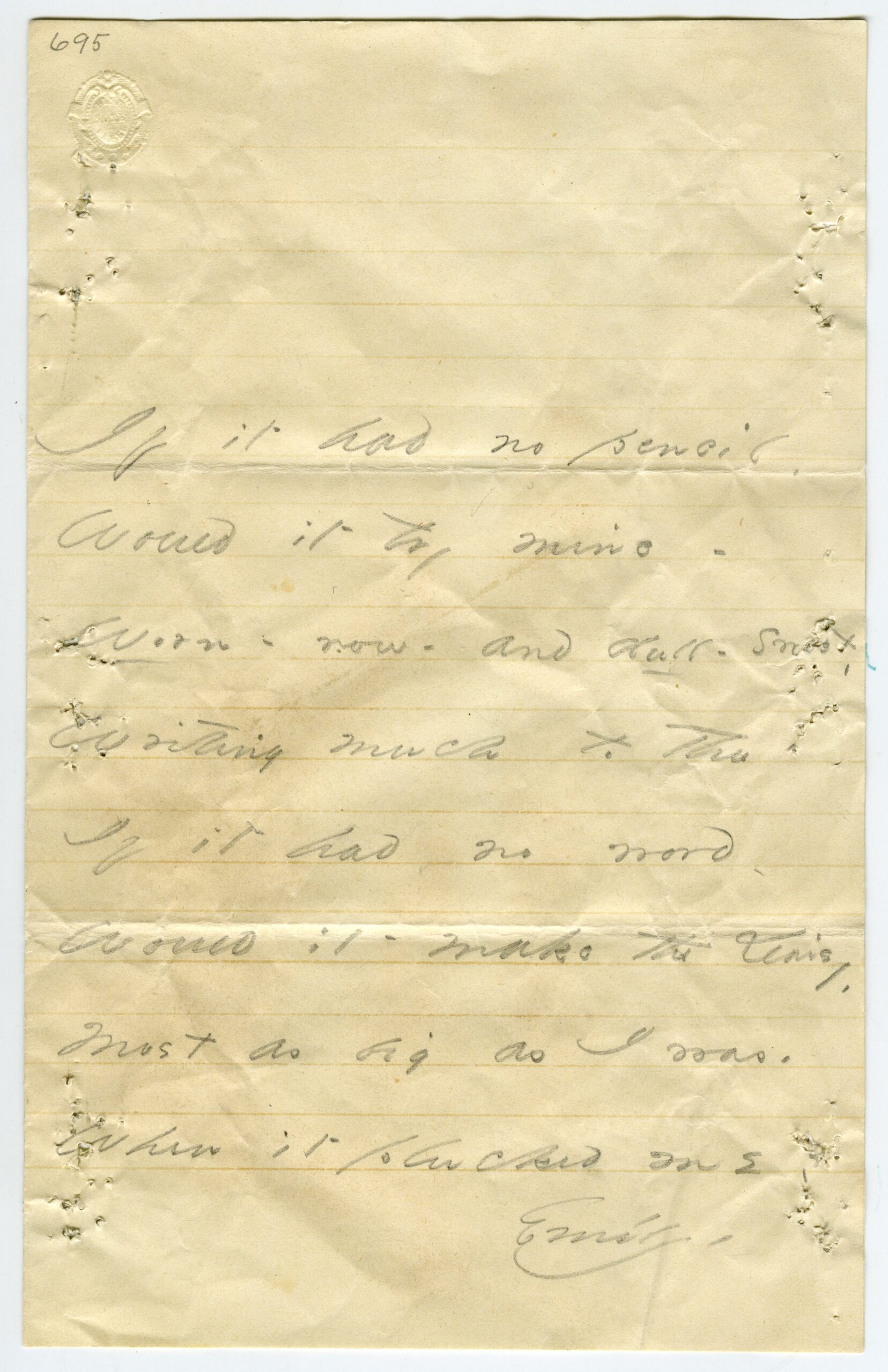
Nor was this characterisation anomalous. A pencil cost next to nothing, fit in anywhere, and passed freely from hand to hand. In 1861, Emily Dickinson mailed the stub of one of her own pencils to a reluctant correspondent along with a poem suggesting that he ‘try mine – / Worn – now – and dull – sweet.’[13] In his Song of the Broadaxe, composed between 1856 and 1881, Walt Whitman lists the pencil along with the hoe, rake, pitchfork, wagon, and staff among the ‘fluid utterances’ of the forest. According to one visitor, Whitman also used a pencil to stir his ginseng tea. Charged with ideas about John Brown’s 1859 uprising in Harper’s Ferry, Thoreau tucked a pencil under his pillow. ‘When I could not sleep,’ he said, ‘I wrote in the dark.’[14]
Ernest Hemingway measured his labour in pencils worn down: seven, he said, made a good day’s work, while Vladimir Nabokov claimed to rewrite so often that his own work was best measured in erasers. For Frank O’Connor, the inexpensiveness of the pencil was a compelling virtue, ‘From the time I was nine or ten, it was a toss-up whether I was going to be a writer or a painter,’ he wrote, ‘and I discovered by the time I was sixteen or seventeen that paints cost too much money, so I became a writer because you could be a writer with a pencil and a penny notebook.’[15]
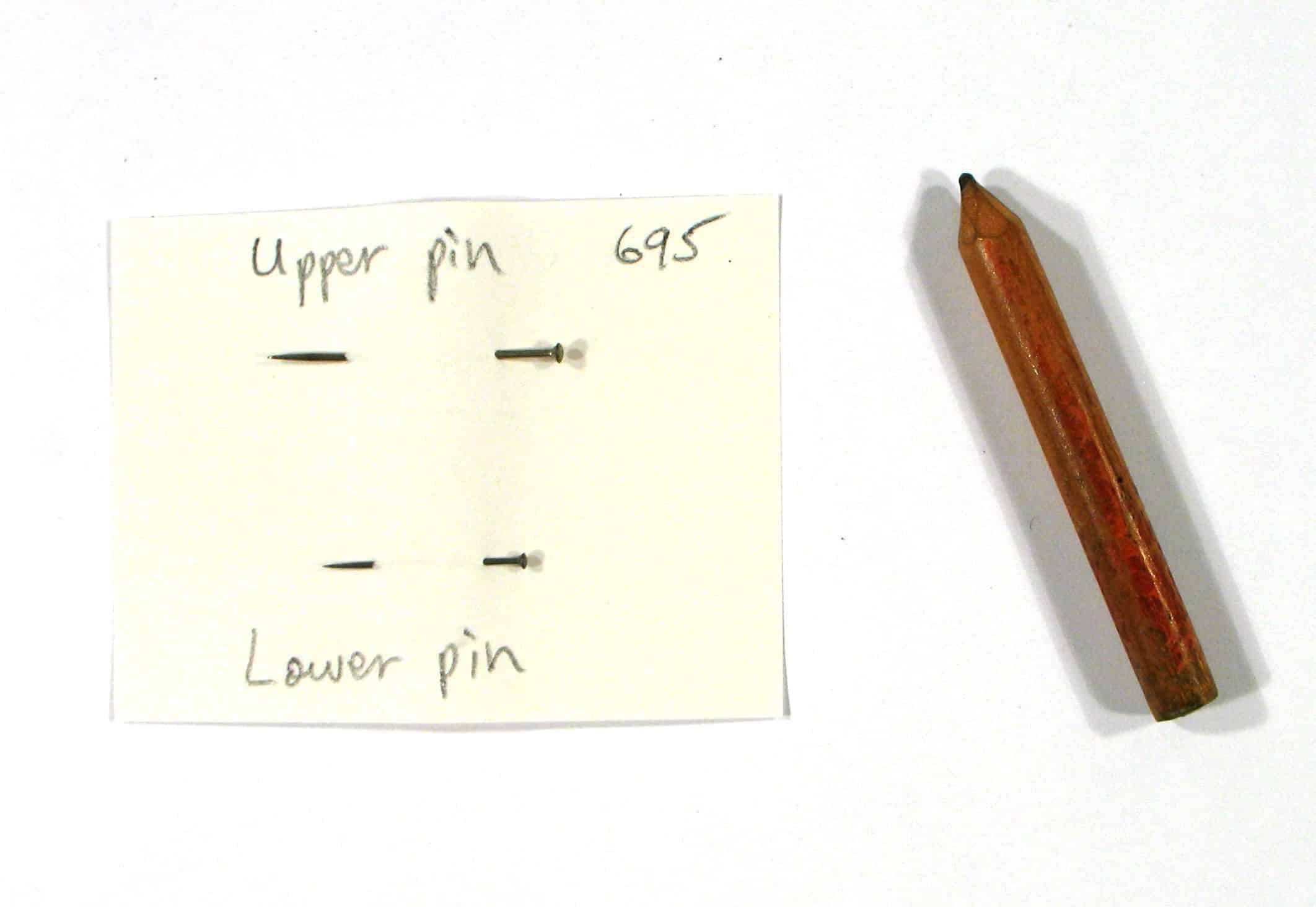
Not only had the pencil become ubiquitous, it had become intimate. You could tuck it behind your ear, slip it through a hank of hair, or grip it between your teeth. In the hand, the pencil was something between a tool and a sense organ. According to the French poet Paul Valéry, ‘There is a tremendous difference between seeing a thing without a pencil in your hand and seeing it while drawing it.’[16] For the nineteenth-century natural historian Louis Agassiz, ‘A pencil is one of the best eyes.’[17]
The pencil soon populated the language, too. A meeting could be pencilled in, while a quick calculation was pencilled out. The size and shape of a pencil became a general reference. ‘What’s great about pencils,’ says food writer Anna Jones, ‘is that they are pretty much a universal measurement. My books have been translated into lots of different languages, but everyone knows what I mean when I say “pencil-thin.”’[18] Virtually anything long and thin could be characterised as a pencil including beams of light, molluscs, electrodes, beards, moustaches, flowers, microphones, solar cells, pants, skirts, trees, stripes, and even necks.
In popular culture, the pencil carries strong associations. Pencils are about process and creativity. In the TV series Mad Men, ad executives write with pens while creatives write with pencils. A similar binary is visible in Hidden Figures, a film about black women mathematicians working at NASA. There, the bosses write in pen but the computers—as these mathematicians were called—use pencil. In the urban high school in the movie Stand and Deliver, high-stakes tests end with the call pencils down.
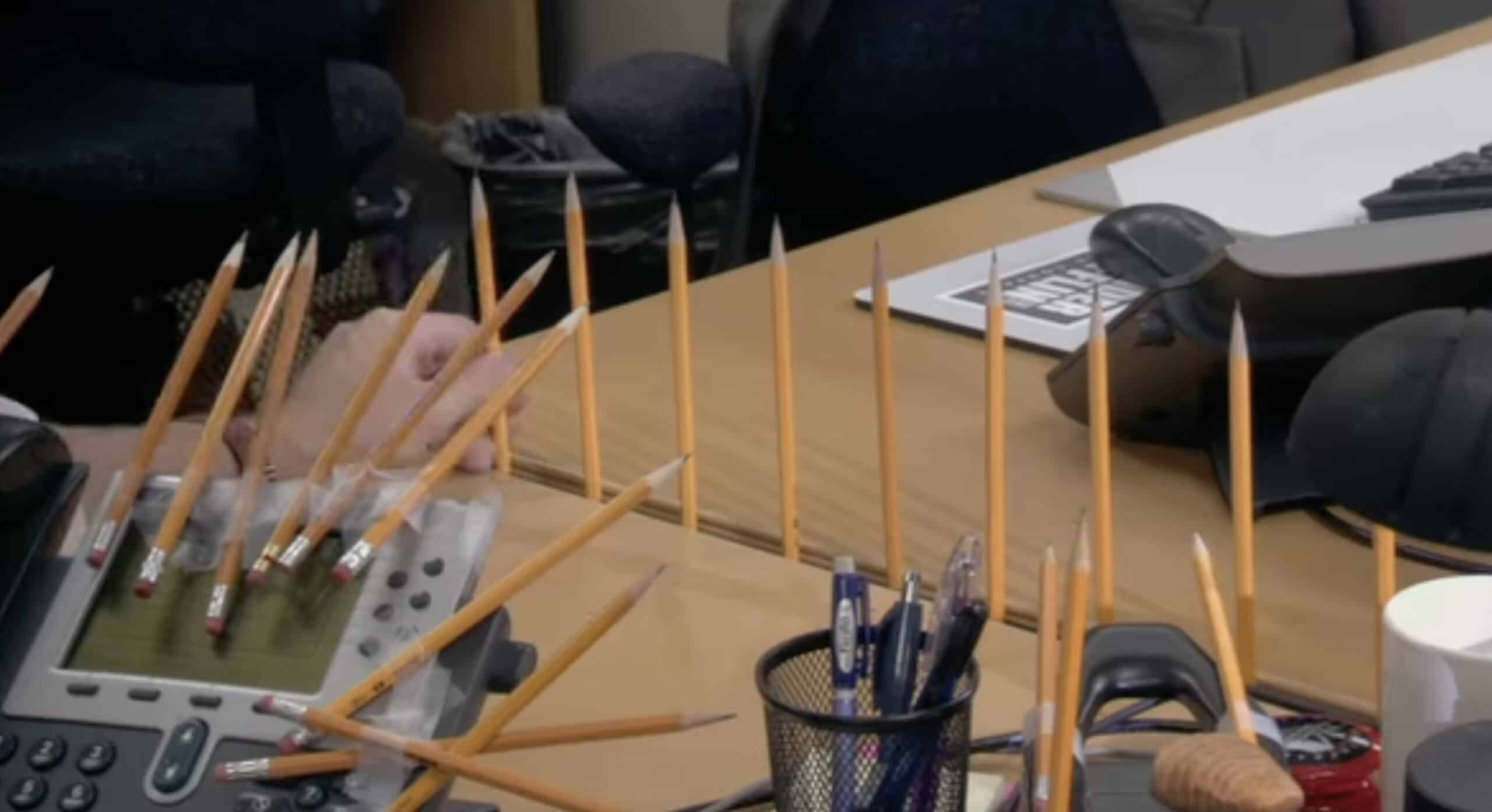
In the The X-Files, a bored Agent Mulder does what every school kid has done at some point, throwing pencils at the fiberboard ceiling, trying to get them to stick. In The Office, Jim builds a picket fence of pencils around his desk to keep Dwight away. In the movie Groundhog Day, the news reporter Phil Connors breaks a pencil before he goes to sleep each night to see if he is really in a time loop. (He is. The pencil is whole again each morning.) There is no end to pencils. It is in their cultural character to pass beneath notice, but once you start noticing them, you notice them everywhere.
Alex Hammond and Mike Tinney’s photographic study, The Secret Life of the Pencil (2017), contains vivid close-up photographs of pencils from the desks of about seventy artists, designers, architects, writers, and musicians and interviews about what their pencils mean to them. The images are beautiful, picking up details not only of what these pencils look like but how they are used. Up close, we can see the rasp of paper on graphite, the grip of a pencil sharpener on wood, the dent of tooth on lacquer.
The premise of Hammond and Tinney’s book is that the pencil reveals something about the individuality of the user: the pencil tip of the Japanese composer Ryuichi Sakamoto is elegant and precise, while the knife-sharpened pencil of film director Mike Leigh is bold and irregular. In these photos, we also see something about the method of work. The exposed wood of a cartoonist’s pencil is black from shading; the tip of a writer’s pencil is dull from notetaking; a furniture designer has exposed a large graphite wedge from his carpenter’s pencil so he can create different widths of line.
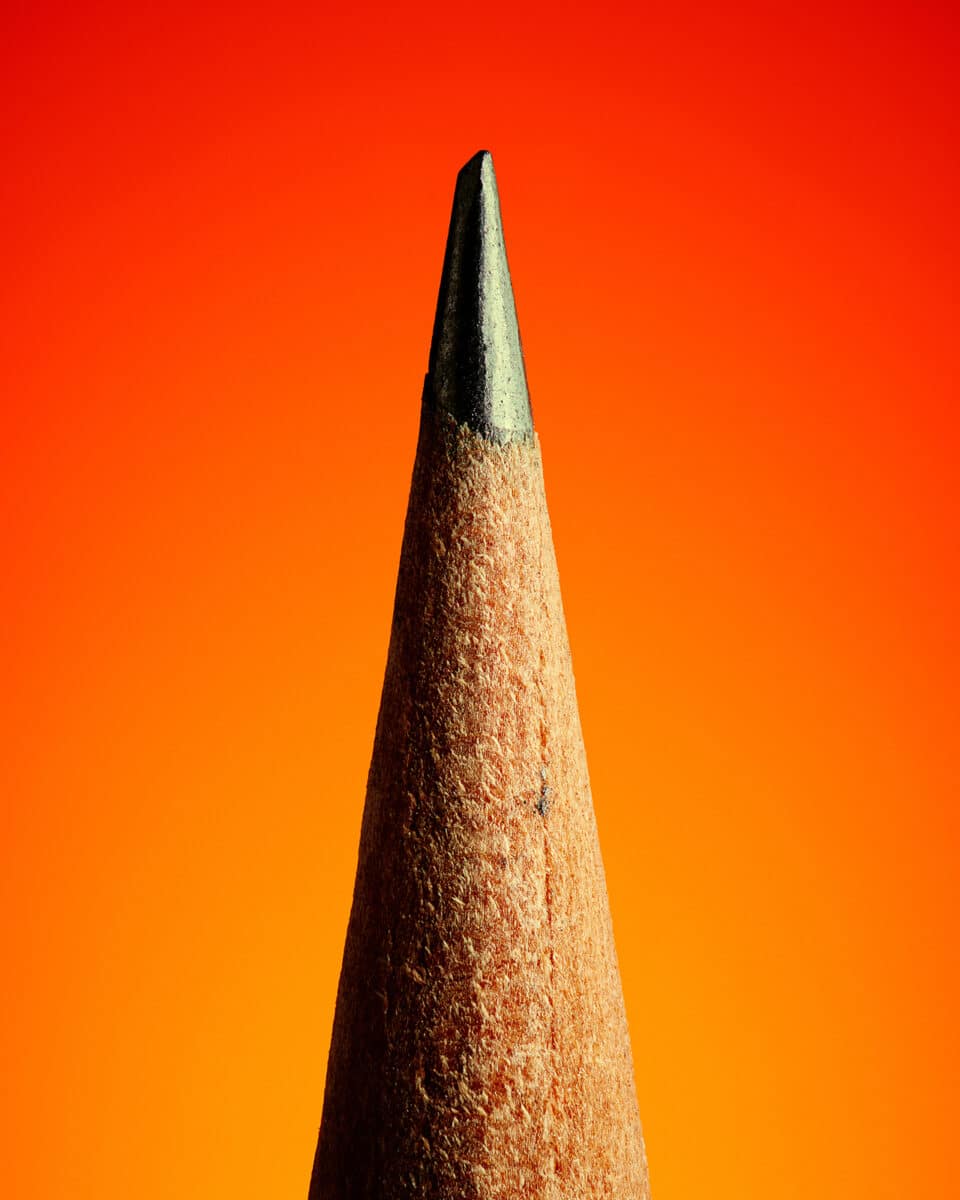
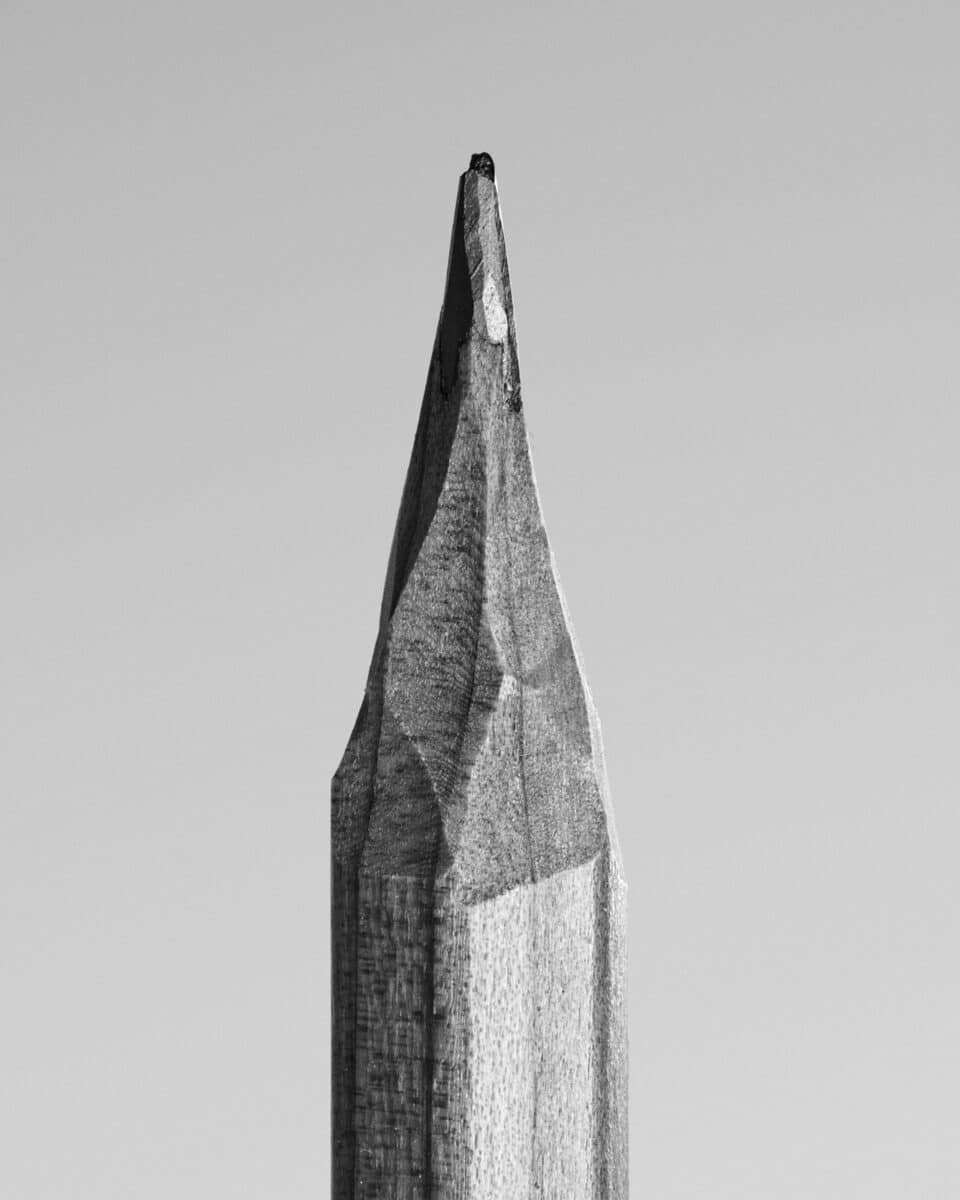
Tinney’s photos are all about the pencil’s physicality. The objects themselves are static, but they don’t look that way. In each of them, you can see process. According to William Boyd, ‘Your sense of yourself, as reflected in your handwriting—which is unique, after all—is best defined by a pencil. Your pencil—in a very real way—is you.’[19] Perhaps. It is not strange to envision an elegant and precise Ryuichi Sakamoto or an irregular and bold Mike Leigh. But maybe it would be better to think of our tools as tools and to allow them their own concreteness. ‘A pencil is like a language,’ says designer Ian Callum in the same book, ‘you can use it without thinking about it.’[20] But maybe, to the contrary, what makes the pencil so interesting today is how hard it has become not to think about it and about the paradoxical ways that it both differs from and resembles the digital media that permeate our cultural environment. ‘Writing,’ says media theorist Vilèm Flusser, ‘is a way of thinking.’[21] In digital times, writing with a pencil is a way of thinking about thinking.
*
Part 6: The Universal Machine
In his 1948 essay ‘Intelligent Machinery,’ computer scientist Alan Turing describes a thought experiment in which a person provided with paper, pencil, and eraser (read/write/erase mechanism) and a set of rules to follow (program) performs the logical functions of a computer. In other words, in this scenario, a person imitates a machine. Two years later, Turing extended the thought to consider an ‘imitation game’ in which a machine plays the role of a person.[22] Much has been written about both scenarios and their implications for artificial intelligence. What is interesting for us is Turing’s choice of materials: paper, pencil, and eraser.
Turing’s articles are careful, and he explains terms minutely. But the pencil in his thought experiment elicits no special explanation. For a reader in 1948, the pencil was the universal rewritable medium. This was as true for my bridge-playing grandmother as it was for Turing. For my grandmother, the important characteristics of the pencil, however, were more practical than logical. In her apartment, there was one telephone, a vertical rotary model attached to the wall in the kitchen underneath the shelves my grandfather had built to hold two volumes of the yellow pages and two volumes of white pages covering the Bronx and Manhattan.
Next to the phone was a small brass hook screwed into the wall onto which my grandmother put quarter sheets of typing paper already used on one side and neatly torn into rectangles. Looped over the hook was a string, at the other end of which was a pencil held on by a thumbtack that went through the string and into the wood. The pencil was for taking notes on the blank side of the paper, which, because of the special characteristics of the pencil, one could do right there against the wall while cradling the phone between shoulder and ear. She also used the pencil to dial, which, after too many calls, tended to chap the index finger. The pencil point could also be used to make or enlarge the perforation in the recycled note paper.
In an important way, Turing’s view of the pencil was the opposite of my grandmother’s. For him, the pencil was a technology so simple that it disappeared into its functions. For my grandmother, it was such a multifaceted physical object that one could improvise around it endlessly. Both perspectives, of course, are correct, and it is this duality that has given the pencil such a durable place in our cultural toolkit. It is also this duality that is evoked in Engelbart’s thought experiment from 1962 and the Apple Pencil of 2015, both of which respond to the ergonomic rather than the logical functions of the pencil.
For my class during the pandemic, the pencil was good to think with. Thoreau’s Walden was, too. Students cited it frequently, above all the remarkable chapter called ‘Visitors’ in which Thoreau considers the virtues of communication at a distance. Thoreau writes,
‘The bullet of your thought must have overcome its lateral and ricochet motion and falling into its last and steady course before it reaches the ear of the hearer, else it may plow out again through the side of his head…. Individuals, like nations, must have suitable broad and natural boundaries, even a considerable neutral ground, between them. I have found it a singular luxury to talk across the pond to a companion on the other side.’
And, as if he were thinking of the COVID-19 pandemic,
‘If we are merely loquacious and loud talkers, then we can afford to stand very near together, cheek by jowl, and feel each other’s breath; but if we speak reservedly and thoughtfully, we want to be farther apart, that all animal heat and moisture may have a chance to evaporate.’[23]
We considered the possibility that Thoreau, avatar of simple living and designer of pencils, might in our day have chosen to communicate across a digital pond at least once or twice.
In these complicated times, many of us have wished to find our own Walden Pond, to step away from our computers to luxuriate in analogue goodness. And pencils seem to promise this. Good pencils are nice, and we all need a break from screens, but, as we discovered in our class, that is only half the work. For us, pencils mattered because we were far from one another physically. The pencil gave us a way to share tactile understanding, even at a distance. It opened a reservoir of creativity around our bodies, which during the worst moments of the pandemic, felt both menaced and confined. In this way, it created a counterpoint to the digital communication that we were practising at the same time, and on some days, it helped us experience our digital islands as places of retreat from which we could better appreciate the complex materiality that persists everywhere in our virtual lives.
Through our discussions and experiments, we learned that the pencil is not the opposite of a digital tool, nor are our digital devices purely virtual. We came to understand the pencil and the computer as tools among others in a heterogeneous and culturally specific communication environment in which heterogeneity and cultural specificity are themselves crucial factors to understand. We came to see the seeming simplicity and timelessness of the pencil as a characteristic expression of a postwar digital condition. ‘A man [sic] provided with paper, pencil, and rubber, and subject to strict discipline, is in effect a universal machine,’ wrote Alan Turing. Just so, and a historically particular one at that.
Notes
- Douglas Engelbart, ‘Augmenting Human Intellect: A Conceptual Framework’ (Stanford Research Institute Summary Report AFOSR-3223, October 1962; Air Force Office of Scientific Research Contract AF 49 (638)–1024).
- Blake Eskin, ‘Back in Blackwing,’ New Yorker (July 20, 2011).
- Henry Petroski, The Pencil: A History of Design and Circumstance (New York: Knopf, 1989), 104–25.
- Among books announcing the pencil moment, see: Caroline Weaver, The Pencil Perfect: The Untold Story of a Cultural Icon (Berlin: Gestalten, 2017); Alex Hammond and Mike Tinney, The Secret Life of the Pencil: Great Creatives and their Pencils (London: Laurence King, 2017); Carol Beggy, Pencil (London: Bloomsbury Academic, 2024); and the brilliant satire David Rees, How to Sharpen Pencils: A Practical & Theoretical Treatise on the Artisanal Craft of Pencil Sharpening for Writers, Artists, Contractors, Flange Turners, Anglesmiths, & Civil Servants (New York: Melville House, 2013). Among blogs: Bleistift Bloghttps://bleistift.blog/, Pencil Revolution https://www.pencilrevolution.com/, Brand Name Pencils https://brandnamepencils.com/pencil-brands/.
- Charles Bethea, ‘SAT Prep for the Über-Rich,’ New Yorker (November 25, 2019).
- Weaver, 2–3.
- Peter Stallybrass, et al., ‘Hamlet’s Tables and the Technologies of Writing in Renaissance England,’ Shakespeare Quarterly, 2004, vol. 55, no. 4, 379–419.
- David Rosand, Drawing Acts: Studies in Graphic Expression and Representation (Cambridge: Cambridge University Press, 2016), 107.
- Ann Bermingham, Learning to Draw: Studies in the Cultural History of a Polite and Useful Art (New Haven: Yale University Press, 2000).
- Omar Nasim, Observing by Hand: Sketching the Nebulae in the Nineteenth Century (Chicago: University of Chicago Press, 2014).
- Aubrey de Vere, ‘Recollections of Wordsworth,’ in Alexander Grosart, ed., The Prose Works of William Wordsworth, 3 vols. (London: Edward Moxon, 1876), 1:487; James Watt, Steam Engine Indicator 1796 (model), U.S. National Museum of American History, MC.309680; Miranda Seymour ‘German for girls: A newly discovered translation by Ada Lovelace of a ghost story by Schiller,’ TLS (13 March 2020).
- Abby Frances Clapp, ‘History of a Lead Pencil,’ The School Gazette, Walpole, Massachusetts, 1849. Thanks to Ellen Garvey.
- Emily Dickinson, ‘If it had no pencil,’ (1861) in Thomas Johnson, ed., The Poems of Emily Dickinson, (Cambridge, MA: Harvard University Press, 1955), 921.
- Henry David Thoreau, ‘A Plea for Captain John Brown,’ October 30, 1859.
- Walt Whitman, ‘Song of the Broad Axe,’ in Leaves of Grass (Philadelphia: David McKay, 1891–1892), sec. 9, 155; Horace Traubel, With Walt Whitman in Camden, 9 vols. (Oregon House, CA: W.L. Bentley, 1996), 9:106. Ernest Hemingway interviewed by George Plimpton, The Art of Fiction No. 21, Paris Review 18 (Spring 1958); Vladimir Nabokov interviewed in June 1962 in Strong Opinions (New York: Vintage, 1990), 4. Frank O’Connor interviewed by Anthony Whittier, The Art of Fiction No. 19, Paris Review 17 (Autumn-Winter 1957).
- Paul Valéry, ‘Seeing and Copying,’ in Degas, Manet, Morrisot, trans. by David Paul (New York: Pantheon, 1960), 36.
- Samuel H. Scudder, ‘In the laboratory with Agassiz. By a former pupil.’ Every Saturday, 4 April (25 March), 1874, n. s., v. 1, 369–370. According to the Thoreau Drawing Archive, Thoreau must have come to the same conclusion. See also Kathleen Coyne Kelly, ‘Why Did Thoreau Draw in His Journal?’ The New England Quarterly, vol. XCVII, no. 2 (June 2024): 121–157.
- Hammond and Tinney, 133.
- Hammond and Tinney, 7.
- Hammond and Tinney, 134.
- Vilèm Flusser, Gestures (Minneapolis: University of Minnesota Press, 2014), 24.
- Alan M. Turing, ‘Intelligent Machinery: A Report by A. M. Turing,’ (1948) and Computing Machinery and Intelligence’ (1950) in B. Copeland, ed., The Essential Turing (Oxford: Oxford University Press, 2004), 395–464, 416. Kittler makes a related argument but notices only paper not pencil. Friedrich Kittler, ‘There Is No Software,’ in The Truth of the Technological World Essays on the Genealogy of Presence, trans. by Erik Butler (Stanford: Stanford University Press, 2014), 219–29.
- Henry David Thoreau, Walden, or Life in the Woods: An Annotated Edition, ed. Walter Harding (New York: Houghton Mifflin, 1995), 136–7. Thoreau, said Emerson, was of a ‘wonderful fitness of body and mind…. He could pace sixteen rods more accurately than another man could measure them with rod and chain. He could find his path in the woods at night, he said, better by his feet than his eyes. He could estimate the measure of a tree very well by his eye; he could estimate the weight of a calf or a pig, like a dealer. From a box containing a bushel or more of loose pencils, he could take up with his hands fast enough just a dozen pencils at every grasp.’ Ralph Waldo Emerson, ‘Thoreau,’ The Atlantic (August 1862). Thank you to the Walden Woods Project.
*
Daniel Rosenberg is Professor of History at the University of Oregon and is currently Provost’s Senior Humanities Fellow at the Oregon Humanities Centre. Rosenberg is an intellectual historian whose work focuses on the history of information and writes on a wide range of topics related to historiography, epistemology, language, and visual culture. His books are Cartographies of Time: A History of the Timeline with Anthony Grafton and Histories of the Future with Susan Harding. Rosenberg is also editor at large at Cabinet Magazine.

– Ahmed Belkhodja