Vaucher’s Shadows
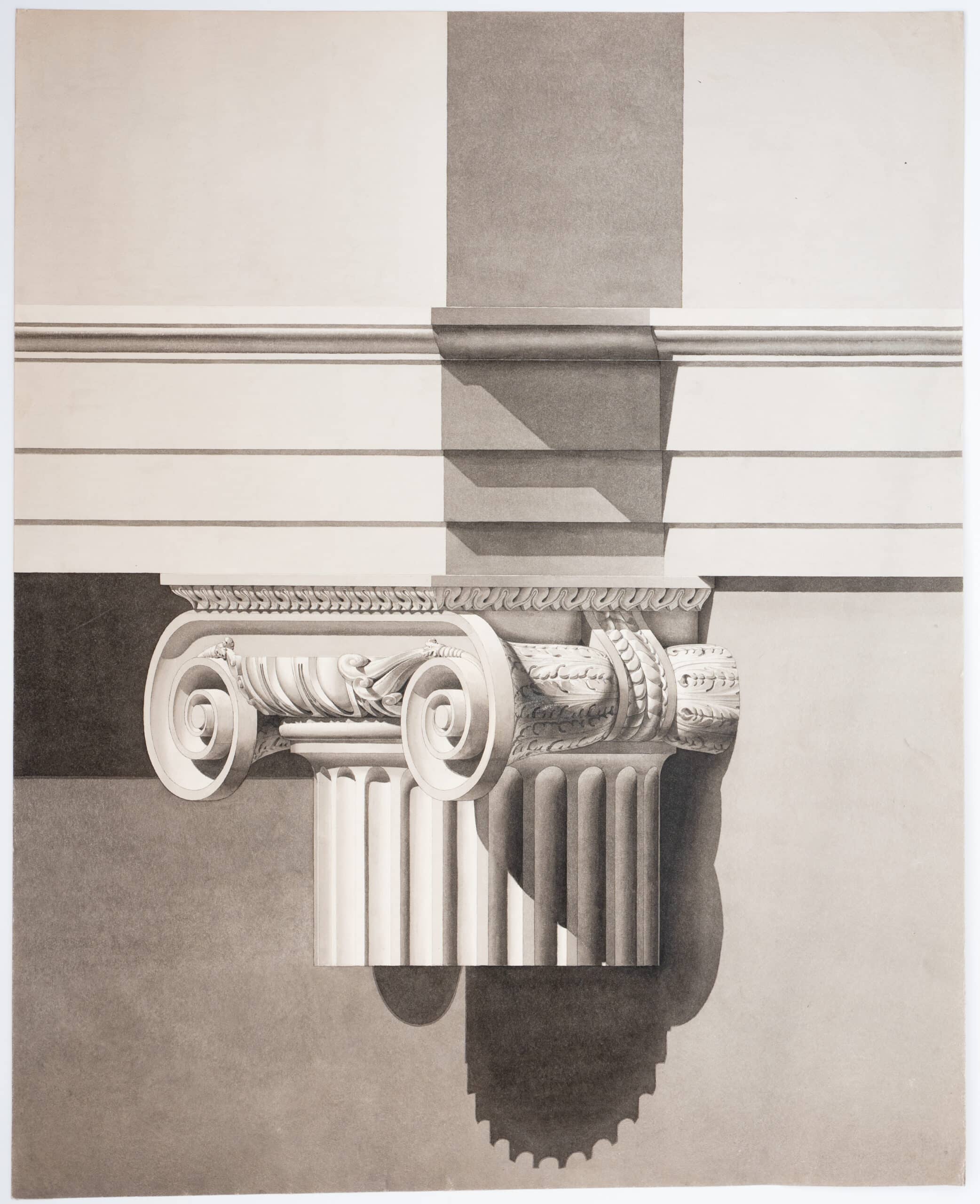
It is a curious drawing, one that exudes an almost Magritte-like aroma of the surreal—the kind that depends upon the rendering of a visual-conceptual oxymoron with an extreme degree of realism. The subject has something to do with this, an isolated Ionic capital cut off at the neck from its shaft, while continuing to support an entablature above. (The arrangement is reminiscent of didactic drawings from the treatises made to describe the elements of the orders. In this case the projection of the shadow on the wall below reiterates the typical horizontal section through a column shaft, albeit in a distorted way.) Rather than displaying the capital’s volutes in front elevation, the view has been rotated by what seems to be a little more than 45º—if it was 45º exactly, all the edges of the architectural elements at the corner above the capital would align. The rotation brings into view, and even emphasises, the merging of the intricately carved vegetal capital with the blank screen of the rear wall, perhaps even raising the idea that it is emerging from or disappearing into it.
Although catalogued as a ‘study perspective’, the view is an orthographic elevational study to which the rotation gives a twist in more ways than one. For it is this, and most importantly the handling of the shadows linked to it, that gives the drawing its great ambiguity. Looking at it, we are caught in a strange alternation of flatness and depth, in which the step in the wall that we see by virtue of our oblique view collapses and is in turn reasserted. The effect is as striking as the familiar optical illusion of the isometric cube, with its reversal of faces (now we seem to be above the cube and one face is to the front, and then we are below and the opposing comes forward). This, however, depends on the ‘wire-frame’ depiction of the cube, and any rendering—which would make the surfaces opaque and introduce shade—would be supposed to resolve the image by fastening down the depicted object. But with the drawing at which we are looking, the opposite seems to be the case. It is a curious effect—the introduction of shadows is intended to give increased definition to the object that is shown in the representation. This is the rationale given at the outset of Gaspard Monge’s ‘Théorie des ombres’, compiled from his papers and appended to later editions of his Géométrie descriptive.[1] Here, however, it is the vehicle through which the drawing seems almost wilfully pushed to a point of internal incommensurability, in which shadows become object-like, seeming to break free from the forms that cast them and to which they are supposed to be subservient.
The author of the drawing at which we’ve been looking, Henri Frédéric Vaucher, was born in Geneva on 14th August 1835 to François Ulrich Vaucher, an architect, and Joséphine Guédin, a marchande de nouveautés (seller of fabrics and women’s fashion accessories).[2] His birthplace was 74 Place de la Fusterie, an area of the city that had historically served as a timber port and place of manufacture but that, in the early 18th century, became the site of the Temple de la Fusterie designed by the architect and Huguenot refugee Jean Vennes. Based on the Huguenot temple in Charenton-le-Pont, Paris (by Salomon de Bross [1623]—it had been destroyed in 1686 in the wake of the revocation of the Edict of Nantes), it was the first church in Geneva specifically built for Calvinist worship. By 1856 we find Vaucher residing in Paris. On the 27th September that year, he was presented by the architect and atelier master Charles-Auguste Questel for the admissions examination to the architecture section of the École Impériale et Spéciale des Beaux-Arts.[3] He would enter the seconde classe—the first period of study, undertaken by all students—two and a half months later, on 12th December.
Vaucher evidently pursued his studies with success. The École’s official tabulation of his achievements records his passage through a series of assessments running from 24th April 1857 (perspective –médaille) to 9th December 1859 (architecture – 1er mention). 26 awards are recorded, and 5 medals. The final date of 9th December is also the one that heads a new sheet marking the student’s entry into the première classe, although thereafter the page is blank. It is Henri’s final appearance in the records of the École des Beaux-Arts.[4]
There are 18 drawings by Vaucher in Drawing Matter Collections, most of which can be attributed to his seconde classe studies. Interestingly, however, three—which are all ink wash drawings, rendered with shadows—are catalogued as c.1860. If the 1860 date is correct, might we be looking at drawings that Vaucher made when embarking on his studies in the première classe? And could it even be that these in some way contributed to his departure from the École?[5]
The drawing that we’ve been looking at is one of the three that is registered as c.1860. Let’s turn again to it and examine it more closely. The light falls, as was the convention, from the top left, as we quickly recognise from the regions of shadow that extend diagonally within the central mid-grey band that rises above the capital. Evidently this band registers a step in the plane of the wall surface, which produces the projection below which the capital shelters. When we look at the upper area of the drawing, above the horizontal line of the moulding, we see that this step, which itself seems to be in shadow, curiously does not then cast a shadow upon the wall surface to the right, which has returned to run parallel to the face of the capital’s volutes. This could only happen if the direction of light is such that it washes the section of the wall that steps back, grazing it at an extremely acute angle. This would account for the mid-grey tonality of the step, and also for the length of the shadows that extend from the overhanging elements within it. Imagining this in plan, we might think of the direction of light, still coming from the left, set up at the usual 45º, with the façade rotated some increments beyond that, as we’ve already observed. We can clearly see this if we look at the shadow cast by the column capital and neck on the wall behind. If the degree of rotation was the same as the angle of the light, so that the rays struck the wall planes at right angles, then the shadow would be symmetrical around a vertical axis. But it isn’t. It is because of the slight difference in rotation and angle of light that we find the shadow of the volute scroll that is closest to us merging into the shadow of the column upon the wall.
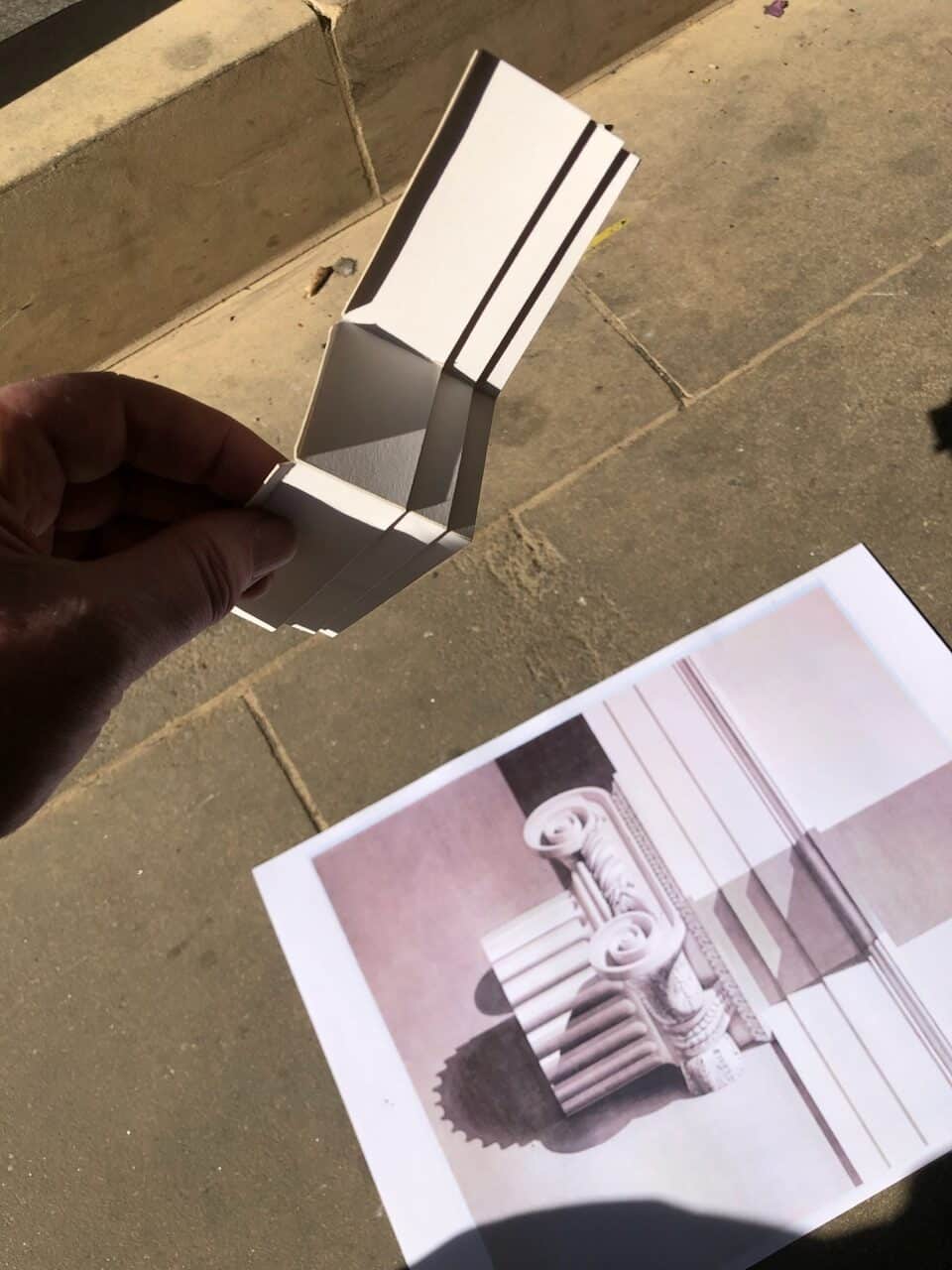
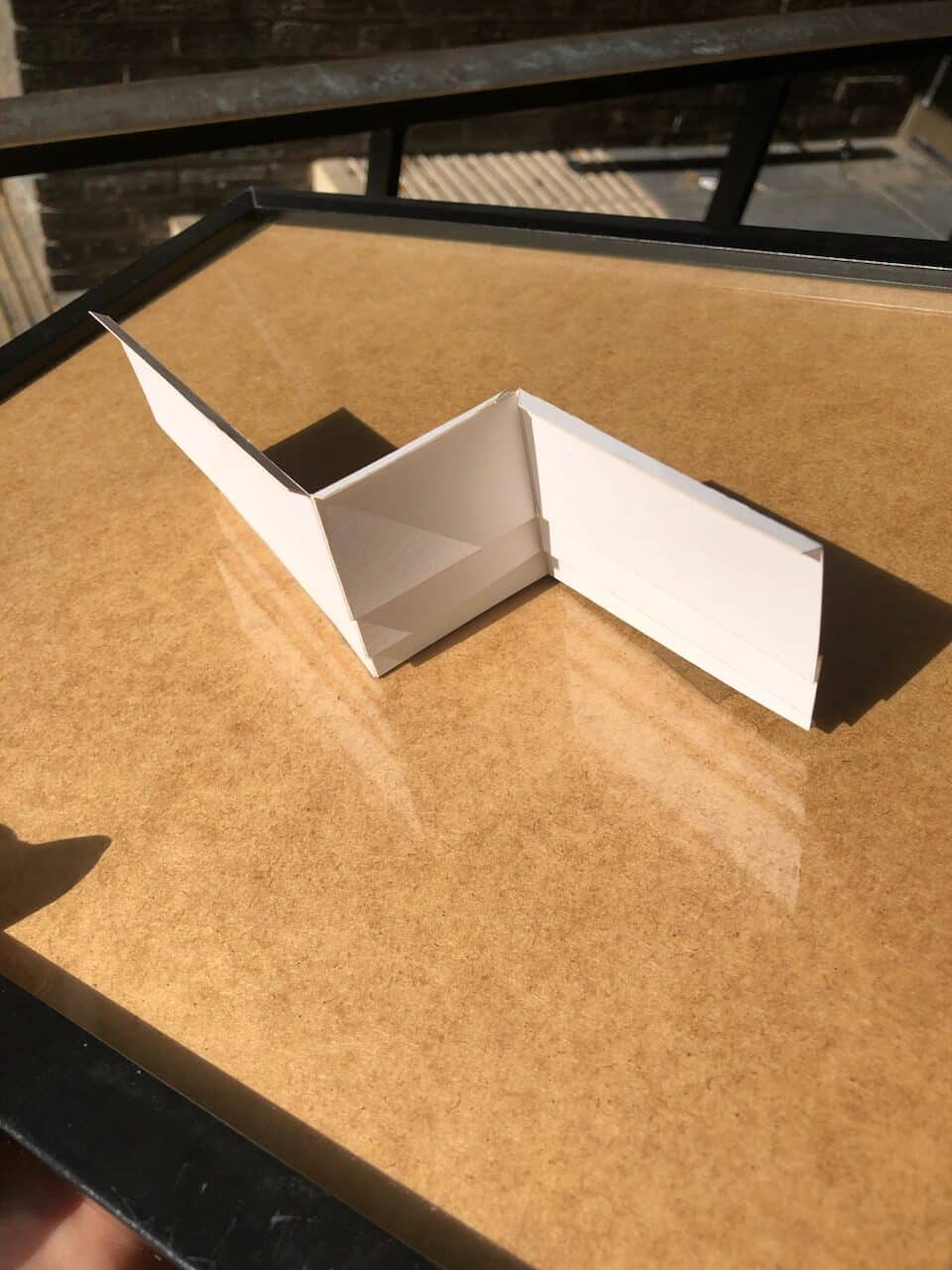
However, none of this resolves the strange shadowplay that is at work in the drawing, which really turns on the detailed handling of the shadows on the three fascia bands of the architrave, above the capital, and their relation to the cyma reversa moulding that runs on top. What is striking is the way that the three dark triangular shadows—which are rendered correctly given the orientation of the light[6]—insinuate themselves at the angle where the wall that steps back returns. In the context of the orthographic elevational drawing, these give the impression of levering the grey shaded band off the surface—an effect then intensified by the curious way that shadow seems to efface the detail of the horizontal cyma reversa as it passes over it. Taken together, these, more than anything else, give rise to the peculiar oscillation between depth and flatness that the drawing sets in motion, for they make the central grey band of shade appear as if it was not the outcome of light falling upon architectural surfaces but rather was like a fabric stretched over them, which might be liable to be rolled up and carried away, as when Peter Schlemihl sold his shadow to the strange grey man in the 1814 novella by Adelbert von Chamisso.
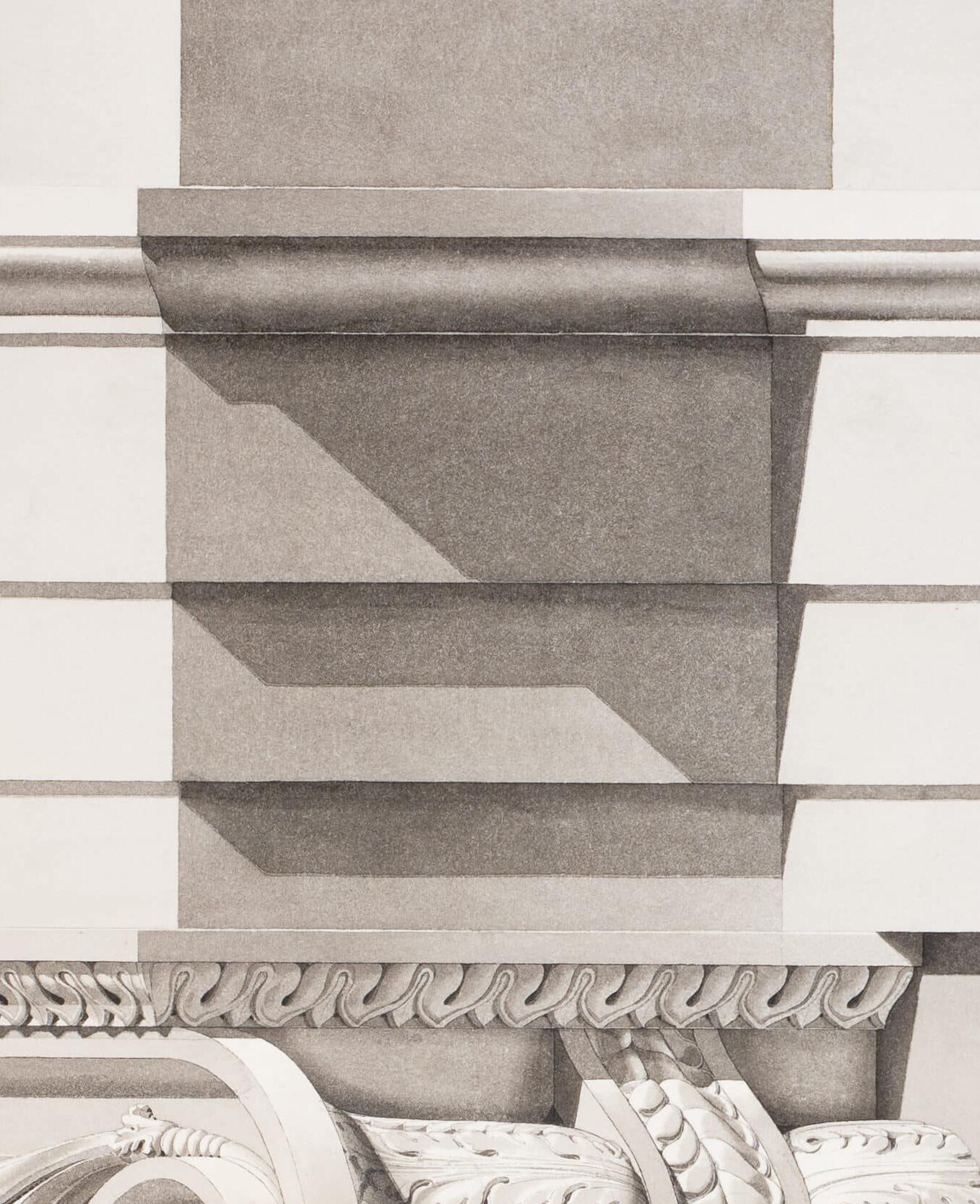
It may be that what we’re looking at here can be considered a kind of error, inasmuch as the shadows work to agitate the image rather than to stabilise it—an error occasioned by the complexities produced by the rotation of the façade in relation to the angle of light. And I suppose that because of this, if the date is correct, the drawing could have hastened Vaucher’s exit from his studies. At the same time, the 24-year-old Henri was clearly highly skilled, and I am struck by the sense of commitment to, and completion of, the drawing, whose peculiarities must have been evident at an early stage. Certainly, the effect produced by the handling of the shadows described above is genuinely weird. It’s true that the completion may have been rushed through in order to finish a given exercise within an allotted time, but we may think that there is more to be said.
Errors can be anticipatory because they give a glimpse of possibilities foreclosed by conventions. They also allow vantage points from which we can see with greater clarity how those conventions are constituted. László Moholy-Nagy, for example, built a theory around so- called ‘faulty’ photographs, valuing the way they stood outside historically transmitted norms of good pictorial composition and, in doing this, allowed the shock of the objectivizing power of the technical apparatus to be experienced.[7] It is the errant quality of the drawing at which we have been looking that gives it its strangely modern flavour. In it, shadows, the things that, in their subservience to form, are supposed to stabilise and disambiguate the image, flip over into their opposite to become agents of occultation rather than elucidation. Victor I Stoichita, writing on the distinction between reflections and shadows, has characterised the encounter with the shadow as persistently an encounter with alterity, and perhaps this is why the shadow has always been imagined to be liable to take on an uncanny life of its own, only contingently tied to the objects from which it derives.[8] This furrow has been ploughed in modernity in the work of Duchamp and many others.
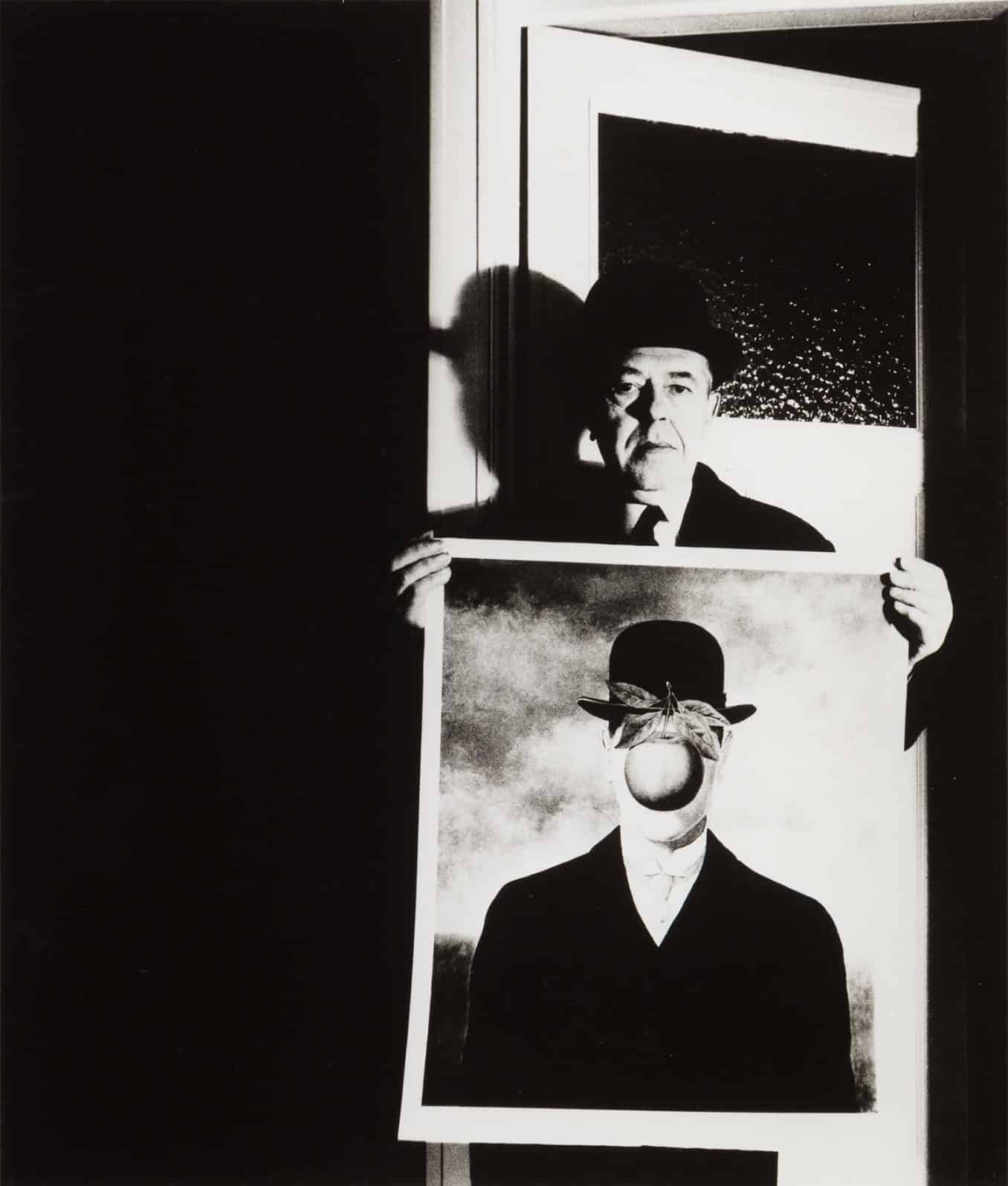
We have already mentioned René Magritte. There is a photograph of him taken in 1966 by Bill Brandt. The artist stands, facing the camera, at the threshold of an open door, holding his painting La Grande Guerre(1964).[9] The image sets up a sequence of frames—of the glass panel in the open door; the doorway itself; the picture that Magritte is holding; and finally, the photograph at which we are looking. To the three frames ‘within’ the image, three figures then correspond—the shadow that is cast upon the door, which stretches toward the expanse of darkness that blocks out the left-hand side of the photograph; the artist himself; and, finally, his life-size double in the painting, complete with bowler hat and suit. In Magritte’s painting the light comes from the top left, as we see from the shadow on the apple that obscures the man’s face. The lighting of the photograph, however, opposes this, entering strongly from a lower position and from the right, casting a shadow of Magritte’s head so that it seems to be drawn toward the reservoir of darkness. The brim of his hat has already merged with it. A tension is set up between the static frontality of Magritte’s pose, which is reiterated by the painted figure, and his shadow, which detaches and twists away from him as if departing.[10]
What in the end became of Henri Frédéric Vaucher? I know little of his story in the wake of his years at the École des Beaux-Arts. The biographical note prepared by Marie-Laure Crosnier Leconte tells me that he returned to Geneva, where he built a large part of the district of Bergues.[11] Its shadows await exploration.
Notes
- ‘Thus the direction of the rays of light being known, there is no need of two projections: one only, with the traces of shadows, will give a complete idea of the object under consideration; and if we have both the horizontal and vertical projections with the shadows constructed, these two projections will be more easy to read, and will show the object more readily, than if we only had the bare projections without shadows.’ J. F. Feather, M.A., An Elementary Treatise on Descriptive Geometry with a Theory of Shadows and of Perspective, Extracted from the French of G. Monge (London: John Weale, 1851), 89.
- The details of Vaucher’s birth and his studies are drawn from the documents presented at: Vaucher, Henri (14/08/1835–9/08/1896) <https://agorha.inha.fr/ark:/54721/bf567861-bb12-44c7-98ad-789de78eb68d> [accessed 13 March 2026].
- Questel’s atelier was notable for its relatively high numbers of Genevan students during the second half of the 1850s. David Ripoll, ‘Genève Francophile: L’architecture et la ville dans la deuxième moitié du XIXe siècle’, in Leïla el-Wakil and Pierre Vaisse, eds, Genève–Lyon–Paris: Relations artistiques, réseaux, influences, voyages (Genève: Georg, 2004), 107–114 (110).
- Although David Ripoll notes that only a few Genevan students passed from the seconde to the première classe, Vaucher seems to have been one of them, to judge from the drawings dated 1860 as noted below. Entry to the Prix de Rome was disallowed to non-French students. Ibid.
- The c.1860 date is derived from the sale catalogue. There is no date marked on the drawings themselves. Four drawings by Vaucher were auctioned on 19 September 2025, which concern a project for a building for the Faculté des sciences. One of these is a page with sketch plans, an elevation and section, which is stamped and dated 1er Mai 1860, and signed ‘H Vaucher, eleve de M Questel’. <https://www.gazette-drouot.com/lots/30337584-attribue-a-henri-frederic—> [accessed 13 March 2026].
- I’m grateful to Nat Chard for pointing this out to me.
- See the discussion in Mark Dorrian, ‘Adventures on the Vertical: From the New Vision to Powers of Ten’, in Writing on the Image: Architecture, the City and the Politics of Representation (London: IB Tauris, 2015), 61–77 (63–64); and Mark Dorrian, ‘Around the New Vision’, in The Aerial Turn, ed. by Matteo Vegetti (Mendrisio Academy Press / Silvana Editoriale, 2025), 12–25 (16–19).<https://susi.usi.ch/usi/documents/332603>[accessed 13 March 2026].
- ‘… the mirror stage involves primarily the identification of the I, whereas the shadow stage involves mainly the identification of the other’. Victor I Stoichita, A Short History of the Shadow (London: Reaktion Books, 1997), 31.
- René Magritte with his painting The Great War, Brussels <https://emuseum.mfah.org/objects/61006/rene-magritte-with-his-painting-the-great-war-brussels;jsessionid=83F735223CA6A43507623FE475CDF3E1> [accessed 13 March 2026].
- Stoichita observes: ‘The frontal relationship with the mirror is the relationship with the same, just as the relationship with the profile was a relationship with the other’ (Stoichita, 41). The two images (painting and shadow), between which Magritte’s body is positioned, seem to dramatize this opposition between (frontal) reflection and (oblique) shadow.
- Vaucher, Henri (14/08/1835–29/08/1896) <https://agorha.inha.fr/ark:/54721/bf567861-bb12-44c7-98ad-789de78eb68d> [accessed 13 March 2026].
*
Mark Dorrian is Editor-in-Chief of Drawing Matter Journal, holds the Forbes Chair in Architecture at the University of Edinburgh, and is Co-Director of the practice Metis. His work spans topics in architecture and urbanism, art history and theory, and media studies. Dorrian’s books include Writing On The Image: Architecture, the City and the Politics of Representation (2015), and the co-edited volume Seeing From Above: The Aerial View in Visual Culture (2013).
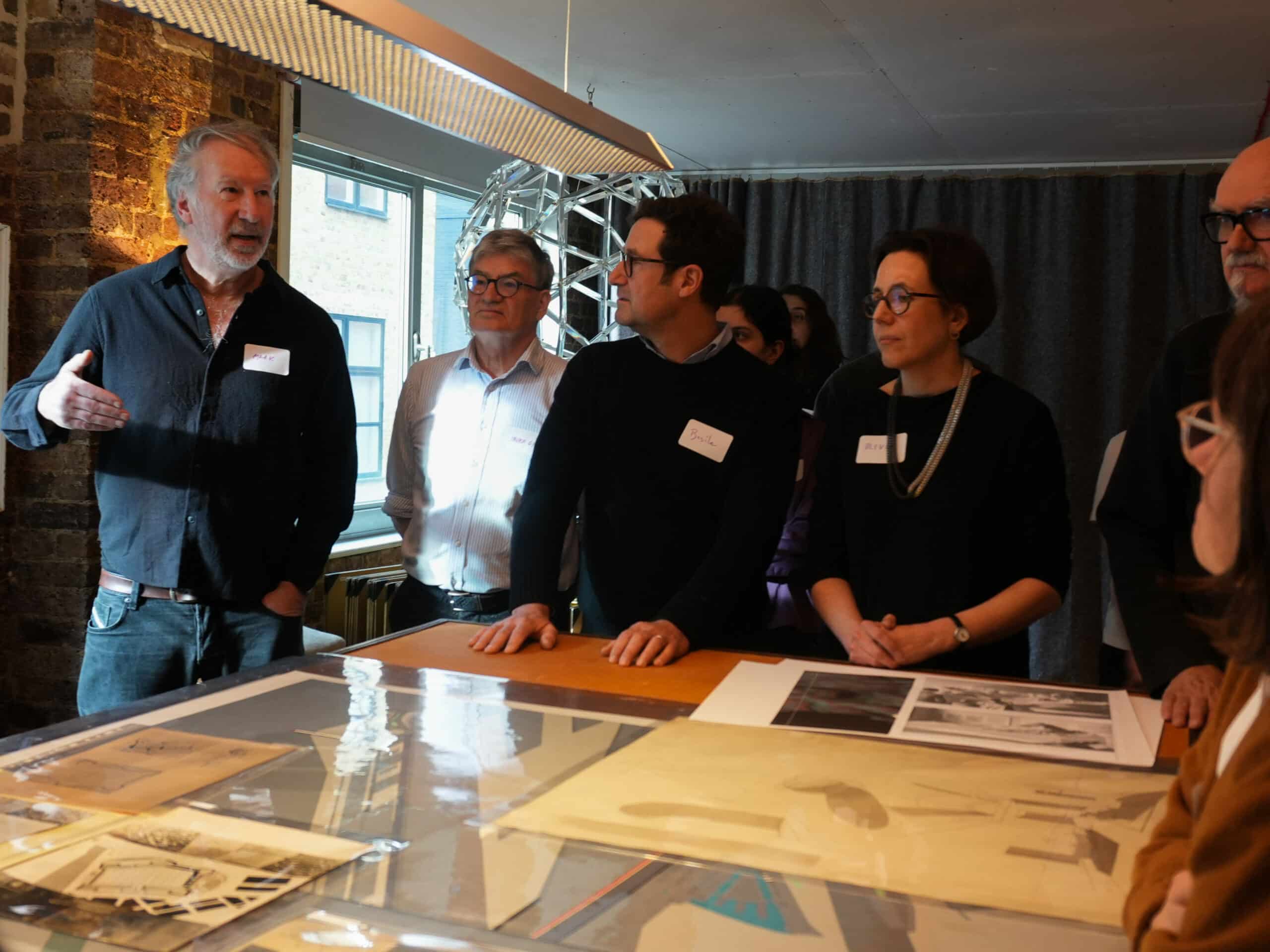
This text offers an insight into Mark Dorrian’s contribution in the third colloquium event ‘Tracing Shadows’ led by Dorrian and hosted by the RIBA, V&A Drawings Collections and Drawing Matter in January 2026—a day of conversations, gathered around original drawings and photographs, in which participants examined the presence (and absence) of shadows in the representation of architecture.
