Viollet-le-Duc: Drawing Worlds
In his Postscript to The Name of the Rose, Umberto Eco describes the first hundred pages of his bestselling 1980 novel as a form of penance, ‘for the purpose of constructing a reader suitable for what comes afterwards.’[1] Beyond creating an easy heuristic for who should or should not descend further into the world of his medievalist detective fiction, Eco’s goal, like the nineteenth-century author Alessandro Manzoni’s before him, was ‘to create a public who could not help liking his novel.’[2]
*
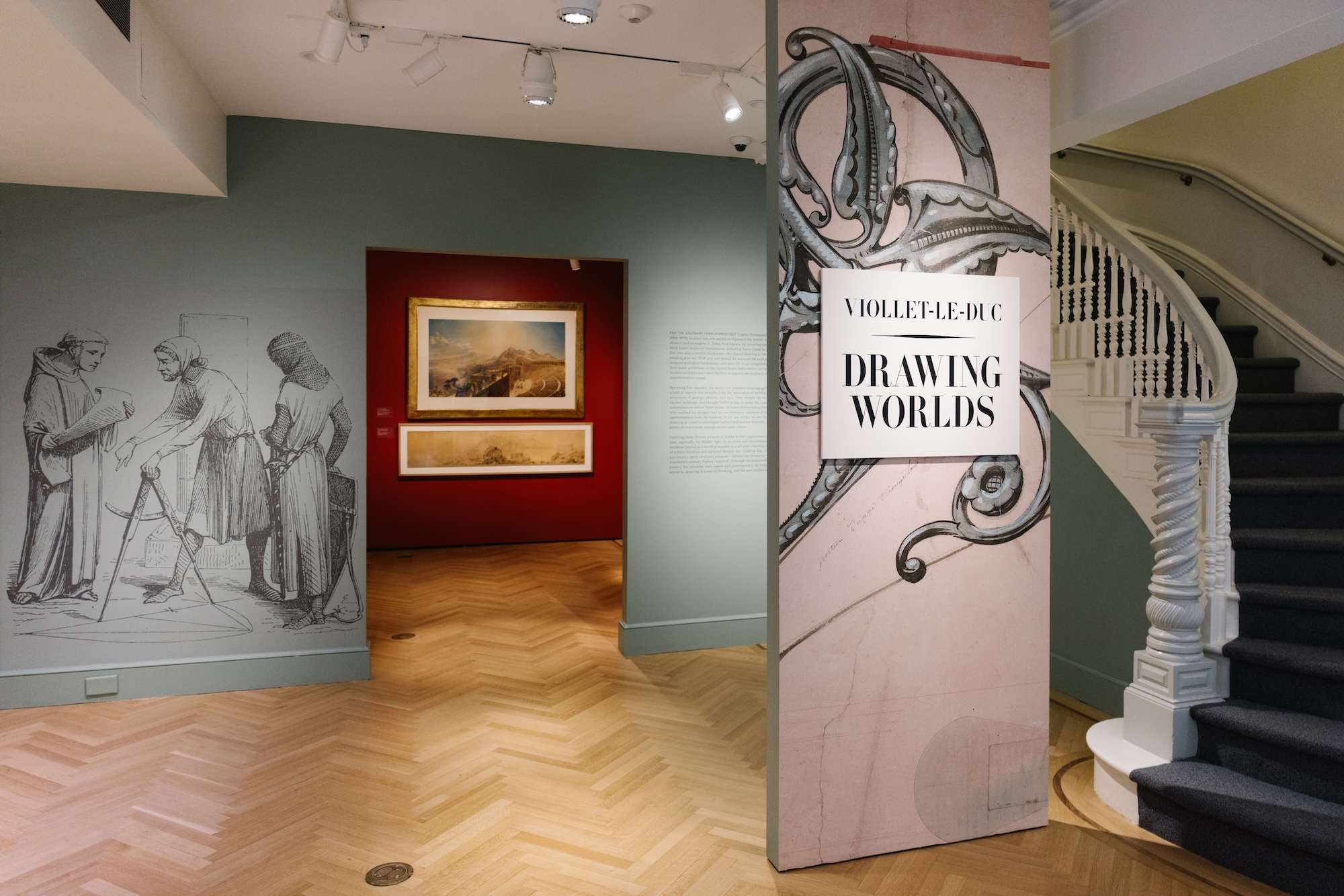
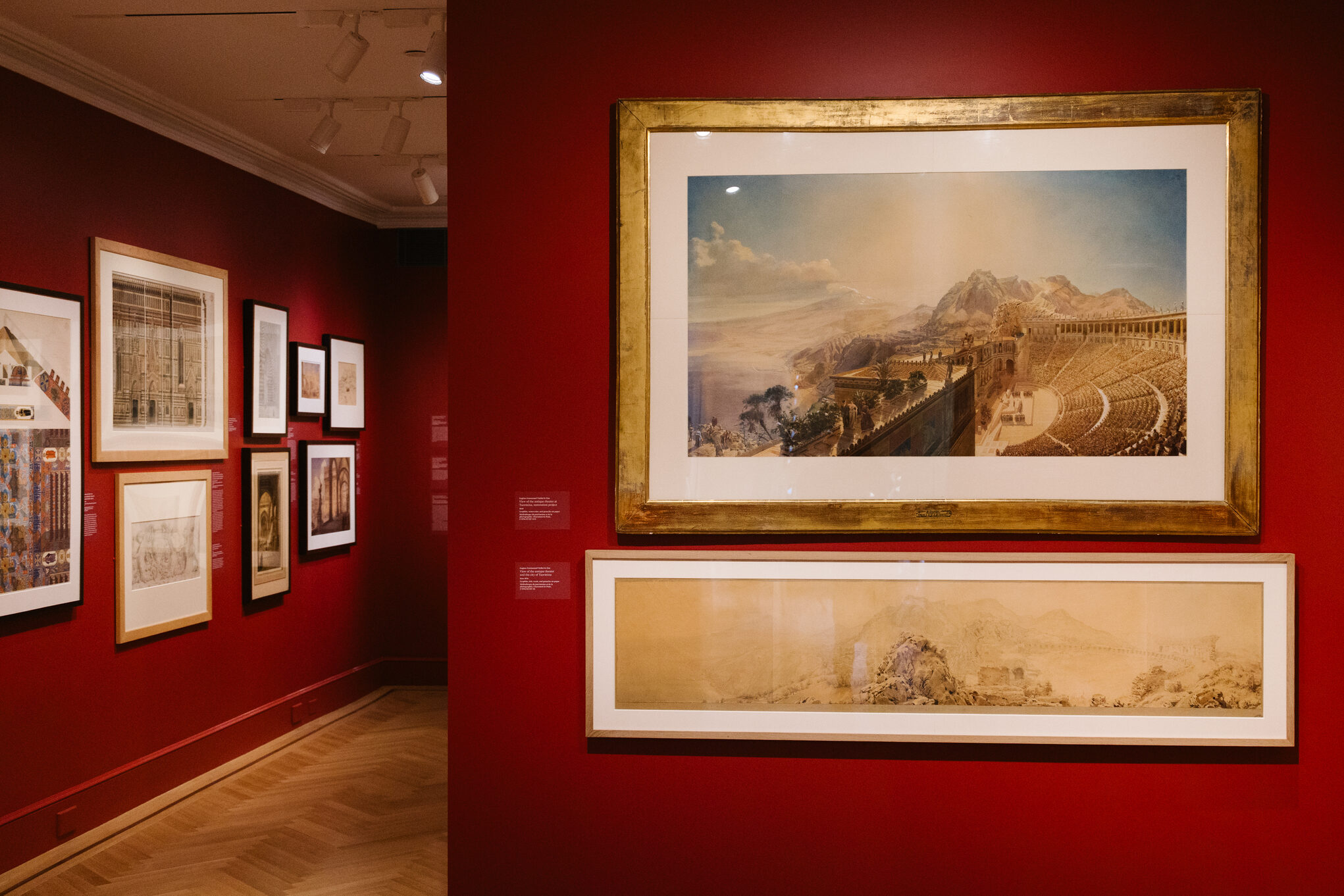
The exhibition Viollet-le-Duc: Drawing Worlds, which was on display at the Bard Graduate Center in New York from January to May 2026, constructed its own ideal viewer as it explored the role of drawing for the French nineteenth-century architect best known for his reconstructions of the town of Carcassonne, the cathedral of Notre-Dame-de-Paris, the abbey church of Vézelay, and many other historic monuments. The first room is pleasurable, not penitential: upon entering the exhibition, viewers were greeted by what is arguably Eugène-Emmanuel Viollet-le-Duc’s most famous drawing, his enormous watercolour reconstruction of the theatre at Taormina in Sicily. Exhibited at the Salon of 1840, it was produced from sketches made during his 1836–37 journey to Italy. The drawing balances the drama of reimagined ancient architecture with an otherworldly landscape, thereby combining subjects which would fascinate Viollet-le-Duc throughout his life. One could spend hours staring at its rich details and provocative colours. The sense of the past brought to three-dimensional life on a flat surface is inescapable and magnetic. This capacity for historical reanimation through the medium of drawing drove Viollet-le-Duc’s engagement with the past, the present, and the future.
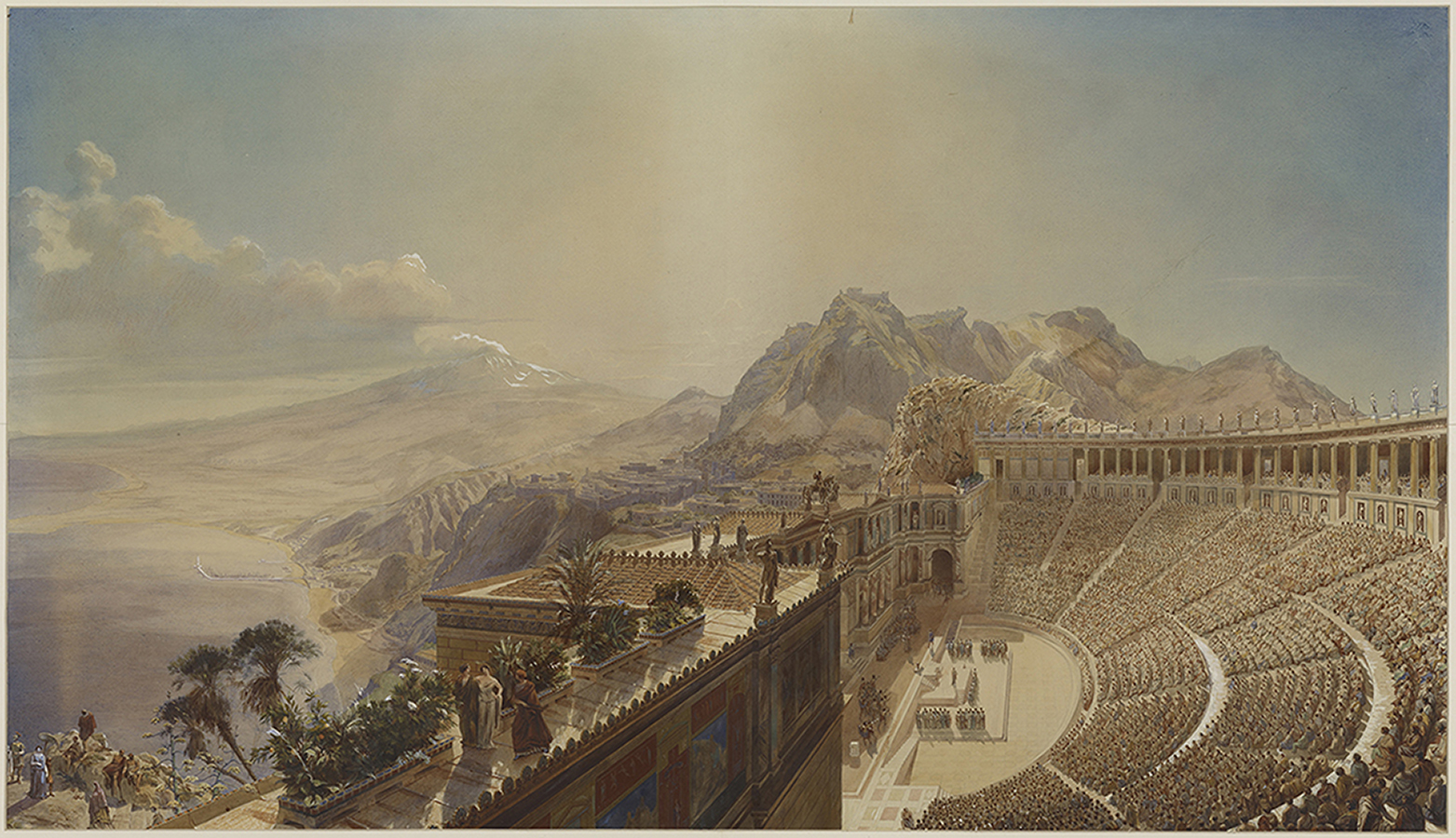
To gaze upon this finely detailed drawing measuring 750 × 1295 mm is to partake in a double fiction. The first is theatrical and quite evident: Viollet-le-Duc has depicted the theatre full to the brim as Aeschylus’s Eumenides is performed on stage. He often staffed his drawings with personages in historical garb. Clearly, this scene is imagined, a world of human relations reanimated within its architectural and geological surrounds. Yet this surround is equally, if more subtly, fictive. As Bérénice Gaussuin notes in the rich catalogue accompanying the exhibition, it is impossible to glimpse both the Ionian Sea (which fills the left-hand side of Viollet-le-Duc’s watercolour) and the theatre from his chosen viewpoint. Gaussuin correctly links Viollet-le-Duc’s pictorial decision to distort the Taormina landscape for dramatic effect with his later theory of historic restoration, which aimed to raise a monument to an idealised state, ‘which may in fact never have existed.’[3]
Curated by Barry Bergdoll of Columbia University and Martin Bressani of McGill University—both leading historians of nineteenth-century historicist architecture and the psycho-social worlds which produced it—Drawing Worlds probed the role of drawing within Viollet-le-Duc’s restorative project. The breadth of drawing types exhibited was remarkable, spanning from construction documents to in-situ sketches, picturesque restorations to ornamental details. While only a slender portion of his graphic output could be included, Drawing Worlds made clear the extent to which drawing was a compulsion for Viollet-le-Duc, whose late motto was Nulla dies sine linea (No day without a line). Taken together in the Bard’s beautiful galleries on New York’s Upper West Side, the exhibited works provoked a sense of immersive joy. To draw is to live, and to draw is to breathe life into form.
Drawings such as the Taormina watercolour, Viollet-le-Duc’s earlier contributions to the Voyages pittoresques, as well as other romantic drawings, were explained in the ground-floor gallery as a painterly rebuke to the orthogonal representations favoured—in fact, required—of architecture students at the École-des-Beaux-Arts, an institution which Viollet-le-Duc eschewed. Ultimately, the distinctions between Viollet-le-Duc’s drawings and those of contemporaries such as Henri Labrouste and Léon Vaudoyer hinge on the matter of analytic accuracy: the latter’s drawings fetishise it, while the former’s transcend it.
The exhibition’s second floor was dedicated to Viollet-le-Duc’s long years at work on the restoration of Notre-Dame-de-Paris. While its origins are medieval, the Notre-Dame which is known to us today—and which was lovingly restored following the 2019 fire—was a project of nineteenth-century minds and media: Viollet-le-Duc, his collaborator Jean-Baptiste Lassus, and Victor Hugo, whose eponymous novel helped create a groundswell of public opinion demanding the cathedral’s restoration. We see the 1843 competition drawings submitted by Lassus and Viollet-le-Duc, which show their scrupulous approach to the restoration. These careful studies were aided by the purchase of daguerreotypes, the earliest recorded use of photography in architectural practice.
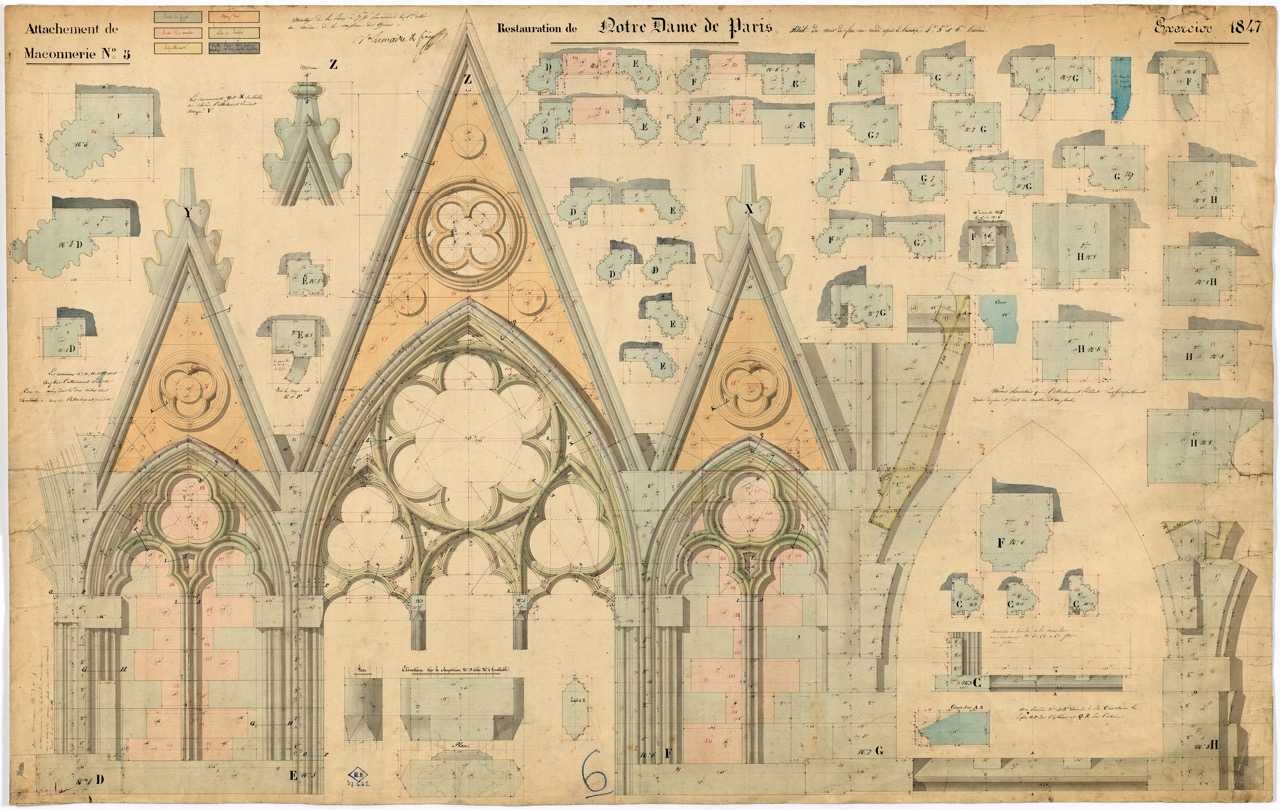
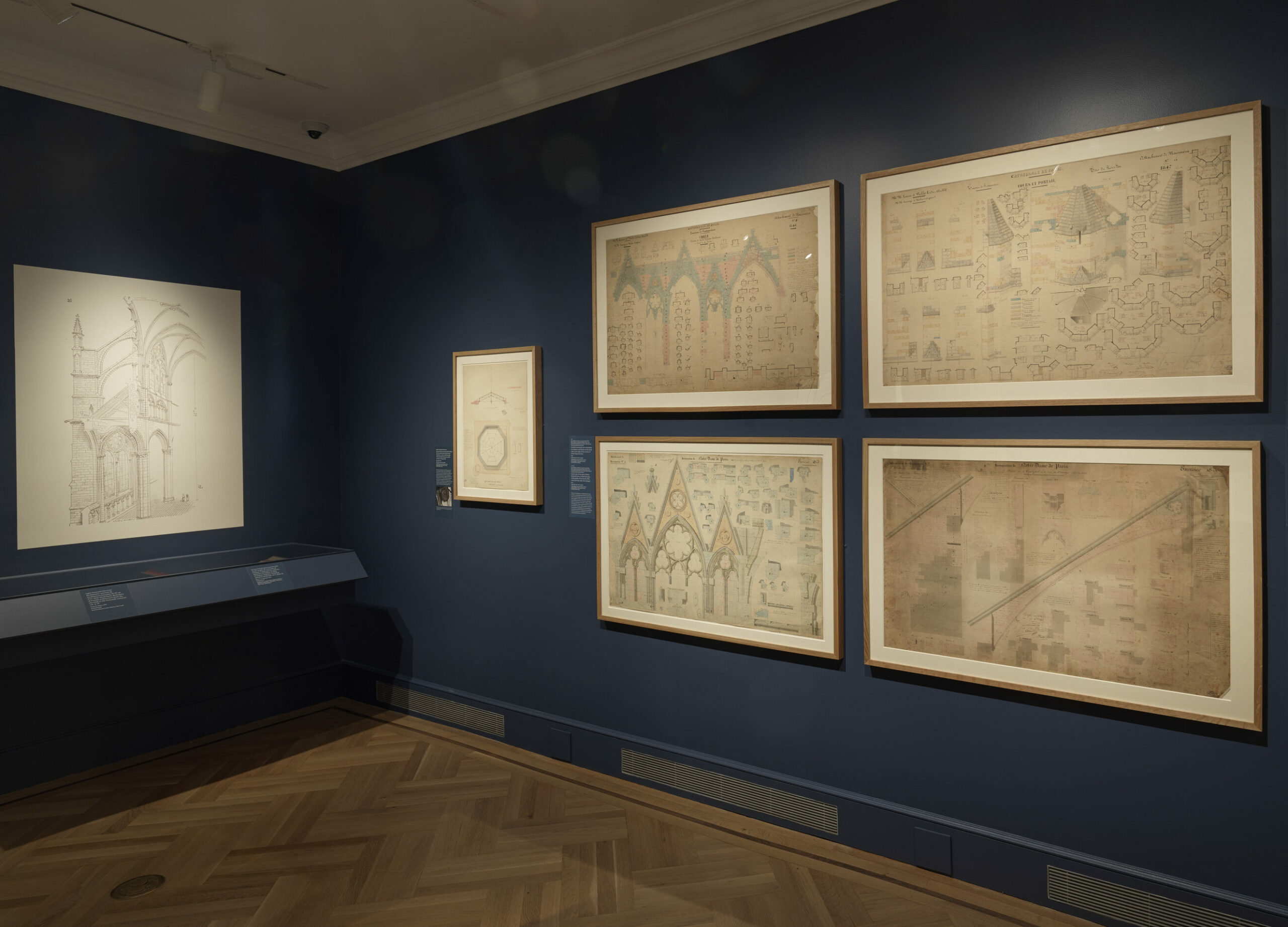
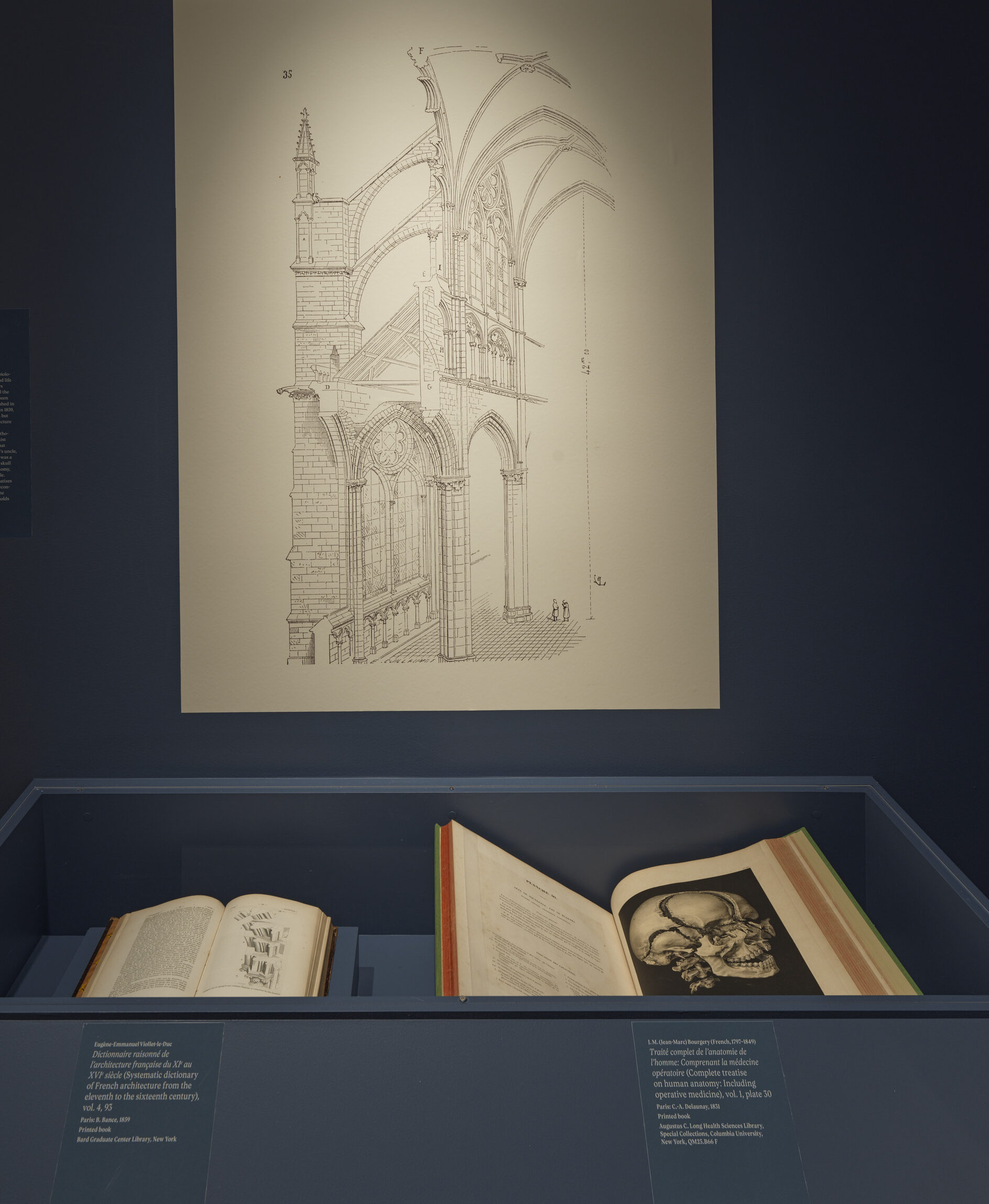
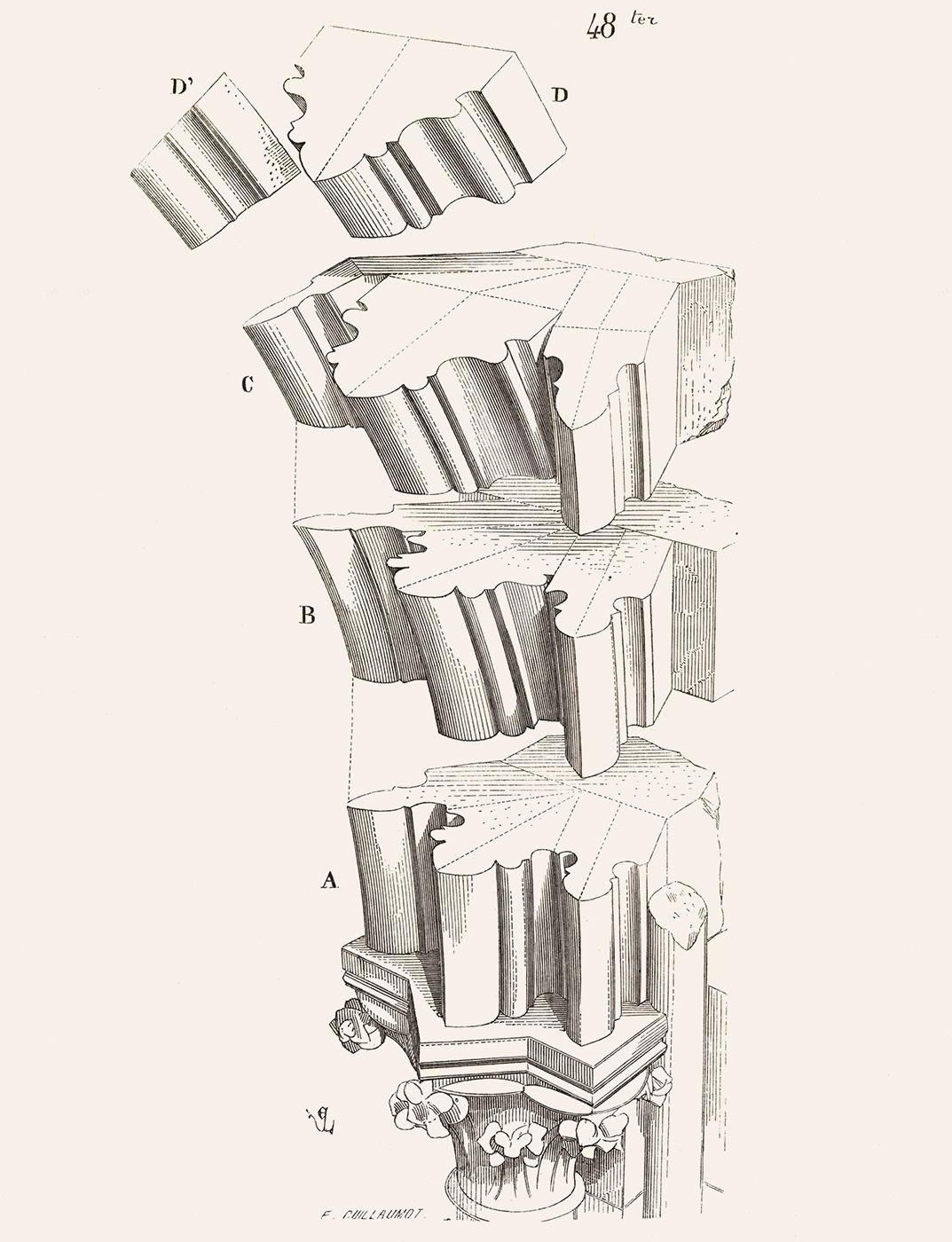
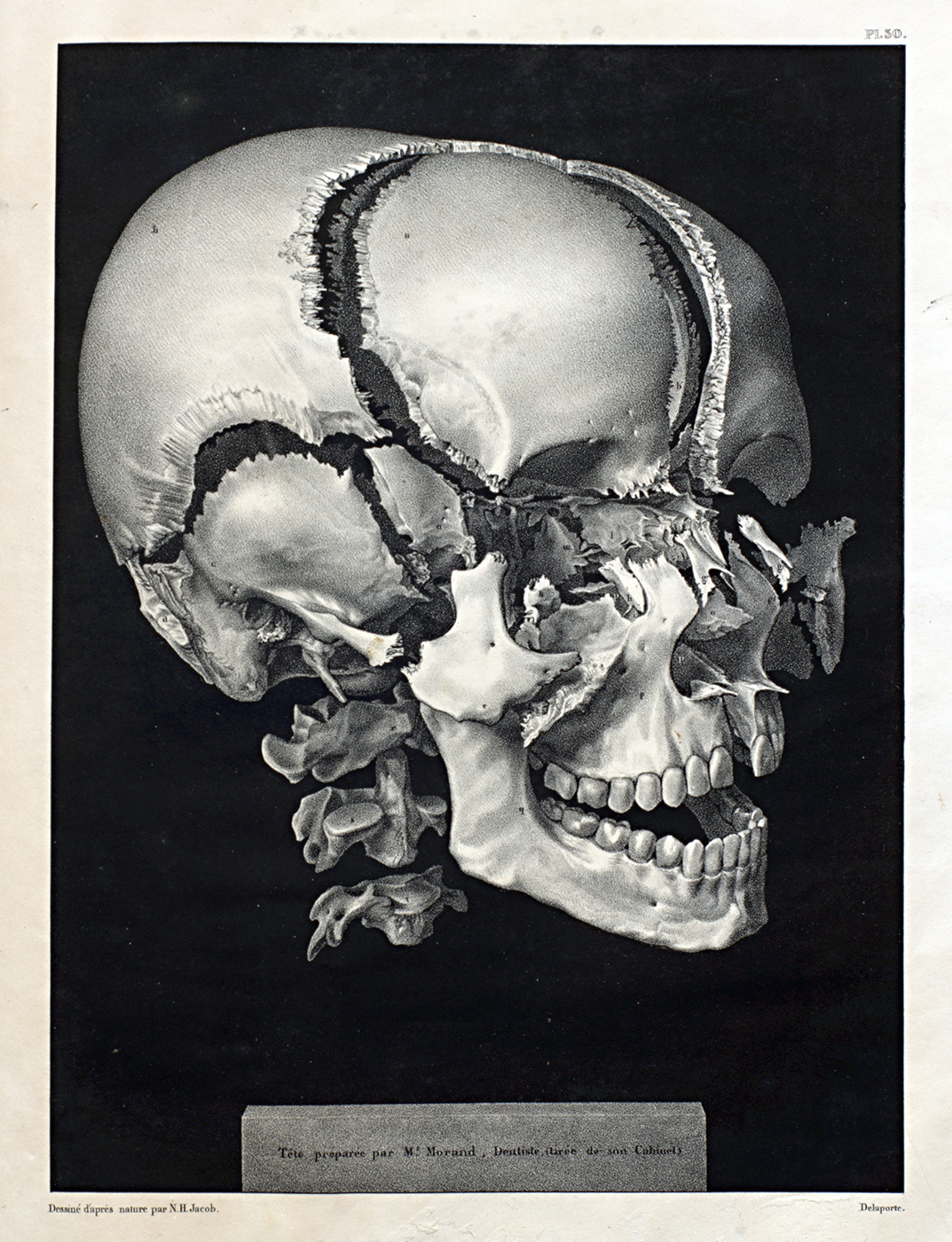
Among the multitude of materials in the Notre-Dame galleries, two drawings stood out. The first is an attachement, a technical drawing made to document the precise cutting of each stone for the restoration of windows and niches on a choir aisle in the sacristy. The utility of such drawings, which were meant to coordinate efforts between architects, stonecutters, and masons, persists to this day, because they tell us which stones were replaced during Viollet-le-Duc and Lassus’s campaign. Not meant for public exhibition, the attachements nevertheless make a spectacle of the very stones which make up the organic unity of Gothic structure. Elsewhere in the exhibition, the famous exploded axonometric of the springing point of an arch from Viollet-le-Duc’s Dictionnaire raisonné is juxtaposed with Jean-Baptiste Marc Bourgéry’s earlier exploded view of a skull. Bressani has often emphasised the connection between the two. As with the attachement, the viewer is able to infer the structural dynamism which will animate the Gothic cathedral through the medium of drawing.
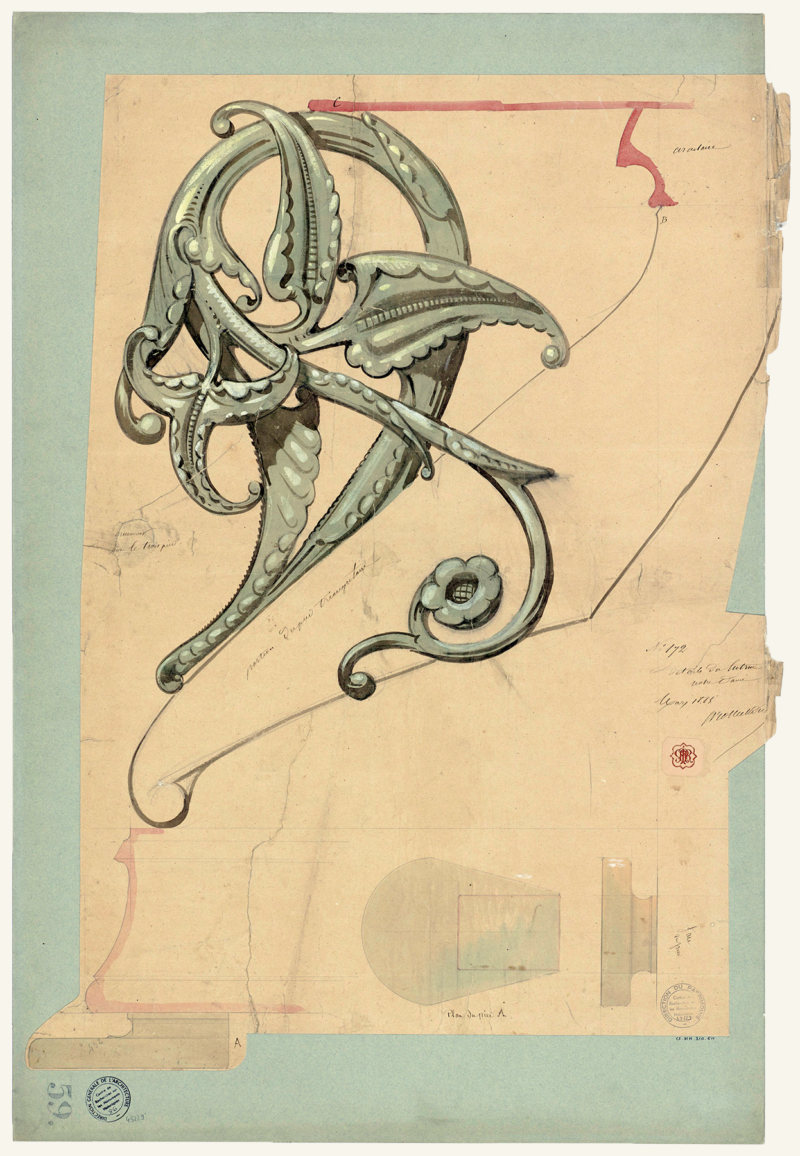
The second is a partial elevation of the base of the cathedral’s great lectern. A snake-like work of wrought iron appears to have been brought to life and forged through the sinuous curves drawn by Viollet-le-Duc’s hand. Here even the most sceptical viewer must believe in drawing’s instantiating power. Animal and floral motifs (perhaps anticipating Hector Guimard’s ironwork for the Parisian Métro in a later generation?) may seem a bizarre choice for a piece of religious furniture. Still, like Notre-Dame’s famous gargoyles, they belong to an altogether different register of anima.
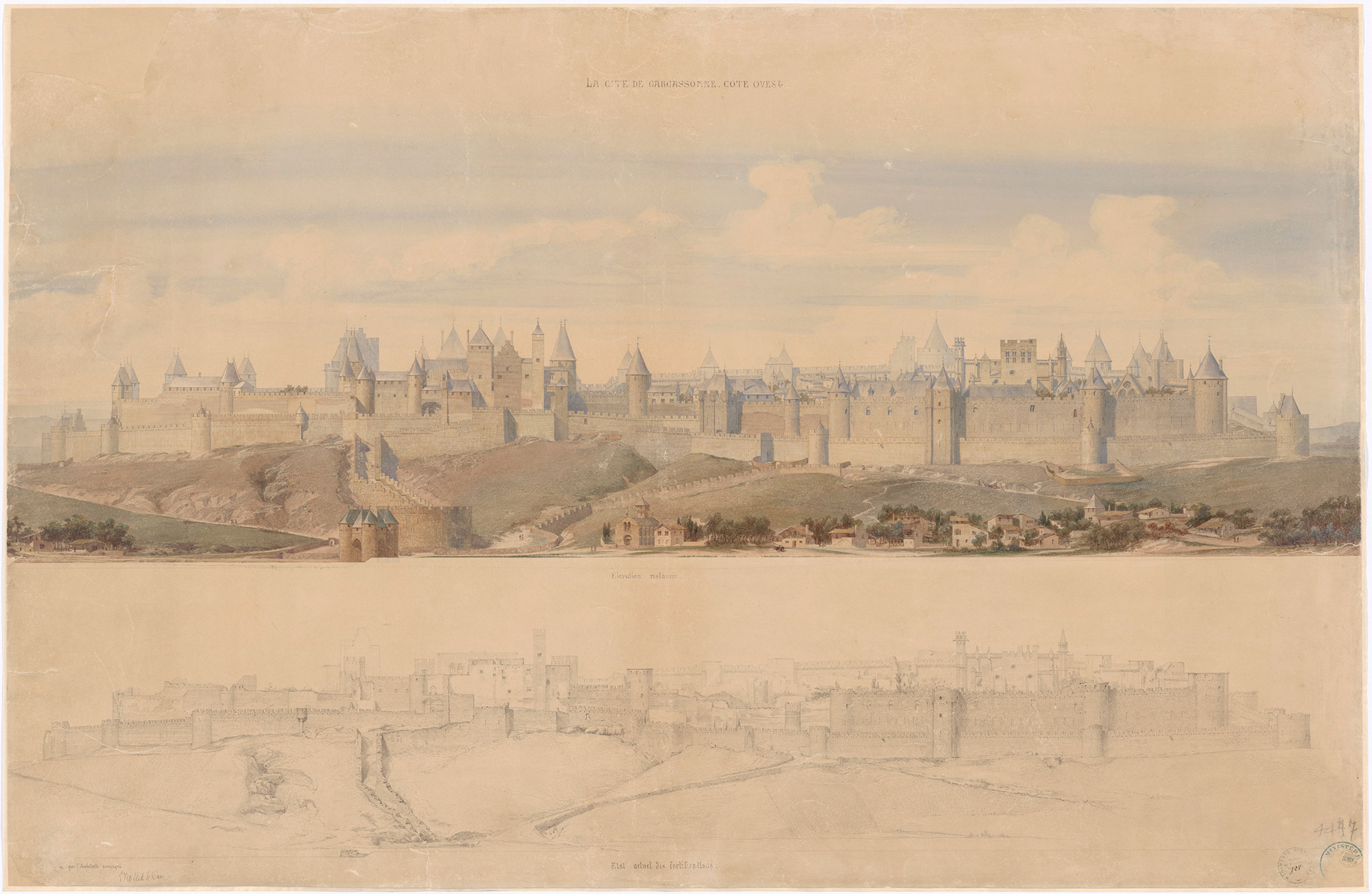
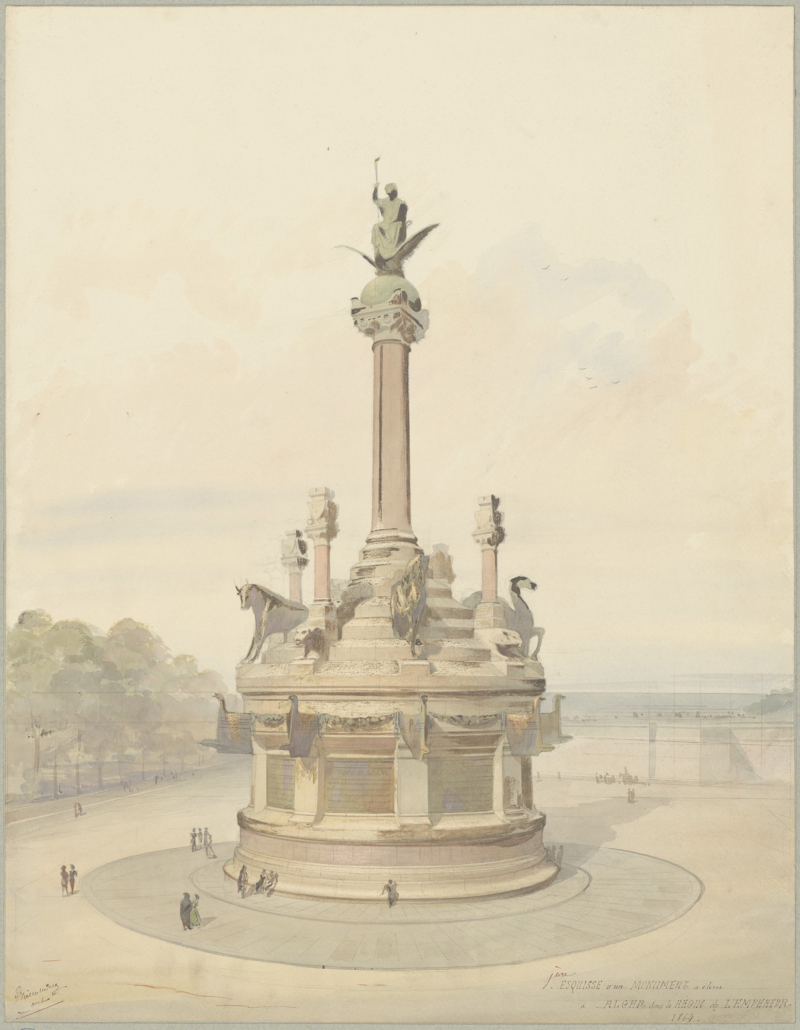
The exhibition’s third floor explored two creative forces—each external to architecture—which preoccupied Viollet-le-Duc: war and geology. In considering the first, Bergdoll and Bressani gathered a heterodox series of drawings from across Viollet-le-Duc’s oeuvre: the restorations of Carcassonne and the Chateau de Pierrefonds, and an unbuilt monument to the French conquest of Algeria. All are linked by a martial spirit and tinged with Bonapartist adventurism; for Viollet-le-Duc, war was a crucible for national renewal. The 1864 Algiers scheme celebrated French colonialism and the purportedly benevolent civilising mission undergirding it. Around the base, wild beasts are shown driven out by domesticated farm animals, while a red column rises skywards crowned by an allegory of France. The design bears comparison with other assertions of French imperialism in Algeria, such as Jean-Eugène Fromageau’s basilica of Notre-Dame-d’Afrique, and Paul Landowski’s Le Pavois memorial to Algerian dead of the First World War.
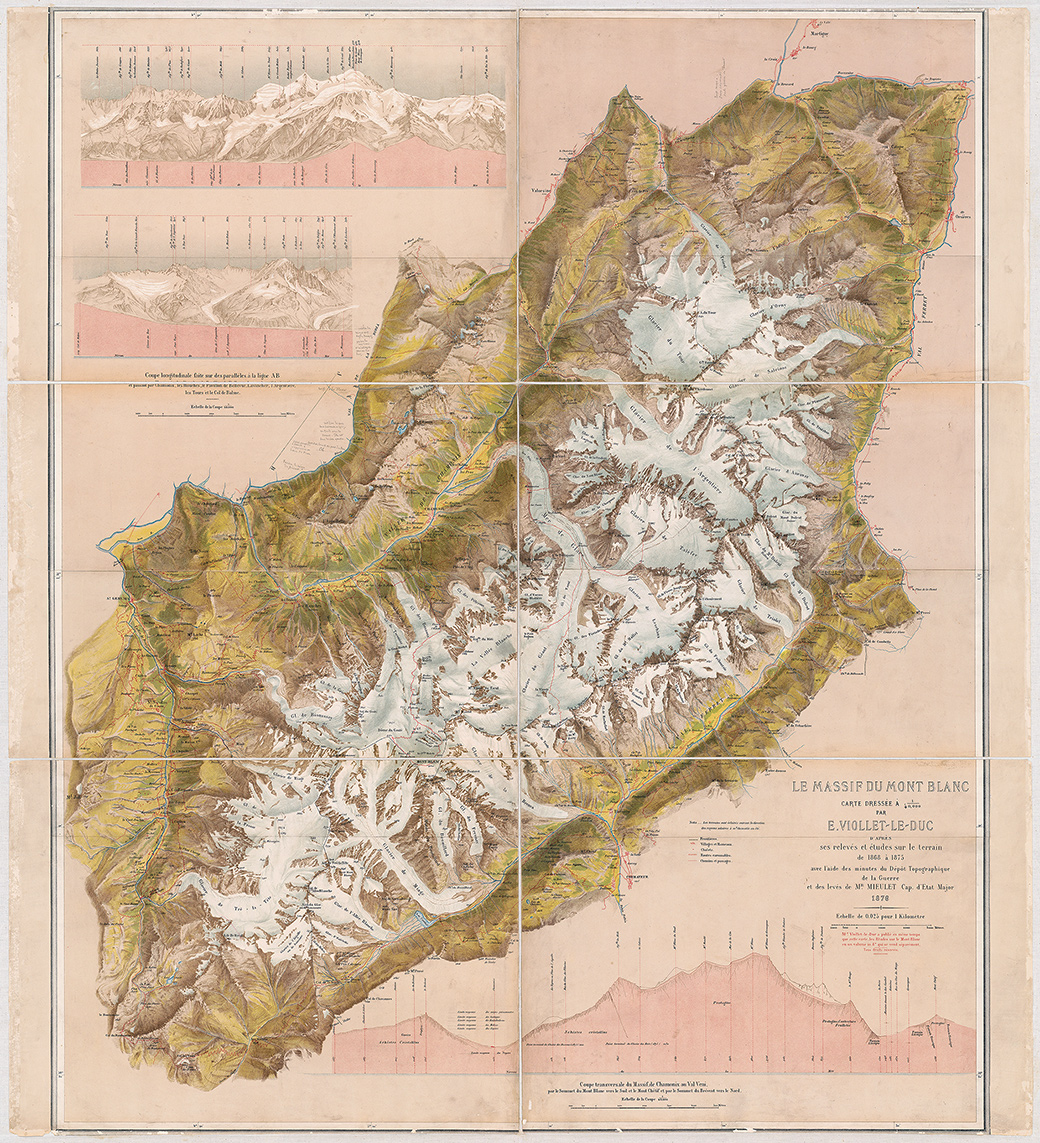
The débâcle of 1870–71 sent the Emperor Napoléon III, whom Viollet-le-Duc had faithfully served, into exile and caused the architect to devote his final decade to carefully drawing the effects of the geological forces which had shaped the French Alps. Order and chaos, destruction and renewal, these were the dramatic forces Viollet-le-Duc sought to represent and harness through meticulous drawing. A stunning chromolithograph map of the Mont-Blanc massif reveals his obsessive compunction for precise observation and novel representation.
Recently, the racial (and often racist) theories of nineteenth-century figures such as Viollet-le-Duc have come under welcome and much-needed scrutiny. An entire chapter in Architecture and the Historical Imagination, Bressani’s definitive account of Viollet-le-Duc’s all-consuming vision of restoration, is devoted to the subject.[4] The exhibition does the same, presenting drawings which showcase Viollet-le-Duc’s own disturbing constructions linking human physiognomy and national styles of architecture.
*
As a historian, my own interpretation of the nineteenth century has been shaped by Bergdoll and Bressani. The latter’s influence on my own career has been enormous, beginning with my days as an undergraduate student at McGill and continuing to the present. Through his writings, his lectures, and our conversations, he has shaped my view of the nineteenth century. In answer to his query when we toured the exhibition together: ‘Well, what do you think?’ I could not help but answer—as Eco’s ideal reader would—‘I love it. But of course I would!’
And yet, my own essay occupies an uneasy if—I hope—productive place in the publication accompanying the exhibition. At no point in ‘Medium, Media, Mediation: Viollet-le-Duc’s Graphic Techniques’ do I contradict the exhibition’s central theme, that drawing offered a unique form of communication, one which enabled Viollet-le-Duc to forge ‘a quasi-mystical connection with the medieval past.’[5] Yet for all his supreme talent with the pencil, Viollet-le-Duc sometimes called upon instrumental forms of mediation to produce his supremely detailed drawings; in particular, he occasionally made use of the camera lucida and photographs. Why he would do so has preoccupied me since my first steps as a historian.
Viollet-le-Duc certainly did not need instruments such as the camera lucida to produce accurate and detailed drawings. In fact, he believed such devices were well-nigh useless for users not properly trained and skilled in drawing: Paradoxically, ‘[T]o draw well with the camera lucida, one must know how to use a pencil.’[6] Where the camera lucida was likely useful for Viollet-le-Duc was a labour-saving device;[7] this was the conjecture of his collaborator and disciple Claude Sauvageot, whose Viollet-le-Duc et son oeuvre dessiné (1880) remains the best primary source on Viollet-le-Duc’s graphic oeuvre. Drawing Worlds featured drawings made with a téléiconographe, an optical instrument which combined a camera lucida and a telescope. Viollet-le-Duc had praised this invention and made use of it for his late-career studies of the Mont-Blanc massif.
The greatest value provided by mechanical aids to Viollet-le-Duc was in fact discursive. Photographs allowed Viollet-le-Duc to write about monuments in the Yucutan and Russia, which he himself had never seen in person. The camera lucida and photography offered an analogy by which to explain and praise the accuracy of the French master’s freehand drawings. Furthermore, these devices allowed him to appeal to the ‘truth value’ embedded within media such as photography and plaster casting, and instruments such as the camera lucida, as a means of parrying claims that Viollet-le-Duc’s restorations were false. In an oft-quoted passage from his Dictionnaire raisonné, Viollet-le-Duc praised photography’s documentary usefulness and role in forcing architects to pay attention to the details of the buildings they were restoring. Moreso, photography provided architects ‘with a permanent justification for the restoration work they carry out.’[8]
For Viollet-le-Duc, photography played a mediumistic role—in the spiritualist sense—encyclopaedically transferring a monument’s spirit to the mind of the architect, who would then produce an idealised restoration. Additionally, it provided proof that such a transfer had in fact occurred.
Comparisons between Umberto Eco and Viollet-le-Duc as conjurors of medieval worlds must necessarily seem forced: the former’s facility with postmodern semiotics made him well aware of the gulf between then and now; it was in this gap that The Name of the Rose took flight and caught the popular imagination. Viollet-le-Duc’s life’s work sought to bridge this chasm, to restore a temporal and architectural unity lost over centuries and in moments of violence and rupture, such as the French Revolution. Even more than building or publishing, drawing was his means for doing so.
Notes
- See Umberto Eco, ‘Constructing the Reader,’ in Postscript to The Name of the Rose, trans. by William Weaver (San Diego: Harcourt Brace Jovanovich, 1984), 48.
- Ibid., 50.
- Eugène-Emmanuel Viollet-le-Duc, ‘Restoration’, in The Foundations of Architecture: Selections from the Dictionnaire raisonné, trans. by Kenneth D. Whitehead (New York: George Braziller, 1990), 195.
- Martin Bressani, ‘Instinct and Race,’ in Architecture and the Historical Imagination: Eugène-Emmanuel Viollet-le-Duc, 1814–1879 (Farnham, UK: Ashgate, 2014), 333–79.
- Peter Sealy, ‘Medium, Media, Mediation: Viollet-le-Duc’s Graphic Techniques,’ in Barry Bergdoll and Martin Bressani, eds., Viollet-le-Duc: Drawing Worlds (New York: Bard Graduate Center, 2026), 191.
- Sealy, ‘Medium,’ 199.
- Robin Kelsey has noted the many labour-saving devices, of which the photographic camera was one, which were invented or popularised in the 1830s. These include the lawnmower and the mechanical reaper. See Kelsey, ‘Photography, Chance, and The Pencil of Nature’ in Kelsey and Blake Stimson, eds., The Meaning of Photography (Williamstown, MA: Clark Art Institute, 2008), 18.
- Viollet-le-Duc, ‘Le Téléiconographe’, Journal officiel de l’Empire français (29 June 1869), 888.
*
Peter Sealy is an architectural historian and assistant professor at the University of Toronto, where he directs the undergraduate architectural studies program.

– Martin Bressani