Drawing Superpositions
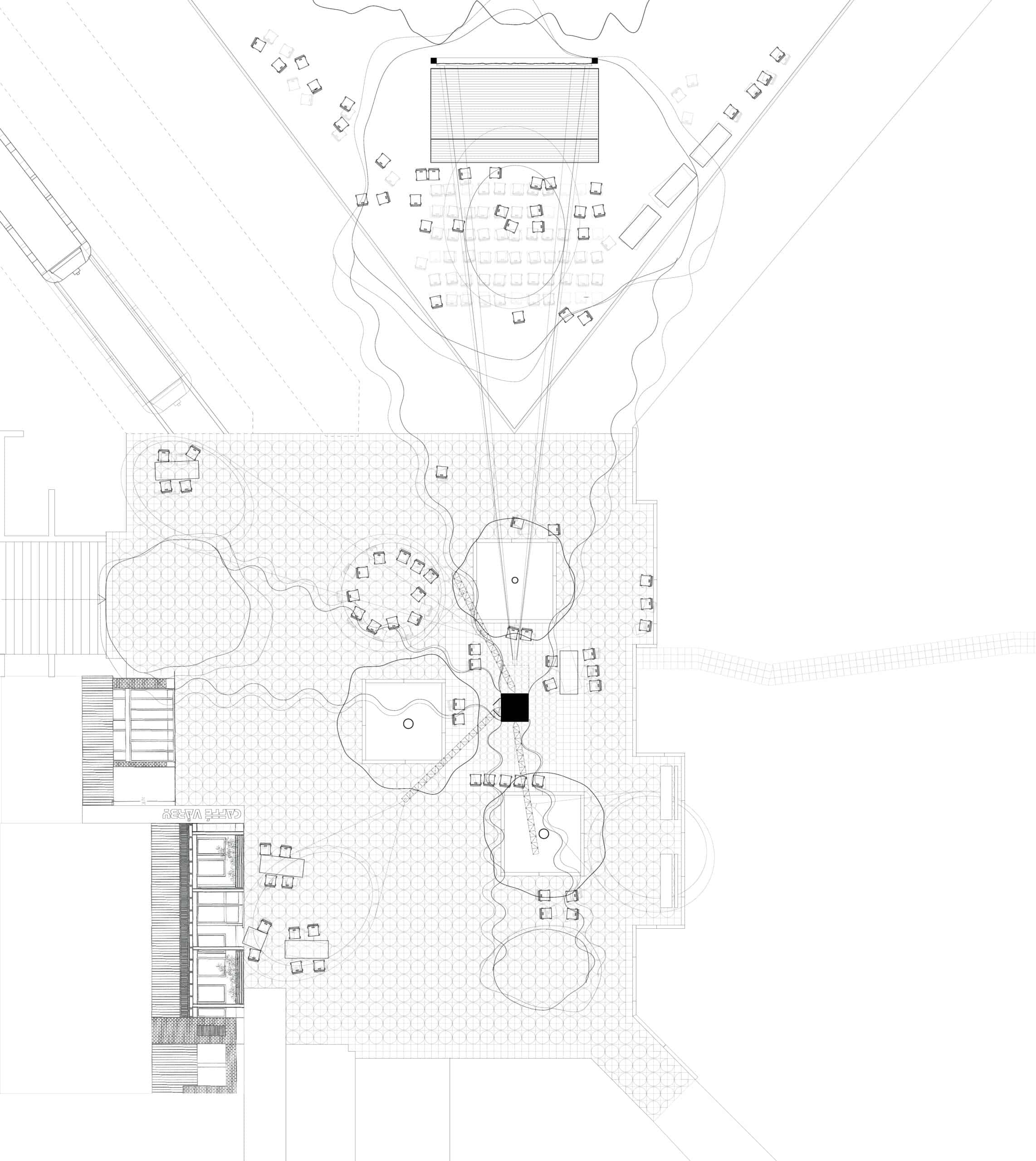
When drawing plans for a project that does not primarily form architectural space through solid mass, the question of what a line signifies becomes especially critical. This drawing faced the challenge of representing an object that produces light and sound, situated in the public space of Vårby Gård, a suburb of Stockholm. In conventional architectural practice, we construct complex layered structures that embed meaning into a line’s metadata, allowing us to understand what each line represents. Although some of these drawing systems can describe abstract or immaterial conditions, they often fail to capture the emotional and subtle spatial qualities created through light and sound. A concrete example would be creating a plan that allows an acoustic engineer to determine, in the design of a nightclub, where a patron would first hear the music and how quickly it intensifies as they move towards the centre of the space.
To draw lines that represent light and sound, the aim was to make them distinguishable from those representing built matter. The choice of line types became somewhat intuitive—squiggly waves for sound and sharp, sometimes dotted, lines for light. The drawing is an exploration in communicating a space not made from built matter. Attempting to capture photons and vibrations in the air at an impossibly short (imaginary) moment becomes essential when describing the proposal. In this plan, the temporal dimension of light and sound naturally became central, stretching that moment into the span of an evening during which a film screening could take place. Over the course of this imagined evening, almost all non-static elements in the drawing undergo some form of transformation.
Allowing a site drawing to exist in a kind of superposition—like that of subatomic particles in quantum entanglement—introduces problems similar to those found in physics. As soon as you try to measure particles that occupy two positions at once, they collapse into a single measurable state. The same might be said of the lines in the drawing, as they build up the spaces they form and easily blend into one—thus making it a diagram rather than a plan. By thinking about architectural drawing as something inherently temporal, and recognising that even abstract representation captures imaginary moments, our language for expressing architecture expands.
*
Leo Julin is a student at KTH in Stockholm, currently doing an internship at OFFICE Kersten Geers David van Severen in Brussels. The presented drawing was produced as part of a research project in preparation for his BA thesis.
This text is one of the selected responses to the second category of the Open Call 2025: Visibility, and the Unseen—a series of short contributions that either bring to the surface the unseen drawings within the Drawing Matter Collection (I. In the Archive) or explore original architectural drawings, created by the author(s) of the contribution, which make visible the unseen (II. In Practice).
