The Unperformed: Eisenstein’s Set Design for Heartbreak House
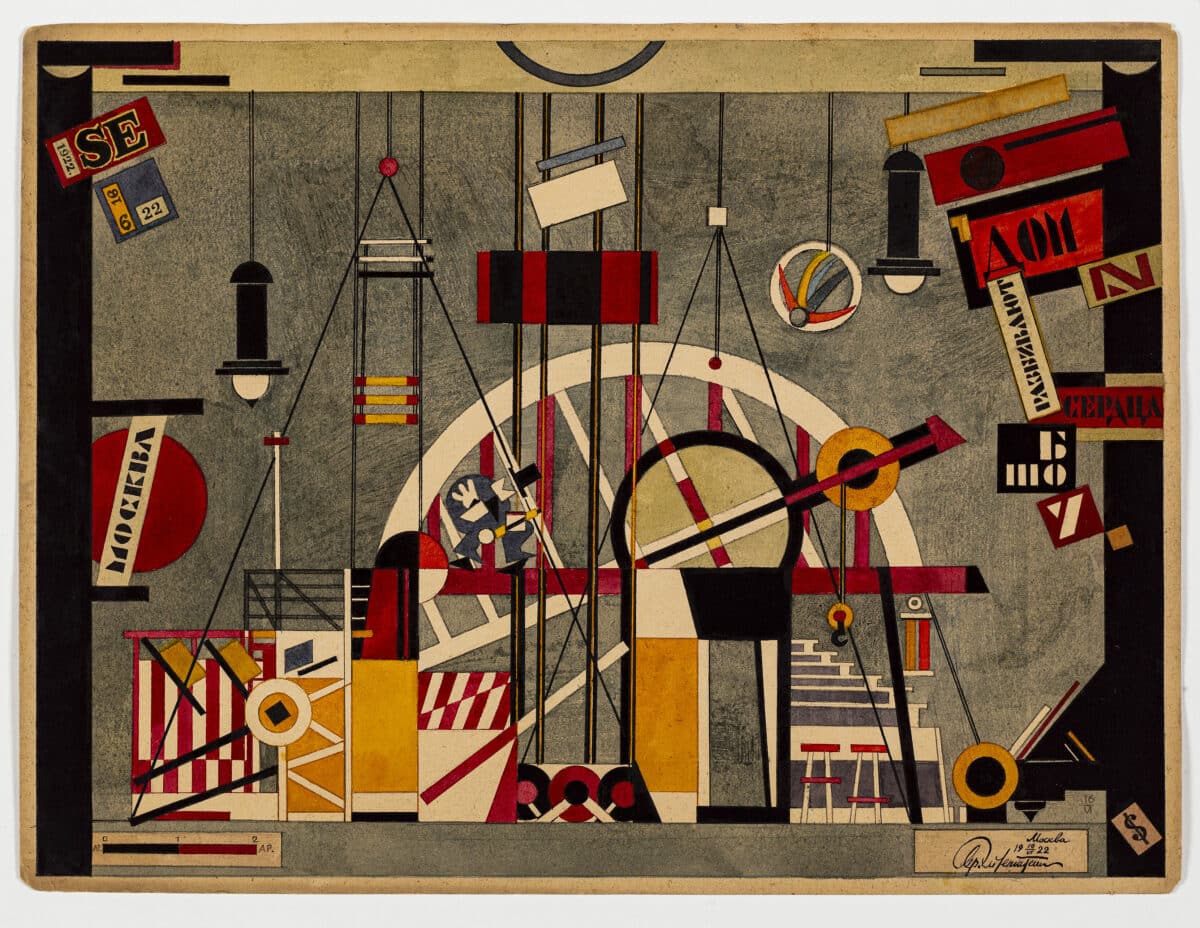
The sole drawing by Sergei Eisenstein in the Drawing Matter archive is a set design for a production of George Bernard Shaw’s Heartbreak House (1919) from 1922. It is a rare, interdisciplinary confluence of a socialist Irish playwright (Shaw), a Russian filmmaker and theorist (Eisenstein), and a radical theatre maker (Meyerhold). The production for which this drawing was made was never performed.
THE TEXT
Shaw gave detailed stage directions for the mise-en-scène of Heartbreak House—nearly two pages of description. According to Shaw, the play should be set within a house that had been designed to resemble the interior of a ship’s stern gallery.[1] This effect could be achieved with maritime windows, ‘heavy timbering’, and a ‘stern post.’[2] The floor would be made of bare wooden planks ‘like a deck’, the sofa ‘oddly upholstered in sailcloth’, and ‘a flagstaff on a little esplanade’ would be in the garden beyond.[3] Other details Shaw specified included a carpenter’s bench, a draughtsman’s table, and an observatory visible through the windows at the back of the stage.[4] This maritime theme was to be juxtaposed with the green hills seen through the windows and the presence of doors in places that could not exist on a real ship.[5] In his description, the house-as-ship is rendered empty, false, and adrift.
The patriarch of the play, Captain Shotover, is an ex-naval officer who suffers from delirium and nostalgia for his maritime days; it is in his home that the play’s action unfolds. One of his children, Lady Utterwood, laments her childhood—marked by irregular meals, clutter, and neglect, with ‘the same disorder in ideas, in talk, in feeling.’[6] The various characters make decisions in reaction to this crisis of familial authority.
Shaw proposed an allegorical form—both in the drama and the mise-en-scène—seeking to register within the bourgeois family how the breakdown of old British values, intensified by the First World War, led variously to reactionary politics, anxiety, or delirium. The set design would concretise this sense of dislocation by contrasting the house-ship with the English landscape outside.
THE STAGE
Sergei Eisenstein had been a student at Vsevolod Meyerhold’s Theatre Workshop from 1921. He was 24 when he worked on the design for Heartbreak House and had not yet made any films.
Eisenstein’s designs for the play, of which this drawing is one, abandoned Shaw’s naval theme almost entirely and instead proposed an abstract design in the Russian Constructivist style.[7] (The year before this project, the first exhibition of Constructivist drawings was held in Moscow, titled 5 x 5 = 25). The stage was to include several kinetic elements: two trapeze swings, a trapeze hoop, a lift, and a moving walkway.[8] The design would therefore emphasise automation, mechanisation, and spectacle.
It is the synthesis of technologies and forms that gives the design its critical force. The architecture of the home is opened out—the stairs on the right lead out of sight, there are no walls or windows, and the floors have little to no furniture. The character designs, in a related pair of drawings by Eisenstein, suggest a dandyish pleasure in the carnivalesque—one of the characters, Mangan, can be seen on the left side of the Drawing Matter image.[9] Eisenstein also proposed to ‘augment’ the set with ‘cages of wild animals’, which would have connected the containment and display of biological life to industrialisation.[10] Eisenstein sought to integrate these heterogeneous components of modernity into a new visual order.
In addition to the influence of Russian Constructivism, Eisenstein was also working towards Meyerhold’s approval of the design. In his writings on theatre, Meyerhold uses the term ‘biomechanics’ to describe how the body can be explained purely physiologically and in turn mechanically.[11] He was against transcendentalism, focusing instead on balance, rhythm, and the gradual perfection of the body’s movements through practice and reflection.[12] Similarly, the set design for Heartbreak House used suspension cables, weights, and cogs, working towards a state of equilibrium among its various constituent parts. The figure of the gymnast or trapezist is the figure of biomechanics writ large—they perform the body in a way that dramatises total subjective control over gravity, balance, and the body.
The set design therefore marks a significant break with the text of Heartbreak House, for it stresses the satirical, absurdist aspects of the play at the expense of the melancholic alienation implied in Shaw’s proposal. If Shaw was interested in registering crises in the family home through the staging, Eisenstein and Meyerhold were interested in what might come after these crises: a new, idealised combination of zoo, carnival, theatre, factory, and home.
Notes
- George Bernard Shaw, Heartbreak House (Penguin, 1970), 49.
- Ibid.
- Shaw, Heartbreak House, 49-50.
- Ibid.
- Shaw, Heartbreak House, 49.
- Shaw, Heartbreak House, 55.
- The other drawings are held at the Bakhrushin Theatre Museum, Moscow.
- See an aerial view of Eisenstein’s stage plan, which lists these elements in the diagram. Sergei Eisenstein, ‘Sketch of Scenery. Plan of Construction’, 1922, held in Bakhrushin Theatre Museum archive, archive number 180169/1501.
- I have deduced this from the presence of the top hat, and the spherical shape of the torso, which aligns with the design for Mangan in the related drawing. Sergei Eisenstein, ‘Costumes Design. Educational Work of Sergey Eisenstein. Sheet 3,’ 1922, held in Bakhrushin Theatre Museum archive, archive number 180169/1503.
- Edward Braun and Vsevolod Meyerhold, Meyerhold: On Theatre, ed. and trans. with commentary by Edward Braun (Bloomsbury, 2016), 233.
- Braun and Meyerhold, Meyerhold: On Theatre, 243-253.
- Ibid.
*
Max Livesey is an artist and a writer who works with sculpture, installation, video, sound, and fiction. He is currently studying at the Royal College of Art, where he is researching the history of leprosy in medieval England through site-specific sculpture.
This text is one of the selected responses to the first category of the Open Call 2025: Visibility, and the Unseen—a series of short contributions that either bring to the surface the unseen drawings within the Drawing Matter Collection (I. In the Archive) or explore original architectural drawings, created by the author(s) of the contribution, which make visible the unseen (II. In Practice).
