An Attardé Draftsman: Giacomo Beverati
‘In a certain sense the past is far more real, or at any rate more stable, more resilient than the present. The present slips and vanishes like sand between the fingers, acquiring material weight, only in its recollection’ —Andrei Tarkovsky
Italian culture has always produced artists who were attardé, either because they were out of sync with their time or because they were voluntarily committed to resisting it in the name of traditionalist ideals. In literature, Pier Paolo Pasolini was a fierce critic of the neo-avantgarde of the 1960s, nostalgic for peasant civilisation. In architecture, a debate between Reyner Banham and Ernesto Nathan Rogers crystallised this tension: in 1959, Banham wrote the famous essay The Italian Retreat from Modern Architecture about this generation, subtly accusing Ernesto Nathan Rogers of being their bad master—after all, his Torre Velasca in Milan was a Neo-Medieval pastiche. Rogers, in Casabella-Continuità, responded that Banham would do well to reread John Ruskin to better understand Italian culture.[1] This has in fact always been marked by a constant millenarianism of Catholic origin, from Dante Alighieri to Giorgio Agamben, a continuously suspicious and critical attitude towards modern technology, the antithesis of the USA as Jean-Louis Cohen has noted well.[2] Italy has thus become the rearview mirror of architectural culture, beloved by conservatives around the world, starting with the English, who in the mid-19th century orchestrated the Dantesque Pre-Raphaelite revival, beginning when Gabriel Dante Rossetti decided to invert his first names and began publicly reading the Divine Comedy alongside Edward Burne-Jones and many other London followers.
In the 1990s Manfredo Tafuri focused on studying the Renaissance, extolling Venice’s resistance to modernity and at the same time categorically rejecting the Postmodernism proposed by Portoghesi at the Biennale since 1980. Giacomo Beverati was educated in that city and in that cultural climate—one that combined Marxism and Catholicism, just as Pasolini, Cacciari, and many other Italian intellectuals before him. Born in a small industrial town in the Marche region, particularly affected by the brutal and rapid industrialisation of the post-war period, Beverati enrolled in astronomy at the University of Padua and then in architecture at IUAV University of Venice, following Tafuri’s final course on the artistic diaspora in northern Italy after the 1527 Sack of Rome.
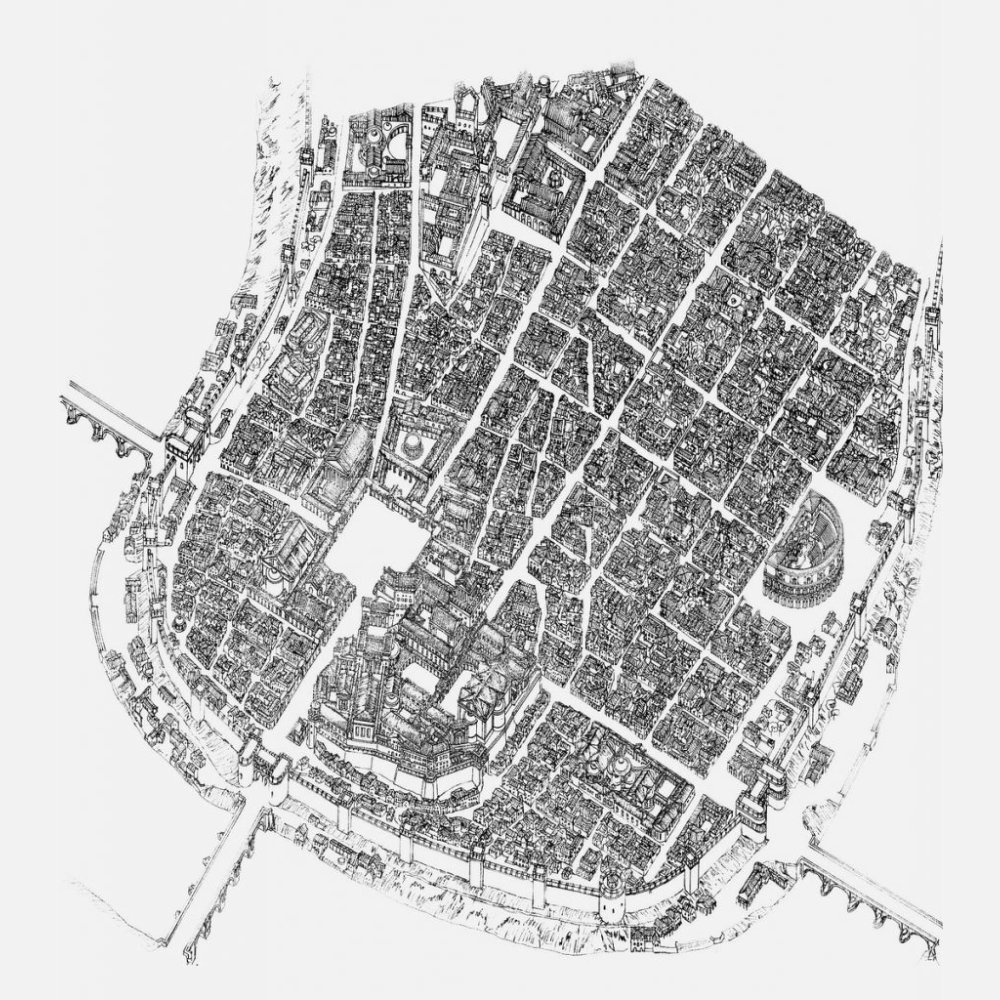
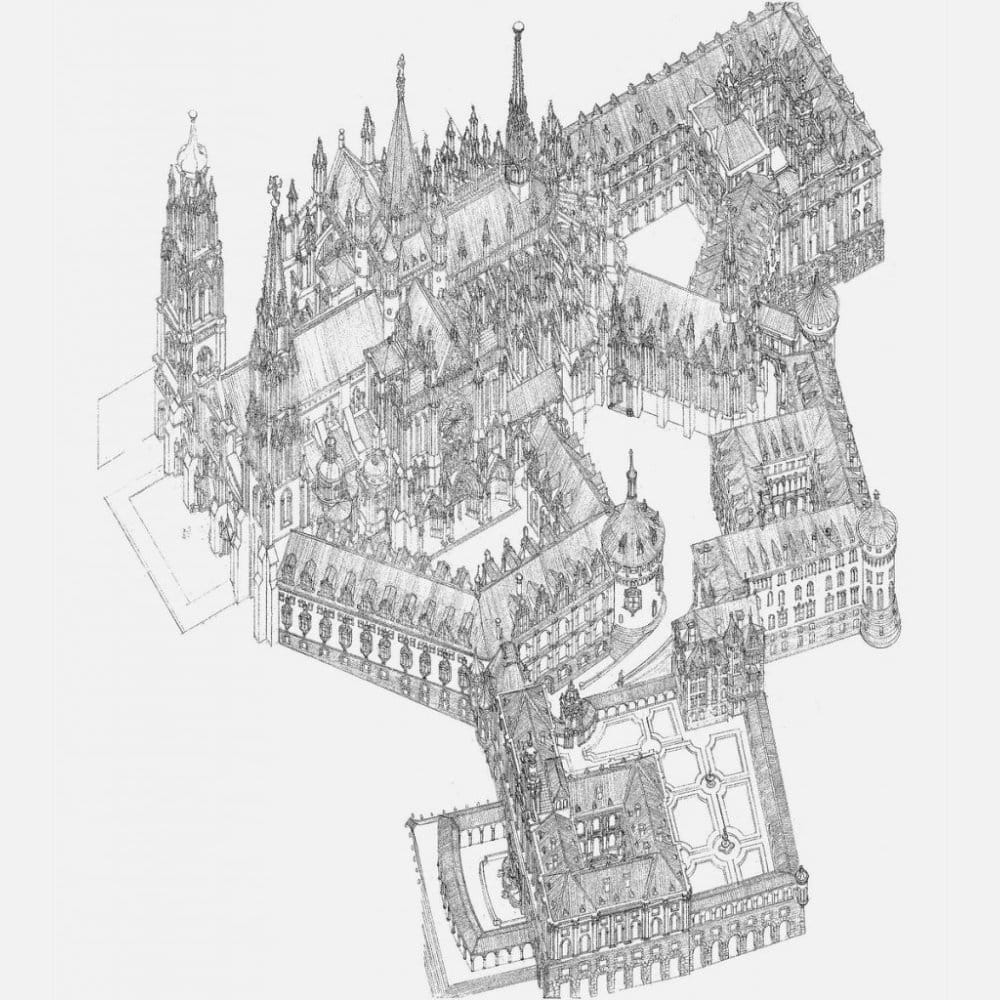
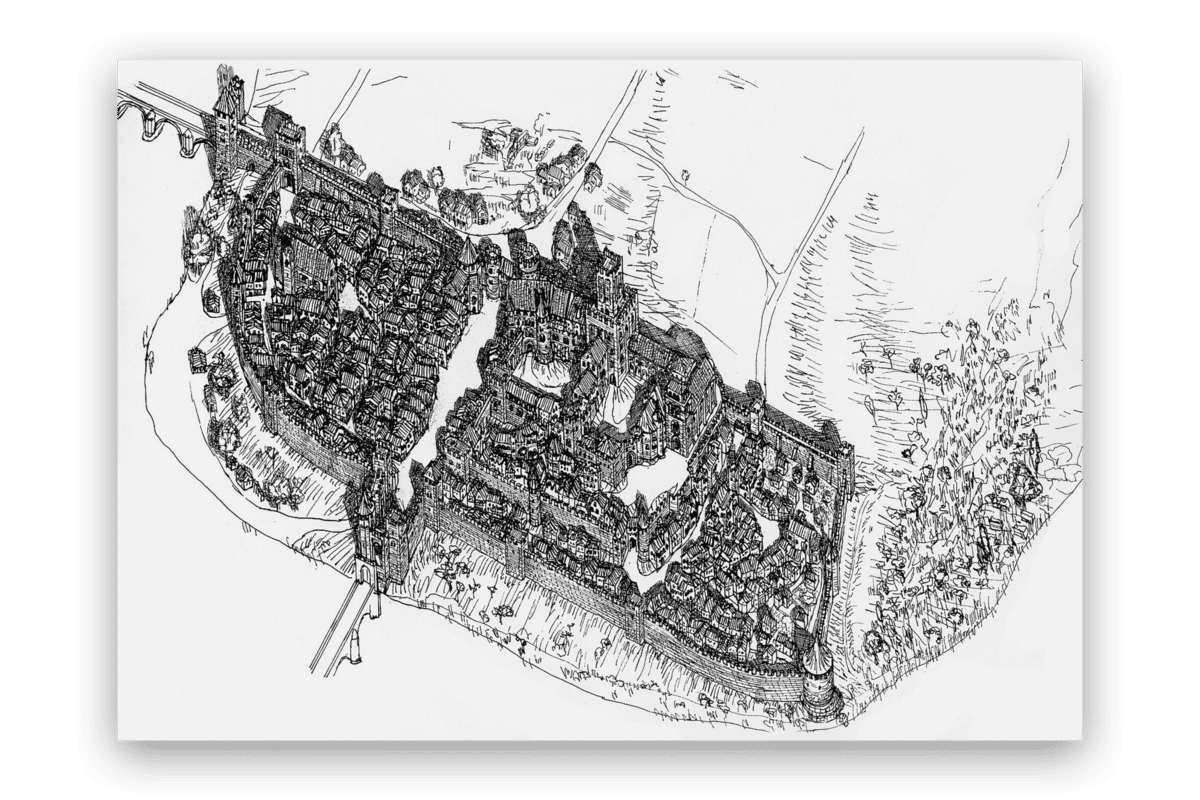
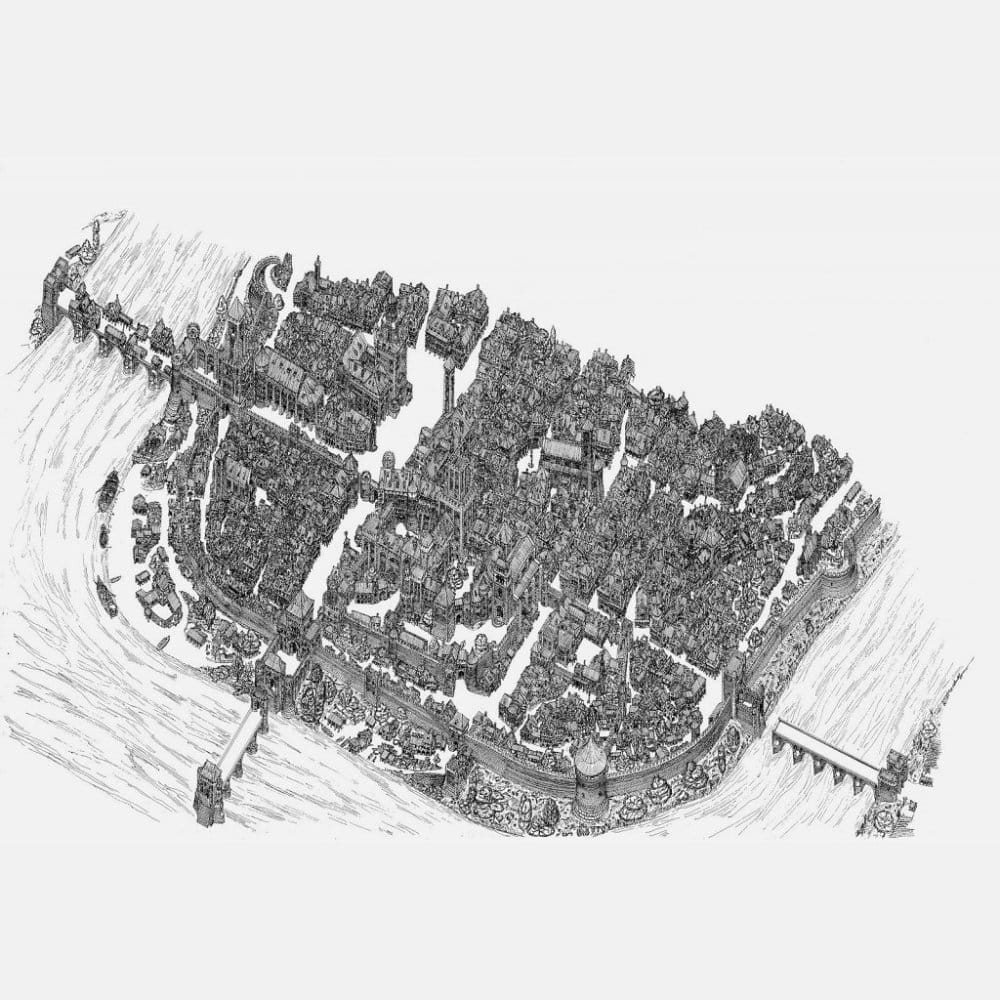
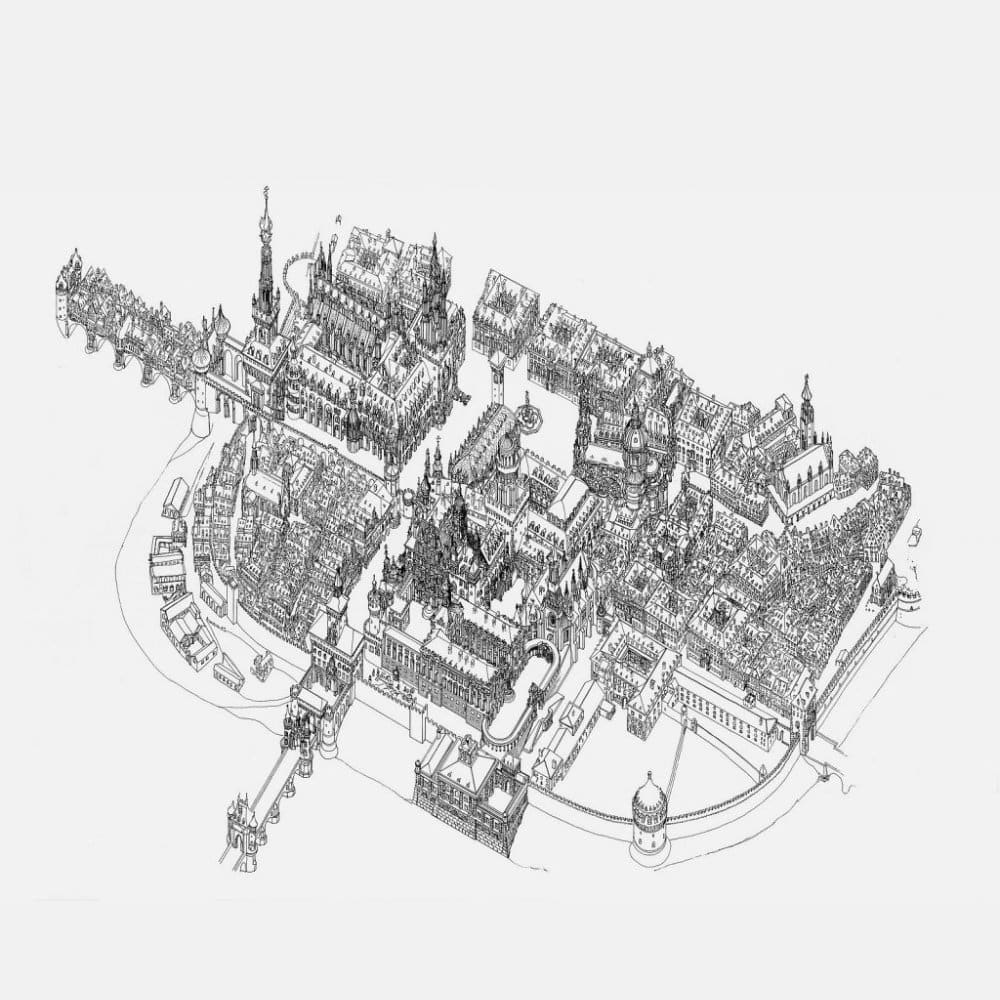
In general, the 1990s also marked the transition from hand-drawn to digital drawing, another professor at IUAV, Massimo Scolari, was then investigating ‘anti-perspective’ visual representation across two thousand years.[3] However, the transition to digital drawing was immediately and fiercely resisted by Beverati, who continued to use pencil, following the rules of central perspective defined by Piero della Francesca. His work thus focused on a fictional city, Liszell, located in an unspecified area of Central Europe, a fairytale land where both the Gothic style, so beloved by English anti-modernists like A.W.N. Pugin, and the late Baroque style beloved and studied by a reactionary Norwegian historian like Christian Norberg-Schulz, flourished. Liszell, however, was designed by Beverati in different historical periods, each of which coincides with a style: Roman, Romanesque, Gothic, Baroque, Rococo, Eclectic, stopping short of the dreaded 20th century. Each of these styles could be preceded by the term ‘neo’, which surprisingly sits well with the ‘pre’ of pre-modern—a new form of Pre-Raphaelite? Certainly, the historical styles are reassuring: in the study of arts, style is associated with certain characteristics that are ‘more or less stable, in the sense that they appear in other products of the same artists, era or locale’ and also ‘flexible, in the sense that they change according to a definable pattern when observed in instances chosen from sufficiently extensive spans of time, of geographical distance.’[4] Beverati’s work is therefore fictional, but it is still a reassuring invention, aimed at recomposing what has been shattered and lost.
In an unpublished recent conference, Beverati said ‘I consider my work to be ‘scholastic’: it simply transmits the suggestions of an art that can only superficially be defined as ‘past’ and which still today can be, and perhaps should be, a source of inspiration.’ Nevertheless, it is a profoundly romantic operation. For this reason, the most significant missed encounter was with Portoghesi, whom he met briefly during the Master’s course in ‘Design and Restoration of Churches’ at Sapienza University in 2003. Portoghesi had said at the time that he was very interested in Beverati’s drawings, and for good reason: for many years, in fact, he had retired to a small, enchanted village north of Rome, Calcata, which appears in the Russian director Andrei Tarkovsky’s film, Nostalghia (1983) as a symbol of an original, pre-modern life. Calcata has a closed shape and has no outskirts, the buildings are all built with a single native material, tuff, which is abundant throughout Tuscia—the province where Pasolini also had a house. In San Marino, a fairytale town similar to Calcata, Beverati designed the expansion of the Palazzo Pubblico, guarded by fortress guards in a uniform from another era, and a new Audience Hall with Gothic-arched windows. All these references share with Beverati the need to resist or escape modernity, but it is not a question of taste but something deeper—something existential, or even more precisely, a metaphysical belief.
Notes
- Ernesto Nathan Rogers, The Hero of Doubt. Selected Writings, ed. by Roberta Marcaccio (Cambridge, Mass: MIT Press, 2025), 41.
- ‘Italy would remain the stage for the reconstruction of history. To Italy, nostalgia for the past, and to America, this ‘nostalgia for the future’.’Jean-Louis Cohen, La coupure entre architectes et intellectuels: ou les enseignements de l’italophilie (Brussels: Mardaga, 2015), 22.
- Massimo Scolari, Oblique Drawing. A History of Anti-Perspective, with an introduction by James S. Ackerman (Cambridge, Mass: MIT Press, 2015).
- James S. Ackerman, A Theory of Style, ‘The Journal of Aesthetics and Art Criticism’ 20 (3), 1962, 227–37.
*
You can view the work of Giacomo Beverati online here.
Manuel Orazi is an editor at the Italian publishing house Quodlibet and is currently a visiting professor at the Academy of Architecture in Mendrisio, Switzerland.
