Louis Kahn: Sketch for a Mural
Drawing Matter holds a large number of drawings, prints and other materials relating to a project for an office building in Kansas City designed by Louis Kahn. The project was one of the last that the architect worked on before his death in 1974, and many of the drawings carry his distinctive hand either as annotations or on sheets of yellow tracing paper traced-off office drawings. Among these, kept in the same drawer, is another drawing by Kahn, but this one is very much an outlier. Drawn in black ink on paper, the drawing reads as six panels. The panels vary in subject and viewpoint: the top left appears to be a view looking down on a volume or room, the top right and bottom left seem to be views into interior spaces, and the centre-bottom resembles a window frame looking out towards two vertical slabs. The contrast between the yellowing white of the paper and the black of the ink suggests harsh shadows, but how these shadows are cast by objects is ambiguous; in the bottom right corner panel, for example, a small pyramidal shape appears to have one plane in shadow but also to cast a shadow on the opposite side.
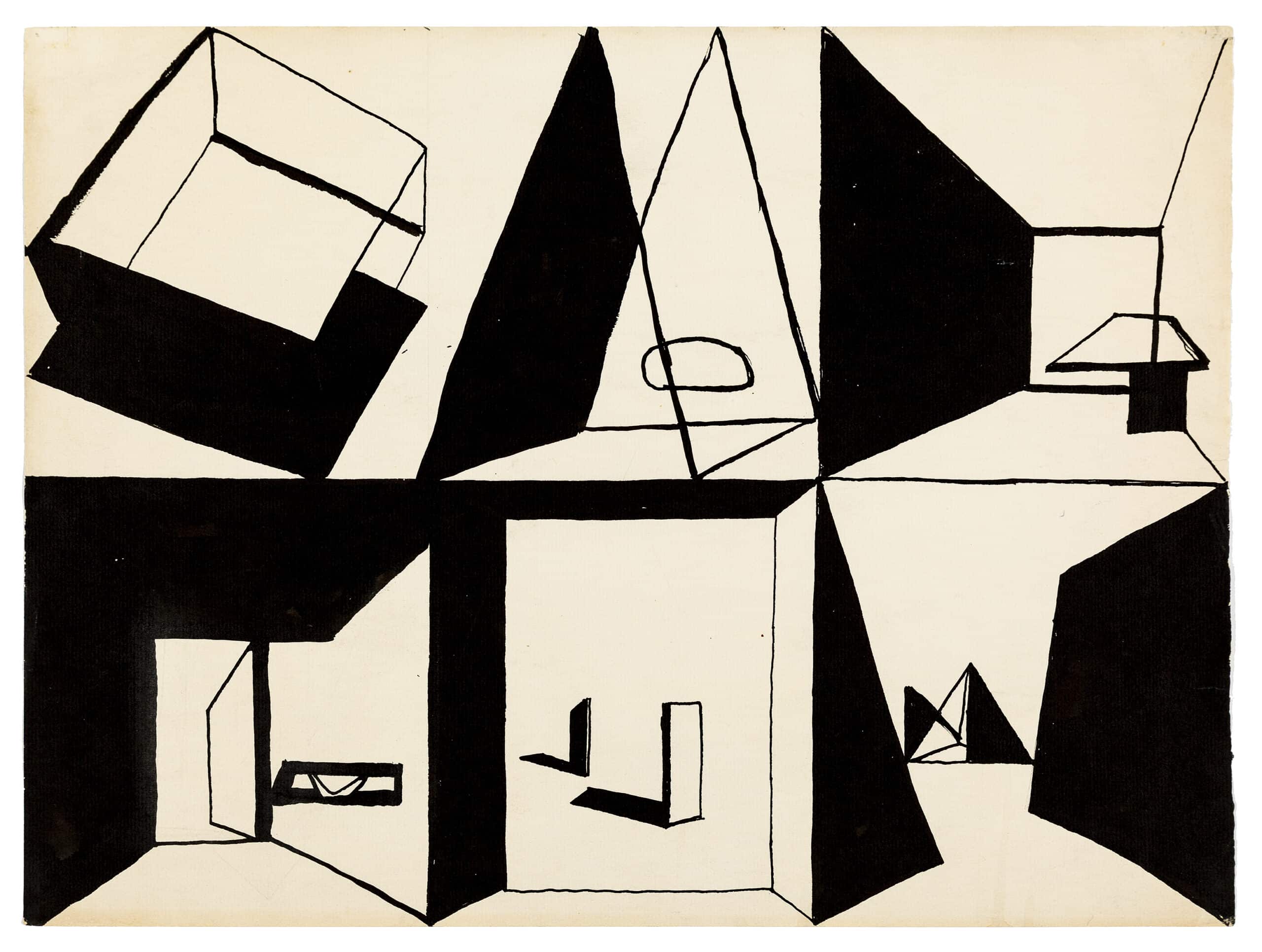
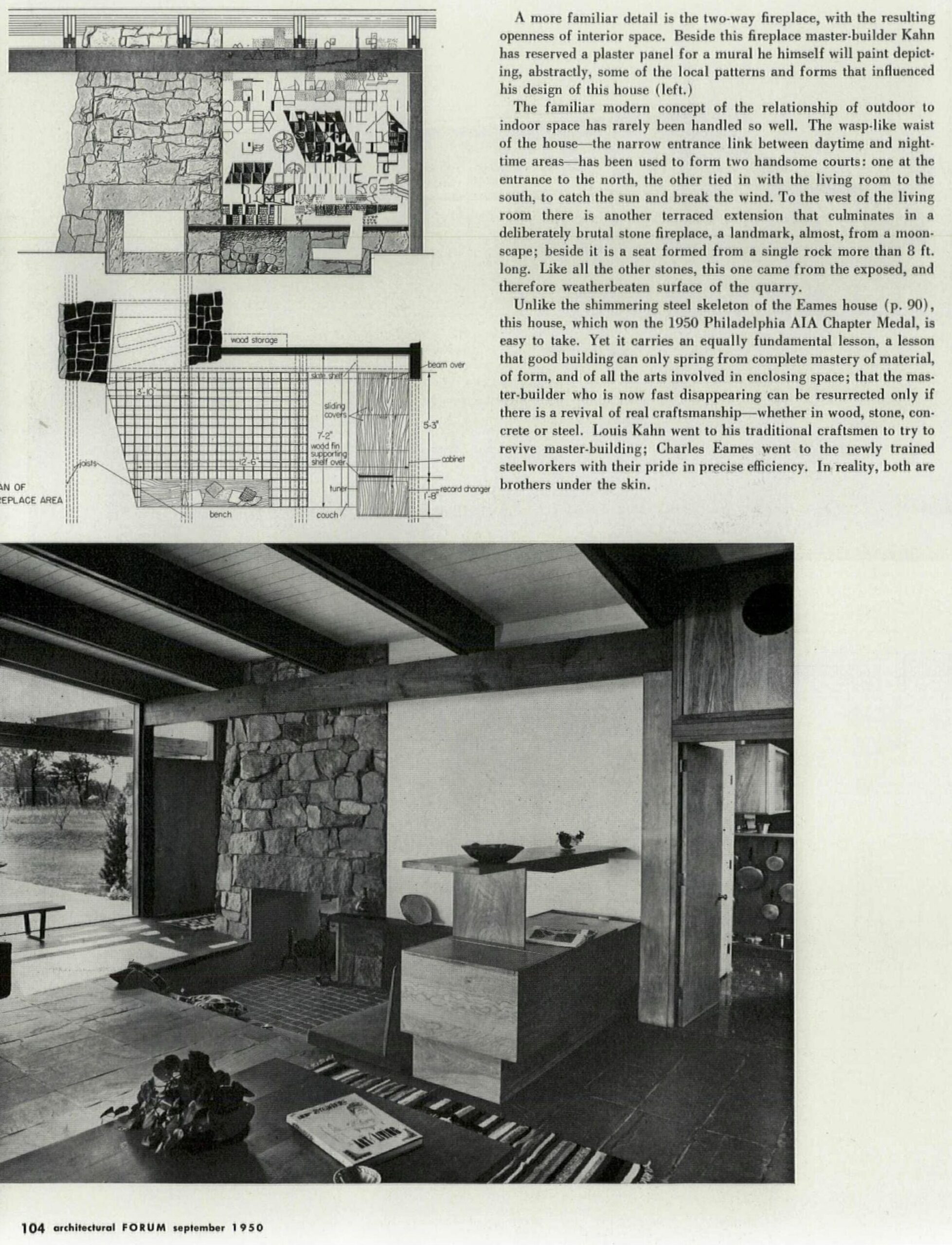
It is not known for certain what the drawing was made for, but it bears a stylistic resemblance to a mural designed by Kahn for the sitting room of the Weiss House (1947–50), one of his first houses and the project for which he was awarded a medal by the American Institute of Architects. The Weiss mural was not executed until 1955, five years after the house was completed, but it was an integral part of the design. An article in Architectural Forum from September 1950 shows a blank white wall adjacent to the living room fireplace and published alongside a drawing for the mural with the caption: ‘Beside this fireplace master-builder Kahn has reserved a plaster panel for a mural he himself will paint depicting, abstractly, some of the local patterns and forms that influenced his design of this house.’ The published design for the mural contains several motifs derived from the Pennsylvania Dutch landscape: in the centre is a windmill, and in the lower right corner are gates, along with various abstract shapes similar to those in the Drawing Matter drawing. In photographs of the completed mural, a number of the explicitly ‘local’ motifs have been omitted, with Kahn favouring more abstracted and geometric forms and patterns.
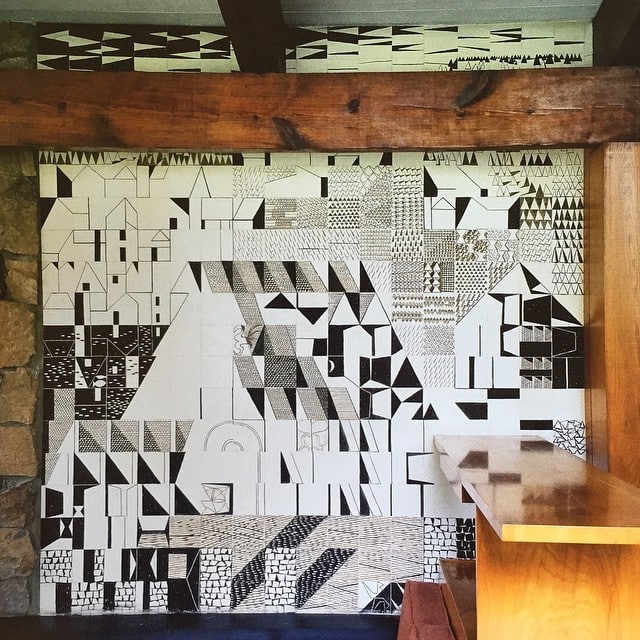
If the Drawing Matter drawing is related to Kahn’s designs for the Weiss House mural, the gap between the completion of the house and the completion of the mural is interesting. Four months after the article in Architectural Forum, Kahn took up a residency at the American Academy in Rome (1950–51). It was during this time that he made his well-known travel drawings in Italy, Greece and Egypt, many of which are studies in light and shadow rendered with high contrast between black and white. Perhaps the drawing is an alternative design for the Weiss mural based on Egyptian rather than rural American motifs—a vehicle for translating the light and shadow Kahn observed on his travels to a Pennsylvania sitting room?
*
Matt Page is an artist and editor. He is a senior editor and public programme curator at Drawing Matter and the editor of Artists’ Drawings magazine.
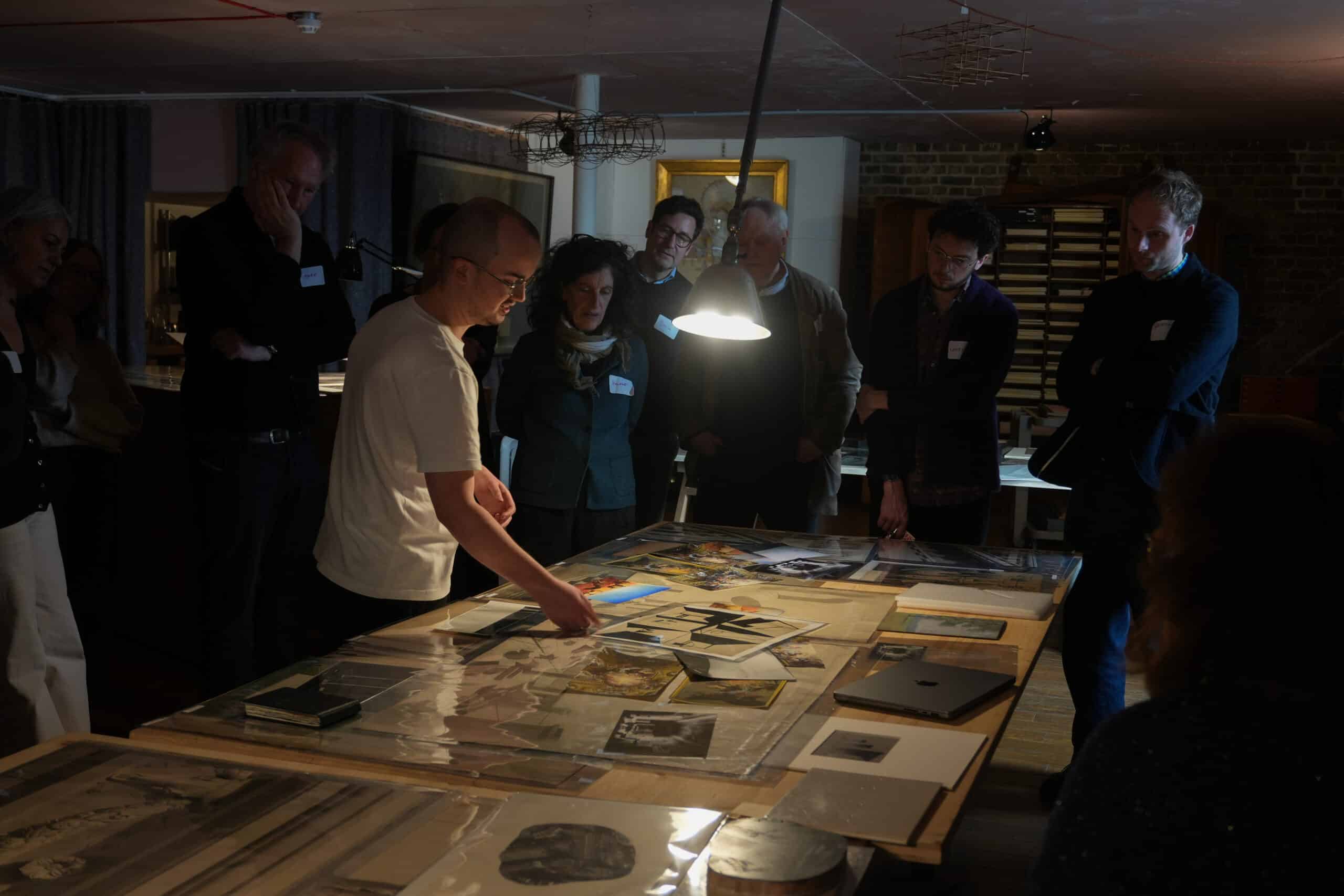
This short text offers an insight into Matt Page’s invited contribution in the third colloquium event ‘Tracing Shadows’ led by Professor Mark Dorrian and hosted by the RIBA, V&A Drawings Collections and Drawing Matter in January 2026—a day of conversations, gathered around original drawings and photographs, in which participants examined the presence (and absence) of shadows in the representation of architecture.

– Stan Allen