Provenance in Architecture, A Dictionary: Architectural Drawing
The following text is one of the entries included in the book Provenance in Architecture, A Dictionary (Berlin: Hatje Cantz Verlag, 2025) edited by Uwe Fleckner and Mari Lending. The book, presented in the form of a dictionary, examines architectural provenance across 101 key concepts, from acquisition to will. Each entry provides a new way of writing architectural history, highlighting how architecture moves, is destroyed, survives and is transformed.
Each highlighted word in the text below is also a separate entry in the book.
*
Every drawing of a building by an architect has a double identity: as a sheet of paper carrying marks that are sometimes beautiful, but equally as the singular record of the author’s thinking and intention (authorship). At the extremes of ownership, this duality becomes irreconcilable—the drawing either fading and illegible on the walls of a museum, or unseen, even unrecorded, deep in an archival vault (archive, collecting). On quite rare occasions, these double lives can coalesce fully in the physical passage of an individual drawing, across seas and mountains or over time itself, and their eventual safe arrival engenders some seminal event for architectural history (image vehicle). ‘Drawing-as-object’ has acted then as the true steward of ‘drawing-as-idea’; the two holding fast to each other, for the duration of their journey at least, through the specificity of their original purpose or of the audiences to whom they are shown.
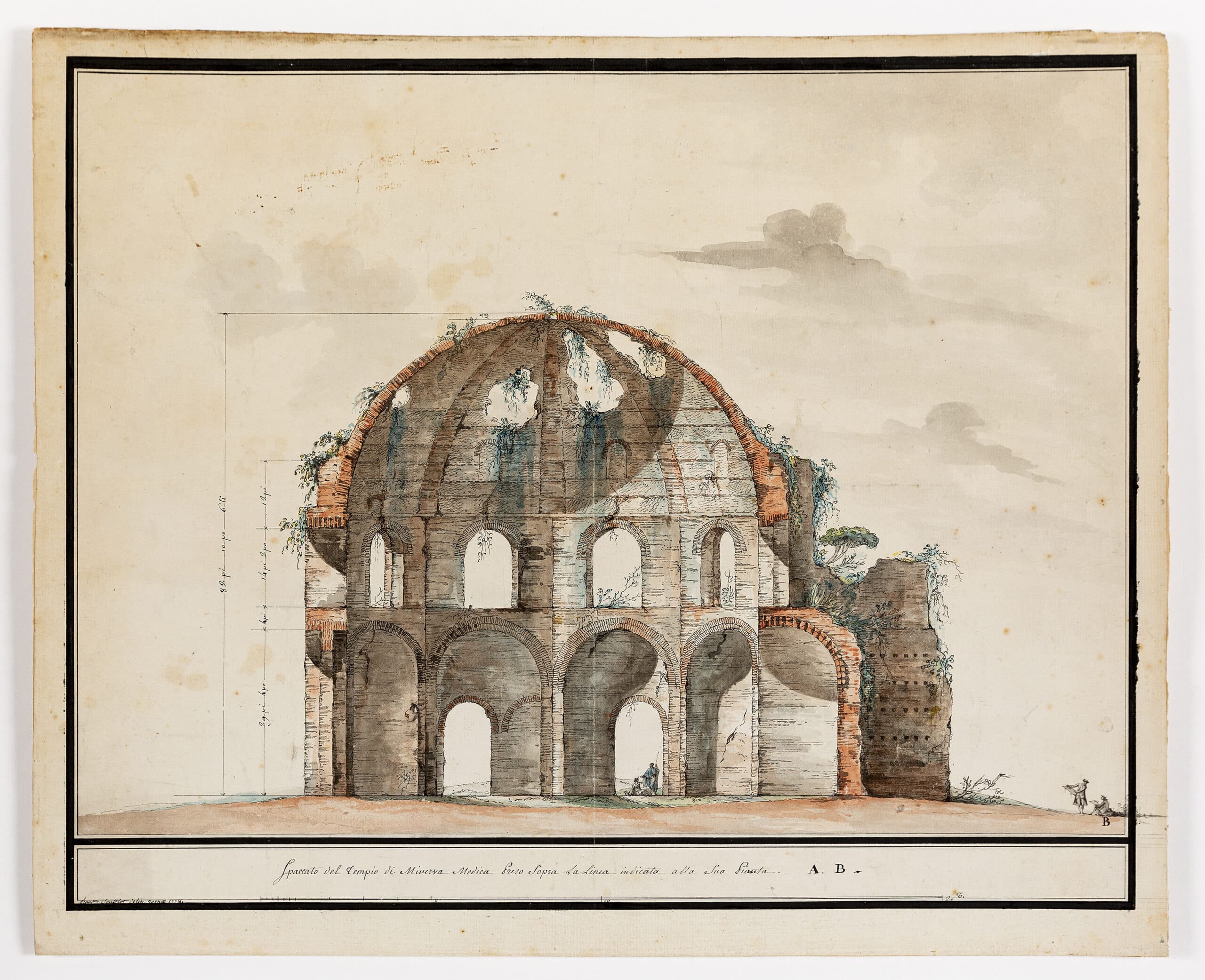
On 23 April 1788, Jacques-Germain Soufflot presented a survey of Minerva Medica to his colleagues at the Académie Royale d’Architecture in Paris, with the object of demonstrating that his ambitious dome for Sainte-Geneviève could be built on sound engineering principles. A few months earlier, challenged publicly and in the press by his rival Pierre Patte (dispute), he had commissioned his nephew, François Soufflot, called Le Romain, to make record drawings of surviving domed structures in Rome.
Anxious for the attention of a sophisticated Parisian audience, the younger architect took the opportunity to play on the conventions of survey drawing; his study in section, of what was then understood to be a Roman temple, is dressed around in a fictional landscape that includes himself and a colleague at their drawing boards.
In their minutes, the académiciens encouraged Soufflot to continue his research and recorded that the structure ‘seems suitable to be imitated fruitfully and successfully in many circumstances.’[1] The dome was completed in 1790 to Soufflot’s designs, but after his death. The following year, the church was rechristened the Panthéon, transformed into a revolutionary temple modelled on the (imagined) Roman original; the dome of Minerva Medica collapsed in 1828.
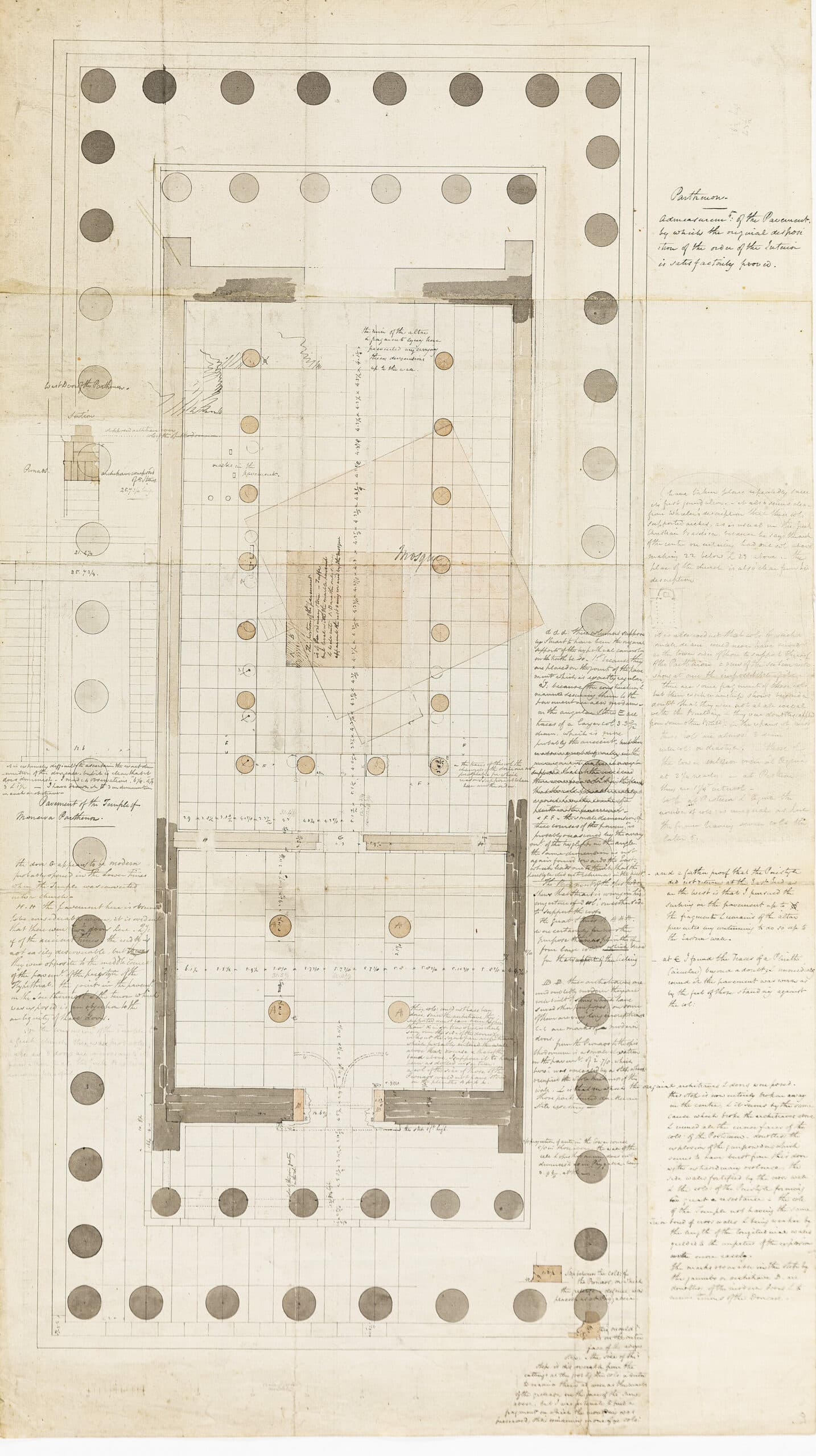
Charles Robert Cockerell arrived in Athens in the Autumn of 1810 and seems to have wasted no time developing a survey of the paved floor of the cella of the Parthenon—an extraordinarily complicated drawing that records both the footprint of the former mosque and, crucially, uses the grid of marble slabs to infer the original location of columns destroyed by the great explosion of Turkish gunpowder in 1687.
For Mediterranean travellers, good drawing paper was always in short supply, and Cockerell at some point extended the sheet to include the floor of the eastern end of the temple, using the reverse of an earlier drawing that had attempted an arrangement of the recently excavated marbles from the pediment of the temple at Aegina. The architect returned with the drawing to London only in June 1817 and, after being engraved for Peter Oluf Brøndsted’s Reisen und Untersuchungen in Griechenland (Paris 1826), it became the accepted basis for understanding the original form of the Parthenon amongst succeeding generations of historians. A scruffy and nearly unintelligible drawing had actively stewarded the transfer of critical architectural knowledge—the seeds, indeed, of the Greek Revival (afterlife)—from Athens to northern Europe. Early in the 1840s, Cockerell added a further section of paper on the right, heavy with general notes and observations, and so further repurposed the original diagram to be held up by a gloved assistant as an illustration to his early lectures as professor of architecture at the Royal Academy.
Thirty years later, in 1871, in the same room, George Edmund Street will tell his audience:
‘In giving my first lectures under the auspices of this Academy, I can hardly forget the first lectures that I ever heard within its walls. They were those of the late Professor Cockerell, an architect so distinguished by his close and careful study of classic art, by his thoroughly artistic and cultivated taste, and by his real earnestness in carrying out what he felt to be good in his work, that none could set before him a nobler example of the course an architect should take. The refinement of his executed works was in full harmony with the length and care of his study of ancient examples; and he proved, if ever anyone did, how necessary such study is to the real success of an architect in Classic or Renaissance buildings, just as much as it is in the case of Gothic buildings.’[2]
A drawing and a conceptual approach from Cockerell’s youth, over several iterations, still worked as one, but from within the conjured memories of a younger rival pursuing a somewhat different thesis.
In contrast, after its day out in Paris, Soufflot’s idea and his nephew’s drawing soon went separate ways. If only as a pretty thing, the drawing had a busy afterlife in the collecting market and belonged for a time to the decorator Armand Rateau, and later to Olivier Lefuel. Its true history and importance as a messenger emerged obliquely only a few years ago to the excitement of scholars. The assemblage of the Parthenon sheets was identified at much the same time, still unattributed and hardly appealing visually, but recognised as perhaps worthy of research (attribution).
The lesson is just that the images themselves and the obscure histories related above have always to be retained together, and that value, for their stewards of the longer durée, lies in catching them in just those interludes. Ideas are even more fugitive and fragile than the papers, inks and graphite that support them, but they should be understood as the truer content of any collection of architectural drawings.
Notes
- Henry Lemonnier, Procés-verbaux de l’Académie Royale d’Architecture, vol. 8 (1768–1799) (Paris: Libraire de la société de l’historie de l’art Français, 1911), 341f.
- George Edmund Street, ‘A lecture delivered at the Royal Academy last session by George Edmund Street, R.A.’, The Architect, vol. 6 (1871), 299–301, 310–312 and 323–325 (325).
*
Niall Hobhouse is the Director of Drawing Matter; he collects drawings by architects, curates exhibitions and writes about buildings, landscapes and museums.
