DMJ – The Iconography of the Grid: Narrative and Architectural Storytelling in the Work of Superstudio
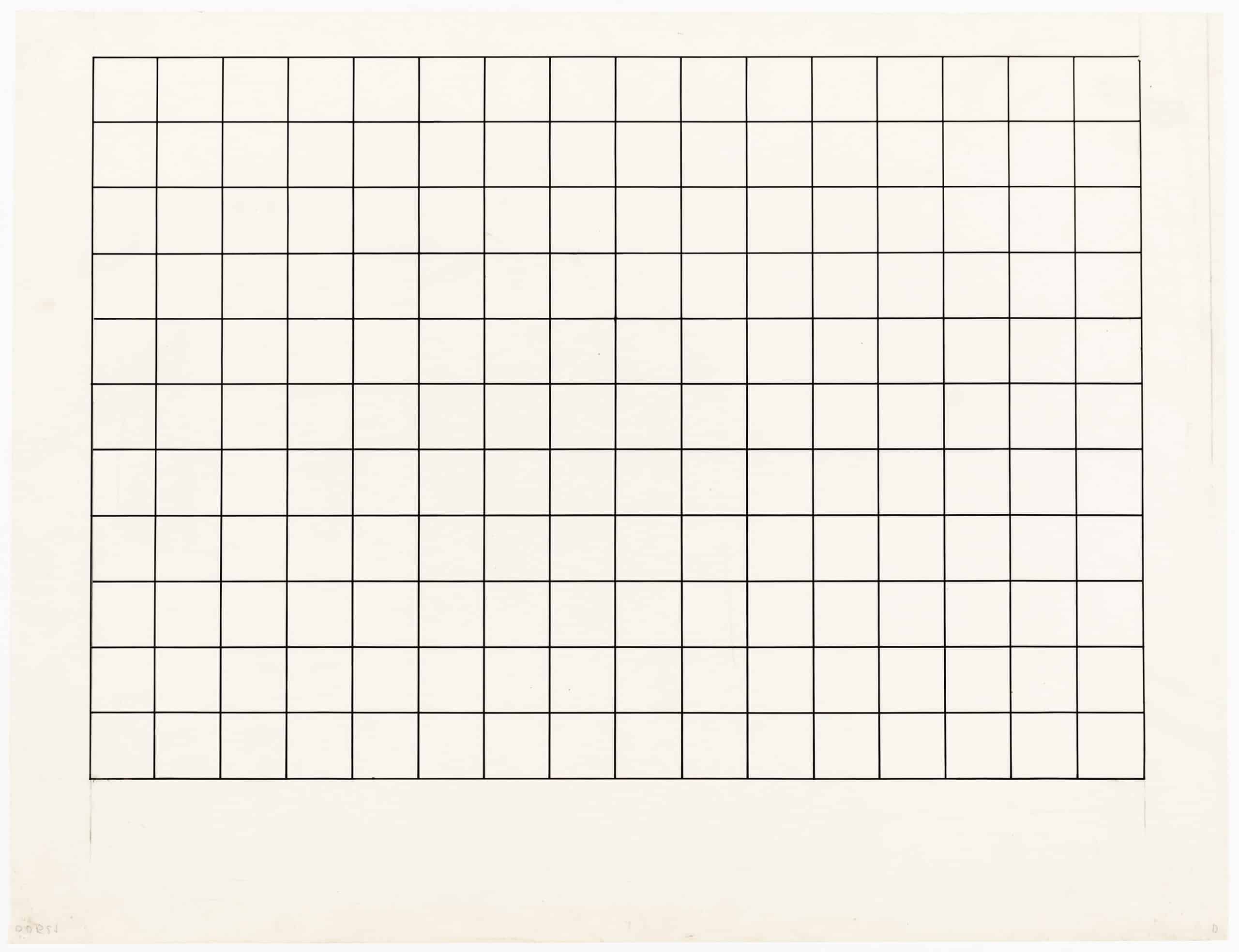
This article examines the architectural and narrative instrumentality of the grid in Superstudio’s Continuous Monument (1969) and related projects, from A Journey into the Realms of Reason (1967–69) to the Fundamental Acts (1972) and Adolfo Natalini’s unpublished An Entire Life (1972). While the grid has often been read as an emblem of rationalism, abstraction and totalising modernity, the essay argues that, in Superstudio’s work, it also operates as a temporal and mediating device: a means of arranging fragments, producing sequences, and allowing architecture to become fiction, while also reflecting on that fictionality.
Through close readings of drawings, collages, storyboards, sketchbooks and exhibition materials held in Drawing Matter Collections, as well as an unpublished interview with Adolfo Natalini, the article traces the movement between the grid as architectural figure and the grid as narrative infrastructure. It shows how Superstudio’s serial ensembles drew upon the visual languages of film, comics, postcards, advertising and scriptural image-sequences, while also transforming these media through architectural modes of iteration, projection and conceptual ordering. The Continuous Monument is therefore understood not only as an iconic speculative megastructure, but as a project whose critical force depends upon the recursive relation between gridded form and gridded storytelling.
The essay repositions Superstudio’s grid away from a primarily formal or ideological reading and towards an account of mediation: the grid becomes the surface on which space and time, image and text, architecture and narrative are made mutually operative. This reading clarifies the project’s historical significance within post-war and post-modern architectural representation, while opening a wider understanding of drawing as a medium through which architectural reason can be staged, unsettled and undone. In the later work of Natalini, where the grid persists as storyboard, supersurface and residue, architecture establishes the conditions for its own disappearance. What remains is not simply a sign of rational order, but a device of escape.
Download the full article as a printable PDF
DMJournal–Architecture and Representation
No. 3: Storytelling
Edited by Mark Dorrian and Paul Carter
ISSN 2753-5010 (Online)
ISSN 2753-5002 (Print)
About the author
Sophia Banou is Senior Lecturer in Architecture at UWE Bristol. She studied architecture in Athens, Newcastle and Edinburgh, completing her PhD at ESALA in 2016 with a scholarship from the Bodossaki Foundation. Her doctoral research examined architectural representation and drawing conventions through a critical-historical study of urban representation. She has practised architecture in Greece and taught architectural design and theory at Newcastle University and the University of Edinburgh. She has co-edited Charrette (AAE) and Drawing On, and her written and creative practice work has been published, presented and exhibited internationally. Her research explores architectural media, representation, heritage and social sustainability.
