Shadowed plans
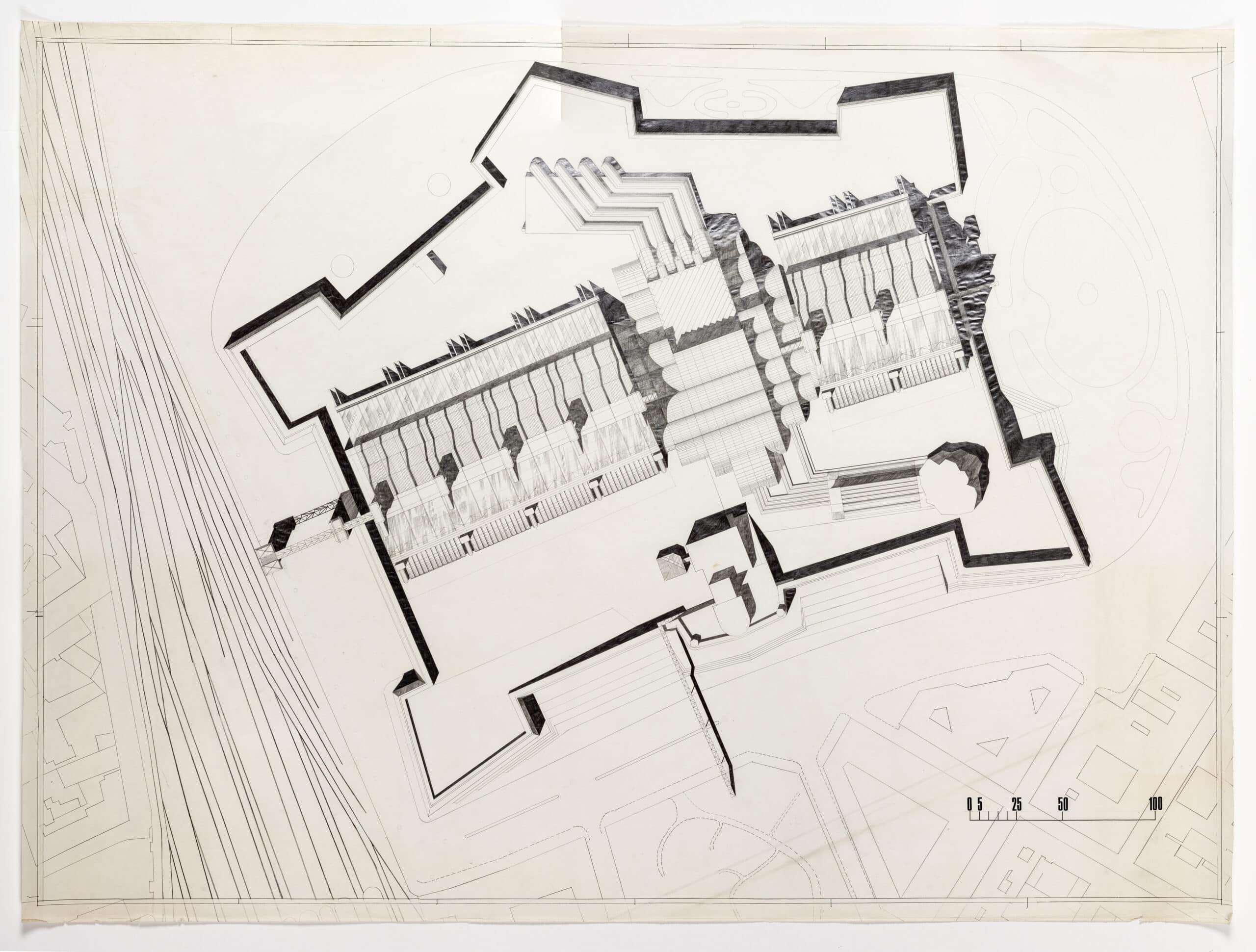
Drawing Matter holds in its collection a plan by Superstudio architects Carlo Chiappi and Adolfo Natalini for the 1967 competition for the restoration of the Fortezza da Basso—a 16th-century fort in Florence—and its transformation into a National Centre for Arts and Crafts.[1] The drawing combines traditional plan-making techniques with remarkable power. The urban environment surrounding the fortress is rendered in linear drawing: thin contour lines for the green spaces on the right, dotted lines for the sidewalks, and thin continuous lines for building masses. The main subject of the drawing—the fortress walls and the studio’s intervention within the inner compound—is accentuated by strong shadows that evoke the traditional poché of the walls associated with the Beaux-Arts tradition. Though never formally defined within Beaux-Arts pedagogy by figures such as Julien Guadet, the poché played a role similar to the shadows we see in the Fortezza da Basso rendering. It makes tangible the projection and relief of the walls in relation to the ground, producing a stark and monumental effect.
Rather than rendering wall thickness through washes of dense black ink, the Superstudio draughtsmen chose instead to introduce shadows in order to establish a hierarchy of values among the different structural elements of the complex. The fortress walls, for instance, are drawn almost in isometry, but the projected shadows falling on the skylights of the main exhibition buildings serve a purpose beyond pure aesthetics: they convey information about an architectural detail—drawn as a simple rectangle—regarding both its nature and its height. These two types of shadows, informative and affective, which are not mutually exclusive, are inherited from a long tradition of shading in plans.
As Paul Emmons has aptly written, ‘before Durand’s redefinition of the plan as a horizontal section, it had been conceived as a footprint, or ichnographia, of the building’s weighty pressure on the earth. Afterwards, architectural drawings largely ceased to be read as indexes of construction; they were rather understood as based on a set of conventions.’[2] Most early Renaissance plans were cut at ground level, but it soon became apparent that this level did not allow window bays to be represented. After the 15th century, the convention of placing the horizontal section at the level of windowsills was widely adopted among European draughtsmen.
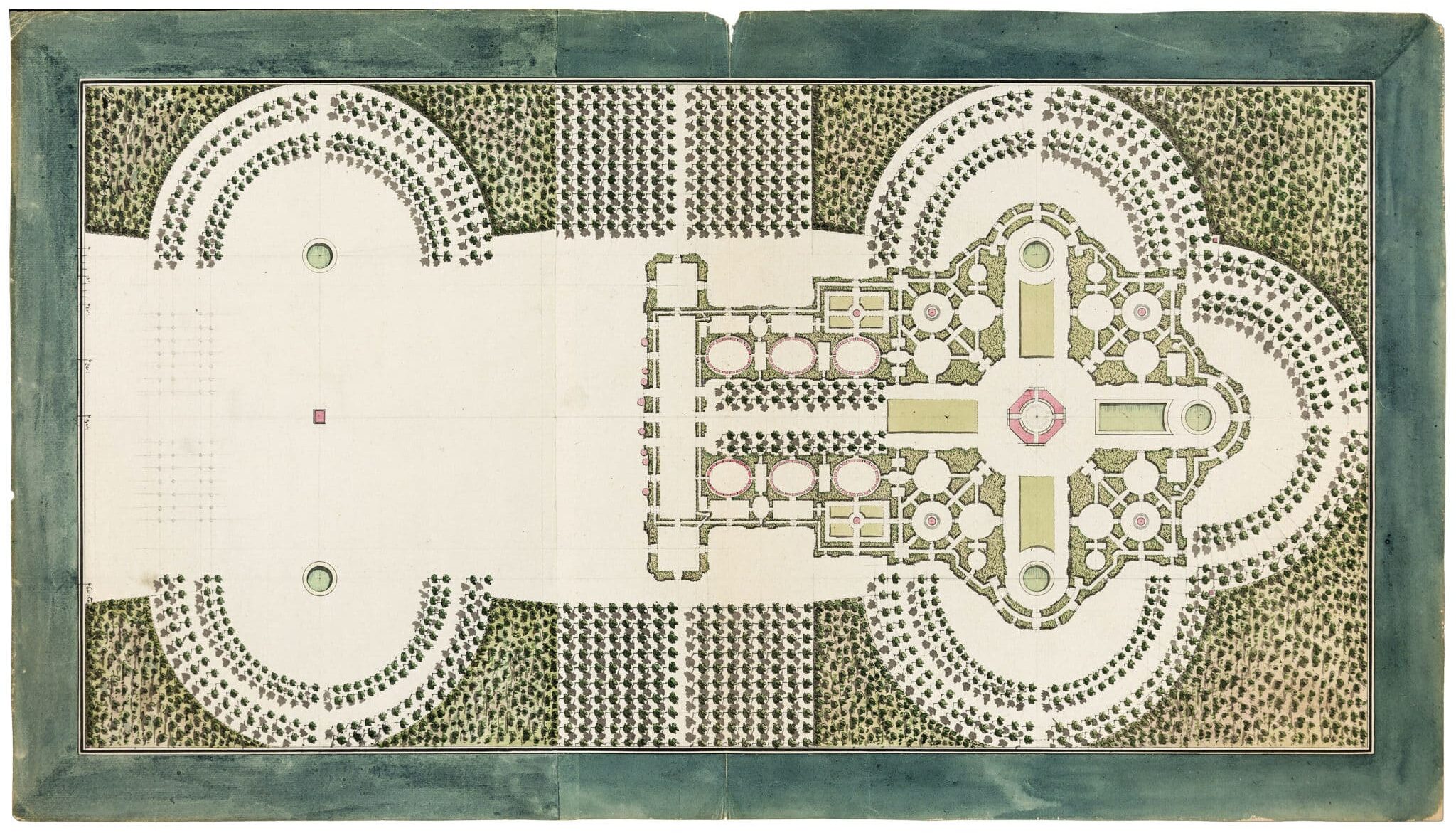
The French architect Gabriel Pierre Martin Dumont employed different levels of section to ingenious effect in his Garden Design Following the Ground Plan of St Peter’s, Rome, 1769, embedding the plan of St Peter’s basilica and its square within a garden design. As Sylvia Lavin has rightly observed, the plan of the piazza is cut at the base of the columns, while the plan of the basilica is cut significantly higher, at the springing of the small domes over the side chapels.[3] In the interest of clarity, however, architectural draughtsmen always sought to maintain a single line of horizontal section across their plans. This did not prevent them, as the same drawing shows, from routinely mixing plans with other representational systems, notably isometric projections. The trees here are not drawn in plan—which would reduce them to a series of discs representing their sectioned trunks—but in foreshortened isometric projection. Dumont further enhanced the sense of verisimilitude by giving each tree its own shadow. This technique was inherited from cartography and military engineering at a moment when architects were integrating their buildings into complex landscapes designed to enrich their renderings and appeal to viewers.[4]
As the Fortezza da Basso drawing demonstrates, isometry and shadows serve three parallel goals: to reduce ambiguity, to establish a hierarchy of values among a drawing’s components, and to animate it. The same drawing reflects an adherence to the old Beaux-Arts convention of casting shadows at a 45-degree angle from the upper left corner of the page. Despite Jean-Paul Carlhian’s assertion that this practice—shadows ‘inevitably cast at a 45° angle from the upper left corner’— ‘can be traced to the fact that France was a country which refused to acknowledge the existence of left-handedness,’ the convention in fact predates the Beaux-Arts system.[5] From a military standpoint, it was the problem of measurement that prompted a reconsideration of parallel projection in the mid-16th century.
In 1551, Oronce Finé, in La Sphère du Monde, proprement dite Cosmographie (The Sphere of the World, Properly Called Cosmography), drew on the gnomonic tradition and linked the calculation of measurements inextricably to shadows, observing that ‘if the said height of the sun is precisely 45 degrees, then all shadowy bodies are equal to their shadows, both straight and inverted.’[6] A few years later, Gemma Frisius demonstrated that the height of any object could be calculated from its shadow. While shadows cast at a 45-degree angle in elevations and sections became the norm once architectural drawing was taught and assessed in academies, their use in plans appeared, however much later and with less consistency. In French academic competition drawings, the earliest known occurrence dates from 1758, in Mathurin Cherpitel’s ground plan of a pavilion along a river, where the student introduced projected shadows to indicate the raised terrace on which the pavilion stood.[7] The technique became widespread in the second half of the 18th century, deployed not only to convey height information relative to the ground plane, but also to bring architectural drawings closer to the pictorial arts.
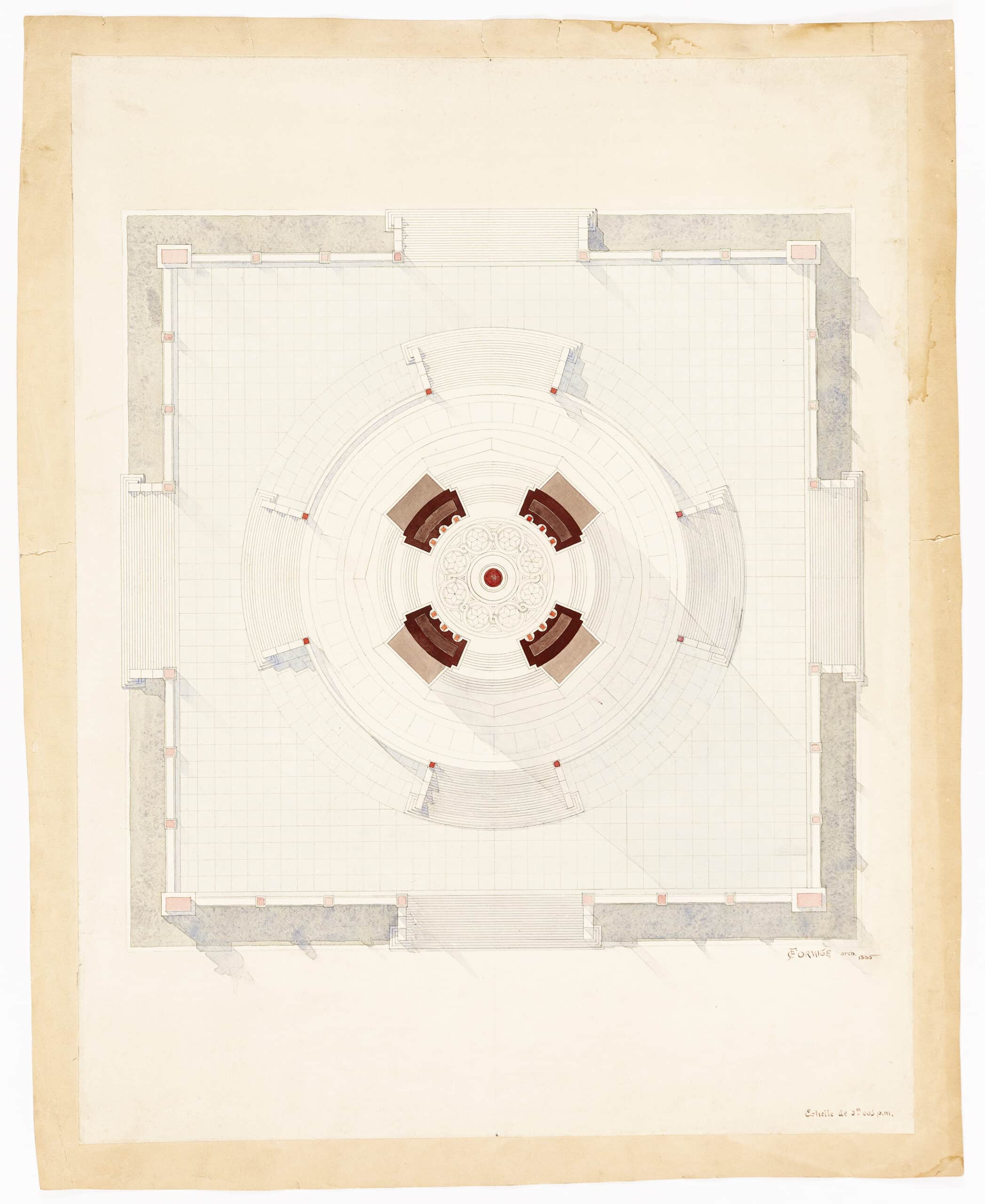
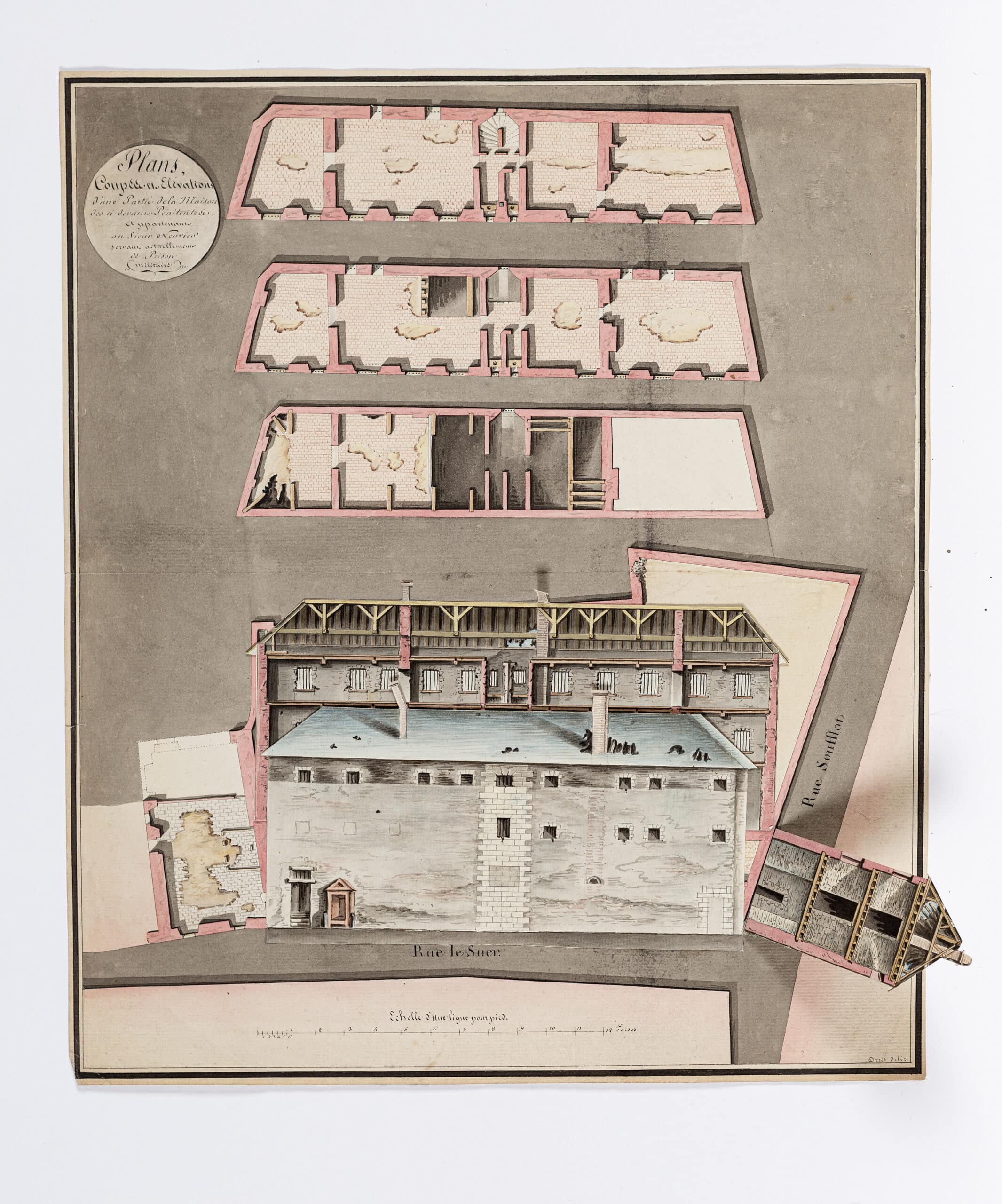
Jean-Camille Formigé, in his 1885 Plan for a Circular Pavilion Set in a Square, similarly uses shadows to suggest the forms of elements located above the horizontal section. Formigé lightly washed in grey-blue the projected shadows of the sculptures at the corners of the terrace, the profile of the balustrade, and the outline of the central pavilion itself. Yet shadows in plans can introduce confusion rather than resolve ambiguity. In an anonymous French Revolutionary project to convert a former convent into a military prison, the sectioned walls—washed in pink according to the by-then-established convention—project grey shadows across the page.[8] These shadows, however, do not trace the missing portions of the walls but only the fragment located beneath the section, an approach that is not only redundant but misleading. Here, the affective dimension of the technique clearly works against its informative one. Such excess attracted criticism early on.
As early as 1803, Claude Mathieu Delagardette, author of the highly influential Nouvelles Règles pour la pratique du Dessin et du Lavis (New Rules to Practice Drawing and Wash), advised that shadows should be added to a plan only for ‘steps, pedestals of figures, basins and other accessory objects,’ and ‘should never be added to walls.’[9] In their place, he recommended what he called coups de force—strong strokes: going over all lines on the shadowed side with a pen two or three times as thick, in the densest black ink—in short, the forerunner of the poché.
Architectural draughtsmen have generally shown restraint in their use of shadows in plans. Among all the conventions and graphic techniques at their disposal, this may be the one most liable to undermine the abstract character of the plan, introducing verisimilitude and the suggestion of vertical depth. Unlike the use of isometric projections for trees—without which the nature of the object would be illegible—shadows in plans, particularly on walls, veer toward the pictorial. They seem to push the plan unnecessarily, and somewhat dangerously, in the direction of axonometry. Given the relatively small number of draughtsmen who have employed them, one can safely observe a clear correlation between the degree of abstraction in graphic representation and the presence or absence of naturalistic signs such as shadows.
Notes
- Peter Lang and William Menking, Superstudio: Life without Objects (Milan: Skira, 2003), 100.
- Paul Emmons. ‘Drawing and Representation. The Uncertain Future of Craft: From Tools to Systems’, Architectural School, ed. by Joan Ockman. (Cambridge, MA: The MIT Press), 2012, 299.
- Sylvia Lavin, ‘Trees Move In’, Drawing Matter, 22 October 2020, https://drawingmatter.org/trees-move-in/ [accessed 25 January 2026].
- Basile Baudez, Inessential Colors: Architecture on Paper in Early Modern Europe (Princeton: Princeton University Press), 170-173.
- Jean-Paul Carlhian, ‘The Ecole des Beaux-Arts: Modes and Manners’, Journal of Architectural Education 33, n° 2 (Novembre 1979), 16.
- Oronce Finé in La sphère du monde proprement dite cosmographie, Paris, Vascosan, 1551, 43, as quoted in Massimo Scolari, Oblique Drawing. A history of anti-perspective (Cambridge MA: The MIT Press, 2012), 12.
- Beaux-Arts de Paris, PRA 49-2.
- Baudez, Inessential Colors, 118-145 and in ‘Karl Friedrich Schinkel’, Drawing Matter, 7 June 2017, https://drawingmatter.org/karl-friedrich-schinkel/ [accessed 22 February 2026].
- Claude Mathieu Delagardette, Nouvelles Régles pour la pratique du Dessin et du Lavis (Paris: Barrois l’aîné, 1803), 7-8.
*
Basile Baudez is an associate professor of architectural history in the Department of Art and Archaeology at Princeton University.
This short text offers an insight into Basile Baudez’s invited contribution in the third colloquium event ‘Tracing Shadows’ led by Professor Mark Dorrian and hosted by the RIBA, V&A Drawings Collections and Drawing Matter in January 2026—a day of conversations, gathered around original drawings and photographs, in which participants examined the presence (and absence) of shadows in the representation of architecture.
