Collection Guide: Aldo Rossi
– Rosie Ellison-Balaam and Nicholas Olsberg
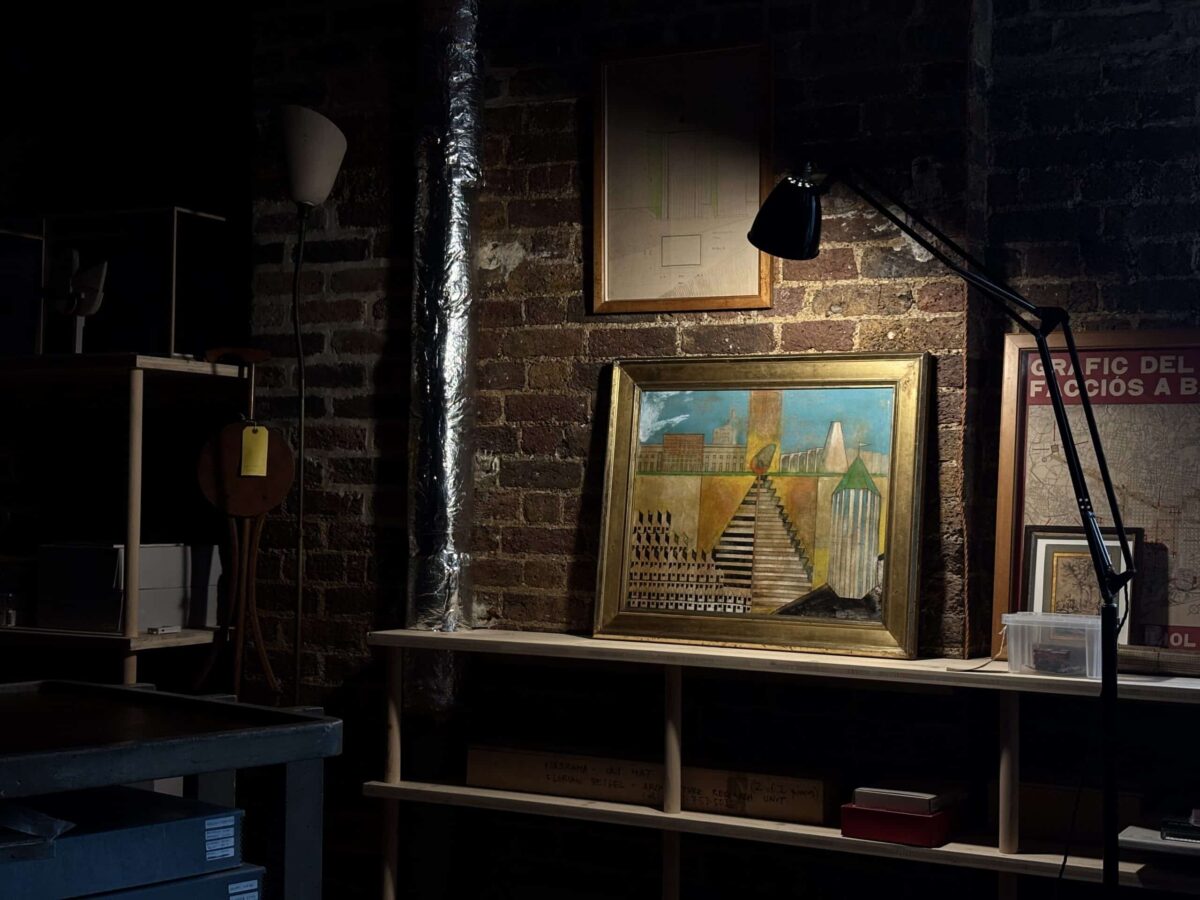
Aldo Rossi (1931-1997) was born in Milan. At age ten, he moved away from the city due to worsening wartime conditions; his early education took place at Lake Como, and later in Lecco. Rossi returned to Milan in 1949, where he entered the Politecnico di Milano to study architecture under Piero Portaluppi (1888-1967). Rossi received his architecture degree in 1959, having taken ten years to graduate; he had taken a larger interest in politics than his studies, joining the Italian Communist Youth Federation in 1954, and began editing their magazine Voce comunista. Rossi first contributed an article to Casabella-Continuità in 1954 and by 1955 was invited by Ernesto Nathan Rogers to become an editor. While a student Rossi also worked in the architectural offices of Ignazio Gardella and later for Marco Zanuso.
It was in these Milanese circles of architecture and Marxism that Rossi encountered Carlo Aymonino and Giorgio Grassi, with whom he would form the movement later known as La Tendenza. The group sought to challenge the dominance of the Modern Movement, which had failed to respect or respond to the traditions of building, and lacked an engagement with how people interacted with architecture. They proposed engaging traditional forms as active agents in the production of architecture. Rossi’s L’architettura della città, first published in 1966, articulates his theoretical programme for architecture. He emphasises the significance of typology to understand a city and its individual buildings, but also in developing appropriate architectural designs. He writes the text not as a doctrine, but as an analytical approach in which identifying typologies becomes the first step in the design process.
By 1965 Rossi had won his first architectural competition for the new piazza in front of the city hall of Segrate in Milan, which included the monument to the partisans of the Second World War. He would go on to win the competition for San Cataldo Cemetery in 1971, shortly after a serious car crash on a trip to Eastern Europe with Giorgio Grassi. The same year, the construction began on the Gallaratese district of Milan, which he had worked on with Carlo Aymonino. From the late 1970s into the 1980s, Rossi received more international attention, from his teaching positions at the Cooper Union and Cornell University, and his involvement with the Institute of Architecture and Urban Studies run by Peter Eisenman. In 1986, Rossi opened a satellite office in New York to oversee his first major commissions in the United States. Following this expansion, Rossi received global acclaim, winning the Pritzker Prize in 1990.
Although his architectural career commenced with writing, editing, and teaching, drawing—especially drawing with colour—remained the principal means to explore and communicate his ideas, and to evoke the emotional resonance of his built works. One day each week was dedicated to imaginative drawing, regardless of his other commitments. Working and specification drawings were largely assigned to associated practices, allowing the studio to remain an atelier practice in which Rossi’s fascination with drawing could be sustained. As a result, his work fitted very readily into the new gallery and museum world of the 1970s and 1980s, entering collections across Europe and North America.
The principal archive of the office—with well over two thousand project drawings and models—is at the CCA which received the material from Rossi’s estate in 2001. However, substantial collections were gathered throughout Rossi’s lifetime by many other repositories as well, most notably the Deutsches Architekturmuseum, with extraordinary holdings of the earlier work from the period between 1969–78. The Getty Research Institute acquired the principal corpus of the libri azzuri—the written and drawn journals that constitute the bones of Rossi’s A Scientific Autobiography—while Centre Pompidou has a significant group of later drawings, starting in 1973. In recent years the substantial, albeit somewhat scattered, material from branches of the estate and the gallery market have continued to enter collections, including those of the Italian state. A comprehensive collection of printed multiples and other graphic works is held at the Bonnefanten Museum, and there are small but important incidental groups at the Museum of Modern Art in New York, and the Tchoban Foundation in Berlin.
The selection gathered by Drawing Matter covers the entire scope of Rossi’s architectural work from 1969 to 1995, and illustrates the varied methods, media, and techniques he employed. This selection provides a window into Rossi’s central ideas as expressed through drawing.
ON ALDO ROSSI AND HIS APPROACH TO DRAWING, READ HERE TEXTS PUBLISHED ON DRAWING MATTER SINCE 2011.
TO VIEW THE COMPLETE DRAWING MATTER COLLECTIONS OF ALDO ROSSI, CLICK HERE.
MUSEUM SKETCHES, 26 DECEMBER 1969
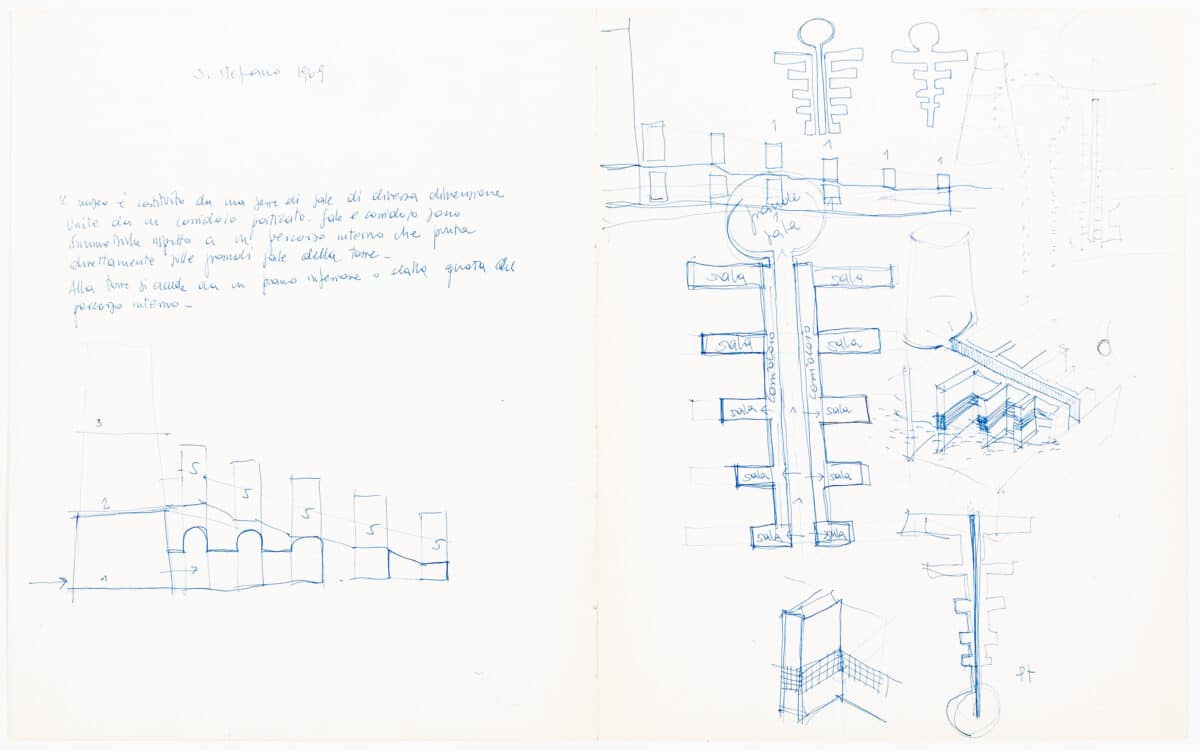
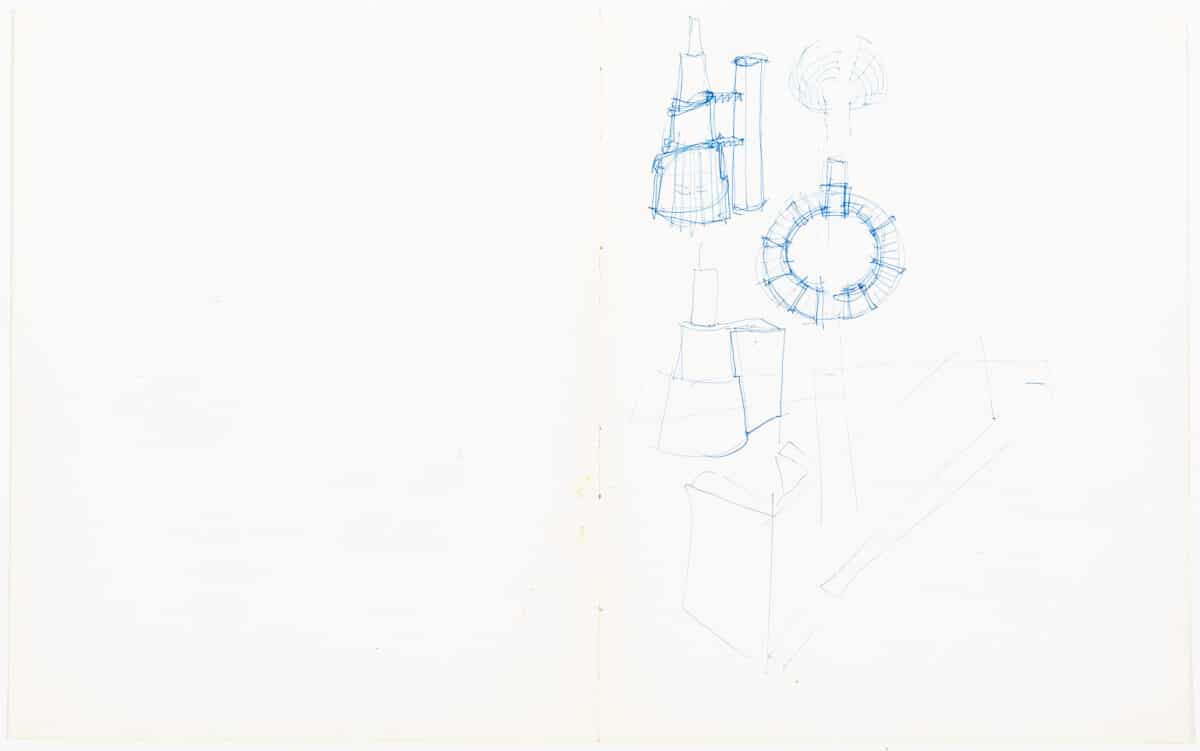
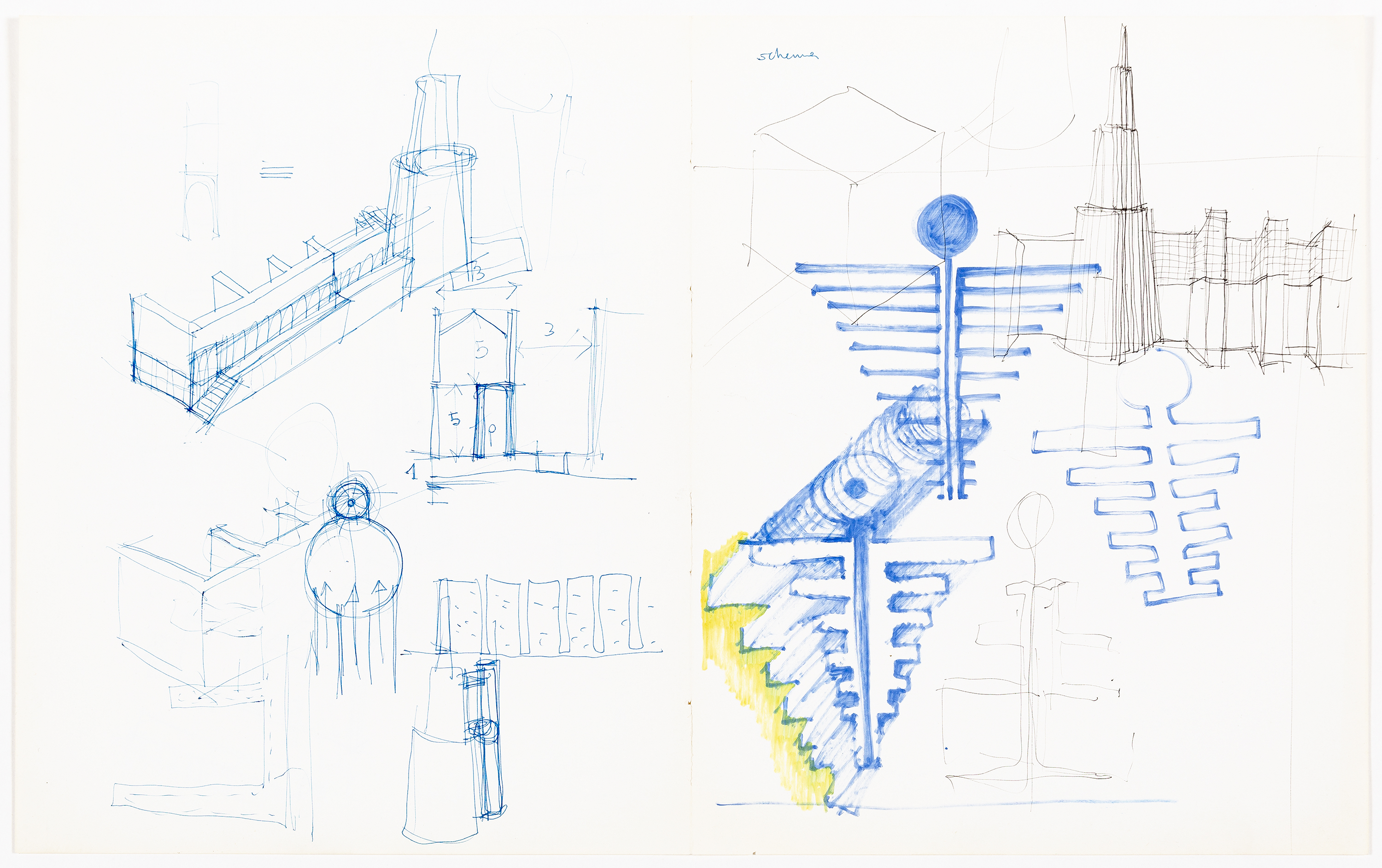
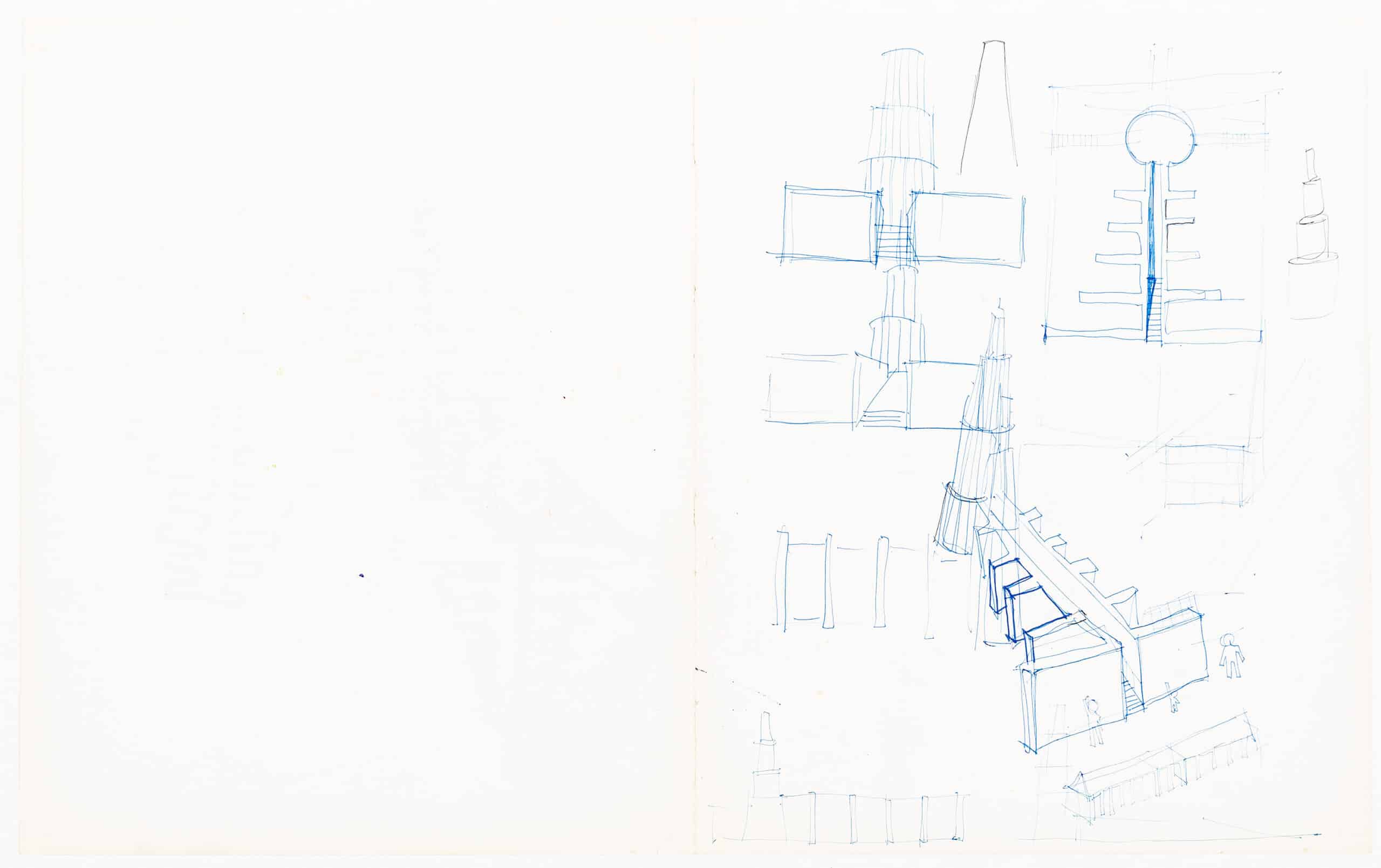
Two sheets taken from early sketchbooks with conceptual studies for a proposed museum. The drawing is dated ‘S. Stefano, 1969’ (26 December) and Rossi provides a short note explaining the arrangement of rooms in his design.
‘Il museo è costituito da una serie di sale di diversa dimensione
unite da un corridoio porticato. Sale e corridoio sono
simmetriche rispetto a un percorso interno che punta
direttamente sulle grandi sale della torre.
Alla torre si accede da un piano inferiore o dalla quota del
percorso interno.’
‘The museum is made up of a series of rooms of different sizes
connected by a porticoed corridor. The rooms and the corridor are
symmetrical with respect to an internal route that points
directly toward the large rooms of the tower.
Access to the tower is from a lower level or from the elevation of the
internal route.’
The building was developed as a pair of rising, graduated sequences of rooms flanking a porticoed corridor, which ends in a tapered, conical, or ziggurat tower on a circular base. The studies have a striking resemblance to Rossi’s sketches of the progetto di concorso per la galleria d’arte contemporanea, Milano (competition design for the contemporary art gallery, Milan) produced in 1970 held in the collection of the Fondazione Aldo Rossi.
The studies explore formal characteristics that were beginning to appear in the designs for his first important built project in the Gallaratese district of Milan (1969-70). These forms became essential elements of the two major built works that followed: San Cataldo cemetery in Modena (1971-78) and the school at Fagnano Olona (1972), and also took a central place in his imaginative constructions of the theatre of the city, late into the 1970s, before reemerging in elegiac form in the Bonnefanten Museum in Maastricht (1990–95). The two sheets in the Drawing Matter collection came from the collection of critic and Rossi’s collaborator Vittorio Savi.
SAN CATALDO CEMETERY, MODENA, 1972
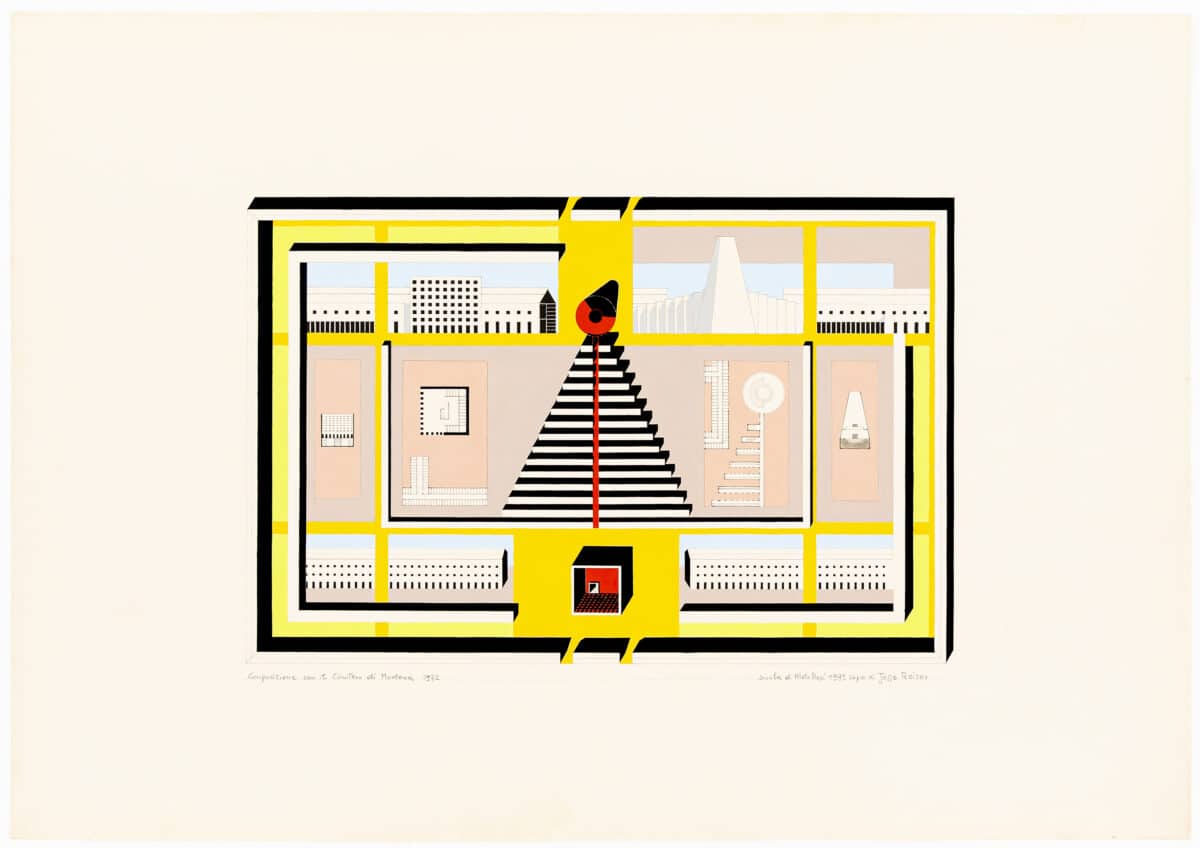
Aldo Rossi and his collaborator, Gianni Braghieri designed the Cemetery of San Cataldo for a 1971 competition calling for an extension to the adjacent nineteenth-century Costa Cemetery. Their winning proposal, rooted in the typology of the cemetery, is laid out by Rossi in the competition text, ‘L’azzuro del cielo’ (‘The Blue of the Sky’). The text was first published in Controspazio 10 (October 1972), with the first English translation following in 1976, in Oppositions 5. The text addresses the composition of forms, the types of burial (graves and ossuaries), its materiality, and its relationship to the existing site and context, with particular focus on its urban and civic significance.
Drawing Matter holds an edition of the iconic summary presentation of the San Cataldo scheme in which systematised silhouette perspectives and simplified plans of the entire proposed scheme and its elements—some never completed—are rendered as a montage.
Rossi employed this aerial perspective in many iterative drawings to give a sense of both plan and elevation at once, drawing on perspectives developed in the fifteenth century. For this view of the cemetery, Rossi credits Braghieri. ‘Questa visione prospettica o di una strana assonometria ribaltata è uno dei punti principali da cui ho sempre visto il progetto. Esso deforma il disegno originale fatto da Gianni in mia assenza che mi aveva colpito moltissimo per le ombre in avanti’ (‘This perspective view, or strange inverted axonometric projection, is one of the main points from which I have always viewed the project. It distorts the original drawing made by Gianni in my absence, which struck me greatly because of the forward shadows.’) The combination of this perspective with its graphic framing presents the scheme in both fragment and summary, both part of a city and a city in itself. Coupled with its elemental forms and colours, the drawing constructs a visual journey through the drawing; often likened to the children’s boardgame Il gioco dell’oca (the game of the goose).
Several original versions in softer tones appear in other collections, notably in the Deutsches Architekturmuseum, which holds the primary corpus for the project. The framed original can be seen in Luigi Ghirri’s photographs (1988) of Rossi’s studio on Via Maddalena. This revisited version, in the Drawing Matter Collection, was painted in vivid colours directly from the tube by Rossi’s intern Jesse Reiser, who had studied at the Cooper Union under John Hejduk, and met Rossi during his time there.
STUDENT HOUSING, ‘LA CALDA VITA’, TRIESTE, 1974-75
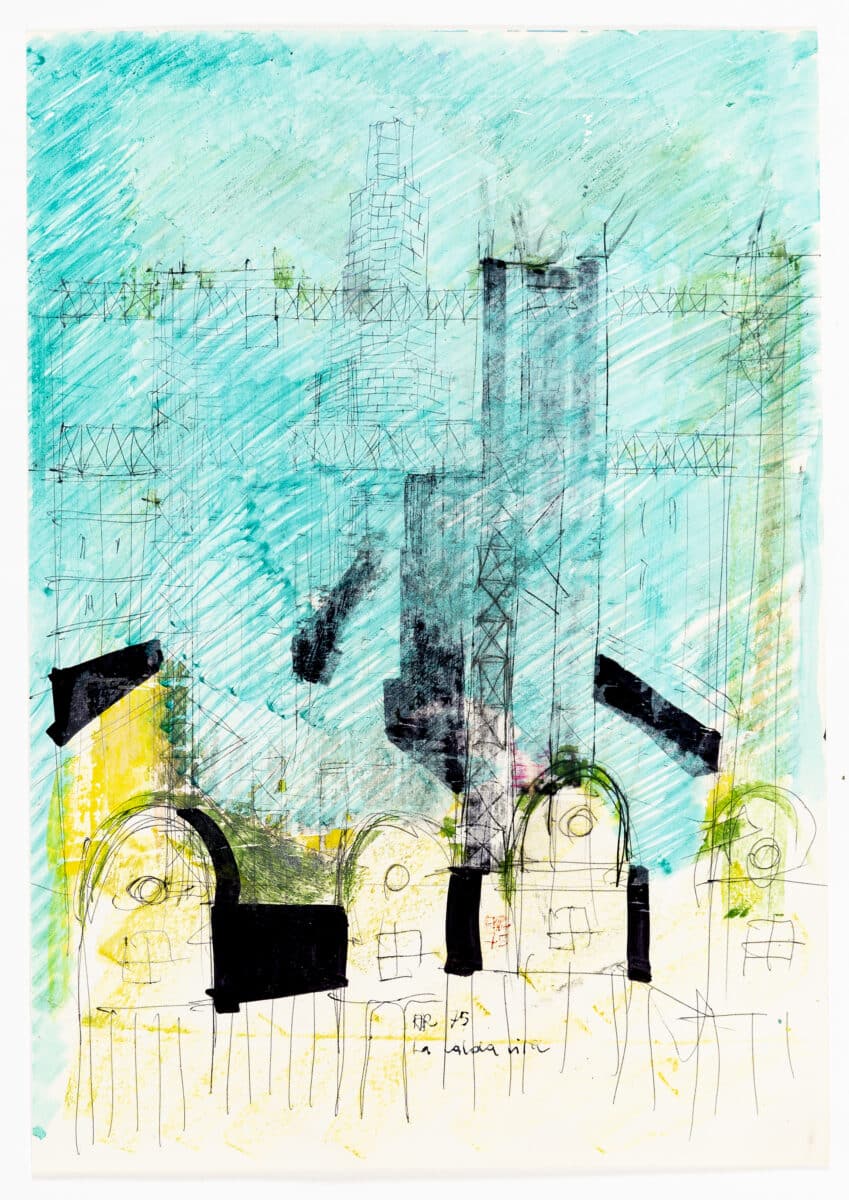
This coloured perspective depicts an unbuilt student housing scheme in Trieste, a project often referred to as ‘La calda vita’ (the warm life). This informal title speaks of the life of the city, and is a direct reference to two Triestine writers, the poet Umberto Saba and novelist Pier Antonio Quarantotti Gambini, whose 1958 coming-of-age novel had the same title.
Rossi’s proposal places the student rooms within four scaffolded frames, projecting outward from a community building. These wings are raised to negate the sloping conditions of the site. The model for Rossi’s radiating building has its origins in both Karl Moser’s Lichthof at the University of Zurich (1914) and Berlage’s Amsterdam Stock Exchange (1896), as well as the Galleria del Mengoni in Milan (1865), it is also a form which Rossi had previously implemented in his design for a villa in Ticino (1973). Similarly to San Cataldo Cemetery, there is a civic desire both to create a city in itself and to connect to the wider surroundings. Rossi composes the complex with archetypal forms from the city, creating an urban terrain of streets, tunnels, and squares.
The project is exhaustively documented in a collection of drawings held at the CCA.
ELEMENTARY SCHOOL, FAGNANO OLONA, 1972-75
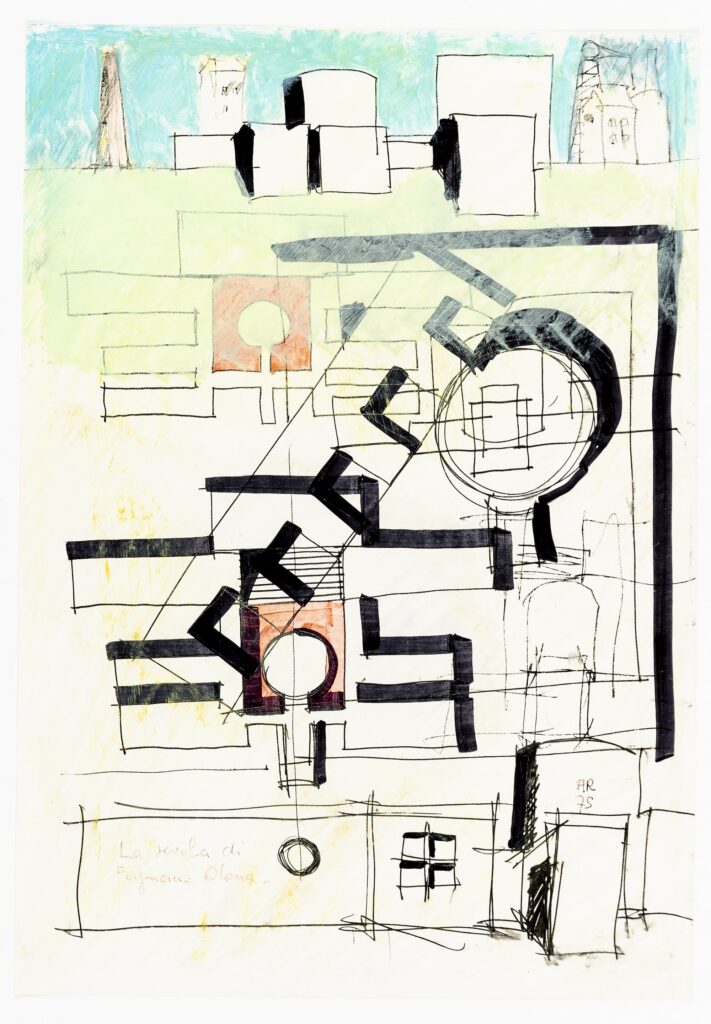
A composite of sketches of plans and perspectives on a single sheet presenting the entire scheme for a primary school in the town of Fagnano Olona, just south of Varese in Lombardy.
The built project contains 22 classrooms which open onto the central courtyard space; Rossi likens this interior space to that of a theatre—‘Questo spazio si presta sia alla attività didattica all’aperto sia a rappresentazioni teatrali didattiche per gli scolari’ (‘This space is suitable for both outdoor educational activities and educational theatre performances for children’). Unlike with other projects, which began with a perimeter, the primary school at Fagnano Olona was devised from the library outward: ‘Ma in questa scuola la biblioteca è il punto iniziale della progettazione della forma’ (‘But in this school, the library is the starting point for the design of the building’). In the sketch held by Drawing Matter, the library’s central rotunda appears five times across the image.
STUDENT HOUSING, CHIETI, 1976
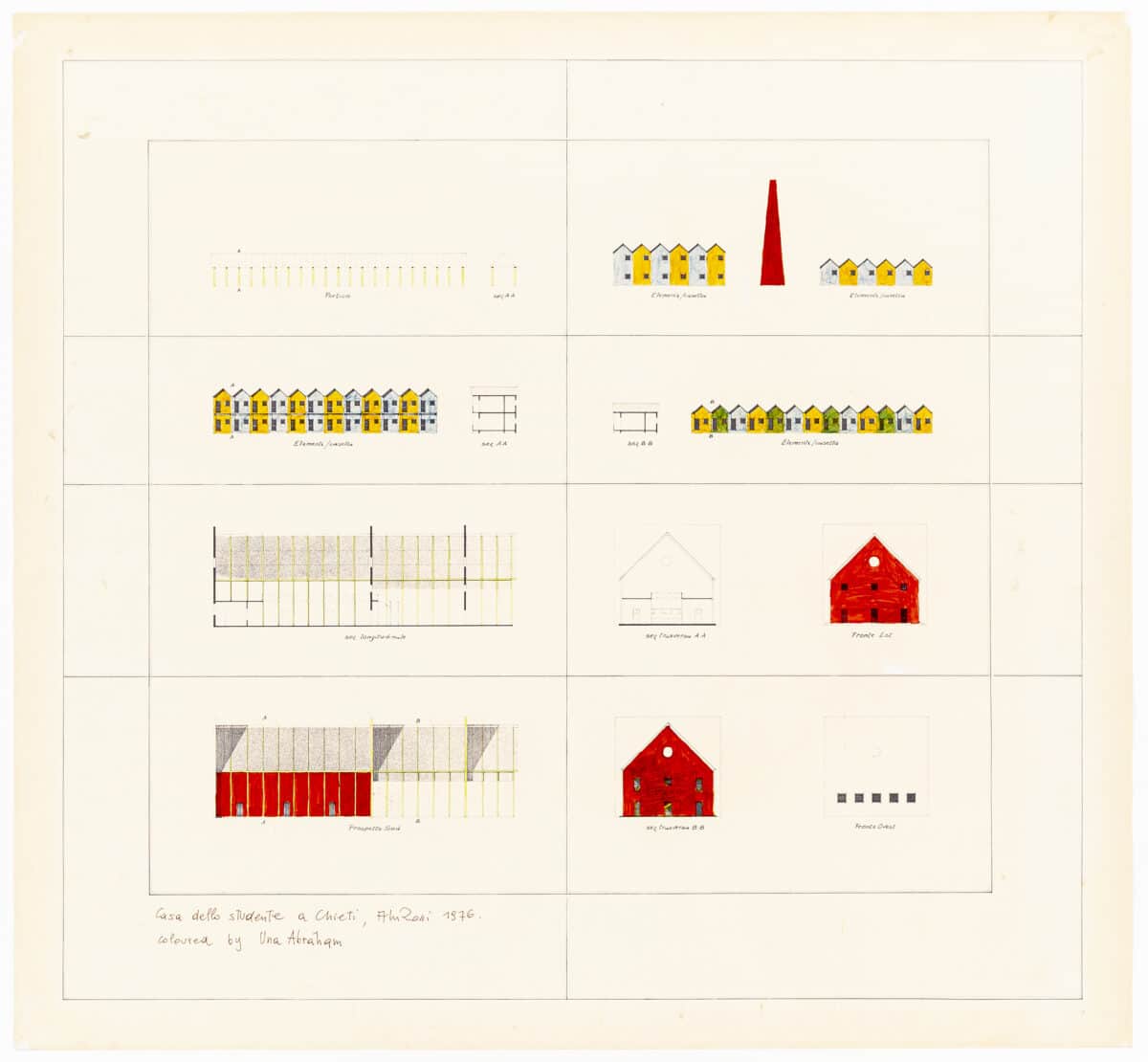
A formal montage of 8 measured drawings of Rossi, Gianni Braghieri, and Arduino Cantafora’s 1976 competition entry for student housing for the newly founded D’Annunzio University in the city of Chieti, close to Pescara in Abruzzo. The drawing presents elevations of the two housing types and the project’s community centre. It states in the bottom left corner that the drawing was coloured by Una Abraham. Abraham, an architect herself, but also the daughter of Rossi’s peer Raimund Abraham.
The scheme presented ‘a miniature town’ where students could live like other citizens in a house of their own—this ‘house’ rendered with a pitched roof and square windows, typifying its vernacular form. Rossi traces his interest in this simplified architecture back to the beach cabins of Isola d’Elba. This form was equally tied to the economy of the project, each unit could be built individually and in a variety of materials to accommodate the university’s fluctuating budget.
BUSINESS CENTRE, FLORENCE, 1977-78
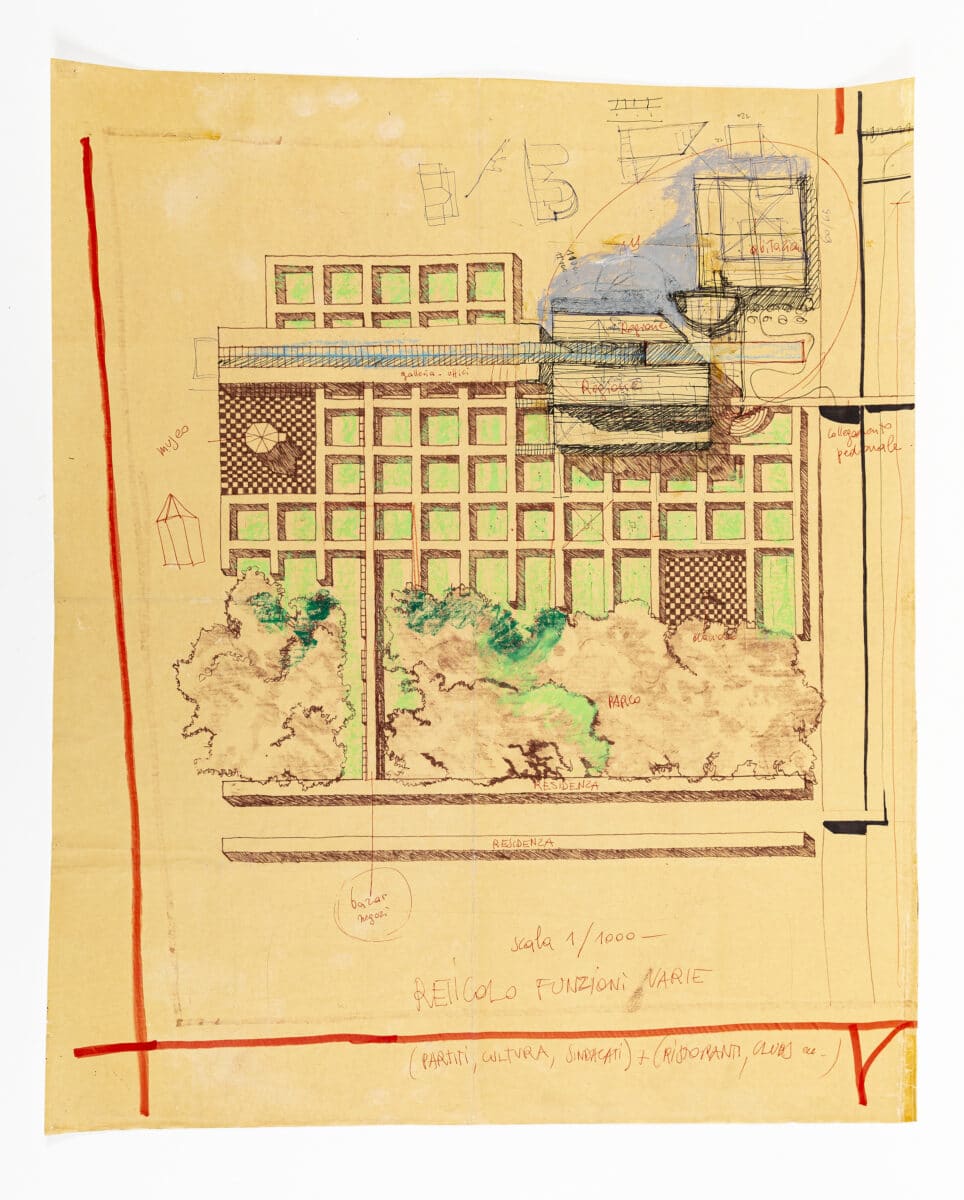
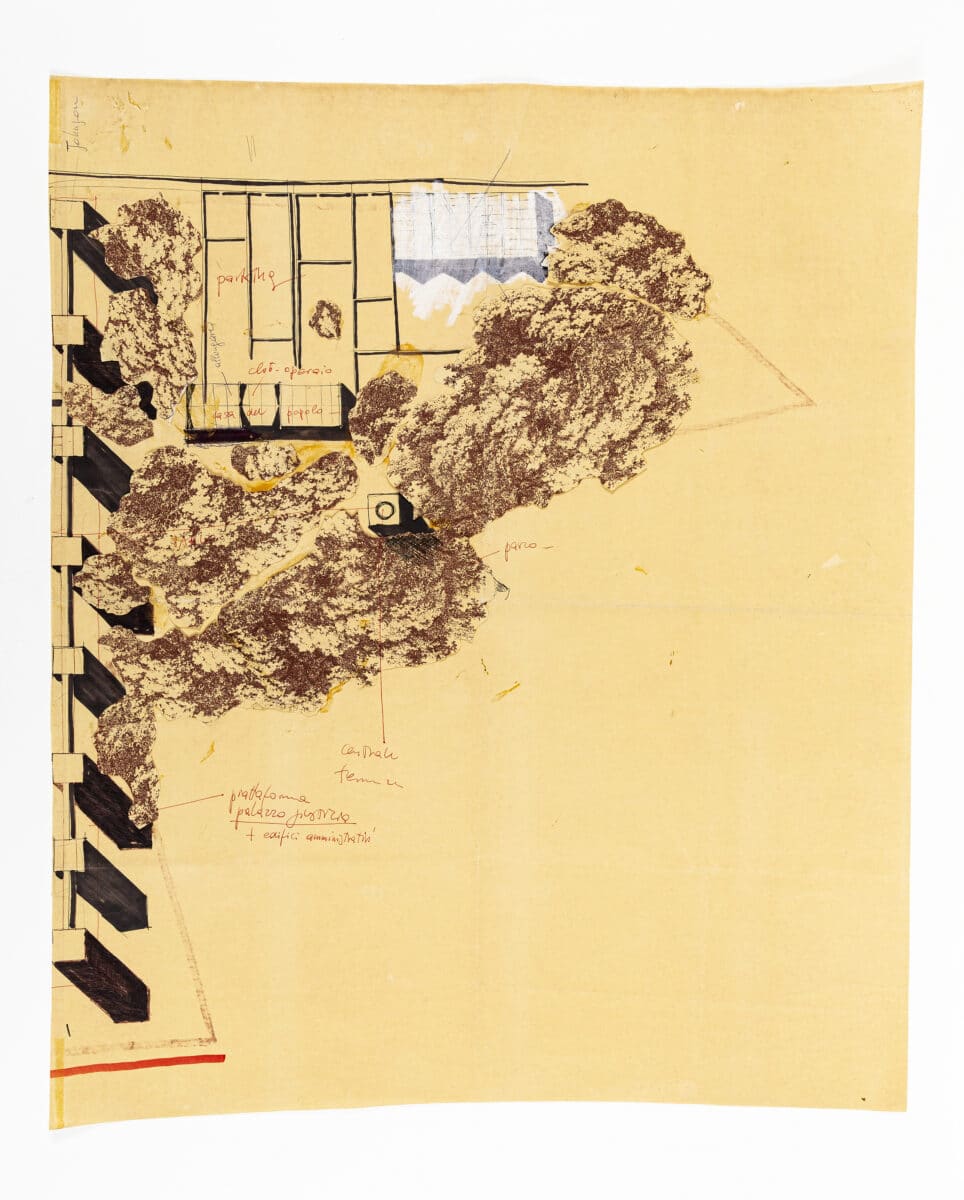
A large coloured collage on a photocopy base of a proposed business centre in the west of Florence. The drawing is littered with annotations and sketches by multiple hands, perhaps a drawing at the centre of a conversation between his collaborators Gianni Braghieri and Carlo Aymonino. The notes are predominantly regarding the programming of spaces, from shops, parks, a ‘people’s palace’, administration spaces, parking and residences, to a museum. At the bottom of DMC 2344.1 Rossi writes, ‘scala 1/1000, reticolo funzioni varie, (partiti, cultura, sindacati) + (ristoranti, clubs, ecc.)’ (scale 1/1000, various functions grid, (political parties, culture, trade unions) + (restaurants, clubs, etc).
Rossi criticises the concept of the ‘business district’ as a detached element from the urban dynamic and thus approaches the scheme as one that tries to integrate into Florence. He does this through the unification of pre-established ‘pieces’; the types of other cities, recovery of his own works, and homages. In the case of ‘il centro direzionale’, Philip Johnson is cited as one of those homages; on the top left of DMC 2344.2 ‘Johnson’ is written.
These two sheets held by Drawing Matter act as a key to the extensive archive of the project at CCA.
URBAN FRAGMENTS
Rossi operates as an artist as he does as an architect, throughout his career producing drawings and paintings that formulate, explore, and reiterate his vocabulary of historical and vernacular forms. These analogous drawings represent a decontextualised recomposition of architectural memory, producing dream-like visual assemblages. This reuse and reinvention of forms and themes speaks to his attitudes towards architecture itself; nothing is ever exhausted; the process of architectural design is an evolution of existing forms. As he explains in his seminal text, L’architettura della città (1966), the city is a collection of urban artefacts integrated into collective memory, enabling the thread of history to extend to the present.
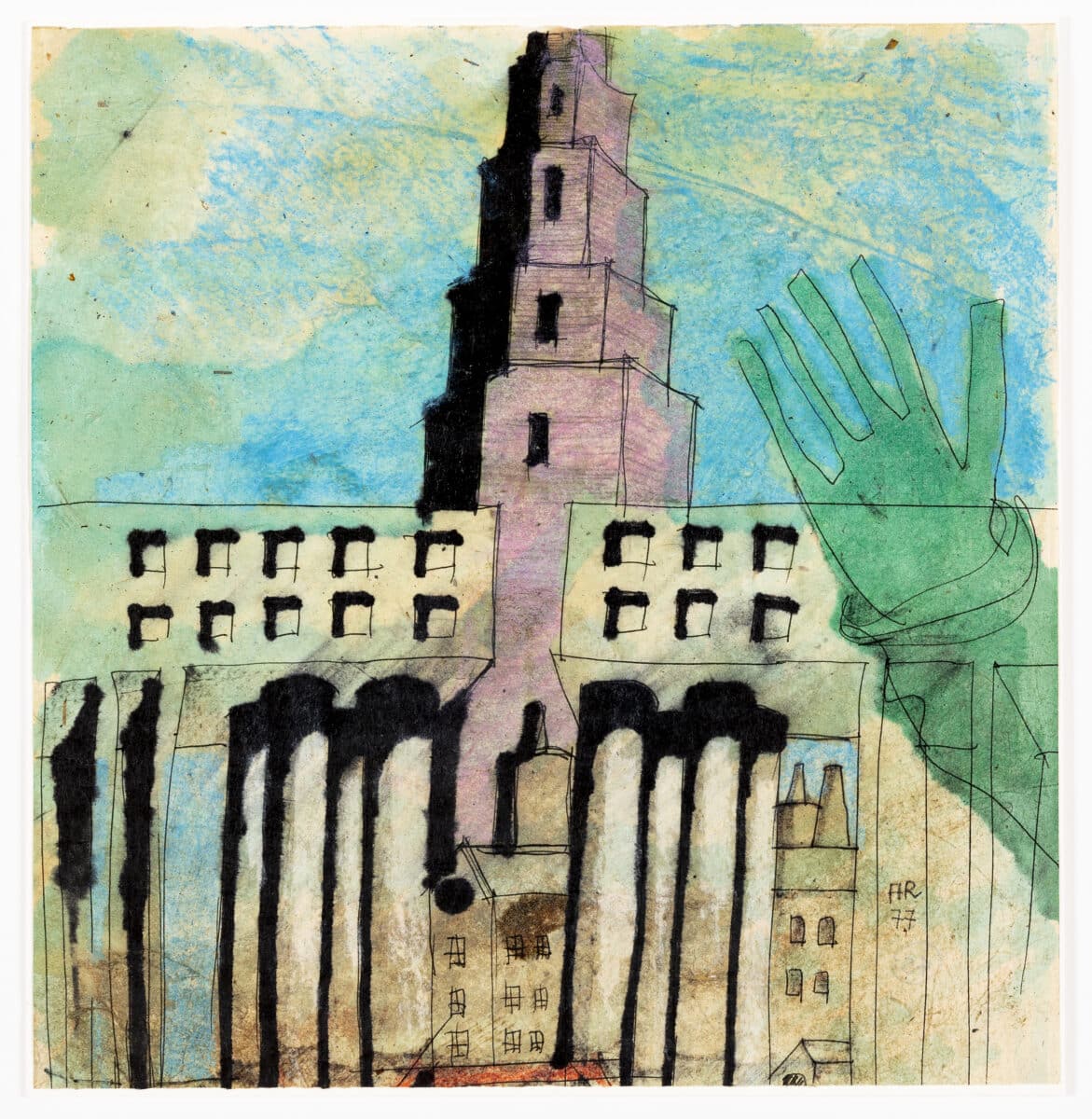
DMC 1799 entitled ‘urban fragment’ reiterates both the entrance to the Cemetery of San Cataldo and the elevated housing of Gallaratese. Projected over the scene is the hand of San Carlo Borromeo (also known as San Carlone), a colosso statue of the saint in Ancona. It was a statue which had captured Rossi’s imagination since his childhood, not only in its giant scale, but in the ability to climb stairs in its interior to view Lake Maggiore through windows in San Carlo’s eyes.
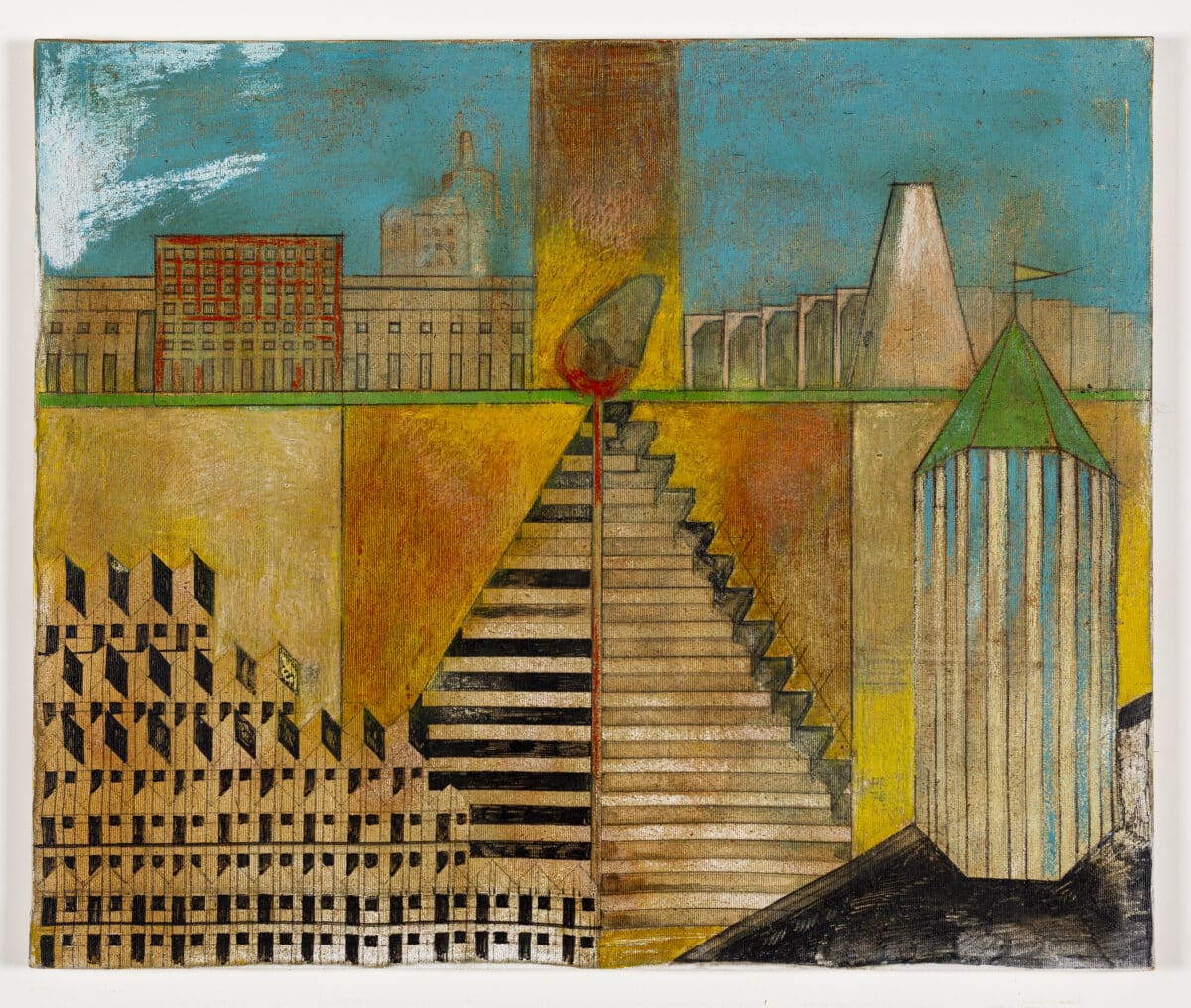
DMC 3584 is Rossi’s painting ‘Geometrica della memoria’ (Geometry of the memory) which collages together San Cataldo, Gallaratese, and the proposal for student housing at Chieti, with a turreted striped tent. From the 1970s onward Rossi’s architectural thinking had evolved from the collective memory of the city, incorporating more and more personal memory. These later painted works became autobiographical.
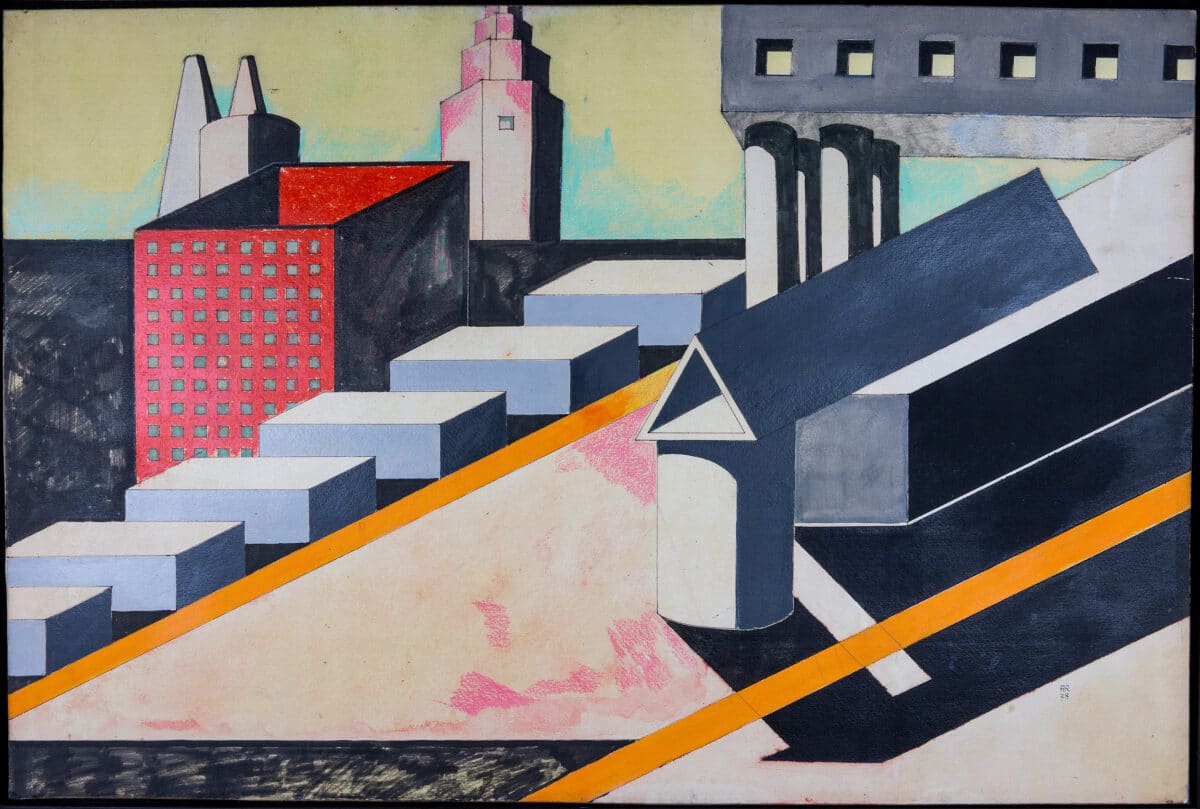
Titled ‘Scena per il teatrino’ (scene for the little theatre) DMC 2286, captures the forms of Gallaratese, San Cataldo, and his first built work, the Segrate monument in Milan (1965), to the partisans of the second world war. Many of these later works were produced as art pieces for sale; Rossi’s works were sold in his lifetime, primarily through the Max Protetch gallery.
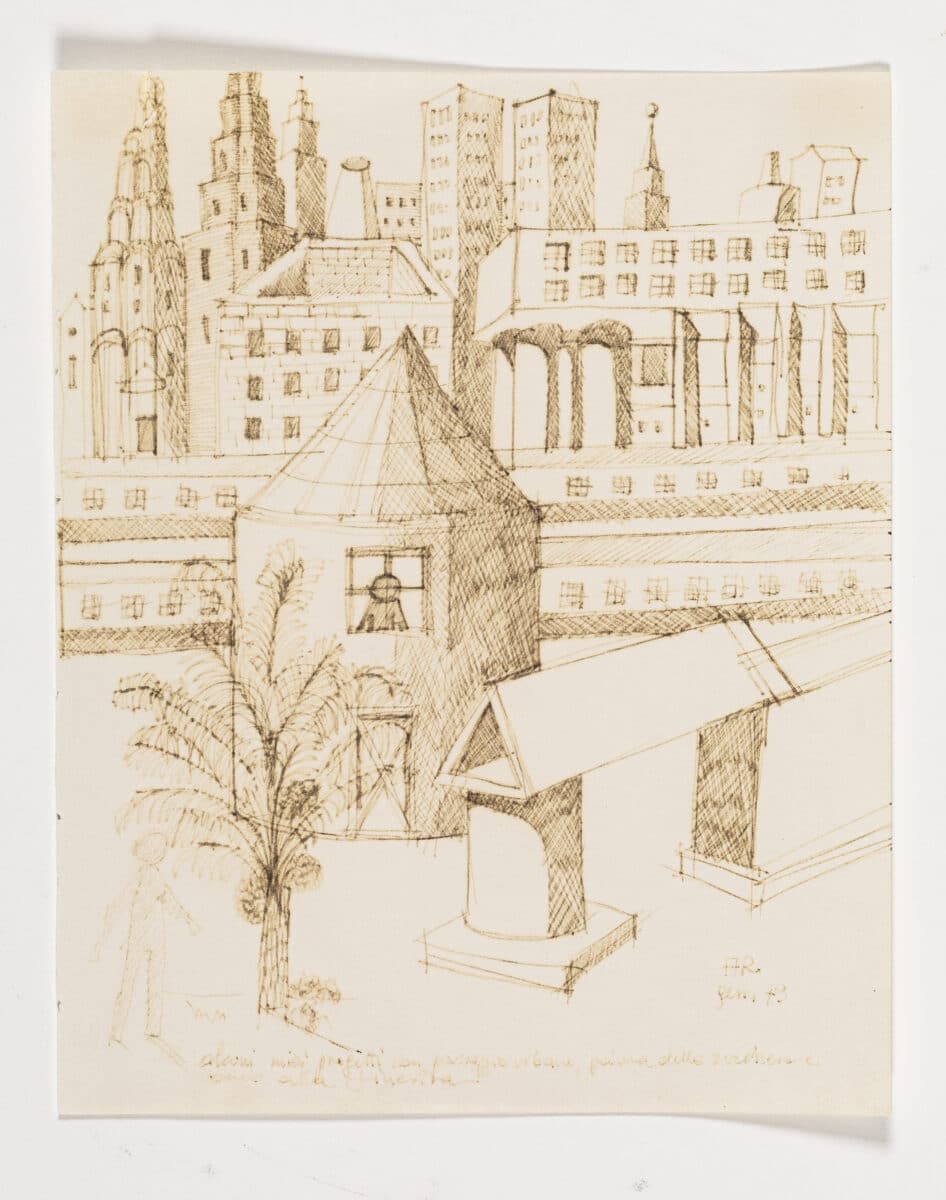
DMC 3583 entitled ‘Alcuni miei progetti con paesaggio urbano, palma dello zucchero, e uomo alla finestra’ (‘Some of my projects with urban landscape, sugar cane, and man at a window’), depicts amongst stepped towers, San Cataldo, Gallaratese, the Segrate monument. In the foreground is a circular structure with a turreted roof, door and square window; standing in the window is a small unidentifiable figure. For Rossi the window represents an ambiguous line between private and public space, interior and exterior, implementing them into his drawings to instill a sense of unification or separation.
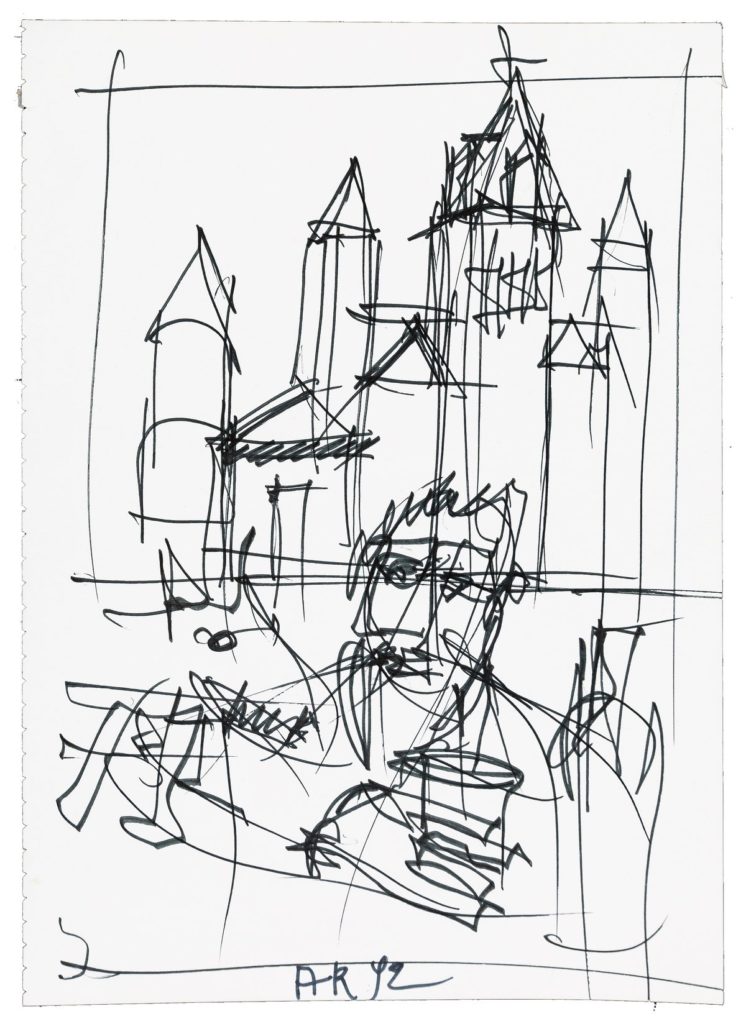
DMC 3013 features a self-portrait of Rossi with his bull terrier, Umberto. They appear to lean on a table, with a glass and bottle in front of them. The sketch was drawn in 1992 at the start of the construction of the Bonnefanten Museum in Maastricht.
TEATRO DEL MONDO, 1979-81
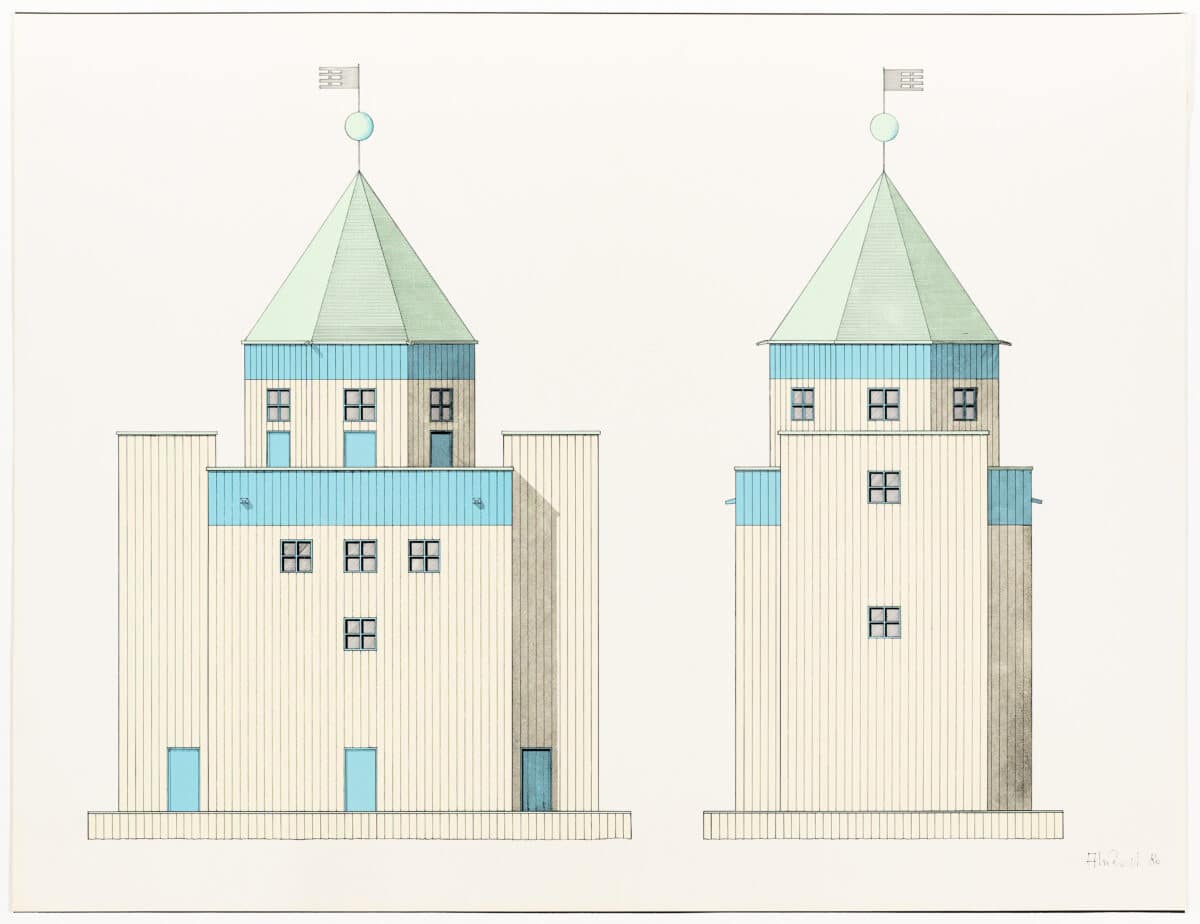
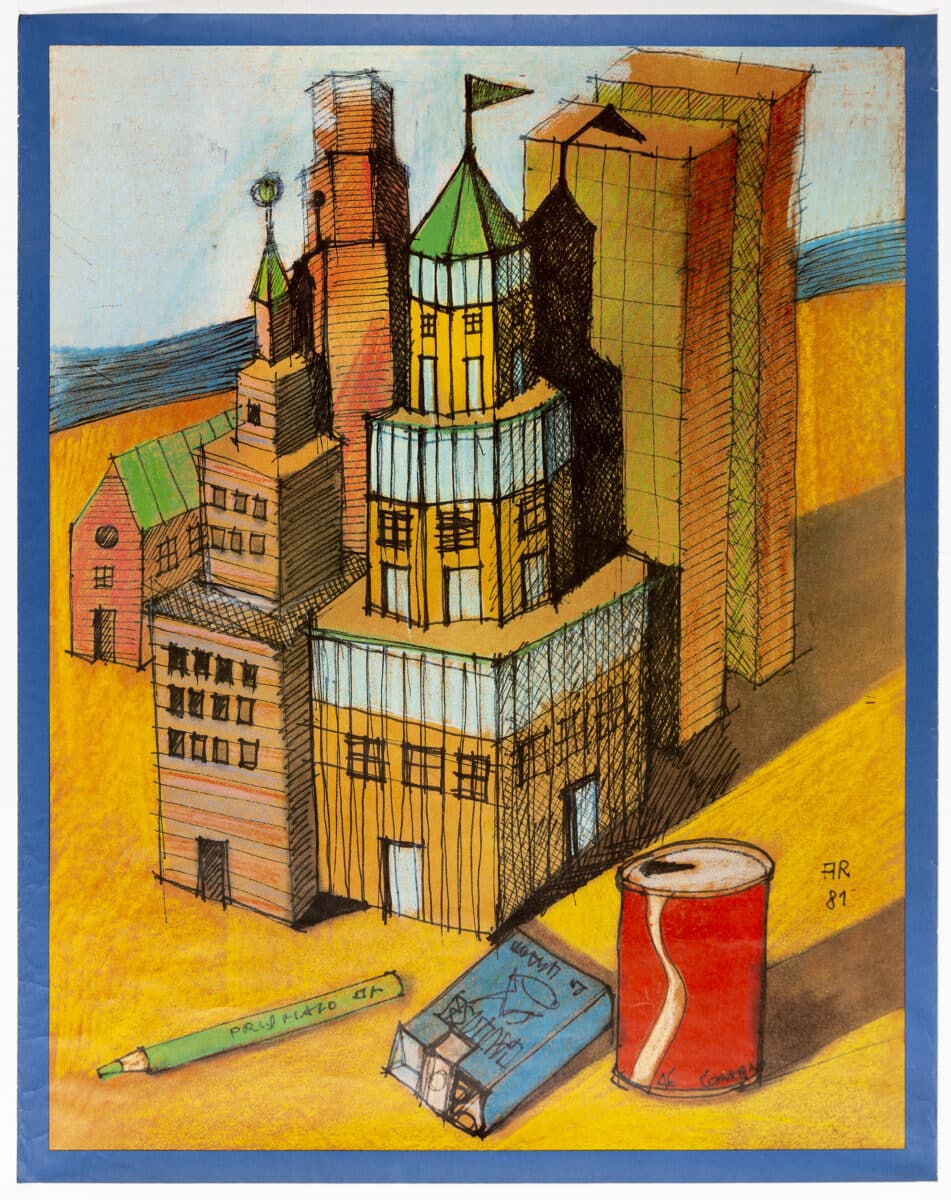
Rossi’s Teatro del mondo was designed and constructed for the First Venice Architecture Biennale, directed by Paolo Portoghesi under the theme of ‘presenza del passato’ (‘presence of the past’). The floating theatre draws on many influences, from lighthouses on the coasts of Brittany and Portugal, the cabins of Isola d’Elba, 16th century floating stages on the San Marco Basin, and the construction of temporary Greek and Roman theatres, and wooden boats. It was also noted by Manfredo Tafuri that the first appearance of the Octagonal tower in Rossi’s oeuvre was for the competition entry to the Florence Business Centre (1977); its centrepiece a theatre-museum informed by the San Giovanni Baptistery in Florence.
Rossi writes particularly on the influence of lighthouses and boats—wooden structures which occupy the liminal space between land and water; Venice the liminal city par excellence. He looked not only to their vernacular forms but to their construction techniques and materiality. The theatre was constructed on a barge in the Fusina shipyards—a 20m-high wooden and steel structure (innocenti scaffold pipes) that could accommodate up to 400 people.
Designed to house ‘scenes’ of urban memory and invention, the theatre was emblematic of the history of historic centres. It entered into a dialogue with Venetian buildings and in particular La Punta Dogana, where it was anchored. Its statue of a putto stood on a golden orb in direct conversation with the theatre’s orb and metal flag.
The project was co-sponsored by the Biennale’s theatre and architecture departments. The theatre was opened to the public on 11 November 1979 as part of a themed exhibition entitled ‘Venezia e lo spazio scenico’ (‘Venice and the space of the stage’). From 28th January to 19th February 1980 the theatre hosted the inaugural ‘Carnival of the Theatre’, then, in early August, was pulled by a barge and travelled south to Dubrovnik to participate in the International Theatre Festival. In Dubrovnik, Rossi remarked on its change in character, in the face of its architecture becoming a castle or fortification. By late August it was pulled back to Venice to participate in the Architecture Biennale. After the Biennale the theatre was burnt, following Rossi’s stance that the work had to be temporary.
Drawing Matter holds two works related to the Teatro del mondo. First, a colour serigraph from 1980 of two paired elevations. Second, a colour print from 1981 in the form of a ‘still life’. The print imagines a collage of the city’s towers with a brick ziggurat and purist glass container, nestled next to an adapted Teatro del mondo. Rossi plays with the scale of the theatre, both a monumental structure on the horizon of the sea, and a set of building blocks sitting on a table amongst his pencils, cigarette packets, and coke cans.
VENICE ARCHITECTURAL BIENNALE, 1980
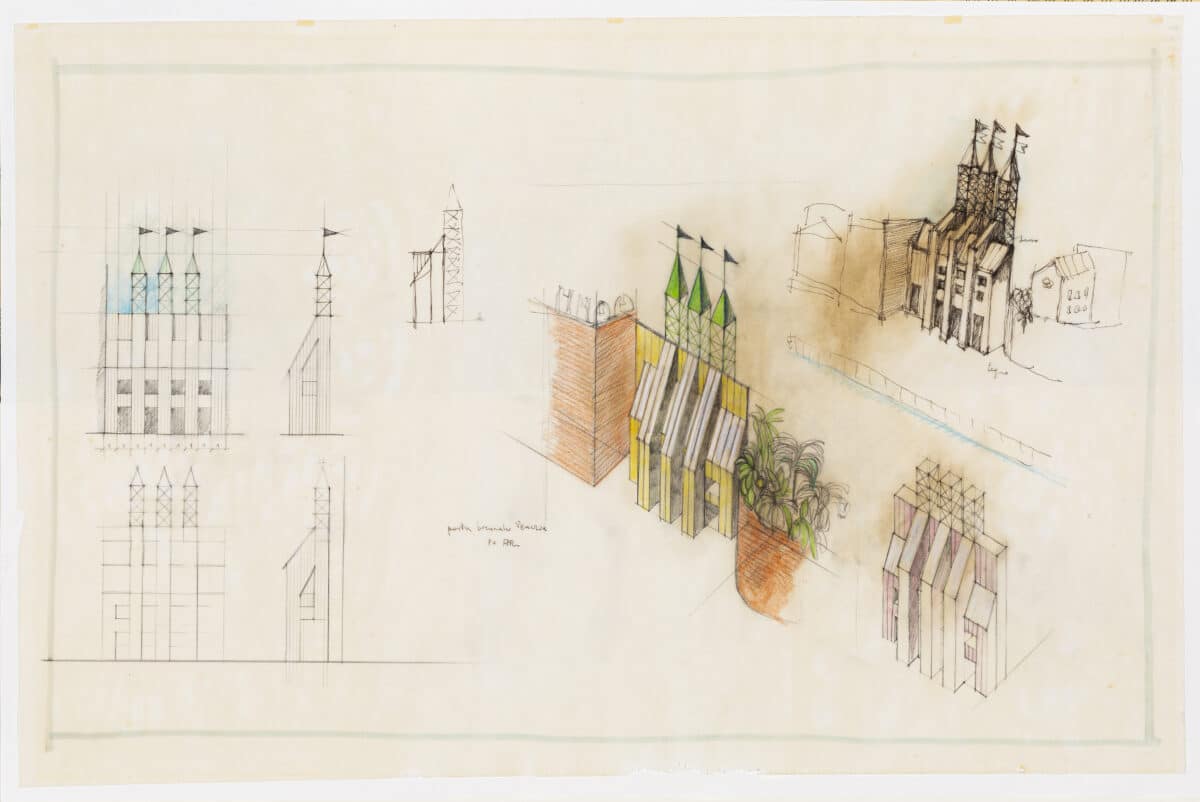
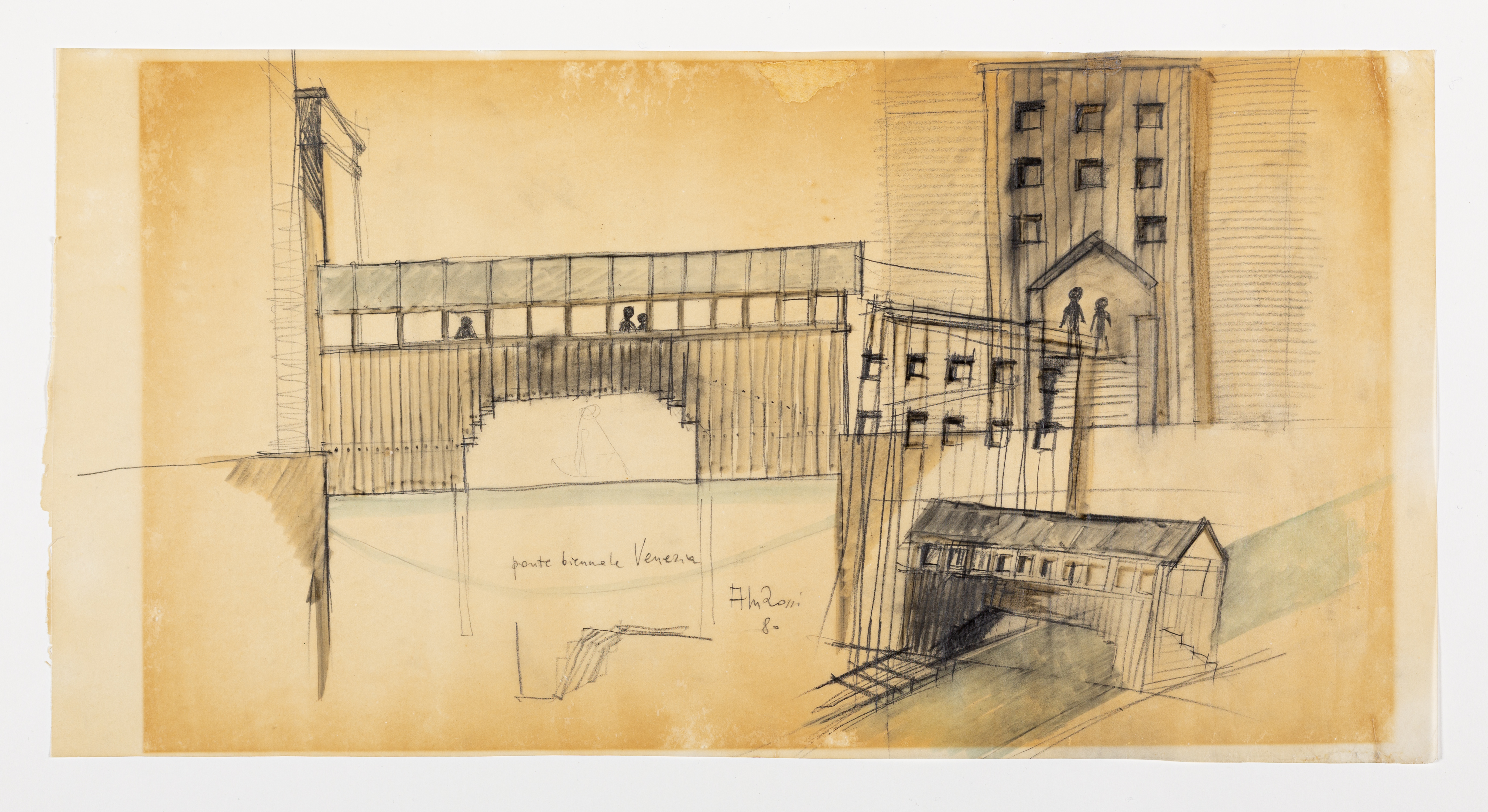
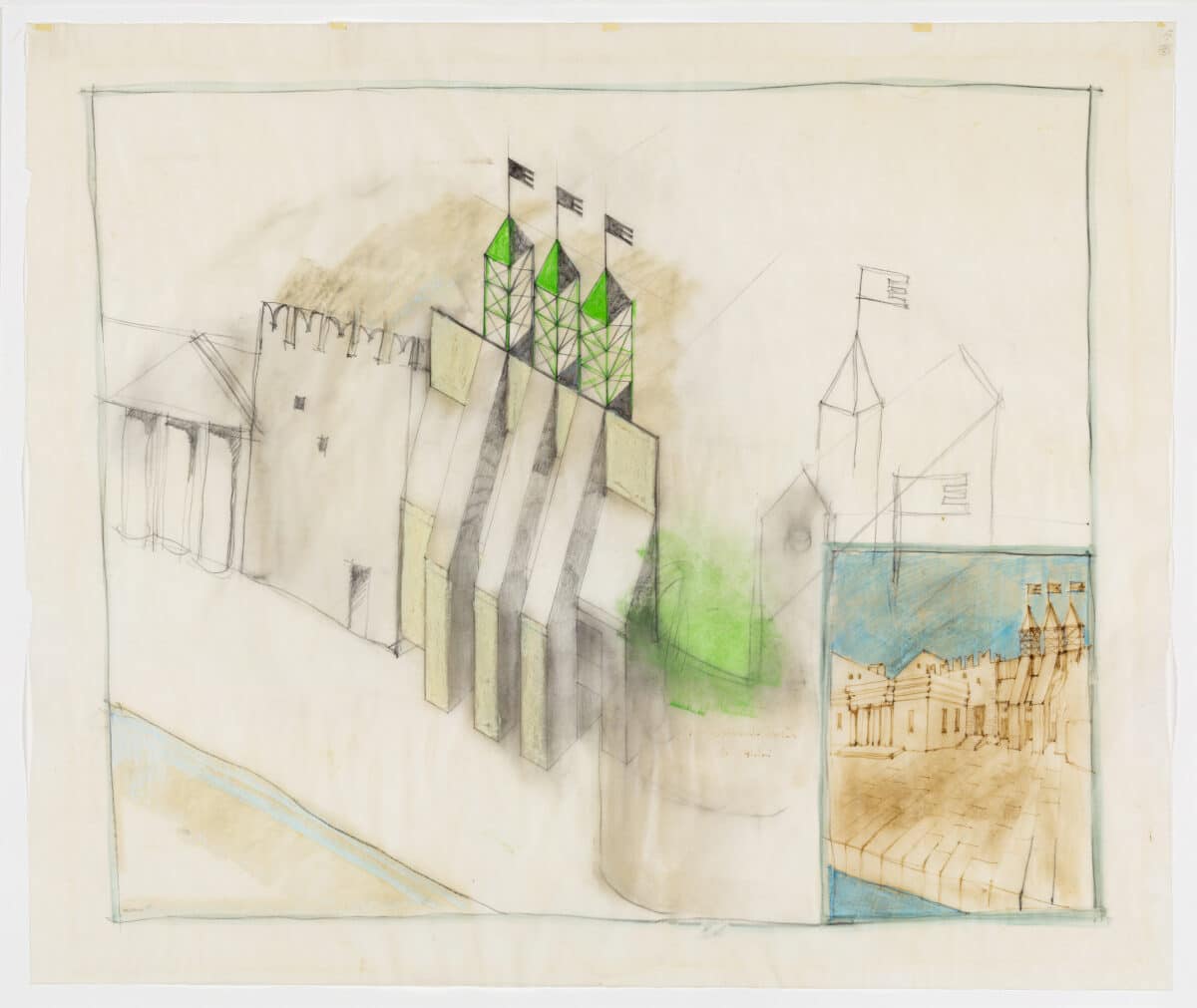
Rossi, in addition to the Teatro del mondo, designed a central component of the Biennale—the entrance gate to Corderie at the Arsenale. Held between two historic structures, the portal was constructed, like the theatre, with a metal frame and wooden cladding. Its materiality and what Rossi called a ‘gothic’ form a clear reference to the ancient city gates erected for urban festivals and ceremonies.
The exhibition behind Rossi’s gate was a coming-of-age show for ideas of post-modernity: a streetscape of facades by many invited architects, including Charles Jencks.
Drawing Matter holds two coloured drawings for this entranceway. In the first (DMC 3586), two perspectives of the scheme are shown, with the second (DMC 3587) also including elevations and sections. The collection also holds a sheet of soft pencil studies for a covered bridge, an unexecuted but related project.
CABINA, 1980-81
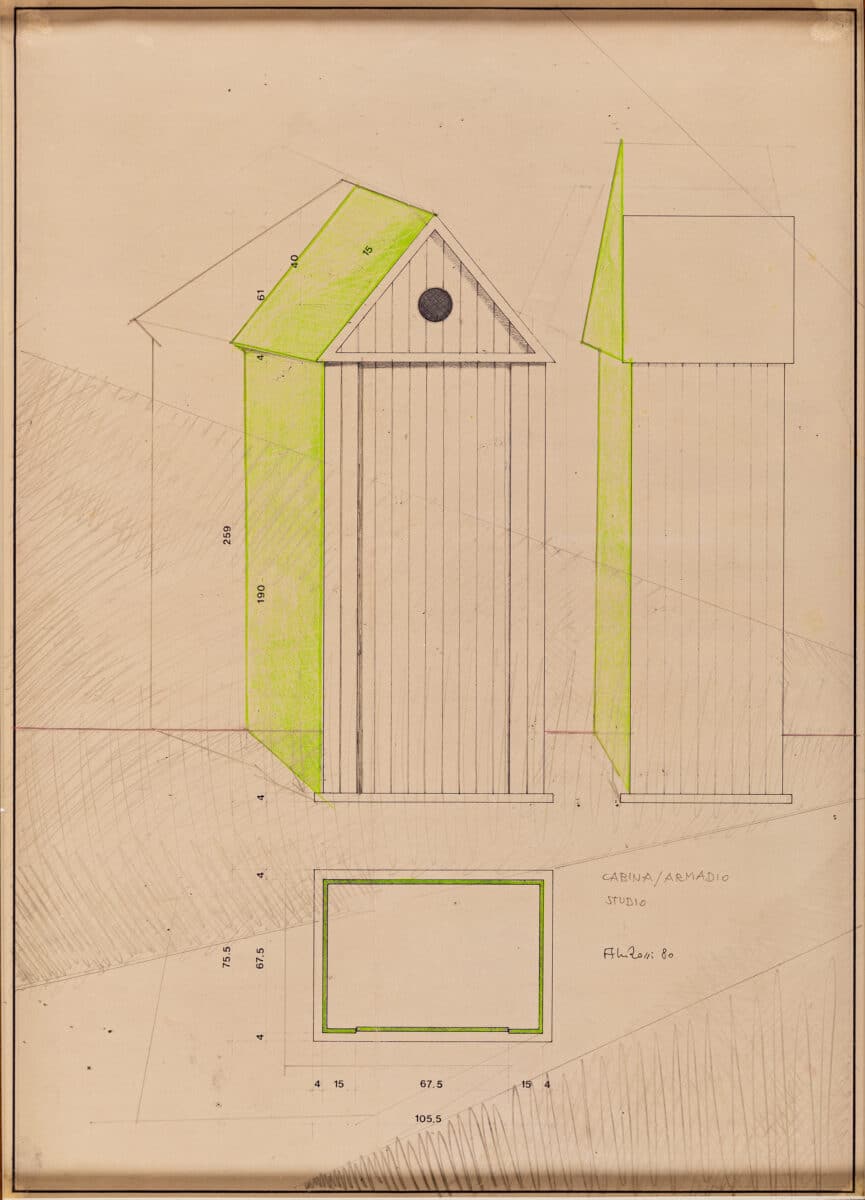
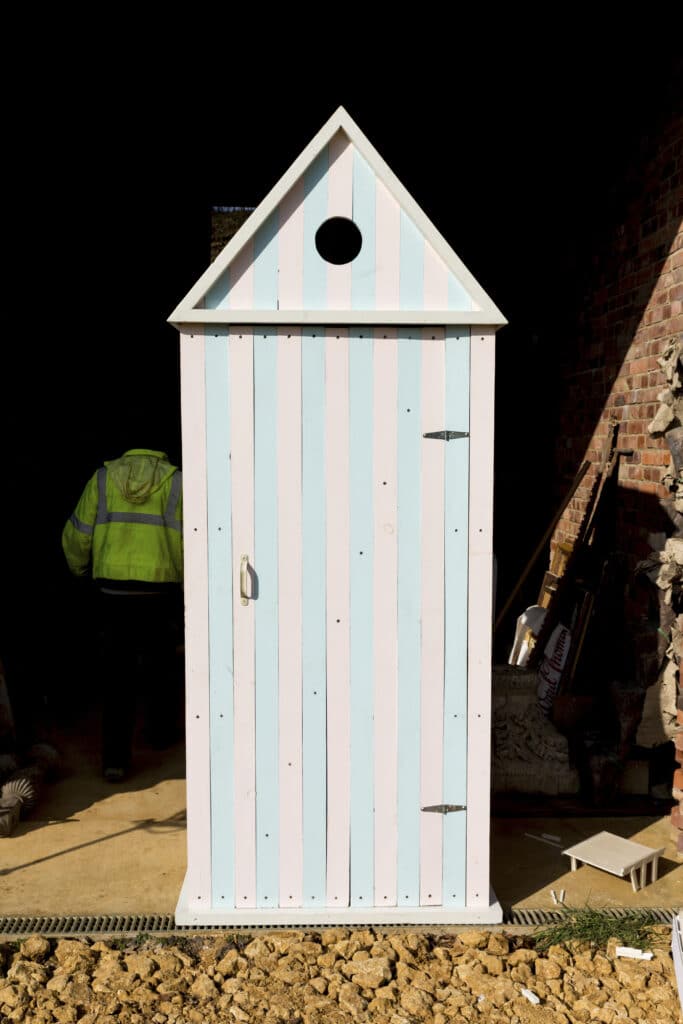
In 1980 Rossi created four prototypes of the Cabina d’Elba wardrobe in collaboration with furniture company Molteni, which were presented at the 1980 Salone del Mobile in Milan. Two years later, the Bruno Longoni furniture atelier in Cantù started producing a variation on the design. The pink and blue striped example held in the Drawing Matter collection is signed by Rossi and featured in an exhibition at the Max Protetch Gallery in New York in 1981. The cabin was acquired alongside a measured and coloured working drawing of the structure, indicated as either a wardrobe or studio. The drawing is signed 1980, while the cabin is signed 1981.
The cabin came from his childhood observations of the beach huts of Isola d’Elba, iconic for their tympanum form and striped decoration. Rossi saw them as transformative spaces that captured the transformative theatre of changing clothes. In his A Scientific Autobiography, he states ‘they seemed to be the minimum size for living, an impression of summer’.
PALAZZO DELLO SPORT, MILAN, 1987-89
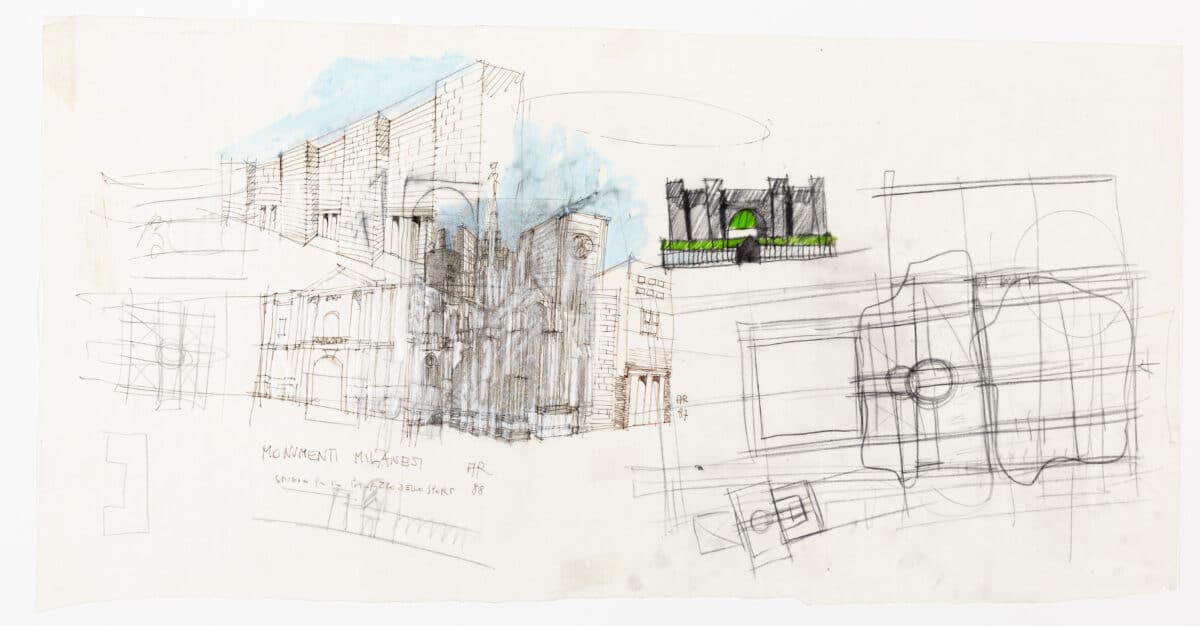
A large sheet of sketches in pencil developed over time; a schematic plan on the right dated 1987 and preliminary perspectives of a grand propylaea entranceway on the left dated 1988.
The proposal was a collaboration between Rossi, Giovanni Da Pozzo, and Paolo Digiuni for a new sports complex in the San Siro neighbourhood, in the western outskirts of Milan. The project, often referred to as the ‘palasport’, was to become another centre of the city, offering not only sports facilities but shops, restaurants, and other leisure activities—what Rossi termed a ‘leisure time citadel’.
As with other other projects held by Drawing Matter, the ‘Monumenti Milanesi’ (‘Milanese monuments’) refer to Rossi’s desire for his architecture to be a city in itself but equally a continuation of it. Through careful design of new ‘monuments’ throughout the city one could revolutionise it; he states,
‘Milano non ha bisogno di un piano regolatore mortificante; la città deve costruire sulle grandi aree che il cambiamento urbano ha rese libere nuovi monumenti che, coordinati tra loro, offrano la nuova immagine della città’ (‘Milan does not need a restrictive urban development plan; the city must build new monuments on the large areas that urban change has freed up. These monuments, coordinated with each other, will offer a new image of the city’).
BONNEFANTEN MUSEUM, MAASTRICHT, 1990-95
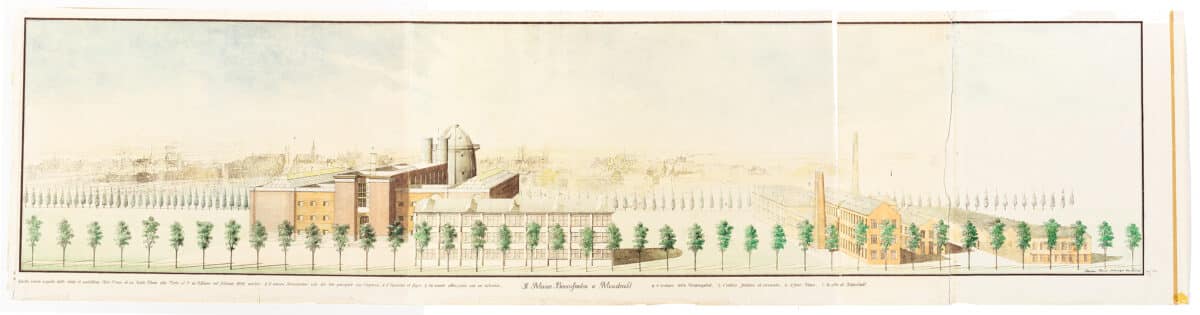
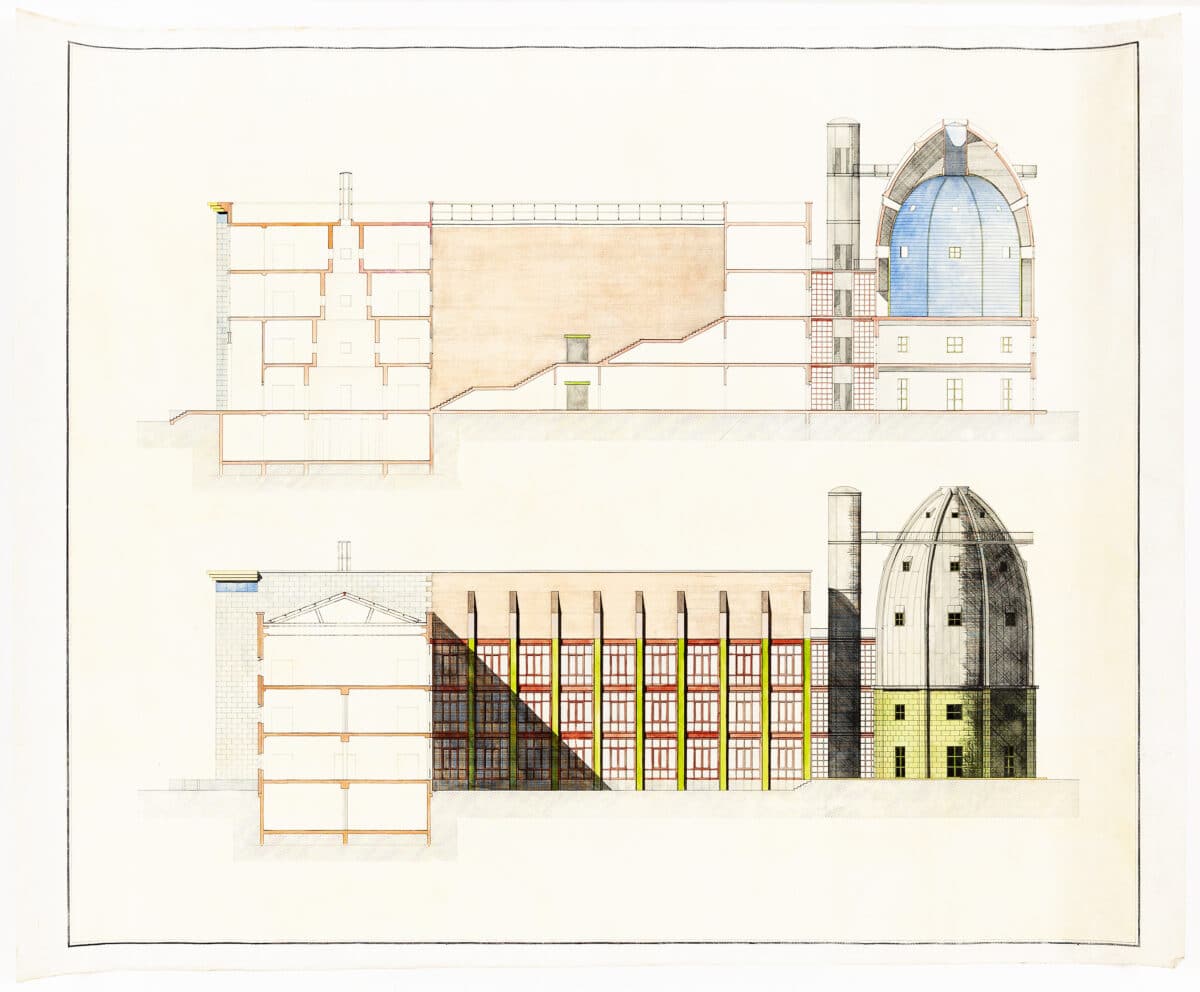
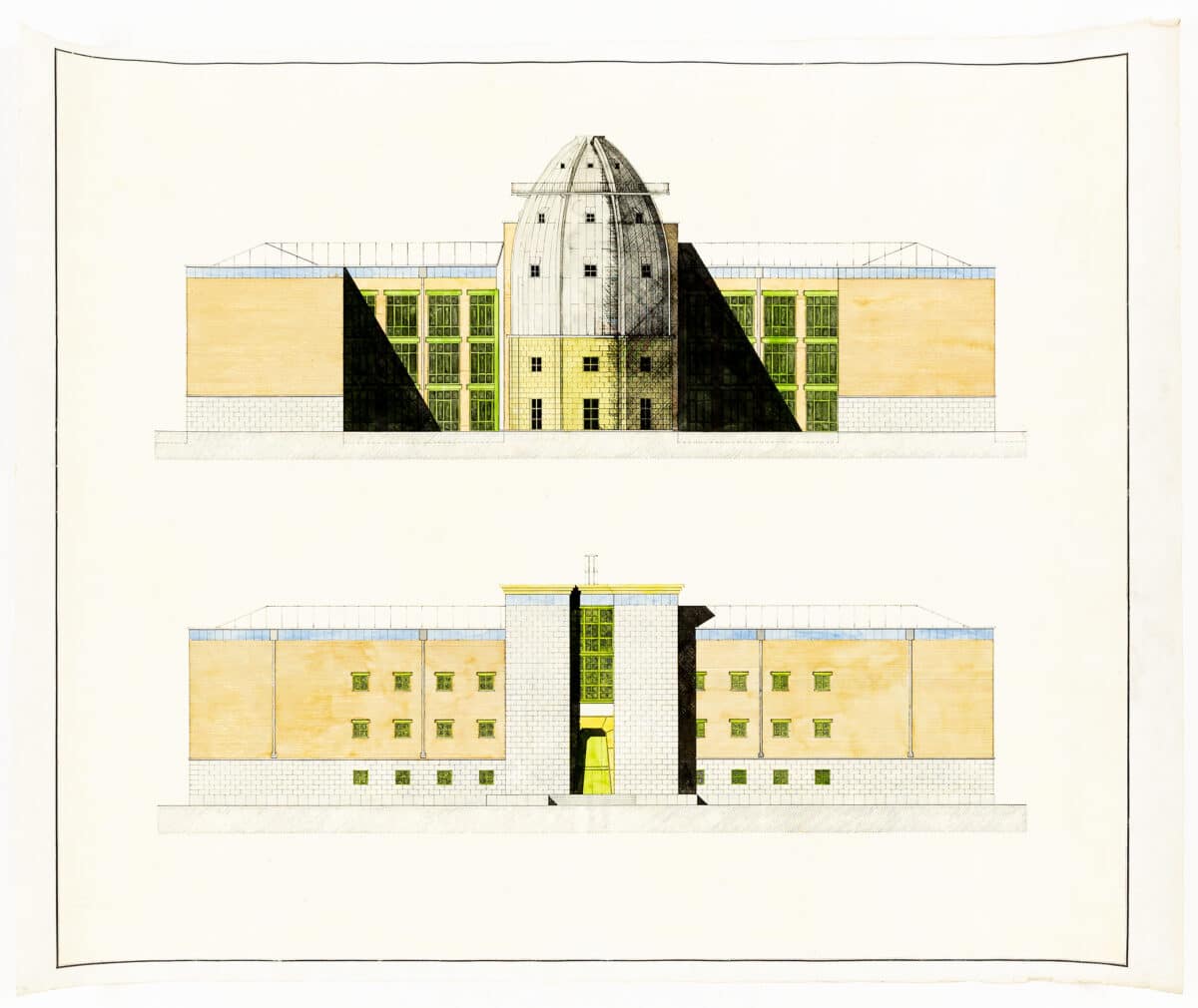
Drawing Matter holds a range of perspectives, measured drawings, conceptual montages, and study sketches for the Bonnefanten Museum. Completed in 1995, the commission was for a new museum for the Province of Limburg, which, in addition to a new building, required the renovation of the existing Wiebengahal ceramics factory on the site.
Rossi did not believe in an architectural type for the museum; its status as a building defined only by what is placed inside it. Therefore, the design draws from other historic institutional forms. From Rossi’s writings of the project, the telescope-shaped dome references the term lichtraum, meaning ‘light room’, in particular the Lichthof at the University of Zurich. But equally, Rossi draws on local structures to stimulate memory: the steepness of the staircase within the dome recalls the steep and awkward Dutch stairs, intended to evoke a memory ‘legata al mondo gotico delle taverne Shakespeariane come ai traballanti personaggi di Conrad’ (‘linked to the Gothic world of Shakespearean taverns as well as to Conrad’s unsteady characters’).
DMC 3016 and 3017 are presentation drawings of the project. They were colour proofs that were not approved. Maurizio Diton, an architect in the office at the time, states that they were drawn with Indian felt pens on glossy paper, then printed onto ‘Canson’ watercolour paper. The final versions of these drawings are held in the Bonnefanten Museum.
DMC 3022 was executed by Marc Kocher. It is a perspectively complex image intended to highlight the entire site of the museum, as well as its connection to the city behind. The original drawing was reworked with a photocopier to bring a specific texture to the image; the drawing, however, was too long for the photocopy machine, and was subsequently split into three parts.
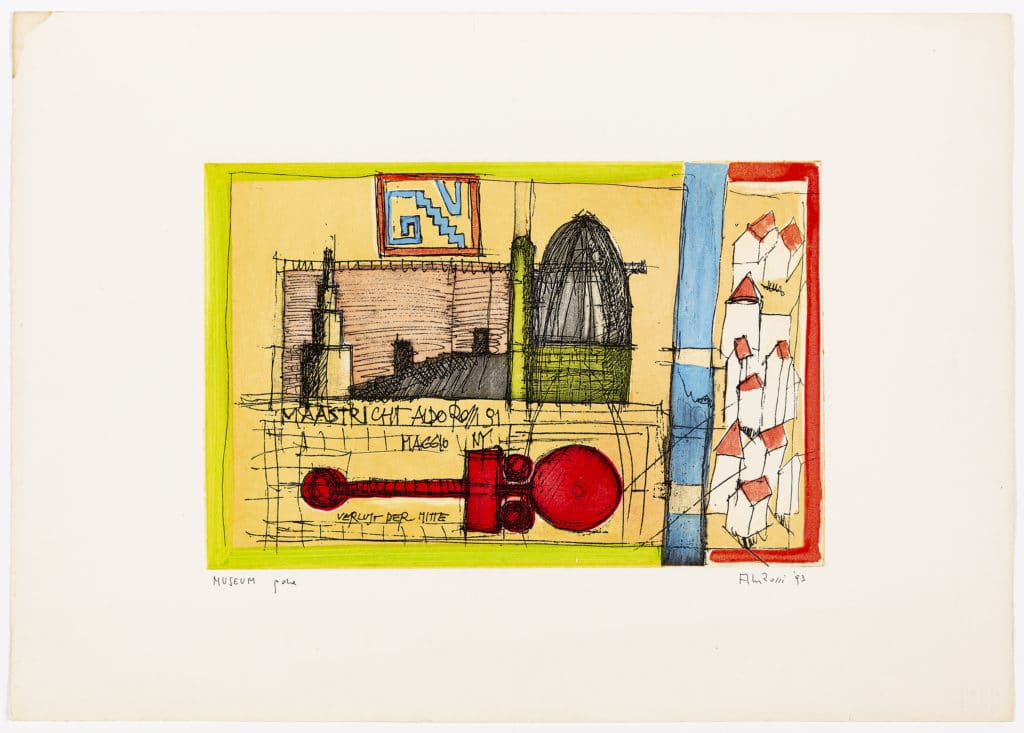
DMC 3015 was created by Rossi in May 1991, while in New York. It situates an elevation of the museum’s dome in relation to the houses of the city across the Maas River. At the bottom of the composition, under a red plan, Rossi has written, ‘Verlust der Mitte’ (‘loss of centre’).
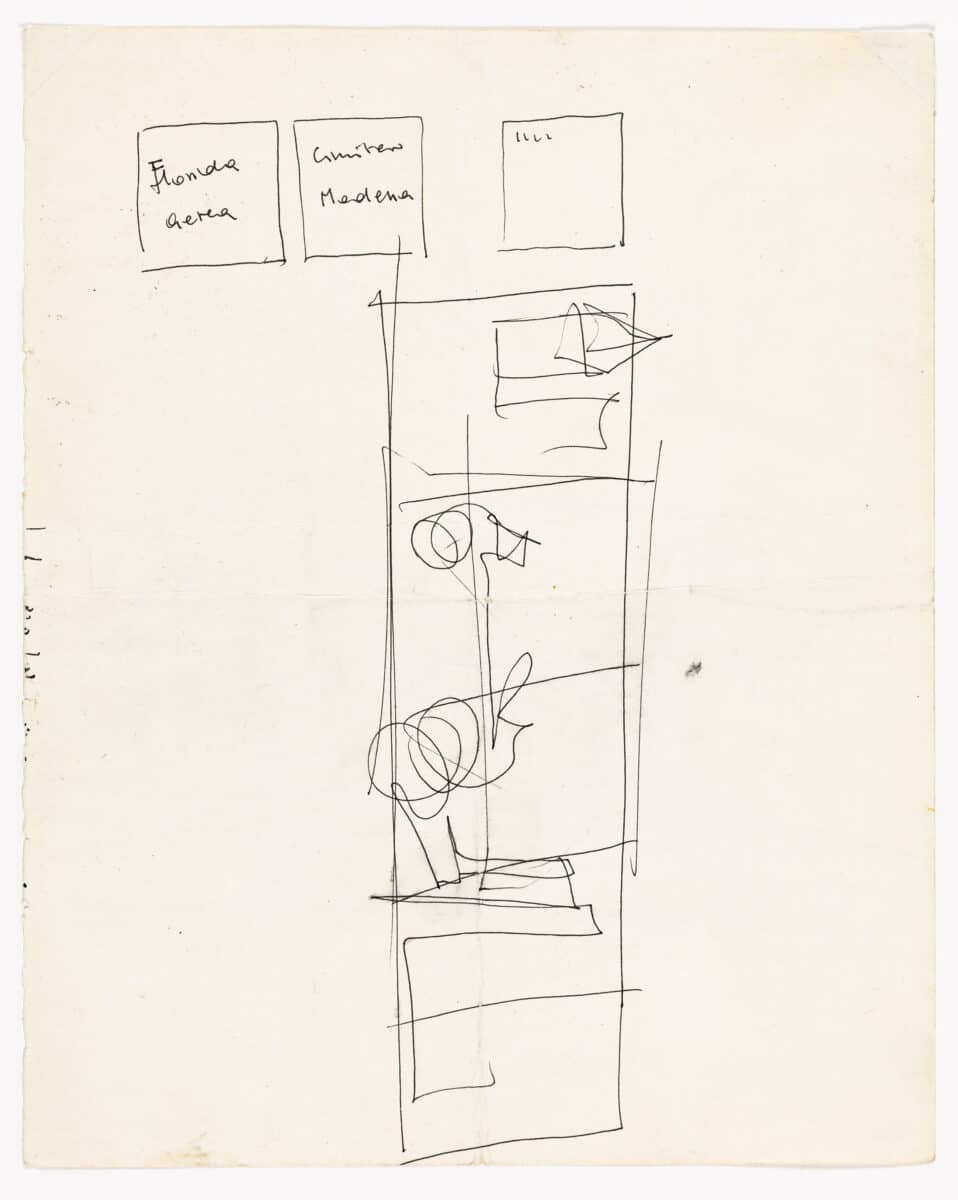
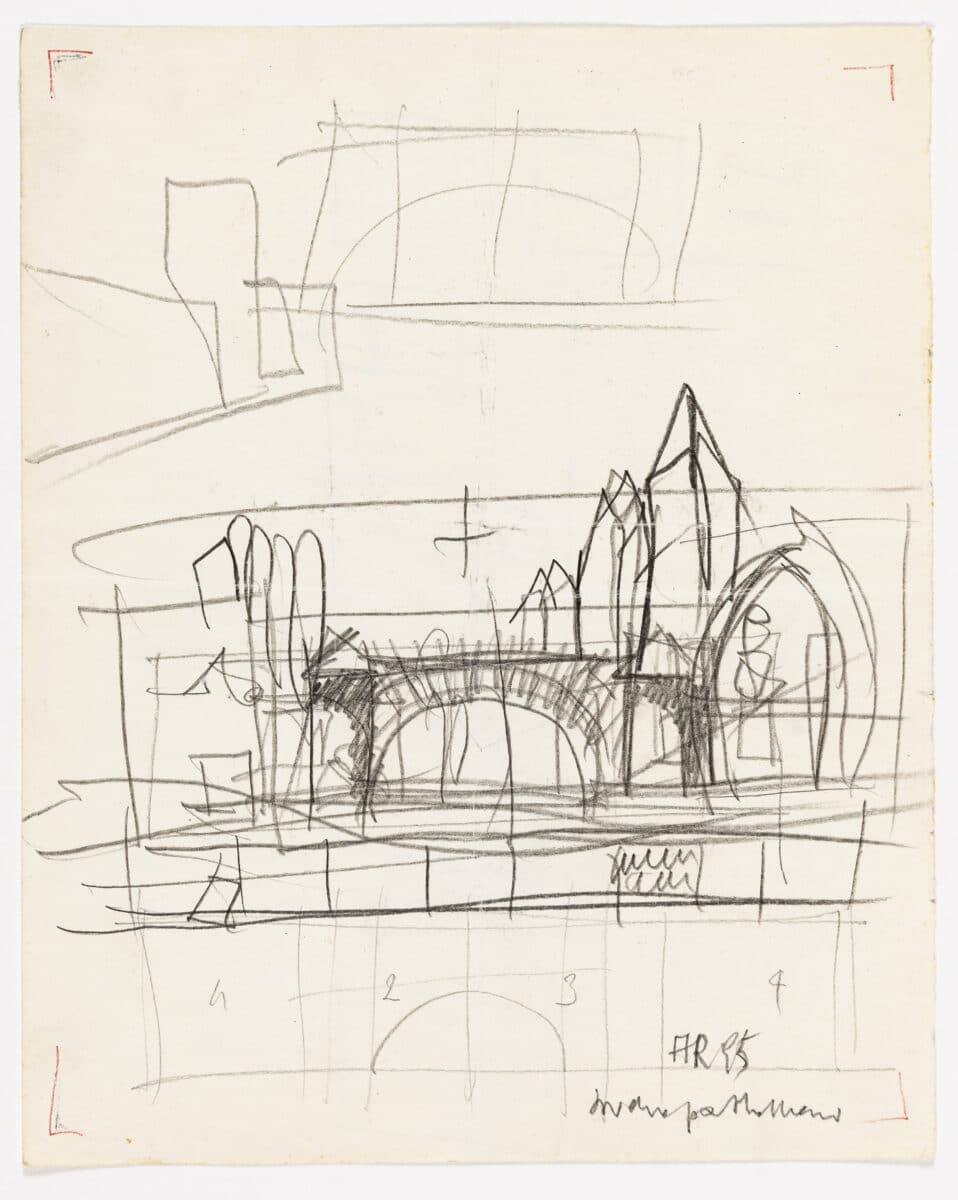
DMC 3012 is a double-sided sheet of sketches. On the verso is a schematic perspective plan with notes on the Cemetery at Modena and a project in Florida. The recto is a composite of sketches, bringing together St. Servatius Bridge, the Onze Lieve Vrouwe Cathedral and the dome of Rossi’s Bonnefanten. Drawn in 1995, after the completion of the project, the drawing aims to cement the museum’s place within the historic structures of the city.
EURODISNEY HEADQUARTERS, PARIS, 1991
Rossi began working for Disney in 1988, with a large project for a hotel at the Euro Disney Resort (now Disneyland Paris). In a faxed letter held at the CCA, from Rossi to his ‘Agli amici di Disneyland’ (‘to our friends at Disneyland’) he explains his frustration with Disney’s comments on the design and withdraws from the project. Disney’s Chief Executive Officer, Michael Eisner, who receives the letter, immediately flies Rossi to the US to discuss working on two more projects in Celebration and Los Angeles. These were later followed by other collaborations, including the offices for Eurodisney.
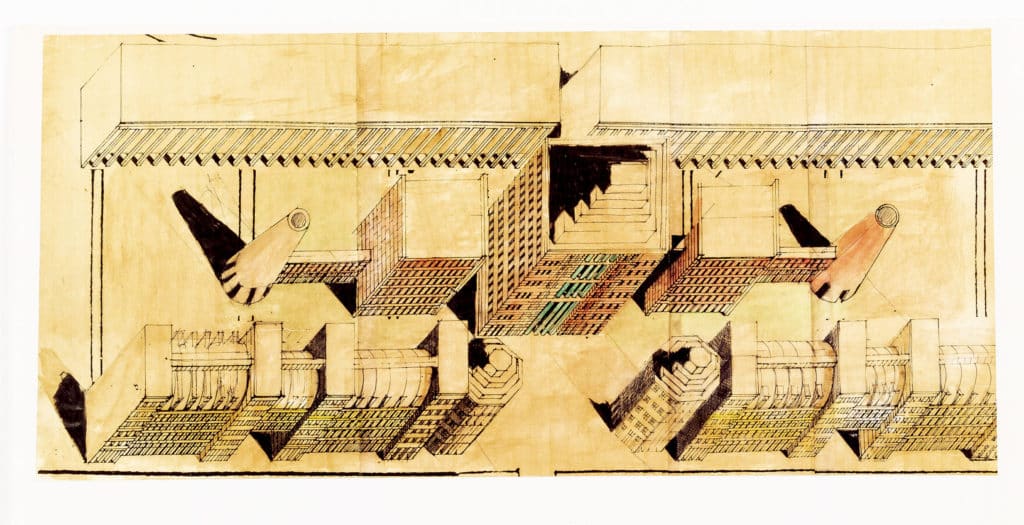
The base drawing of DMC 3021 was executed by Rossi in black ink, the drawing was then copied and printed, colour was painted on top, and the whole sheet soaked in linseed oil, to suggest that the drawing was older than it was.
LANDSBERGER ALLEE, BERLIN, 1992
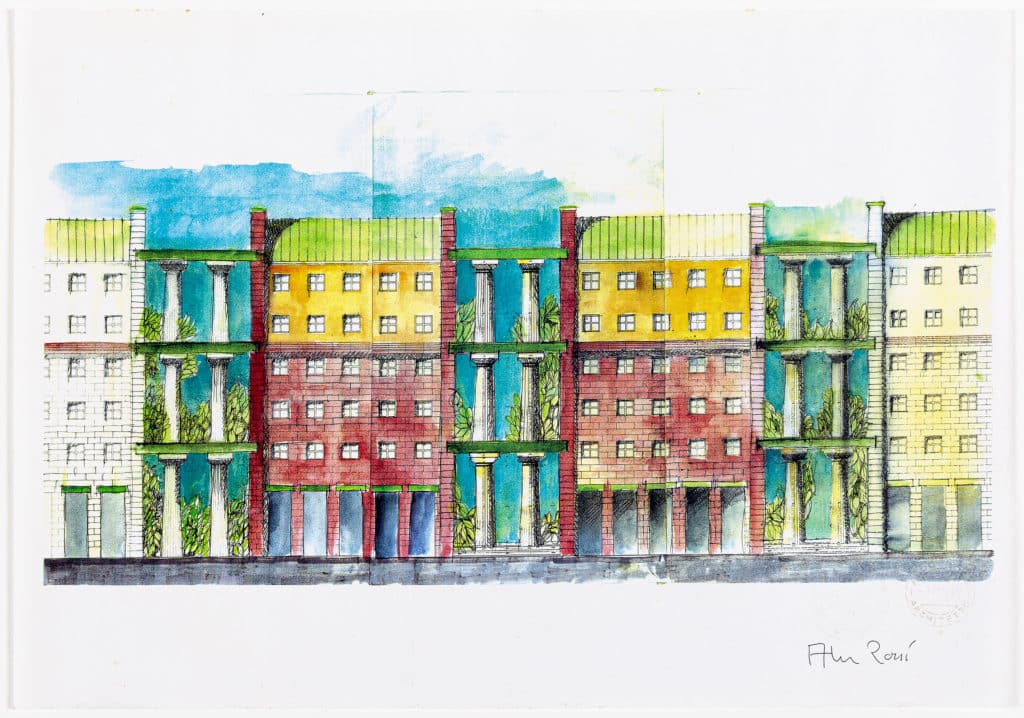
A coloured photocopy drawing of an elevation of the Landsberger Allee office building in Berlin. The long street leads in from the eastern outskirts of the city, with Rossi’s project situated as an ‘urban gate’ close to the ring-road and Landsberger Allee station, marking entry into the city. Rossi incorporates the new block into the city through its relationship to the street, following the long facades of many surrounding buildings.
The project started construction in 1996, but halted soon after due to substantial technical and financial issues. The project was later completed but heavily altered from Rossi’s original design.
SACCA DELLA MISERICORDIA, VENICE, 1991
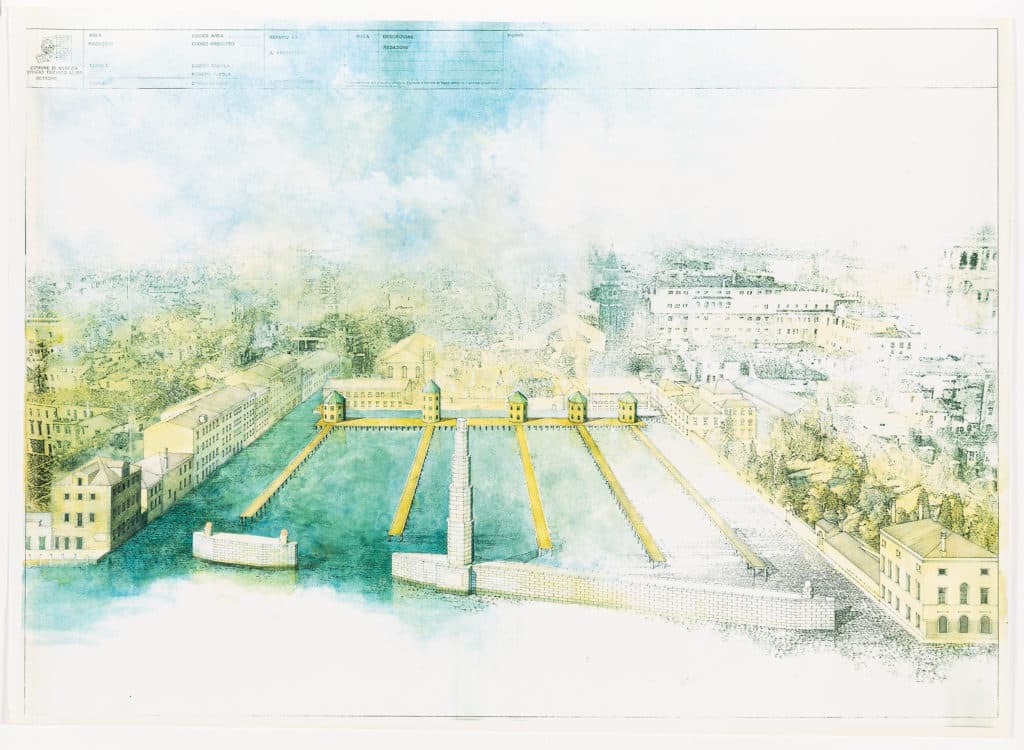
Drawing Matter holds a presentation drawing of a new harbour in the Cannareggio district of Venice, a project about which little is recorded. Similarly to other drawings of the 1990s, Rossi’s office created the work using photocopying technology. The drawing is collaged with photographs of Venice, copied onto transparent paper and then onto the drawing. Maurizio Diton, an architect in Rossi’s office at the time, remarked that these were expensive to produce and were therefore limited to a maximum of two or three.
COLOUR CHART, 1992
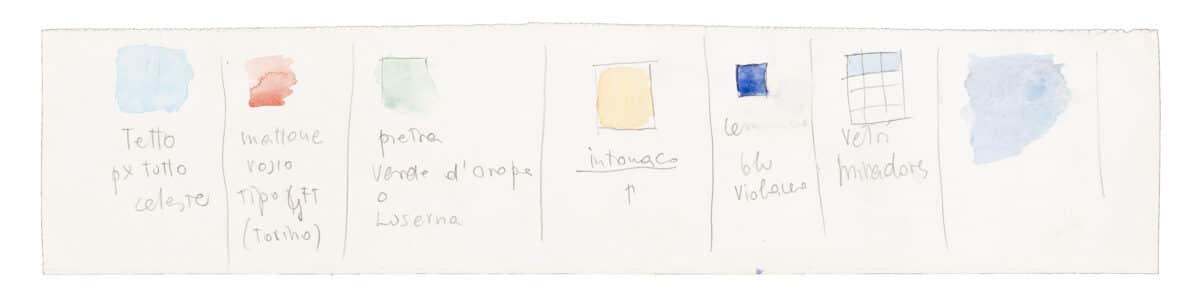
A colour chart made by Rossi as instructions for his office. Each colour has an inscription below: ‘tetto px tutto celeste’ (‘roof px all sky blue’), ‘mattone rosso tipo GFT (Torino)’ (‘red bricks, GFT type (Turin))’, ‘pietra verde d’Oropa o Luserna’ (‘green stone from Oropa or Luserna’), ‘intonaco’ (‘plaster’), ‘ceramiche blu violaceo’ (‘purplish-blue ceramic’), and ‘vetri mirador’ (‘mirador glass’). It is not clear which project this relates to.
ALDO ROSSI: ARCHITETTO, POSTER, 1993
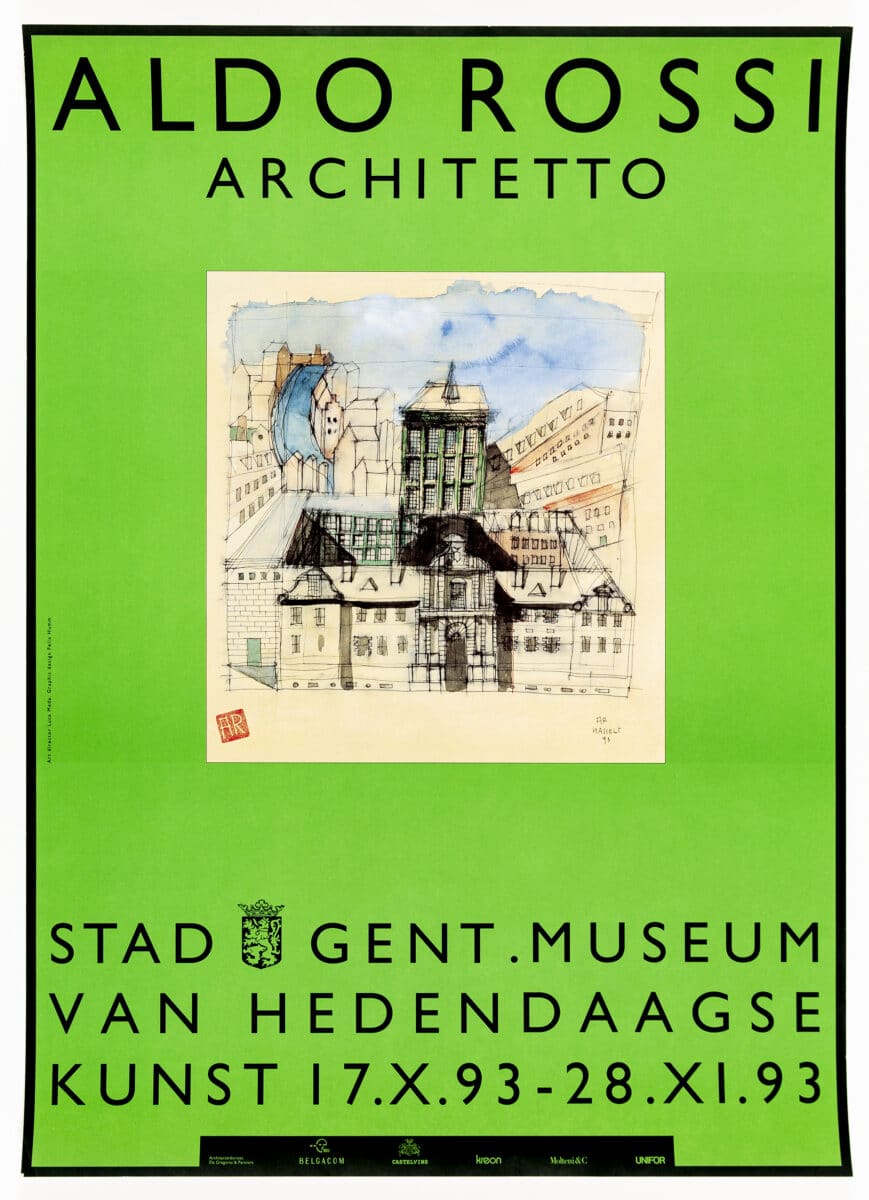
In 1993, a major exhibition of Aldo Rossi’s work was organised between the Berlinische Galerie at the Martin-Gropius-Bau in Berlin and the Museum of Contemporary Art in Ghent, Belgium. This poster for the Ghent exhibition depicts a 1993 drawing of the Oud Gasthuis (Old Hospital) in Hasselt, Belgium.
RESIDENTIAL & OFFICE BUILDING, SCHÜTZENSTRAßE, BERLIN, 1992-94
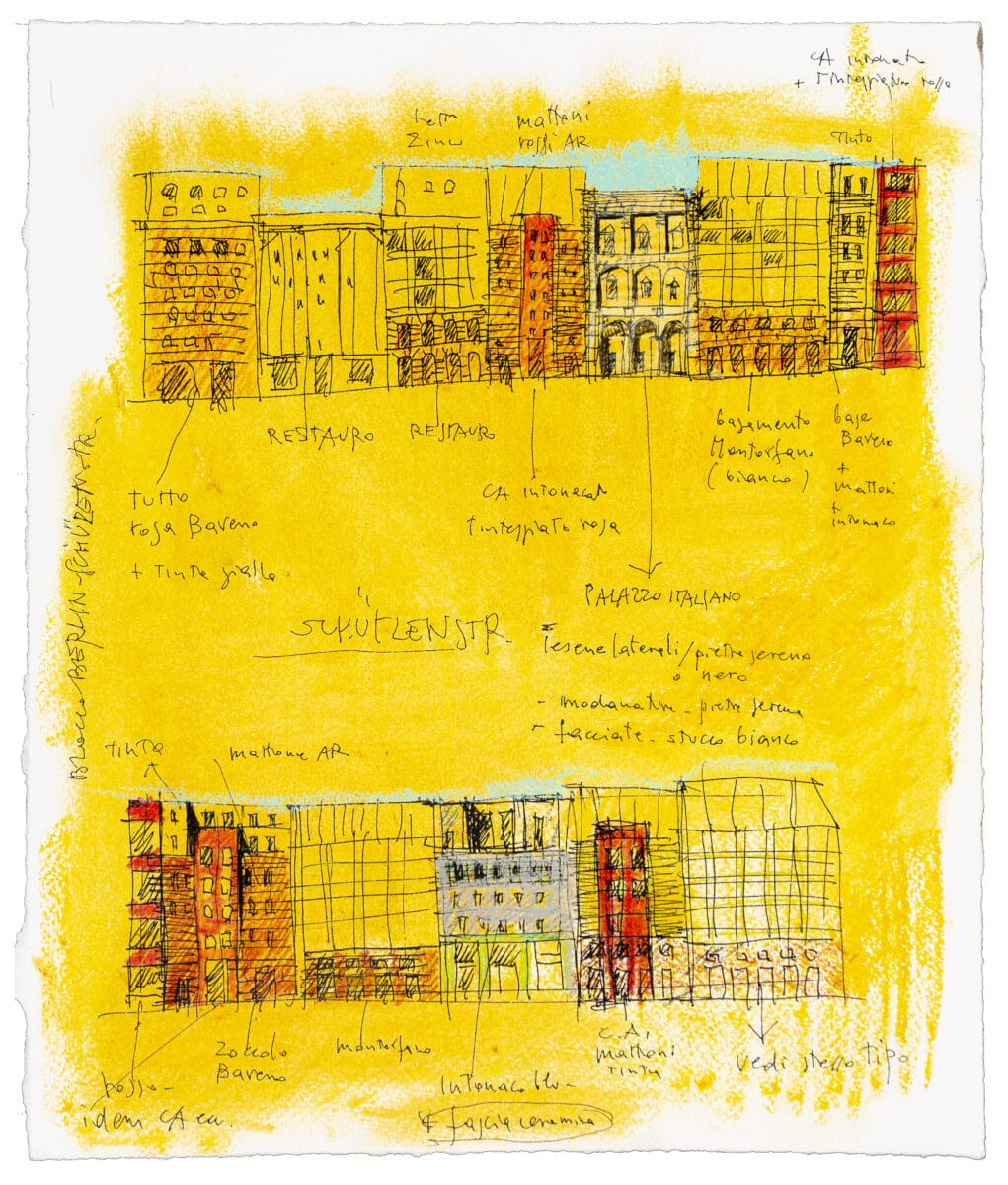
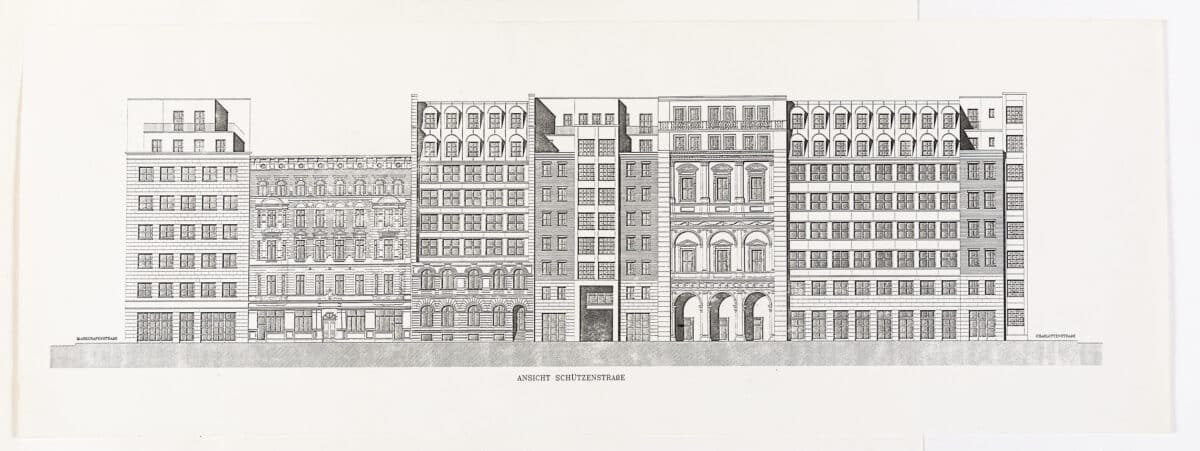
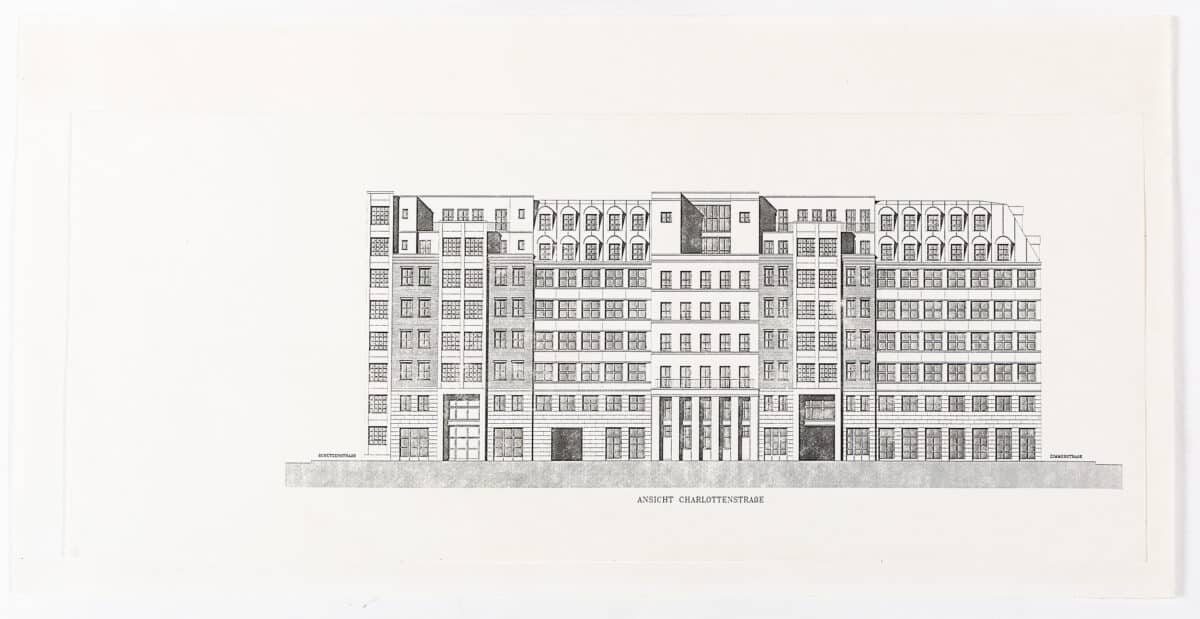
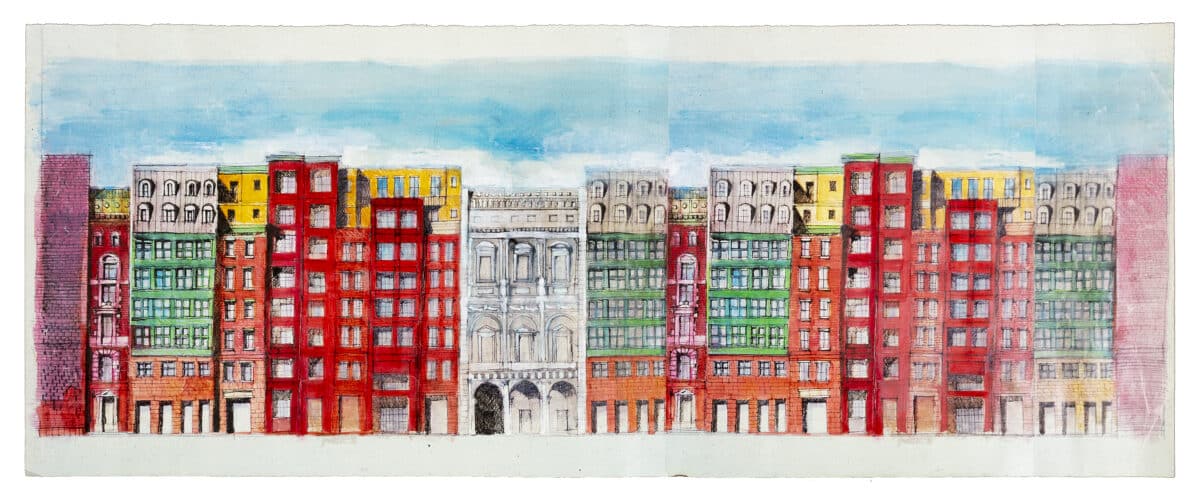
Drawing Matter holds four elevation drawings for a residential and commercial block on Schützenstraße, Mitte, Berlin. A richly annotated colour photocopy sheet identifies the different proposed components and their sources in two sketch elevations; another sheet presents a more articulated rendering of the possible facades; and two black and white prints present the final, simplified proposed elevation.
The city block with three courtyards was designed in collaboration with the architectural offices Bellmann & Bohm and Luca Meda. The project was guided by Rossi’s interest in the reconstruction of Berlin, after the fall of the Berlin Wall in 1989. He studied the restoration of historic buildings, as well as how new buildings were being grafted onto them. The historic block on Schützenstraße, had been damaged during the construction and surveillance of the wall, and Rossi’s project sought to infill the block with colourful ‘framing’ elements made of modern materials: iron and glass. For the four elevations Rossi crafted twelve different facade types, repeating and varying parapets, attics, thresholds, and window treatments. It is an architectural collage that sees Rossi contrast the existing buildings with modern interventions, although he also inserts a direct copy of an internal courtyard facade of the Palazzo Farnese onto the facade.
Additions and amendments are welcomed at editors@drawingmatter.org.
