Collection Guide: Zaha Hadid
– Editors
Zaha Hadid was born in 1950 in Baghdad, Iraq. After studying mathematics at the American University in Beirut, Lebanon, from 1968 to 1971, she moved to London in 1972, where she studied architecture at the Architectural Association (AA). It was here that her work began to reference the Russian avant-garde, and she also started to develop her own architectural methodology through painting. Taught by Rem Koolhaas and Elia Zenghelis at the AA, Zaha later joined their practice, the Office for Metropolitan Architecture (OMA). In 1979, Hadid founded her own practice, going on to win her first competition in 1983 with The Peak. Her work at Drawing Matter is from this early period, from the beginnings of her practice through to the early 1990s. In this material, we see Hadid’s consolidation of a signature style. It captures a stylistic movement away from OMA, into her own world of shifting angular planes and a truly dynamic form of architectural representation.
The material of Zaha Hadid held at Drawing Matter comes primarily from Michael Wolfson, with a few additional pieces from Jeremy Peacock. Wolfson studied under Hadid at the AA in London, going on to work for her until 1991, although he collaborated on later projects. The majority of the works of Hadid reside with the Zaha Hadid Foundation, with other projects, paintings, or competition entries distributed sporadically across the world. The Phaeno Science Centre’s (1996-2015) digital project records are held at the Canadian Centre for Architecture; The Great Utopia exhibition design materials from the Guggenheim in New York, are held at the Getty Institute; some early works and paintings are in the collection of the Boyarsky family; with other works held by the AA, MAK, MAXXI, and the Berlinische Galerie, among others.
DRAWINGS
DUTCH PARLIAMENT EXTENSION, THE HAGUE, 1978
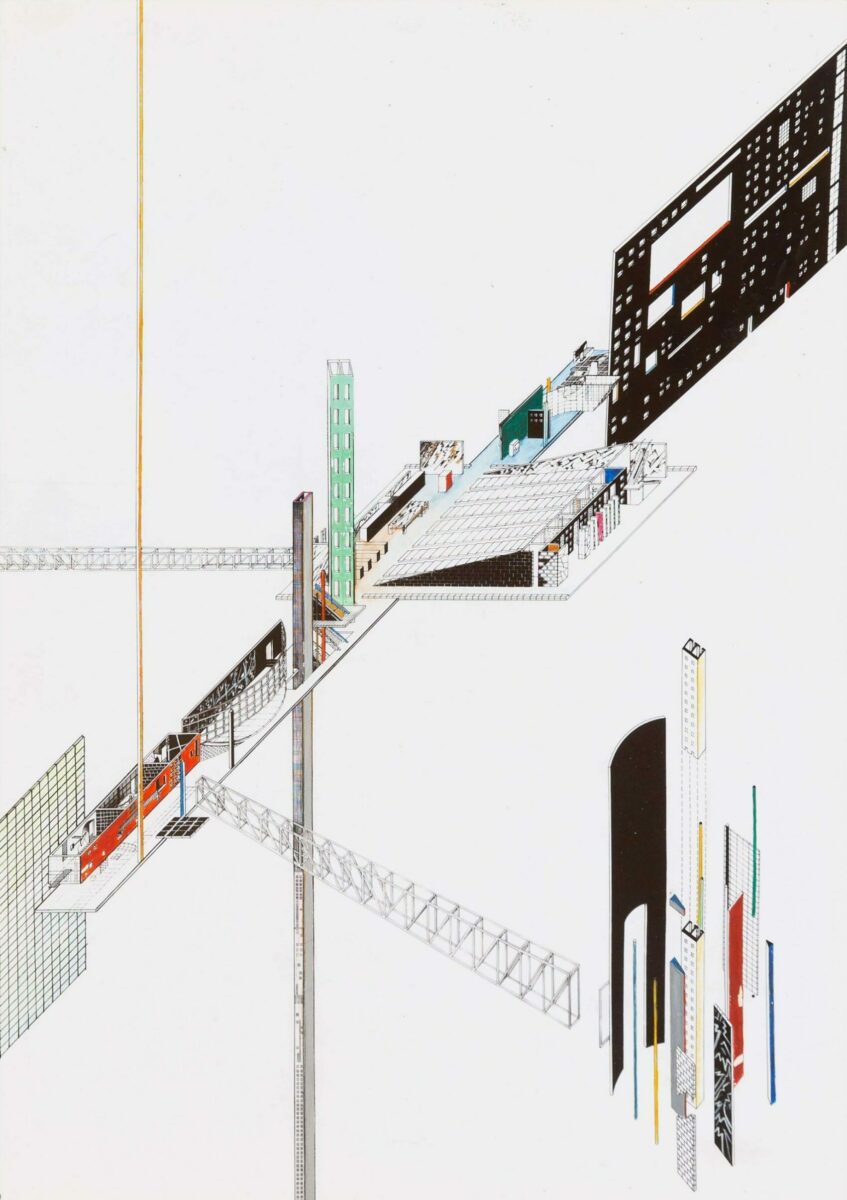
A semi-gloss print of ‘The Ambulatory and its connections’ drawing, part of the competition entry for the Dutch Parliament Extension, drawn by Zaha Hadid for OMA. The competition was for the extension of the historic Binnenhof complex in The Hague, creating distinct spaces for the parliament and government. The project, divided into three parts, was devised through OMA’s adoption of the surrealist game of the ‘exquisite corpse’, allowing separate ideas to be conceived and then brought together. This exploded axonometric shows all three contributions, Rem Koolhaas’ two slabs, Elia Zenghelis’ assembly hall, and Hadid’s ambulatory, which connects all the sites. Desley Luscombe has noted that the print in the Drawing Matter Collection served as a colour experiment.
IRISH PRIME MINISTER’S RESIDENCE, DUBLIN, 1979
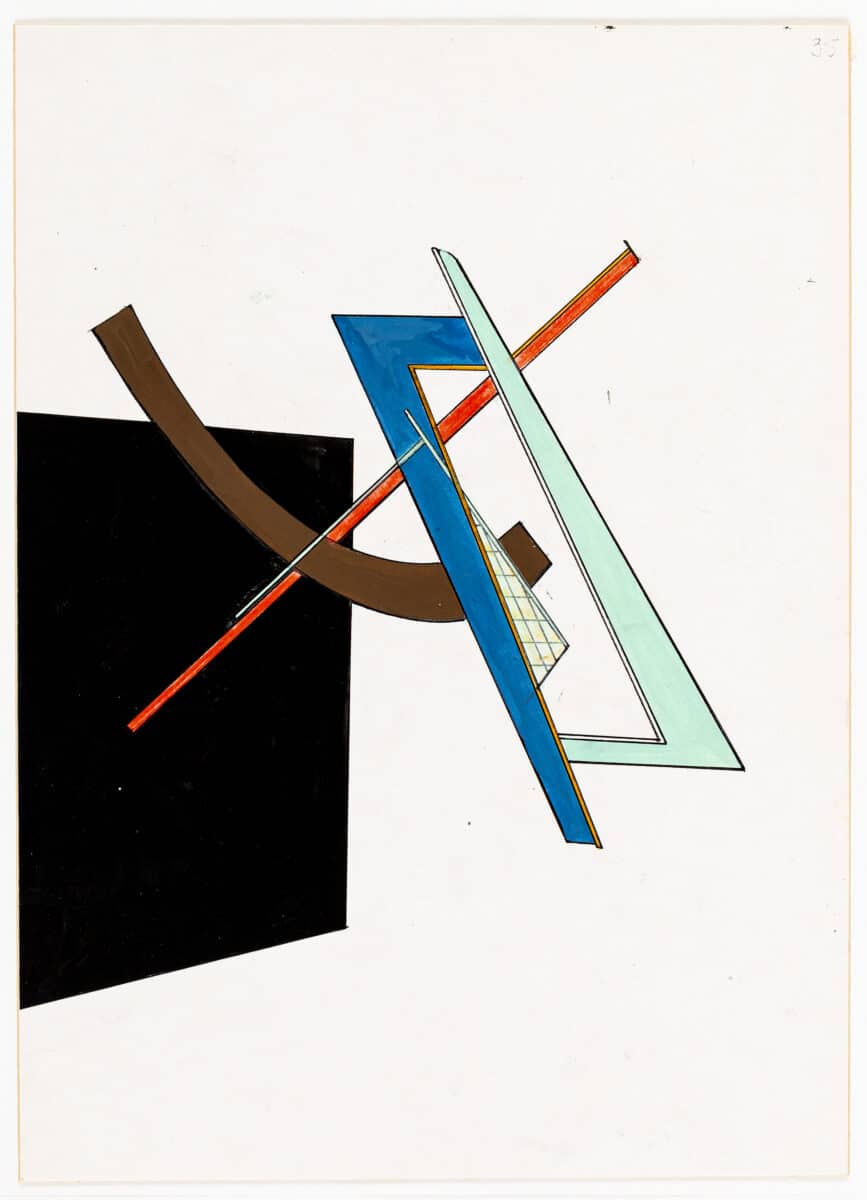
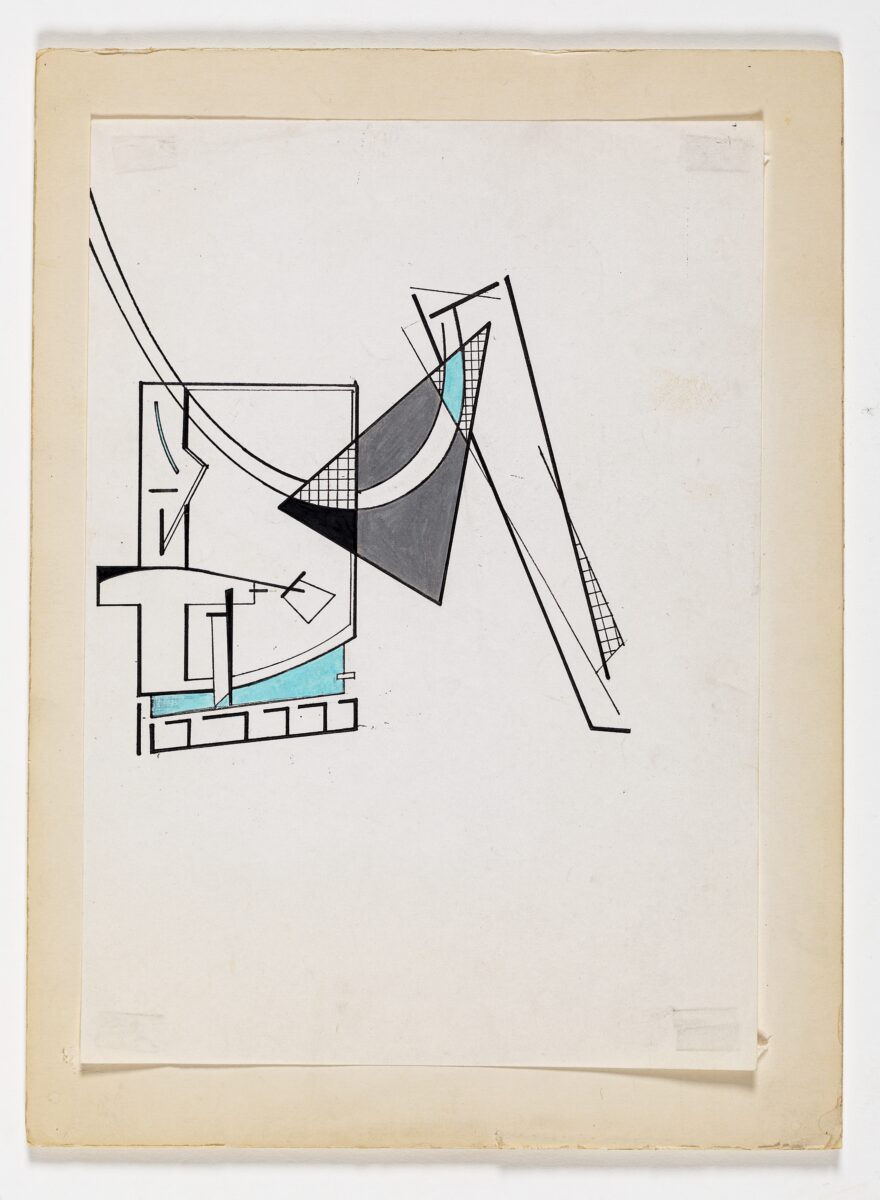
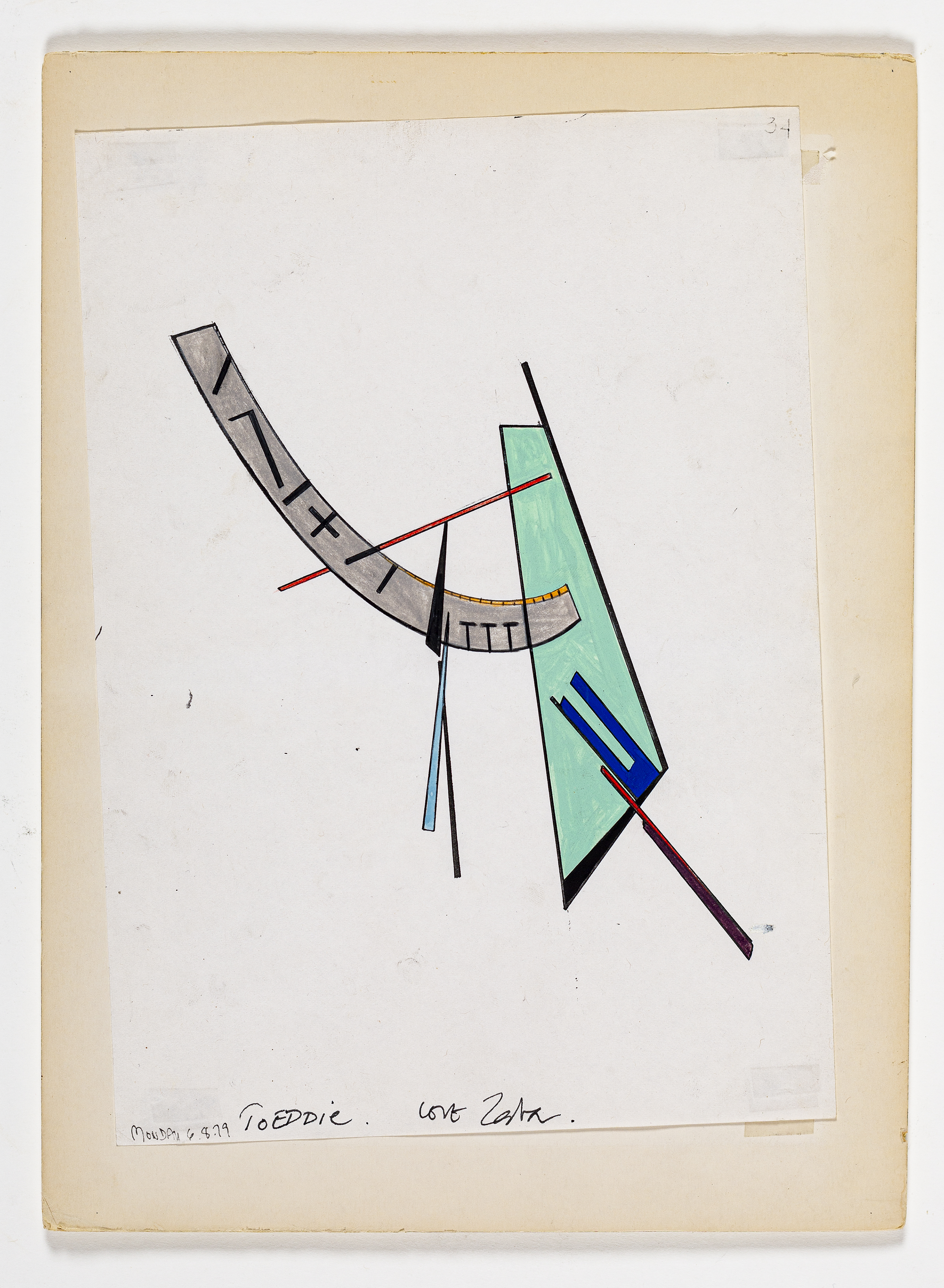
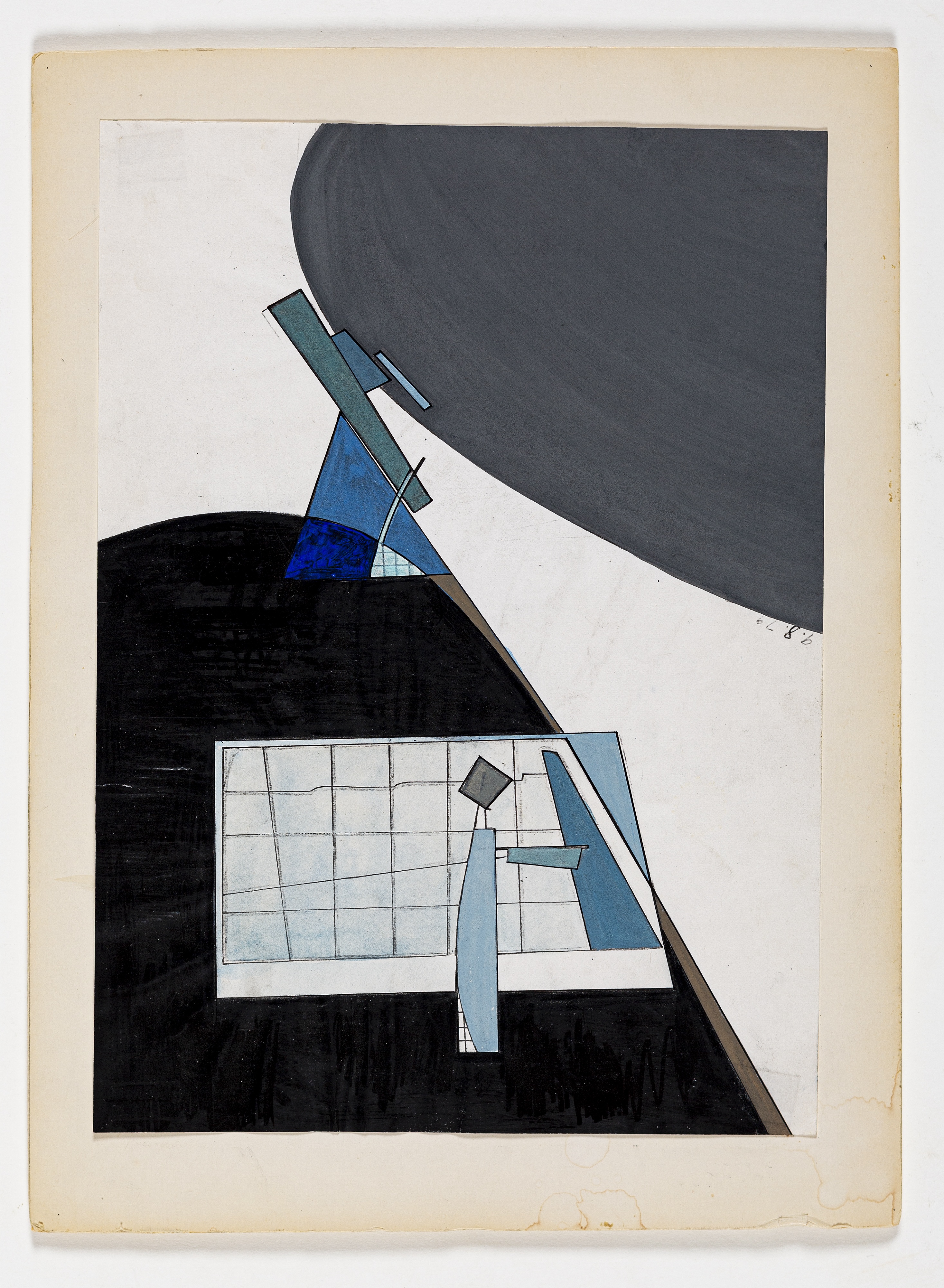
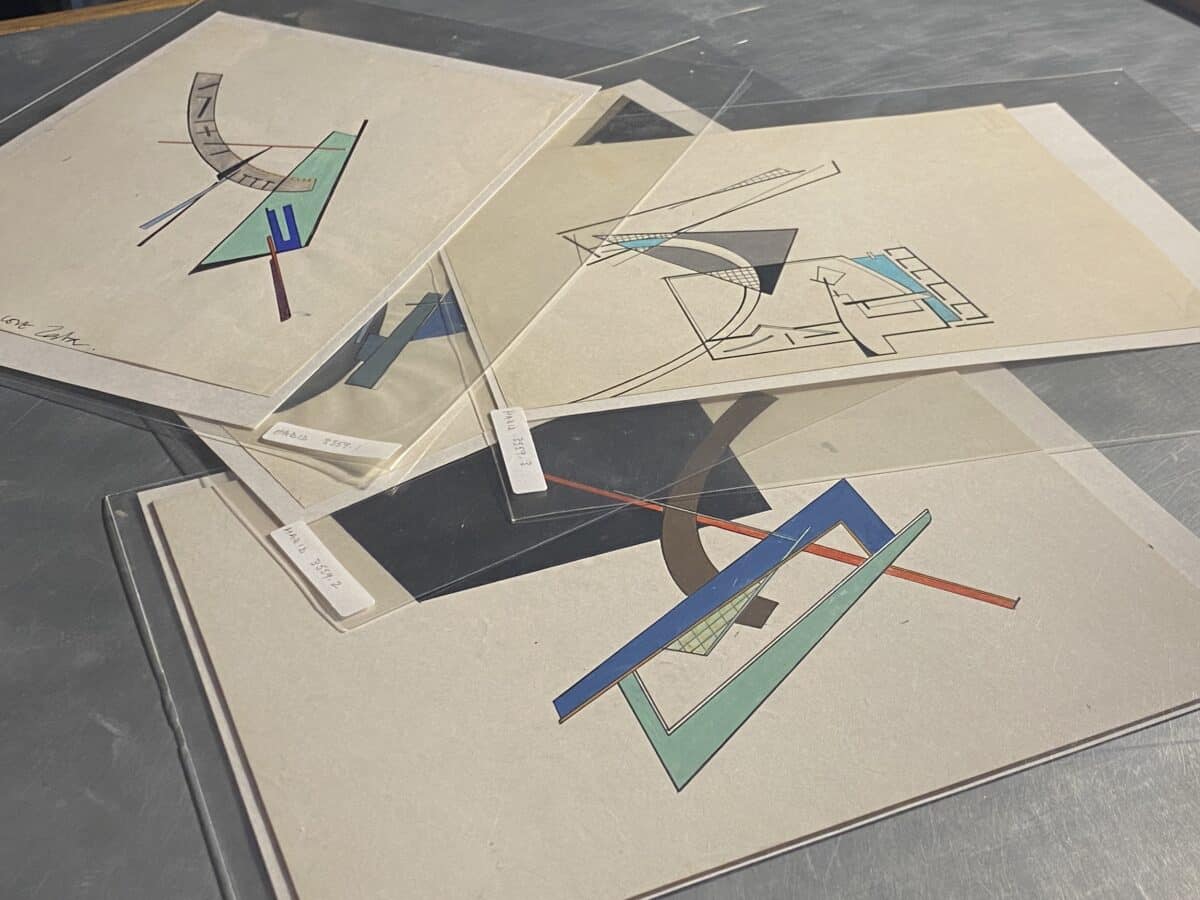
Four painted sketches for the Irish Prime Minister’s Residence (also referred to as the Taoiseach’s new residence). The competition, although not won, marked Hadid’s formation of her own office in 1979 after leaving OMA. It was for a new residence and state guest house in Phoenix Park, Dublin. With the four coloured sketches matching perfectly the composition of drawings in a sketchbook held at the Zaha Hadid Foundation archive, it has been suggested that the pages were photocopied and then hand coloured, presumably for the purpose of sale as works of art; the date of the drawings coincides with her first solo exhibition at the Galerie Van Rooy in Amsterdam.
THE PEAK, HONG KONG, 1983
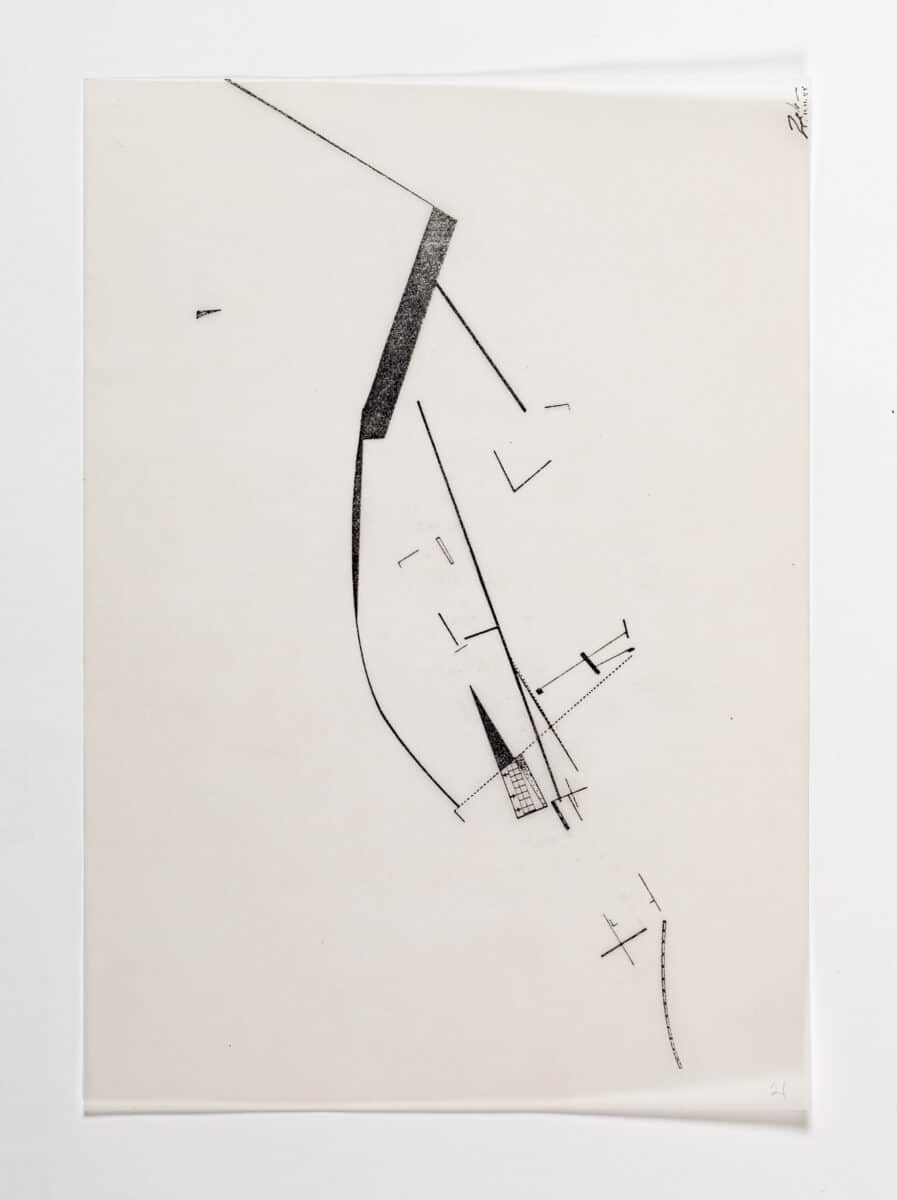
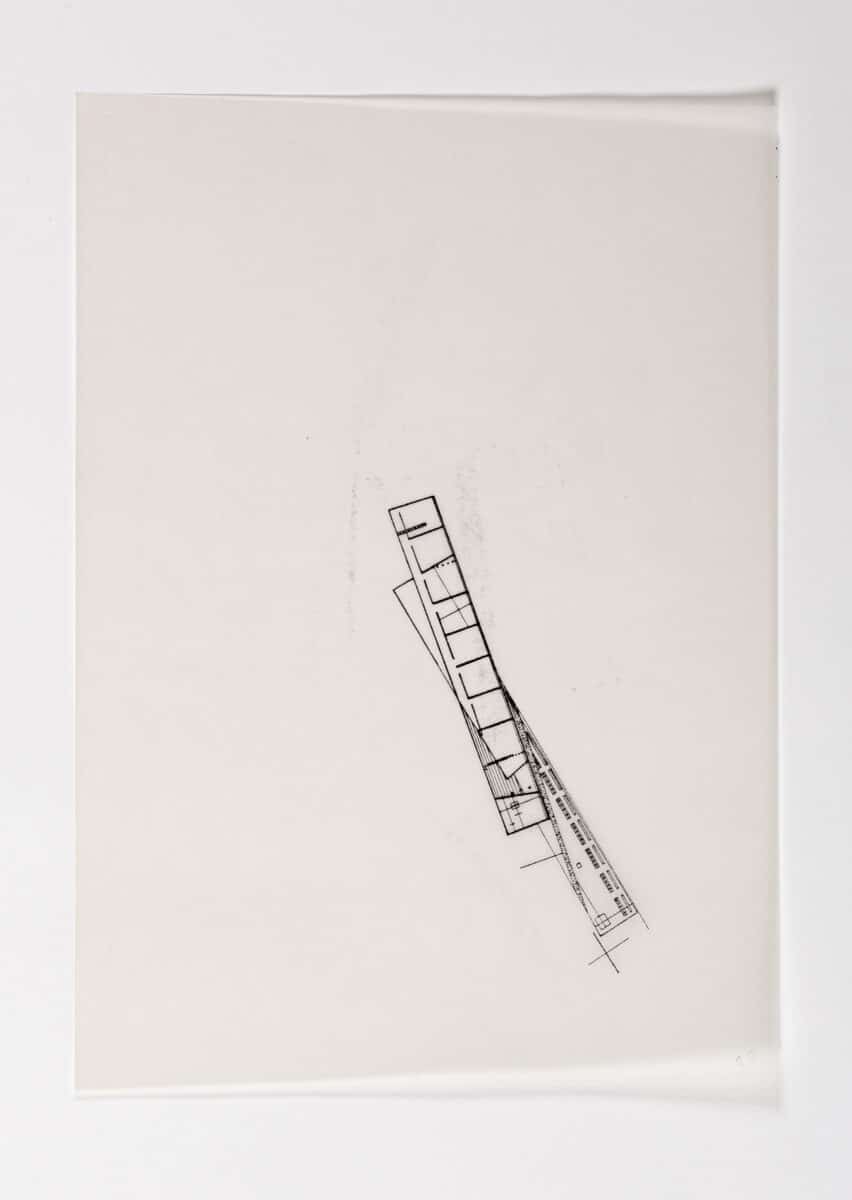
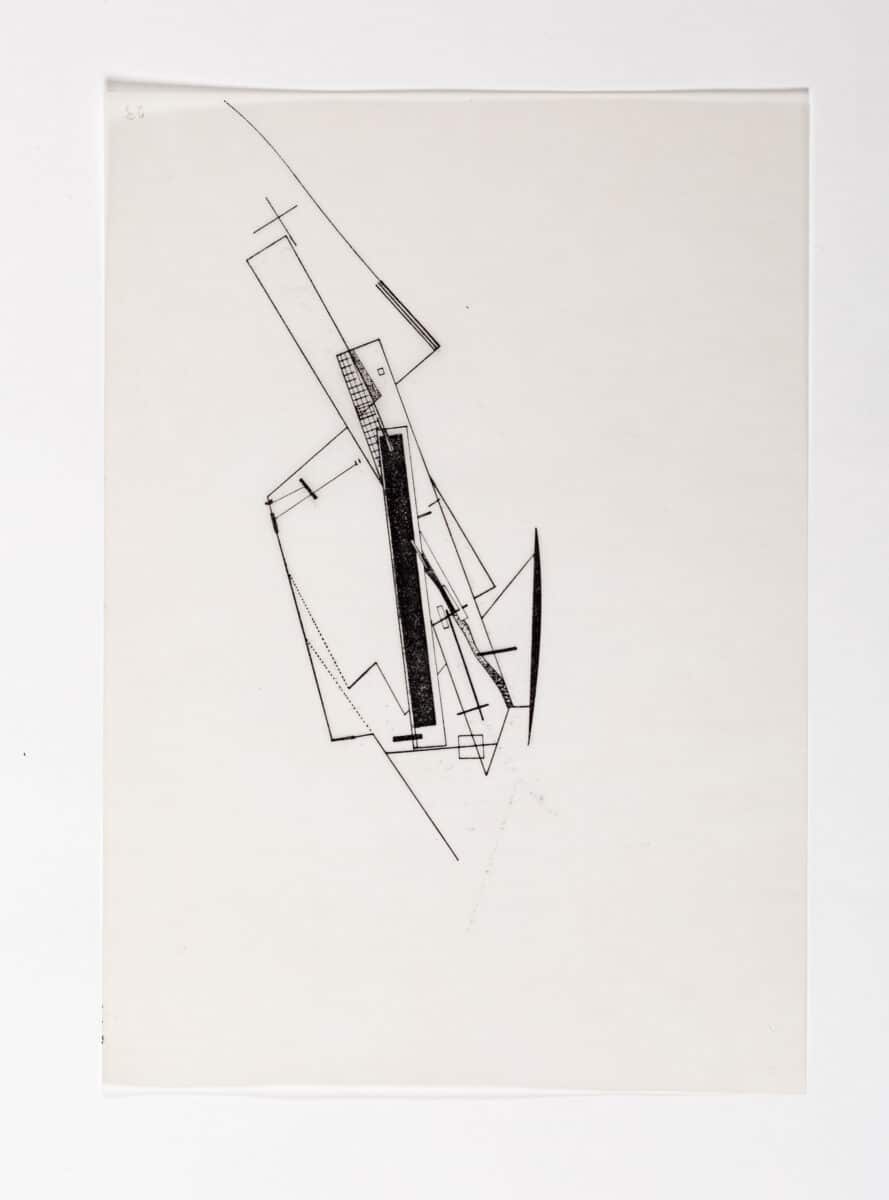
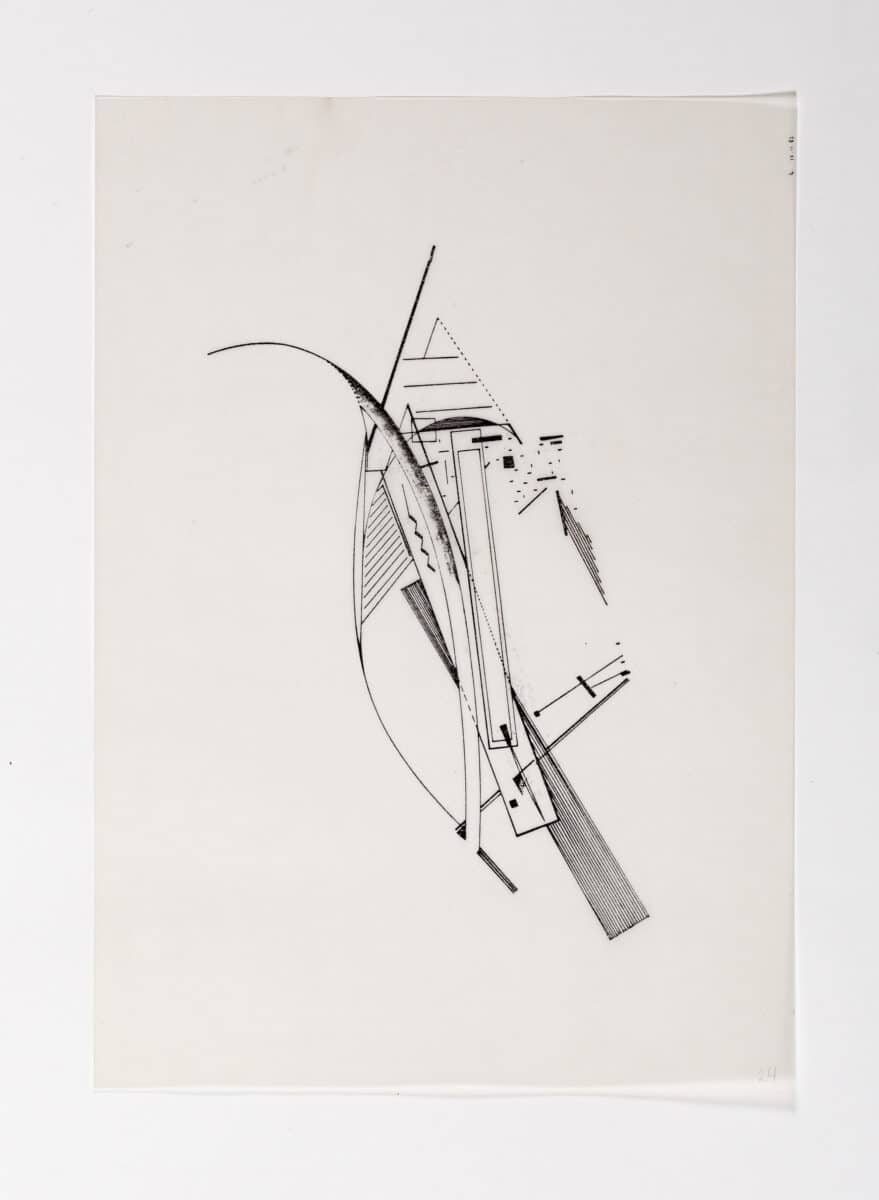
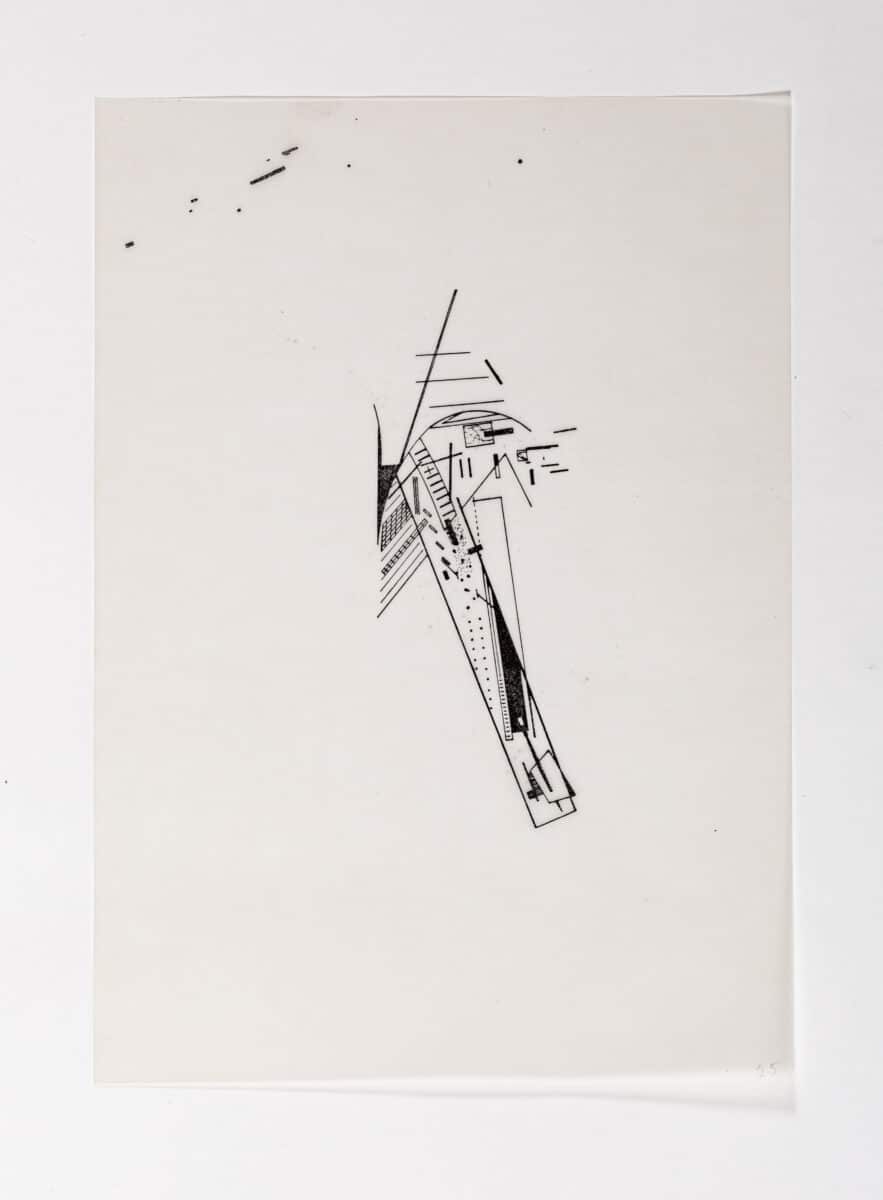
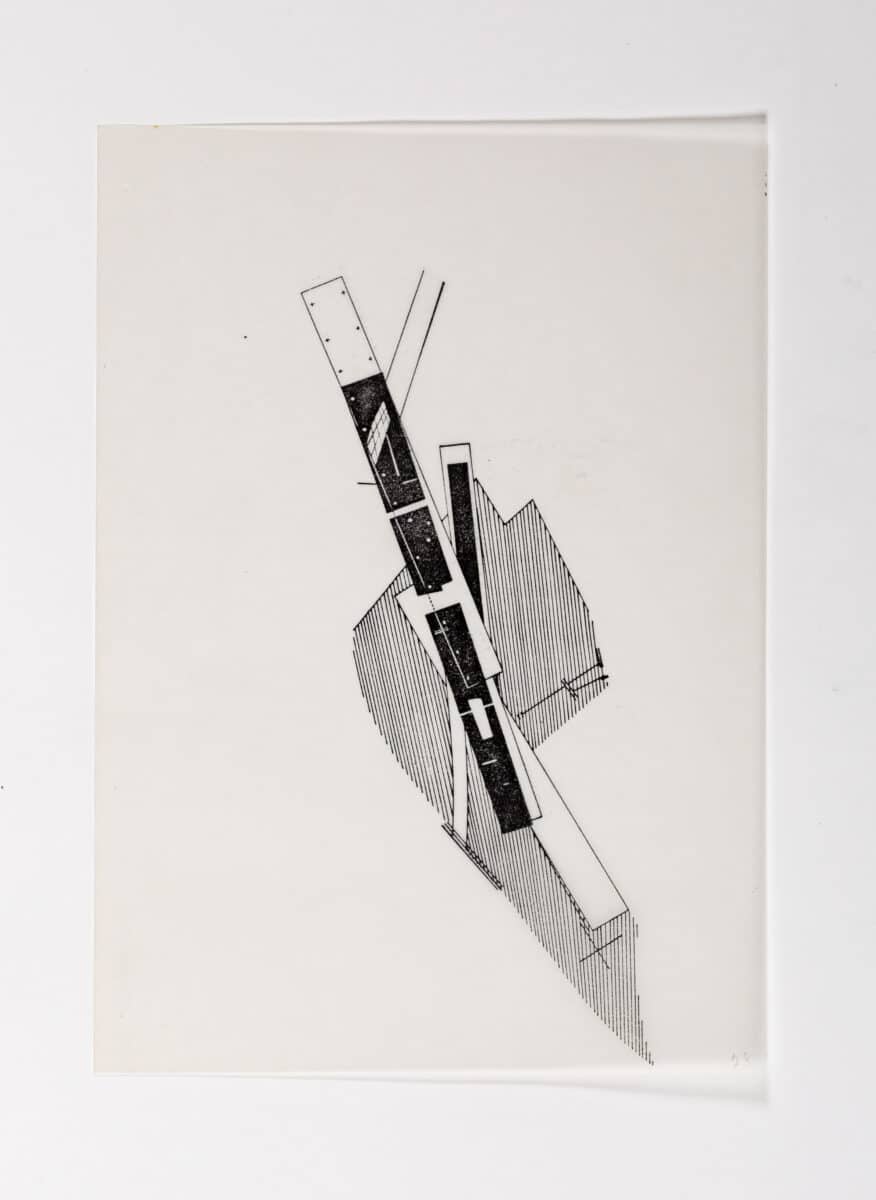
A set of thirteen trace overlays made as an ‘information package’ for the Peak, a club perched in the Kowloon mountains above the city of Hong Kong. The building is layered horizontally, where angular cutting forms create a ‘suprematist geology’. Hadid wanted to form a new topography, excavating the hills for her ‘man-made geology’. Overlaid, the drawings show the shifting nature of the building’s angular planes, but individually they are dynamic compositions, shard-like fragments of a building splintering apart. This is exemplified through their sprawling lines and dashes, what Hadid called ‘tic-tic’, representing elements with the potential of movement. Hadid’s entry to the Peak Leisure Club won, but was never built; it was a pivotal project in the formation of Hadid’s oeuvre.
Michael Wolfson noted upon our acquisition of the drawings that they were constructed with the aid of a ship’s curve (held in the Drawing Matter collection). He also stated these traces were an additional set no longer needed by the office, so he sent them as a gift to his parents.
THE WORLD (89 DEGREES), 1983
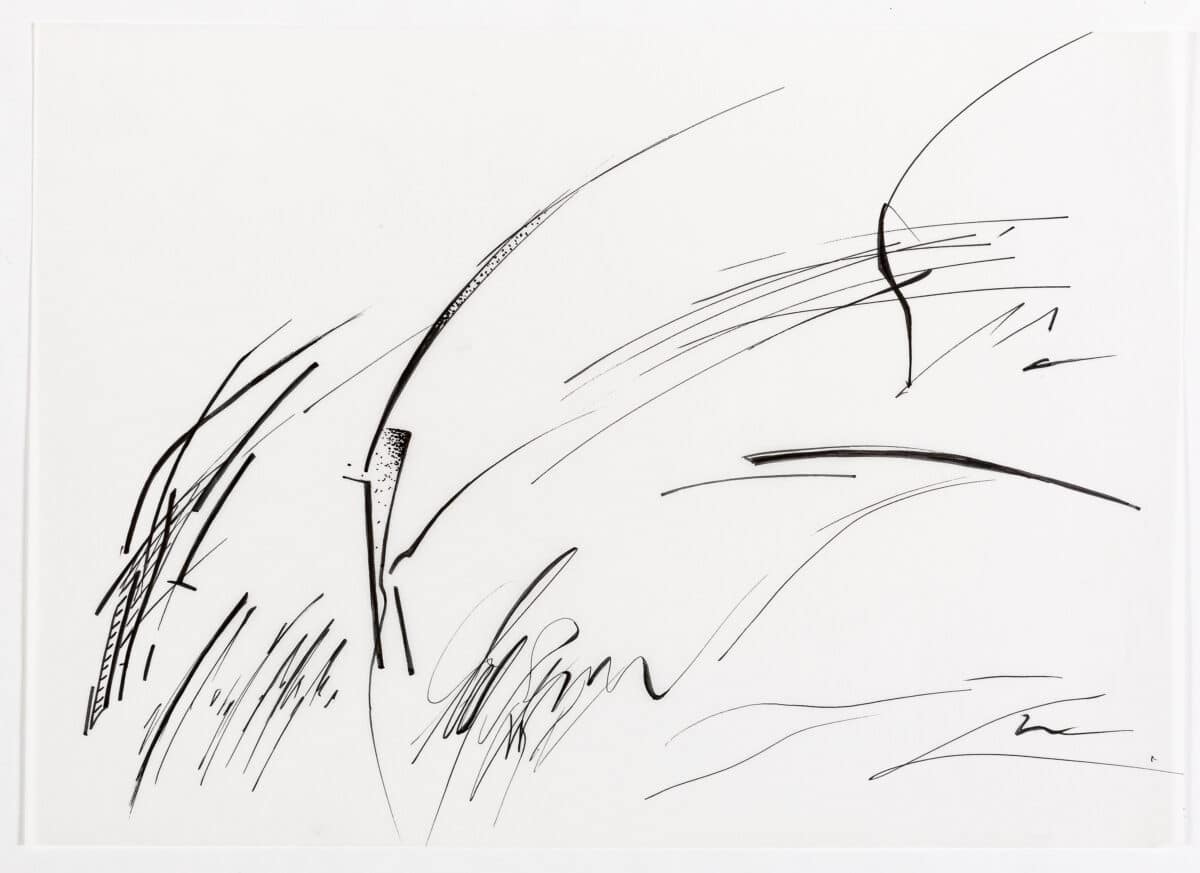
Ink on trace study for her later acrylic painting ‘The World (89 degrees)’, which was exhibited at her 1983 solo exhibition at the Architectural Association, Planetary Architecture Two. The painting is meant to represent all her key early works in the same field, while in Drawing Matter’s sketch no project is discernible; each grouping of lines carries the same arching curve that dominates the direction of the final painting. A version of the painting is featured on the folio cover for Planetary Architecture Two.
TOMIGAYA, TOKYO, 1986
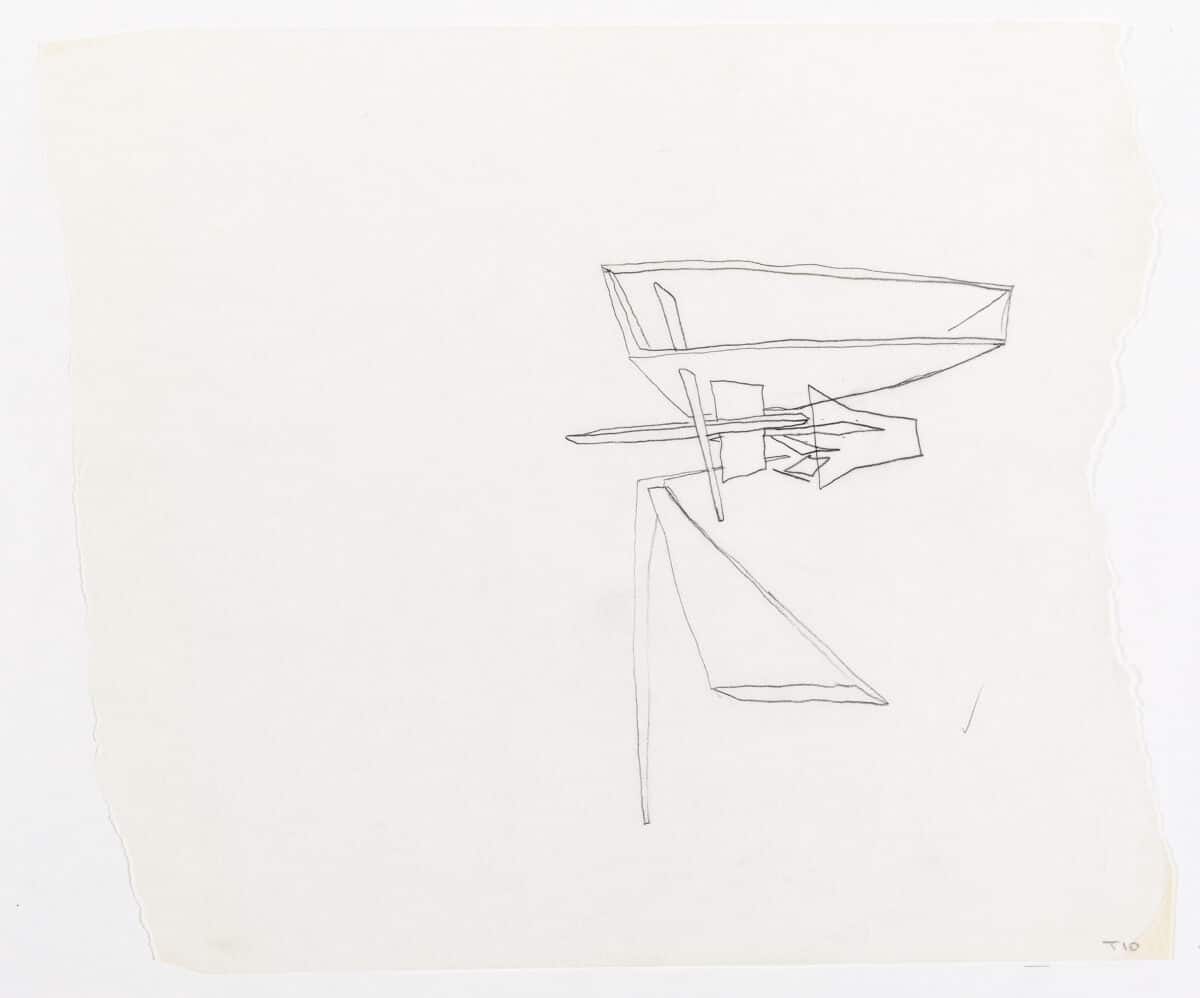
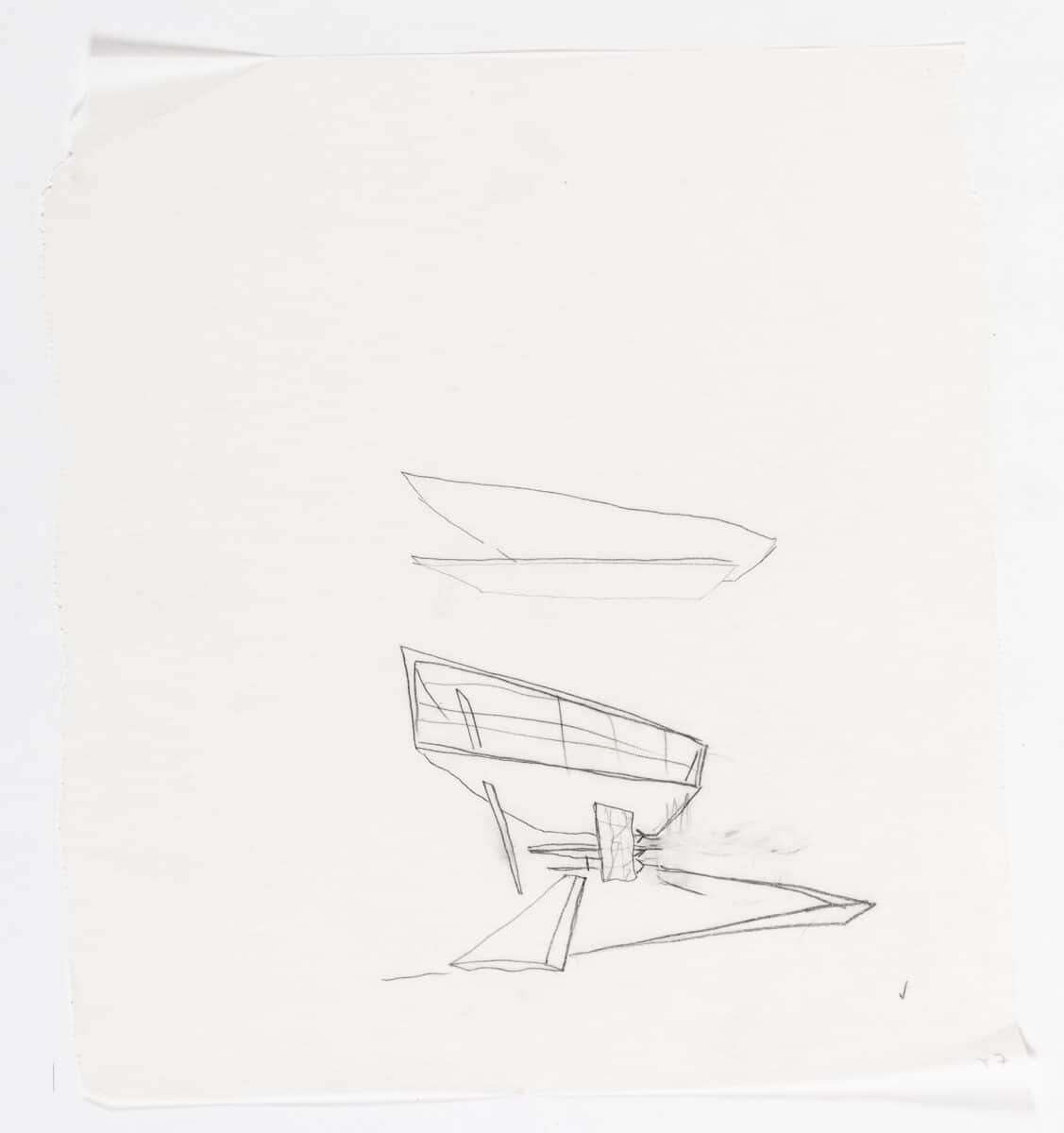
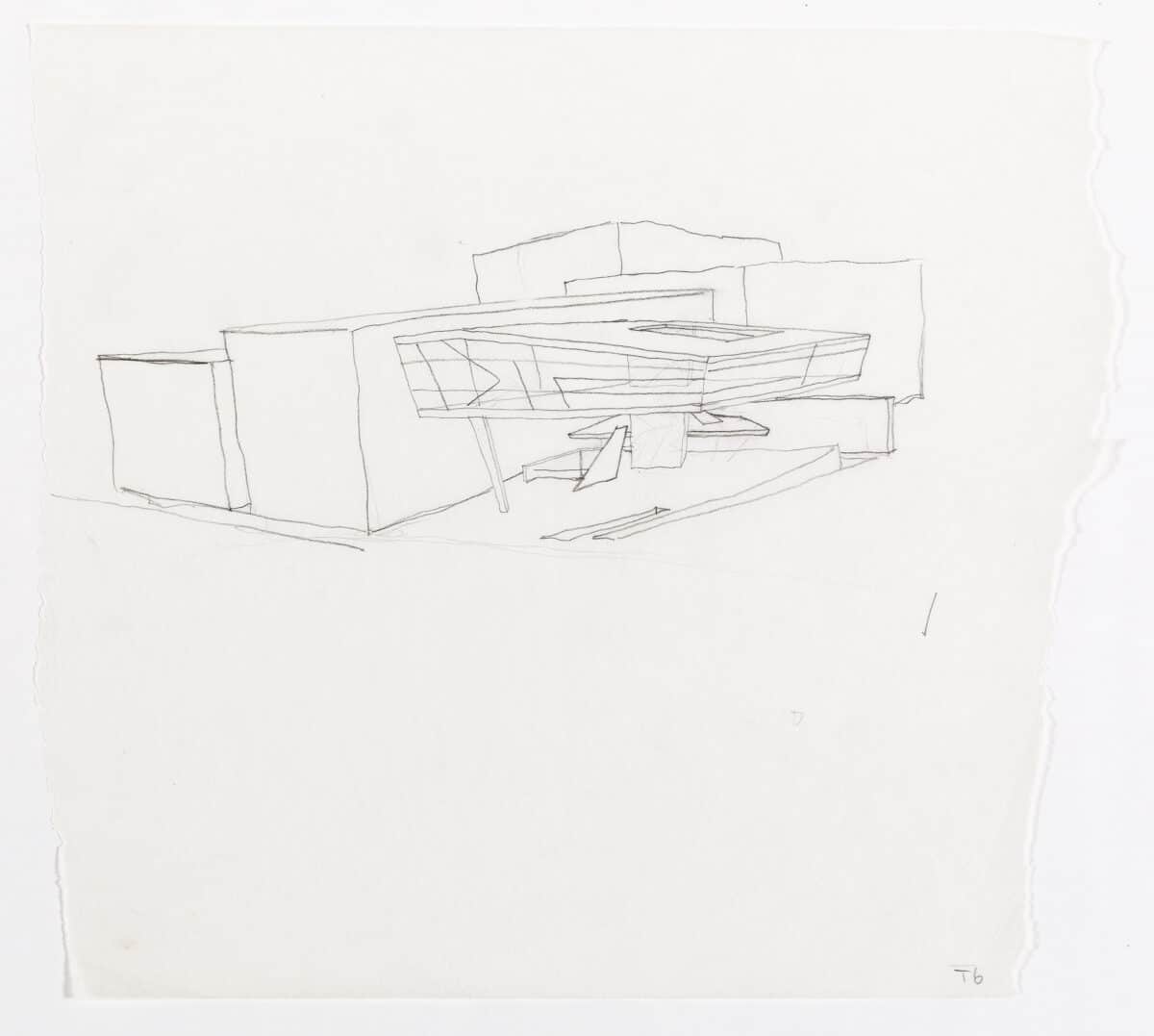
Thirteen perspective studies for Tomigaya, Hadid’s first project to start in Japan; they are a mixture of xerox copies and original drawings. The mixed-use development for the Tomigaya neighbourhood of Tokyo, for the K-One Corporation, is marked by its subversion against its confined urban situation through its single storey that juts out of the facade. This floating form is visually supported by a singular angular column that skewers through the building’s envelope. The construction of the building started in 1992 but was not completed due to the burst of Japan’s economic bubble in the same year. The project coincides with her work on another Tokyo project, Azabu-Jyuban, started in 1987, for the same client.
AZABU-JYUBAN, 1986
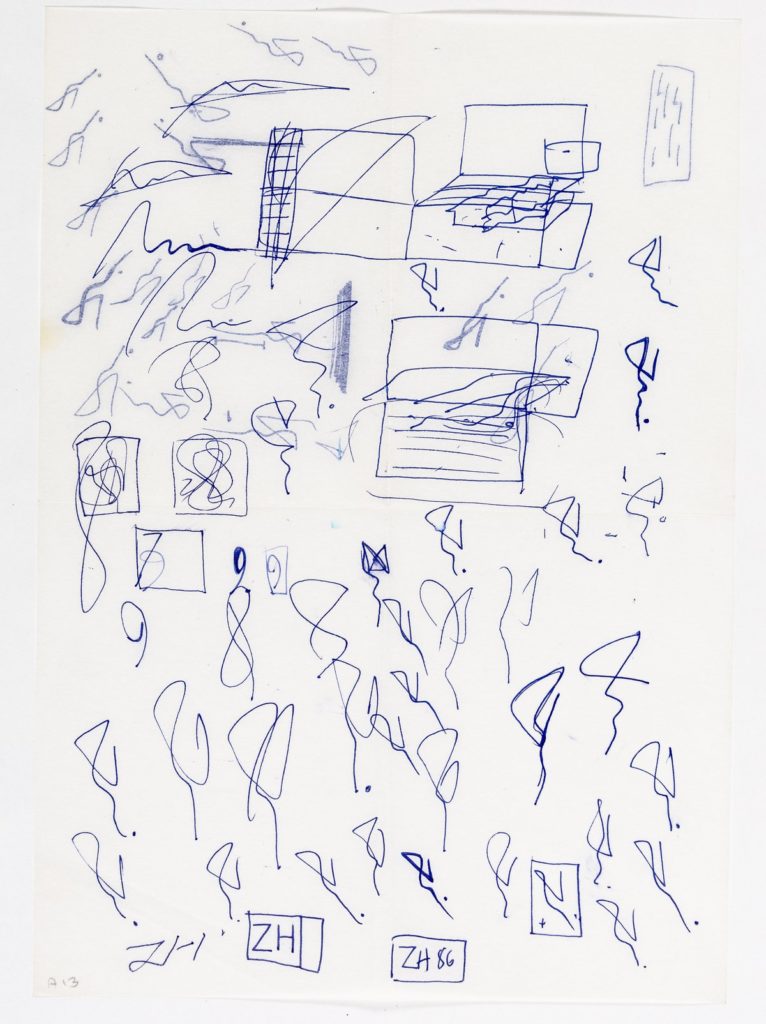
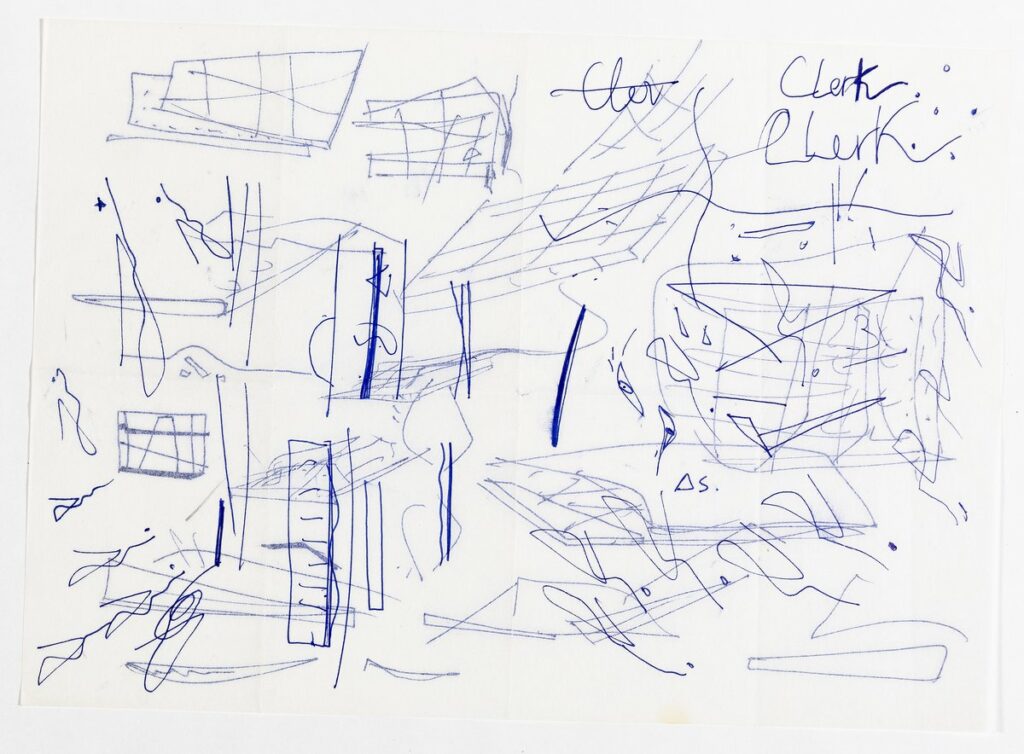
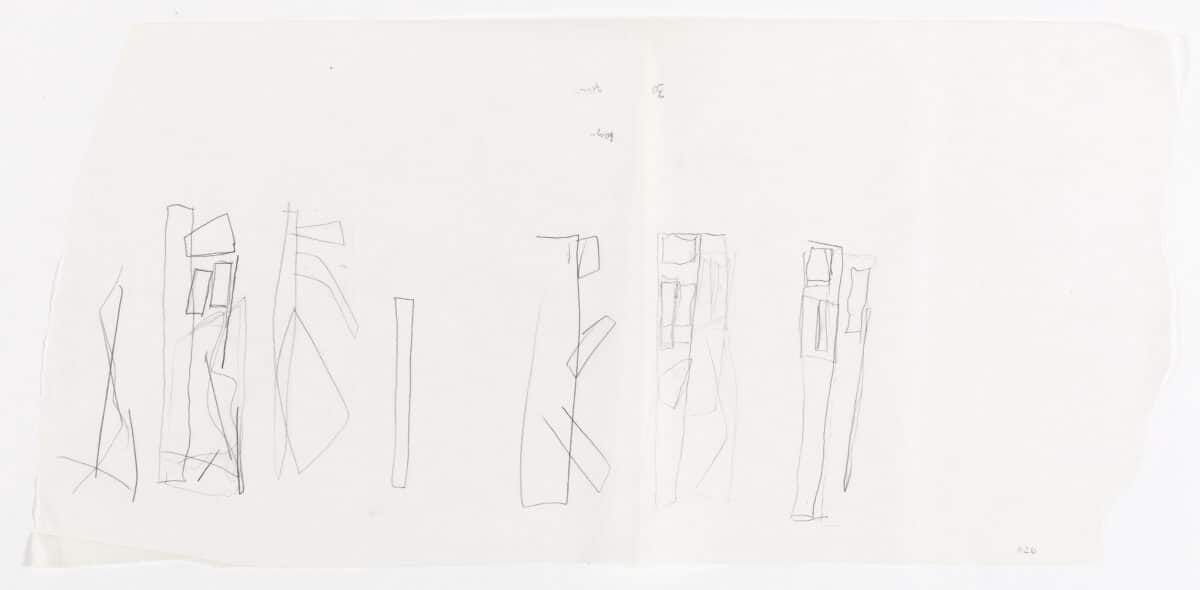
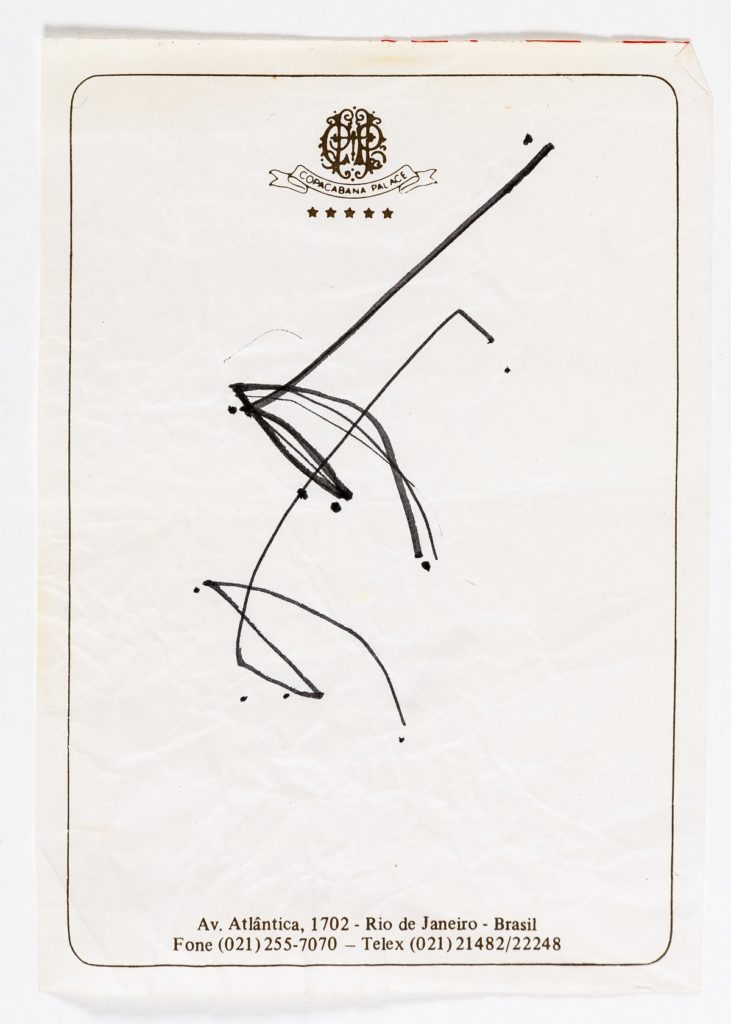
Eleven sketches on trace, post-it notes, and hotel stationery related to the Azabu-Juban office building project in Tokyo for the manufacturing company K-One Corporation. The project was unrealised but like many others of the time, tried to liberate space within a confined urban site. The sketches at Drawing Matter appear to focus on the project’s defining glass curtain walls. Among these sketches we find Hadid’s doodles including variations of calligraphic signatures in Arabic.
WAVY SOFA, 1986
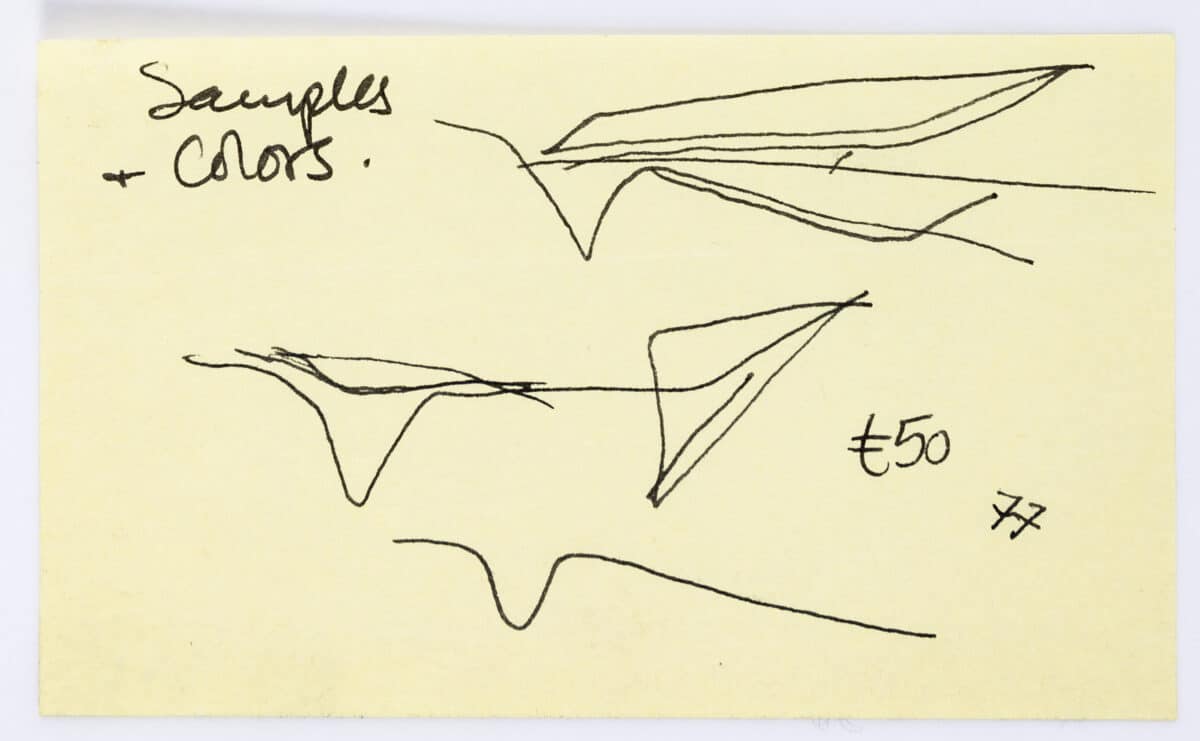
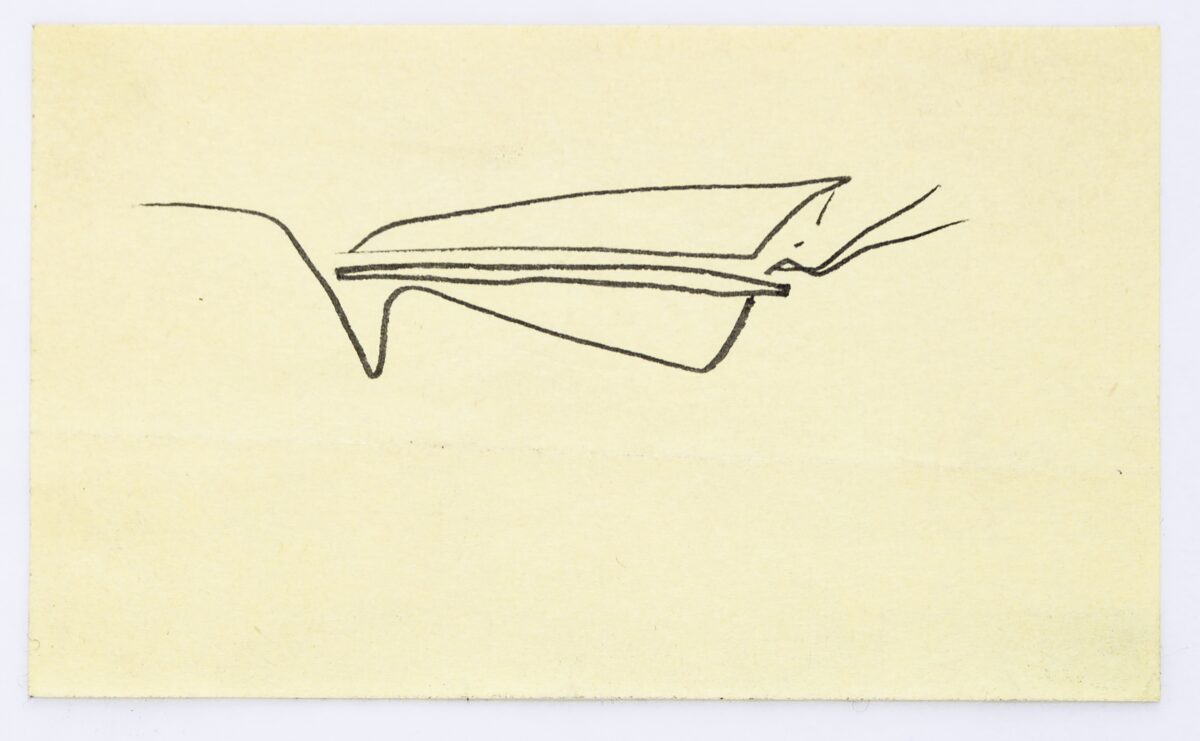
Twelve post-it note development sketches of the Wavy Sofa. It was part of a suite of furniture commissioned in 1985 by furniture importer William Bitar for his townhouse at 24 Cathcart Road, London. The realised suite also contained the Metal Carpet, the Sperm Coffee Table, the Whoosh Sofa, and a sliding storage unit. The Wave Sofa was made of intersecting moulded fibreglass frames. Hadid, describing the work in 1987, stated ‘the sofa is not just a sofa, but also acts as a partition or shield.’ The sofa and its working drawings were exhibited at the AA in early 1988. When Bitar leaves his London house, the furniture is relocated to Hadid’s own apartment. Valerio Mazzei and Massimo Morozzi of the Italian furniture company Edra, see the sofas in an 1987 edition of Casa Vogue and enquire about the industrial production of them. The ‘Wave Collection’, a collaboration on three sofas between Hadid and Edra, was then launched at a Milan nightclub in September 1988, as part of the Milan Furniture Fair. The name of the sofa transitions from ‘Wavy’ to ‘Wave’ upon its production by Edra.
KURFÜRSTENDAMM 70, BERLIN, 1988
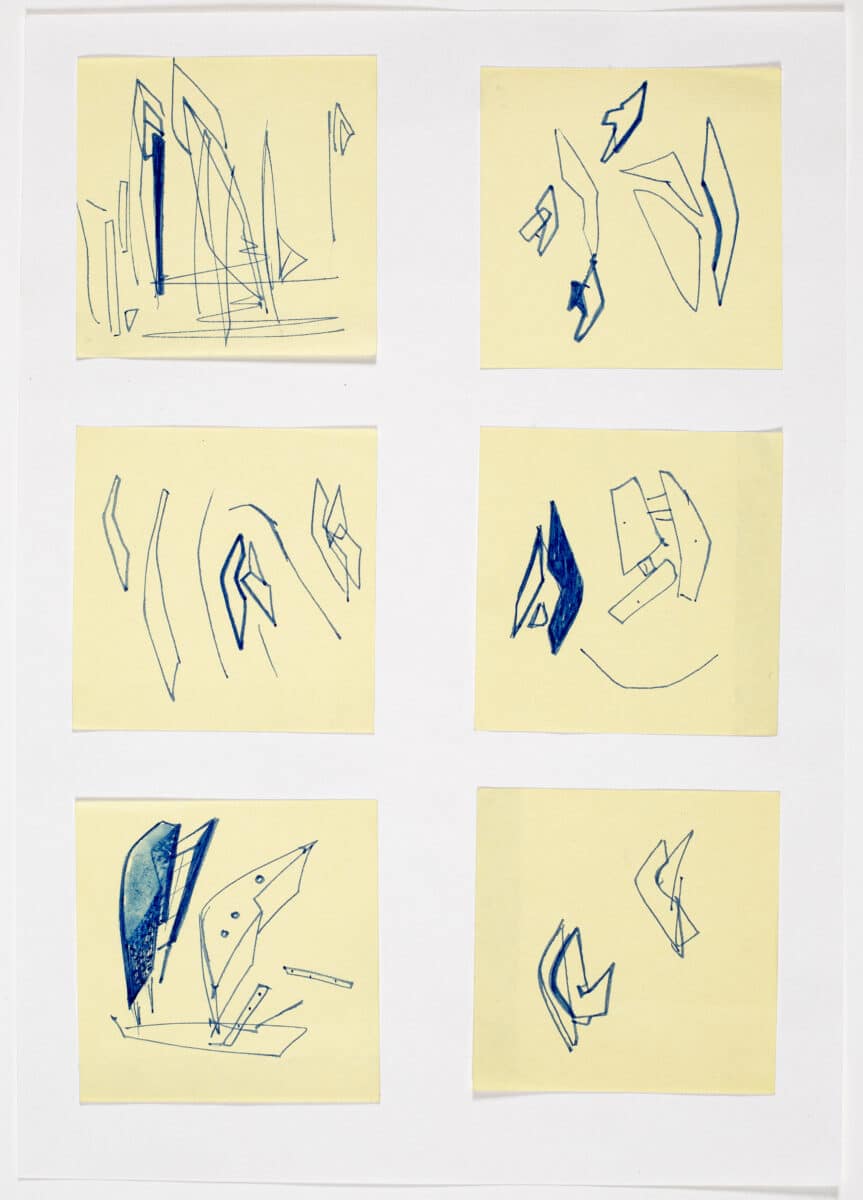
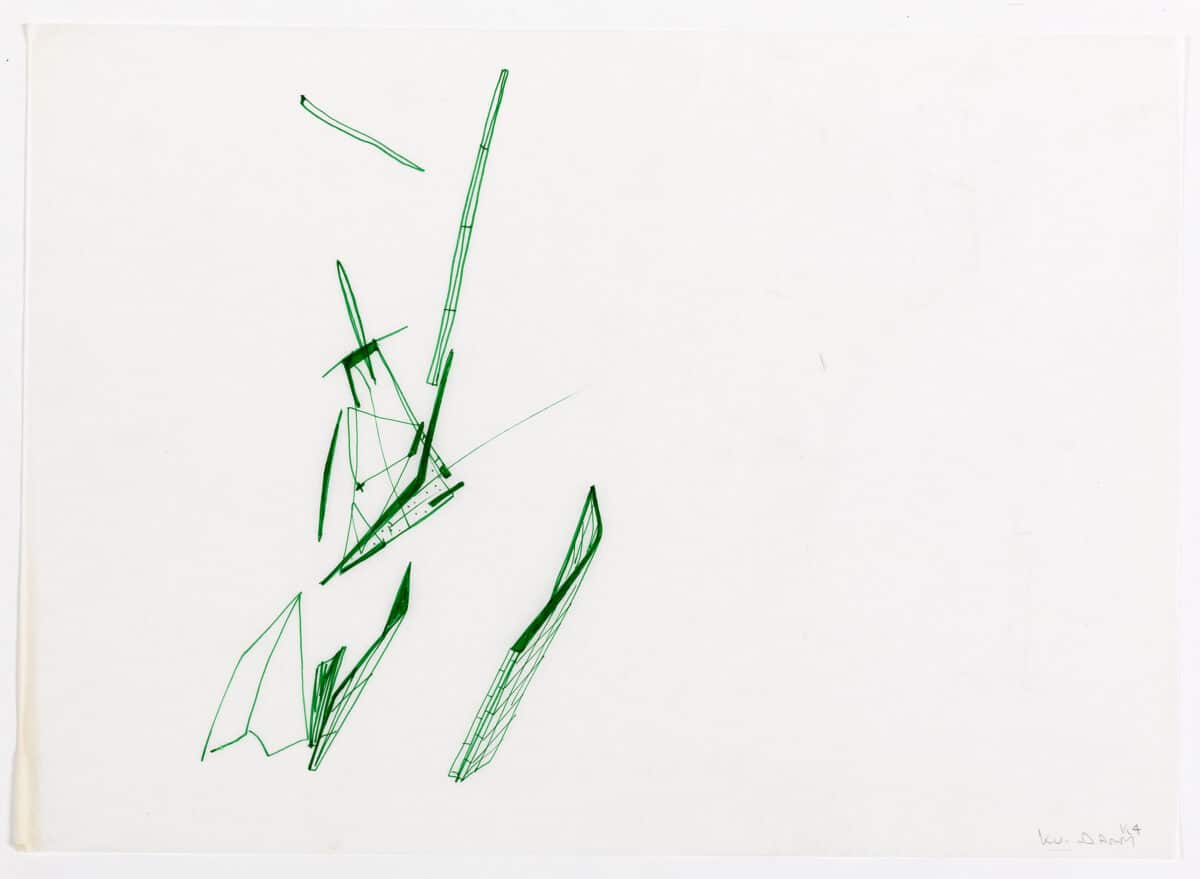
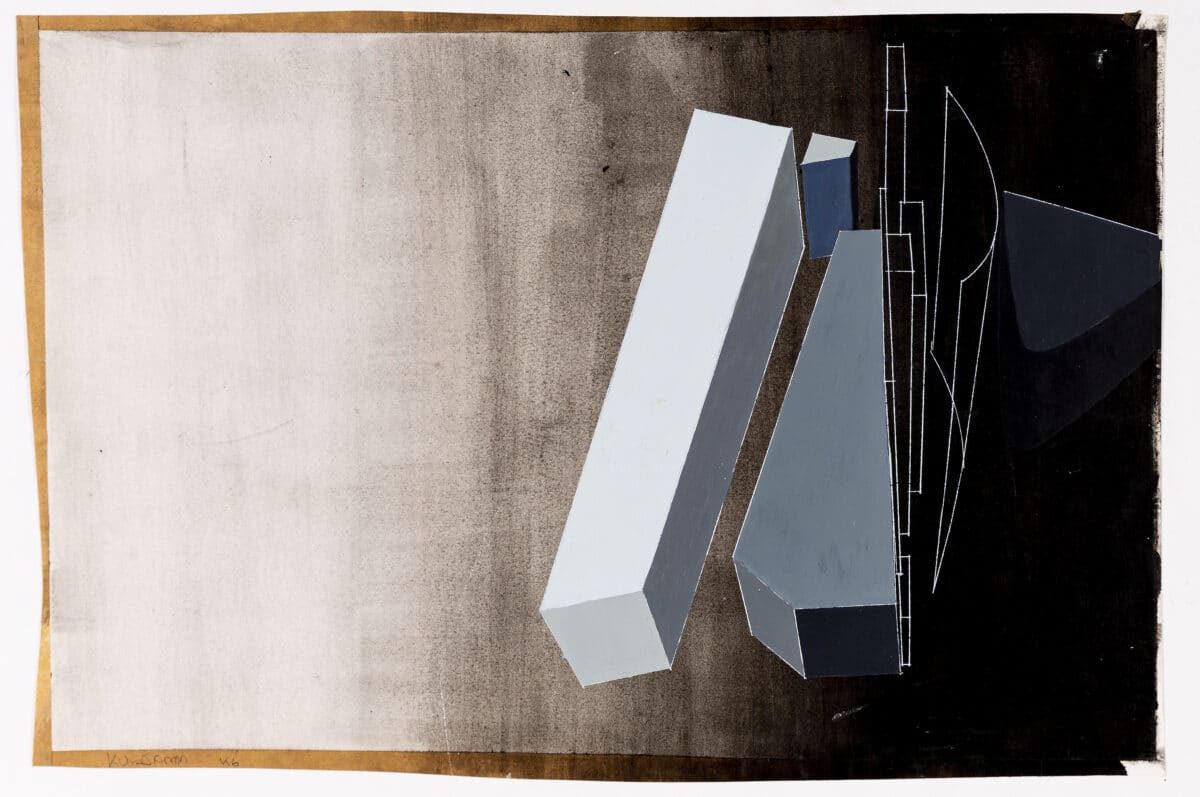
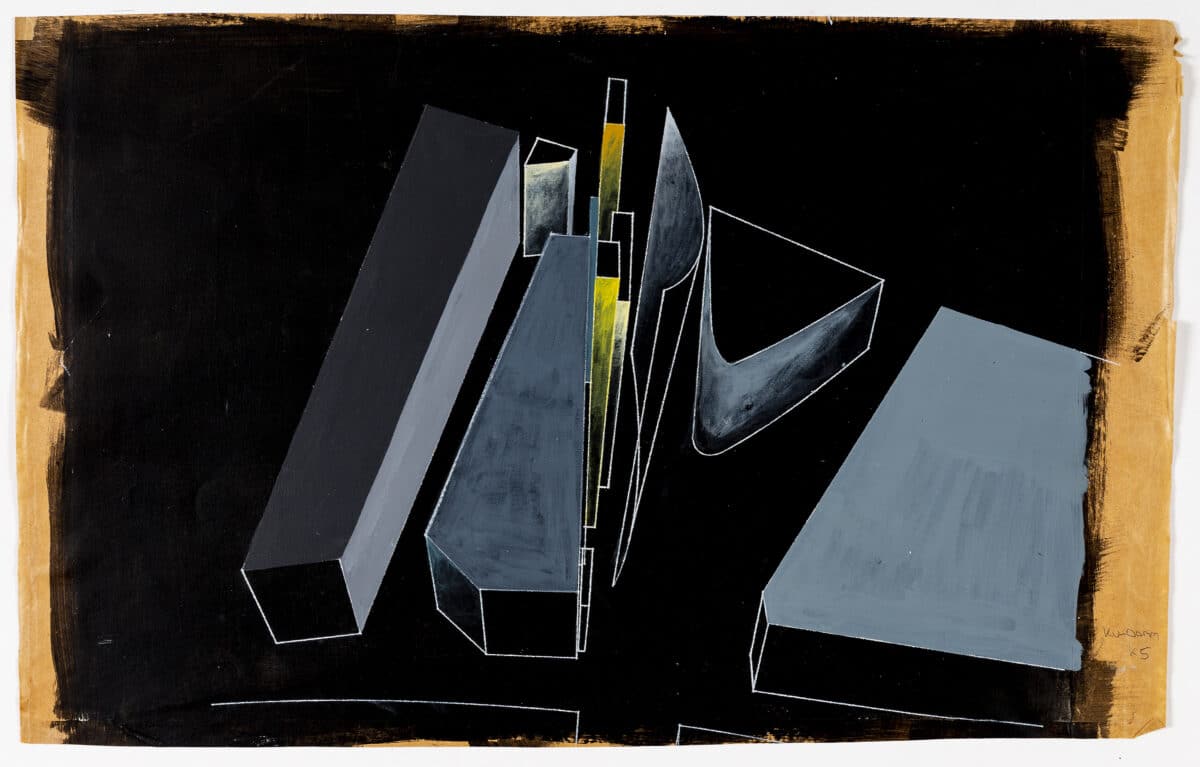
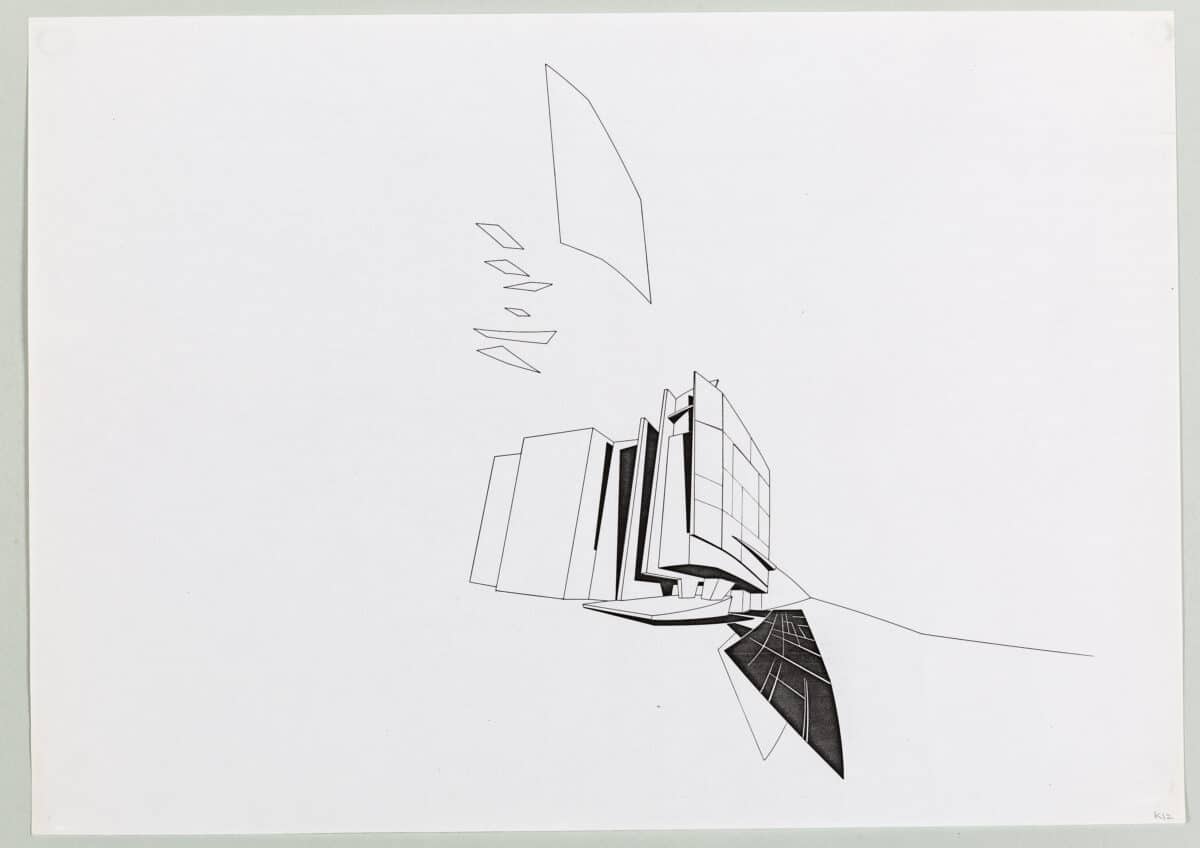
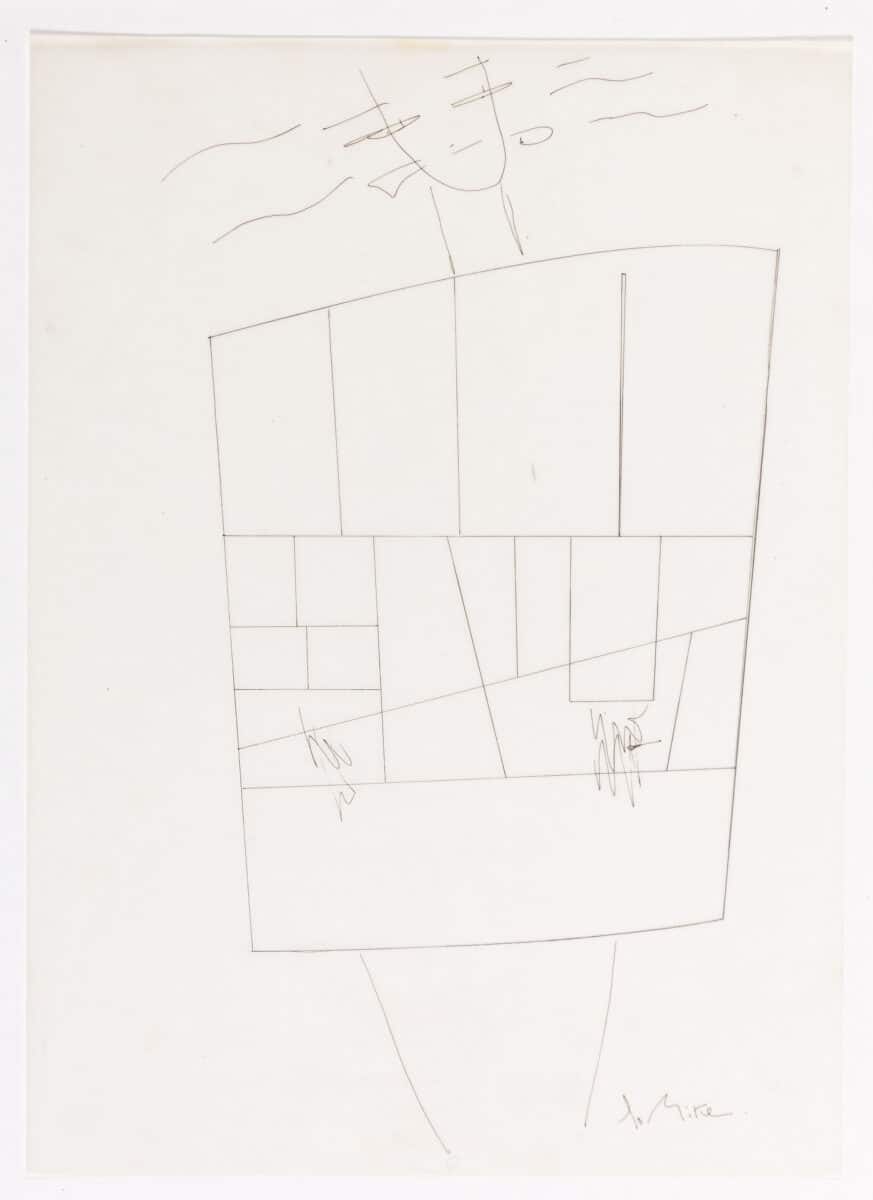
Hadid was part of an invited competition by the developers Euwo Holdings in 1986 for the office building Kurfürstendamm 70 in Berlin. Like Tomigaya, it was defined by its narrow site within an already built-up urban landscape. The site was also a hinge point in the city, where the shopping strip met the residential. The Drawing Matter holdings of Kurfürstendamm 70 consist of a series of preliminary sketches on post-it notes, sketches on trace, xerox copies of perspective drawings, two painted sketches, and a pencil-drawn portrait of Zaha as the building.
VICTORIA CITY AREAL, 1988
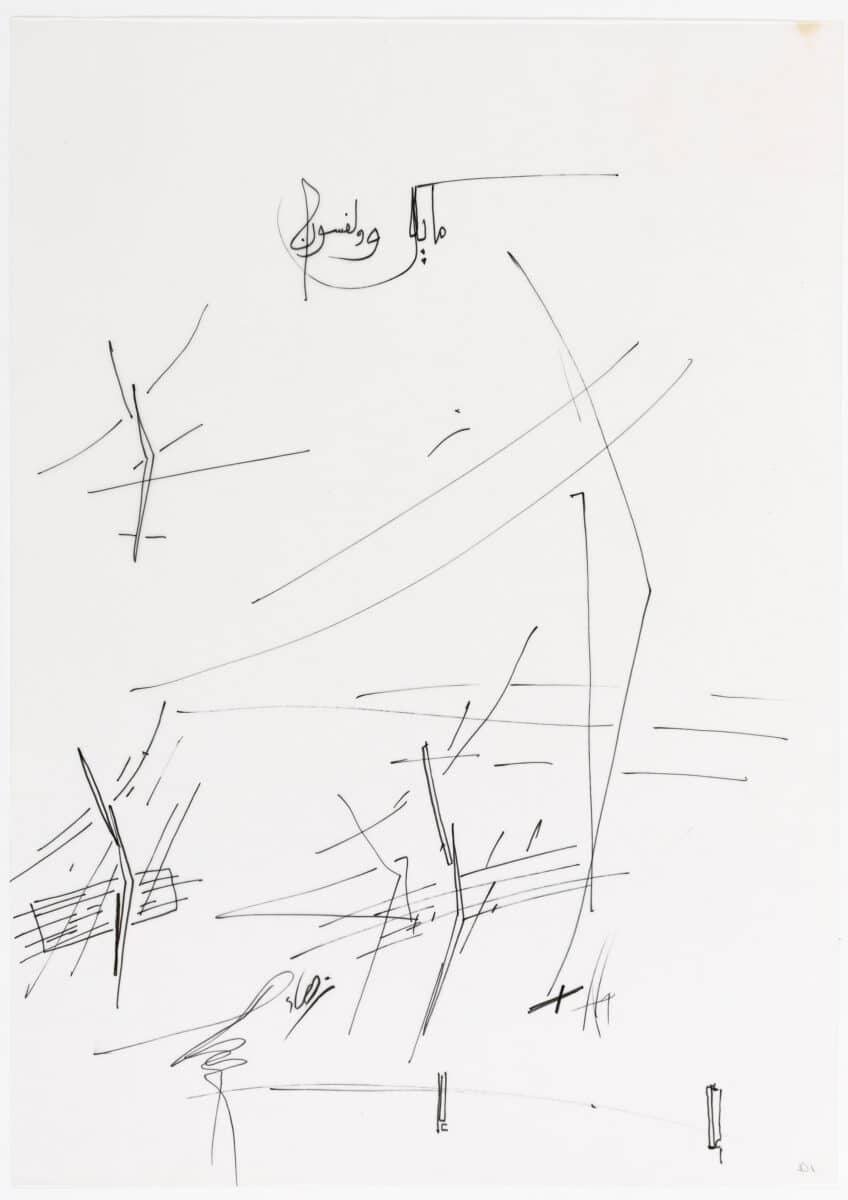
This sketch at Drawing Matter was regarded as part of the material for Zollhof 3 Media Park, but through comparison to works held at the ZHF and the Berlinische Galerie, we can see the similarity of the form to the Victoria City Areal. With this striking angular line and a cross, both emblematic of the Berlin project. The two projects are contemporaneous and speak to the recurring motif of shifting slabs in Hadid’s work at the time. Victoria City Areal was a project initiated by the Berlin Senate to redevelop the area between Kurfürstendamm and Kantstrasse. Hadid’s response to the project was praised but not chosen. The commercial development would encompass shops, office spaces, and hotels; Hadid’s design was for a nine-storey structure which emphasised the horizontality of the city. It was to encourage movement with services that offered permeability, divided by a network of walkways, ramps, and connections to transport hubs.
ZOLLHOF 3 MEDIA PARK, DÜSSELDORF, 1980s
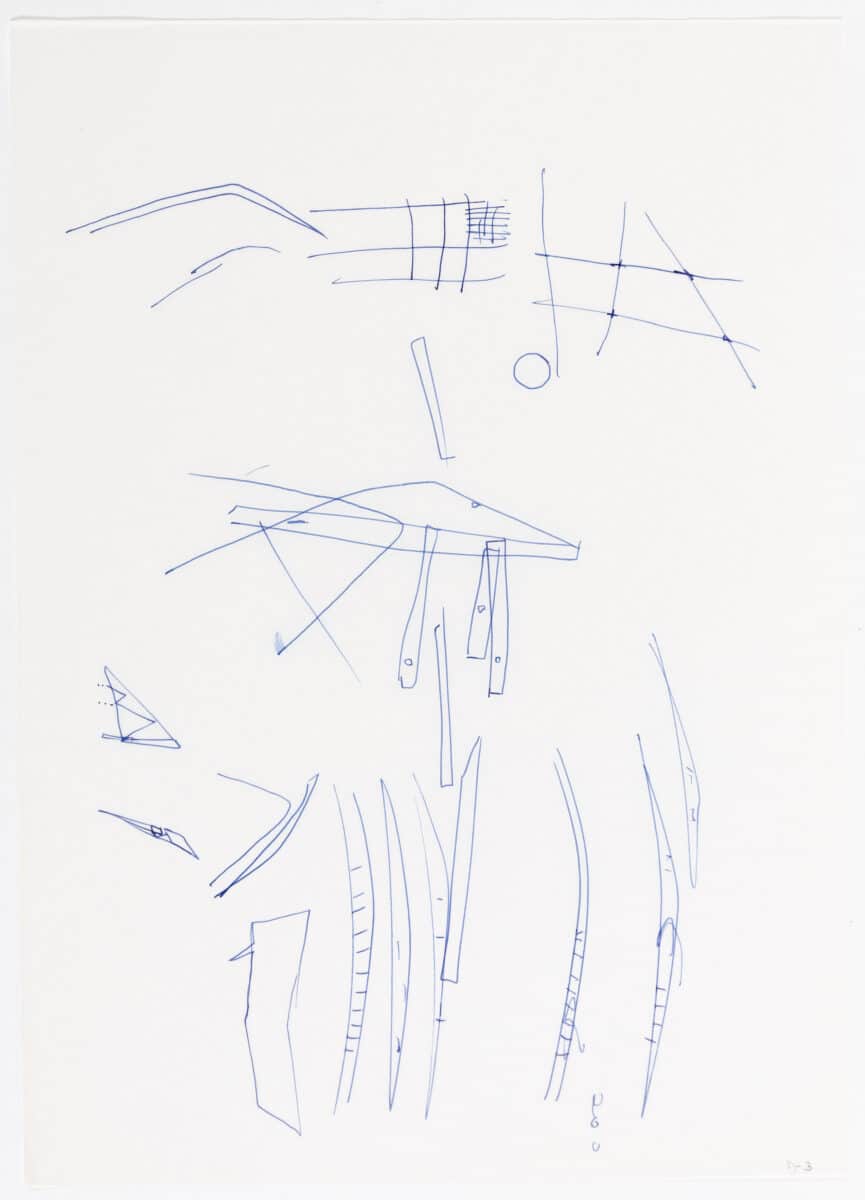
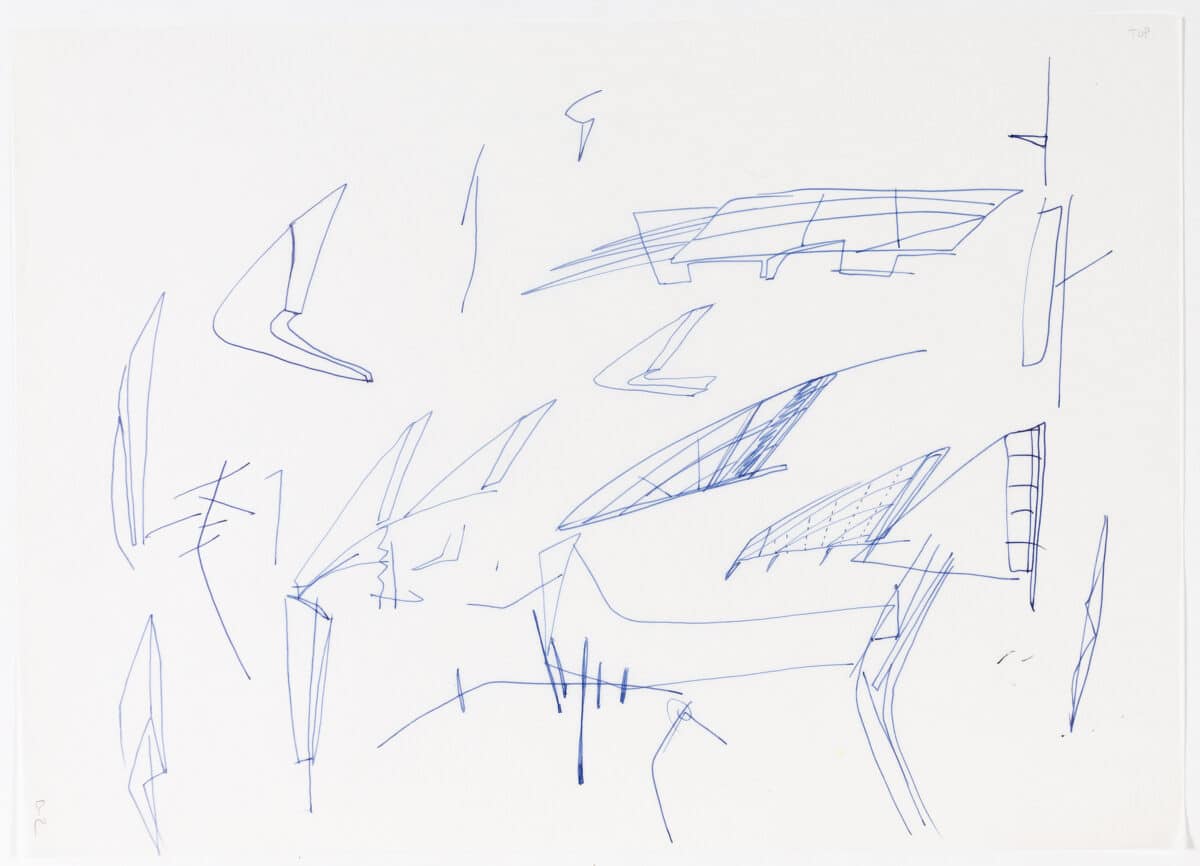

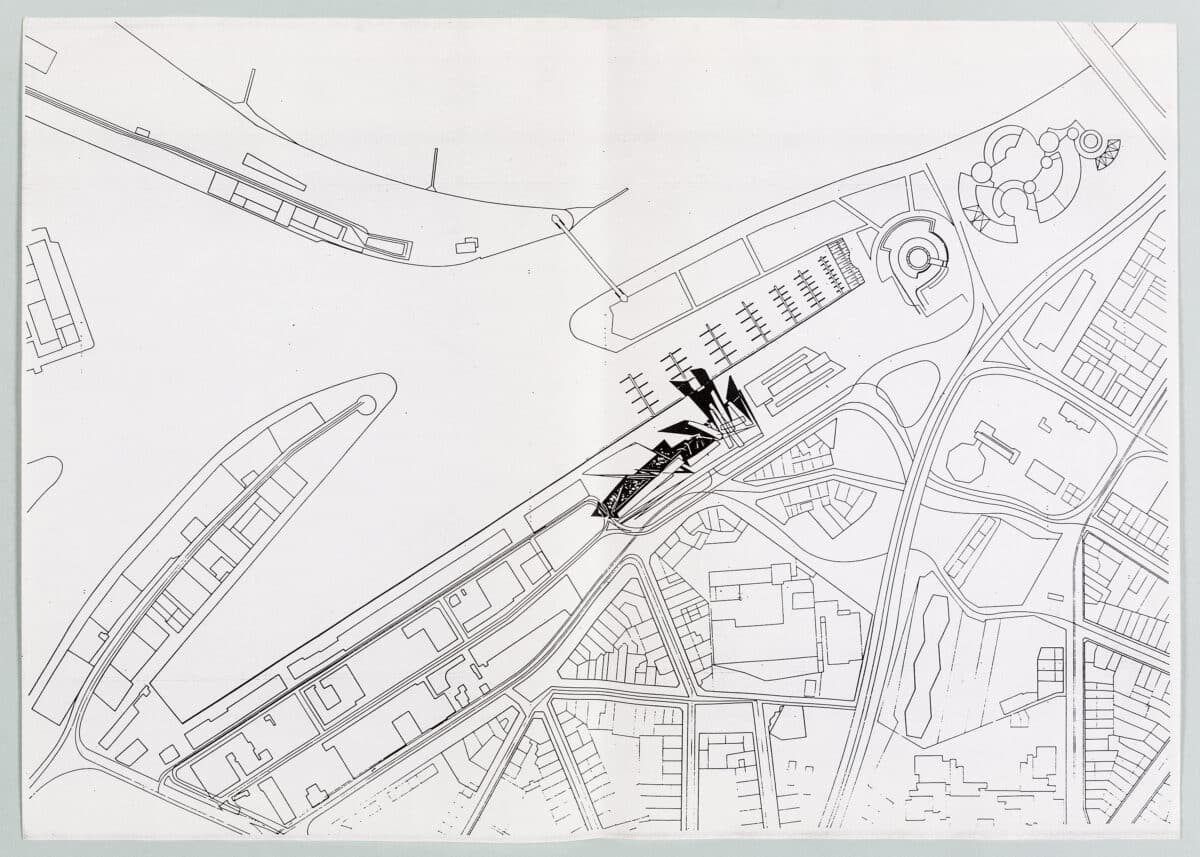
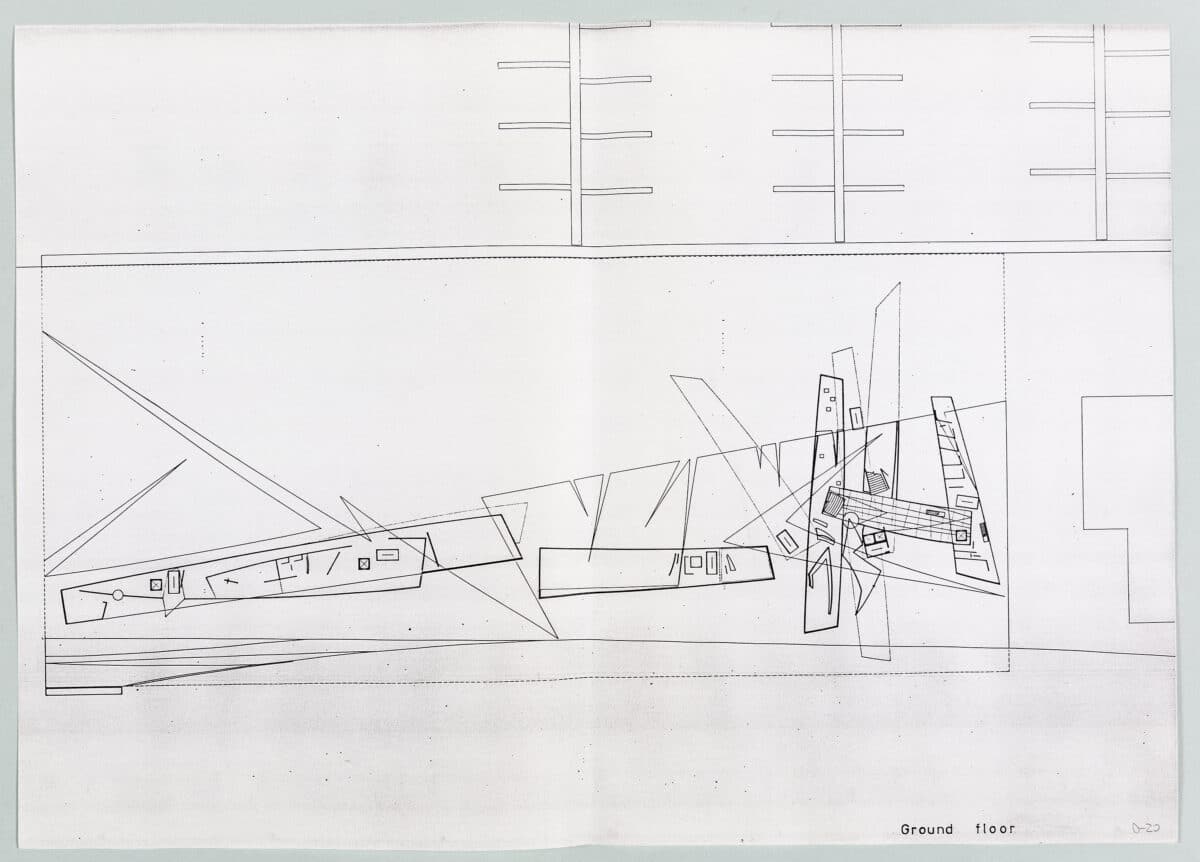
Zollhof 3 Media Park in Düsseldorf was a competition won by Hadid in 1989, for a new arts and media centre for Kunst-und Medienzentrum Rheinhafen (KMR). The project aimed to revive the derelict waterfront into a lively space for the public as well as offices and cultural sites. The Drawing Matter materials for the project are a mixture of Hadid’s preliminary sketches on trace, xerox copies of client development presentation material, design presentation drawings, and architectural prints of the final plan and section drawings. Several forms break through a core slab, speaking to the flooding of the river Rhine, its powerful water often bursting its banks. The project, after four years of development was halted after a change at KRM, with the loss of the original tenant. The developers decided to commission a new design by Frank Gehry.
POSTERS, PHOTOGRAPHS, & PUBLICATIONS
OMA PROJECTS 1978-1981, EXHIBITION CATALOGUE, 1981
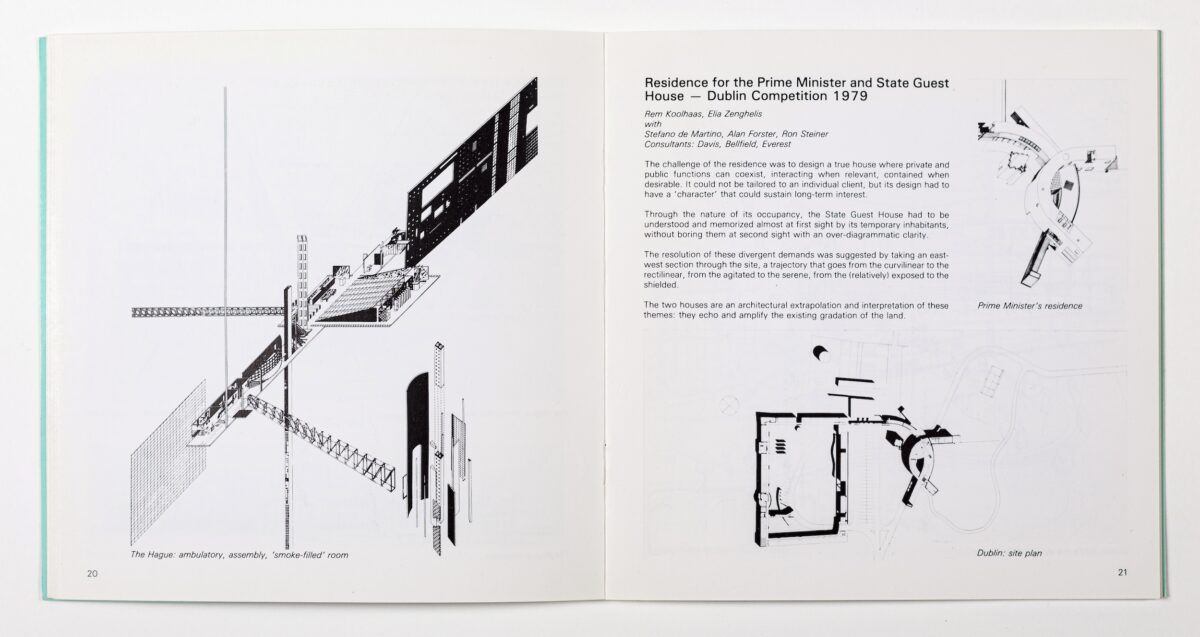
Catalogue published for the AA’s exhibition of OMA drawings in June 1981. It features Hadid, Koolhaas, and Zenghelis’ drawing for the Dutch Parliament (copy held in the Drawing Matter collection), alongside OMA’s rival competition entry for the Irish Prime Minister’s House, once Hadid had left the office.
ZAHA HADID PROJECTS 1977-1981, EXHIBITION CATALOGUE, 1981
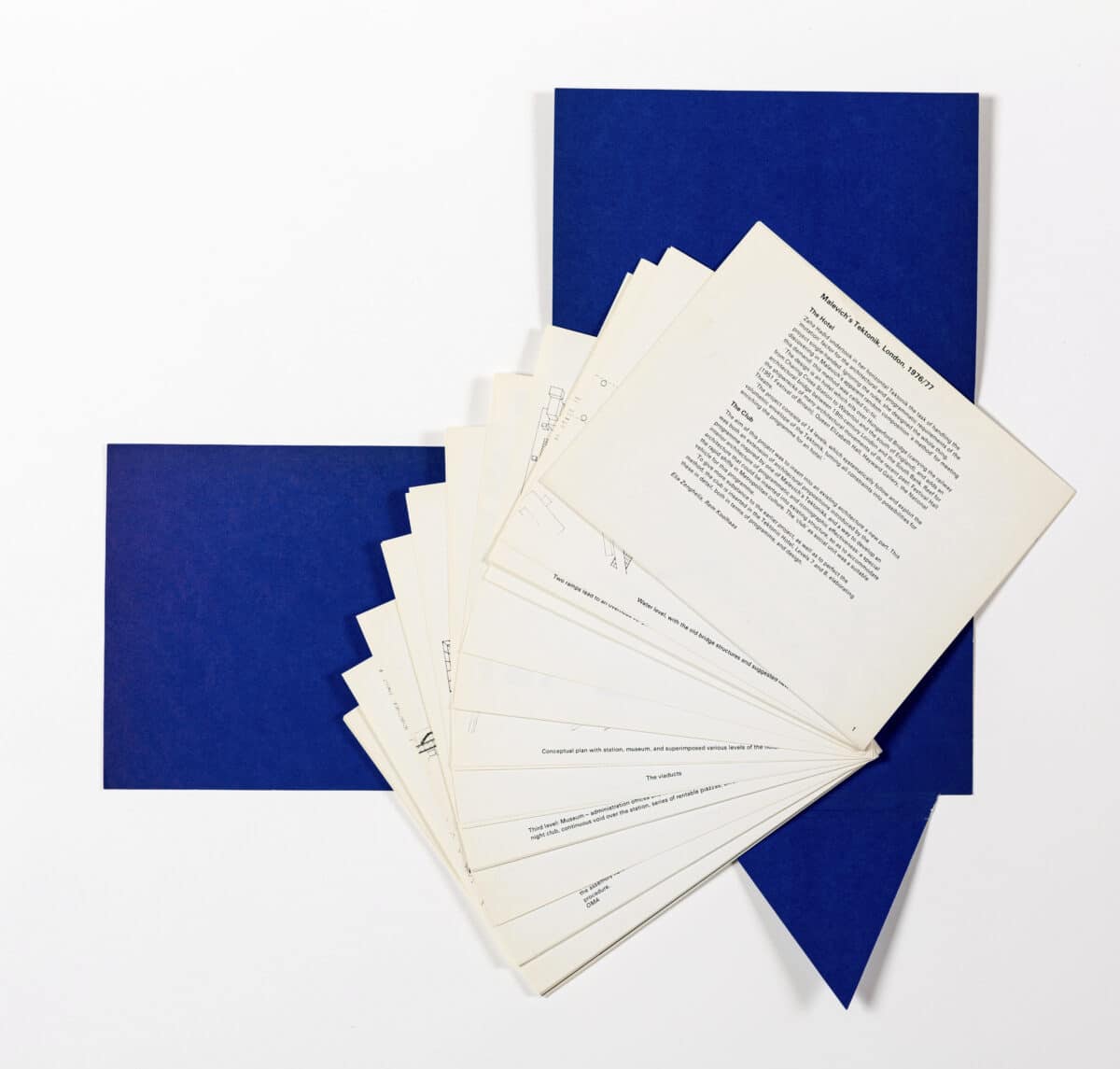
Exhibition catalogue for Planetary Architecture at the Van Rooy Gallery in Amsterdam of Hadid’s early works, comprised of 78 individual sheets. The sheets run through five projects, with introductory information, a series of drawings, and a credit sheet. It opens with Hadid’s student projects Malevich’s Tektonik (1976-77), The Museum of the 19th Century (1977-78), followed by The Extension to the Dutch Parliament (1978-79), Irish Prime Minister’s Residence (1979-80), and 59 Eaton Place (1980-81).
PLANETARY ARCHITECTURE EXHIBITION INVITATION & 6 POLAROIDS, 1981-1982
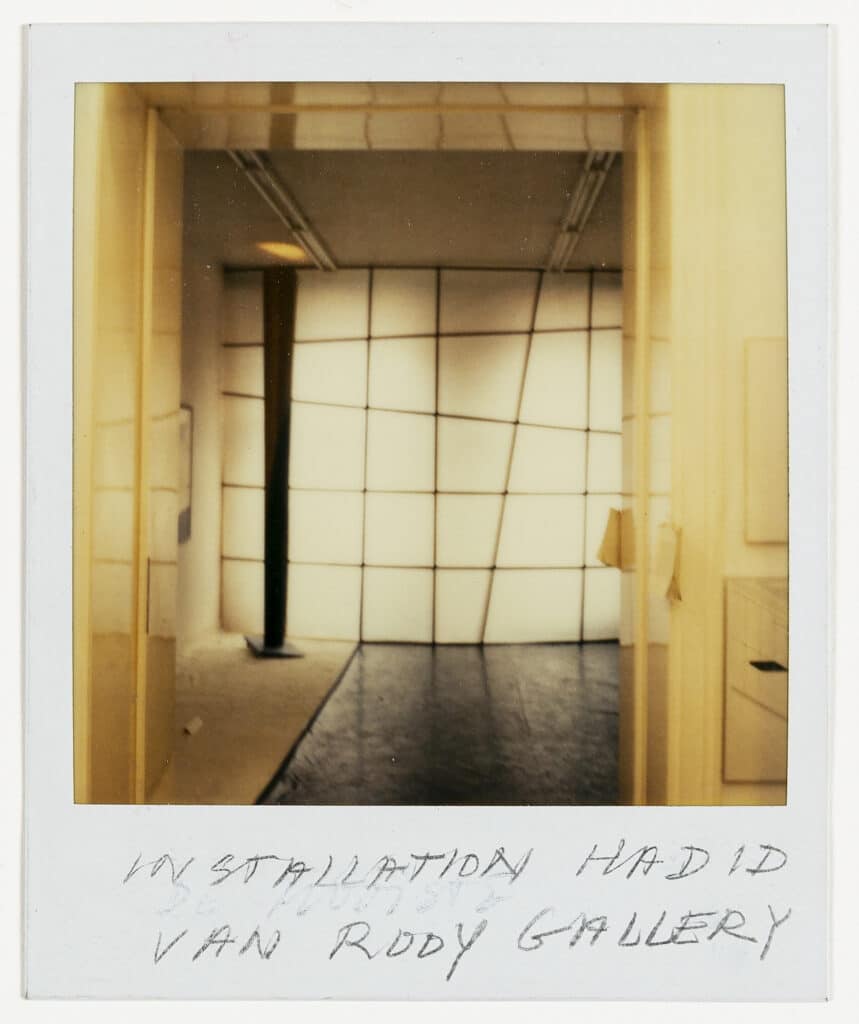
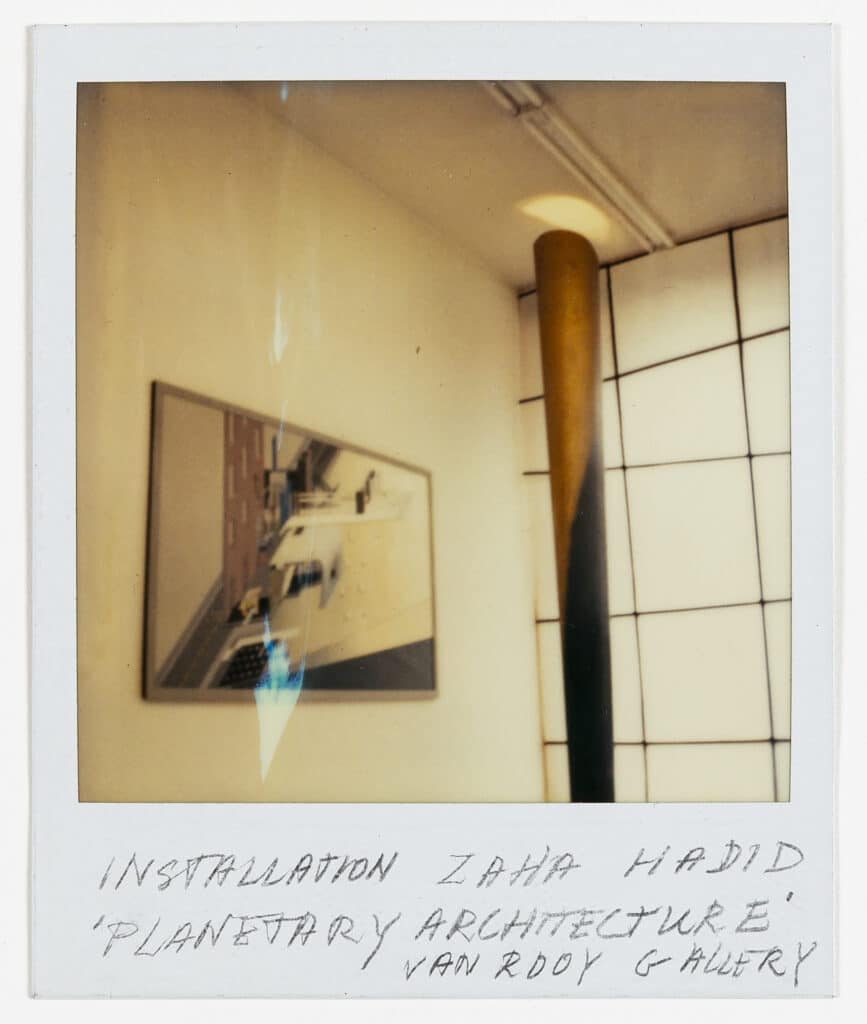
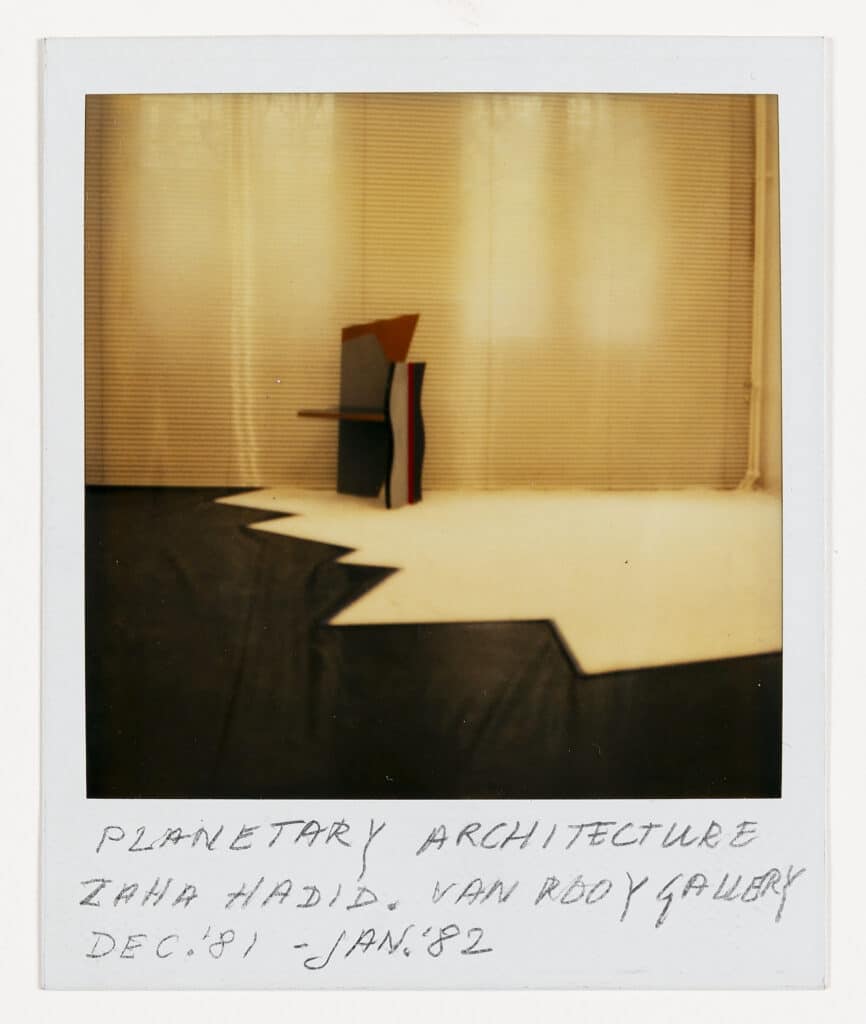
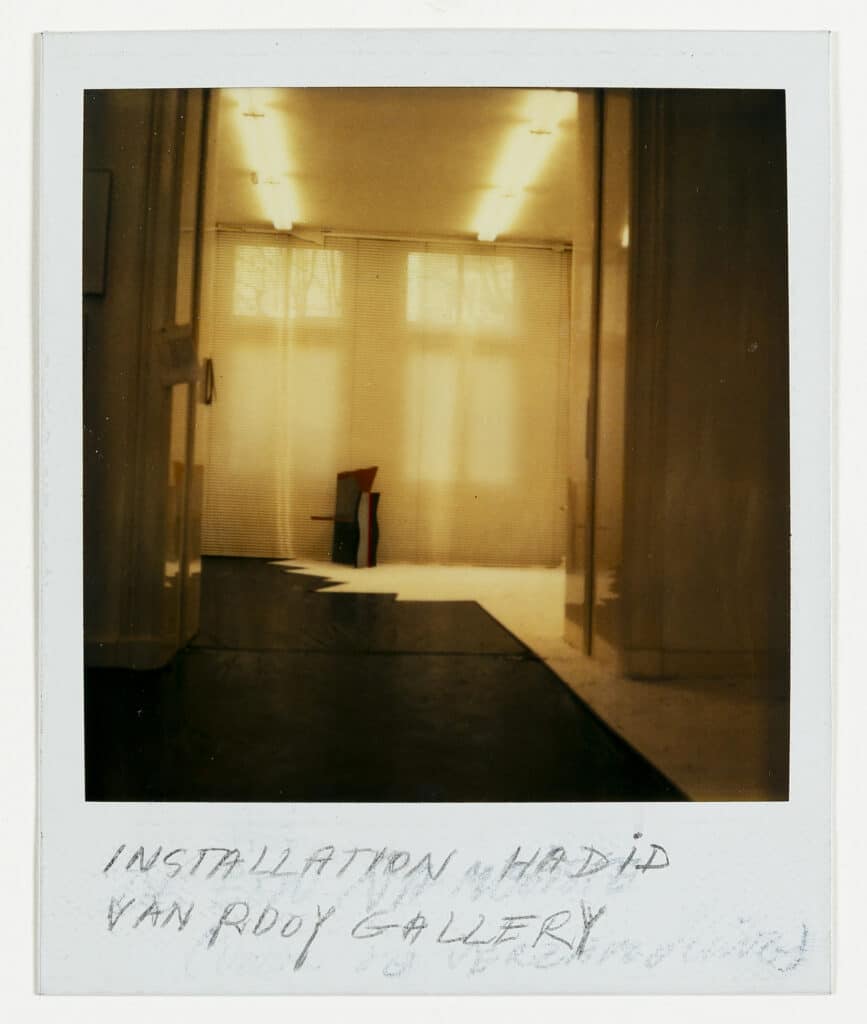
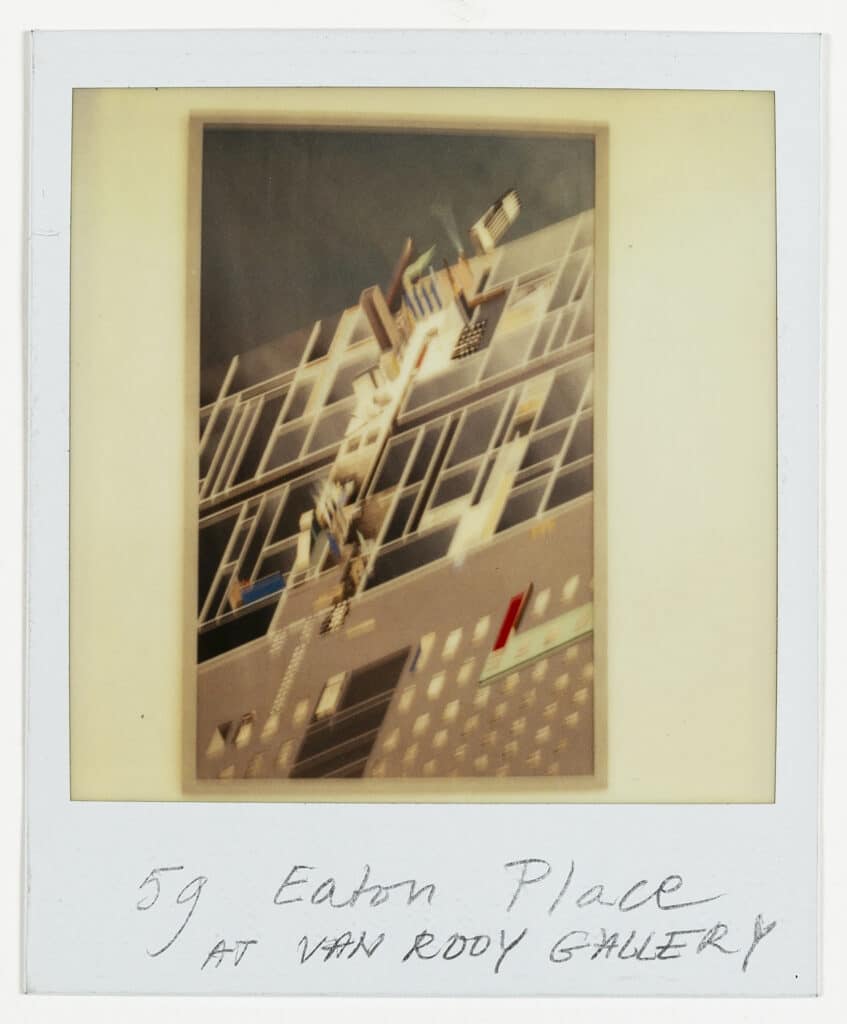
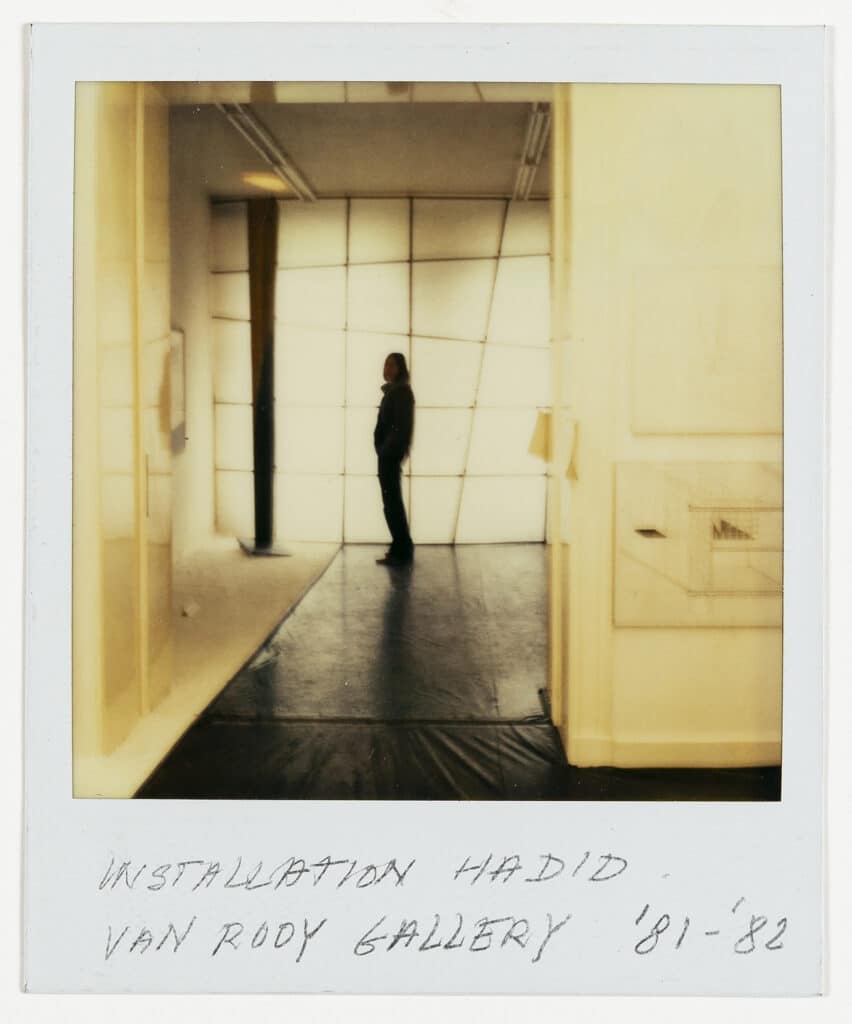
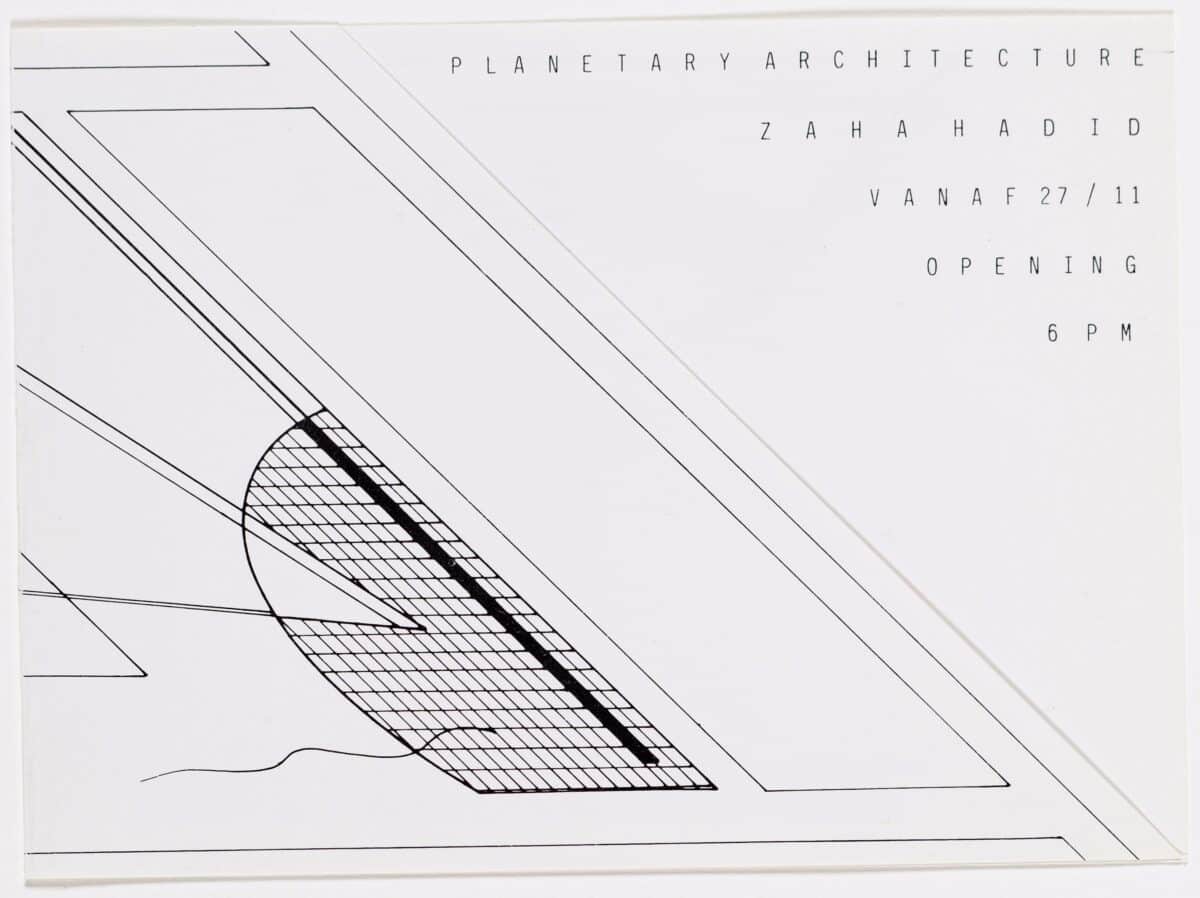
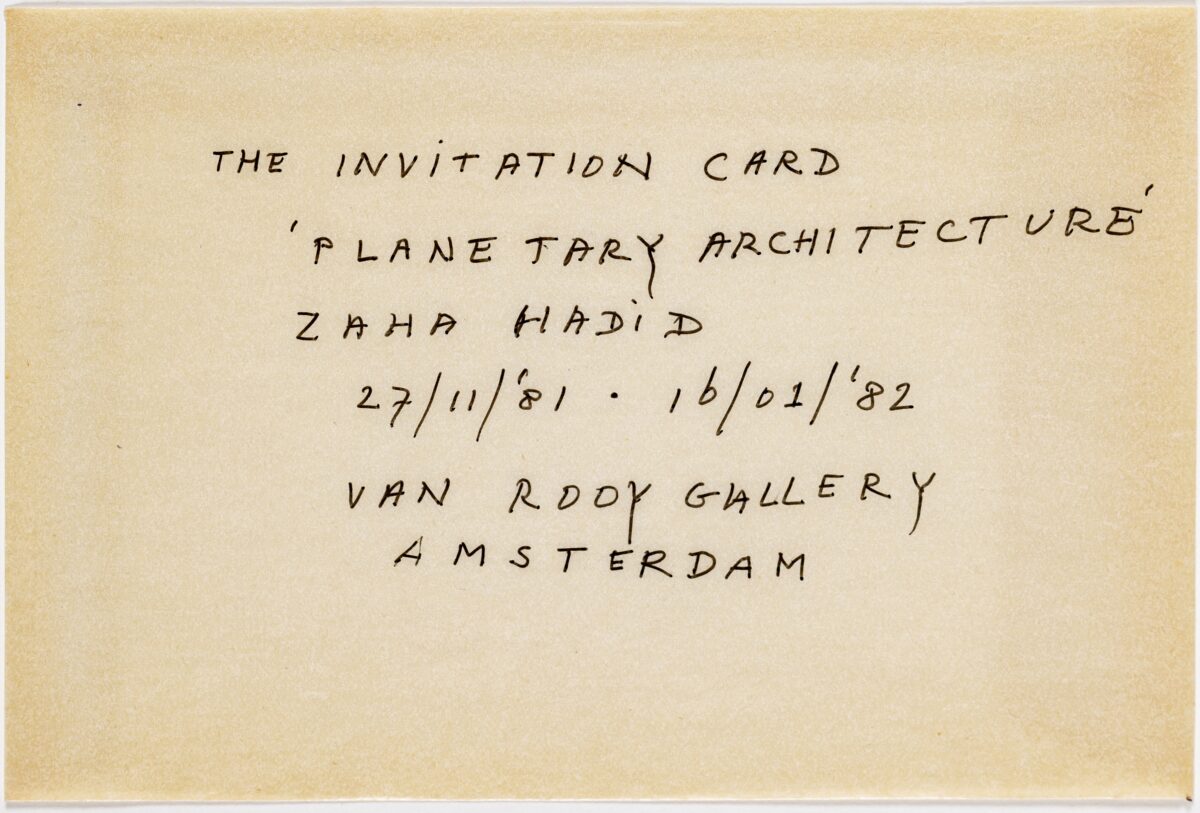
Private view invitation and six polaroids of Planetary Architecture held at the Van Rooy Gallery in Amsterdam from the 27th November 1981 to the 16th January 1982. The exhibition was Hadid’s first solo show and only the ninth exhibition to be held at the Van Rooy Gallery. Hadid’s work on show wanted to explore the spatial potential of architecture; she equally designed the space with a gold rotating column and a wall of gridded lights. The polaroids mainly show the space, but one image does feature a photo of Hadid’s 59 Eaton Place project from 1980.
PLANETARY ARCHITECTURE, NEWSPAPER CLIPPING, 1981
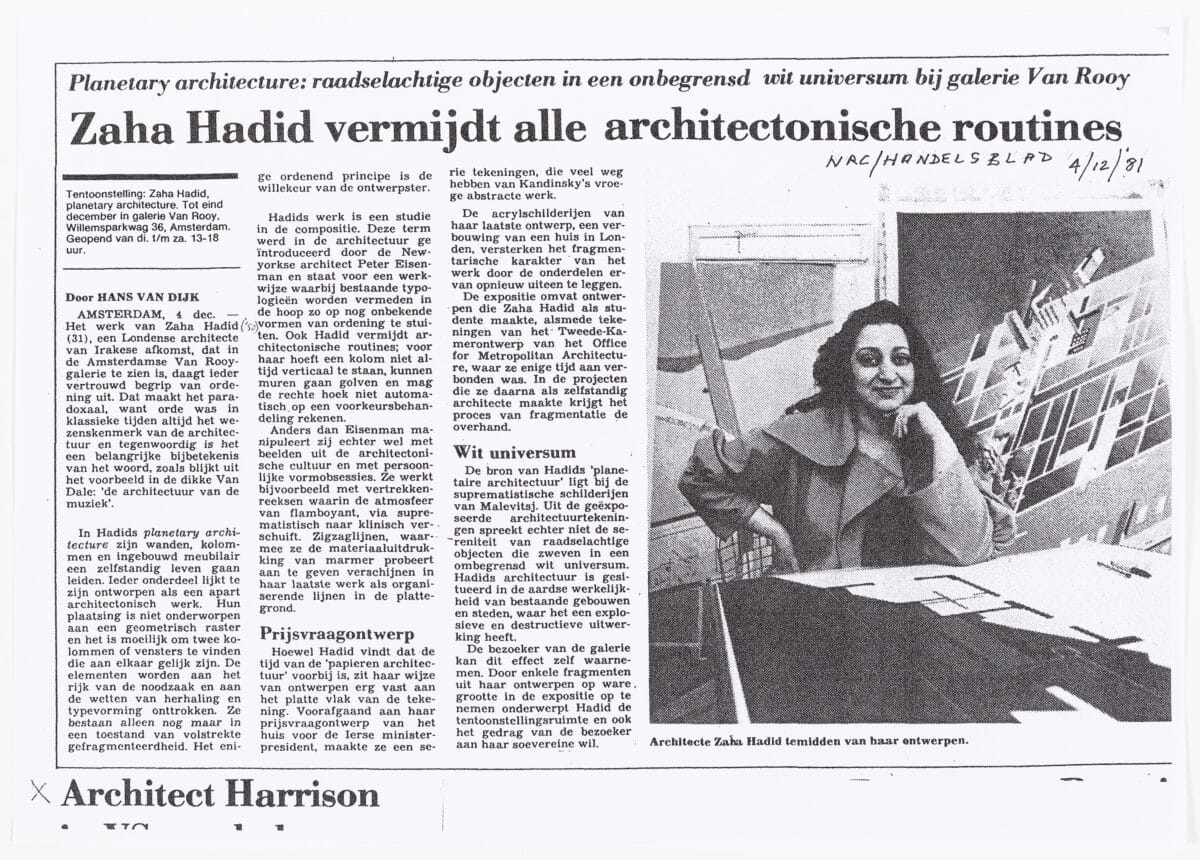
Photocopy of newspaper review for Planetary Architecture by Hans van Dijk published on the 4th December 1981. The article is written in Dutch and features a portrait of Hadid, with three of her paintings.
PLANETARY ARCHITECTURE TWO, 1983
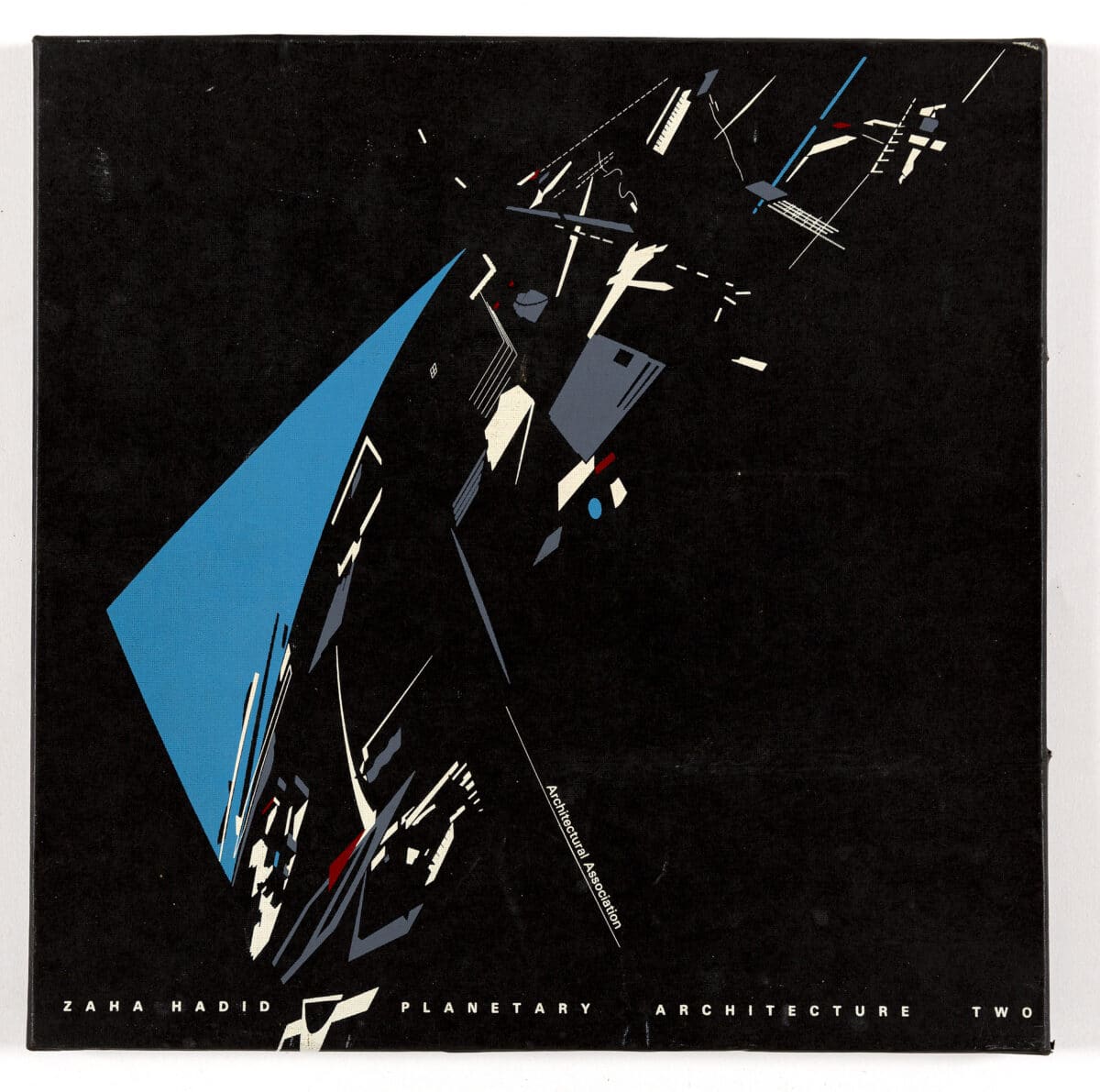
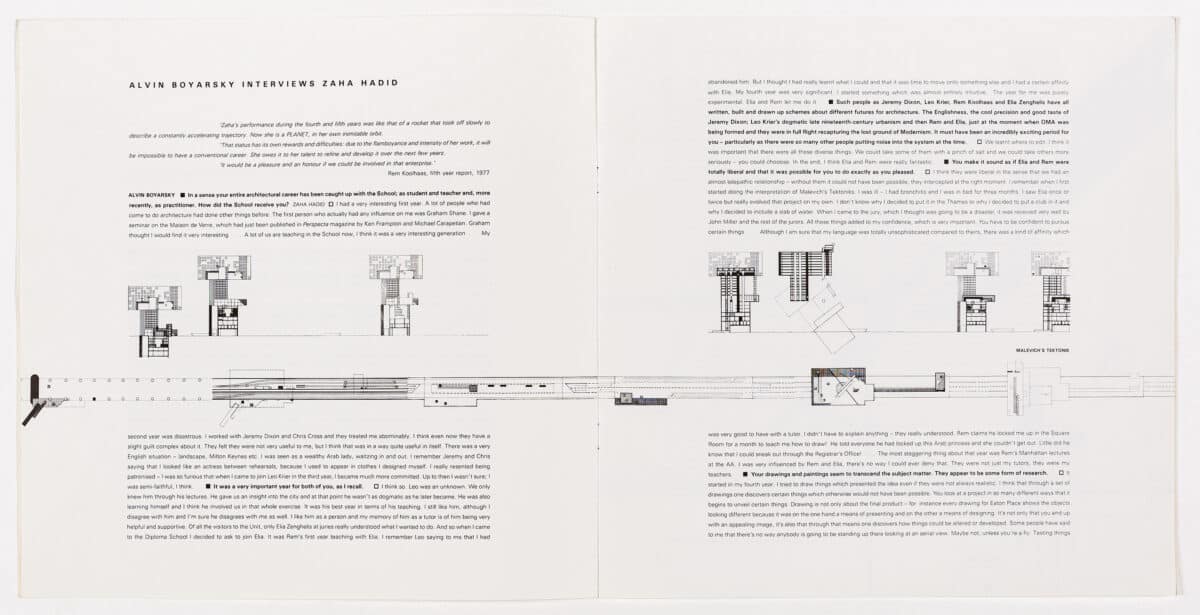
Boxed folio publication to coincide with the exhibition Planetary Architecture Two at the Architectural Association, London. The exhibition opened on the 18th November, 1983 for only a month. It features an introduction by Kenneth Frampton and an interview between Zaha Hadid and former AA director, Alvin Boyarsky, followed by 18 individual sheets of her works from Malevich’s Tektonik (1976-77) and The Museum of the 19th Century (1977-78), to the Irish Prime Minister’s Residence (1979-80), 59 Eaton Place (1980-81), Parc de la Villette (1982), The Peak (1983), and ‘The World (89 degrees)’ (1983).
PLANETARY ARCHITECTURE TWO POSTER, 1983
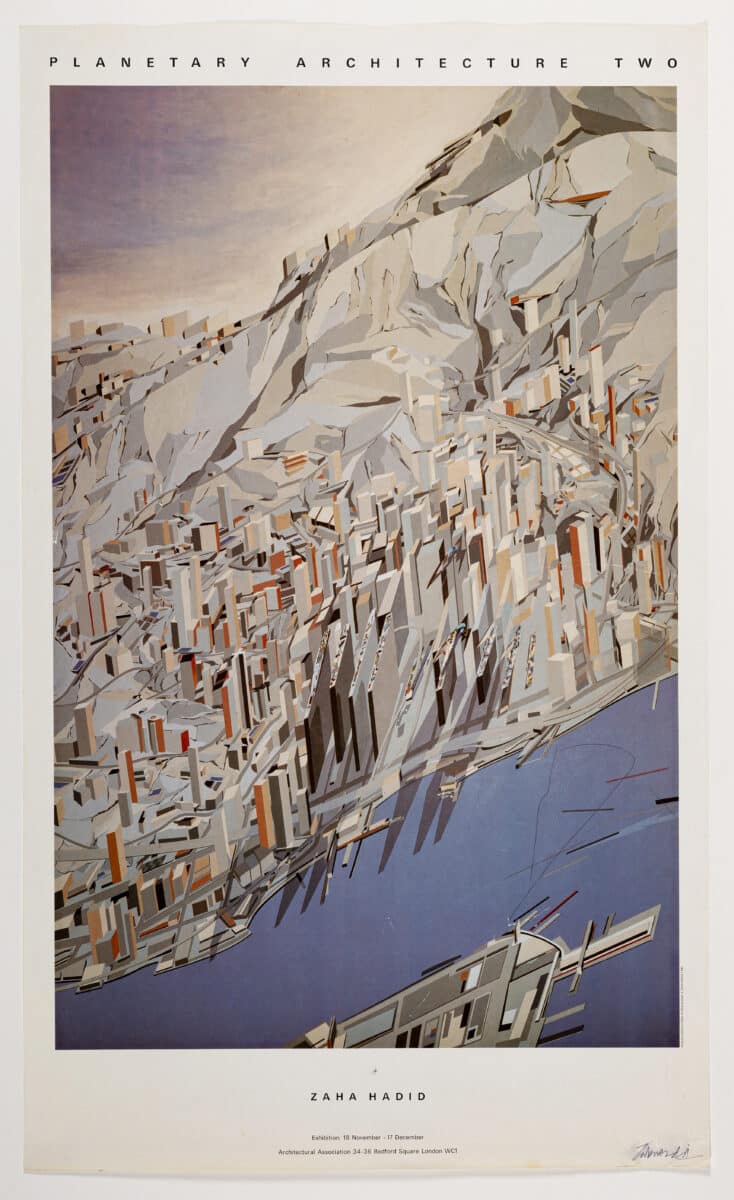
Poster for the exhibition Planetary Architecture Two at the Architectural Association, London. It features the painting for The Peak called ‘Blue Slabs’ and is signed by Hadid.
CASA DELLA FALSITA, EXHIBITION CATALOGUE, 1982
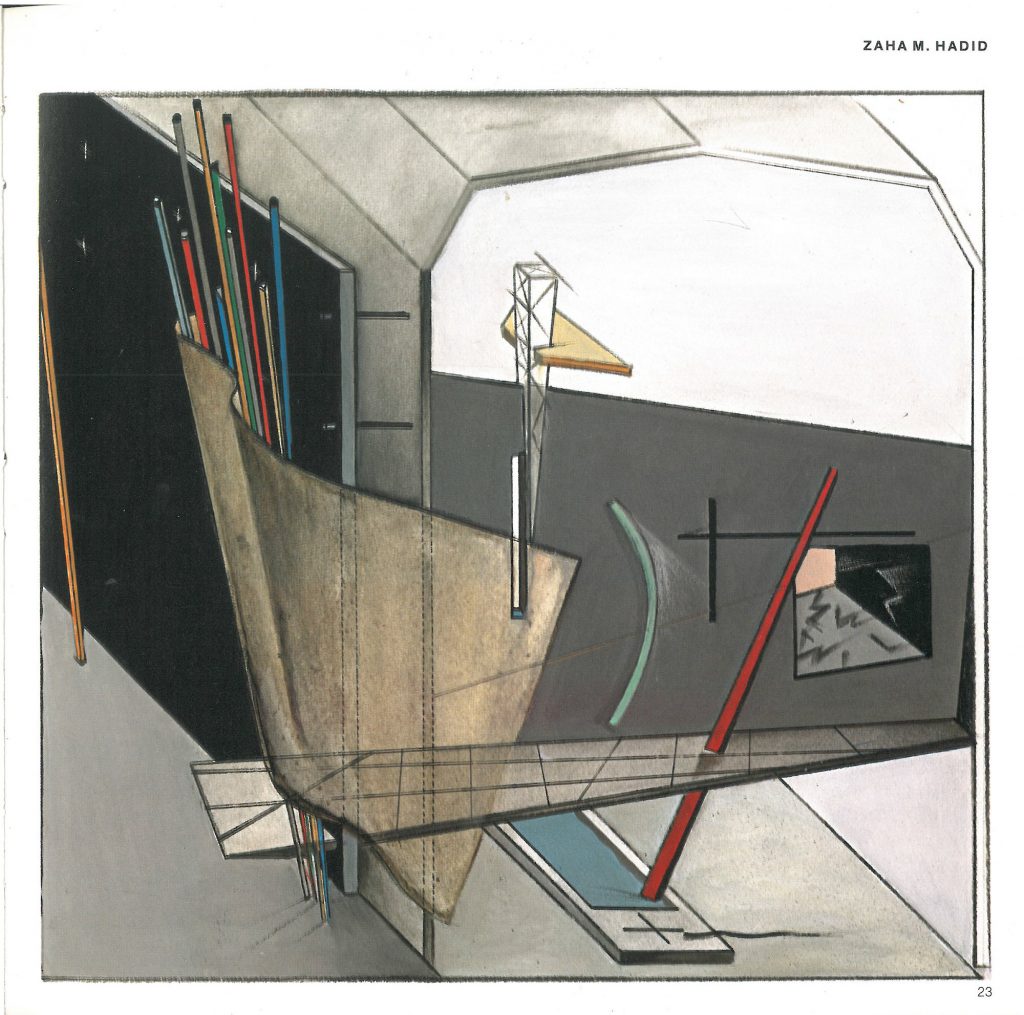
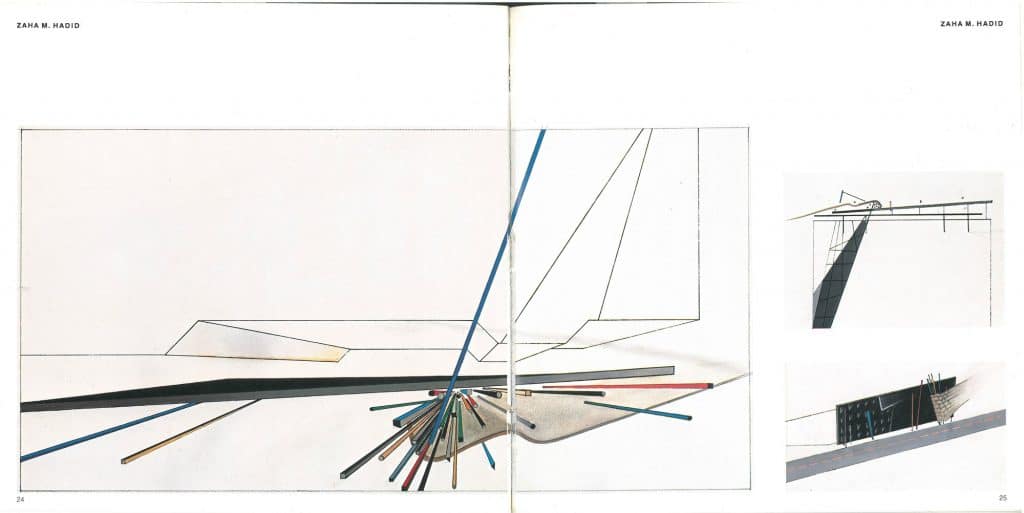
Catalogue for an exhibition held by Peter Pfeiffer at the Focus Furniture Gallery in Munich, in 1982. The Casa Della Falsita (the house of falsehood) was an exhibition of 11 invited proposals for the transformation of his shop; born out of a frustration with local planners after Pfeiffer was denied permission to build a spiral staircase. Zaha Hadid was one of those invited alongside Opera, Andrea Branzi, Trix and Robert Haussmann, Haus Rucker Co., Alessandro Mendini, Bruno Minardi, Robert Maria Stieg, Studio Alcymia, Stefan Wewerka, and Peter Wilson. Her proposal, as reproduced in the publication, consists of four paintings; each from a different perspective, capturing the striking treatment of the facade. A wall that wants to fly off the facade, but is held back by a series of brightly coloured pylons.
OBJECTS
FRENCH CURVE
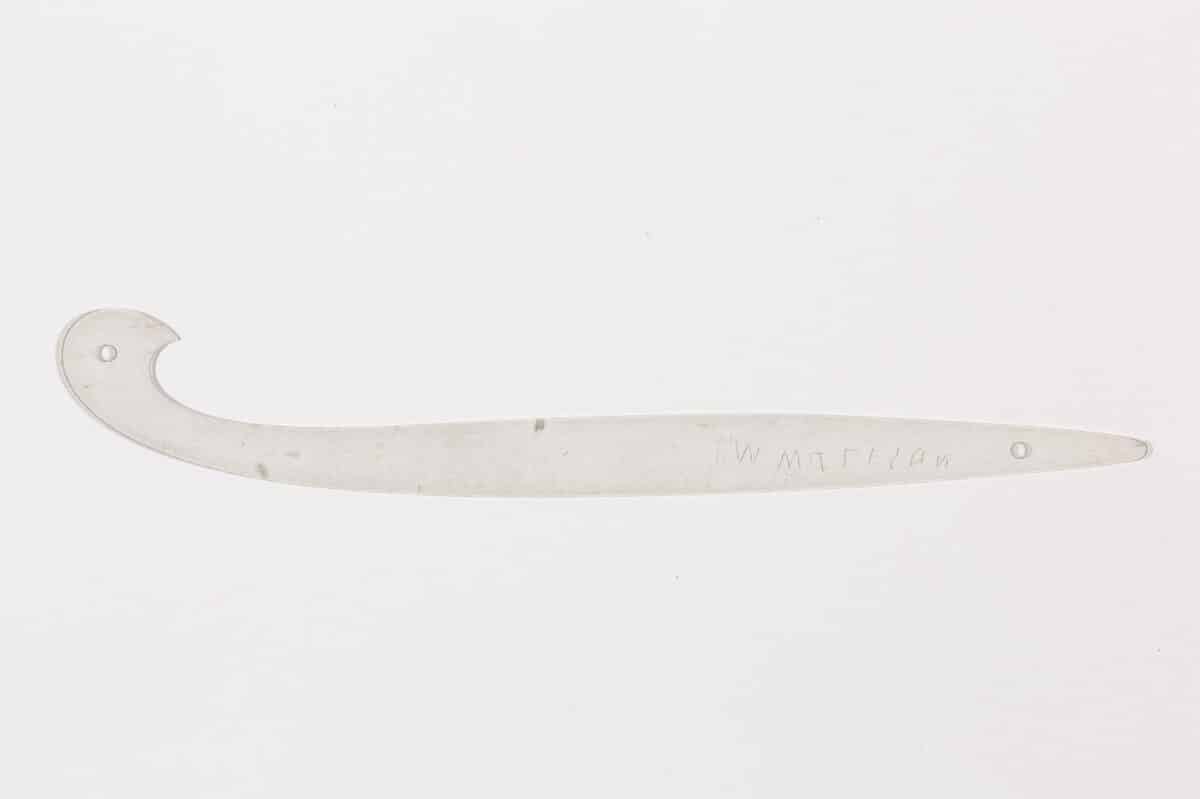
In many early works, Hadid employed the arced edge of a ship’s curve or French curve to create strong bowed lines. Wolfson recounts travelling to Paris with Hadid, where they purchased this acrylic French curve. It includes a hole at one end for pinning the tool to a drawing board.
THE OPUS GLASS CUBE, 2012-2020 & PORT HOUSE, SNOW GLOBE, 2009-2016
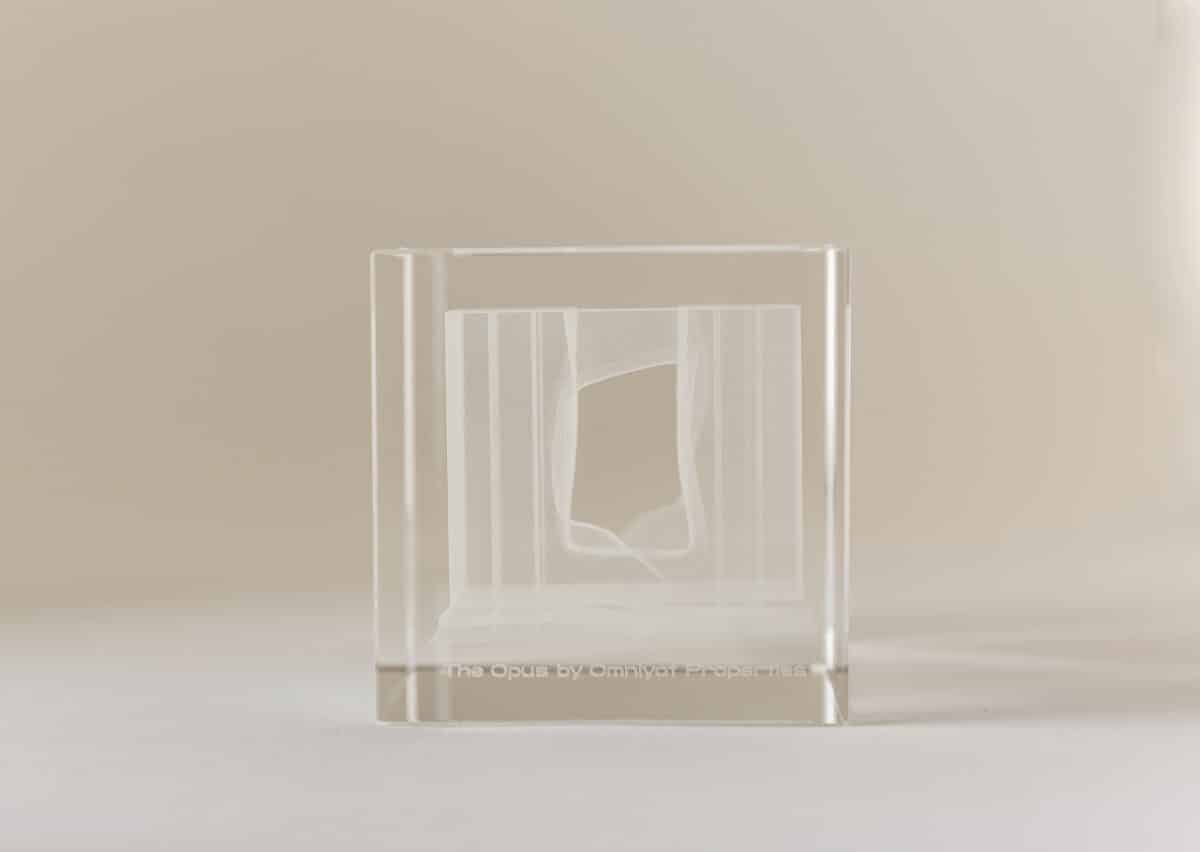
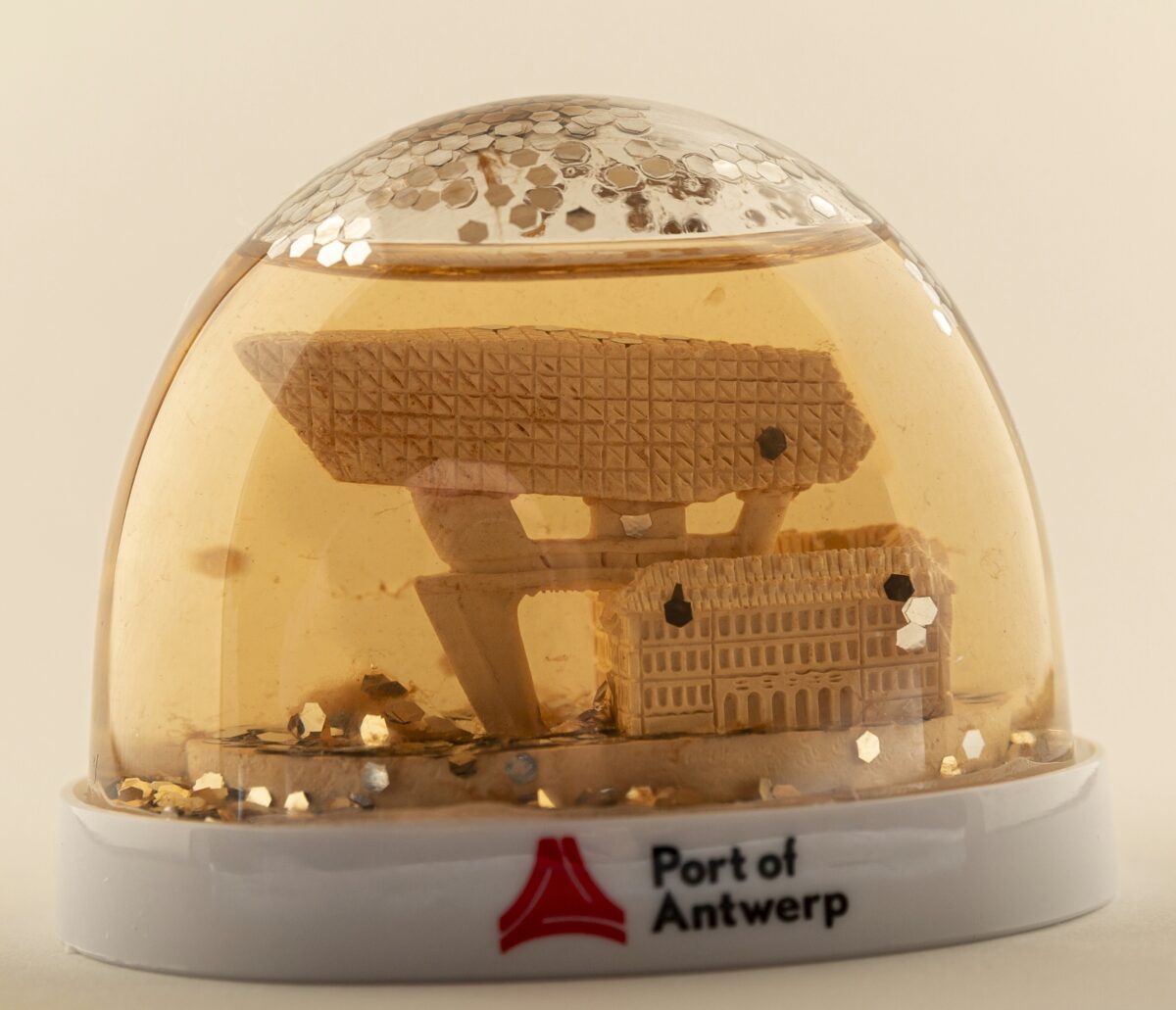
Corporate merchandise for two of Zaha Hadid’s later works. Glass paperweight of The Opus, housing the ME Dubai hotel, designed for developer Omniyat Properties. And a snow globe of the Port House in Antwerp, a renovation of the 1929 derelict fire station on the city’s waterfront. Both objects were acquired through Jeremy Peacock.
ALBUM
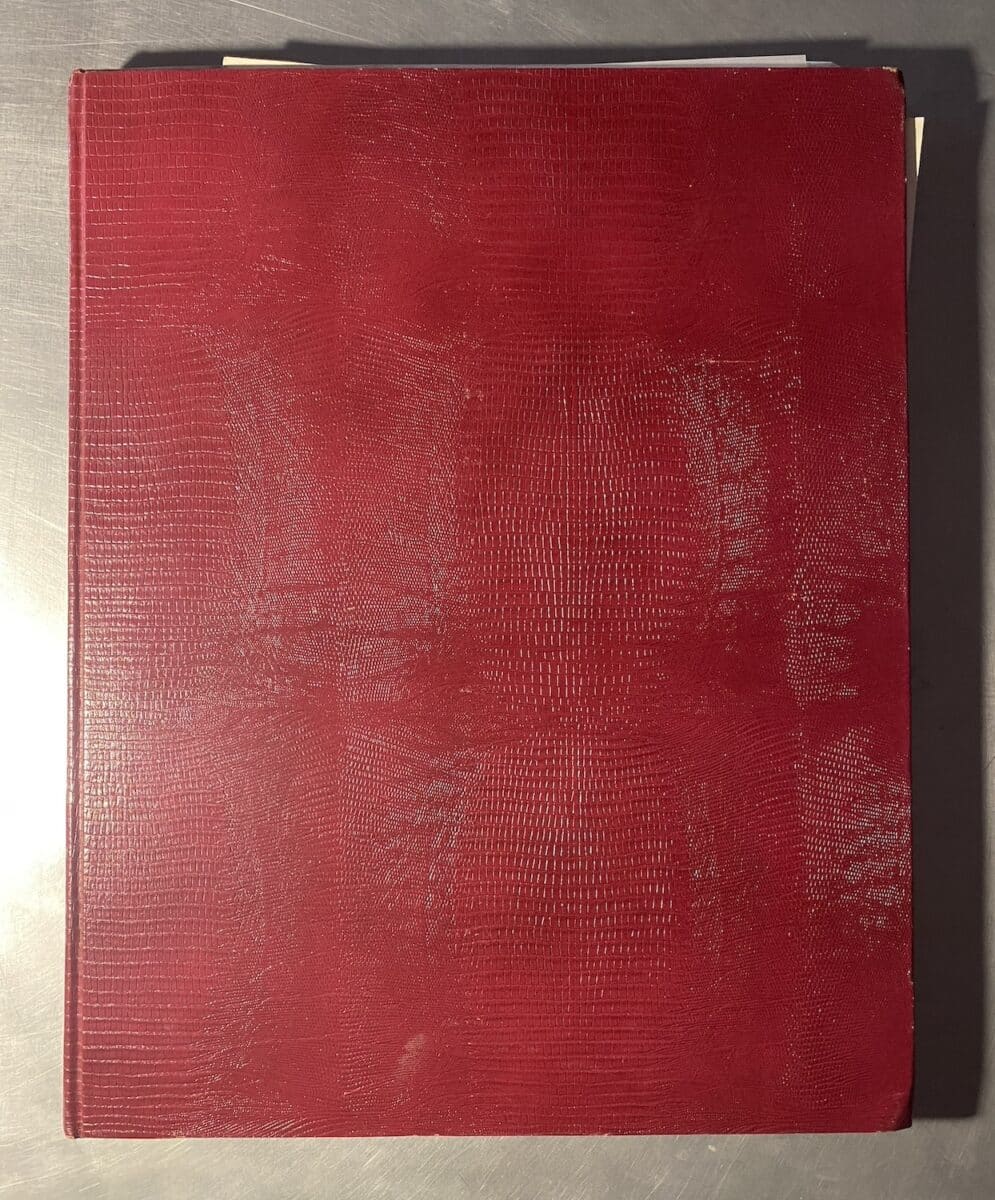
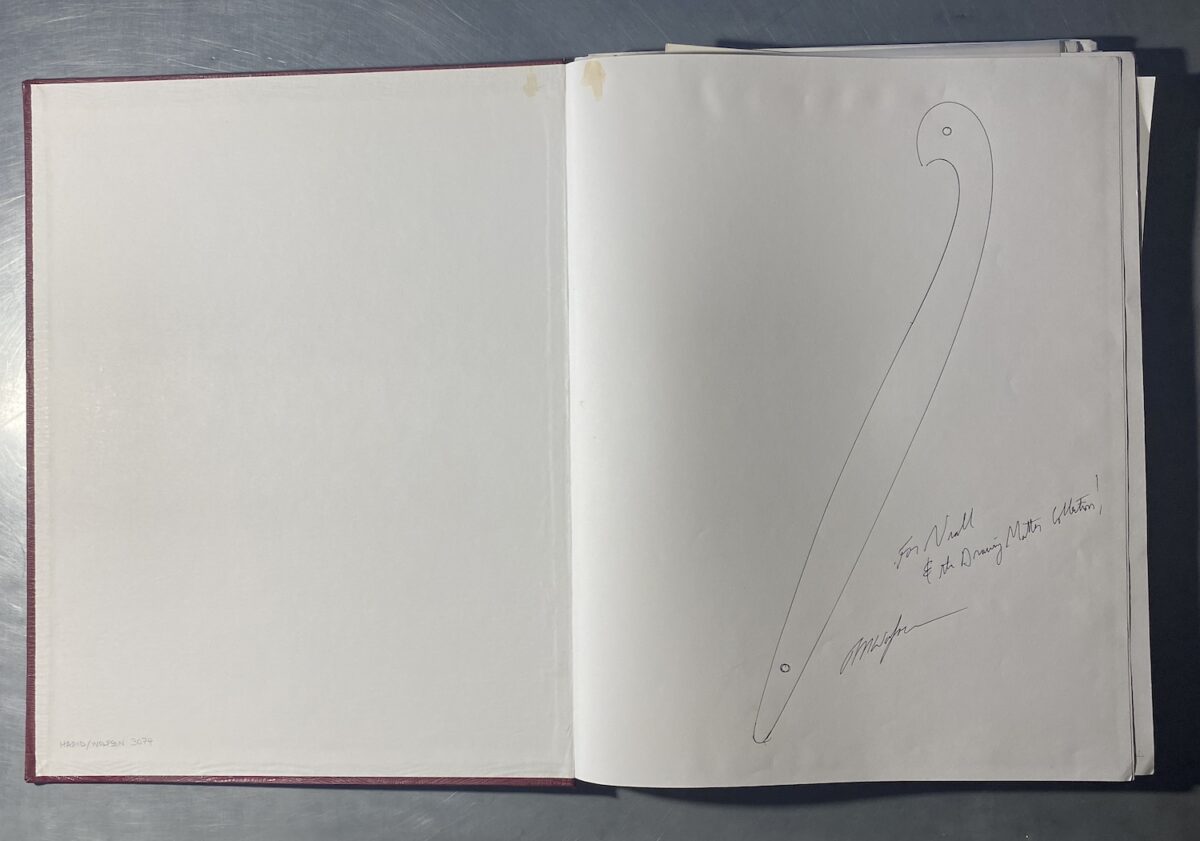
Red Snakeskin leather-bound sketchbook in which all drawings acquired from Michael Wolfson arrived. Now only contains the xerox prints of Zollhof 3 Media Park, Tomigaya, and Kurfürstendamm. Opens with a stencil of the French curve and a dedication from Michael Wolfson to Drawing Matter.
Additions and amendments are welcomed at editors@drawingmatter.org
