Collection Guide: Futurism, Rationalism, and Stile Littorio
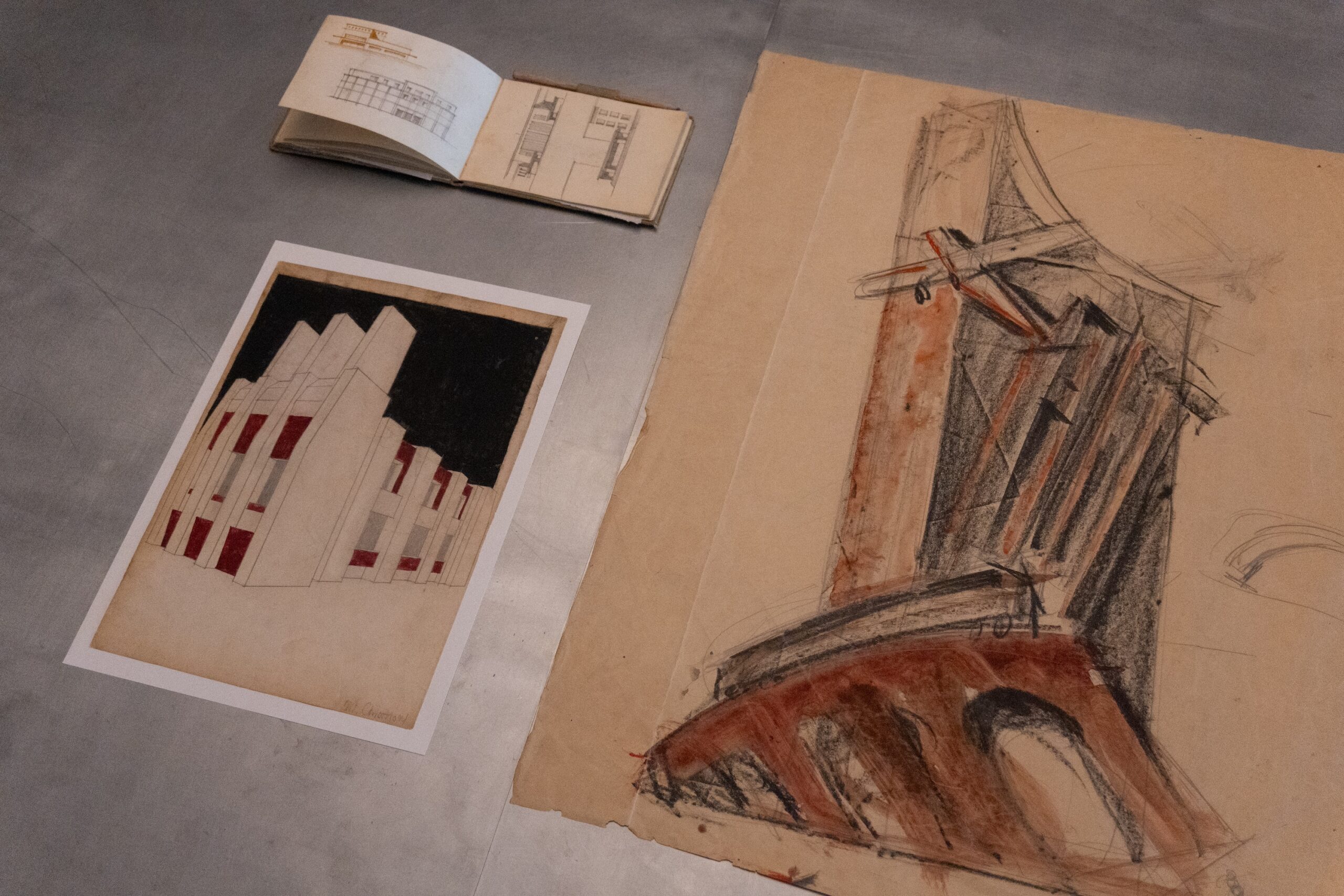
The Drawing Matter collection holds around 70 objects that speak to Italy’s architectural evolution in the early twentieth century. It should be noted that this period was characterised by tremendous stylistic diversity, with movements and groups—often unhappily—coexisting and shifting, ultimately culminating in the dominance of the Stile Littorio.
At the beginning of the twentieth century, at the dawn of the first ‘machine age’, the Futurists offered a new approach to art, architecture, and design, arguing that their technological age demanded a correspondingly progressive art form. On 11 July 1914, the Manifesto of Futurist Architecture was published, signed by Antonio Sant’Elia, detailing their disgust at the glorification of Italy’s past buildings and envisioning a dynamic future architecture. Little time is spent describing this architecture’s physical qualities; it is only given form by the few drawings produced by Sant’Elia entitled Città Futurista which illustrated the text. A number of architects represented in the collection have their origins in Futurism: Mario Chiattone, Virgilio Marchi, and Enrico Prampolini. During the First World War Sant’Elia was killed in battle and by its close the initial energy of the group had dissipated. Although attempts were made to realign themselves with the new Fascist regime, Futurism ultimately fell out of favour.
Benito Mussolini came to power in October 1922 capitalising on national social unrest resulting from the First World War. By 1925 he had dismantled the systems of Italian democracy, declaring himself ‘Il Duce’. Mussolini ‘talked out of both sides of his mouth’: many critics noted in the 1920s he spoke of architecture with equal enthusiasm for a modern aesthetic and for a return to a ‘Roman’ tradition. A pluralism which was reflected in the initially vague idea of what Fascism itself was. In the Enciclopedia Italiana (1932), Mussolini admitted to its undefined beginnings: ‘there was no specific doctrinal plan in my spirit’. Owing to this lack of a clear regime style, through the twenties and into the early thirties, three main stylistic orientations competed for work: the Accademici, the Novecento, and the Rationalists. While markedly different, they shared the cultural goal of creating a new language for Italian architecture that was at once both modern and national. Italy had only unified in 1861, the country’s national identity was still very much in formation at the beginning of the twentieth century.
The Accademici advocated for a reinterpretation of classicism, as well as nineteenth-century styles such as the neo-Baroque. The group was primarily centred around Rome, and included well-established figures such as Marcello Piacentini and Armando Brasini.
Novecento formed in Milan in 1922 and included architects like Giovanni Muzio, Gio Ponti, Piero Portaluppi, and Emilio Lancia, as well as artists such as Mario Sironi and Giorgio de Chirico. The group was connected to the curator and critic Margherita Sarfatti, a prominent cultural advisor to–and mistress of–Mussolini. They promoted a simplified neoclassicism synthesised with the abstract forms and minimal ornament of the international modern movement. Drawing Matter holds material by Gio Ponti, which can be viewed in a separate Collection Guide, here.
Rationalism developed at the end of the 1920s, beginning with the formation of Gruppo 7, a collective of recent graduates from the Politecnico di Milano: Carlo Enrico Rava, Luigi Figini, Guido Frette, Sebastiano Larco Silva, Gino Pollini, Giuseppe Terragni, and Ubaldo Castagnoli, who was replaced in 1927 by Adalberto Libera. Gruppo 7 strongly criticised the work of the Accademici and Novecento, instead calling for a ‘rigid adherence to logic, to rationality’ in their 1926 manifesto published in La Rassegna Italiana. Although clearly informed by the international style, particularly the work of Peter Behrens, Erich Mendelsohn, Le Corbusier, and Walter Gropius, the group’s definition of a rational style lacked clarity. In 1928, their work was displayed on a national scale as part of the ‘First Exhibition of Rationalist Architecture’ in Rome, which tied the style to the regime’s rhetoric, cloaking it in a traditionalist context. In 1931, the ‘Second Exhibition of Rationalist Architecture’ was held, inaugurated by Mussolini himself. Between these two exhibitions the group transformed into the Movimento Italiano per l’Architettura Razionale (MIAR), a national group that aimed to rival the Accademici who later formed the National Union of Fascist Architects.
The Accademici, and in particular, Marcello Piacentini, from the middle of the 1930s took hold of the regime’s architecture, both through their control of the National Union of Fascist Architects, and as Mussolini embarked on imperial ambitions. From 1935 onward Mussolini pursued an aggressive campaign to establish a new ‘Roman’ Empire, invading Ethiopia and then in 1939 occupying Albania. This Imperial mission brought a change in Mussolini’s architectural leanings; a desire to return to the classicism of the first imperial emperor, Augustus. It should also be noted that the style of the Accademici evolved, blending their classical monumentality with qualities of Rationalism. This new iteration of their architecture is referred to as Stile Littorio.
Together, the works in the Drawing Matter collection reflect this complex and shifting landscape, tracing the development of Italian architecture in the early twentieth century from its pluralistic beginnings to the consolidation of an imperial regime style.
VIEW THE COMPLETE DRAWING MATTER COLLECTIONS OF THE FUTURISTS, RATIONALISTS AND STILE LITTORIO HERE.
MARIO CHIATTONE, BUILDING STUDIES, 1914
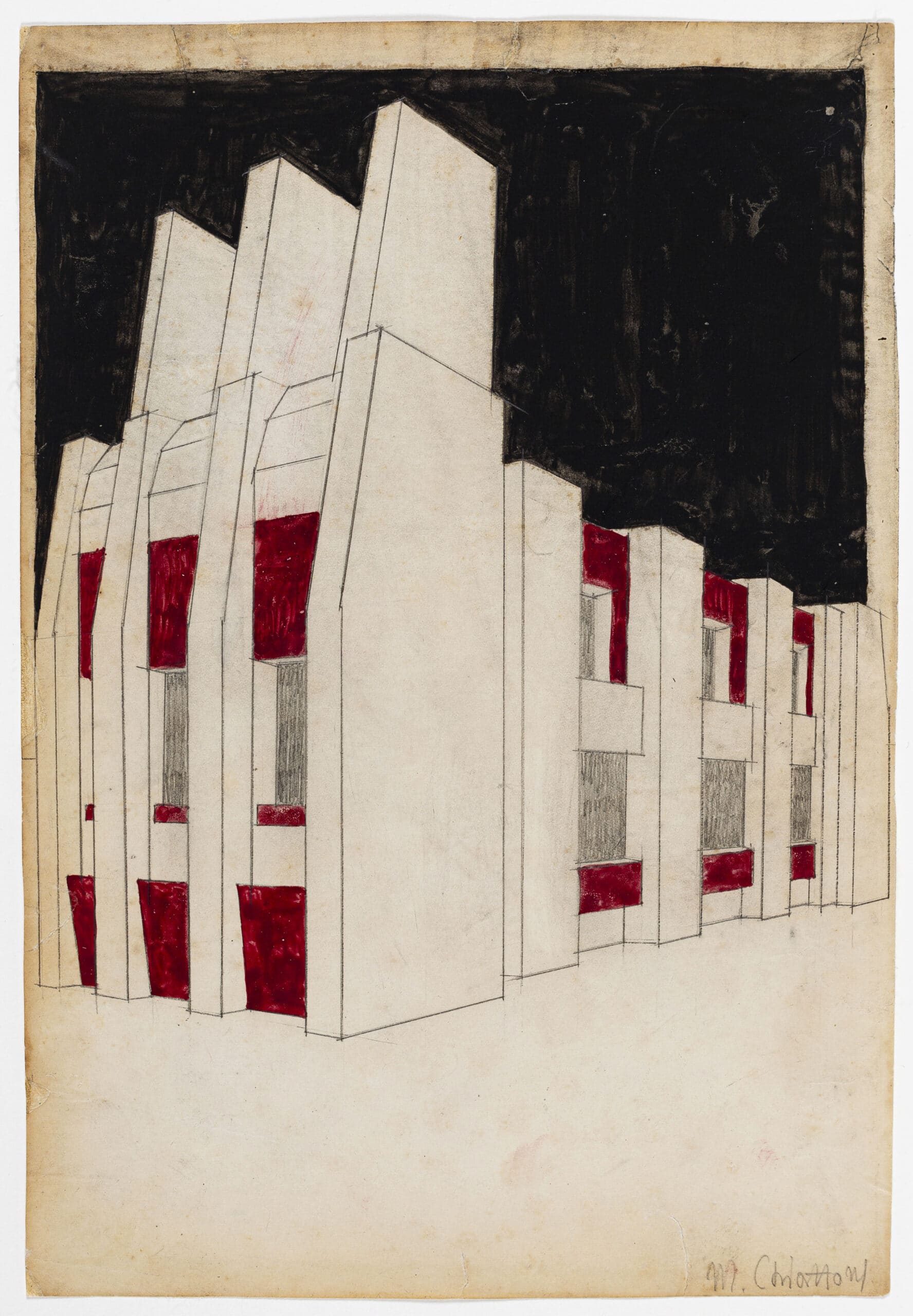
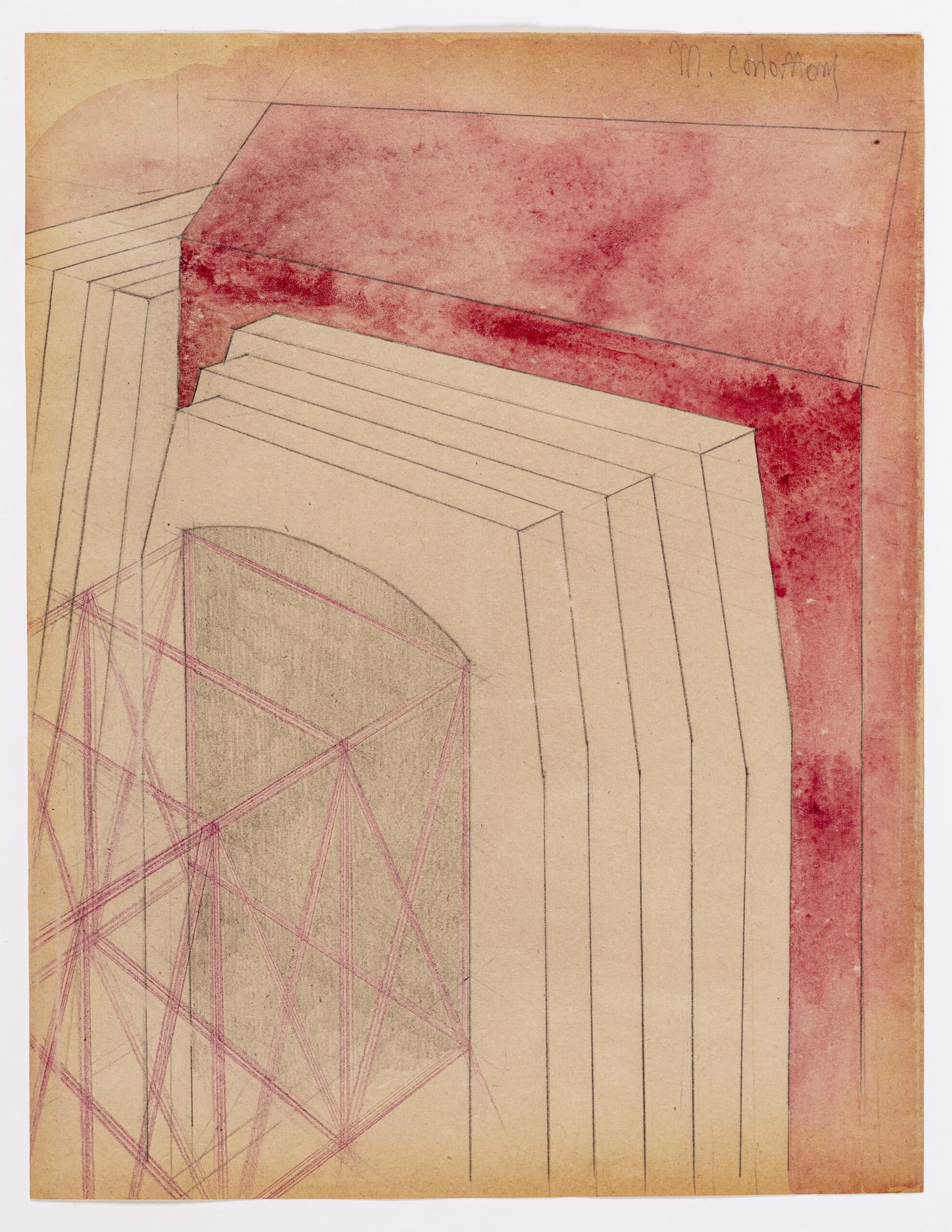
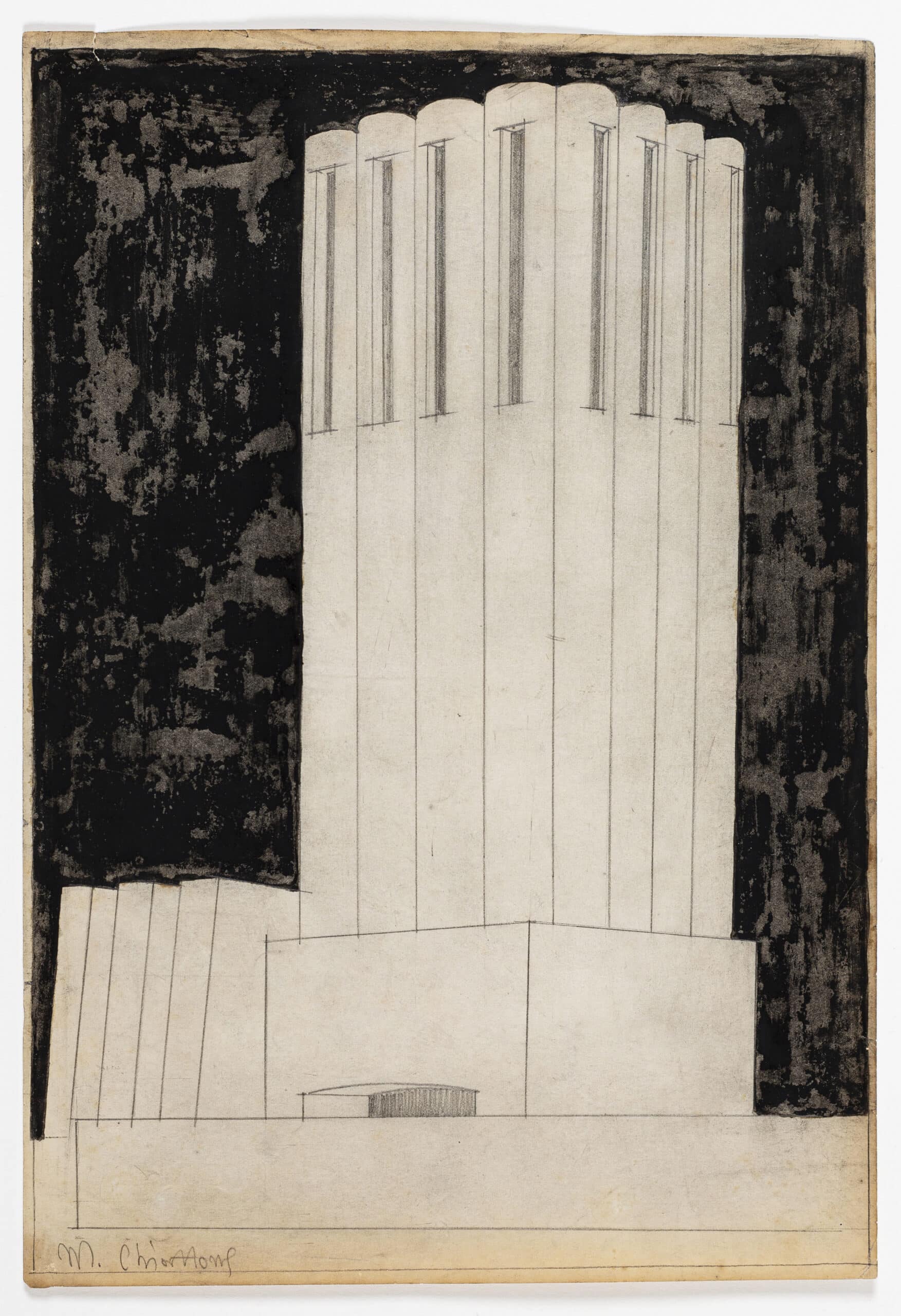
Drawing Matter holds three pencil and gouache studies by Mario Chiattone. He was a Ticinese architect based in Milan and from 1914 to 1915, he worked closely with Antonio Sant’Elia. In the spring of 1914, the pair prepared plates that were exhibited at Nuove Tendenze. It is suggested that Chiattone displayed three plates in the show, entitled Construzioni per una metropoli moderna (‘constructions for a modern metropolis’), Opificio (‘factory’), and Forme (‘form’). Although never formally part of the Futurist group, Chiattone and Sant’Elia collaborated on a few imagined urban schemes. Their collective style was deeply influenced by Otto Wagner’s drawings.
The works at Drawing Matter represent part of their collaboration, which are strikingly similar to Sant’Elia’s drawings, like those for the Futurist Architecture Manifesto. Their style gave visual form to the forces of modernity, a uniform graphic style to represent a new architecture rooted in technology.
Drawing Matter also holds a copy of the 1909 Futurist Manifesto by Filippo Tommaso Marinetti as published in French newspaper Le Figaro. See a PDF of the text here.
ARMANDO BRASINI, CHURCH OF SANT’IGNAZIO DI LOYOLA, 1918-1921
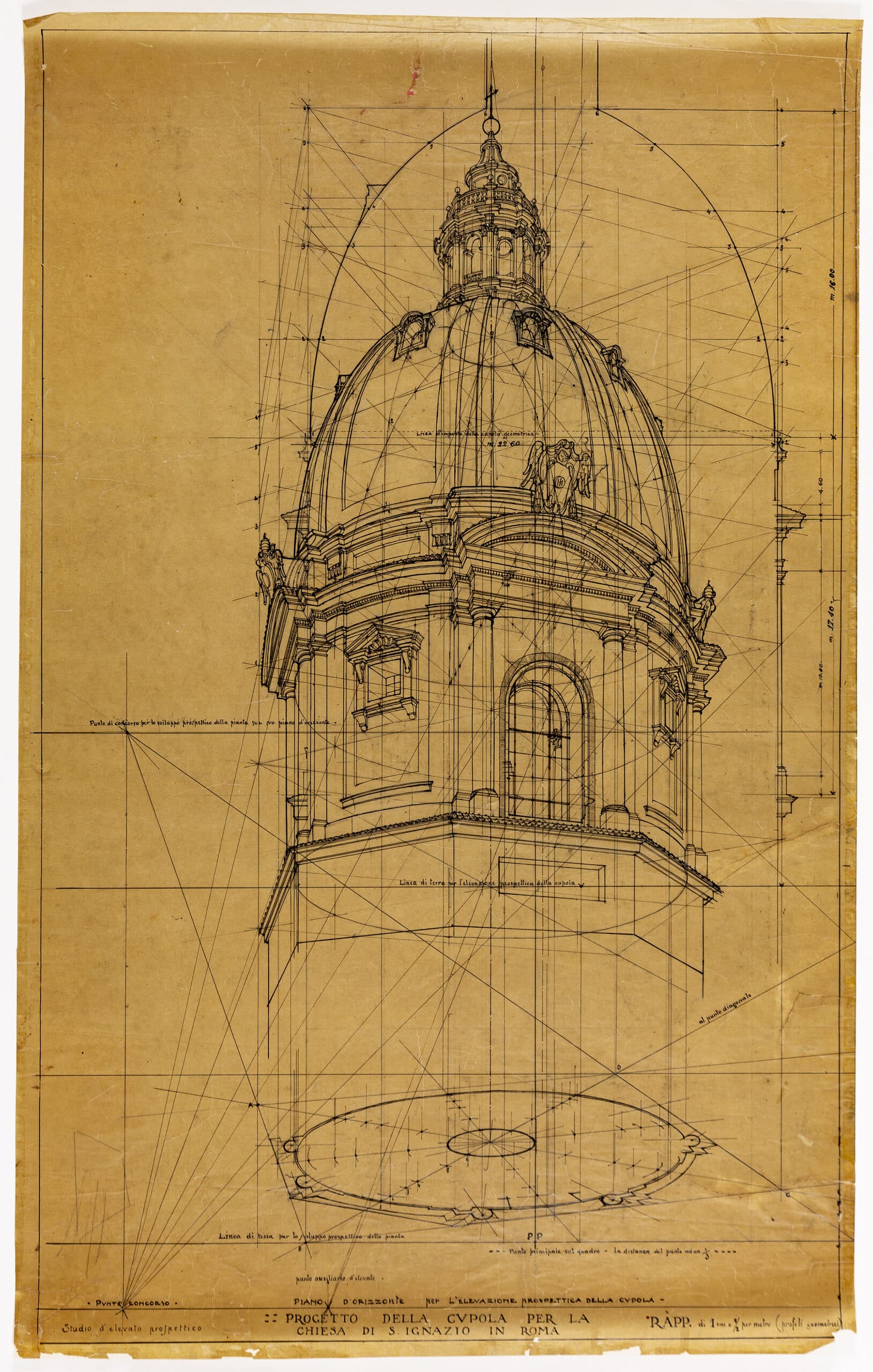
Armando Brasini proposed a new dome for the Chiesa di Sant’Ignazio in Rome. The design was inspired by other lantern domes of the city, such as Rosato Rosati’s San Carlo ai Catinari. The dome was part of a wider scheme for a vast forum in front of Monte Citorio. Another drawing for the project is held in the Armando Brasini Archive.
DUILIO CAMBELLOTTI, STAGE SET FOR ANTIGONE, 1924
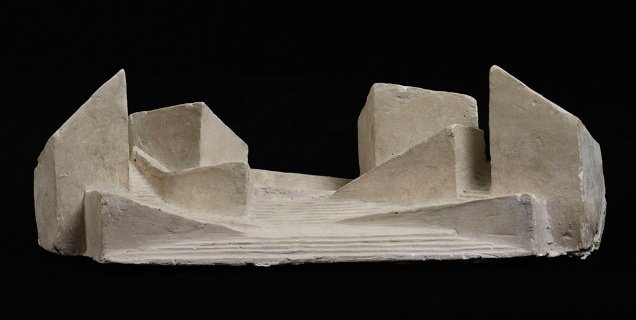
The collection holds a plaster model of a stage set by decorative artist Duilio Cambellotti. The design creates a dynamic scene of multiple levels and disappearing staircases. It was produced in 1924 for a production of Antigone, in the open-air theatre of Syracuse. The scheme was not built until 1927, and was instead hosted at the Ostia Antica Teatro Romano, on the western outskirts of Rome. From 1905 to the 1940s, Cambellotti collaborated with the Theatre Company of Rome, designing primarily costumes and stage sets.
GIUSEPPE TERRAGNI, IL GRADO PER IL MONUMENTO AI CADUTI DI COMO, 1925-1926
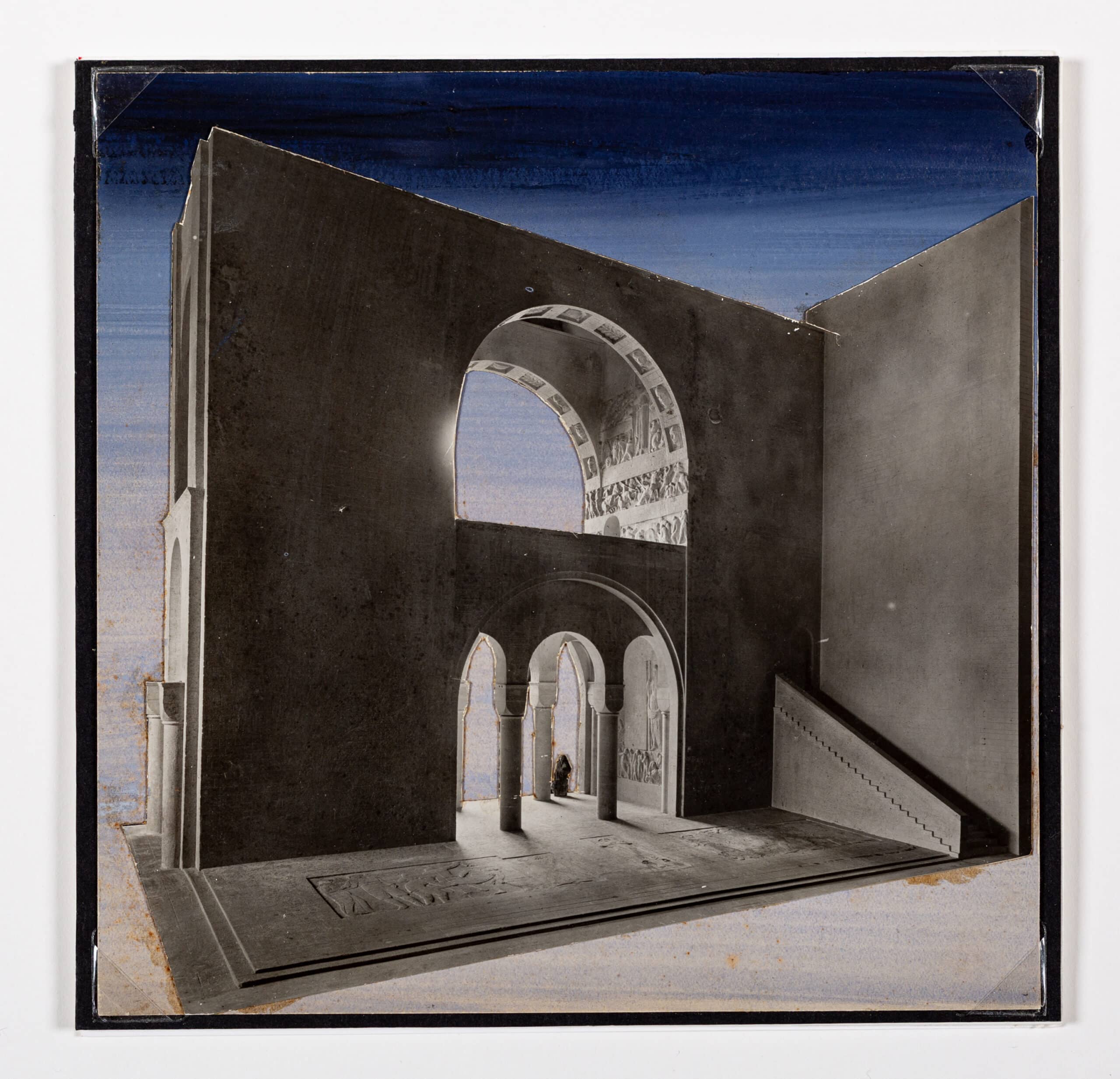
The design for the 1926 competition for the Monumento ai Caduti (War Memorial) in Como was a collaboration between young Como natives, Terragni, architect Pietro Lingeri, and sculptor Giuseppe Mozzanica. One of thirty designs submitted, it was selected alongside two other entrants to progress to the second round (where sculptor Giovanni Battista Tedeschi replaced Mozzanica). Their competitors, the Milan-based Claudio Vender and Mario Asnago, won the competition. In 1928 the scheme was denied authorisation by the municipality. It was only in 1933 that a monument was built, on a new site overlooking the lake, an adaptation of a drawing of a power station by the then mythical Antonio Sant’Elia. This time by Prampolini, although he resigned due to a busy schedule, leaving Terragni and his brother Attilio tasked with its design.
This photocollage by Terragni was for the second entry in the competition, where a model photograph was cut out and placed on a graduated wash background, running from a grey pink to a deep blue. Newly graduated from the metaphysical teachings of Pietro Portaluppi at the Politecnico di Milano, the monument’s form is a transfiguration, an archaic and fragmentary artifact that is clearly defined by its single material. Other images produced for the competition, held in the Terragni archive, highlight the monument’s connection to the existing structures of the site, the Broletto Palace and the bell tower of Sant’Abbondio Church.
In this second iteration of the design, Terragni alongside Tedeschi increased the decorative nature of the arch’s interior. Notes in the competition report in November 1926 state that the monumentality of the interior has been diligently worked on, in particular with their study of its bas-reliefs. The monumentality of the work was paramount to its function; under Mussolini, war was to be celebrated, he believed peace was just an interlude from the constant of war. Despite not fighting for fascism, the dead of the First World War could be used to glorify sacrificing one’s life for their country.
MARIO SIRONI, VARIOUS SKETCHES, 1925-1938
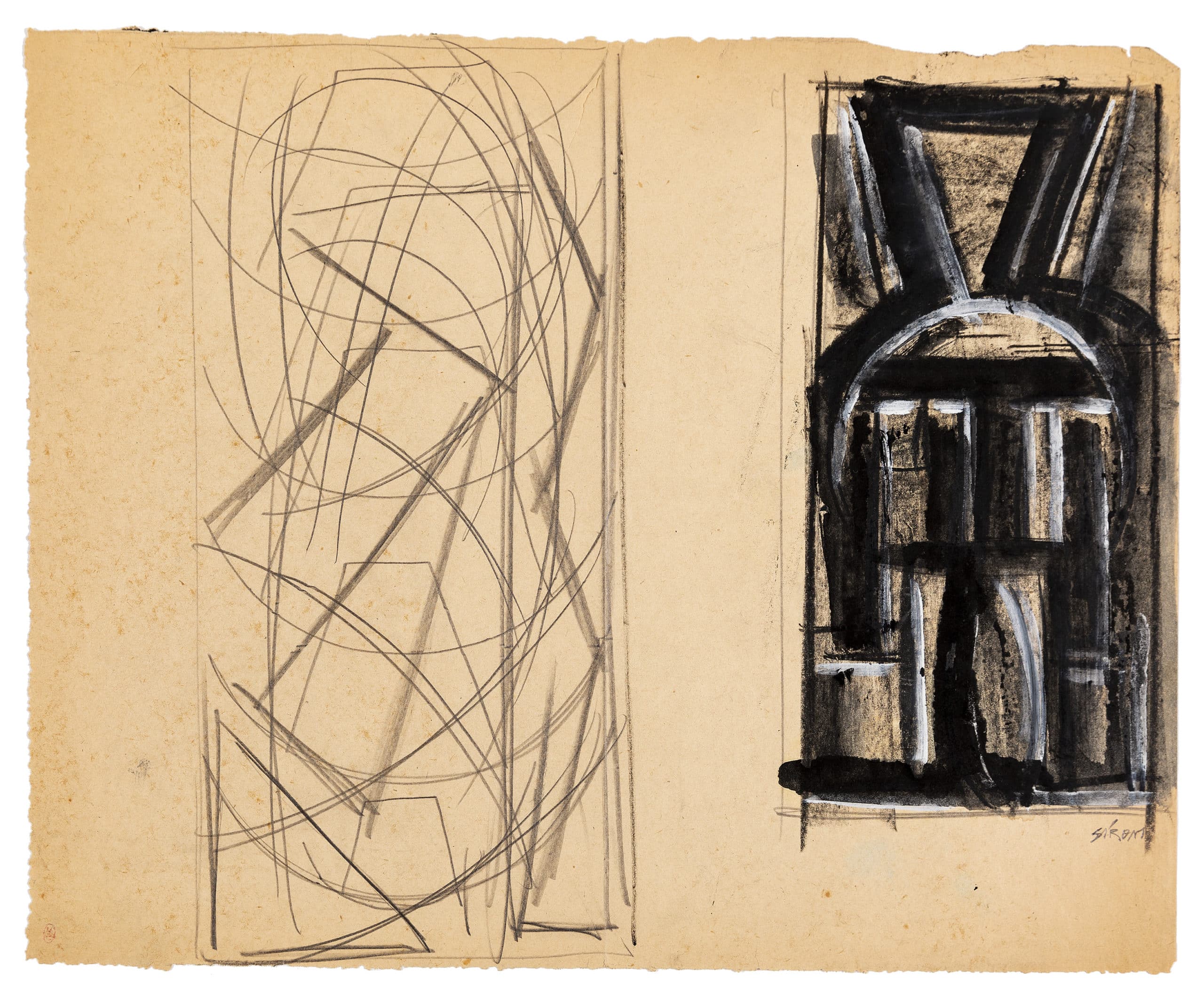
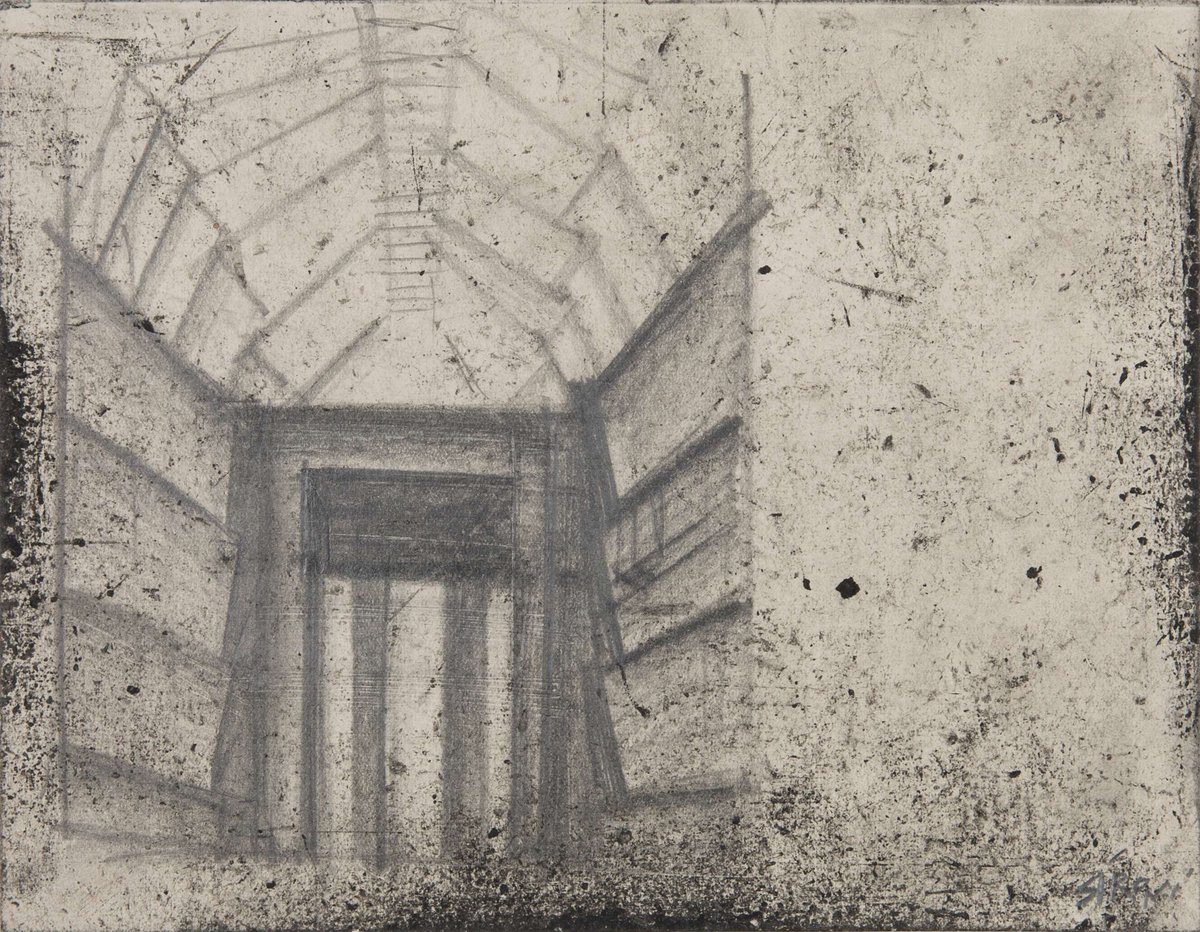
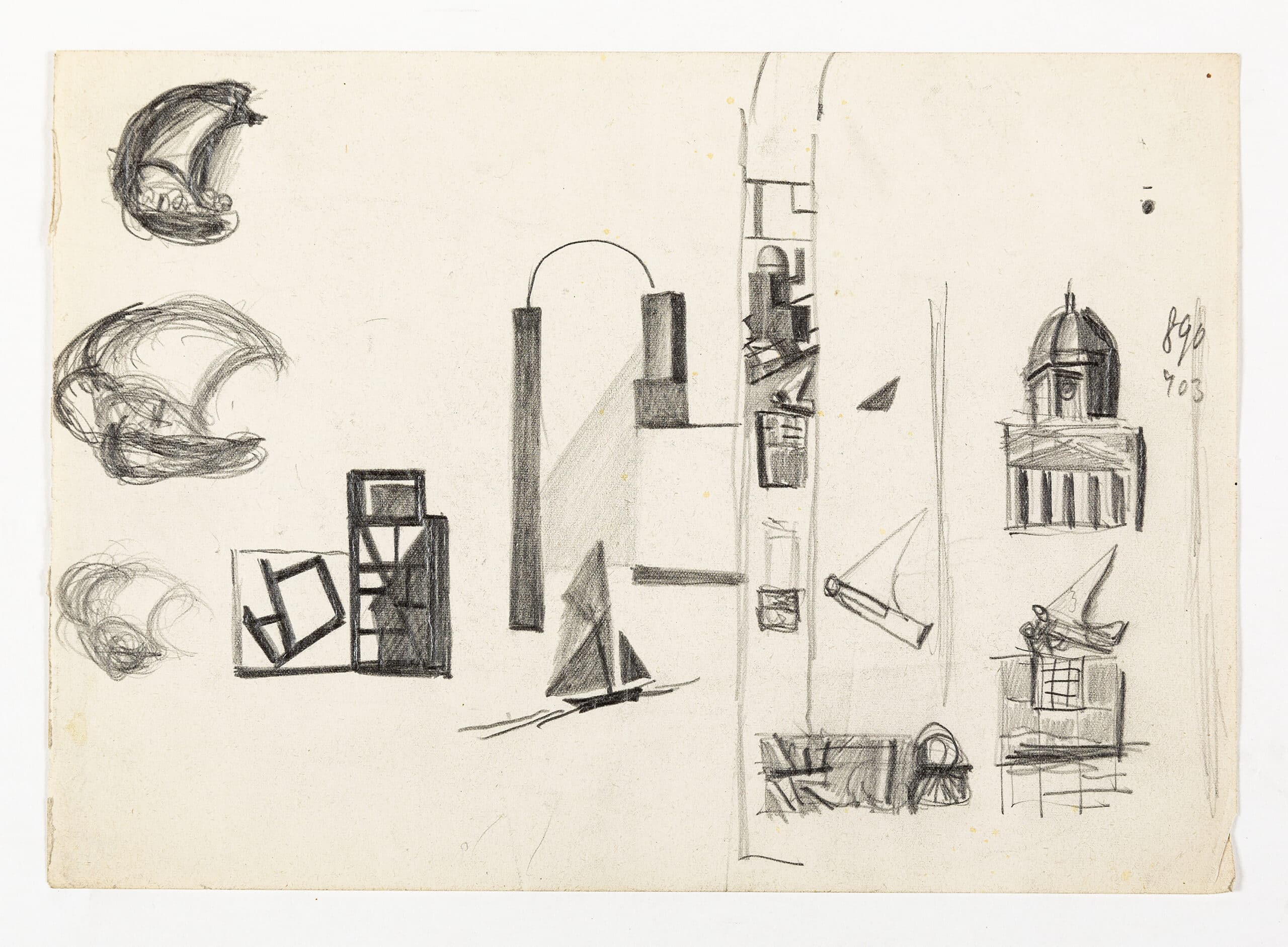
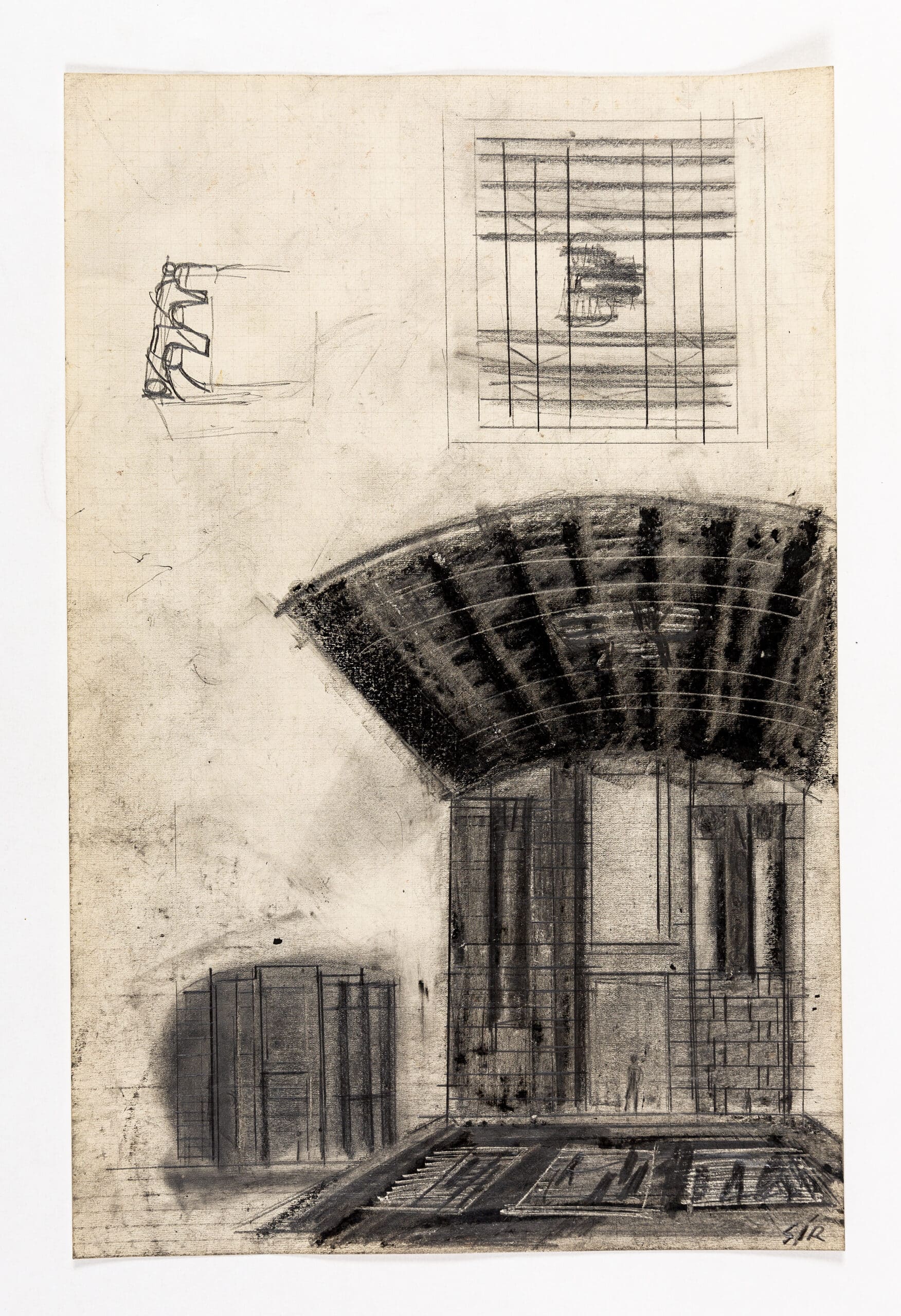
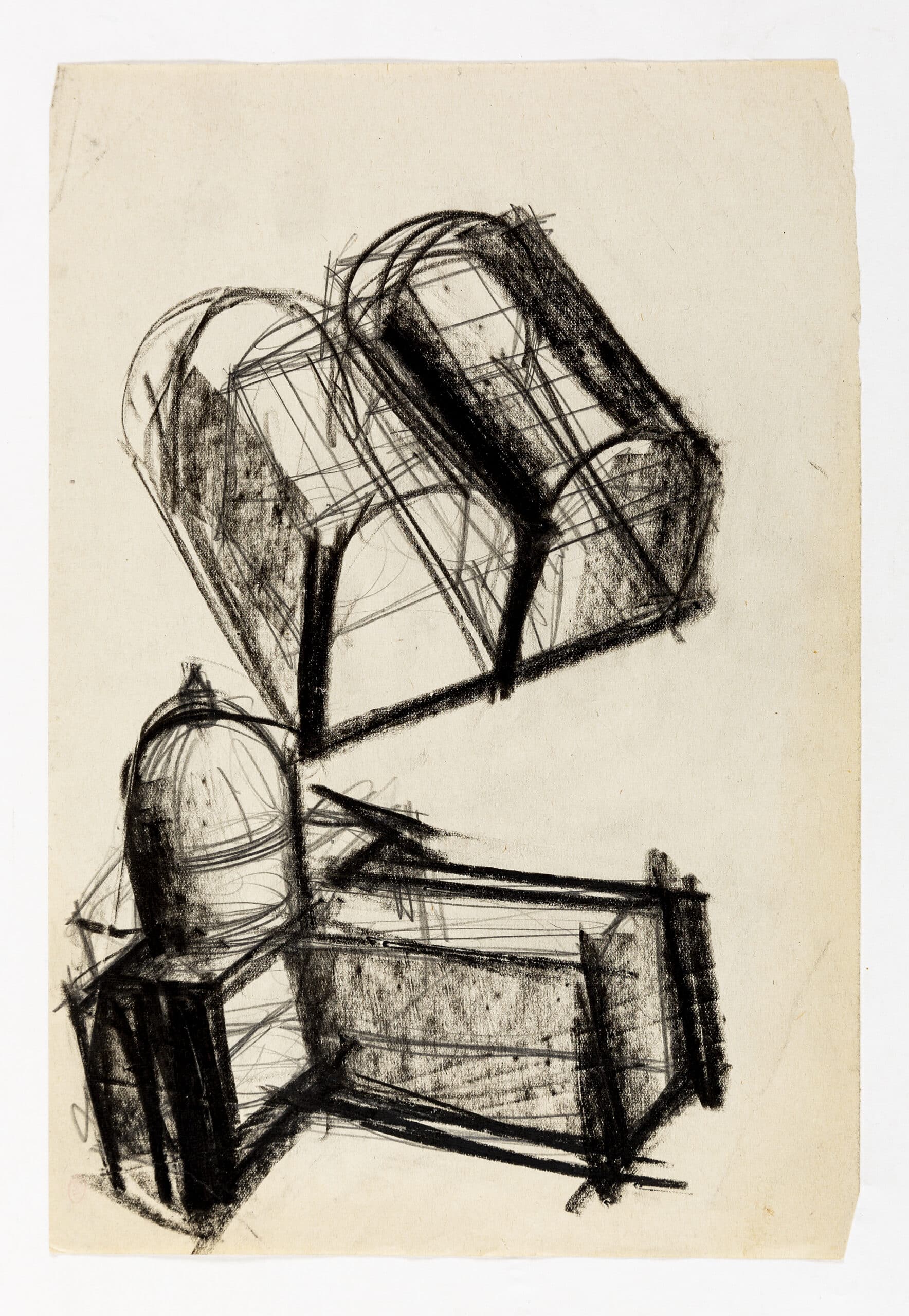
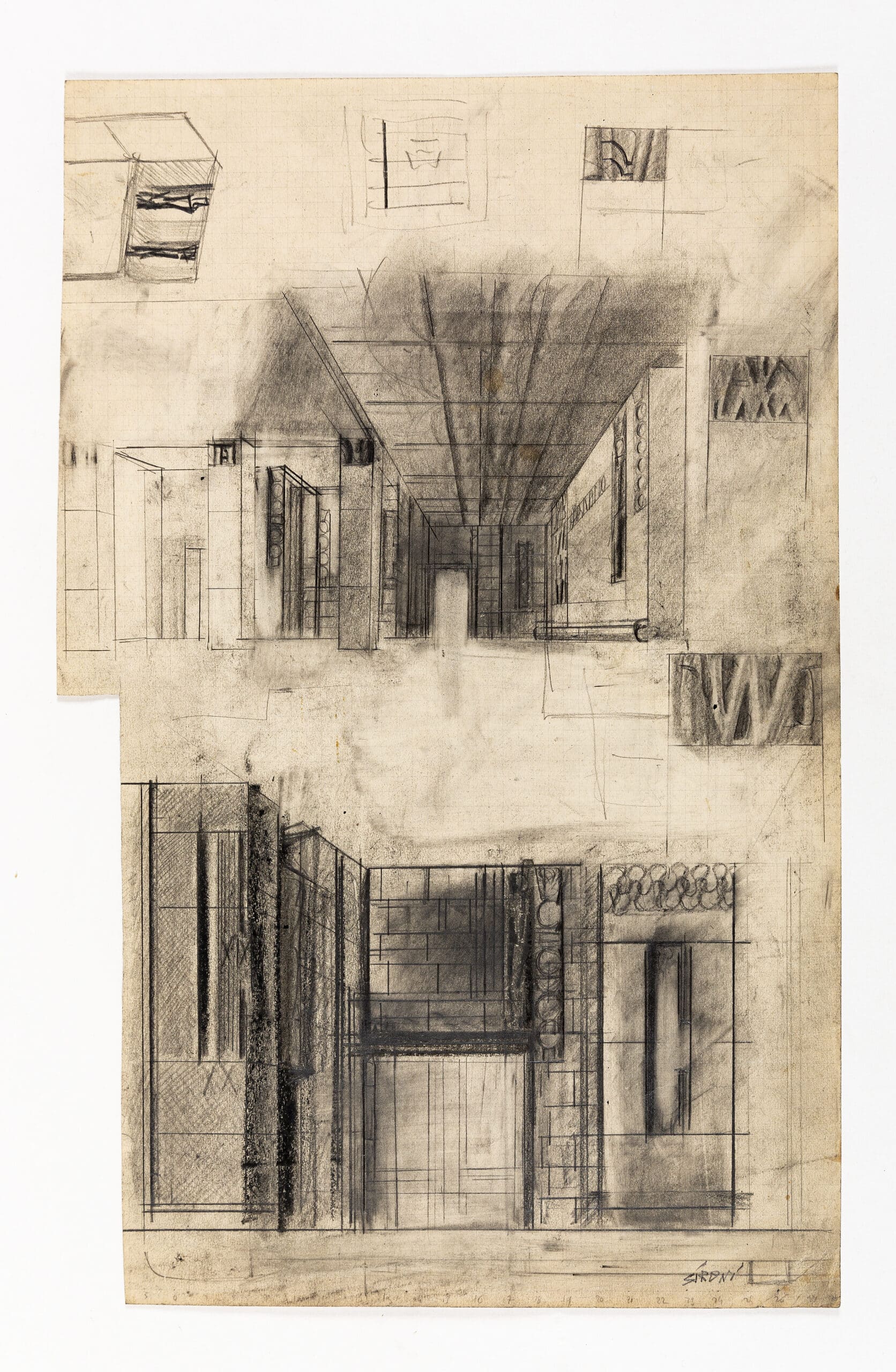
Drawing Matter holds 15 miscellaneous sketches by Mario Sironi. Sironi was an artist who, in the 1920s became a leading member of the Novecento group, famed for his heavy, monumental, and figurative style. Although no official style for fascist art was defined, Sironi’s work achieved success in the inter-war years, as a collaborator of the regime and its official newspaper Il Popolo d’Italia.
MOSTRA DELLE OPERE DELL’ARCHITETTO FUTURISTA COMASCO SANT’ELIA, COMO BROLETTO, 14 SEPT – 3 OCT 1930
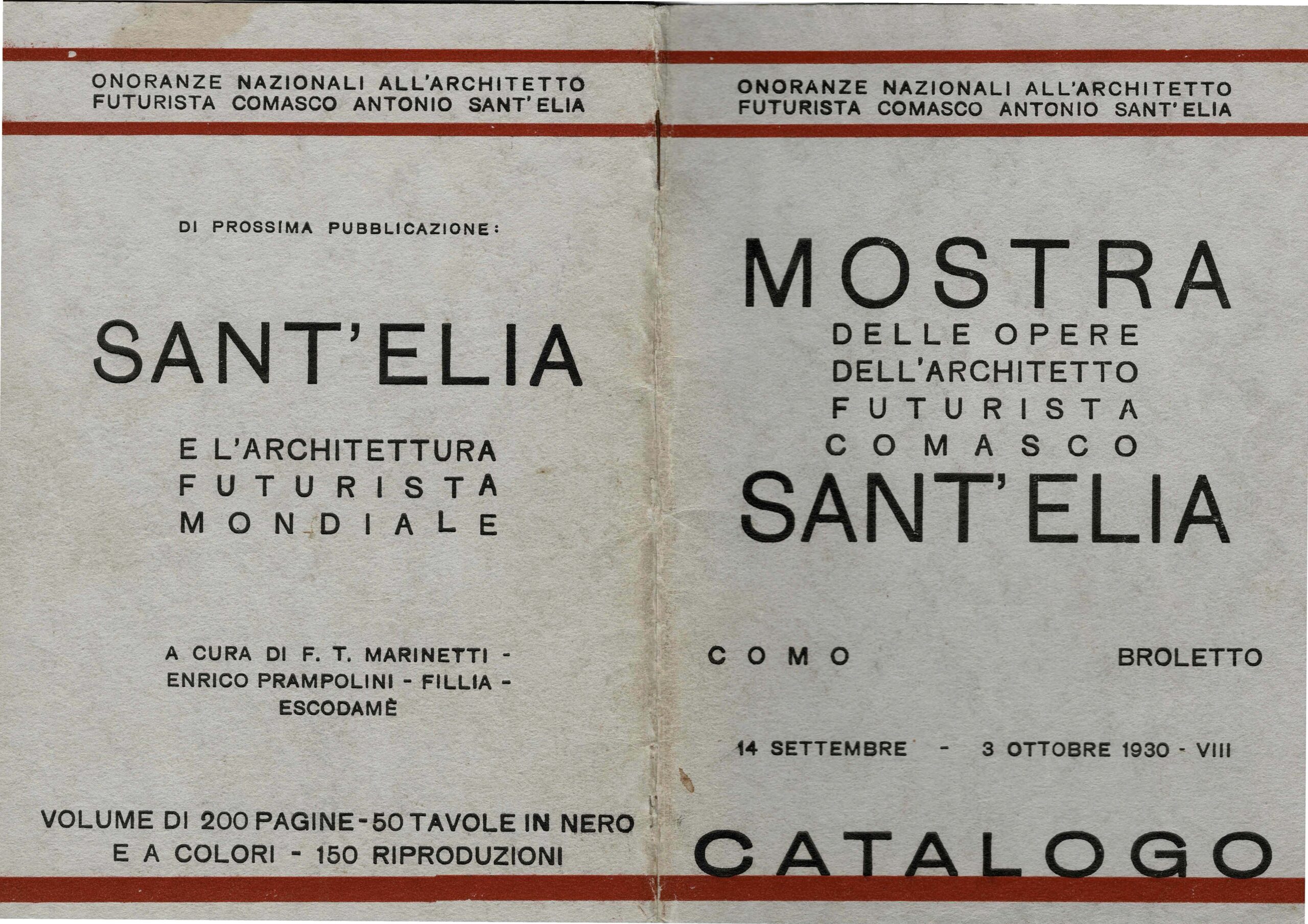
A small catalogue for an exhibition of Antonio Sant’Elia’s work from the autumn of 1930, featuring a biography of Sant’Elia, a text by fellow futurist Filippo Tommaso Marinetti (reproduced on Drawing Matter here), the Futurist architecture manifesto, project lists, and reproductions of drawings.
ADOLFO COPPEDÈ, BRIDGE DESIGNS FOR 1936 ROME OLYMPICS, 1930
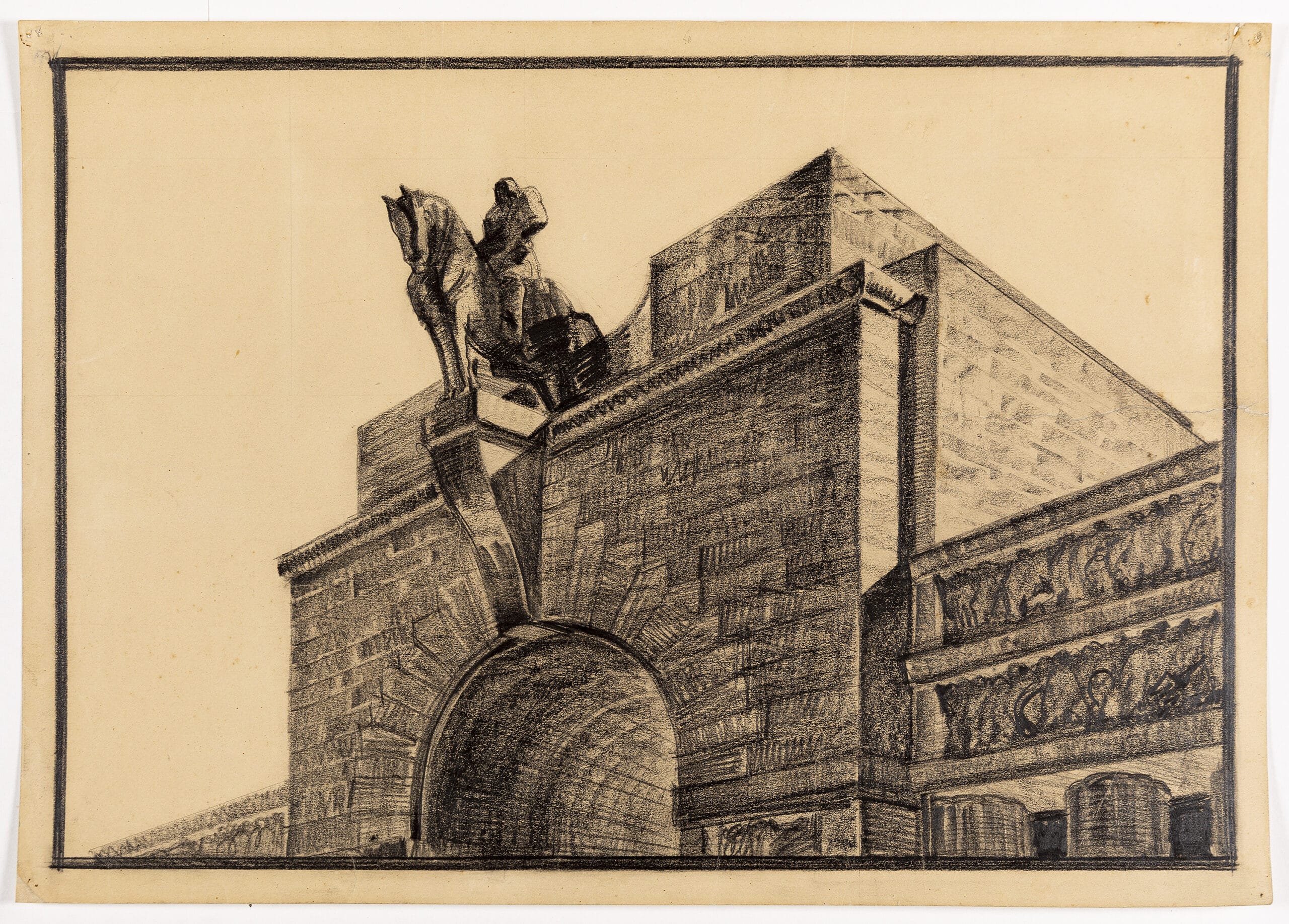
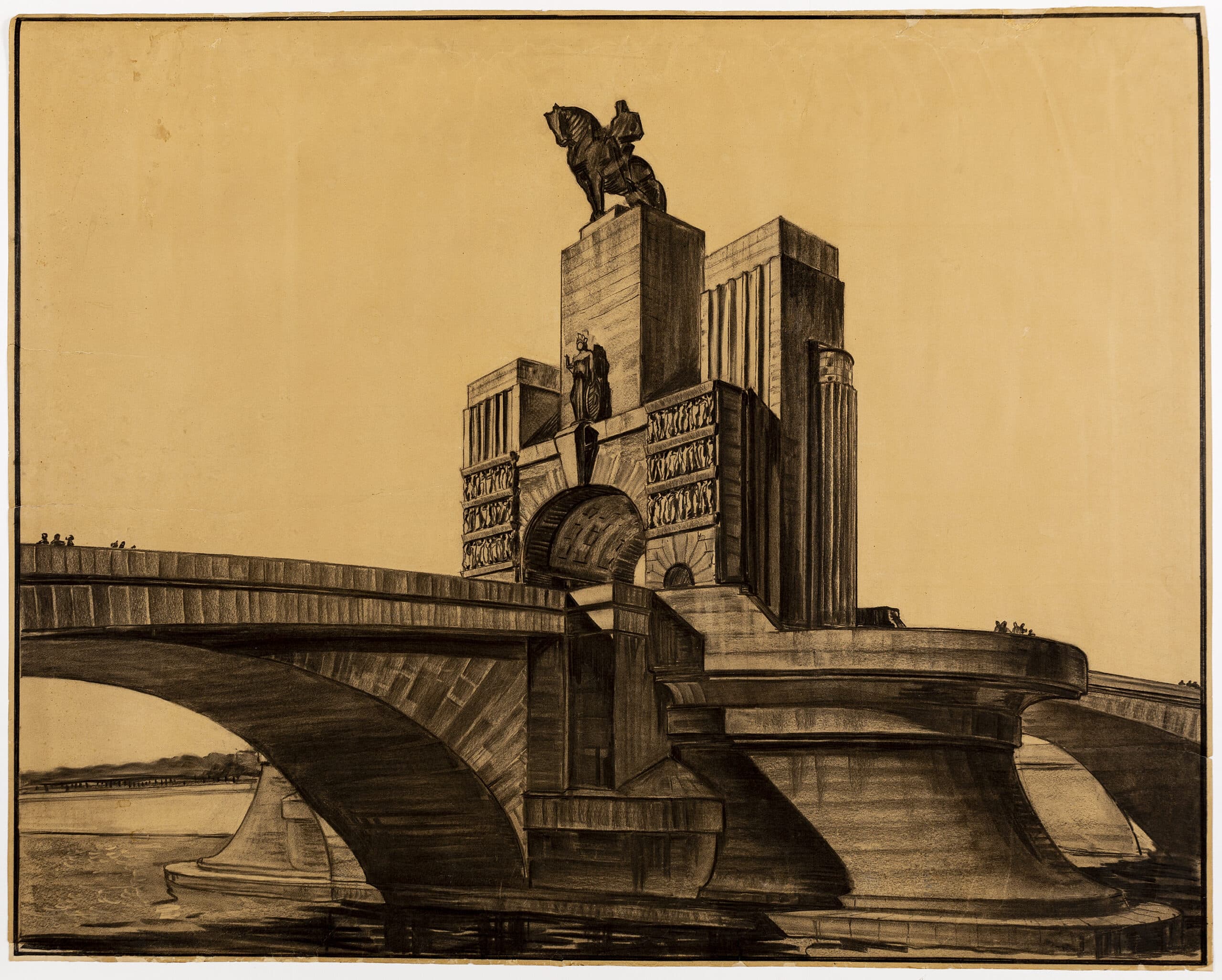
The collection holds two drawings for a bridge surmounted with a monumental arch by the architect Adolfo Coppedè. The design conceived in 1930 is seemingly part of Rome’s bid for the 1936 Olympics. They withdrew from consideration the night before the result, allowing Berlin to host the games. Equally, the bridge could be an alternative to the design of the Ponte Duca d’Aosta executed by Vincenzo Fasolo and Antonio Martinelli (1936-1939), as part of the masterplan conceived by Enrico Del Debbio for the Foro Italico (1927) (formerly Foro Mussolini). The new ‘citadel’ for sport was conceived between the slopes of Monte Mario and Ponte Milvio, at the bend of the Tiber, constructed to support subsequent Olympic bids; the 1940 and 1944 games did not take place due to the Second World War.
In 1932, Coppedè had joined the Partito Nazionale Fascista and a year later published an article in the Telegrafo in which he openly attacked the style of Rationalism in architecture, seeking instead to return to the mastery of classicism.
GIUSEPPE ROBERTO MARTINENGHI, MAGISTER CAEMENTARIORUM, c.1930
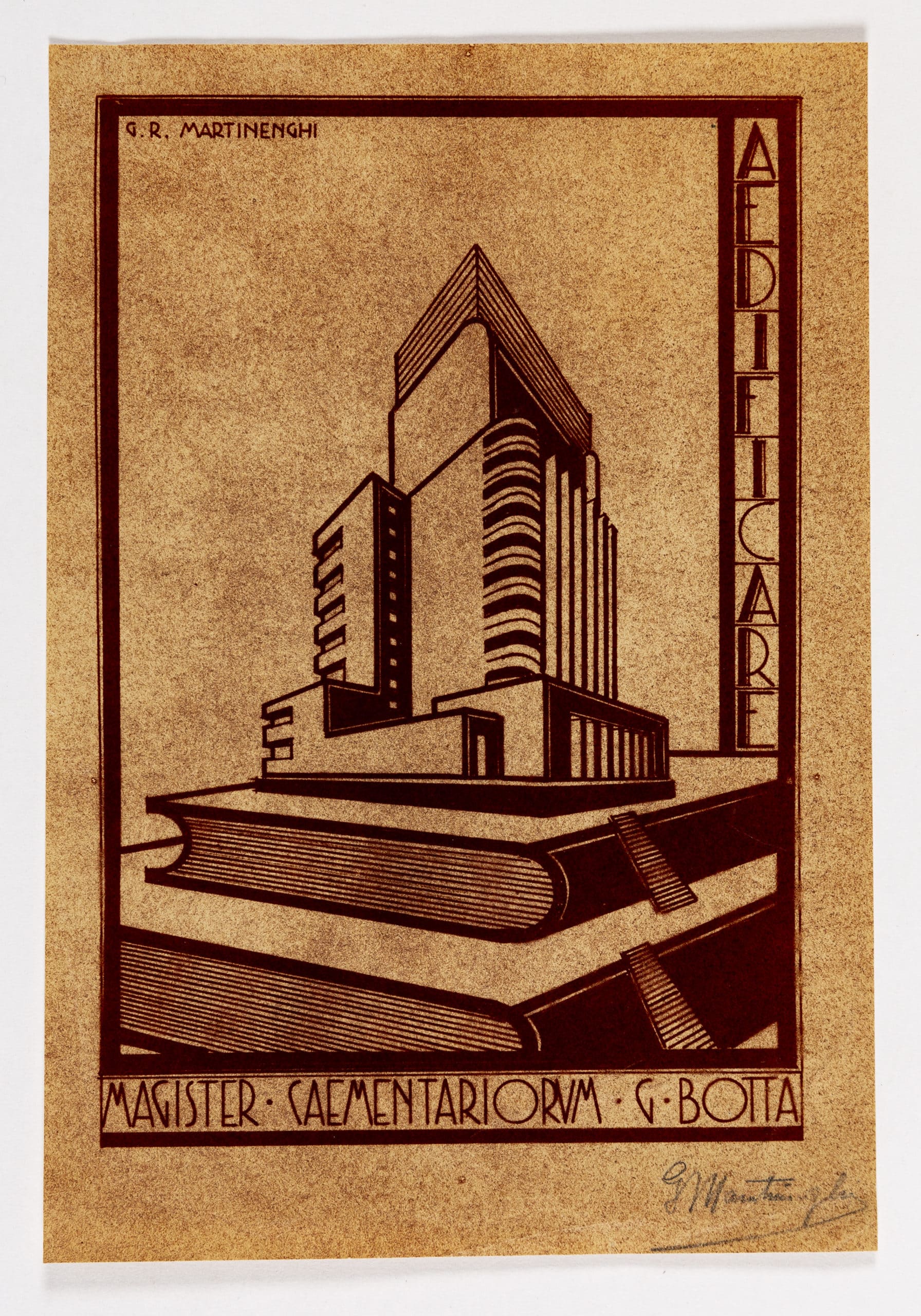
An ex-libris woodcut by Giuseppe Roberto Martinenghi dedicated to an unknown G. Botta, who is called a Magister Caementariorum (‘master mason’), it is in sepia ink on tobacco-coloured paper, the print captures a building atop a pile of books, on the right is printed Aedificare (‘to build’). On the reverse is a bookplate and the copy is signed in pencil.
Martinenghi was a prolific architect in Milan, completing over 300 buildings in the city, although in addition to this was working as an editor. Between 1922 and 1925, alongside Luigi Angelini, Temistocle Antonelli, Carlo Leonardi, Giorgio Wenter Marini, and Emilio Noël Winderling, he published three volumes entitled Ville e casette raccolta di progetti (‘Villas and cottages, collection of designs’), which chronicled their own projects but equally those of their contemporaries.
ROBERTO ROSATI, DESIGNS FOR MONUMENTS, 1930
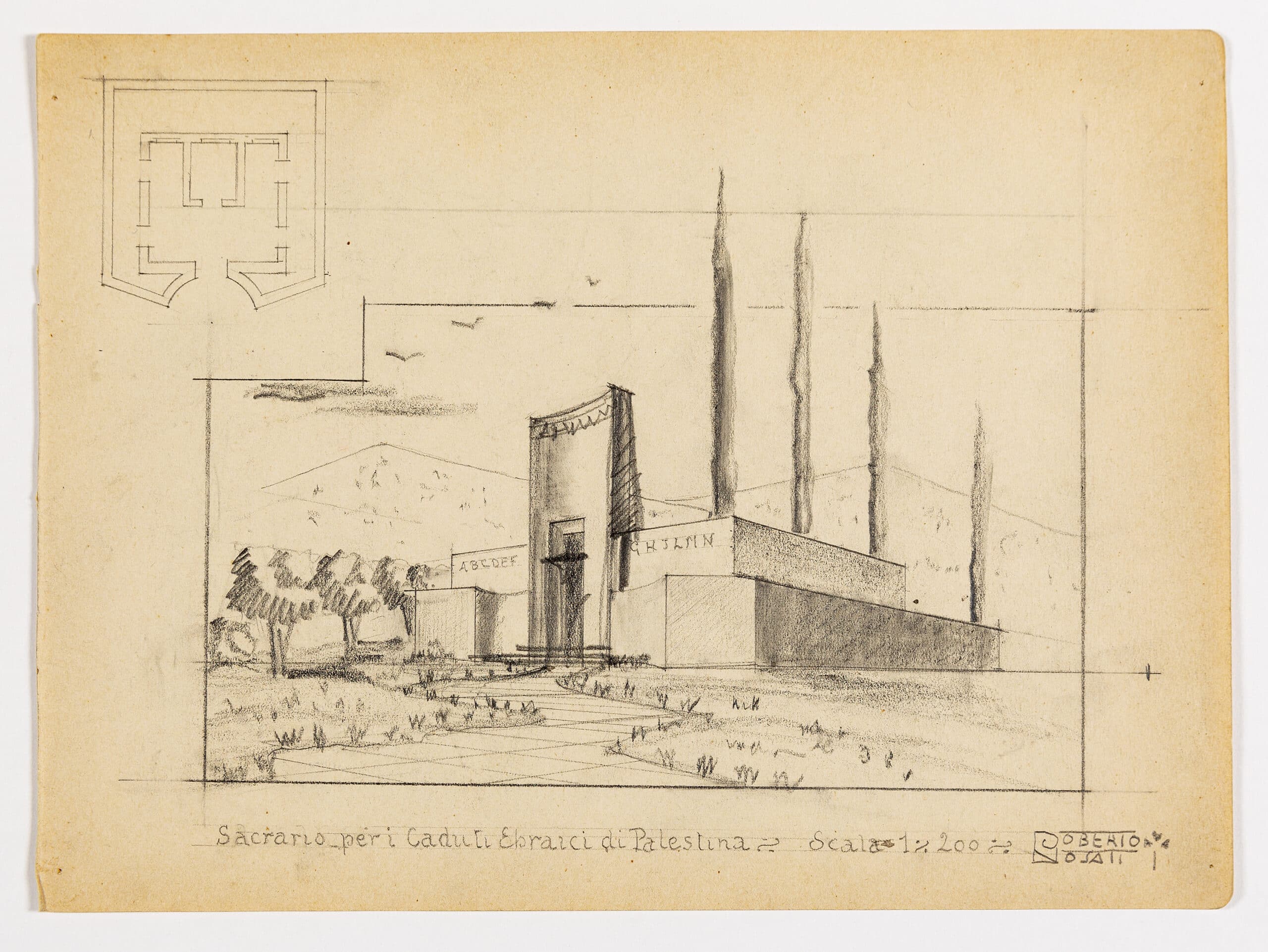
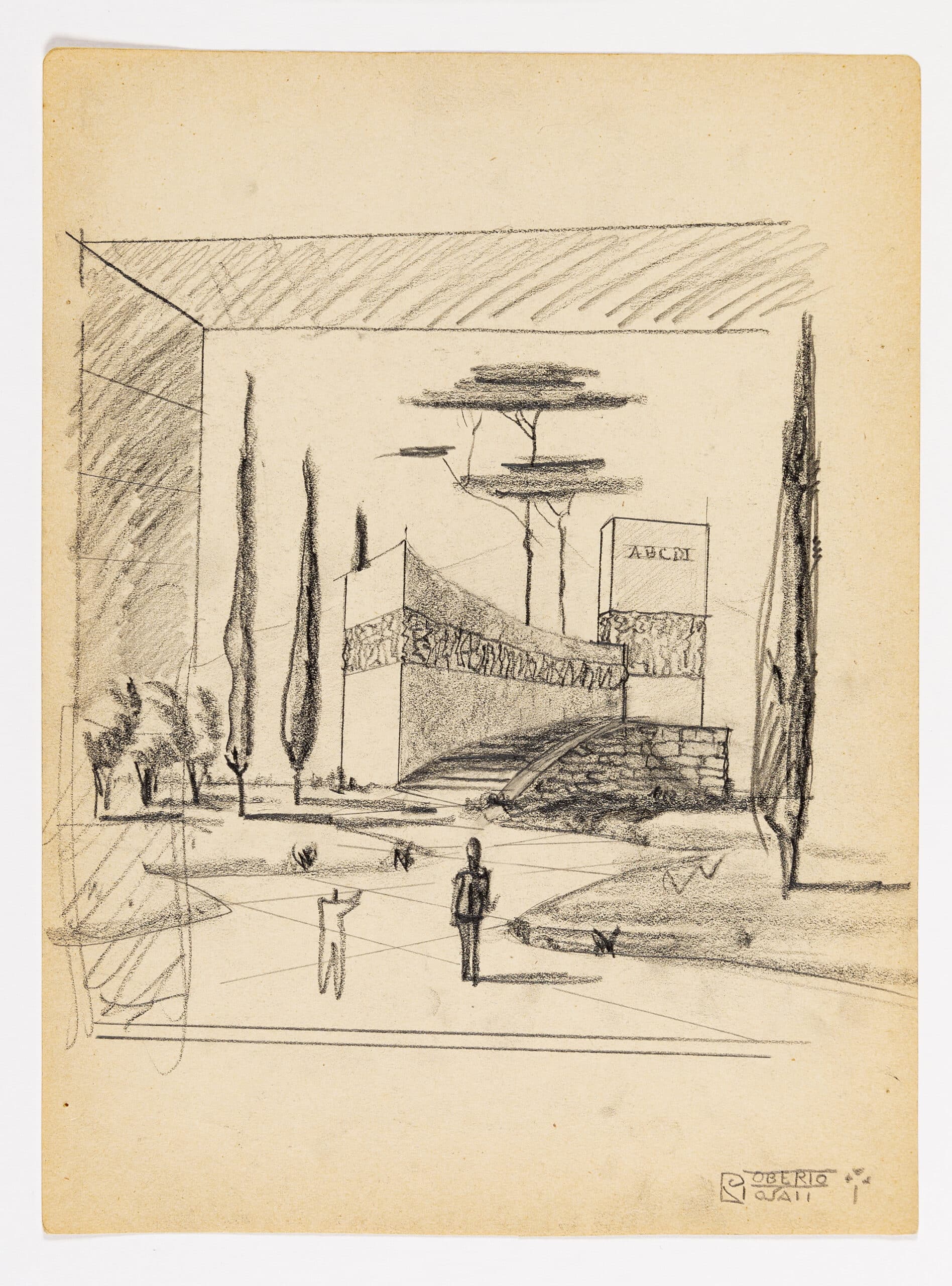
Two drawings by the unknown Italian architect Roberto Rosati, most likely for reburial of soldiers of the First World War; DMC 2686 is titled ‘Sacrario per i caduti Ebraici di Palestina’ (‘Shrine to the fallen Jews of Palestine’) and DMC 2687 is for an unknown monument.
FILLìA, LA NUOVA ARCHITETTURA, 1931
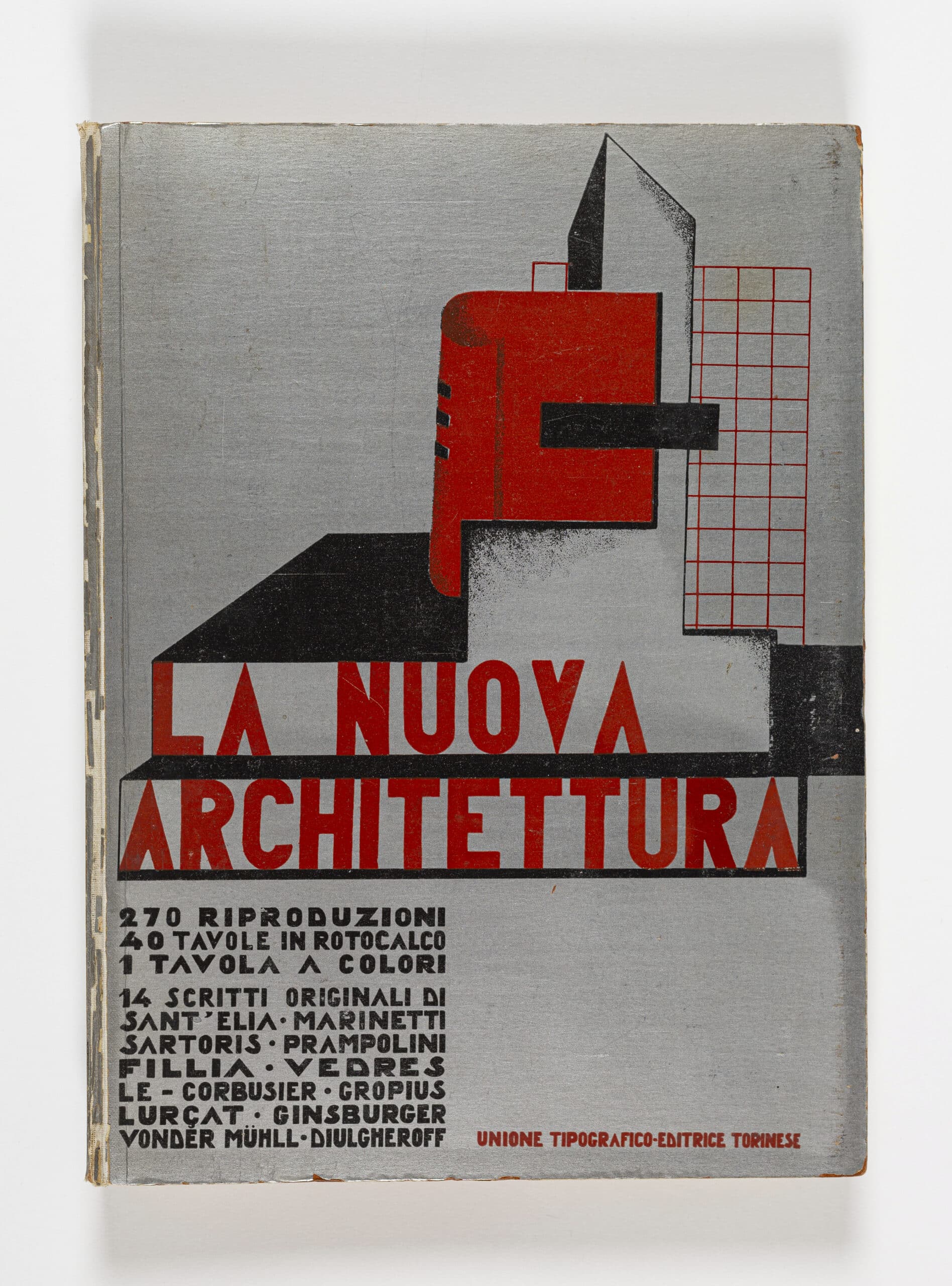
La Nuova Architettura by Luigi Colombo was published in 1931 through Tipografia Sociale Torinese. Colombo worked under his pseudonym, Fillìa which he had derived from his mother’s surname. He was an architect, but also a decorative artist, poet, and editor of the magazine La terra dei vivi. As it declares on its cover, it contains 270 images and 14 texts, contributed by a plethora of European architects, from Le Corbusier, Walter Gropius, Enrico Prampolini, and Antonio Sant’Elia.
VIRGILIO MARCHI, MULTIPLE PROJECTS, 1919-1942
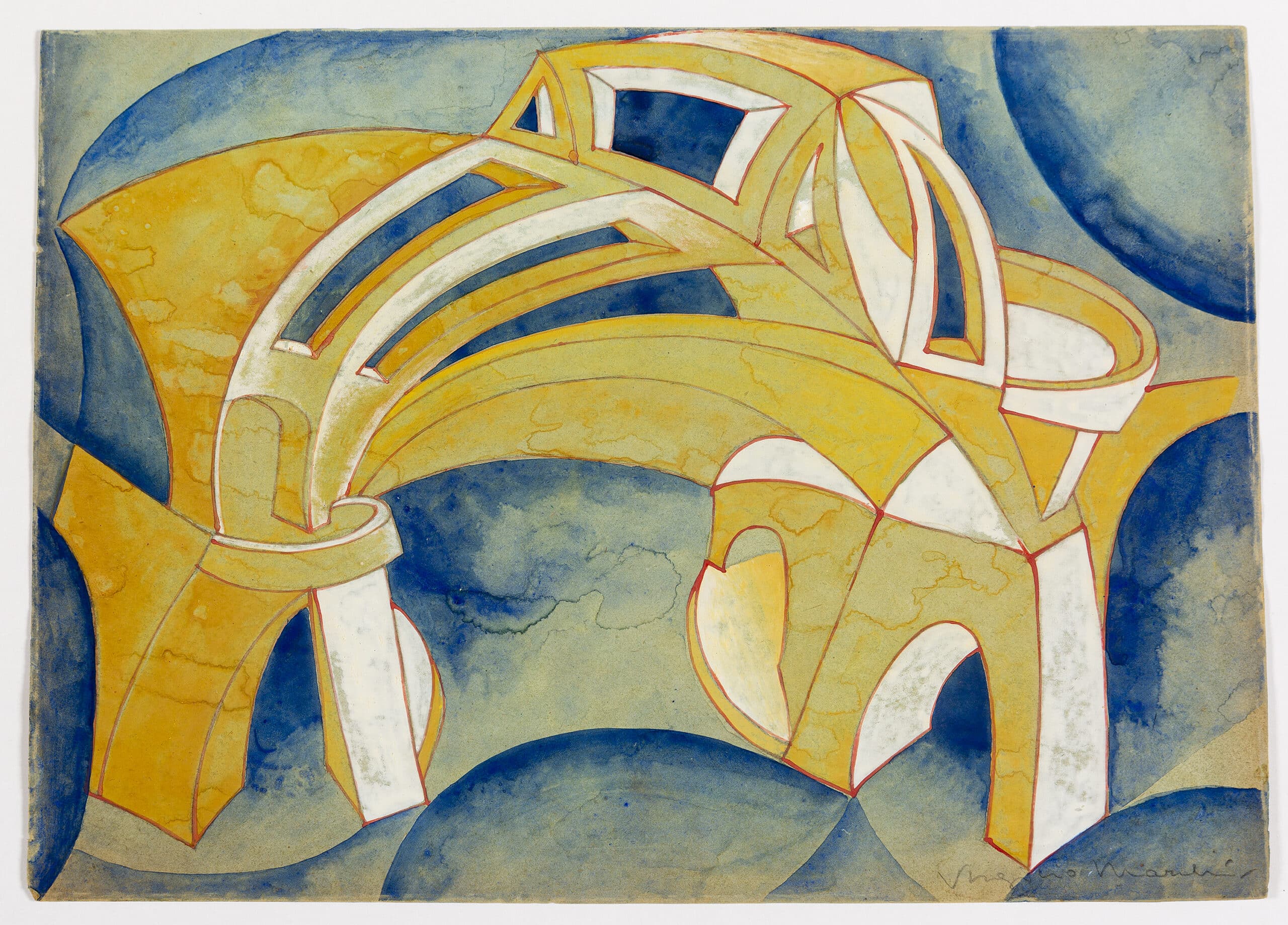
The earliest work of Virgilio Marchi held in the Drawing Matter collection is an untitled painting of a twisting and contorting architectural form. It is one of many imagined structures drawn and painted between 1919 and 1920, which often depicted structures from an ideal city. Another example is held in the collection of The Met in New York. Marchi was deeply engrossed in the concepts of both the German Expressionists and the Futurists, striving for a synthesis of all arts; in particular for Marchi in painting, architecture, music, theatre, and writing. He continually theorises and publicises the concept of Futurist architecture, aiming to continue the work of Antonio Sant’Elia in his Manifesto dell’Architettura Futurista first published in 1914, he writes Architettura futurista ten years later; followed in 1931 by Italia Nuova Architettura Nuova Seguito di Architettura Futurista (DMC 3038), its lineage marked through a reprint of Sant’Elia’s original text.
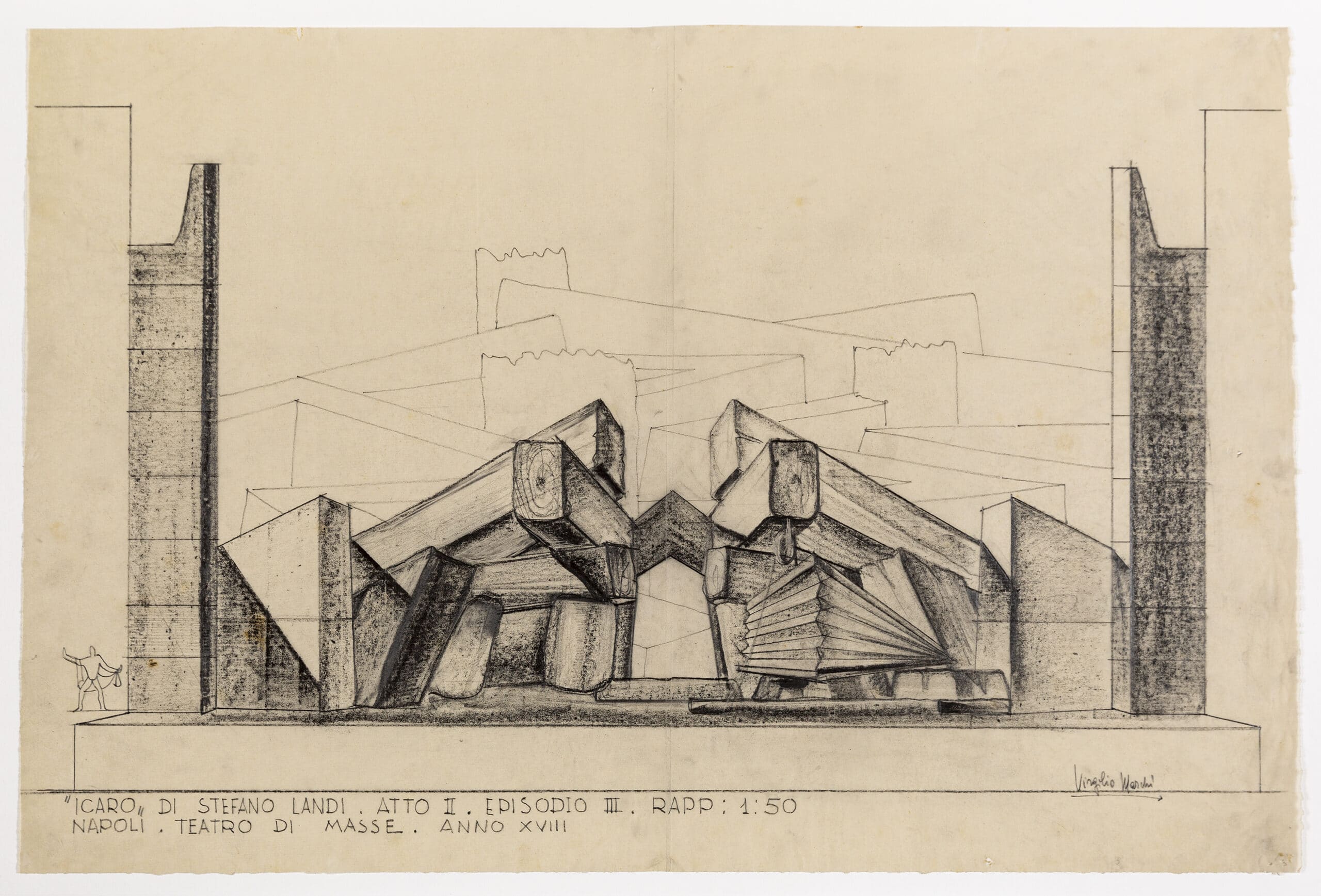
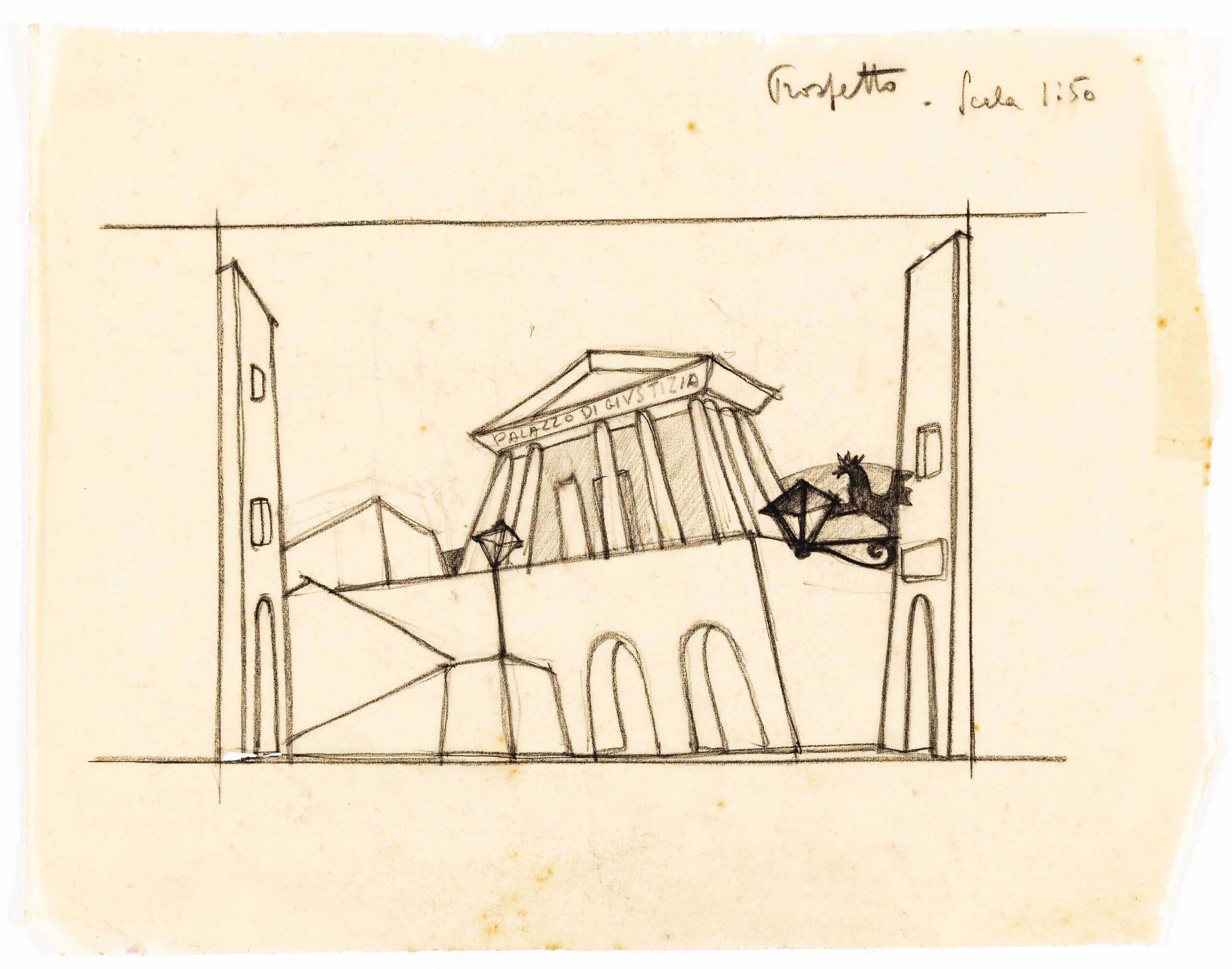
In 1921, fellow member of the Futurists, Anton Giulio Bragaglia, invited Marchi to design his Casa d’Arte Bragaglia with the adjoining Teatro degli Indipendenti, an avant-garde cultural centre and meeting place for artists and intellectuals in Rome; this is classed as the first built work of the Futurists. Here, Marchi becomes involved in the Teatro degli Indipendenti as a stage and costume designer, only fueling his Futurist desire to unify arts. Two years later, the theatre put on the one act play of Futurist set designer Claudio Vicentini Pirandello; it is most likely at this performance that Marchi met Stefano Landi and Massimo Bontempelli. The two set drawings by Marchi in the Drawing Matter collection are collaborations with Landi on his staging of ‘Icaro’ (DMC 2067) and Bontempelli for his opera ‘Valoria’ (DMC 3245.2).
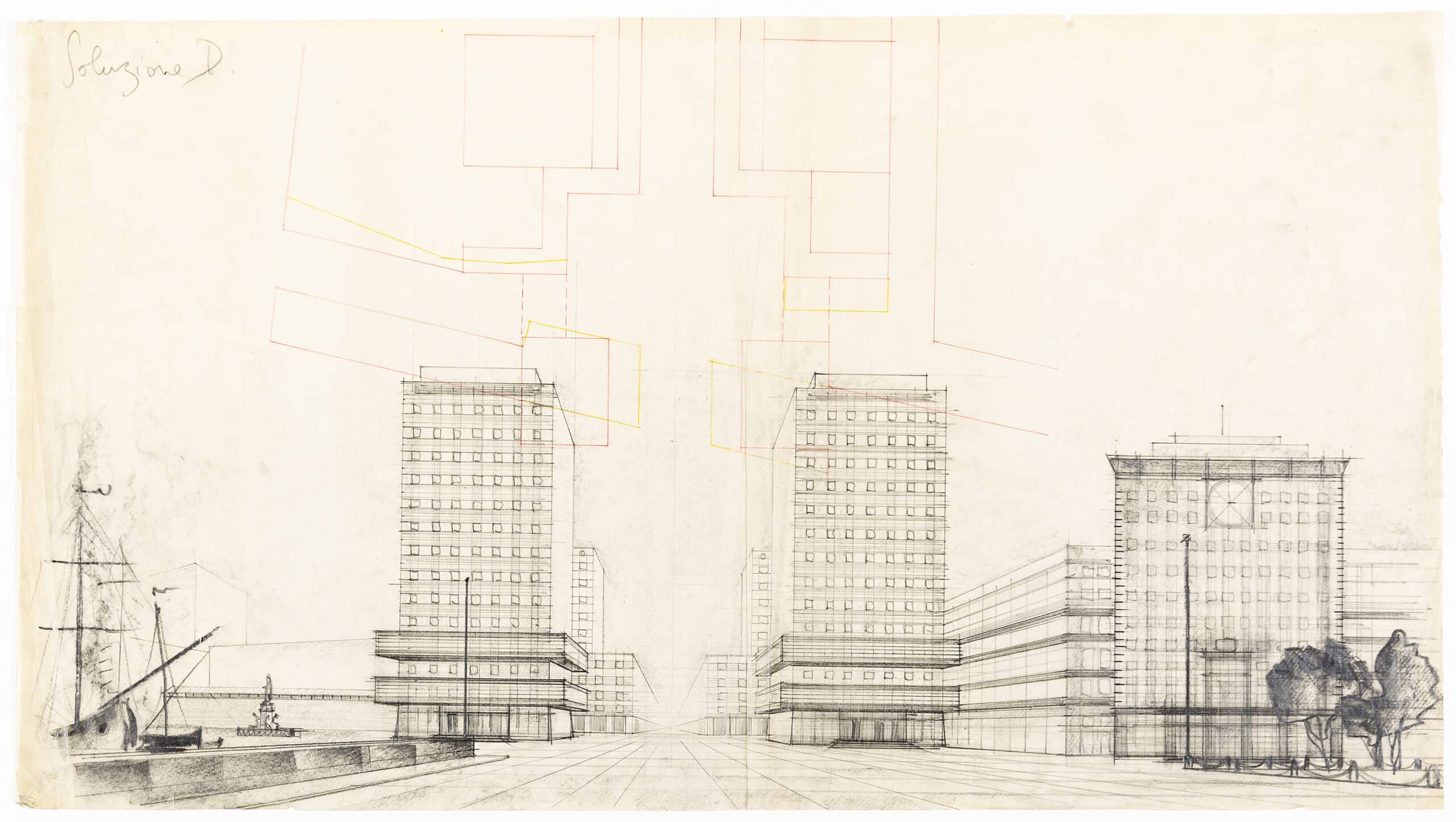
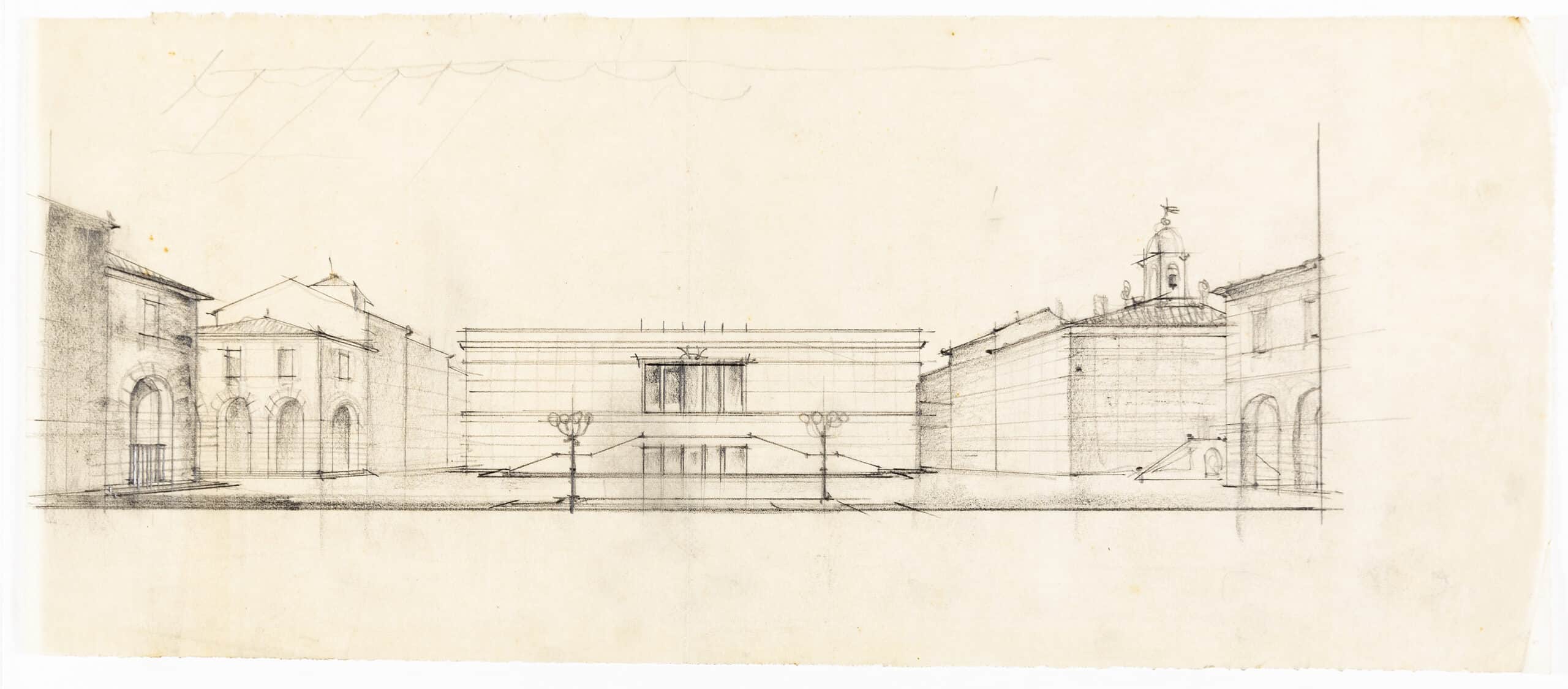
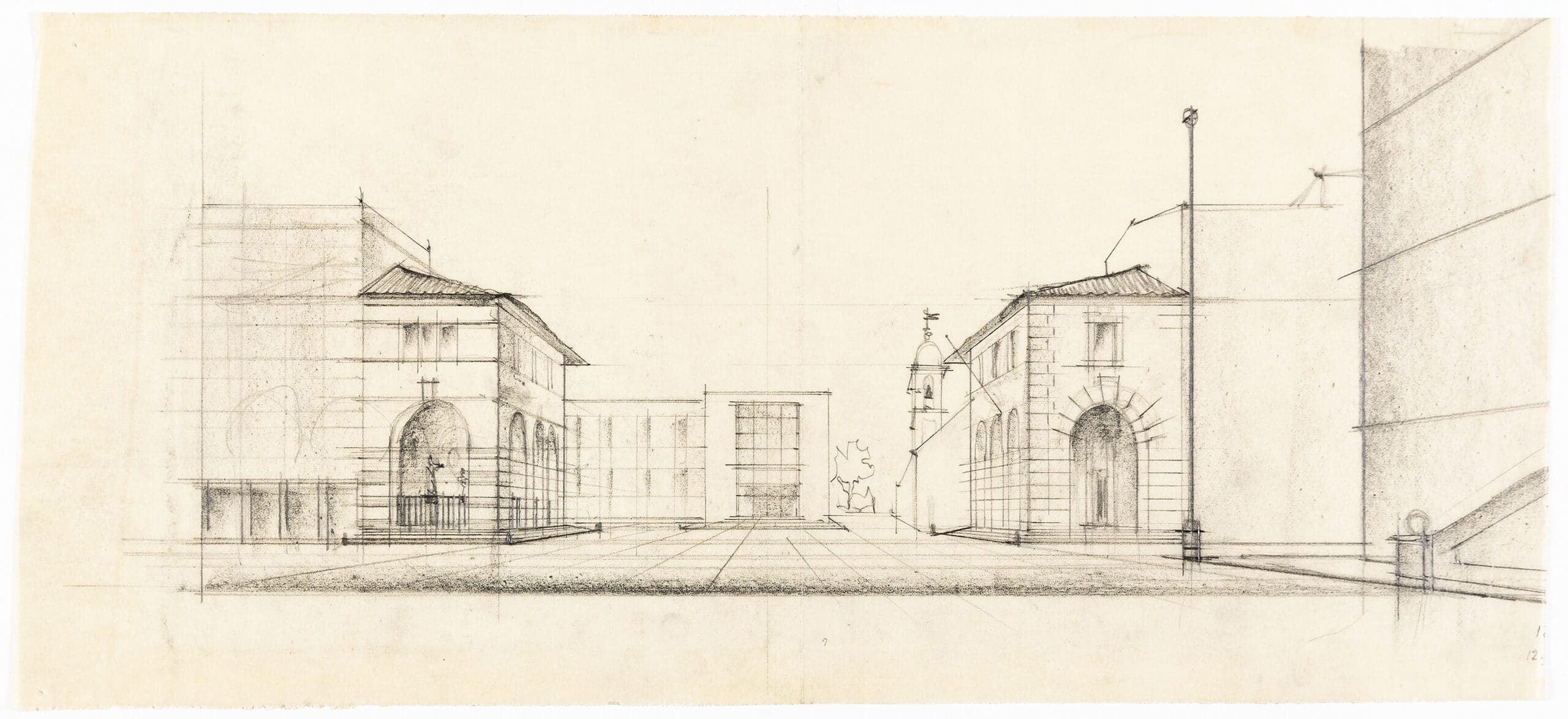
A shift occurred in Marchi’s work into the 30s, his architecture turned away from the swirling constructions of his paintings, and he pushed towards rationalism. This formal change can be seen in his competition drawing for Le Esposizione Universale di Roma (DMC 3245.1), tasked with the development of a new business district in the south of Rome which would form the basis of the city’s 1942 World’s Fair. Known as the E42 project, it was to celebrate twenty years of Mussolini’s rule and represent a ‘Third Rome’. Here, in ‘Soluzione D’, an endless projection of gridded towers extends off an open piazza. Marchi did not win the commission; the E42 site was entrusted to Adalberto Libera for his Palazzo dei Ricevimenti e dei Congressi and Guerrini, La Padula, and Romano’s ‘square colosseum’, the Palazzo della Civiltà Italiana, among others. This form of the projected pencil drawings is also found in DMC 3245.3 and DMC 3245.4; yet they show the integration of new rational structures into a historic town centre.
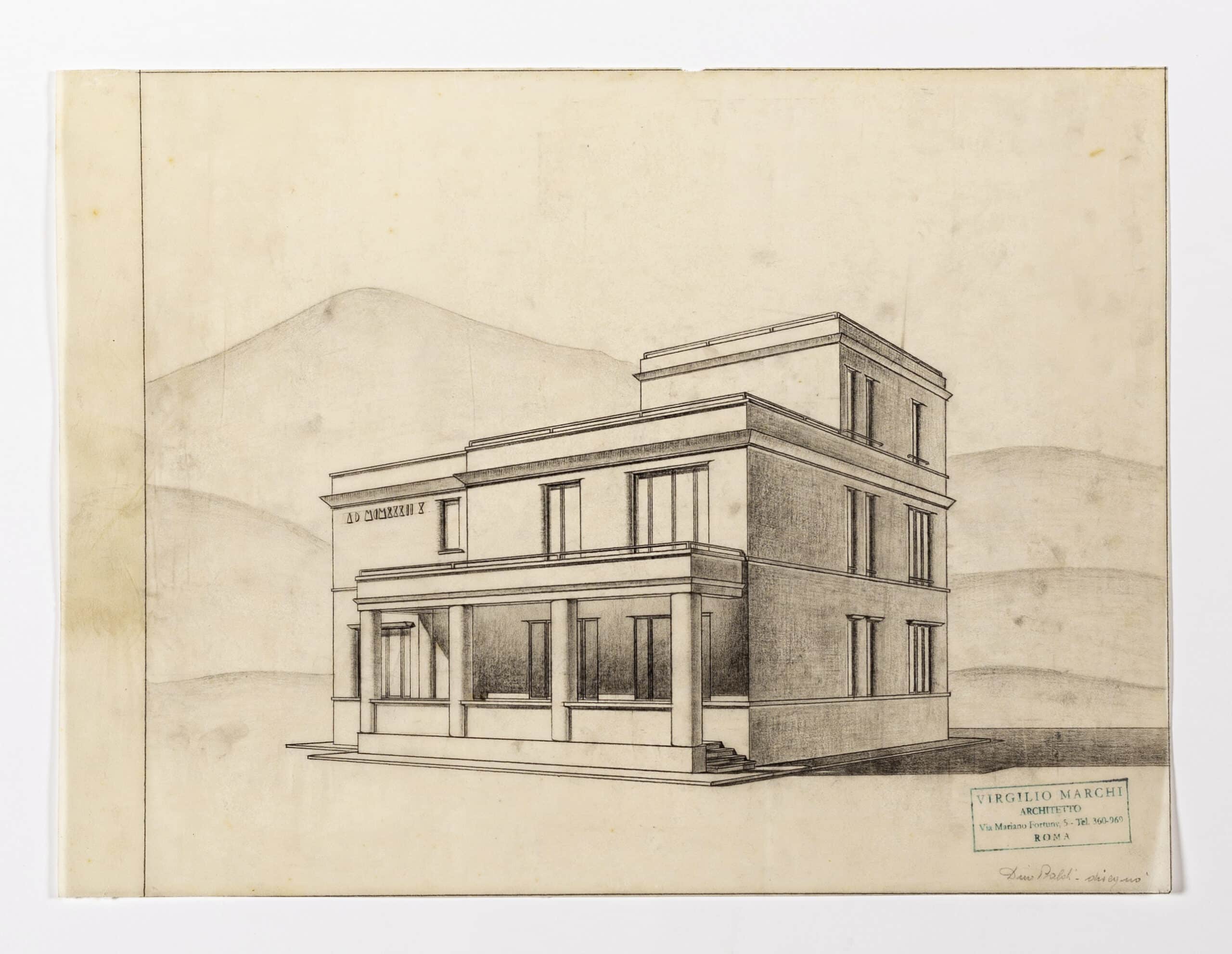
This turn to rationalism is also found in a 1931 drawing of a laboratory office for an explosives factory near Rome (DMC 3871); it stands alone in a blank landscape designed as a classical villa stripped to its bare functional elements.
CARLO MOTTI, REALE FARMACIA, 1932
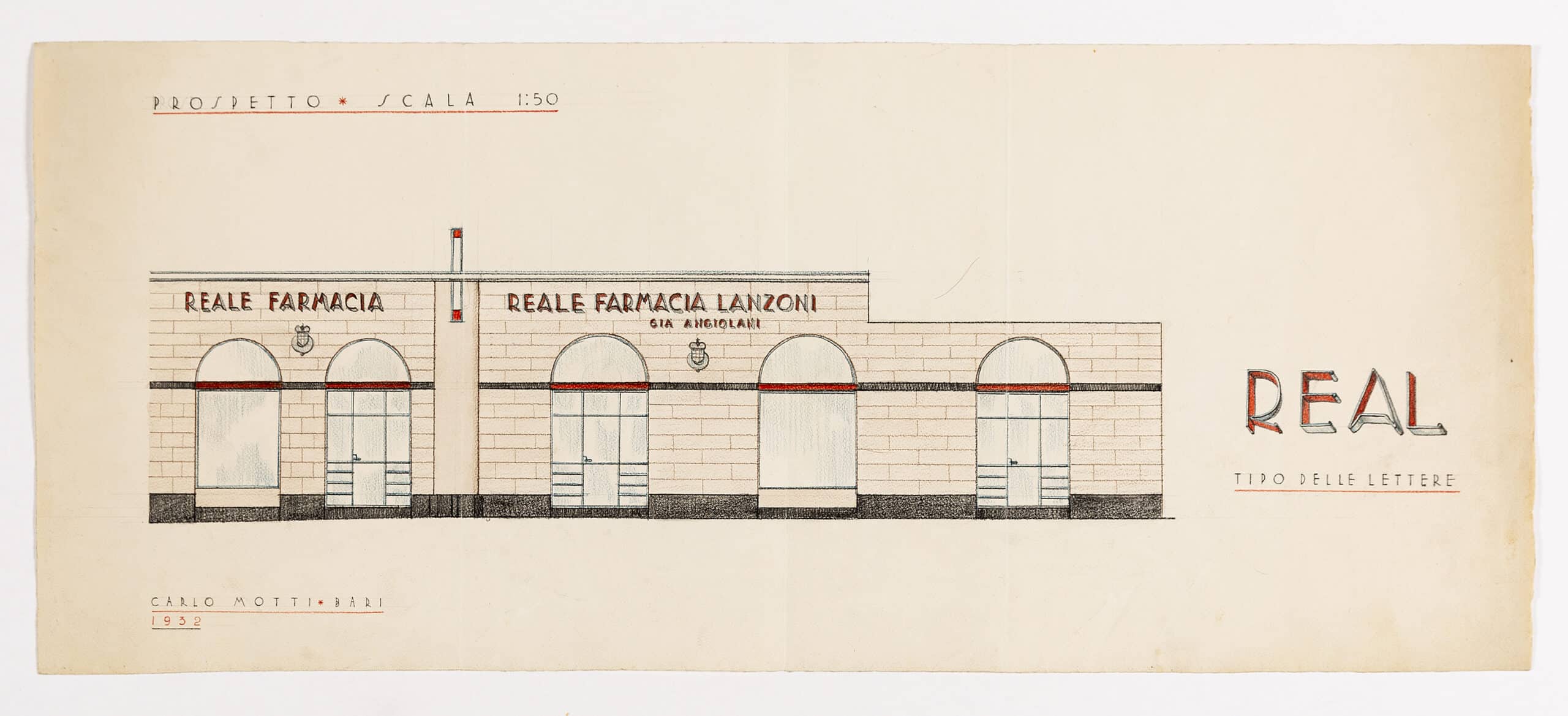
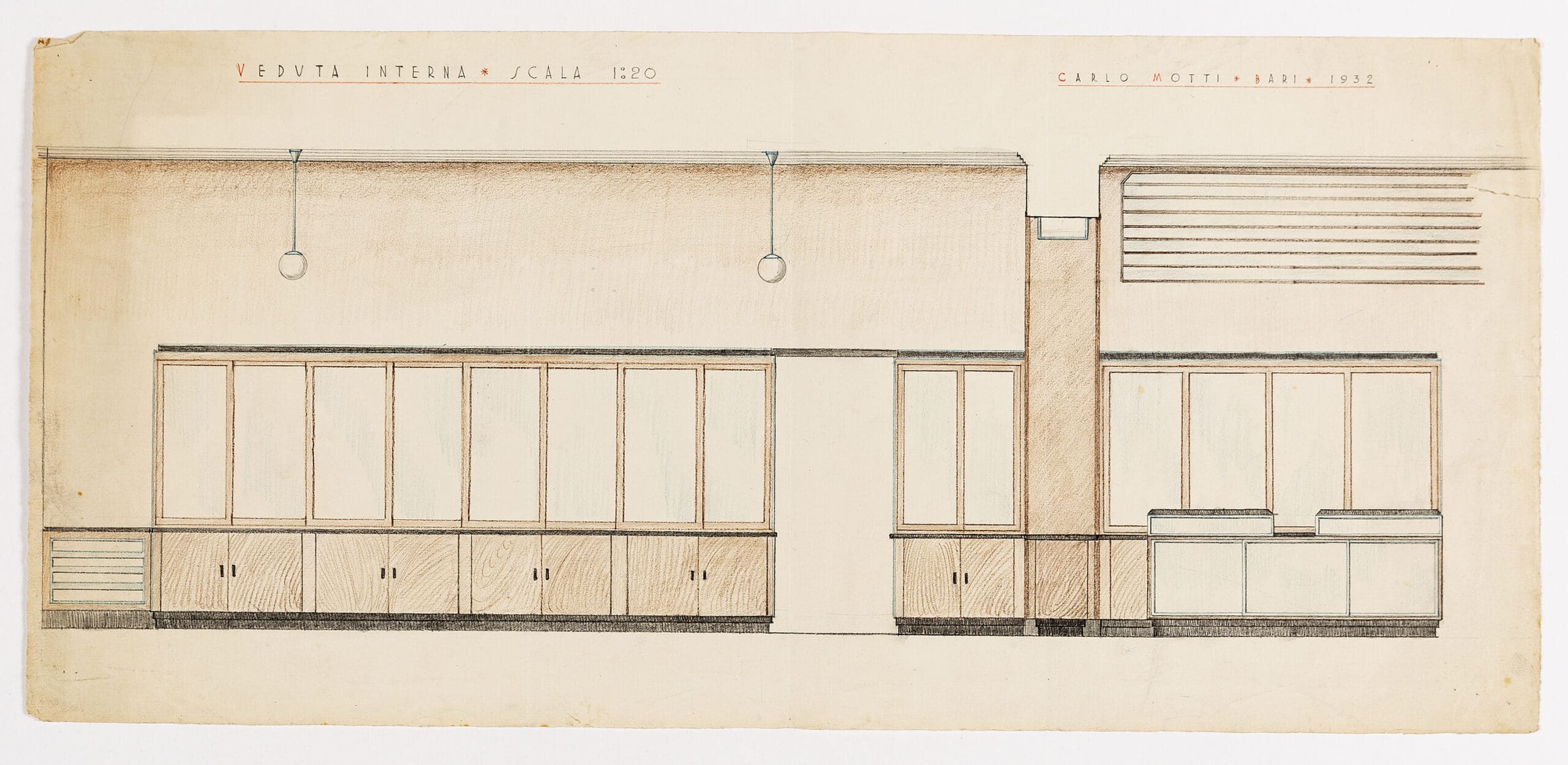
Two drawings by Carlo Motti for a pharmacy, an elevation and section at differing scales. The elevation at 1:50 depicts the shop’s facade, an asymmetrical arrangement of glass arches, cut by a red cornice. It is unclear but the treatment of the dropped roof suggests Motti’s design will sit on the ground level of an existing building. To the left of the drawing the three-dimensionality of the facade’s signage is indicated. The sign ‘Reale Farmacia Lanzoni’ (‘Royal Pharmacy Lanzoni’) suggests that it was a state run pharmacy. ‘Lanzoni’ is potentially the name of the family who own the shop, most likely the pharmacist’s name written below, Gia Angiolani. The interior section focuses on the cabinetry of the space, low wooden cupboards with glass cabinets above. Little is known of Motti, apart from what is indicated on the drawing: that he was working in Bari.
GIUSEPPE TERRAGNI, CASA RUSTICI, 1933
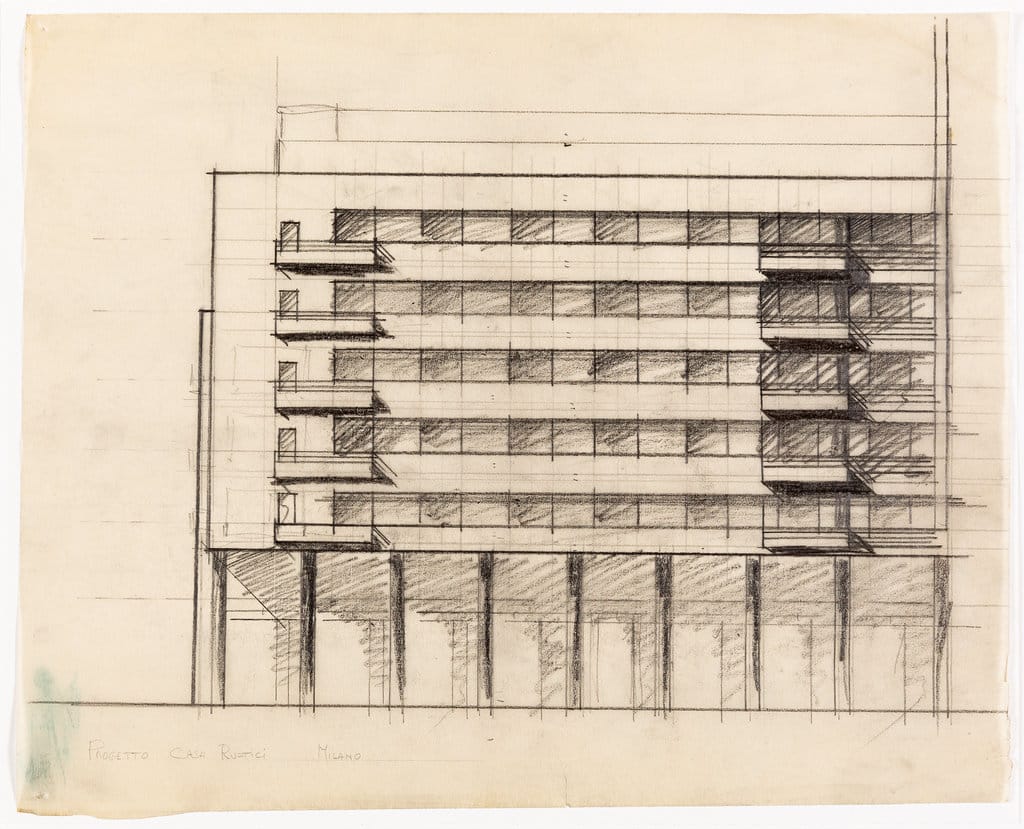
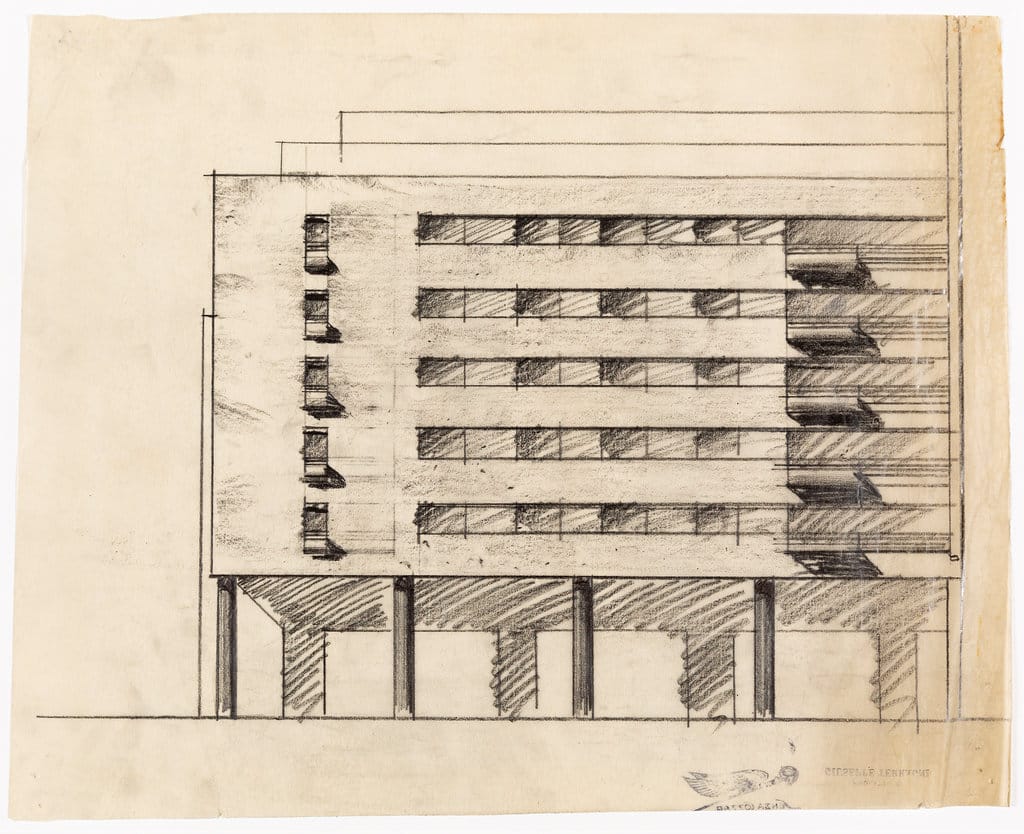
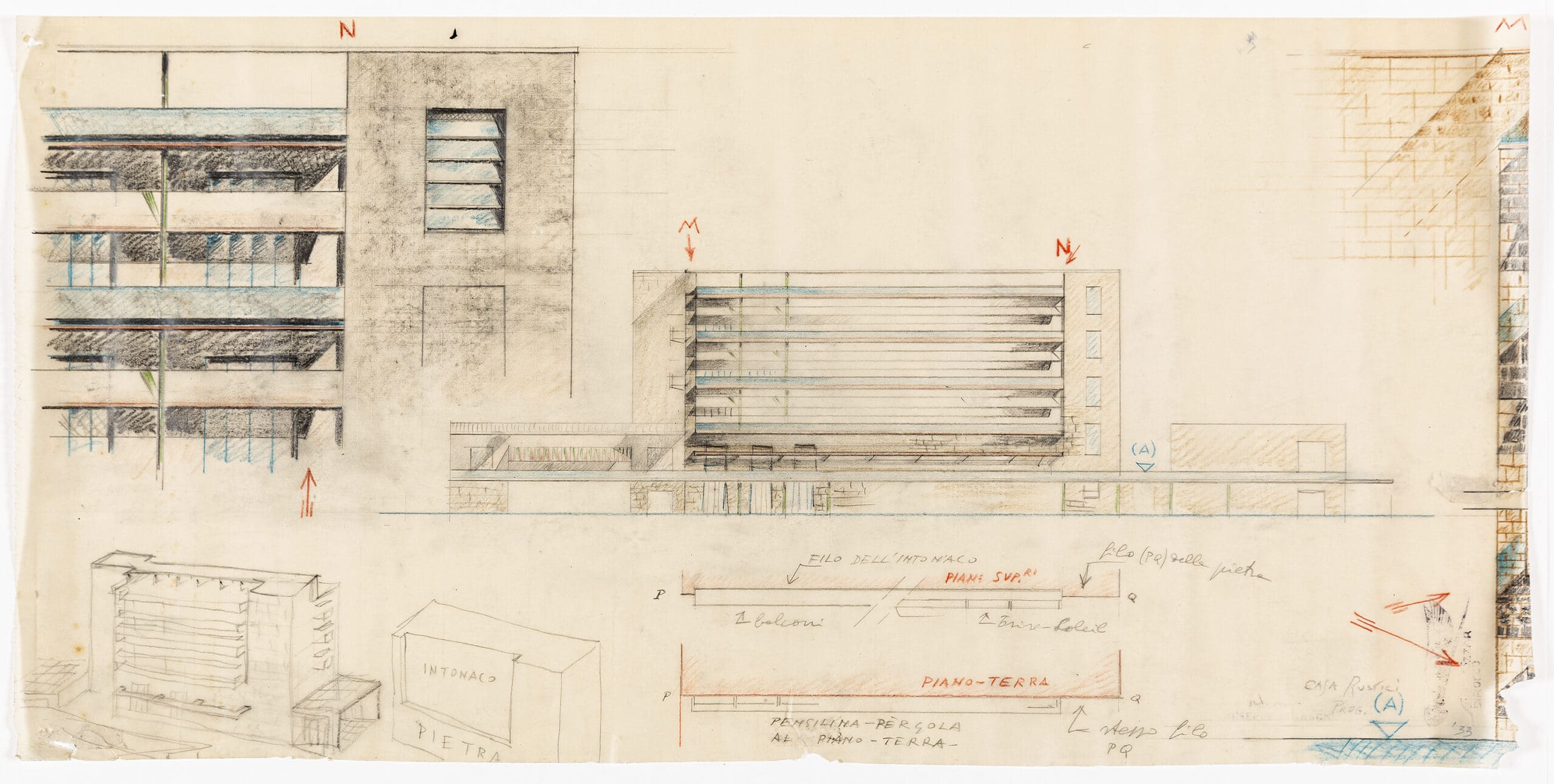
Terragni and Lingeri open a studio together in Milan, and from 1933 to 1936 they build five apartment buildings across the city; Casa Ghiringhelli, Casa Toninello, Casa Rustici, Casa Lavezzari, and Casa Rustici-Comolli; these apartment blocks for the urban bourgeoisie that were only just emerging in Italian cities. In the Drawing Matter collection are three working drawings of Casa Rustici from 1933.
Two of the drawings show facade variations, differing through balcony placements and their number of supporting columns. The other drawing depicts one elevation in full, surrounded by details and other sketches. In the top right we see a detailed corner of the elevation, below is a perspective of the building where we see its barely articulated ‘s’ shape. At the bottom are two perspectives showing how the facade would interact with the street, encompassing a recessed section with brise-soleil. To the right of the image is a cross-section of the ‘M’ line, indicated in the main elevation. All these works are on tracing paper, with pinned corners and two stamps that read, ‘Progetto di GIUSEPPE TERRAGNI’ and ‘Senza Cozzar di Rocco’ (without clashing with rocks), a motto of poet-pilot Gabriele D’Annunzio, about the devastating yet distant act of dropping bombs from the sky.
These drawings of Casa Rustici are unlike the built structure; it is most likely an earlier design, as the project was submitted to the planning department nine times before being approved. The design also bears resemblance to the initial proposal made by Terragni for the later housing block Casa Rustici-Comolli, but the date inscribed on the drawing firmly places it as part of the first Casa Rustici project.
LUIGI MORETTI, SKETCHBOOK, c.1933
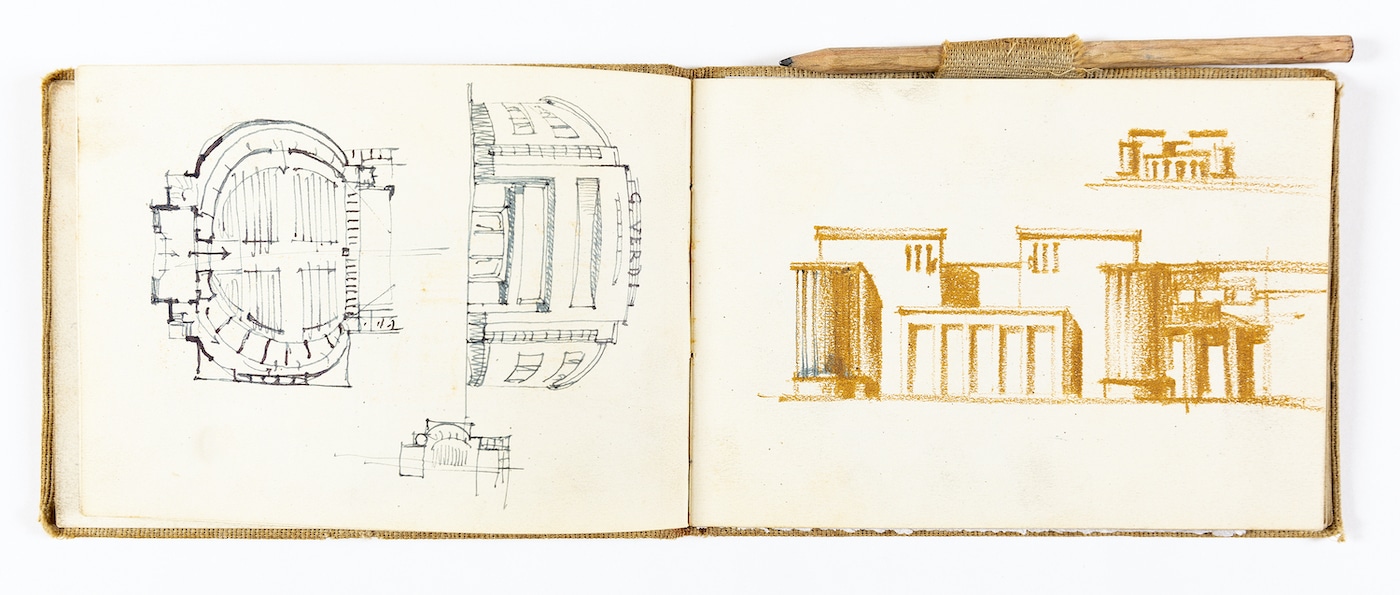
A cloth-bound sketchbook with pencil attributed to Luigi Moretti. Across its 56 pages, the sketchbook features a mixture of travel sketches, technical notes from university classes, and studies of contemporary buildings.
Luigi Moretti was taught at Sapienza, Università di Roma by Vincenzo Fasolo. Fasolo and the Rome school had a distinct approach to teaching architecture, starting first with the composition of the structure. Fasolo was known to sketch typological elements with a geometric simplicity to communicate the compositions of famous buildings; a technique which is on display in the sketchbook held at Drawing Matter. In his depiction of contemporary buildings, which date up to 1933, they are drawn with a ruler, suggesting their creation more formally at a desk from illustrations and photographs featured in publications. Some of the buildings can be matched to images in editions of Popolo d’Italia from the early 1930s. Sapienza scholars, Fabio Colonnase and Lorenzo Grieco, have identified some of the buildings depicted in the sketchbook, which you can view here.
Moretti graduated in 1930 and quickly achieved important public commissions such as the masterplan for Foro Mussolini.
The rest of Luigi Moretti’s material is held between the Italian state archives and the MAXXI and neither holds a sketchbook similar to the one held by Drawing Matter.
MARIO SIRONI, STUDIO PER L’INGRESSO DELLA MOSTRA DELL’ARCHITETTURA MODERNA ALLA V TRIENNALE DI MILANO, 1933
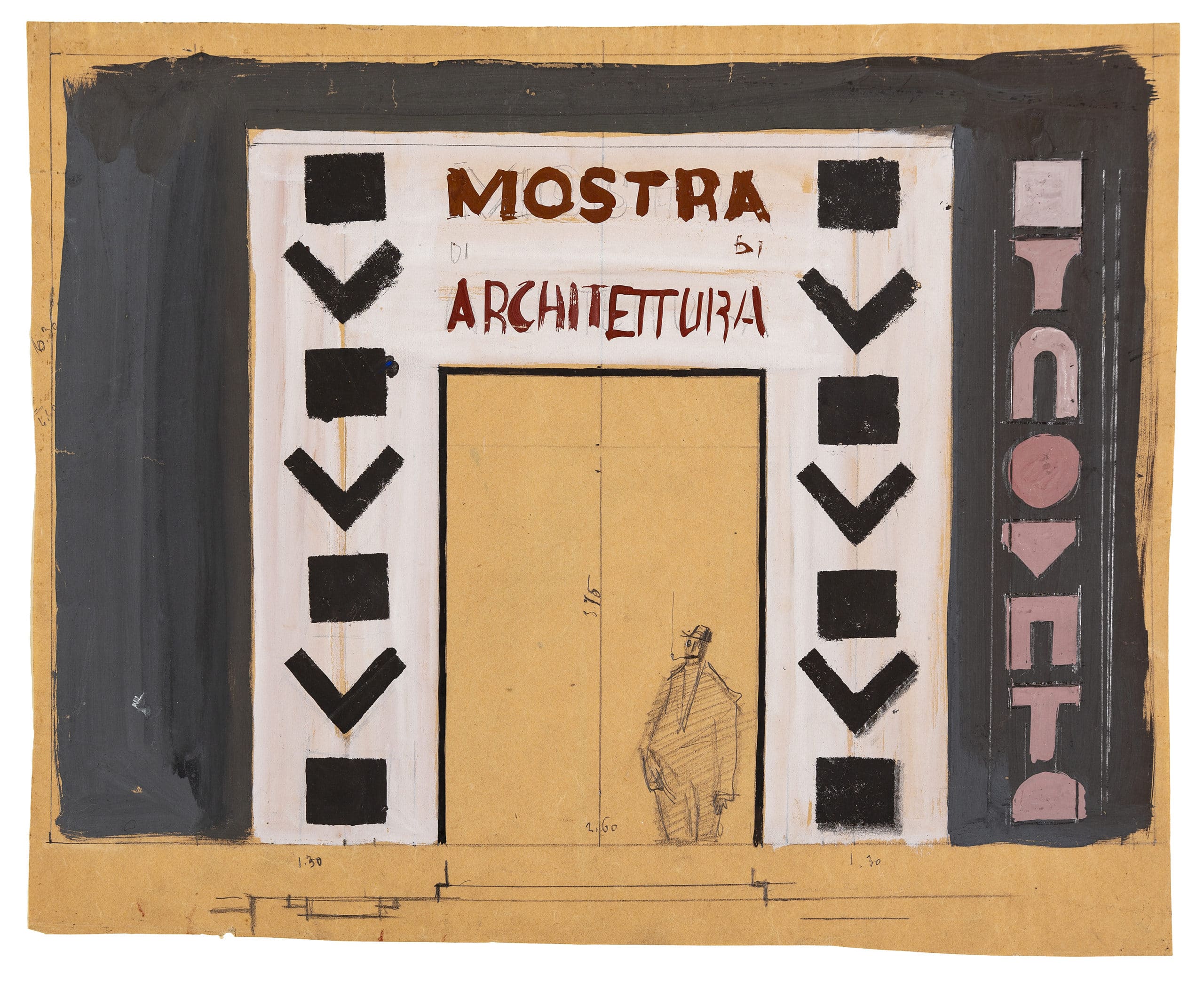
The Fifth Triennale in 1933 was designed by Giovanni Muzio, yet with curatorial input from Mario Sironi. Throughout its site at the Palazzo dell’Arte, Italian artists including Massimo Campigli, Carlo Carrà, Felice Casorati, Giorgio De Chirico, and Achille Funi, exhibited murals, mosaics, and sculptures, coordinated by Mario Sironi. In Il Parco Sempione, next to the Palazzo, Sironi designed the Cortile d’Onore, an area dedicated to outdoor events and decorated with five monumental arches. Drawing Matter holds a design for the entrance to the architecture room, which with some amendments was executed by Sironi alongside Antonio Carminati and Angelo Bordoni.
CARLO MOTTI, IL SACRARIO DEI CADUTI FASCISTI, 1934
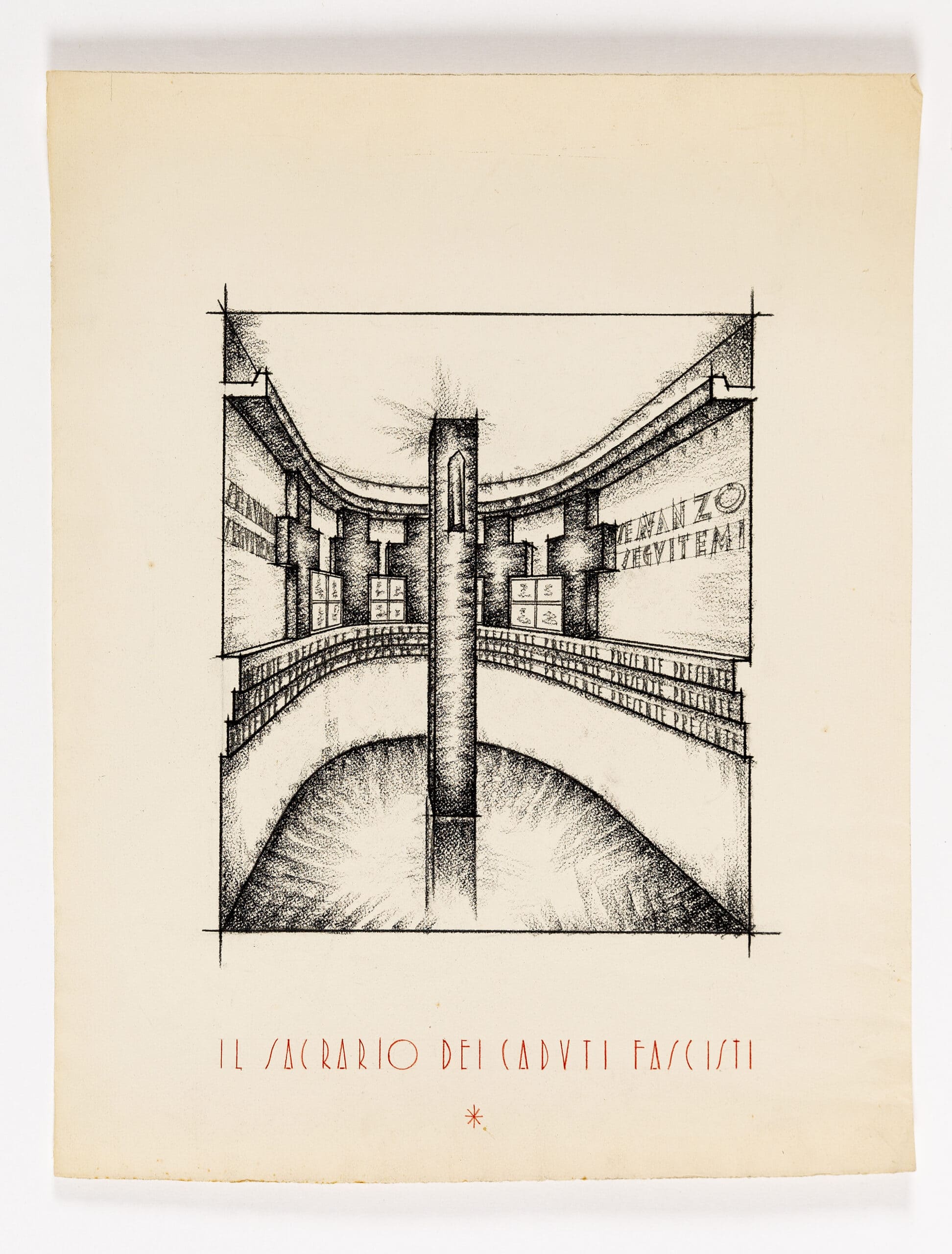
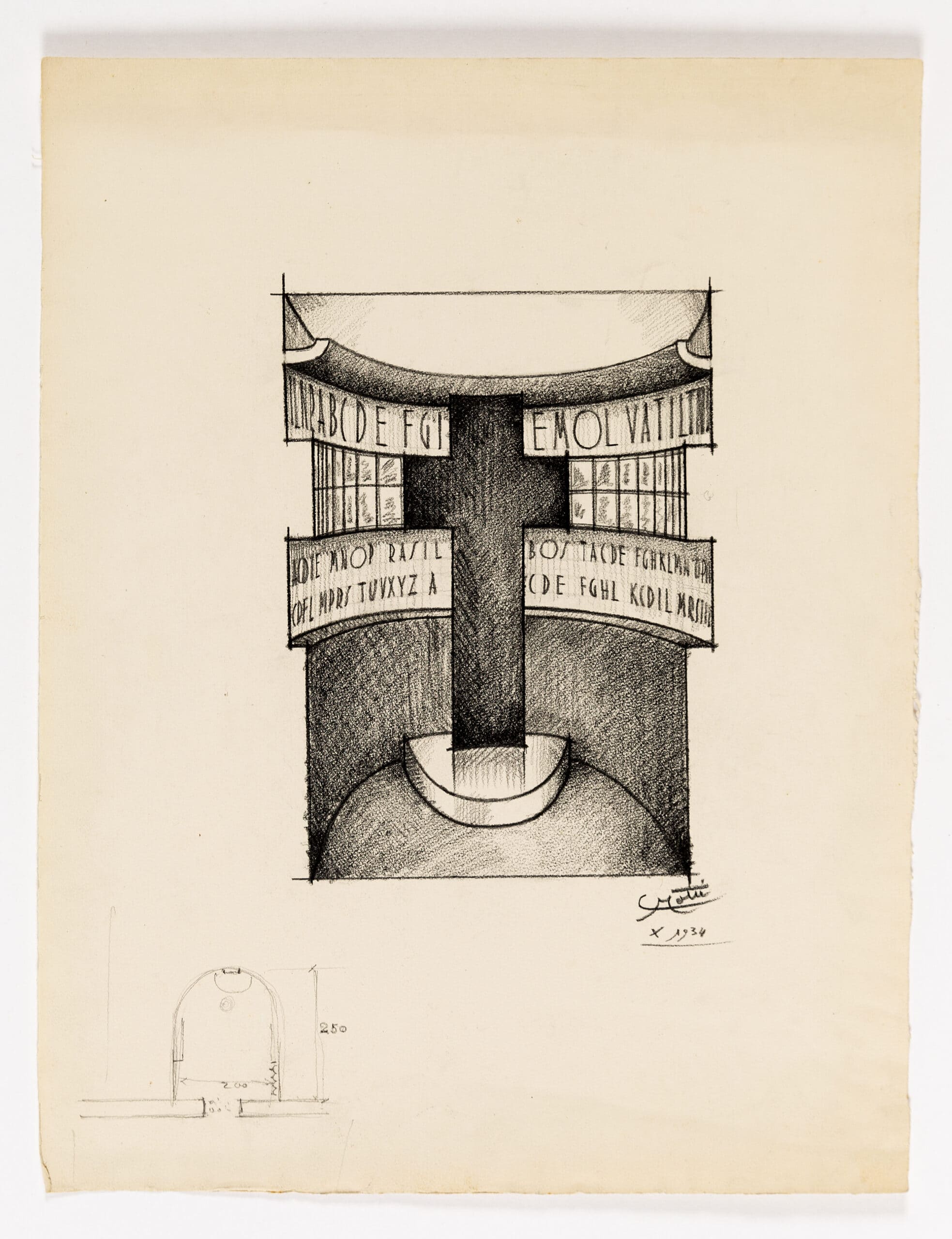
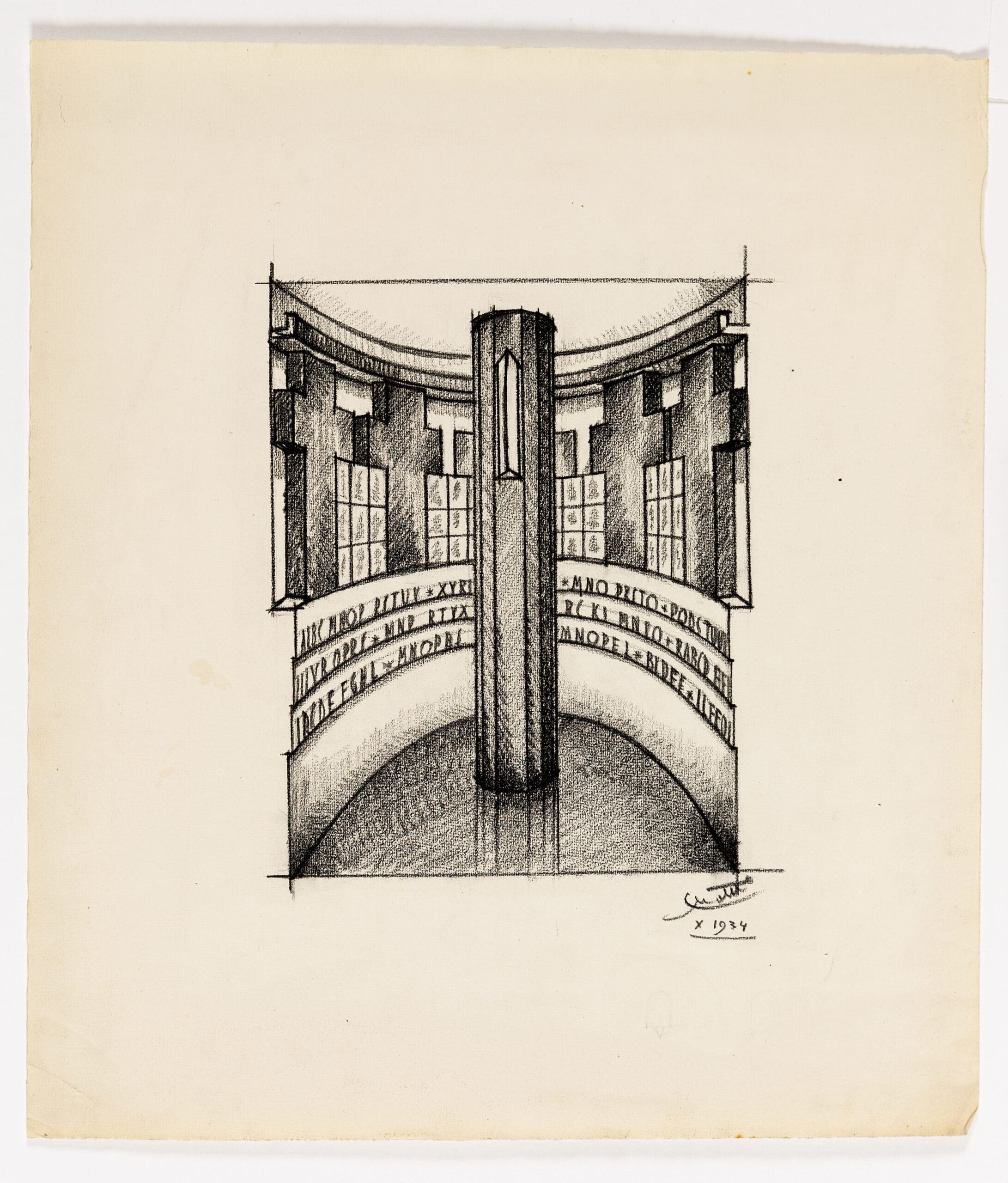
Three designs for interior perspectives of a memorial to the fallen of the first world war. DMC 2576.1 shows the apse ornamented with crosses, with the text, ‘Se avanzo, seguitemi’ (‘if I advance, follow me’) across the walls; it also has a highly polished floor and a central pillar.
DMC 2576.2 places a singular large cross at its centre, surrounded by placeholder text; in the bottom left corner is a pencil sketch of the interior plan. DMC 2576.3 is composed of large crosses which curve around the space, with yet to be decided text placed below; it has a fluted column at its centre.
During the war Italians who had died were buried in makeshift graves close to the battlefields, yet under Mussolini, into the 1920s and 1930s their remains were disinterred to be re-buried by the regime as glorified martyrs who fought for the fatherland. These new shrines to the fallen drew on the abstraction and simplification of ornament instilled by the Rationalists, yet at the same time, deployed explicitly Catholic symbolism to imbue the political move with a sacred power.
PRIMA MOSTRA NAZIONALE DI PLASTICA MURALE PER L’EDILIZIA FASCISTA, 1934
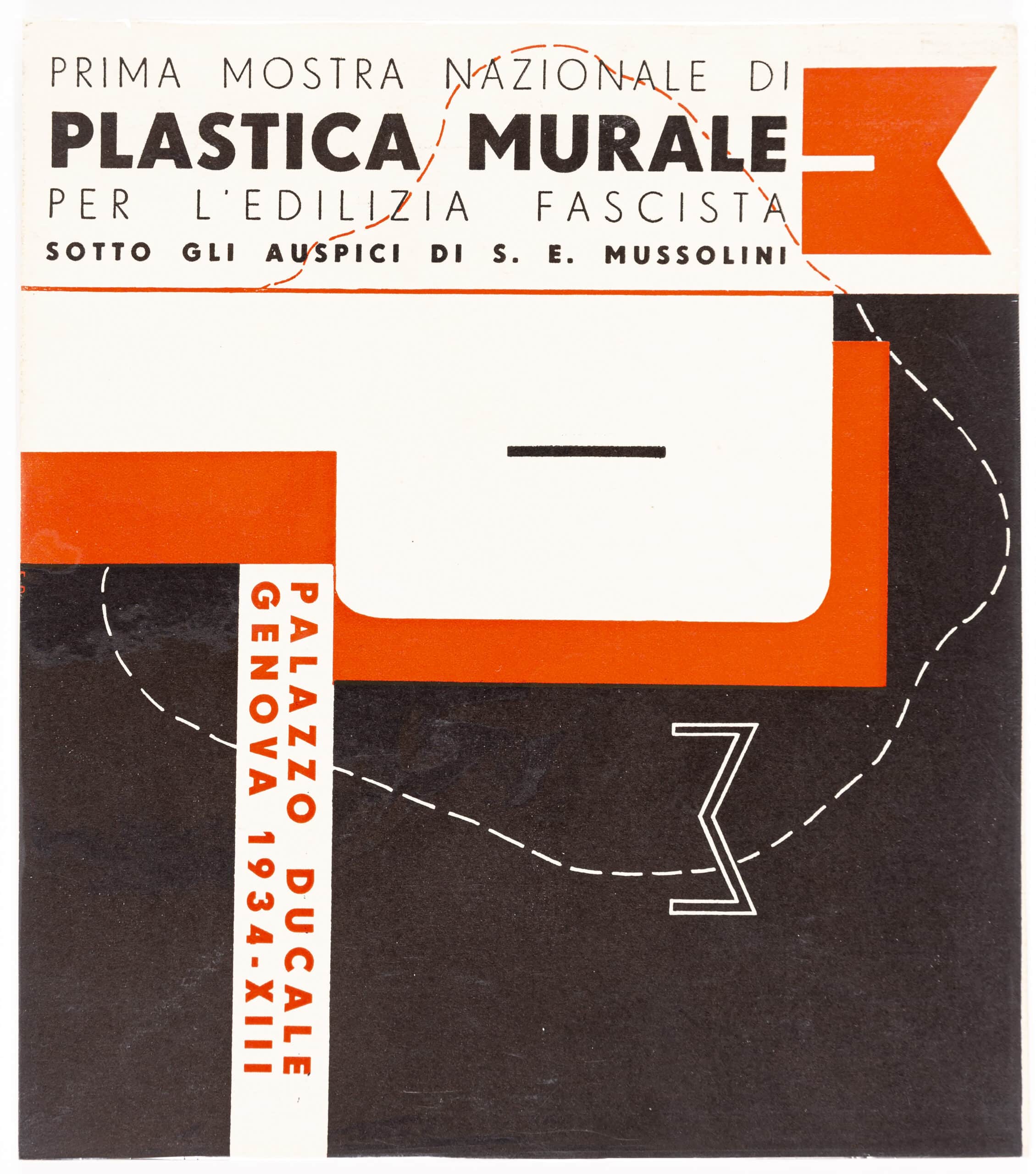
Exhibition catalogue of the Prima Mostra Nazionale di Plastica Murale per l’edilizia Fascista (first national exhibition of mural arts for fascist construction), which was held in the November and December of 1934 at the Palazzo Ducale in Genova. It opens with a text by Filippo Tommaso Marinetti titled Plastica murale e fascismo ispiratore (wall arts and inspiring fascism), followed by images of artworks, graphics, and the show’s exhibition spaces. It was a commercial publication, made evident through the adverts which feature in the back pages.
MARIO BACCIOCCHI, AEROSCALO, SPORTS CENTRE, CASINO, RESORT HOTEL, c.1935
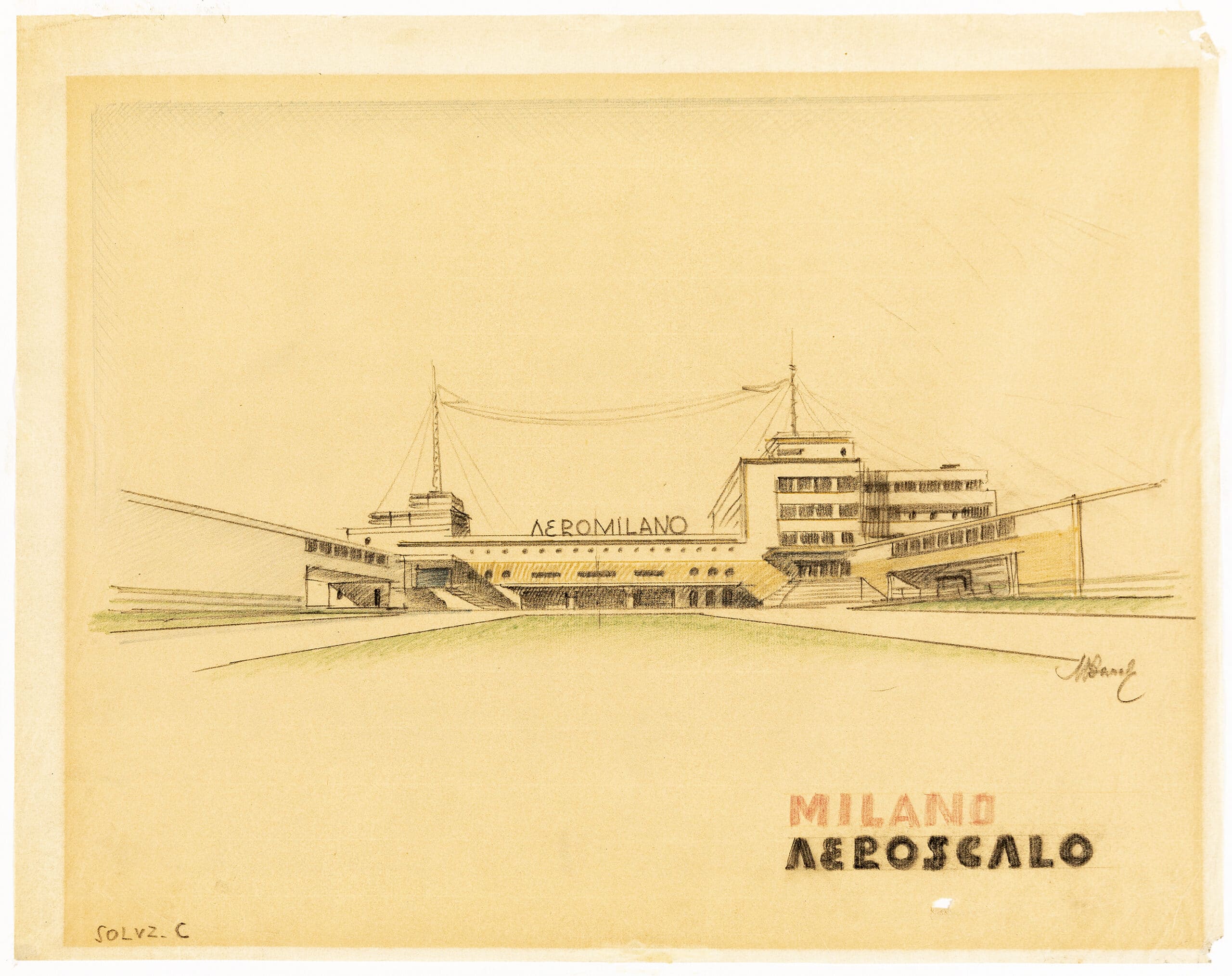
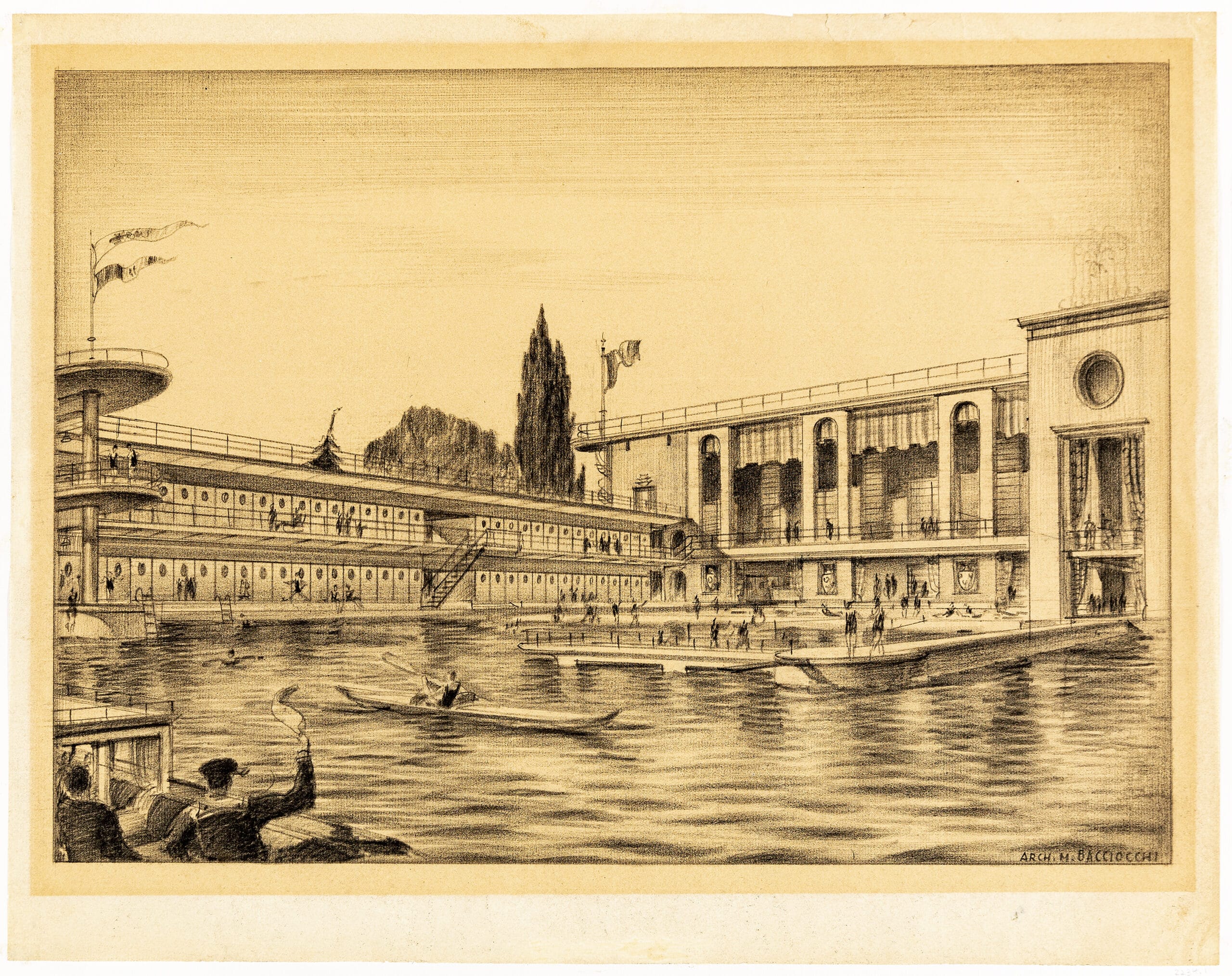
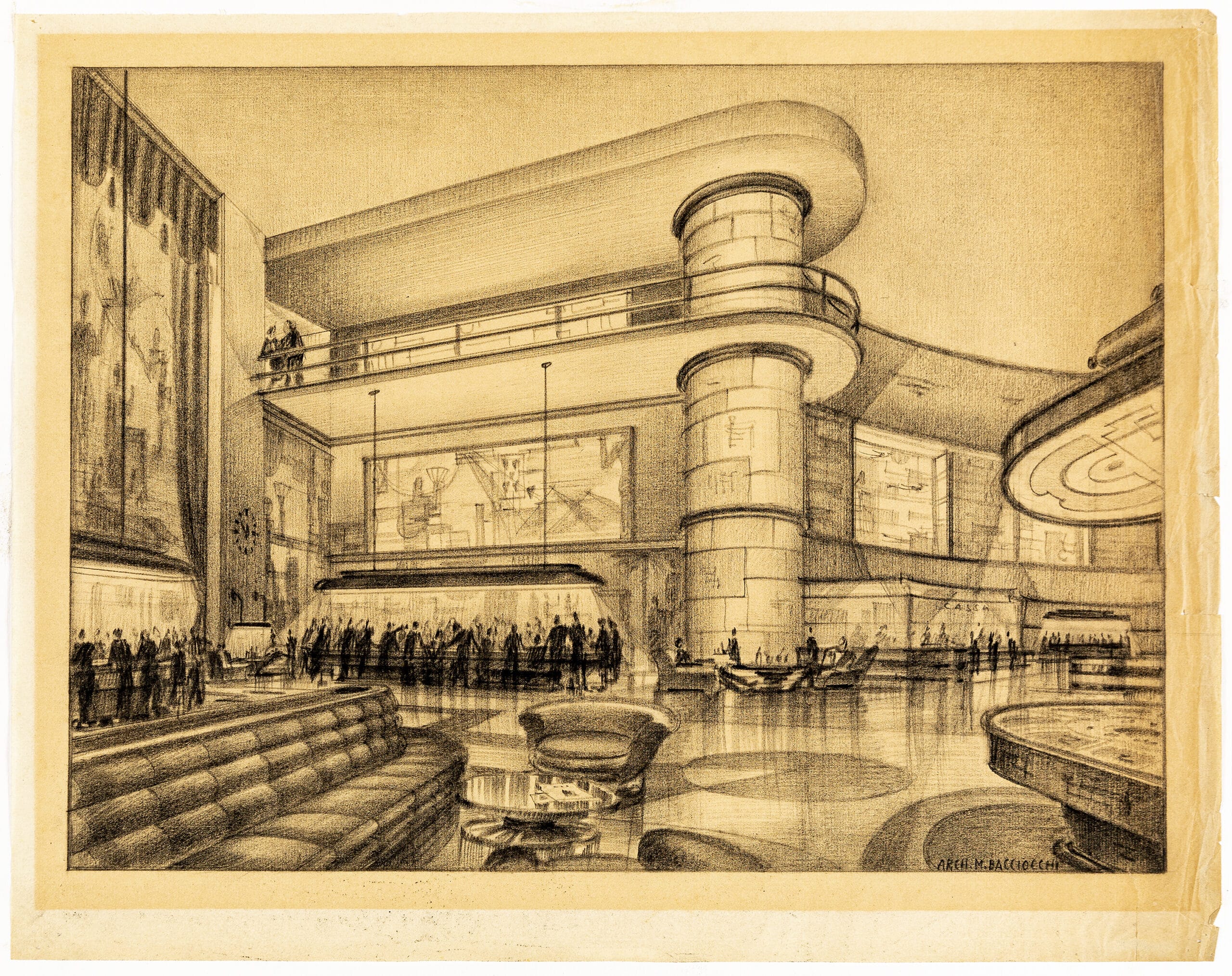
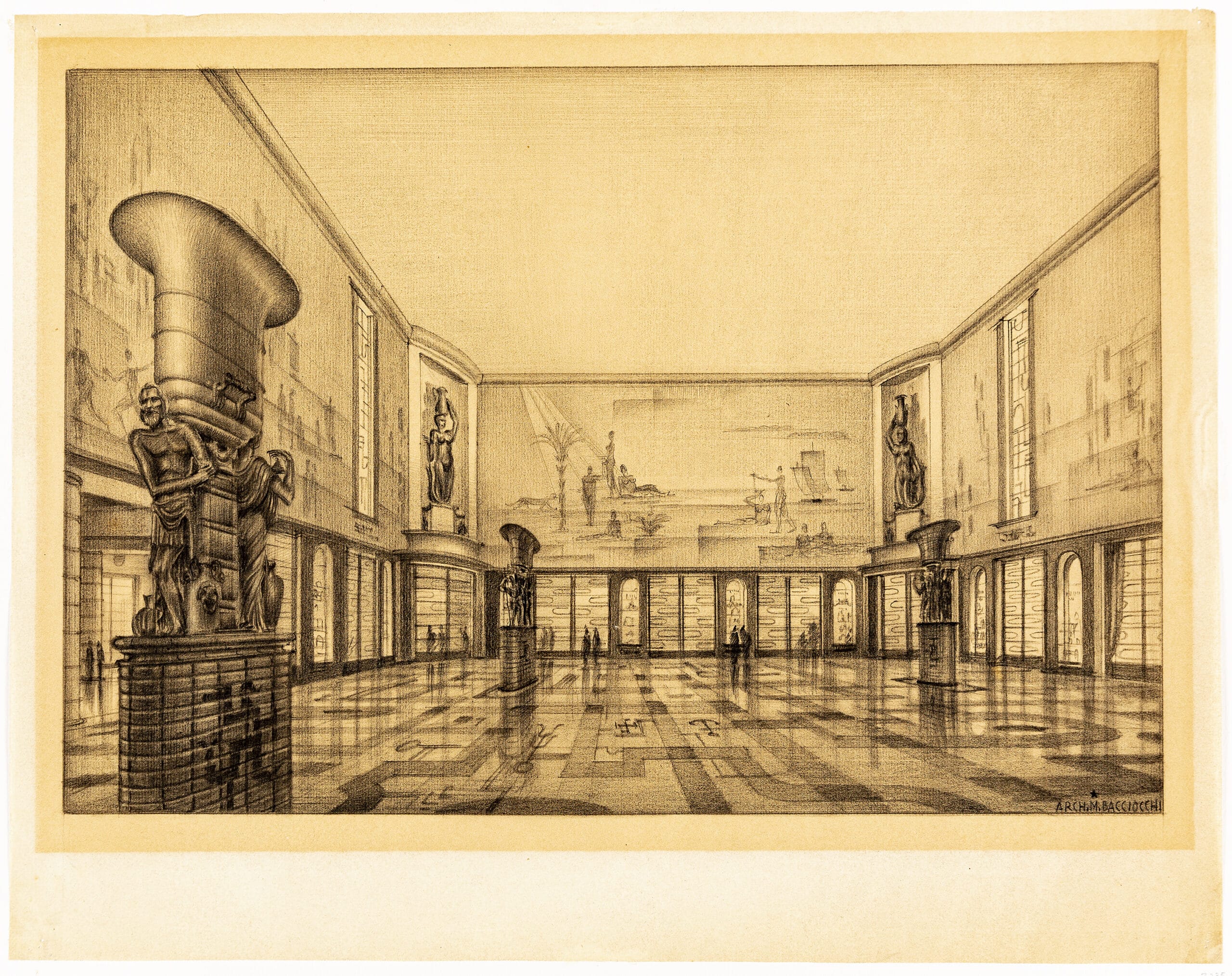
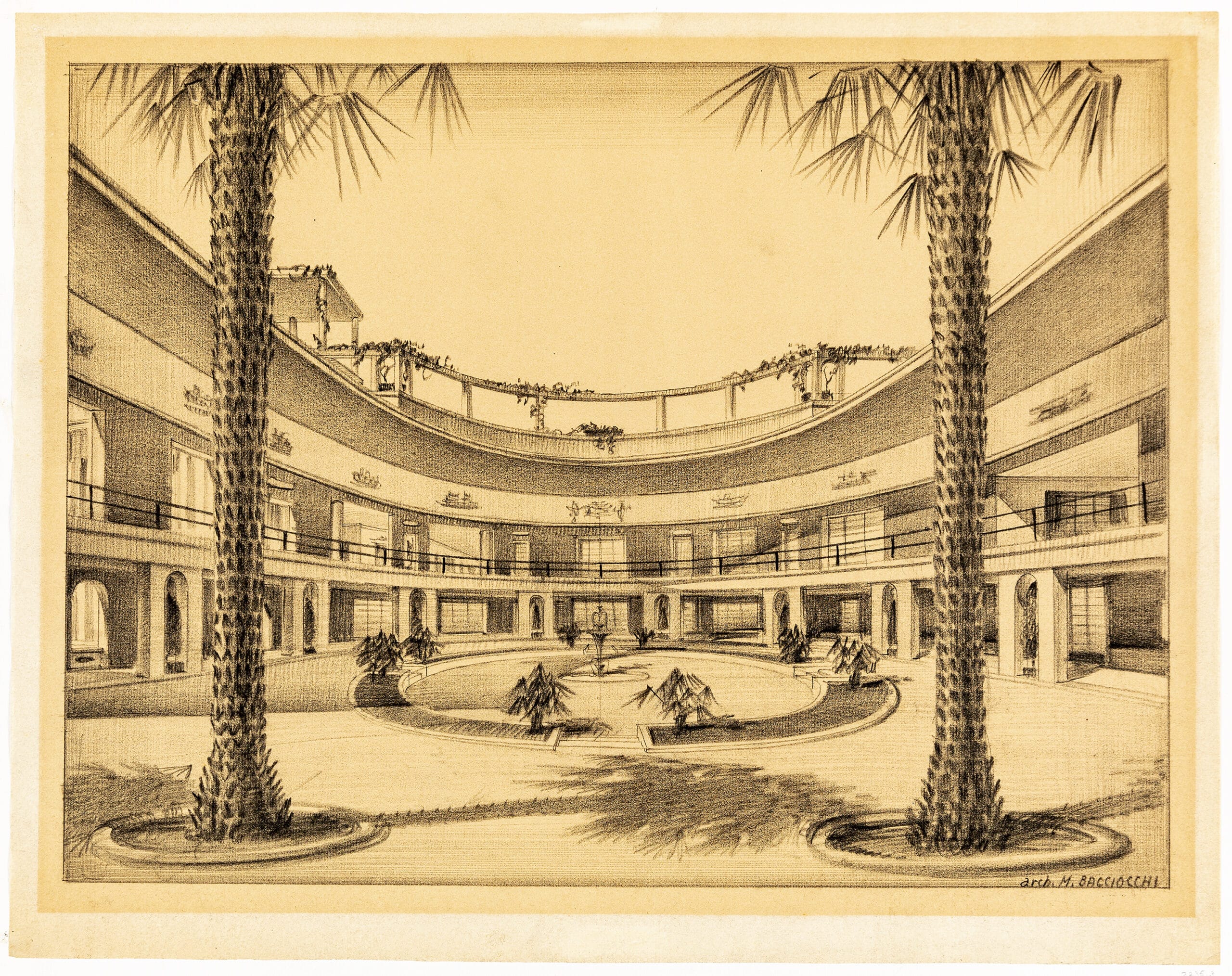
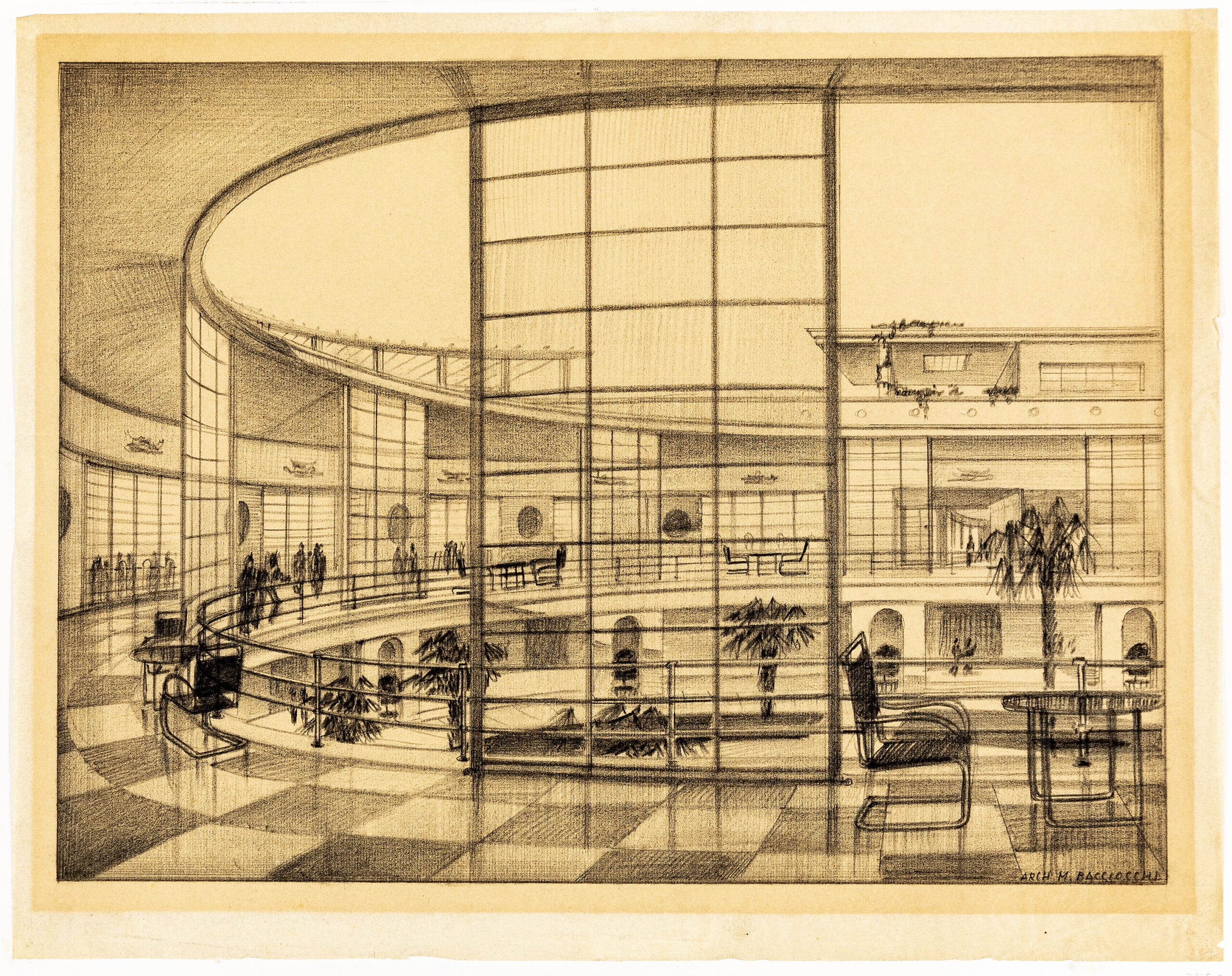
Drawing Matter holds six perspective drawings by Mario Bacciocchi for the Milan Aeroscalo, a sports centre, a casino and a resort hotel. Bacciocchi was working from the 1920s into the 1950s in northern Italy; he is most famous for his sweeping curvilinear design of the AGIP petrol station in Piazzale Accursio, Milan.
DMC 2233 is a perspective of the Idroscalo on the eastern edge of Milan, designed and constructed between 1926 and 1934. This was a project that expanded from a pool to land seaplanes, into a water sports hub, with facilities for swimming and boats.
The drawing for the sports centre, DMC 2234.1 depicts an open-air pool filled with swimmers, divers, and canoeing, framed by two connecting structures. To the left a lower lying building with two storeys for changing rooms abutted against a more monumental building, its facade divided by three arches, each of its openings theatrically draped with curtains. The project is unknown but speaks to multiple projects undertaken by Bacciocchi into the 1930s, such as the stadium and thermal baths proposed in 1933 for Milan, designed whilst working under Giuseppe de Finetti. It was a project where the sports facility instigated larger urban renewal; Bacciocchi then proposed vast areas around the stadium to be reorganised—a rational arm reaching into the regional territory of the city. It is unknown whether the other drawings by Bacciocchi at Drawing Matter have any connection to specific projects.
ERNESTO ‘BRUNO’ LA PADULA, VILLA, MONTEROSSO AL MARE, CINQUE TERRE, 1935
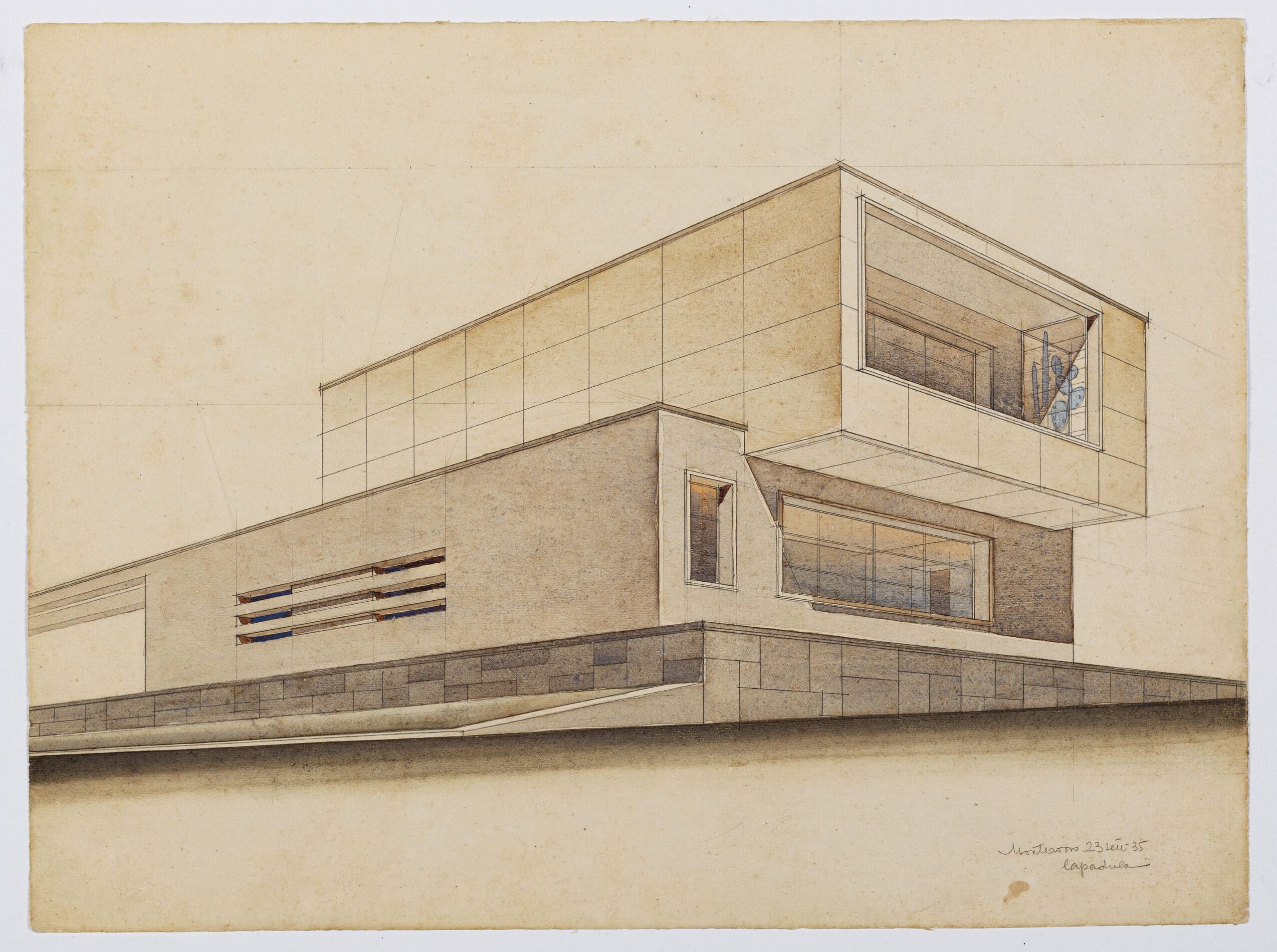
A villa comprising overlapping volumes, with a seemingly unbalanced projection. Yet its repeated forms tie the structure together: the gridded panelling and the paving of the low wall, the long rectangular windows and recession of window frames and balconies. The design was conceived by Bruno La Padula for the seaside town of Monterosso in Liguria.
La Padula was a key figure in the Italian Rationalist movement, joining the MIAR in 1931 and hosting its meetings in his office, as well as going on to build the Palazzo della Civiltà Italiana in Rome as part of the E42 project in 1942.
VITTORIO BALLIO MORPURGO, PIAZZA AUGUSTO IMPERATORE, 1936
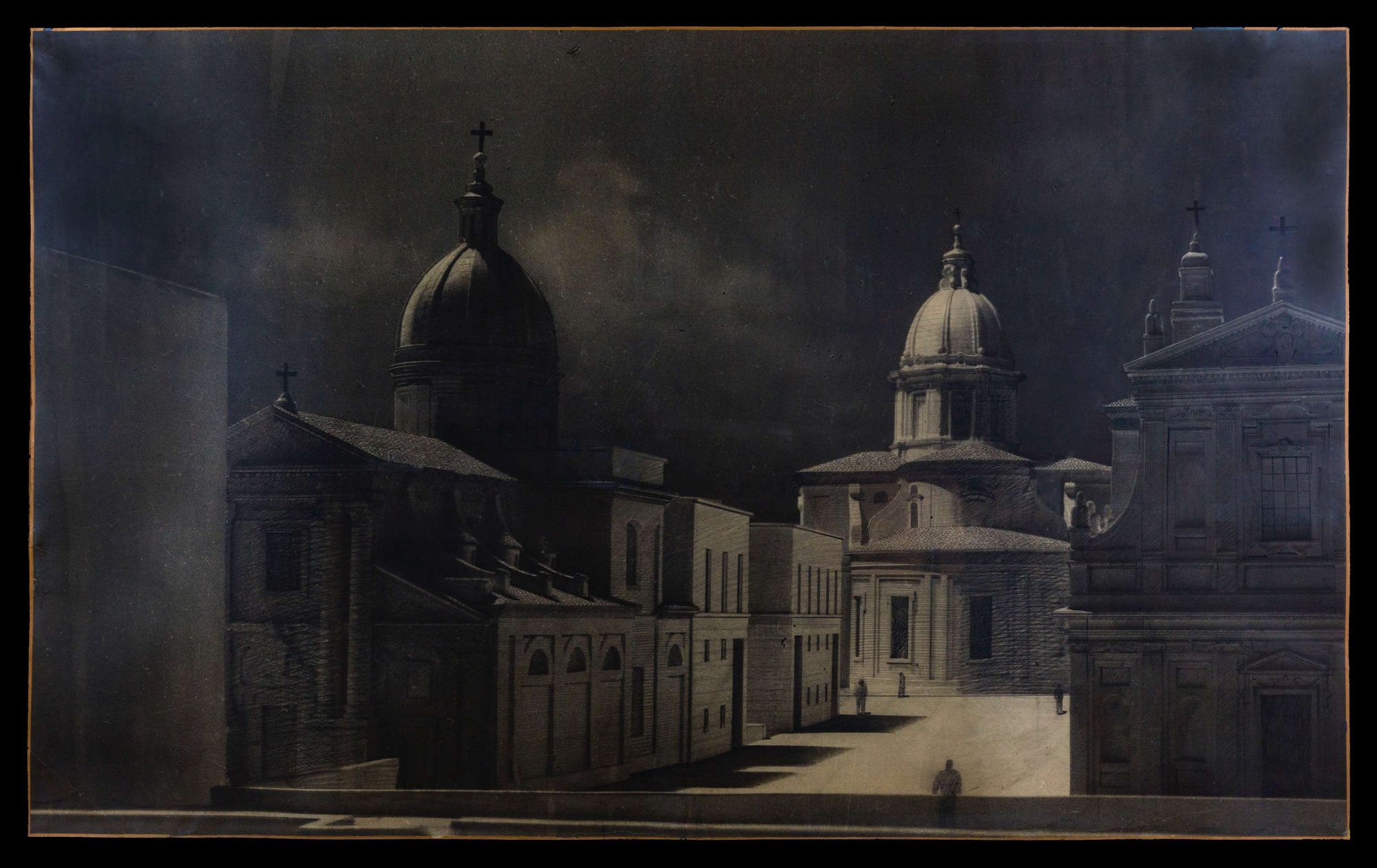
In 1936, Vittorio Ballio Morpurgo was commissioned to redevelop the surrounding area of the 28 B.C.E Mausoleum of Augustus in Rome. The Drawing Matter Collection holds a model photograph on which Morpurgo has drawn over with pencil.
After Italy’s invasion of Ethiopia in 1936, the Partito Nazionale Fascista took an interest in the nation’s historic imperial monuments. In a report by the Piano Regolatore Generale, the Mausoleum of Augustus was described as a ‘suffocated’ monument and instigated the clearing of its surrounding buildings. This project was part of the larger acts of sventrare—the disemboweling of Rome, removing parts of the city to make visible the continuity between Imperial Rome and Mussolini’s Fascism. Murpurgo himself spoke in similar terms of the clearing of the neighbourhood, in the architecture and urban planning journal Capitolium, he spoke of the need to ‘sanitise the area from unhygienic houses’.
Morpurgo’s drawing does not show the Mausoleum itself, but the approach to it from the east, looking from the banks of the Tiber. The image strategically shows the new avenue between Chiesa di San Rocco and San Girolamo degli Schiavoni with the illuminated Basilica San Carlo al Corso at its end. The two asymmetrical rectilinear blocks nestled behind San Rocco indicate in their void the ascent to the Mausoleum of Augustus. The project will become the Piazza Augusto Imperatore, although ultimately executed differently.
MARIO SIRONI, PAVILIONS, 1936-1937
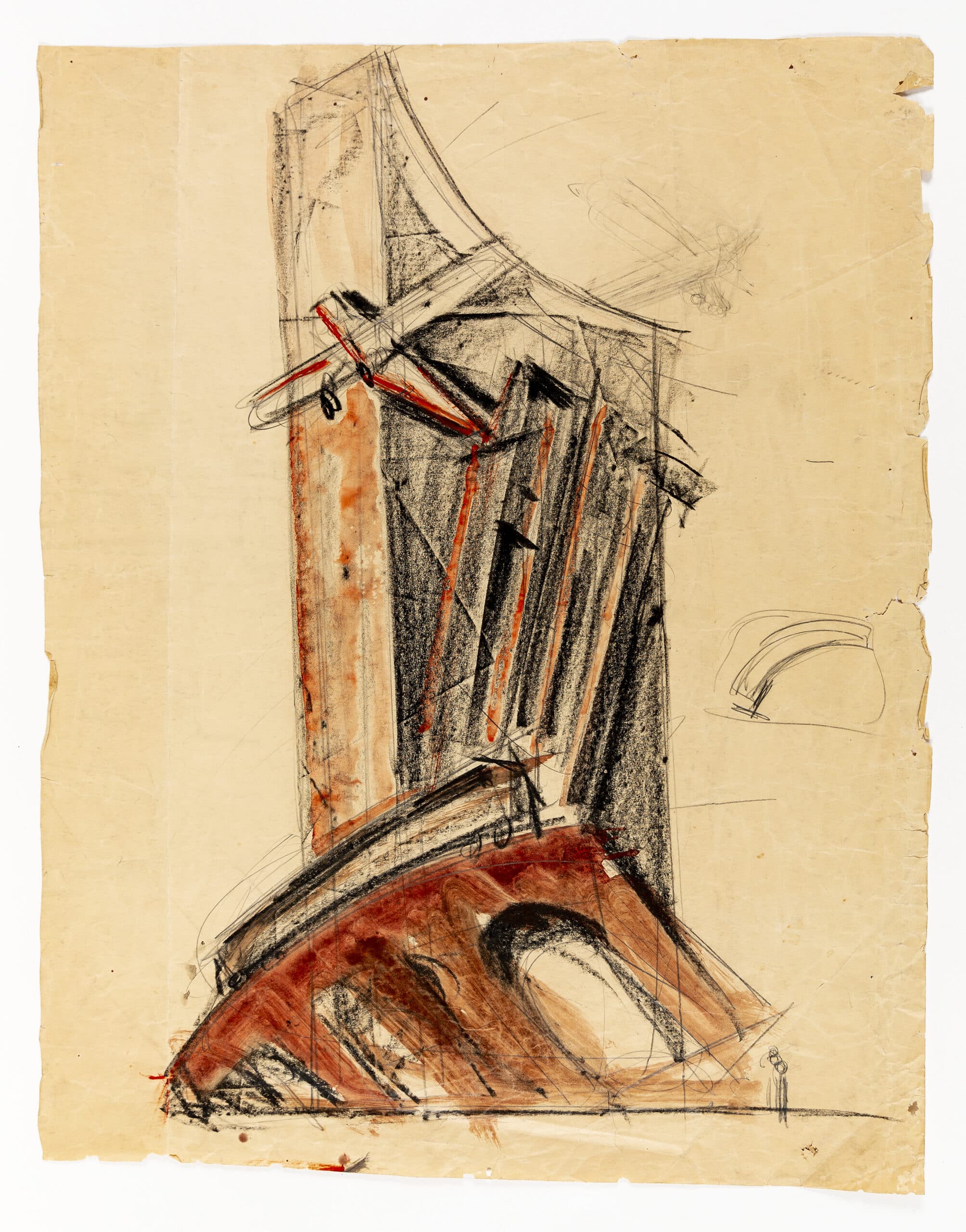
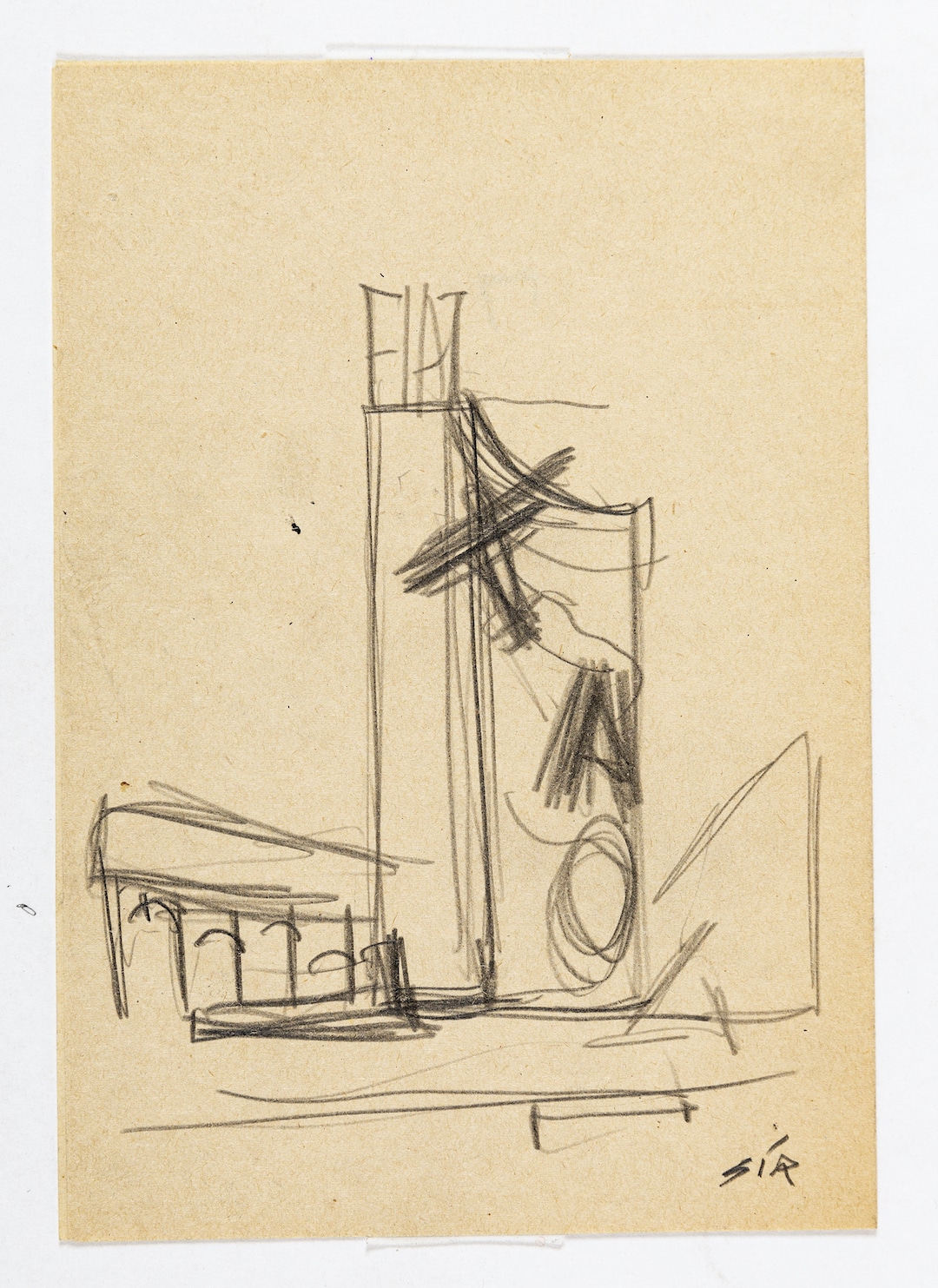
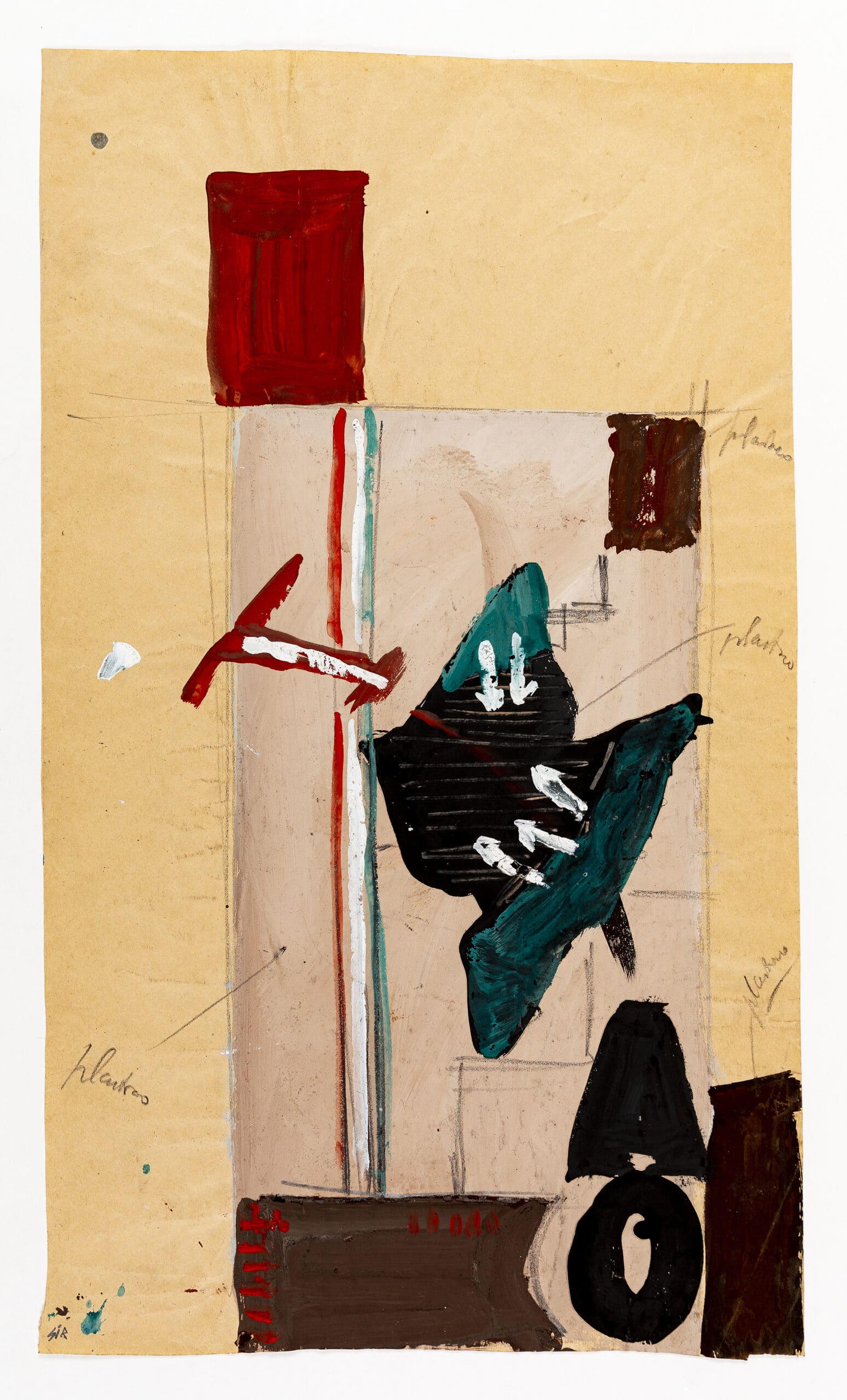
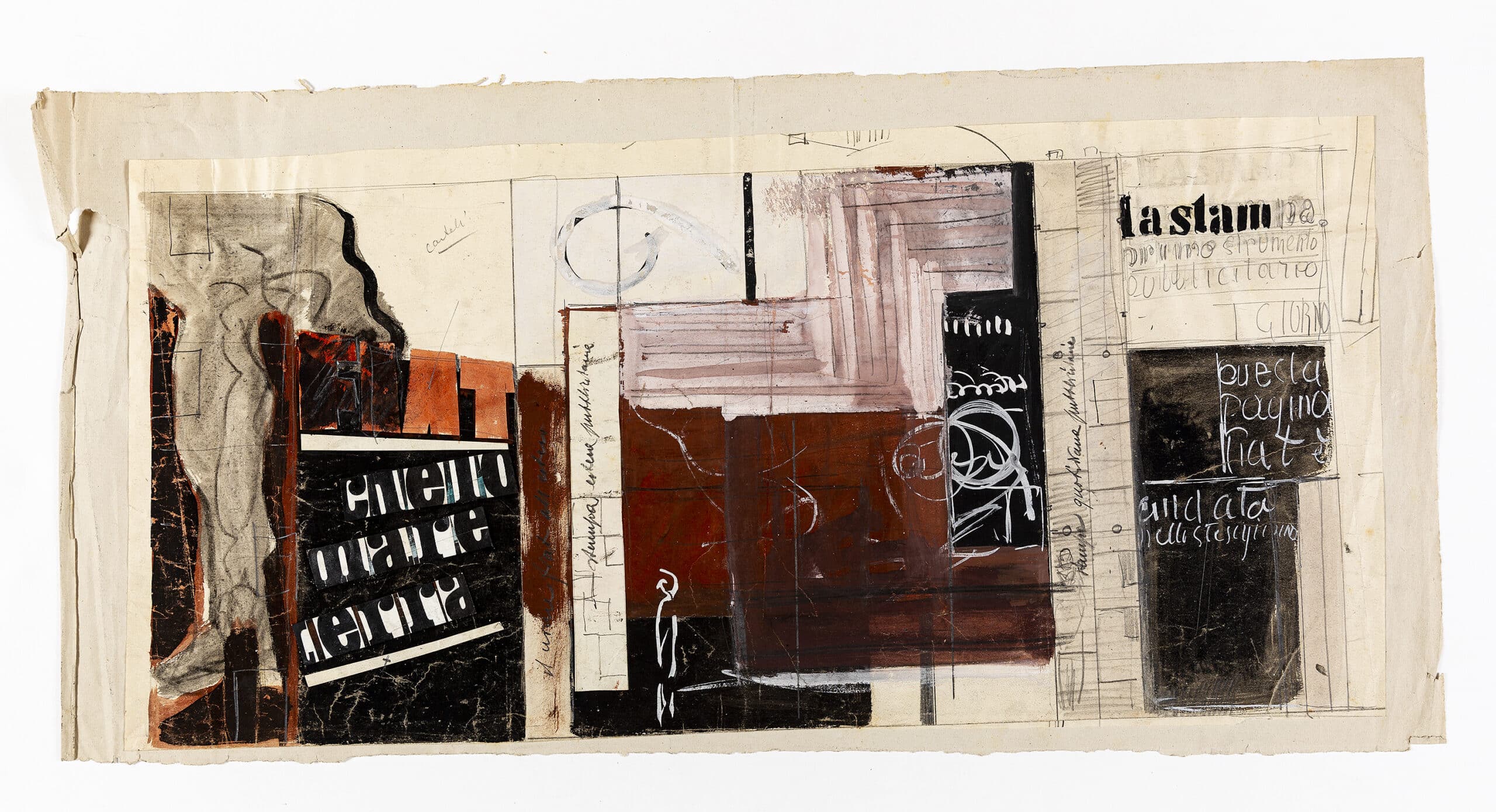
The Drawing Matter collection holds four preparatory works for multiple Fiat Pavilions in 1936. DMC 2037.18, DMC 2037.4, and DMC 2037.3 each depict Sironi’s design for the Fiat Pavilion at the XVII Fiera Campionaria di Milano. By 1936 Sironi had established himself as an institutional artist, capable of interpreting both the concerns of the regime and those of industry. His design for the trade fair pavilion partners Fiat’s motor production with the colonisation of Ethiopia. DMC 2037.18 appears as an early design, with Fiat written across the tower, at its base a series of arches sloping into the ground, with a train perched on top. DMC 2037.3 and DMC 2037.4 are closer to the realised project, where at the base of the tower stand the letters ‘A.O’, which refer to Africa Orientale (‘East Africa’), then above a schematic map of Ethiopia being encroached by arrows and an aeroplane, and atop the building is the Fiat logo; all these elements are connected by a stripe of the Italian flag.
DMC 2071 is a study for the set-up of the Fiat room at the Mostra Nazionale del Cartellone e della Pubblicità al Palazzo delle Esposizioni di Roma, also held in 1936. It shows the design for a wall mural, where the Fiat logo is mixed with text from the newspaper La Stampa, and a mixture of figures and words. In 1933, Sironi had signed the Manifesto della Pittura Murale (‘manifesto for mural painting’), which stated that the highest purpose of art was to act as ‘a perfect instrument of spiritual direction’. Sironi believed the mural was the most effective way of teaching the masses.
In 1937, Sironi designed the Overseas Italian pavilion at the Paris International Exposition (DMC 2037.9). Through the interior, in blue pencil, the letters ‘A.O’ appear again, signalling the colonial exploits of Italy in Africa.
ARMANDO BRASINI, VEDUTE PROSPETTICA DEL FORO IMPERIALE GERMANICO, 1937
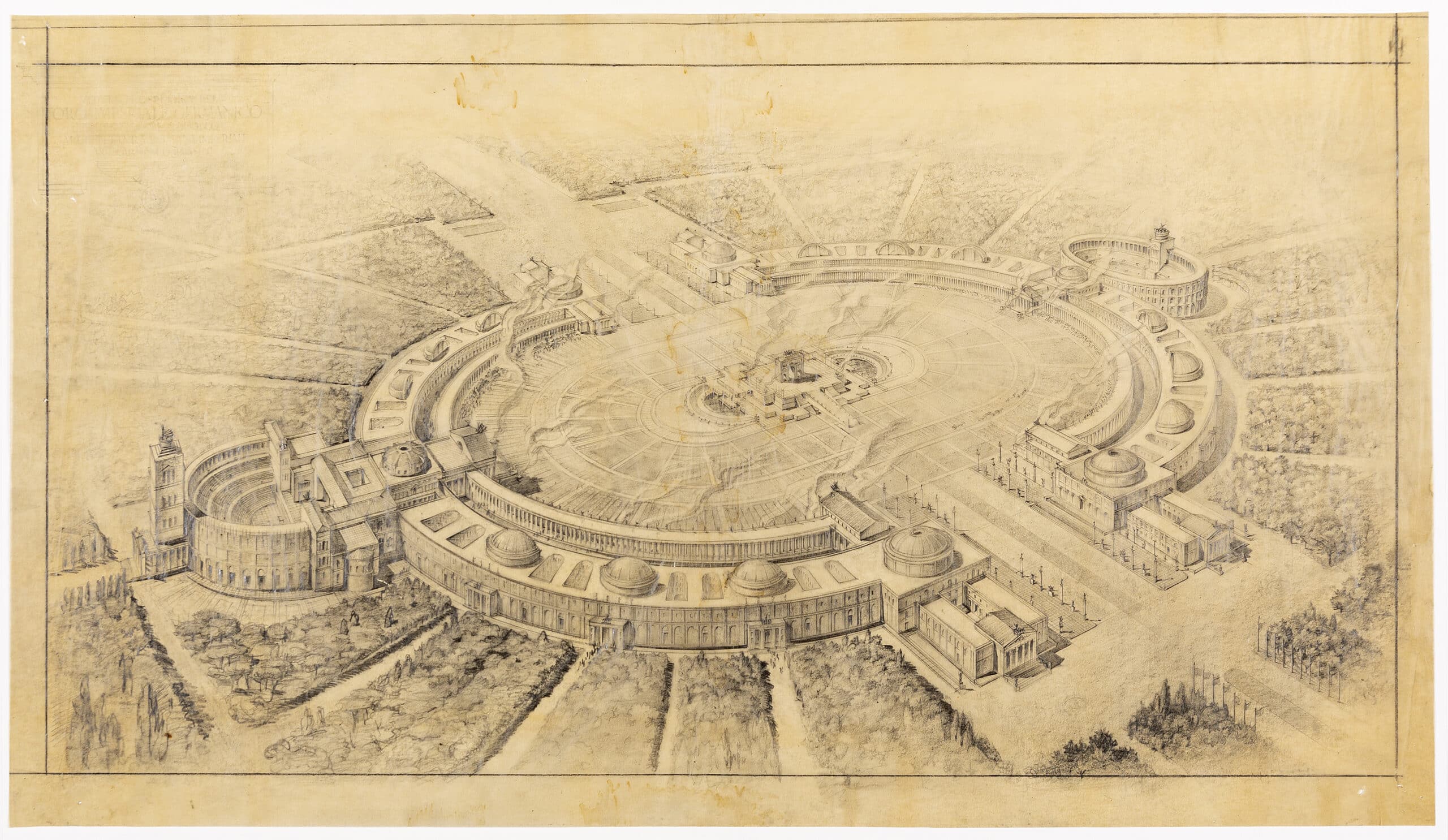
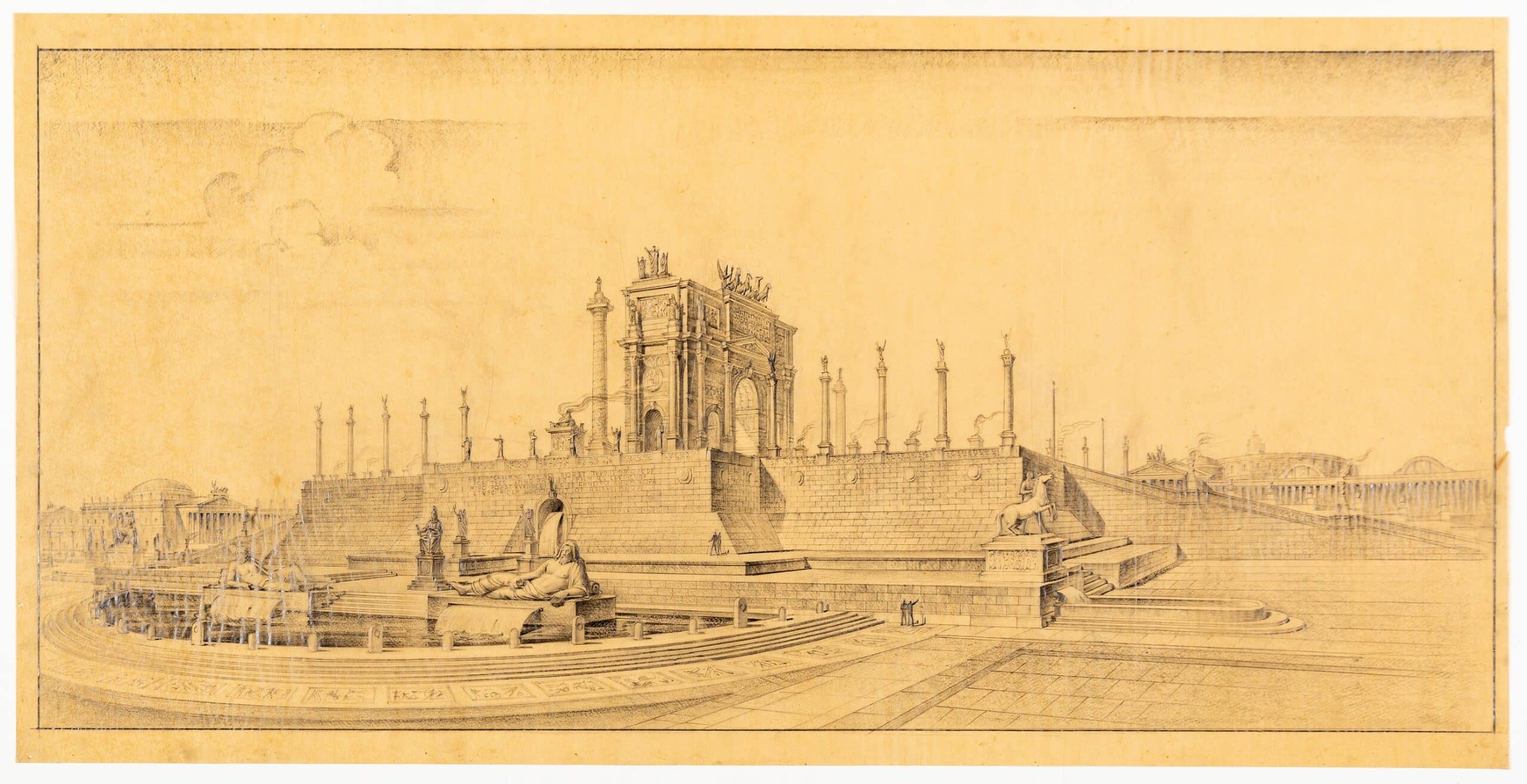
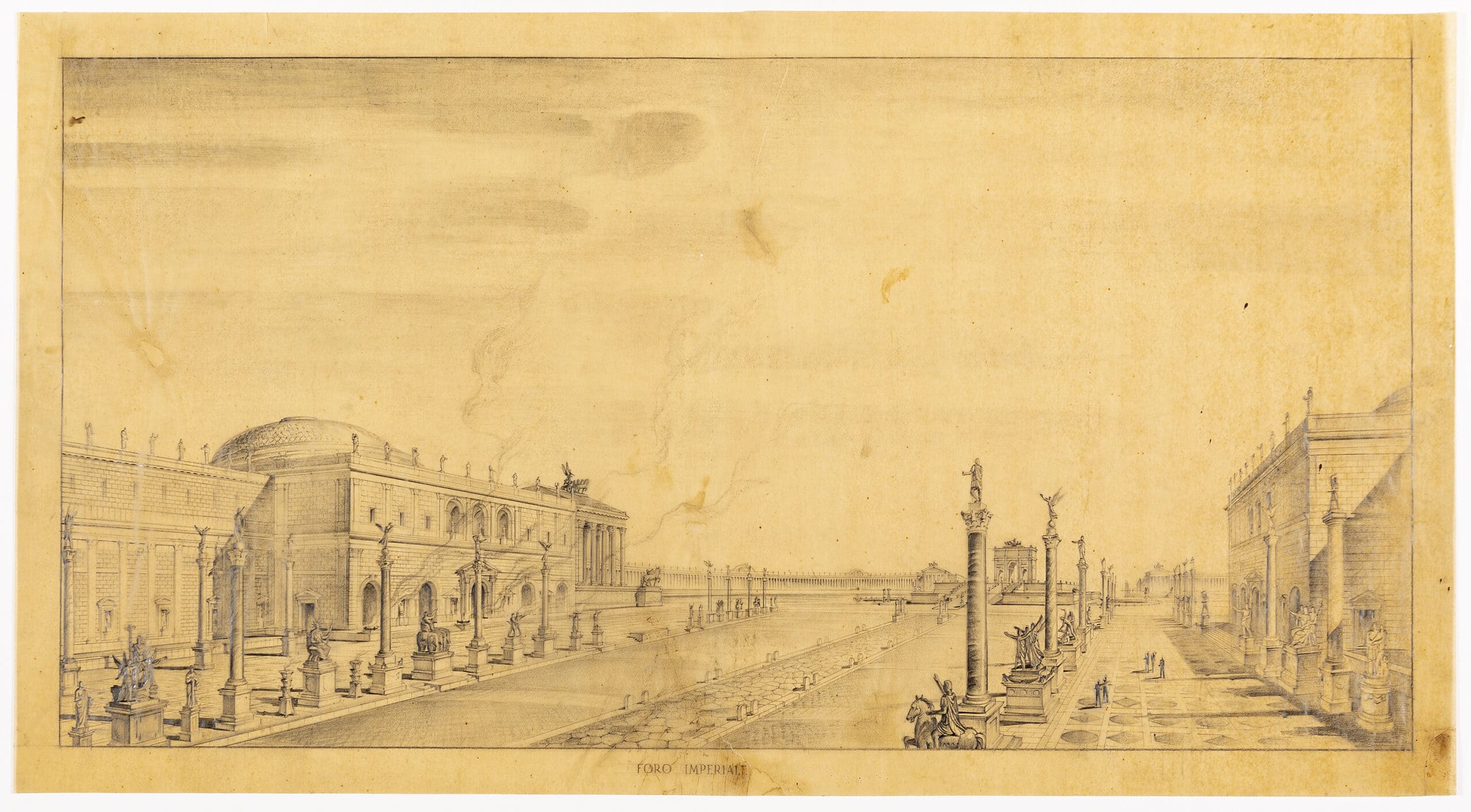
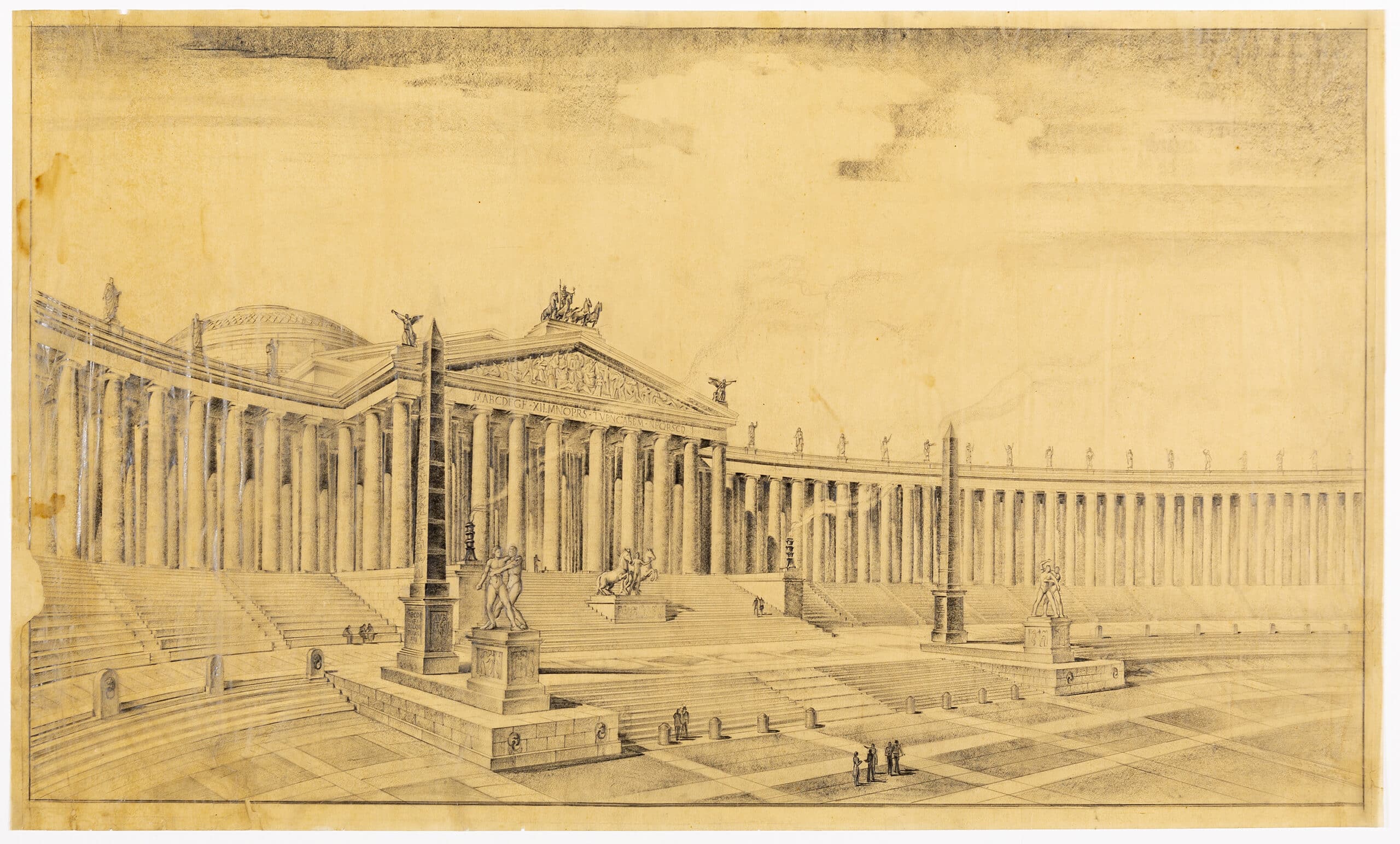
Four perspectives on tracing paper, proposing a forum which unites the Imperial architecture of Germany and Rome. One is a bird’s-eye view displaying the whole scheme of the collonaded oval structure, abutted at either end by Colosseum-esque theatres. The other three drawings depict specific scenes within the forum: a pedimented facade with a grand staircase, the central triumphal arch with surrounding fountains, and a grand boulevard leading to the central arch, lined with statues. Printed in the top left of DMC 1443 is a faded inscription that reads: Veduta Prospettica del Foro Imperiale Germanico, [Illegible line], Architettura Romani Imperiale, Arch. Armando Brasini. The inscription is contained in a frame, decorated by the Nazi party’s Parteiadler symbol, of an eagle holding the swastika.
The drawings were created circa 1937, yet Brasini’s grand urbanist desires had been prominent since the 1910s, well before Mussolini came to power. Brasini had in the first edition of the monthly review, Capitolium (1925), published a plan for the reorganisation of the centre of the city. In 1929, he presented an elaborate proposal for a ‘New Imperial Rome’, which pushed Mussolini to involve him in the new masterplan for Rome; he was appointed to the masterplanning committee in 1930. Brasini sat on the committee with the stylistically different Gustavo Giovannoni and Marcello Piacentini. They communed for only 6 months before providing the Piano Regolatore, a plan which would foreground the city’s ancient physiognomy while addressing the necessities of the city’s traffic problems. In 1931, Brasini entered the international exhibition for the Palace of the Soviets, and then in 1934, sat on the jury for the Palazzo Littorio competition.
Brasini’s large scale complex ceremonial spaces draw heavily on the monumental grandeur of the Baroque, a style and vision which had parallels with Mussolini’s vision of Rome. These parallels speak to their closeness; the two were brought together by Paolo Orano, the editor-in-chief of Mussolini’s propaganda mouthpiece, Popolo d’Italia.
In 1937, Brasini had designed the Mole Littoria, a development on Via dei Fori Imperiali dedicated to Mussolini, including a 330m-tall statue of him, aimed to rival the designs for central Berlin by Albert Speer. Yet, this was not built due to its high cost and Mussolini’s focus on the development of the EUR42 site. However, the four drawings held in the Drawing Matter collection state a connection to Imperial Germany, rather than a rivalry. The project drawn is unknown but perhaps marks Brasini vying for work abroad. Brasini had fallen out of Mussolini’s favour from the early 1930s. At the Colonial Exhibition at the Vincennes Gardens in Paris (1931), Brasini had hired his brothers as contractors, and was investigated for fraud. Brasini then received negative criticism from Mussolini concerning the INAIL building, which had been completed in 1932. Later records from 1941 connect Brasini to Hermann Göring, whom he was selling sarcophagi to for the private collection at his estate, Carinhall.
ENRICO PRAMPOLINI, DESIGNS FOR LA MOSTRA AUTARCHICA DEL MINERALE ITALIANO, 1938
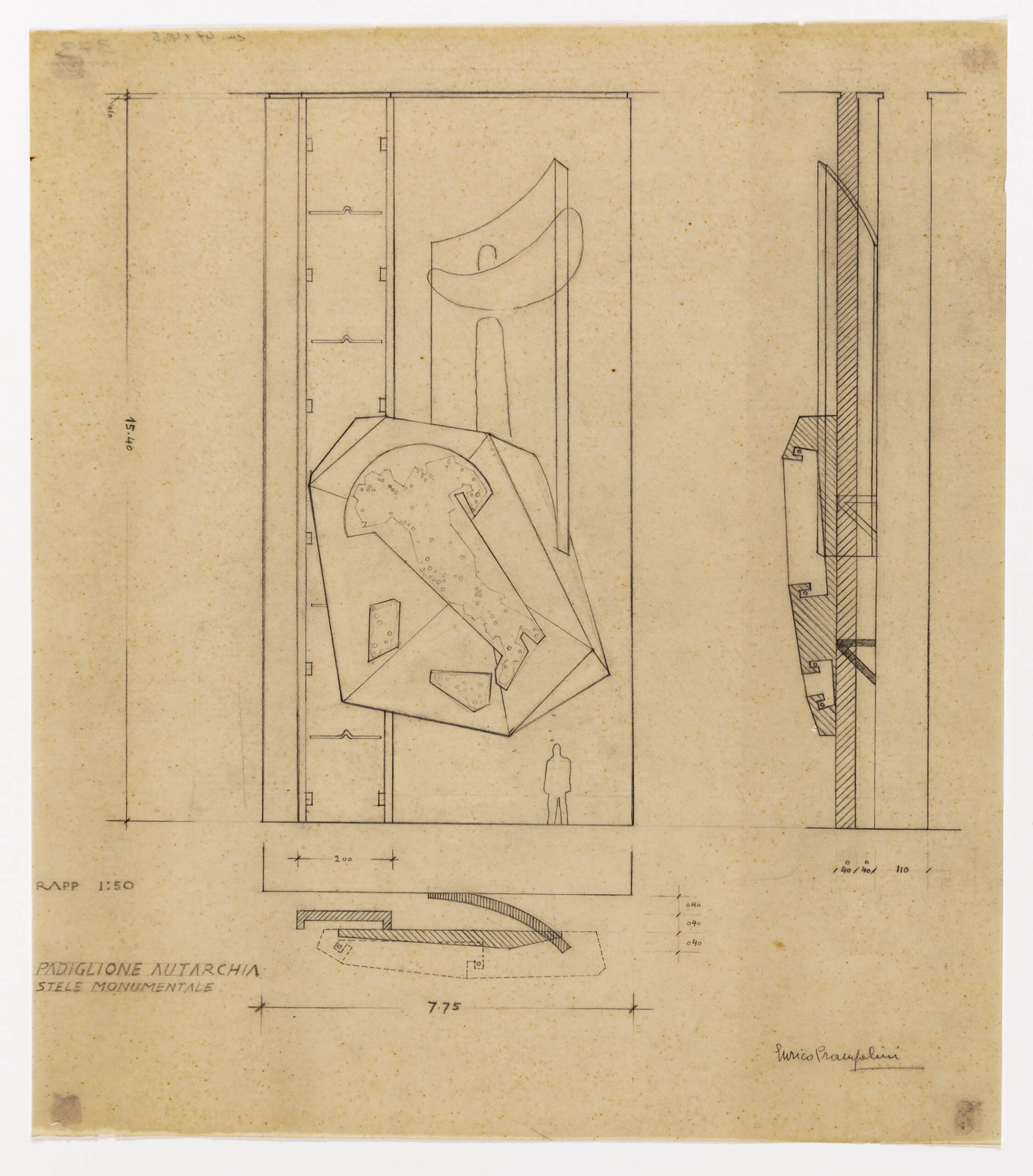
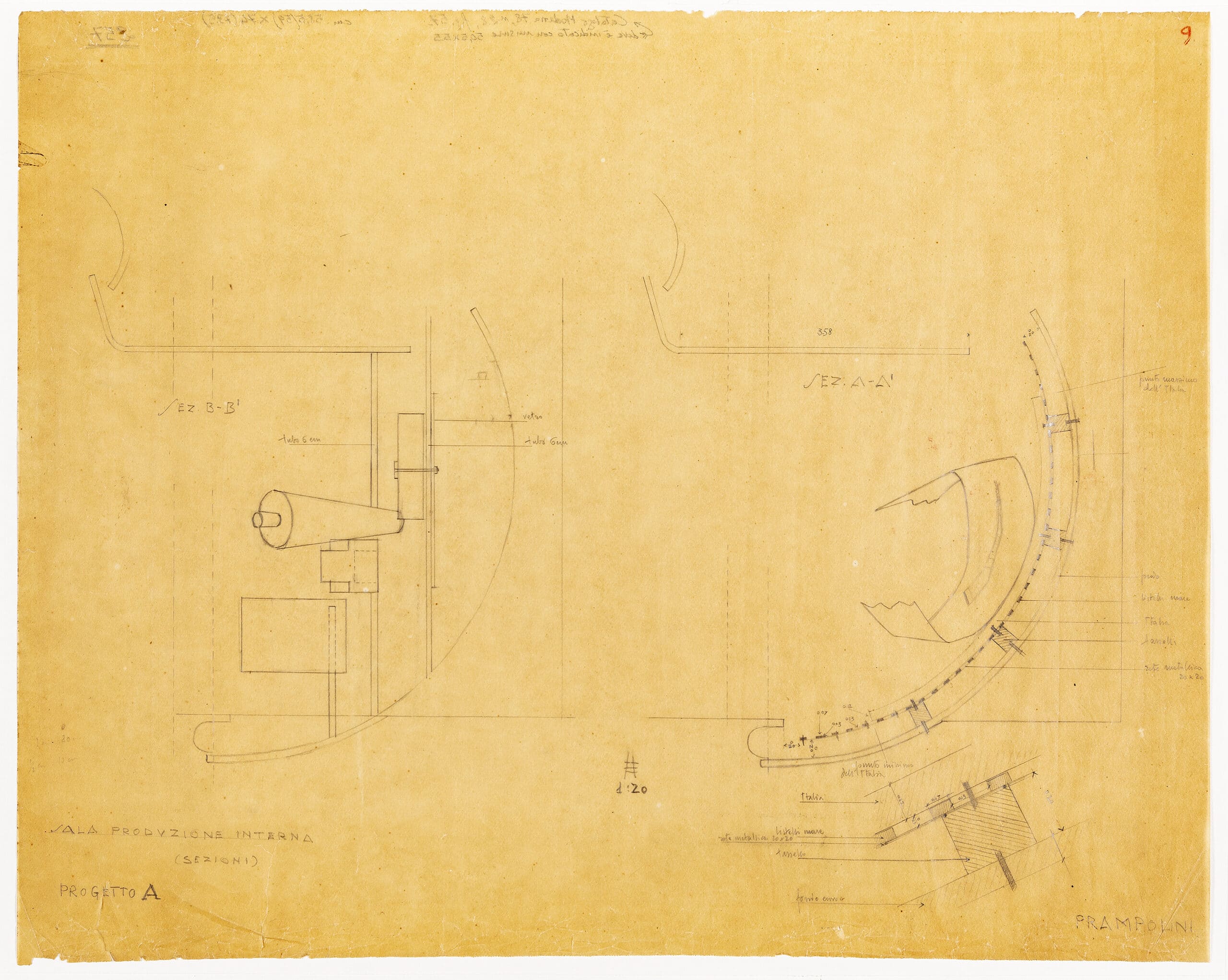
Drawing Matter holds two design drawings for a sculptural wall-mounted map of Italy and sections for La Mostra Autarchica del Minerale Italiano (Autarchic Exhibition of Italian Minerals), which opened on 18 November in 1938 at the Circo Massimo in Rome. The exhibition celebrated Italy’s self-sufficiency in the mining sector, despite the sanctions imposed by the League of Nations, after Italy’s invasion of Ethiopia. It proudly displayed Italy’s national resources, such as pyrites, aluminium, and marble.
Prampolini was a futurist painter, sculptor, and scenographer; therefore his built work was limited to small pavilions, exhibitions, and memorials. He had worked briefly on the Monumento ai Caduti in Como before Terragni completed Sant’Elia’s design.
VIRGILIO MARCHI, CINEMA ODEON, 1942
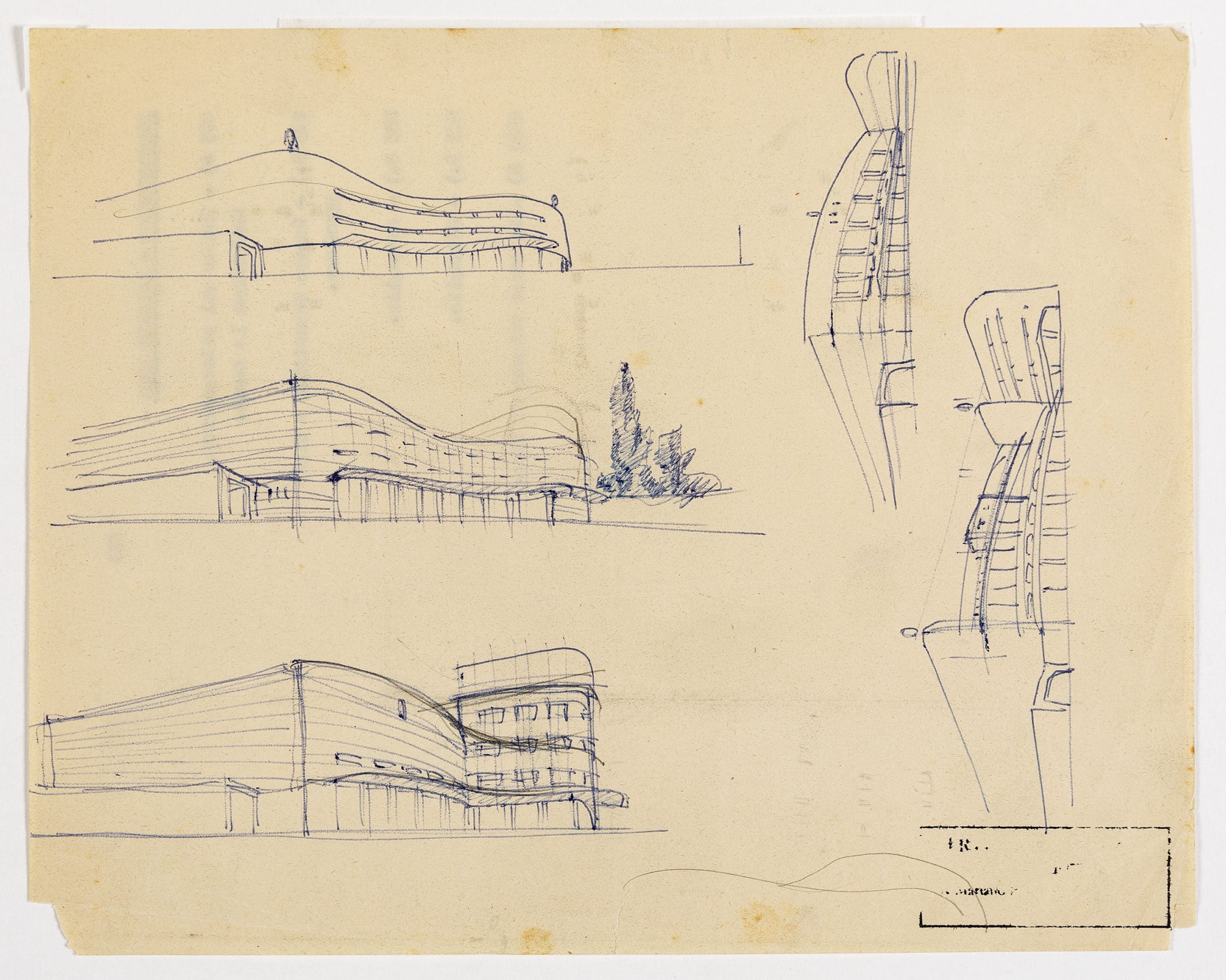
In 1942 Marchi designed the Odeon Cinema in Livorno, defined by its curved facade. The Drawing Matter Collection holds a single sheet of sketches of the project. It shows five perspective drawings repeated over the page. The sheet was most likely repurposed as it features a blurred typed list on its verso.
PIERO PORTALUPPI, CASA DEGLI ATELLANI, 1943
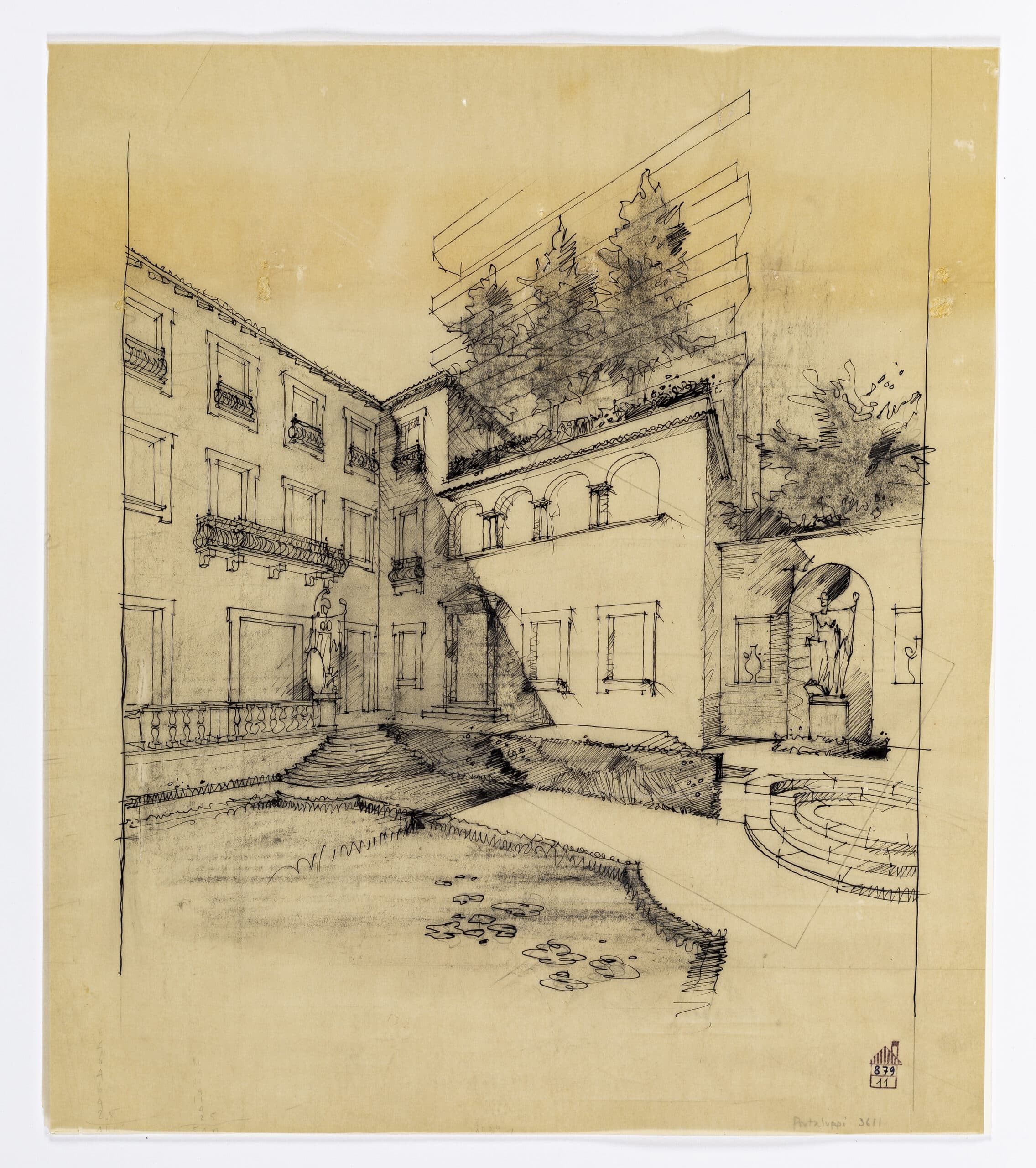
Located on Corso Magenta in Milan, Casa degli Atellani is a historic 15th-century residence, said to be where Leonardo da Vinci was hosted whilst painting ‘The Last Supper’ (1495–1498). Portaluppi first worked on the house from 1919 until 1921, when its owner Ettore Conti commissioned a renovation, which preserved its neoclassical façade but reworked its interior spaces. Portaluppi then took up residence in one of the palazzo’s apartments in 1922, where he would stay until his death in 1967.
The drawing in the collection dates to 1943, after the house was bombed, showing a reconstruction of the facade with a modern intervention perched above the house.
MARIO RIDOLFI, HOUSING FOR THE COMUNE DI CERIGNOLA, 1950
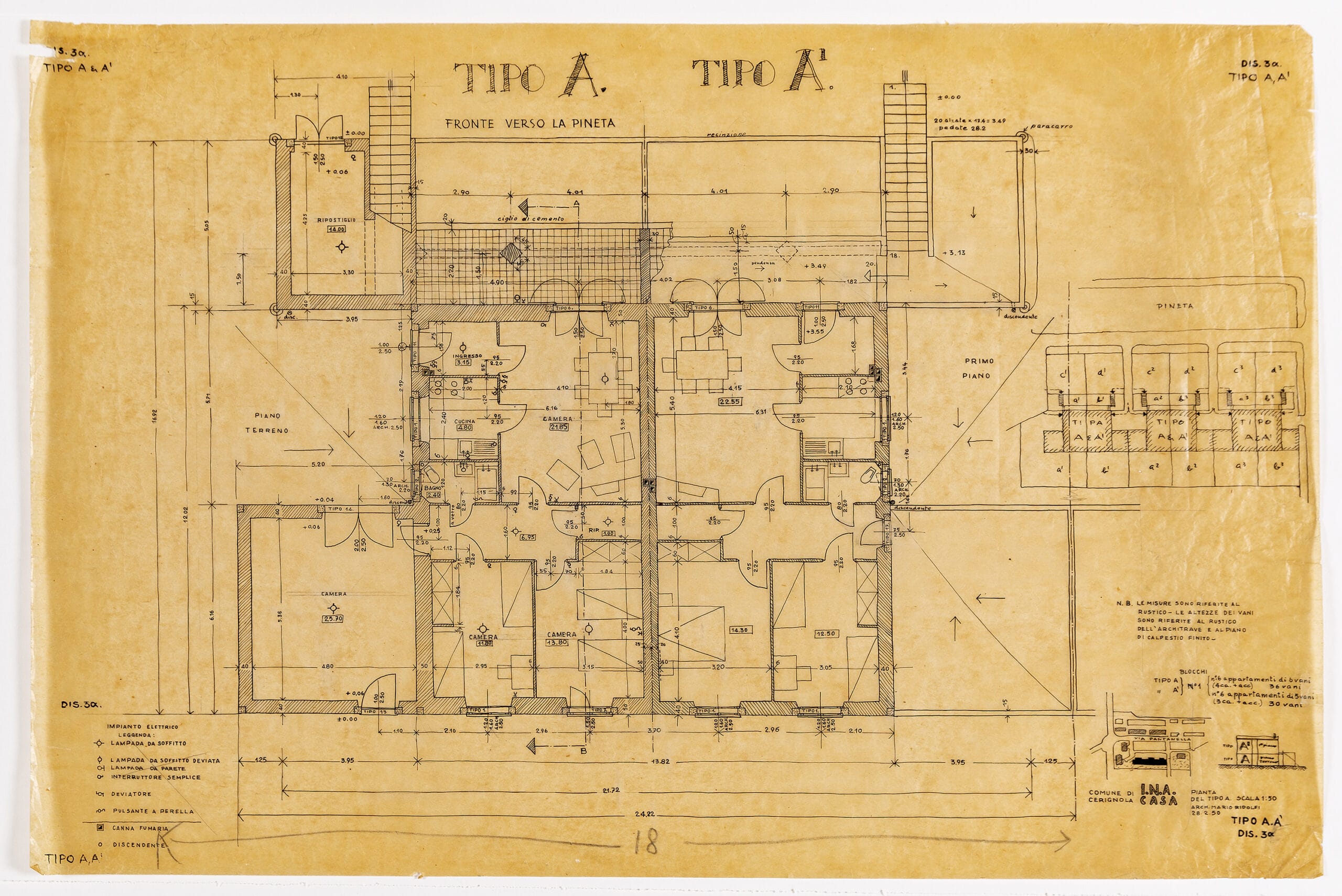
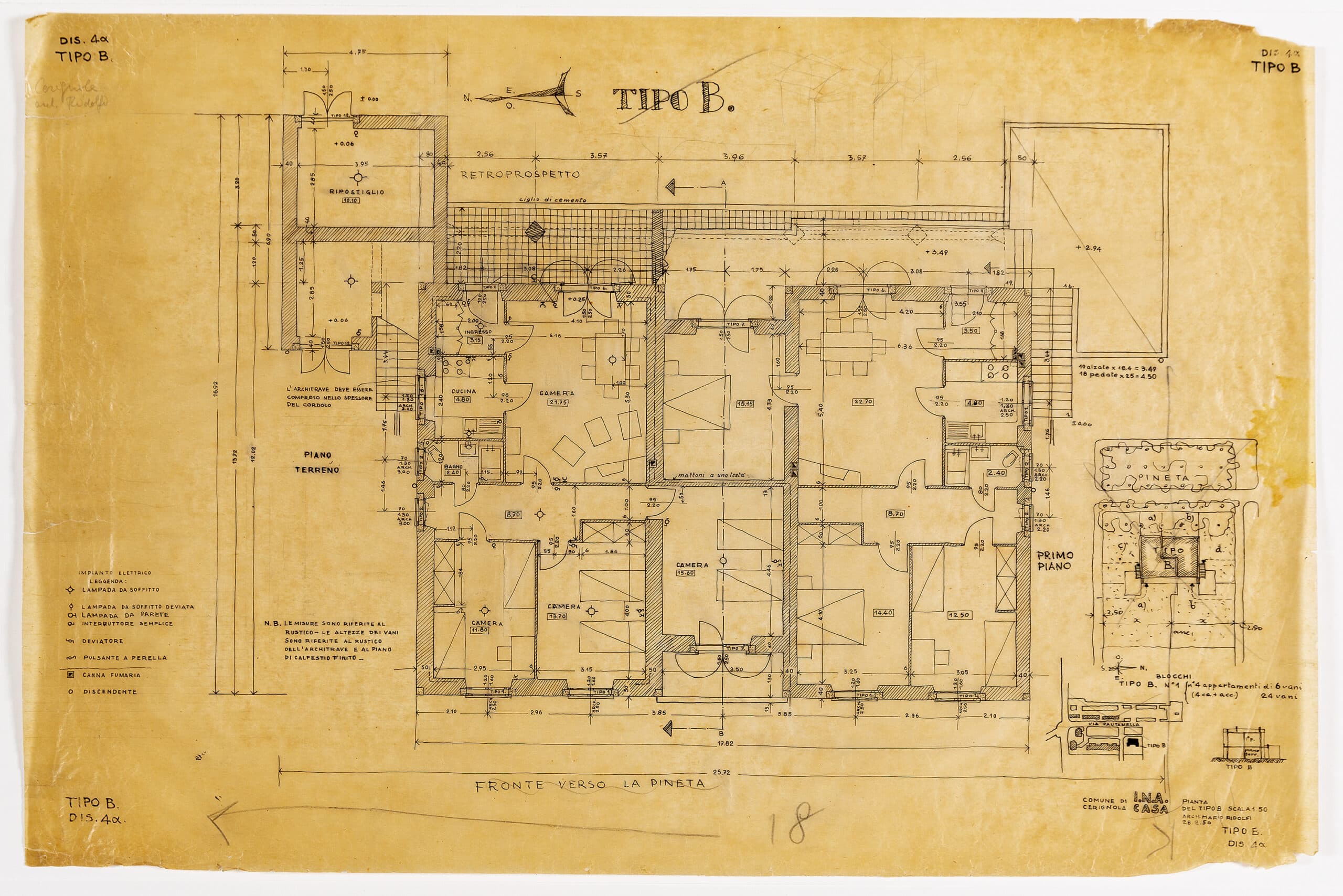
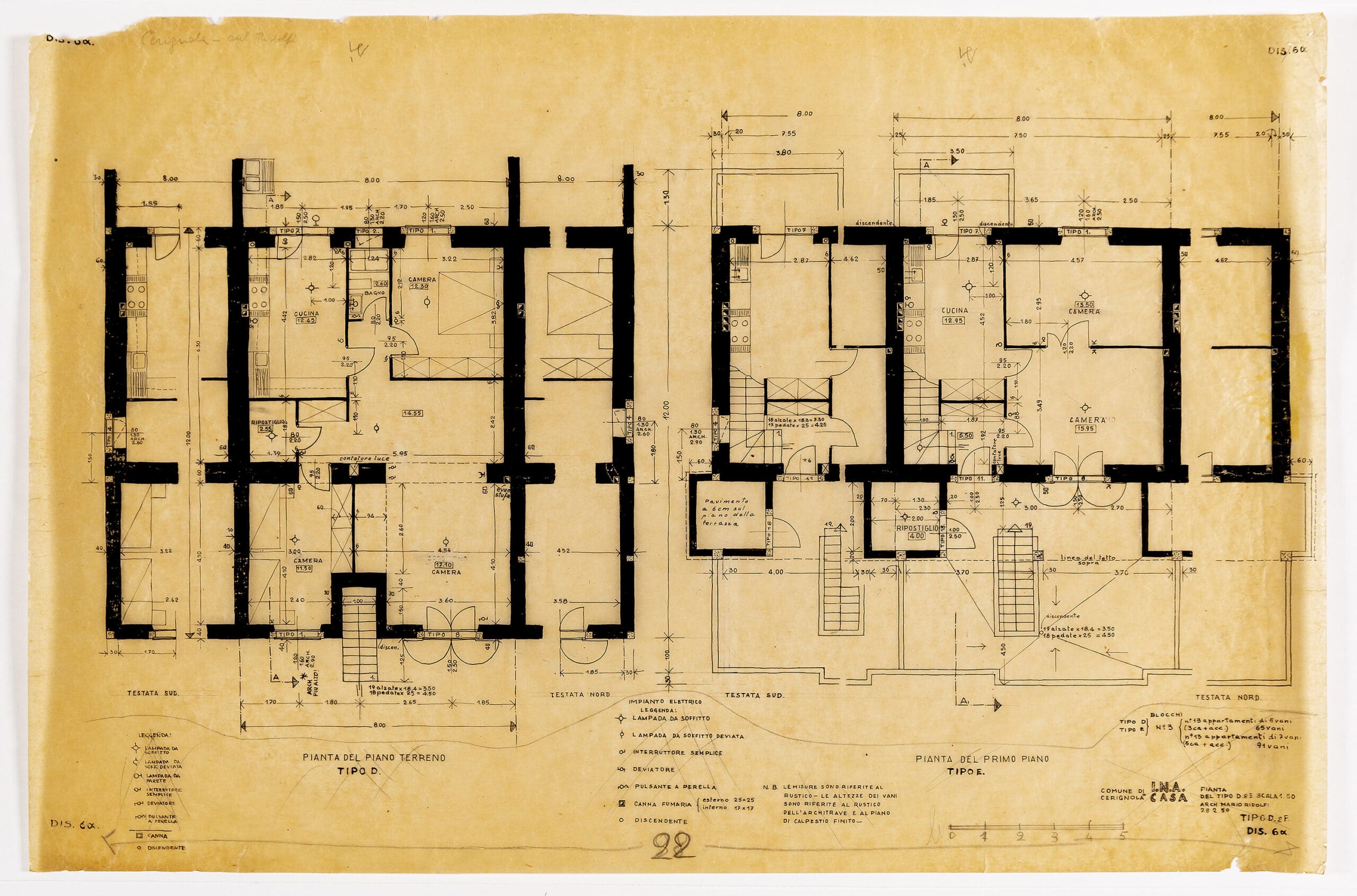
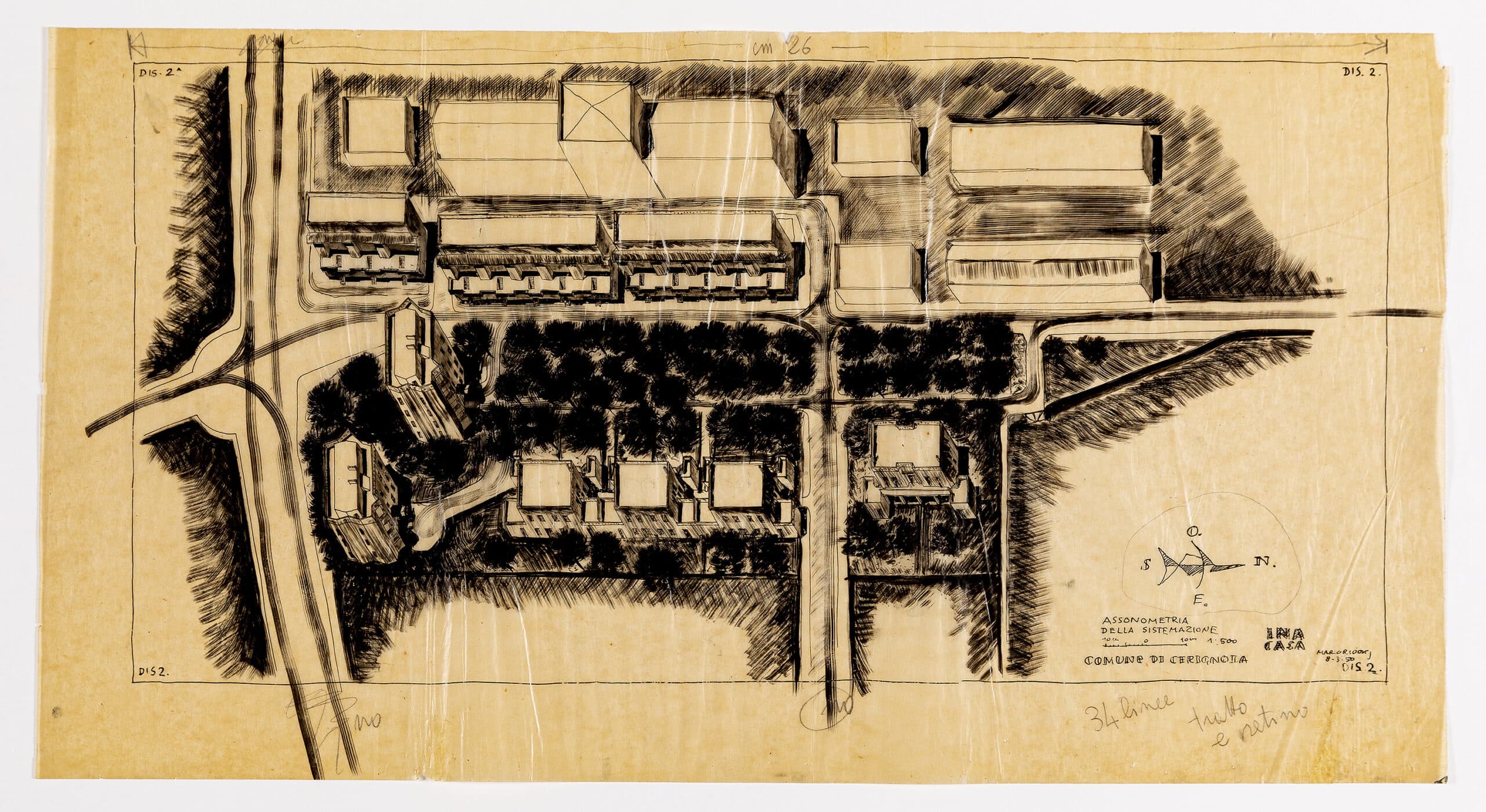
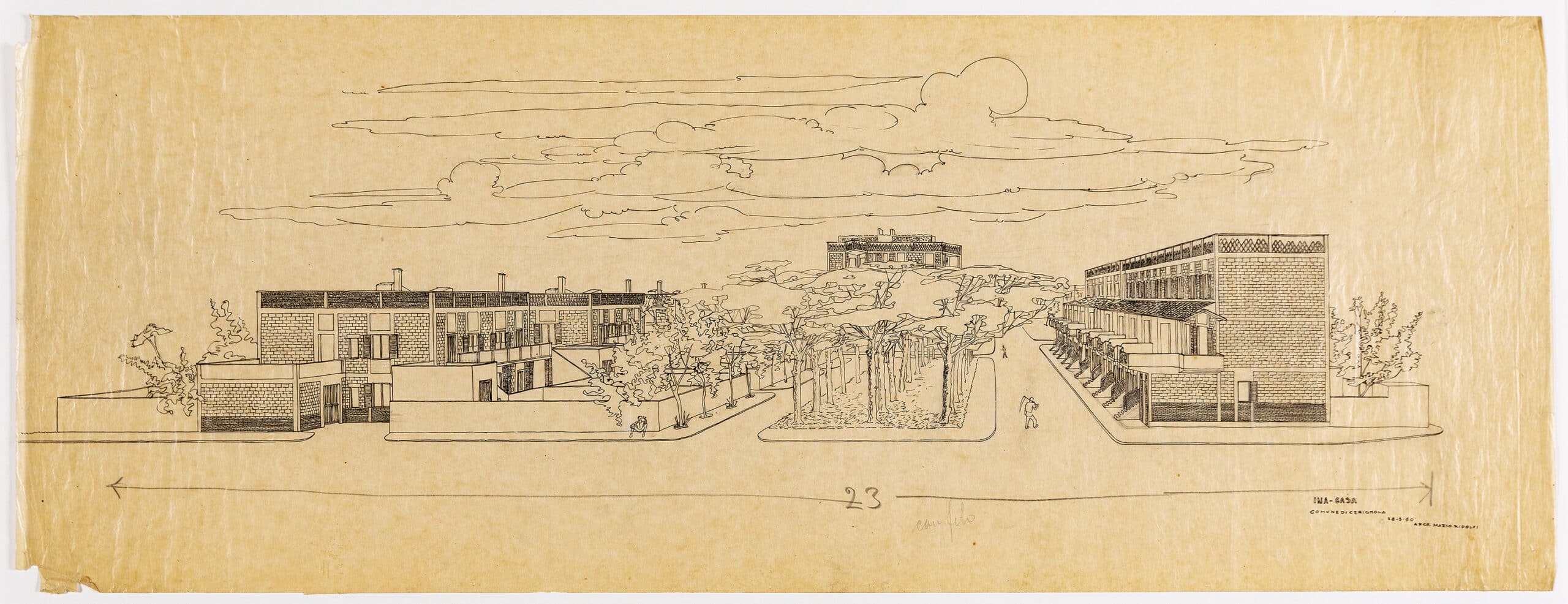
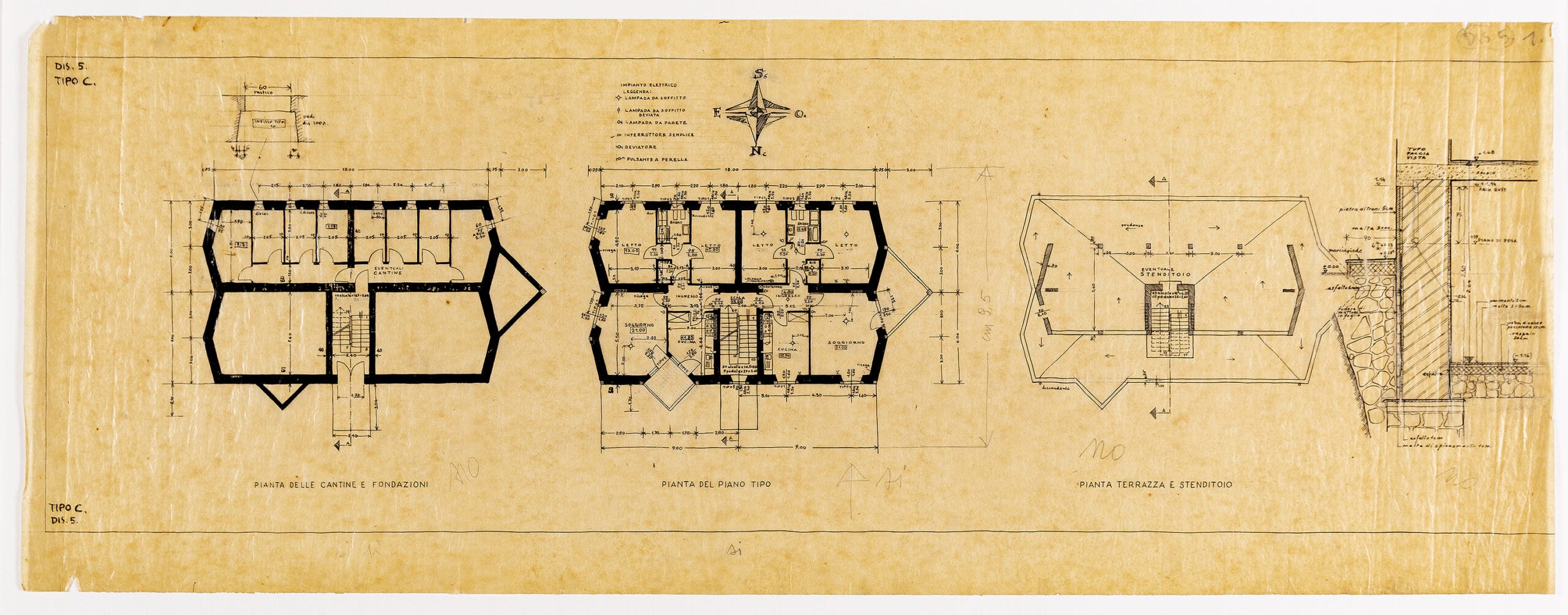
Group of six drawings for a communal housing scheme in Puglia. The drawings consisted of site sketches, perspectives, plans and an axonometric, presenting the scheme with five housing types: A, B, C, D, and E.
The drawings are marked with the acronym ‘I.N.A Casa’, which refers to the Istituto Nazionale delle Assicurazioni (National Insurance Institute), who had conceived of an initiative to counteract widespread unemployment and the need for social housing in the aftermath of the Second World War. Mario Ridolfi had already started on an I.N.A housing scheme in the neighbourhood of Tiburtino, Rome, with Carlo Aymonino, when he and Wolfgang Frankl received the commission from the council of Cerignola. Both the Rome and Cerignola schemes were built.
GAETANO RAPISARDI, SAN GIOVANNI BOSCO, 1952
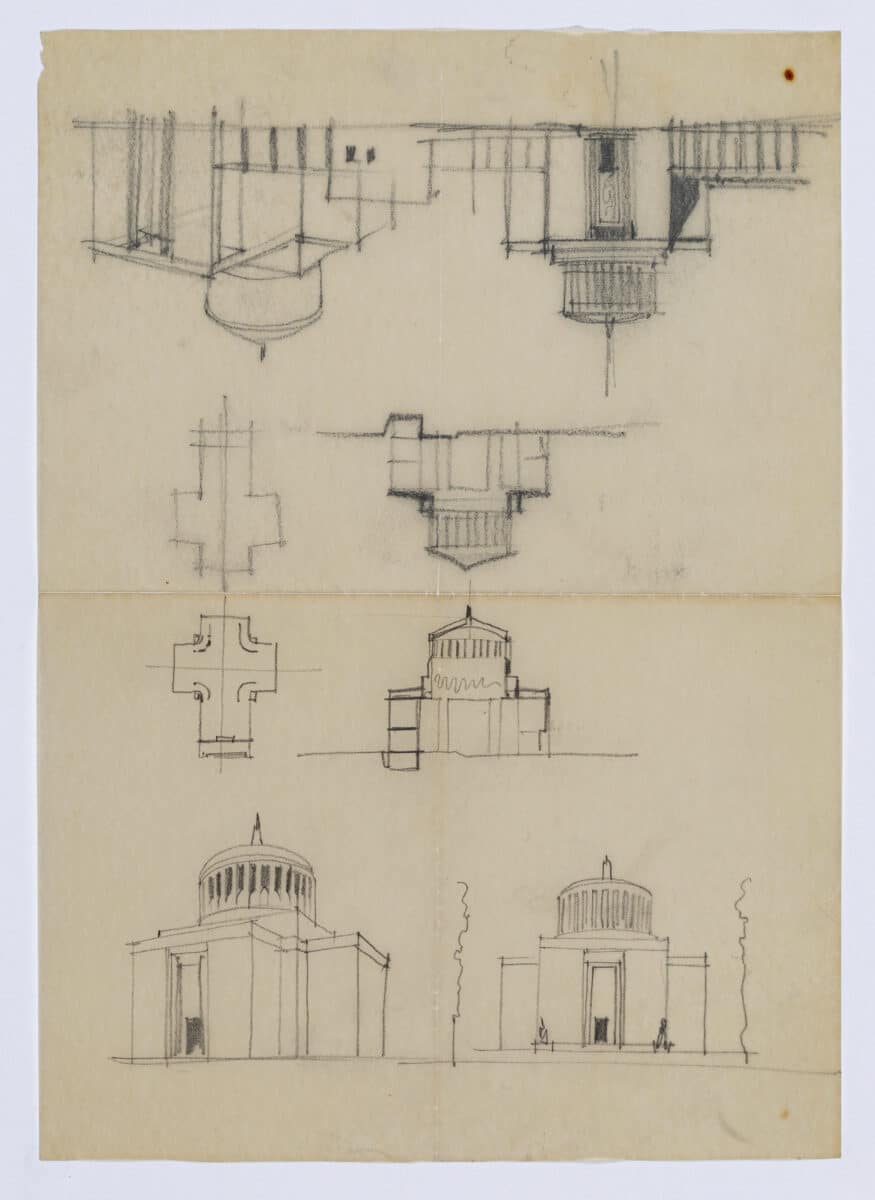
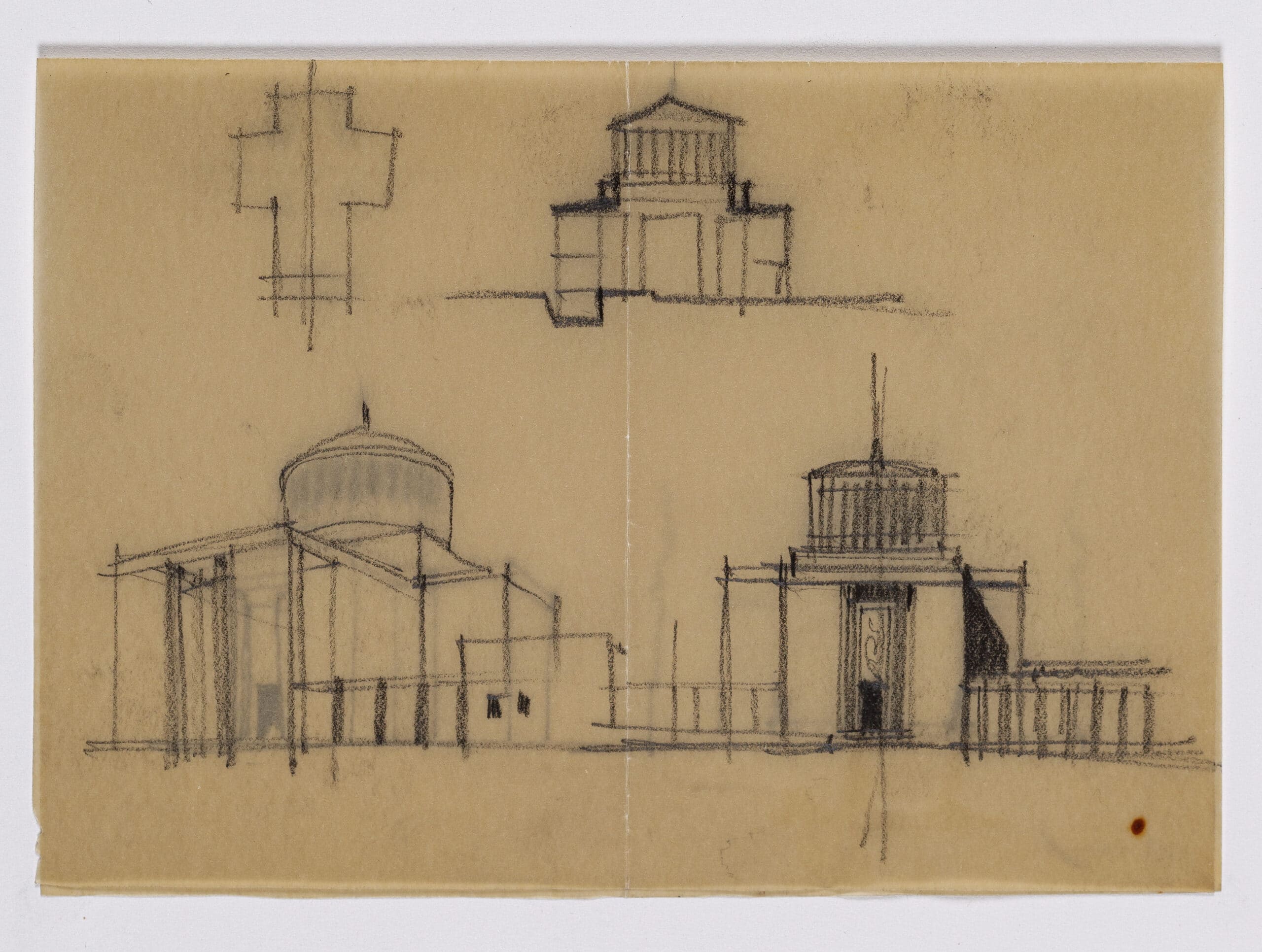
One folded sheet of sketches for the Chiesa di San Giovanni Bosco, which Rapisardi executed in the Tuscolano-Cinecittà district of Rome. Similar to the built work, the drawings depict a tripartite façade, surmounted with a monumental lantern dome. Rapisardi had previously designed the circular church Chiesa di San Tommaso al Pantheon in Syracuse in 1919.
PIER LUIGI NERVI, EXTENSION TO PORTSMOUTH CATHEDRAL, 1966
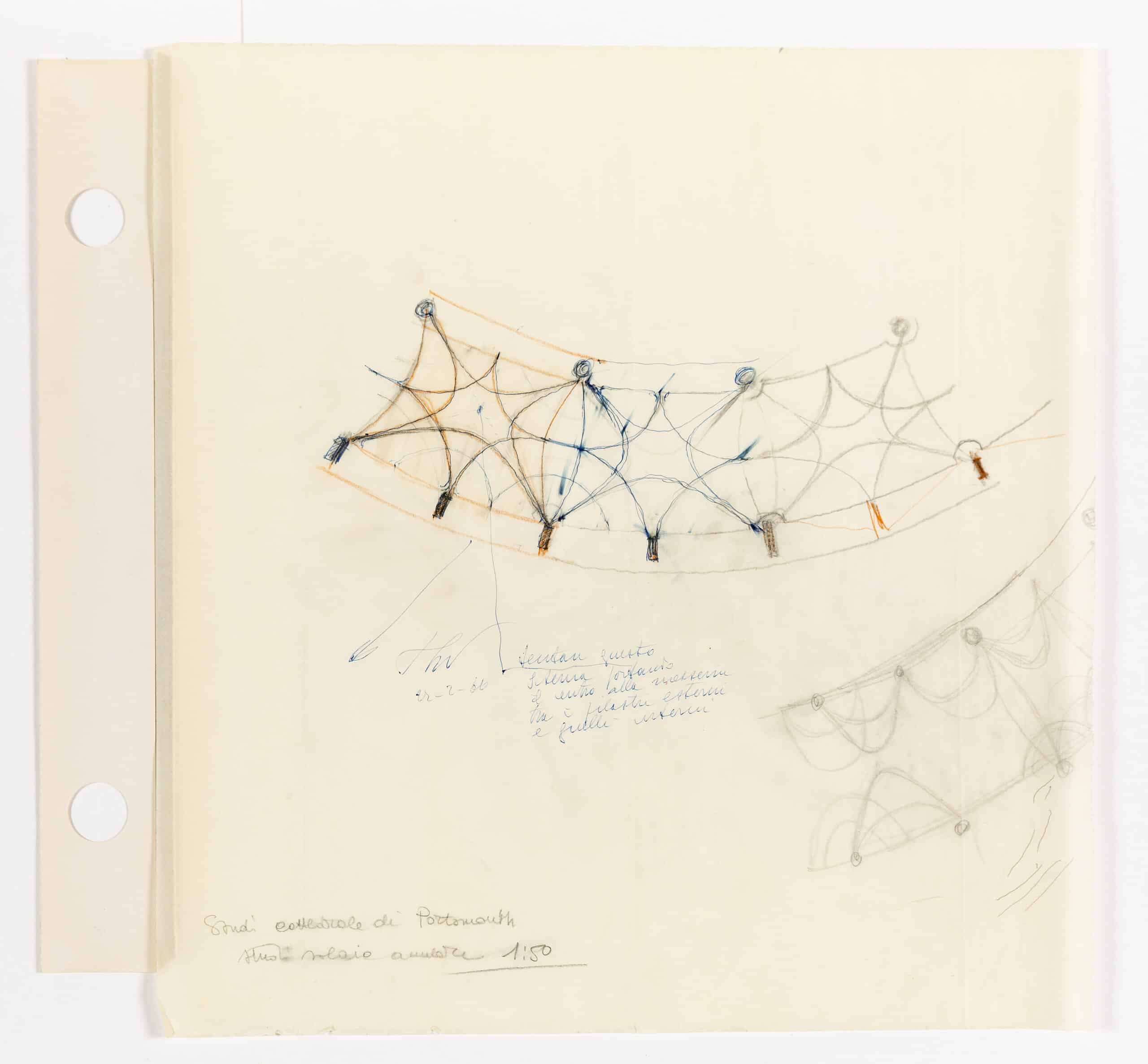
Drawing Matter holds a single sketch by the engineer Pier Luigi Nervi, for the proposed extension of Portsmouth Cathedral. Architect Charles Nicholson had planned a series of works for the newly designated cathedral in 1935, yet construction work halted due to the start of the Second World War. In 1966, a new scheme was proposed by Seely & Paget, with Pier Luigi Nervi as the consultant engineer; the design was supported by the architectural critic Nicholas Pevsner.
Nervi’s projects and international reach had grown exponentially after the war, through his patented ferrocement system. This method reduced the amount of metal required for reinforced concrete, which was created before the Second World War in response to material availability in Italy. The League of Nations sanctions imposed on the country after Italy’s invasion of Ethiopia in 1937 did not allow the sale of any material to Italy that could be used in the war industry. In 1937, the Italian government accused reinforced concrete of being an unItalian material, and by 1939 its use was banned.
Additions and amendments are welcomed at editors@drawingmatter.org.
