Collection Guide: Peter Wilson & BOLLES+WILSON
– Editors
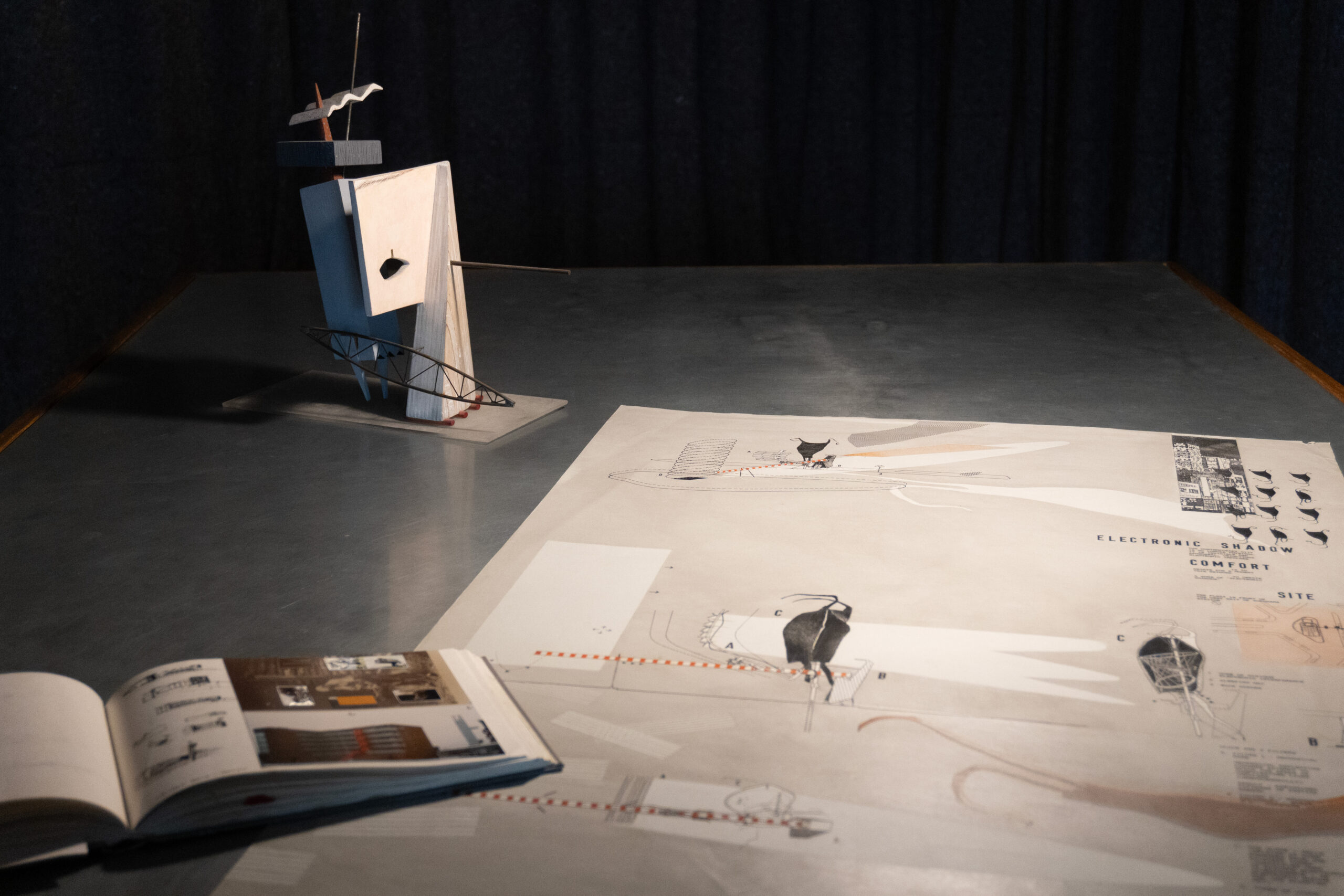
Peter Wilson and Julia Bolles are the founding partners of Architekturbüro BOLLES+WILSON. Peter Wilson was born in Australia, he studied architecture at the University of Melbourne and the Architectural Association, where he later taught from 1974–1988 (Diploma Unit Master 1980–88). Julia Bolles was born in Münster and graduated from the Karlsruhe Institute of Technology in 1976, going on to study at the Architectural Association; from 1996 to 2014, she was a professor of architectural design and Dean of the school at Münster School of Architecture. She was subsequently the first woman President of the NRW Academy of Arts and Sciences.
Their practice BOLLES+WILSON (known as Wilson Partnership before 1988) was founded in 1980 while Wilson was teaching at the Architectural Association and Julia teaching at the Chelsea School of Art. For eight years they practised in London, focused on research, exhibitions, and conceptual designs, presenting work across the world, but establishing a particularly strong connection to Japan. In 1988 with their first major commission for the Münster City Library, the practice relocated there.
Their work is held in institutions across the world, Letzebuerger Architektur Musée, Architecture Museum of the Technical University of Munich, the Vedute Collection, Tchoban Stiftung, the Metro Media Collection, Museum of Modern Art Iran, the Victoria & Albert Museum, the Canadian Centre for Architecture, the Royal Institute of British Architects, and the Architectural Association, as well as in private collections. The Drawing Matter collection holds eighteen projects and five sketchbooks by Peter Wilson and Bolles+Wilson dating from 1975 to 2024.
VIEW THE COMPLETE DRAWING MATTER COLLECTIONS OF PETER WILSON & BOLLES+WILSON HERE.
FIND ALL TEXTS ON DRAWING MATTER ON PETER WILSON HERE AND ALL TEXTS ON BOLLES+WILSON HERE.
In the summer of 2020 Mark Dorrian held a conversation with Peter Wilson on his practice which was published on Drawing Matter in two parts. See part one here and part two here.
WATER HOUSE, 1975
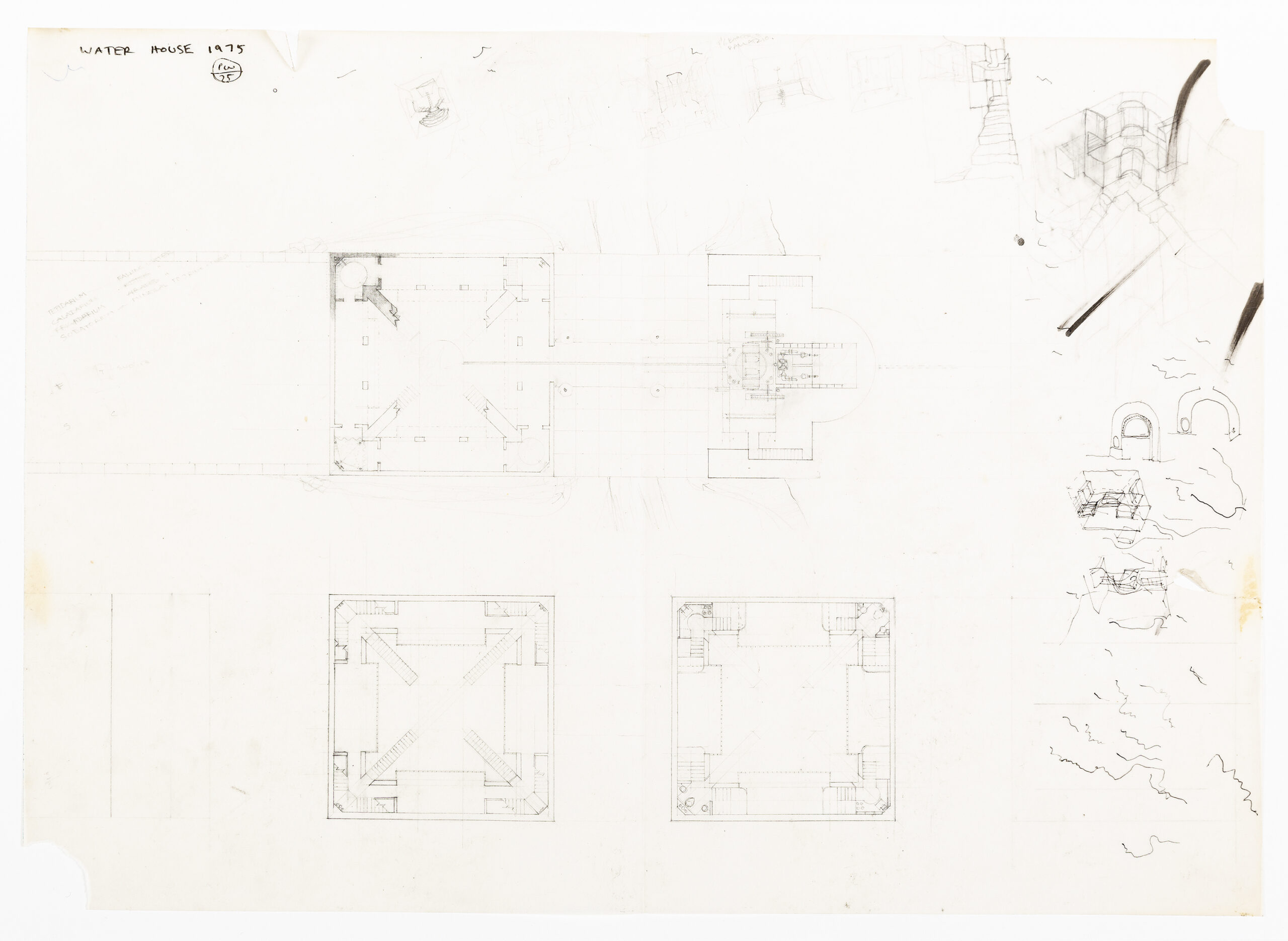
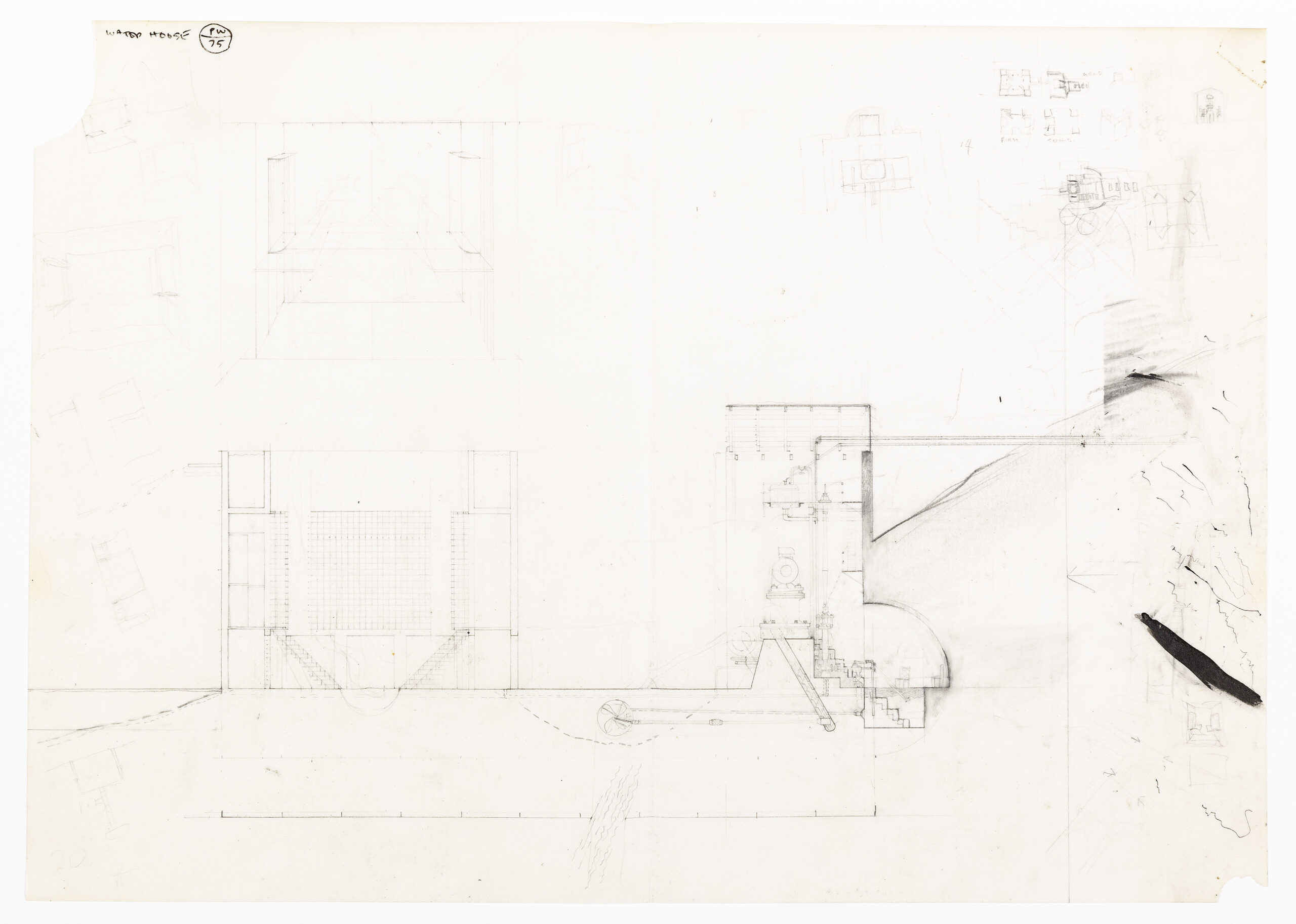
Set in a wild landscape, the Water House is an architectural device that domesticates a bubbling stream. Drawing Matter holds two sheets of sketches for the Water House, the design of which was submitted to the Shinkenchiku (Japan Architect) competition under the theme ‘A House at an Intersection’. The competition’s judge was Richard Meier, and although it didn’t win, it received an honourable mention. Conceived in 1975, these drawings preceded the Water House that appeared again in Wilson’s 1976 Public Convenience.
SKETCHBOOK, 1975
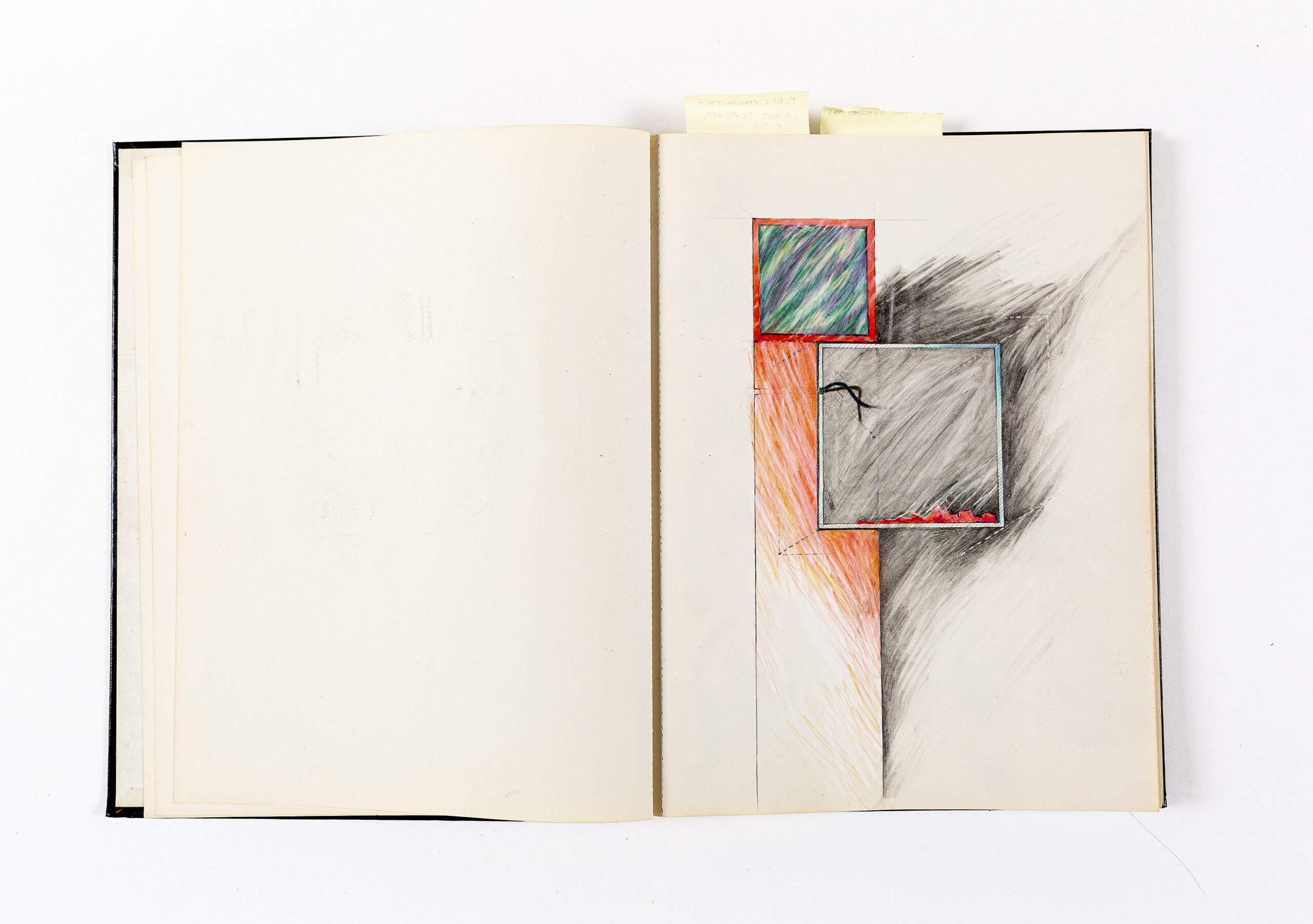
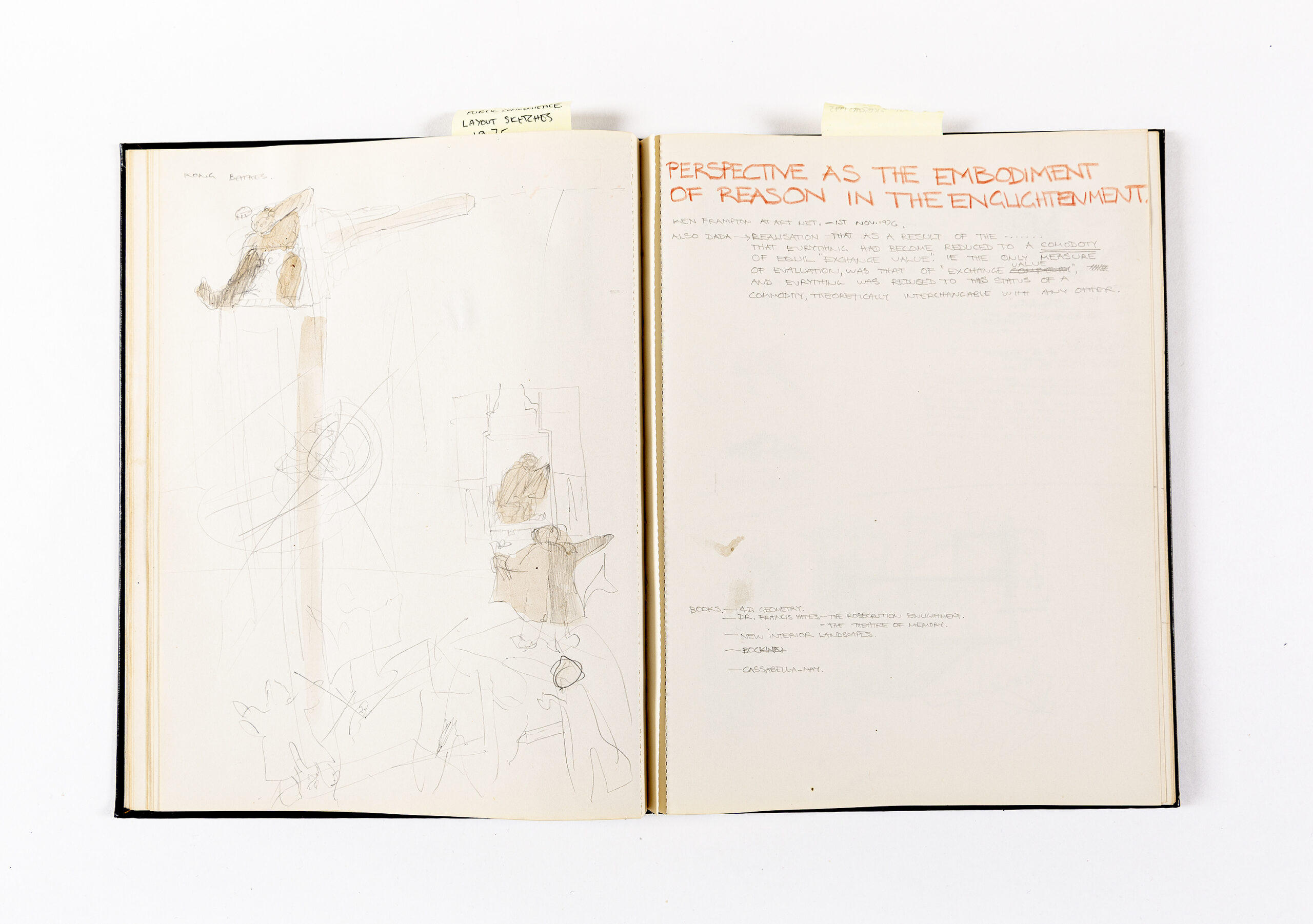
A sketchbook from 1975, where Wilson drew the initial ideas for Public Convenience.
PUBLIC CONVENIENCE, 1976
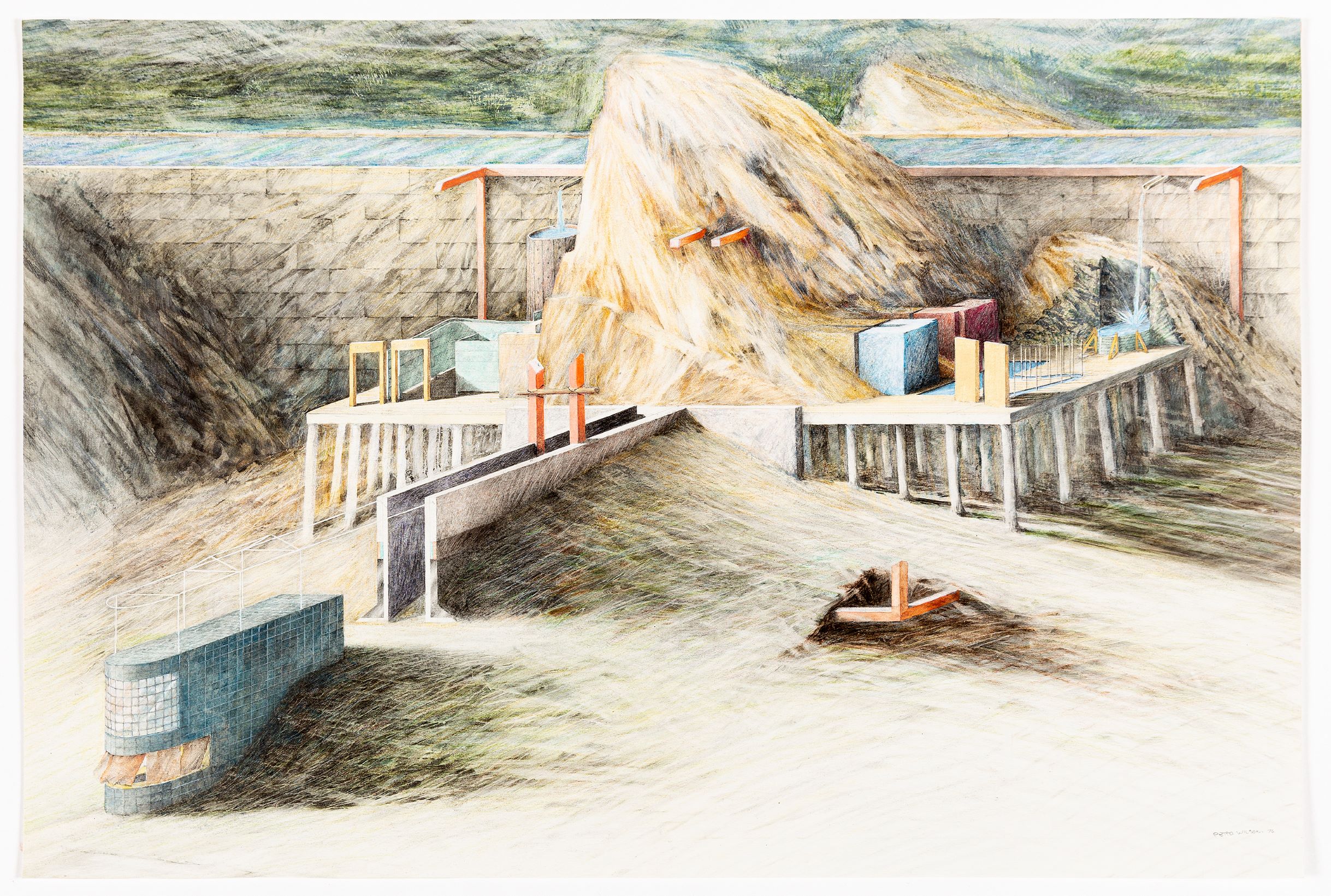
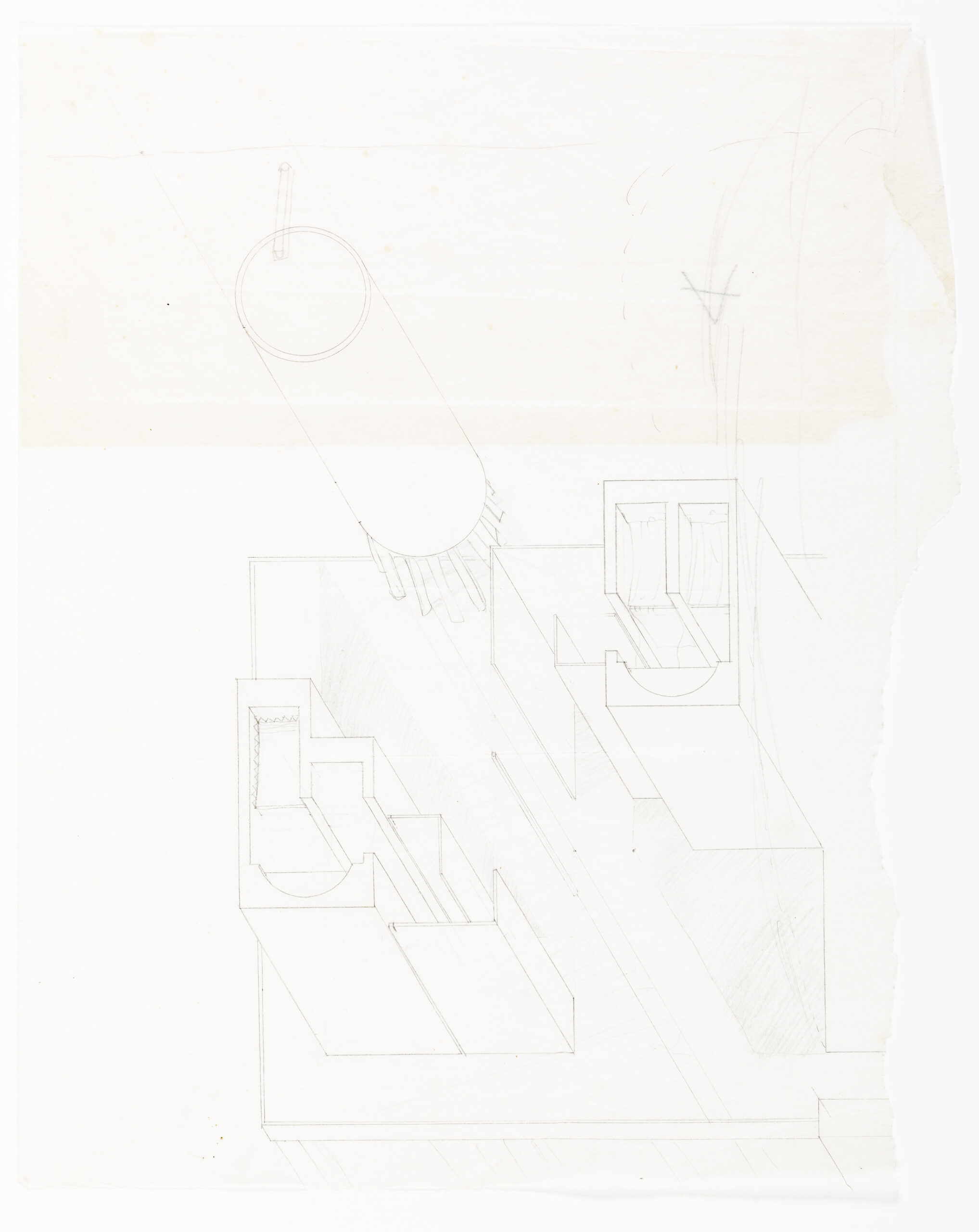
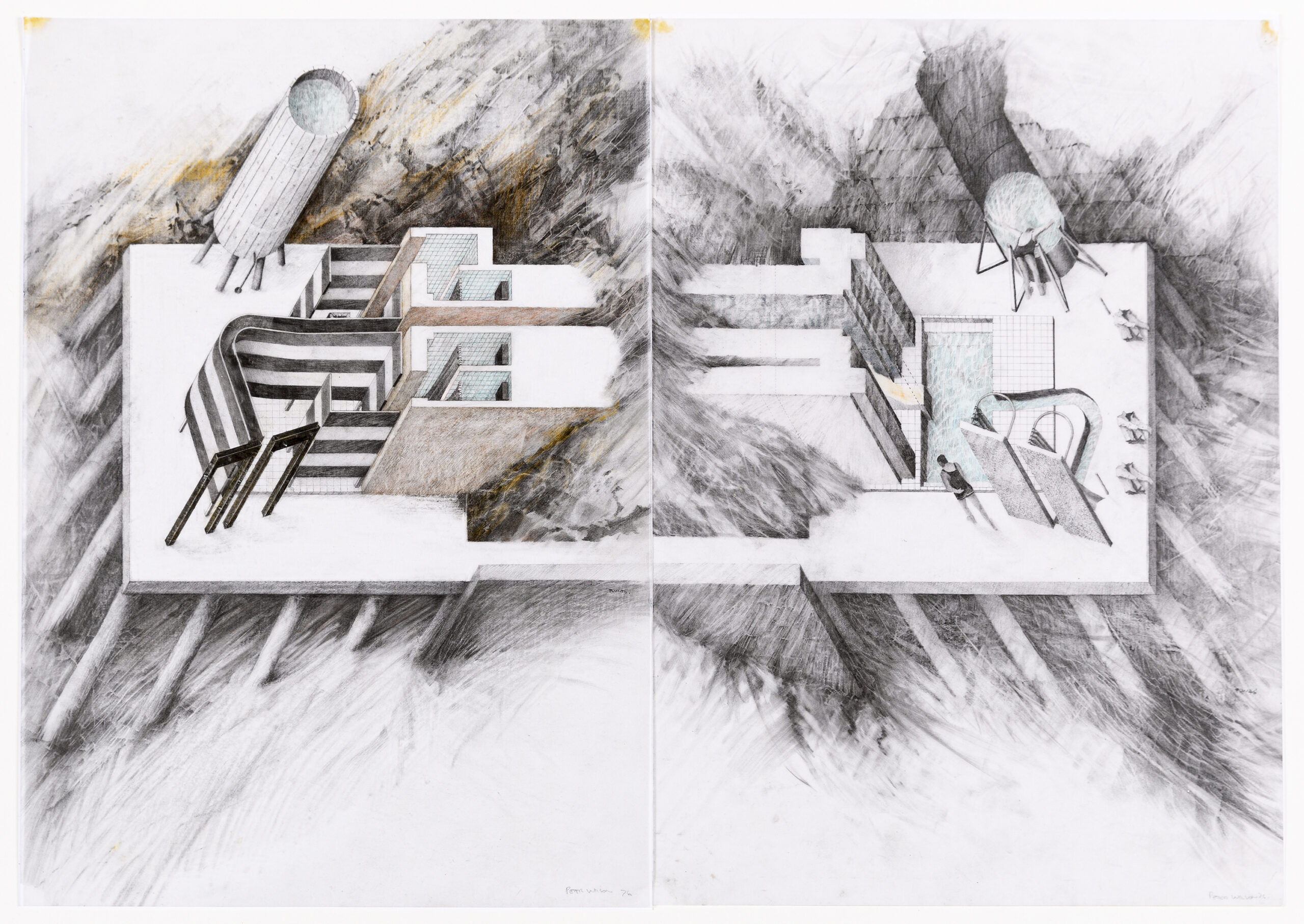
Created as a follow up to the Water House, Public Convenience was a series of drawings that expanded his transformation of wild landscapes into usable tools. The Public Convenience is located on the canal that originated with Water House I, here Water House II is shown, the element water coming under the strictures of utility (toilets). Wilson drew the project directly after graduating from the Architectural Association, while teaching there half-a-day a week. The Drawing Matter collection holds five preparatory sketches and five finished drawings, as well as sketches within sketchbooks.
Find the project in Wilson’s own words here.
SHROUDS & CURTAINS, 1977-2024
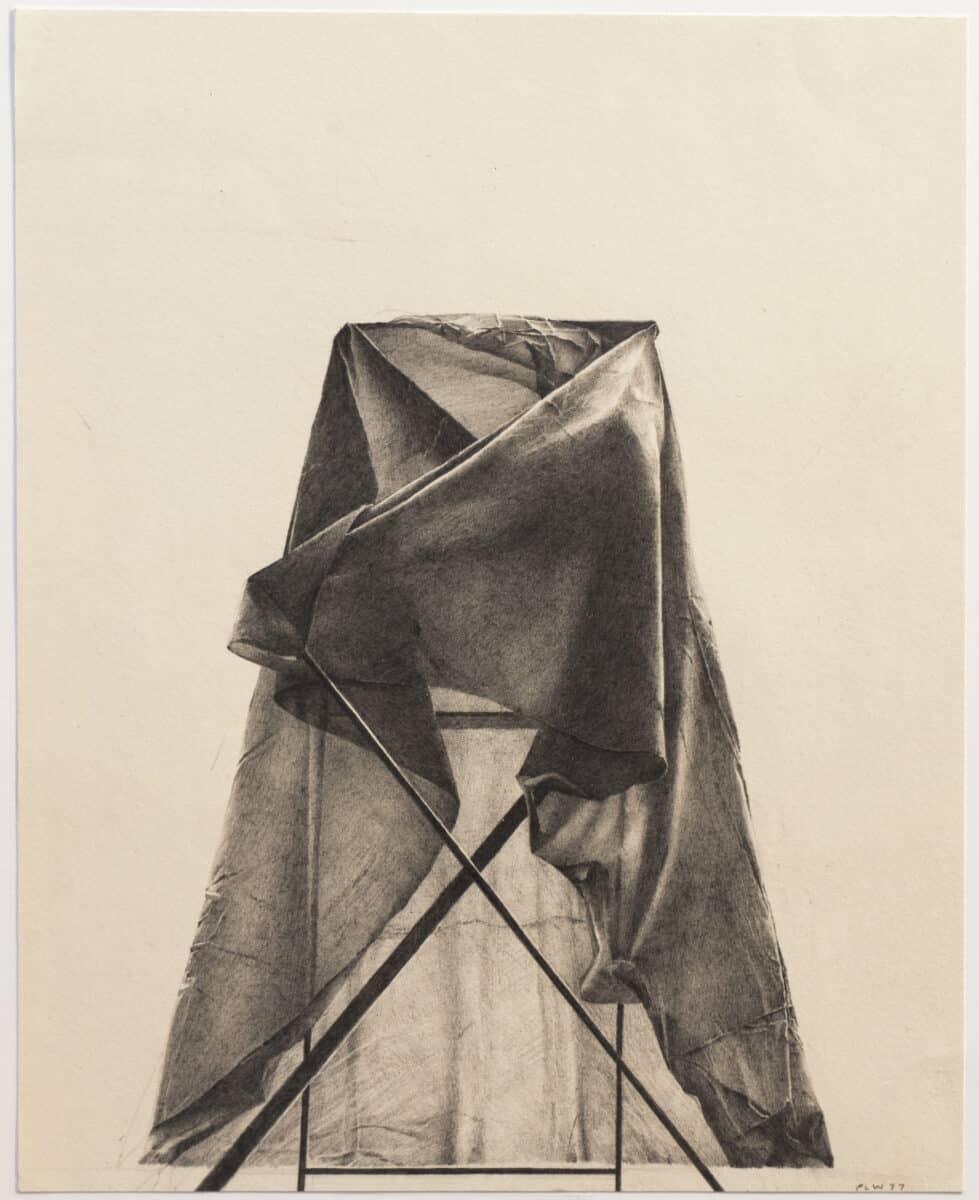
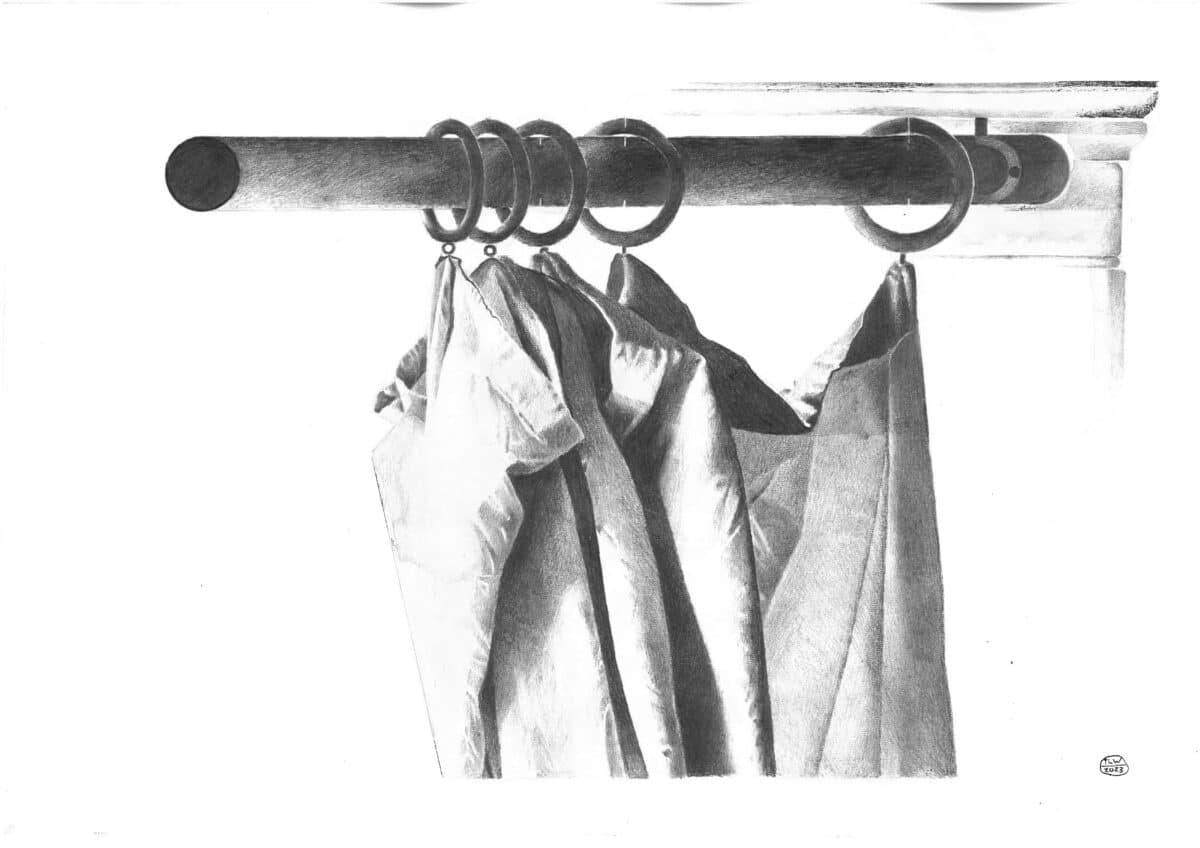
Wilson drew the Shroud in 1977, when he was 27 years old; 46 years later, in 2023, Wilson created a follow-up drawing of a curtain; the second drawing is of the same piece of cloth which had fallen into the regime of utility, serving for many years as a curtain. This second drawing is part of a series of four drawings created between 2023 and 2024.
Find out about the drawings in Wilson’s own words here.
CASA DELLA FALSITÀ, 1982
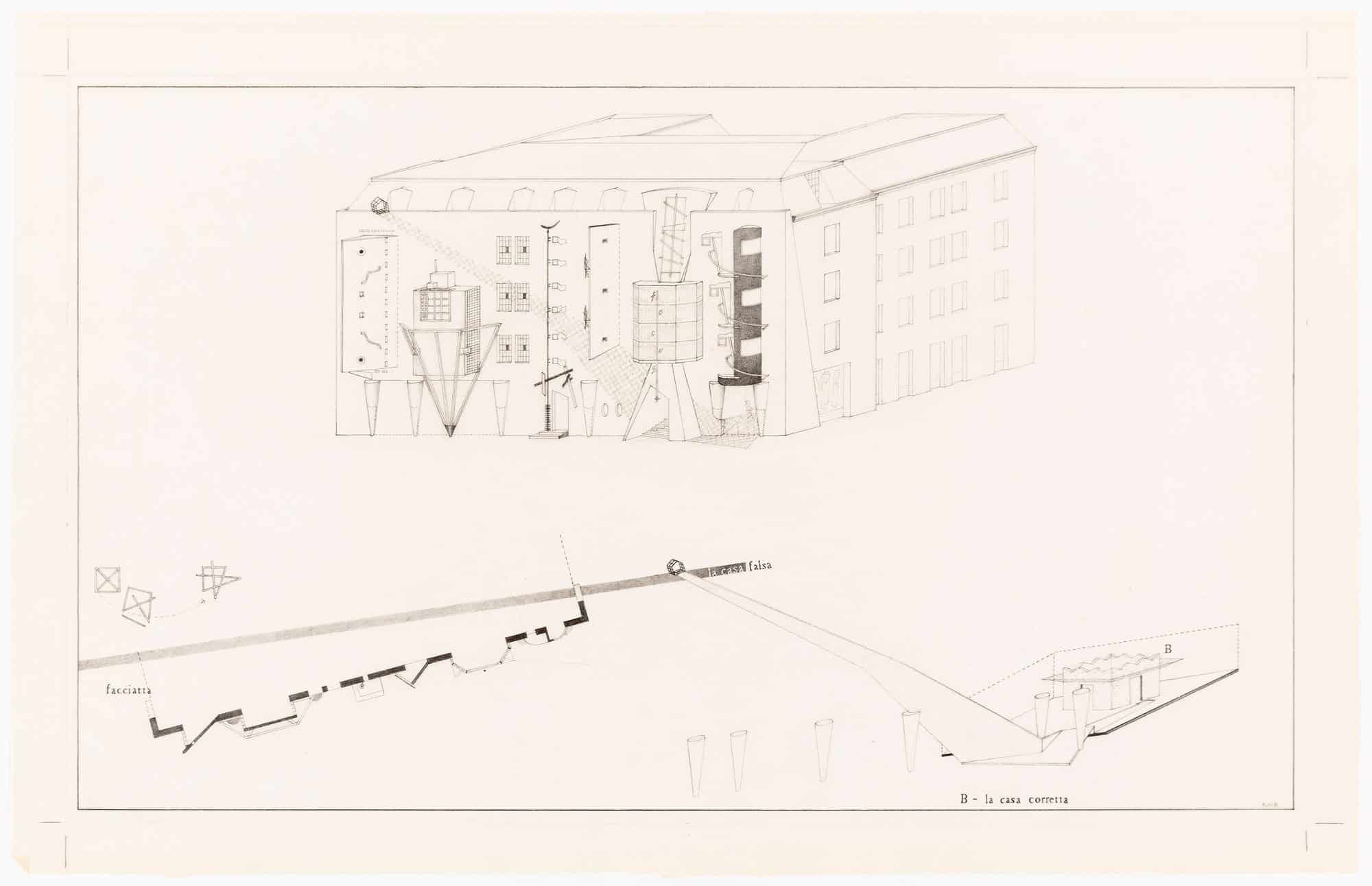
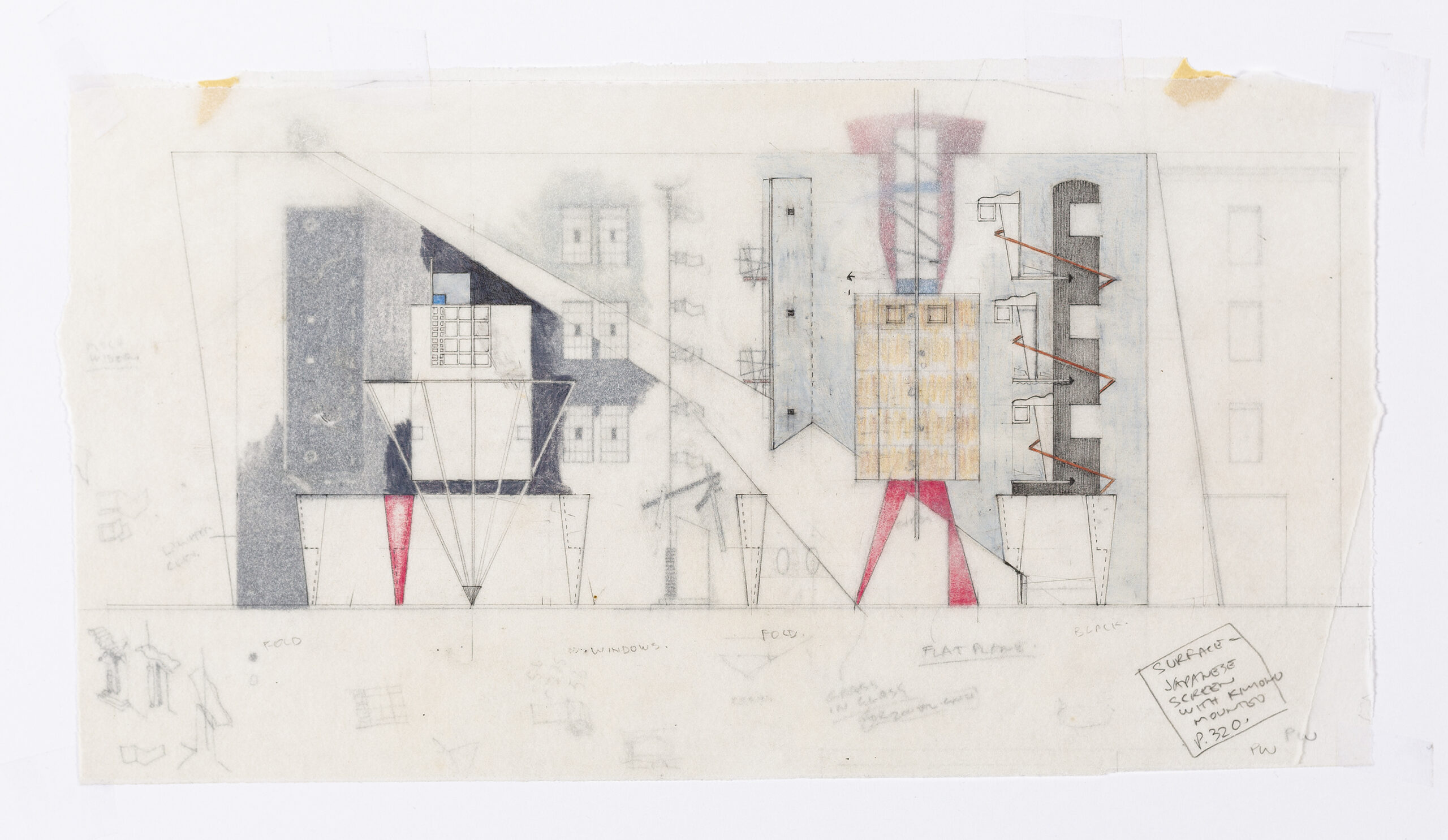
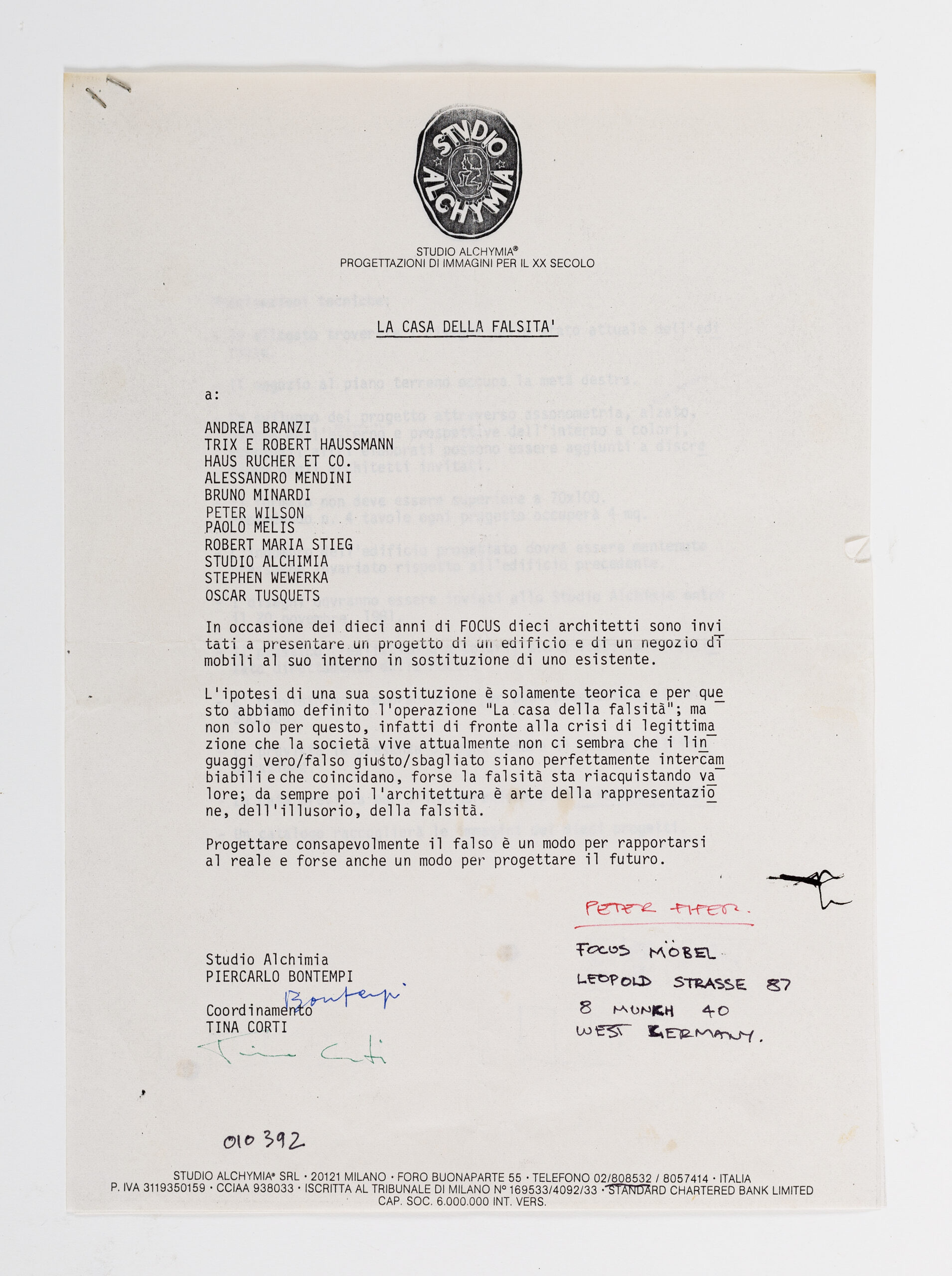
The Casa Della Falsità (‘the house of falsehood’) was an exhibition of 11 invited proposals for the transformation of Peter Pfeiffer’s house on Leopoldstrasse in Munich. Peter Wilson was one of those invited alongside Opera, Zaha Hadid, Trix and Robert Haussmann, Haus Rucker Co., Alessandro Mendini, Bruno Minardi, Robert Maria Stieg, Studio Alchimia, Stefan Wewerka, and Andrea Branzi. In Wilson’s proposal the facade was composed of ‘linguistic confusion’ stitched together by a grey band, and labelled at one end ‘la Casa Falsa’. Drawing Matter holds five drawings of the project, alongside a letter of invitation from Peter Pfeiffer and the exhibition catalogue from the show held at Munich’s Focus Gallery in 1982.
Find a description of the project in Wilson’s own words here.
PARIS OPERA, 1982-1983
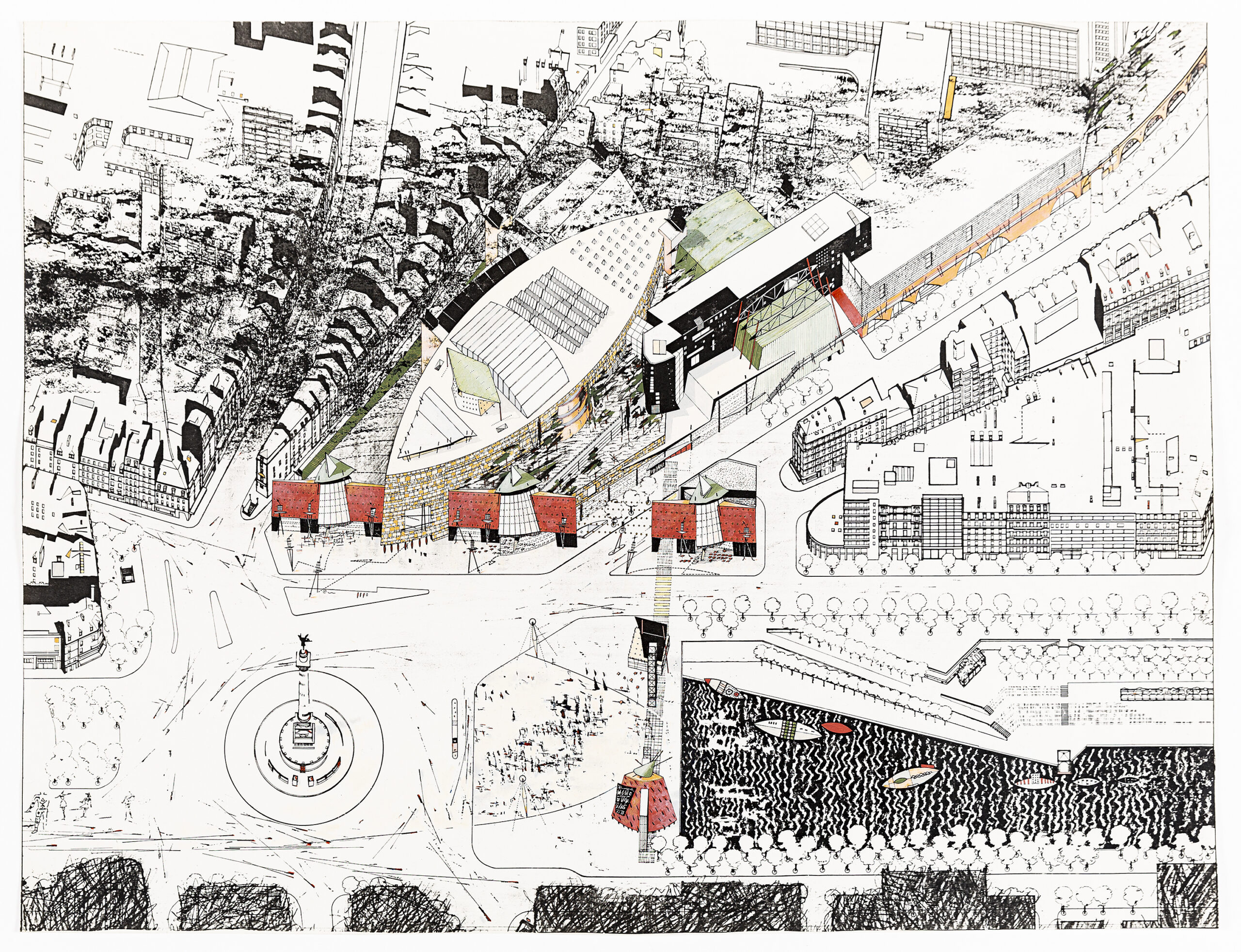
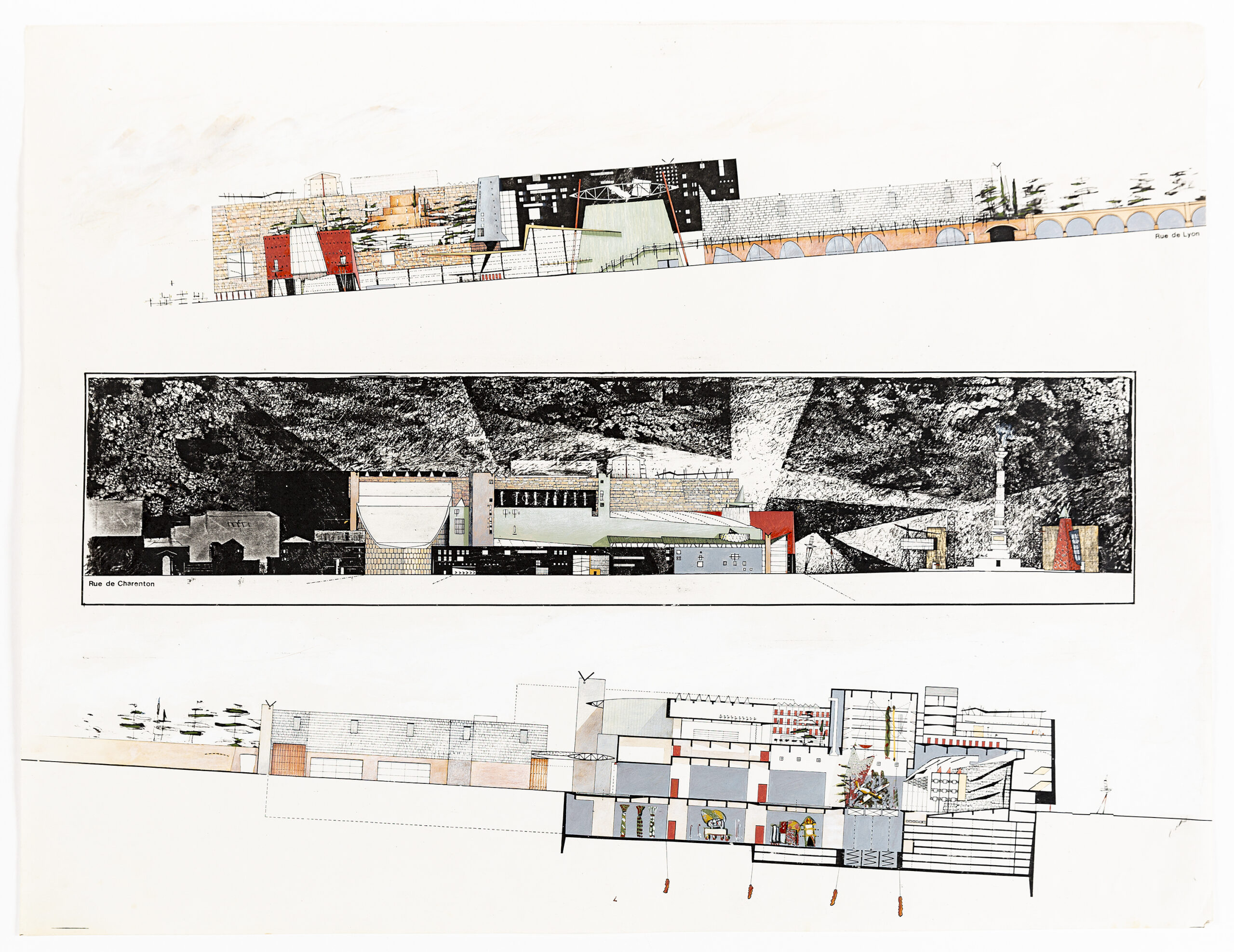
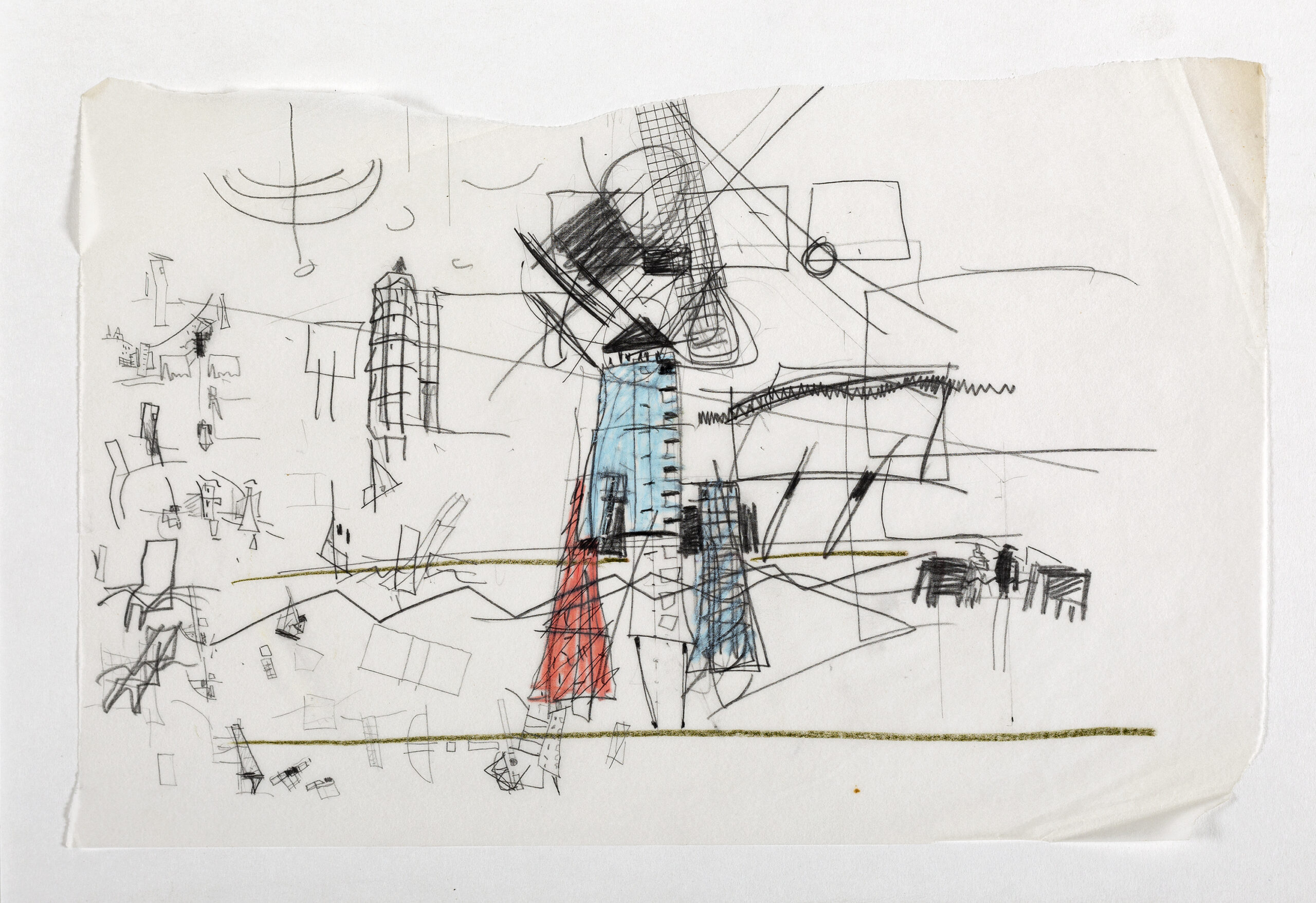
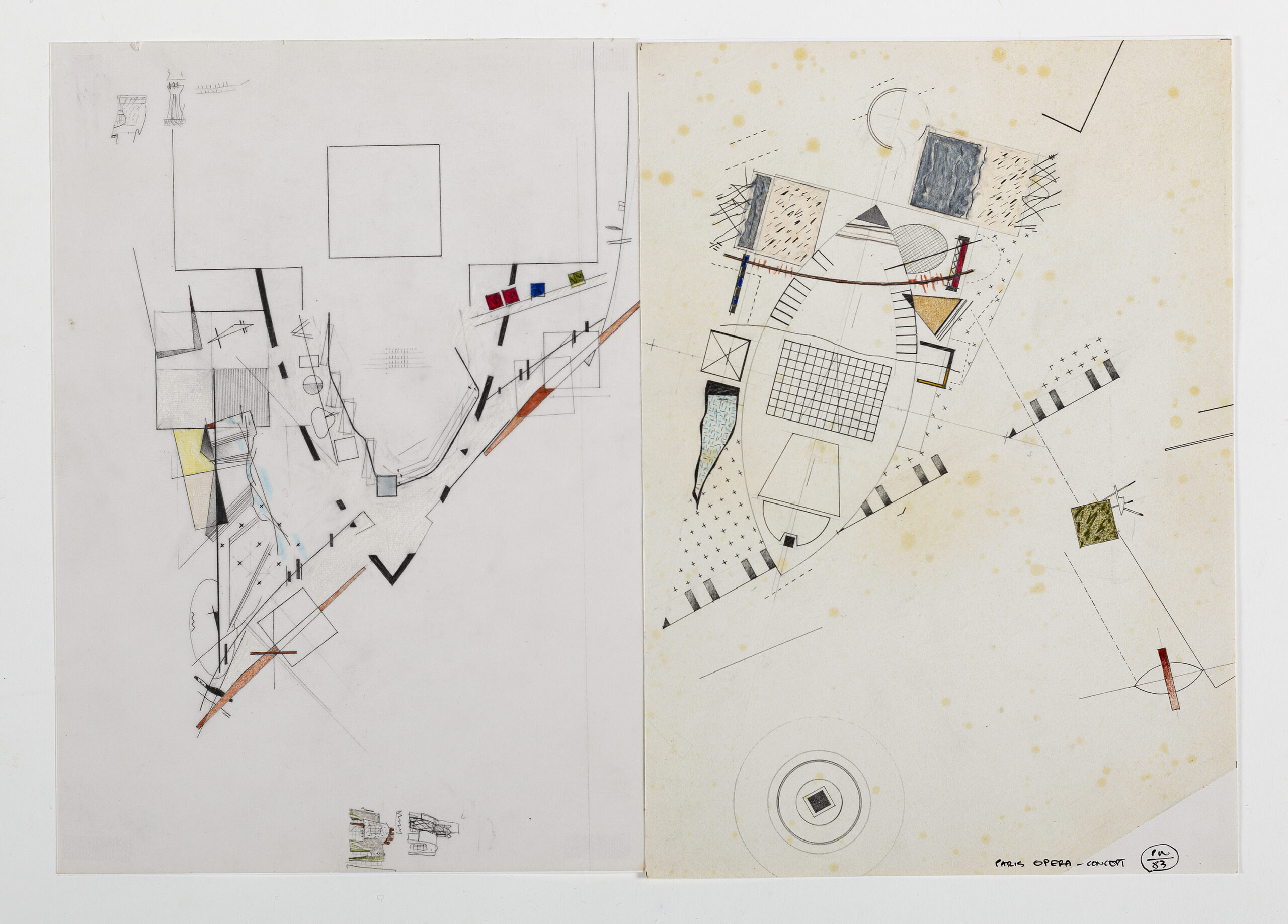
Drawing Matter holds 36 drawings for Wilson’s entry to the Opéra Bastille competition. It was launched by President François Mitterrand and received over 1,700 entries. The competition was won in November 1983 by Carlos Ott. The project’s location was the historic site of the Bastille prison, and aimed to create a venue with more seats and technical capability than the Opéra Garnier. Wilson proposed a ship-shaped structure that projects into the Place de la Bastille roundabout, a geometric form conceived as a vessel, an ark adrift within Paris’ urban fabric. The proposal’s sweeping form is obscured from the street by a ‘flotilla of local incidents’—three large entranceways and ticket offices. This series of structures supported multiple narratives, reflecting his desire to create figurative architecture.
PONT DES ARTS, 1982-1984
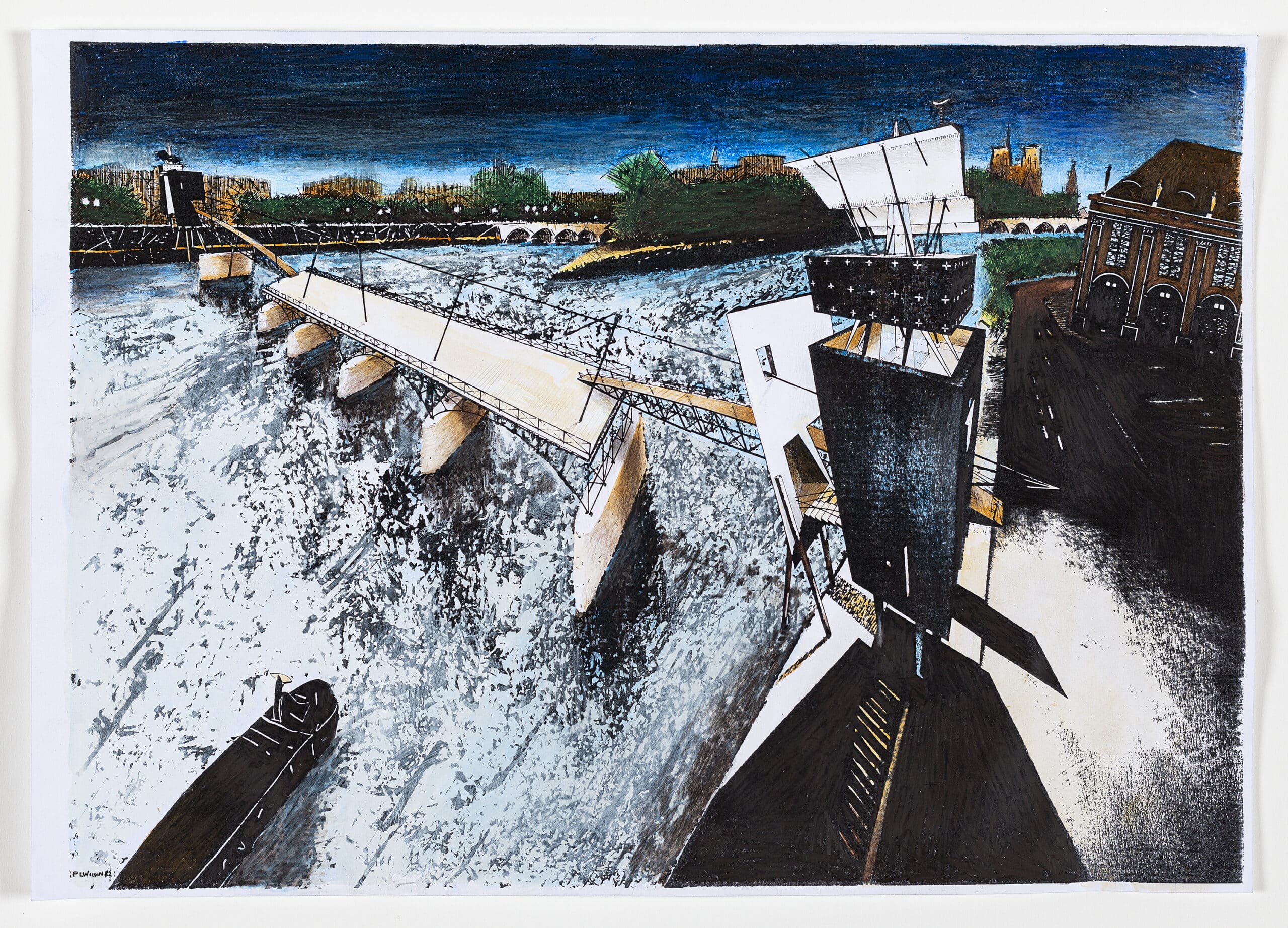
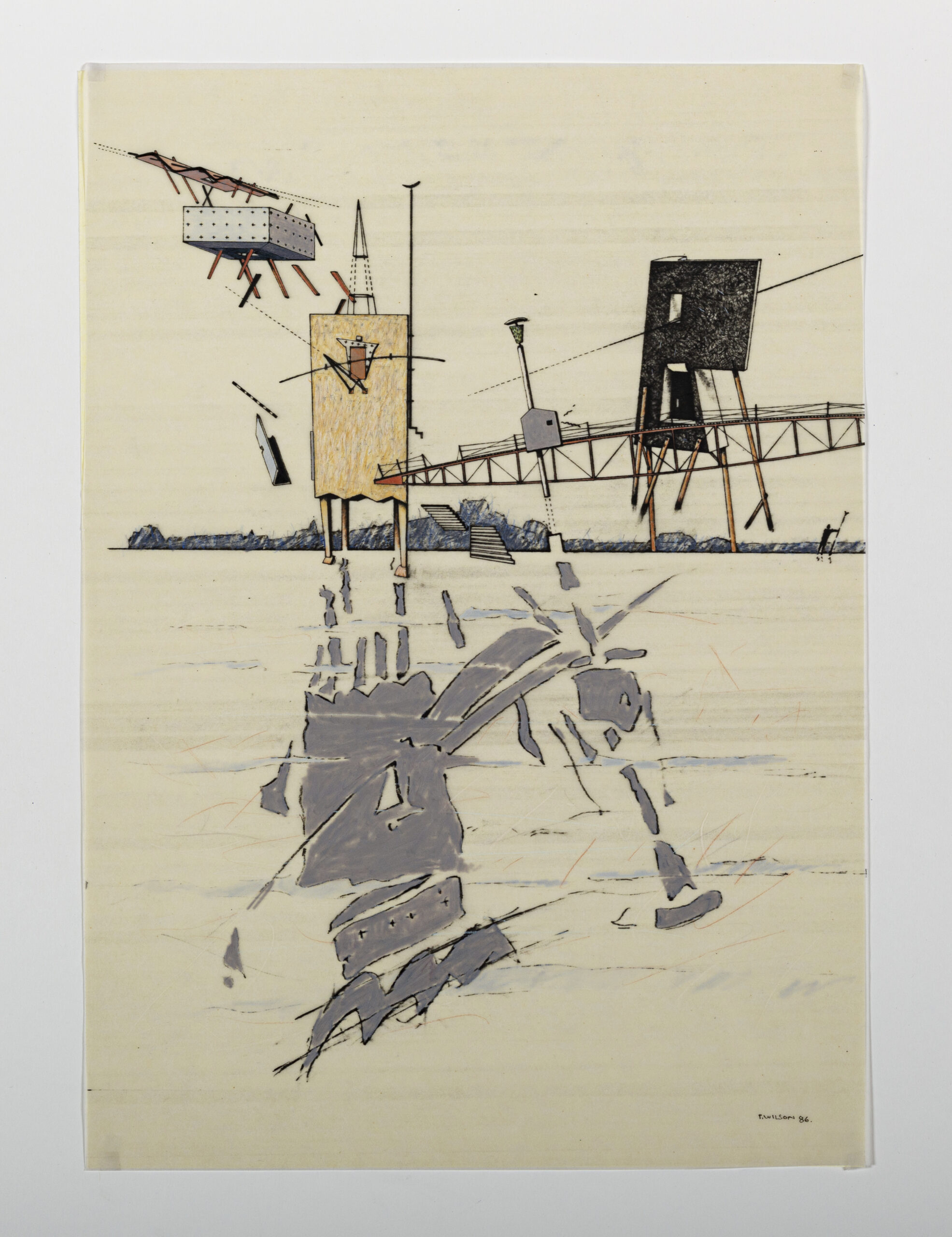
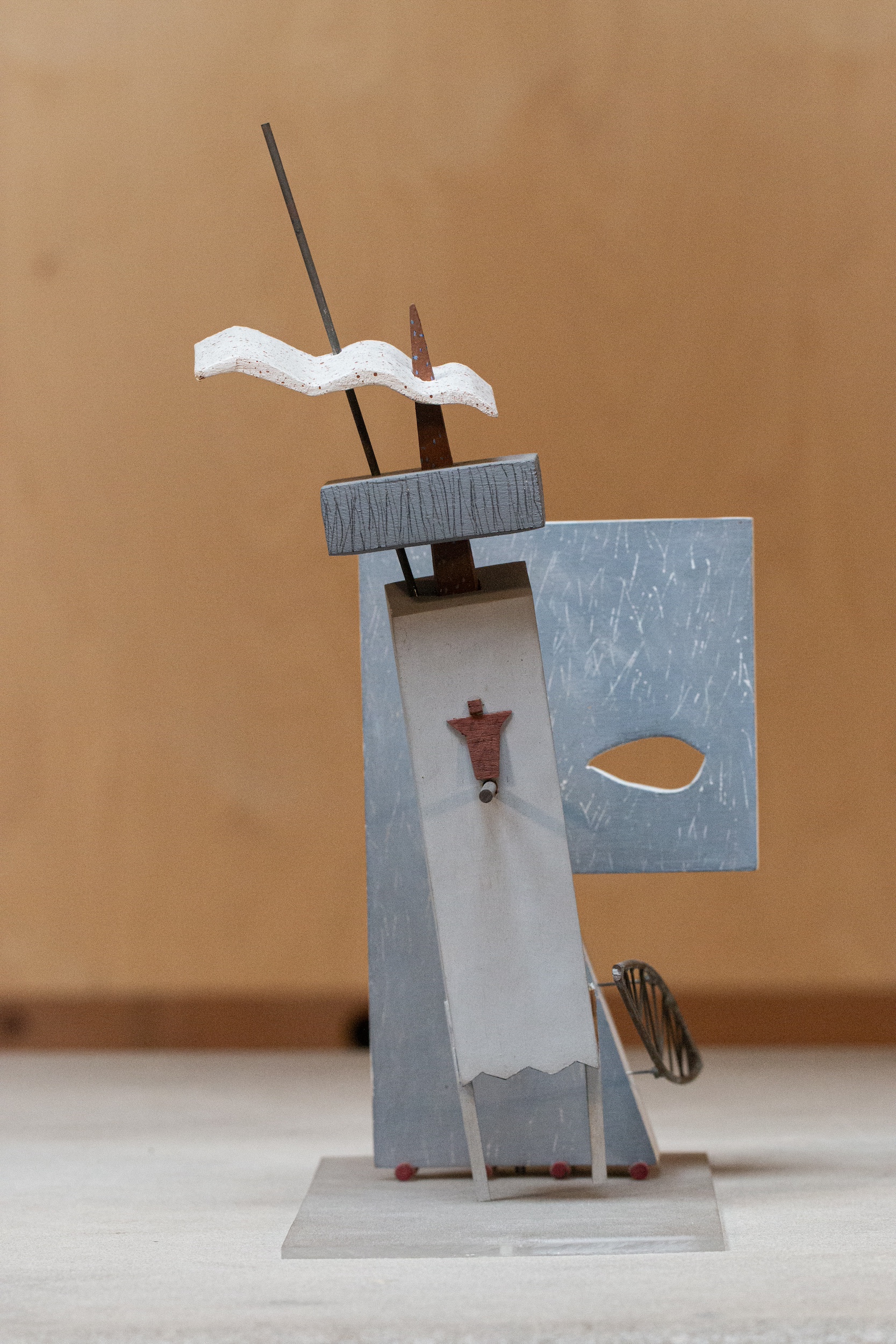
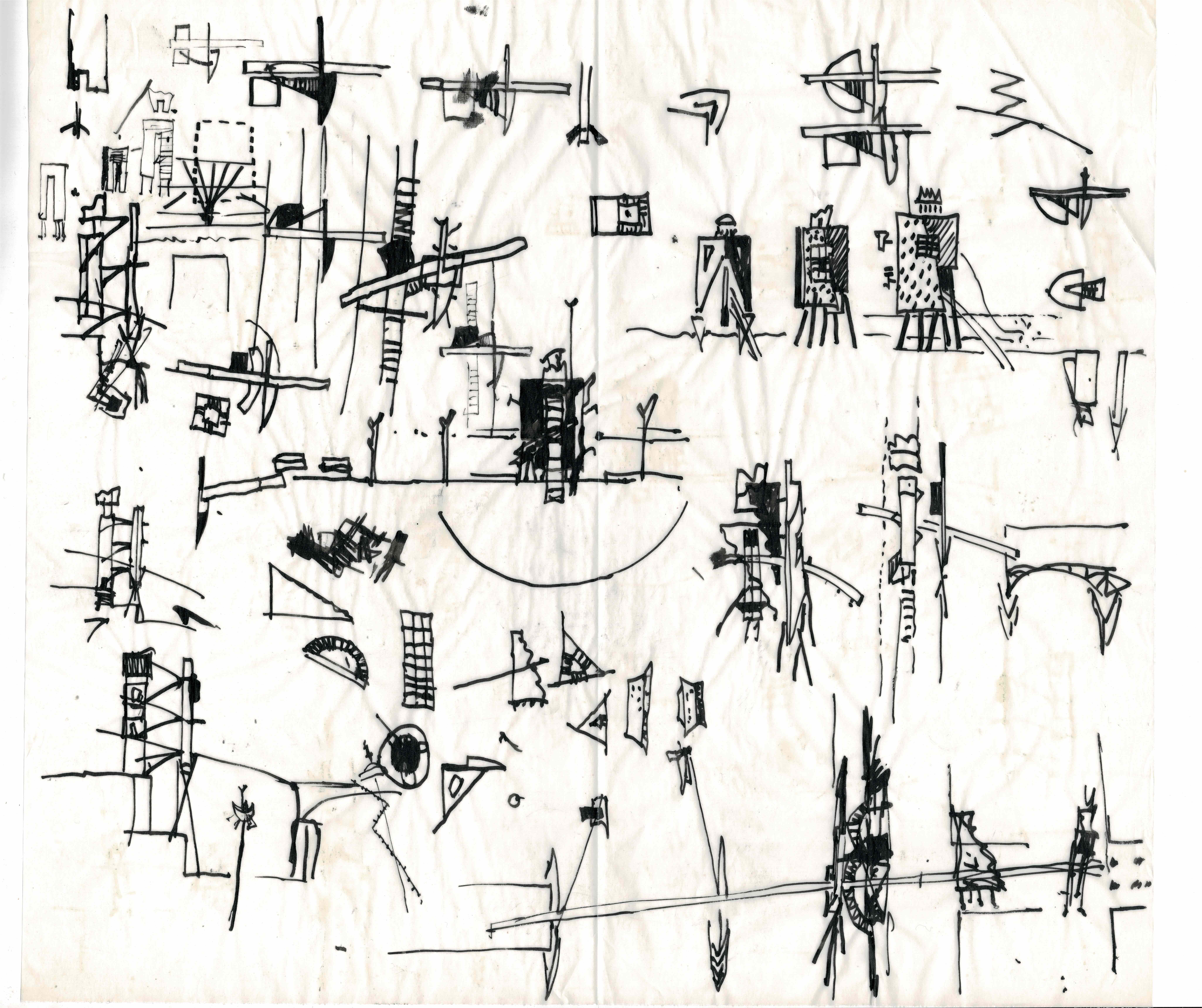
Drawing Matter holds one model, twenty three sketches, and five presentation drawings of Wilson’s 1982 response to a request by the French magazine L’Ivre de Pierre for a project about Paris. Wilson proposes a redevelopment of the Pont des Arts bridge in Paris. The pedestrian cast-iron bridge, originally built in 1804, had suffered severe damage from barge collisions.
Wilson introduced, through his proposal what he referred to as the ‘frame and adjacency theory’: the idea that fragments of the ruined bridge could act as the frame around which secondary narrative elements could operate. The bridge remains and floating signifiers are bracketed by two identical towers, each with its own screen; the towers were ‘Postcard Museums’.
SKETCHBOOKS, 1984
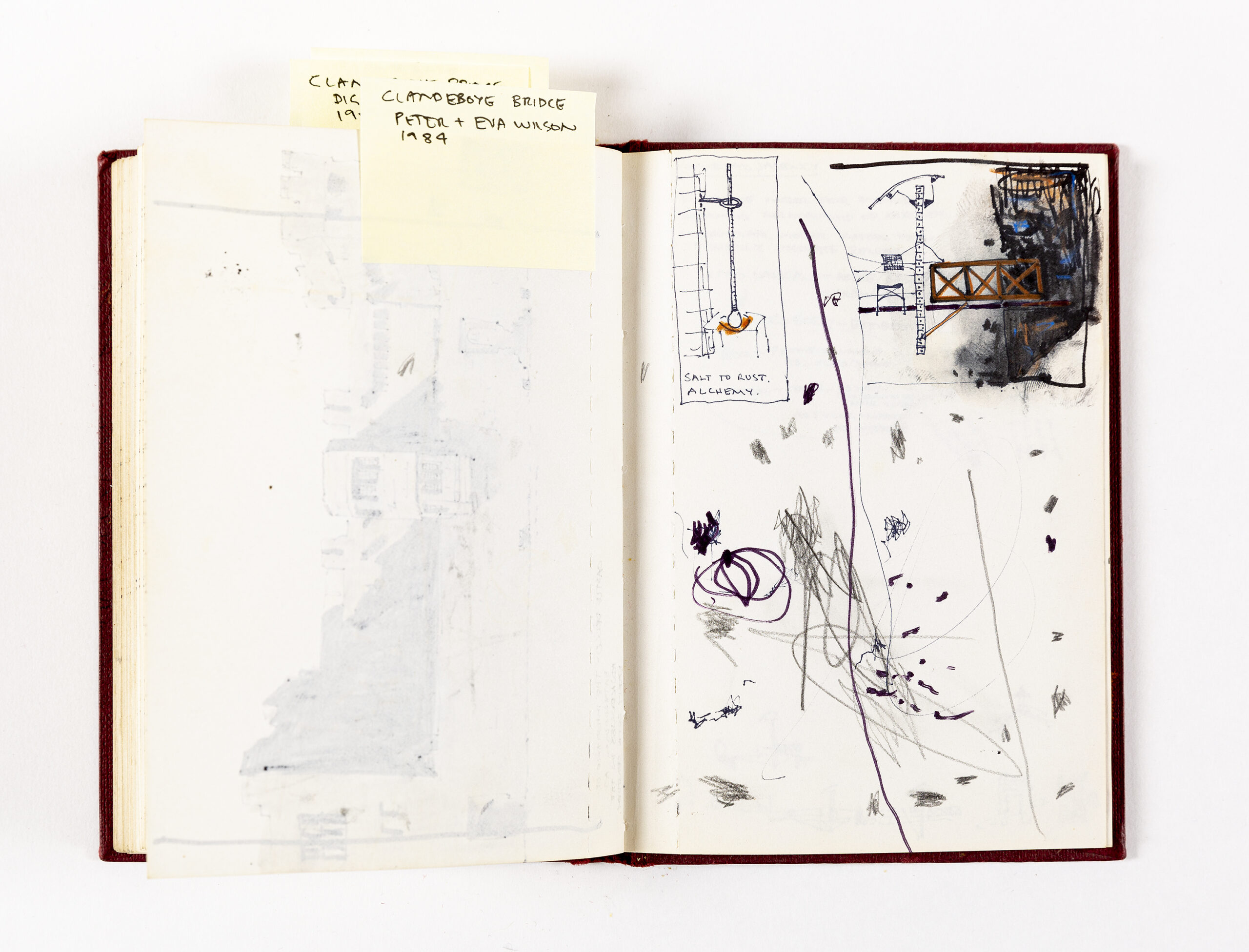
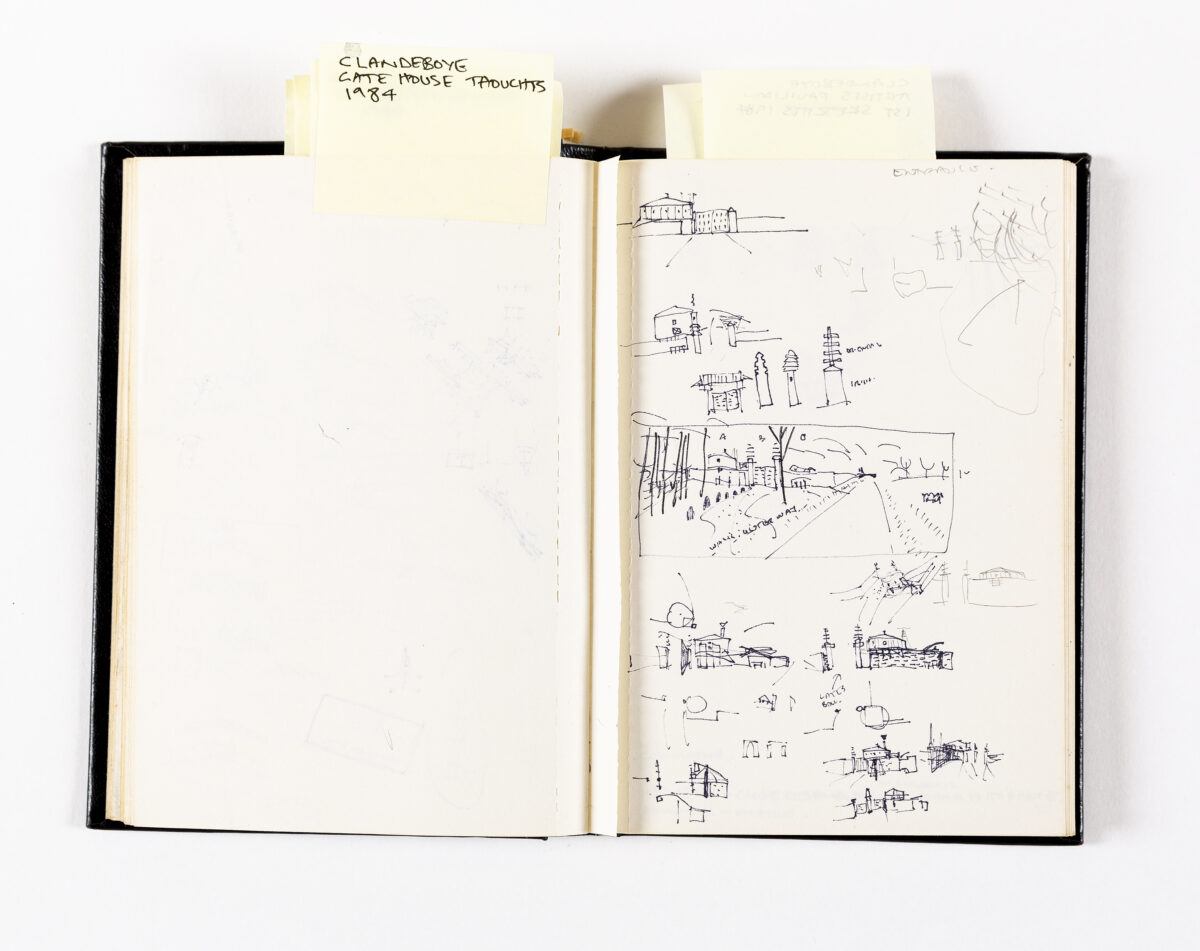
The Drawing Matter collection holds two sketchbooks by Peter Wilson from 1984: one from March and one from July. They encompass multiple projects, but both include sketches for Clandeboye.
CLANDEBOYE, 1984
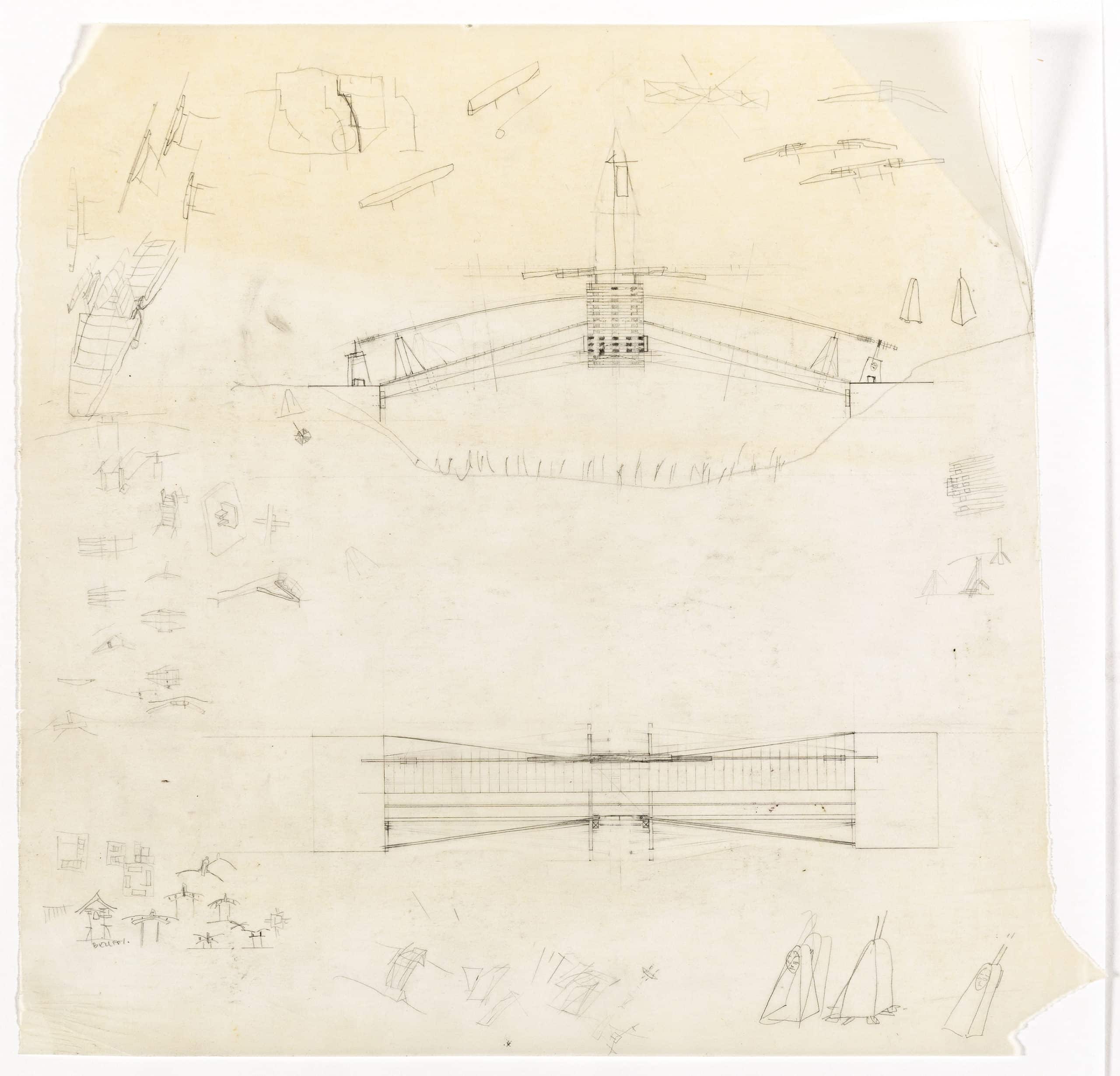
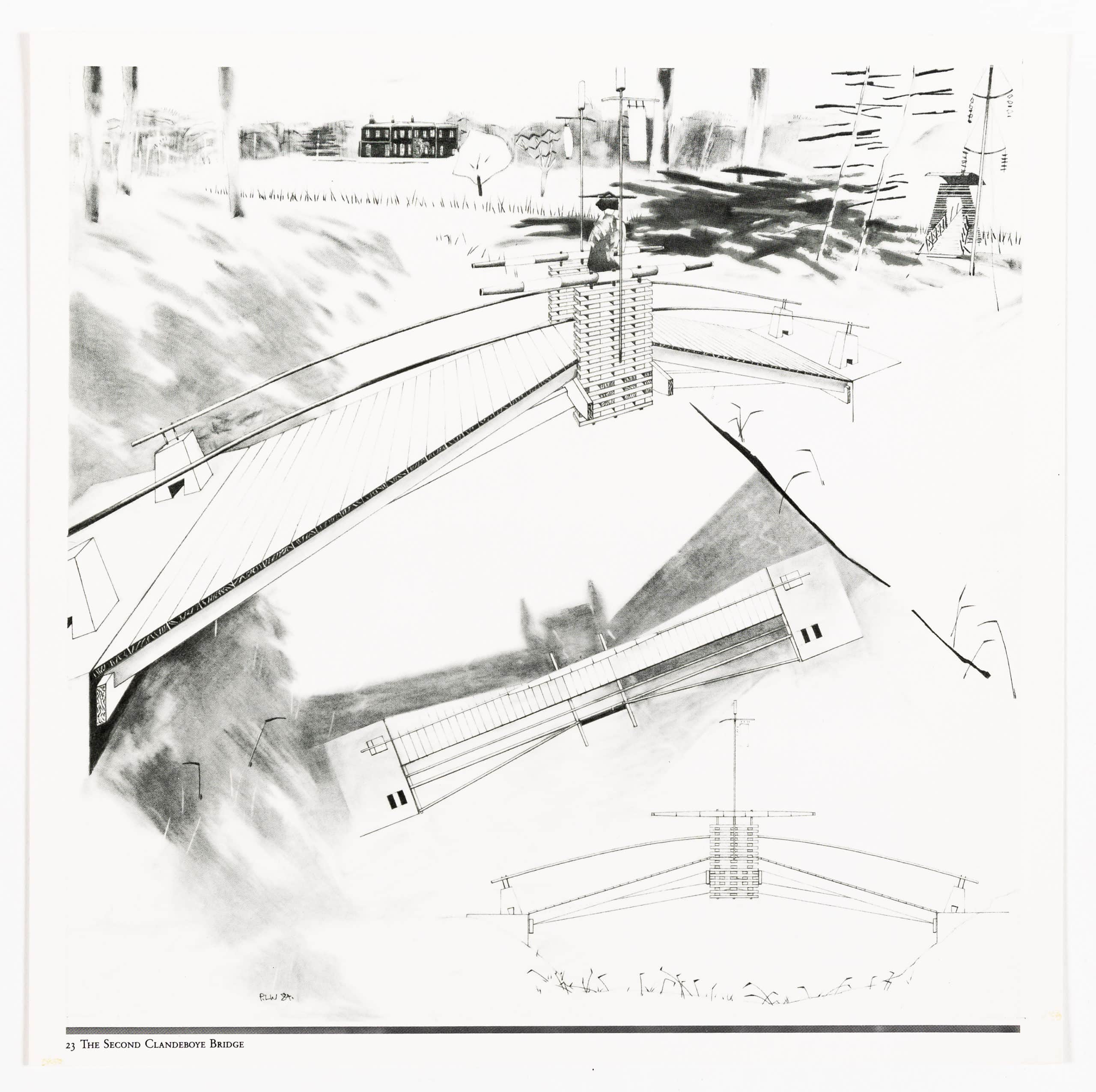
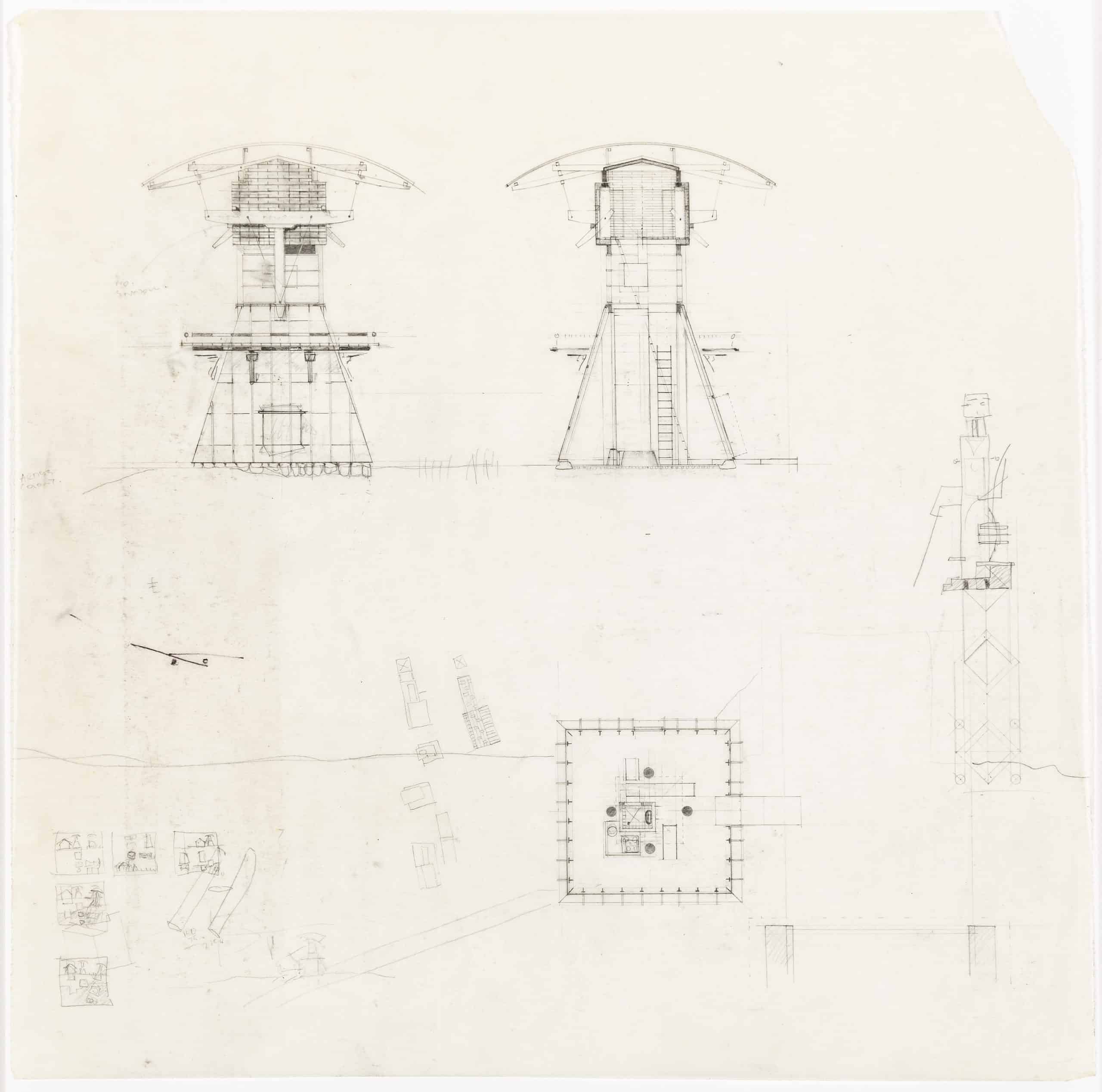
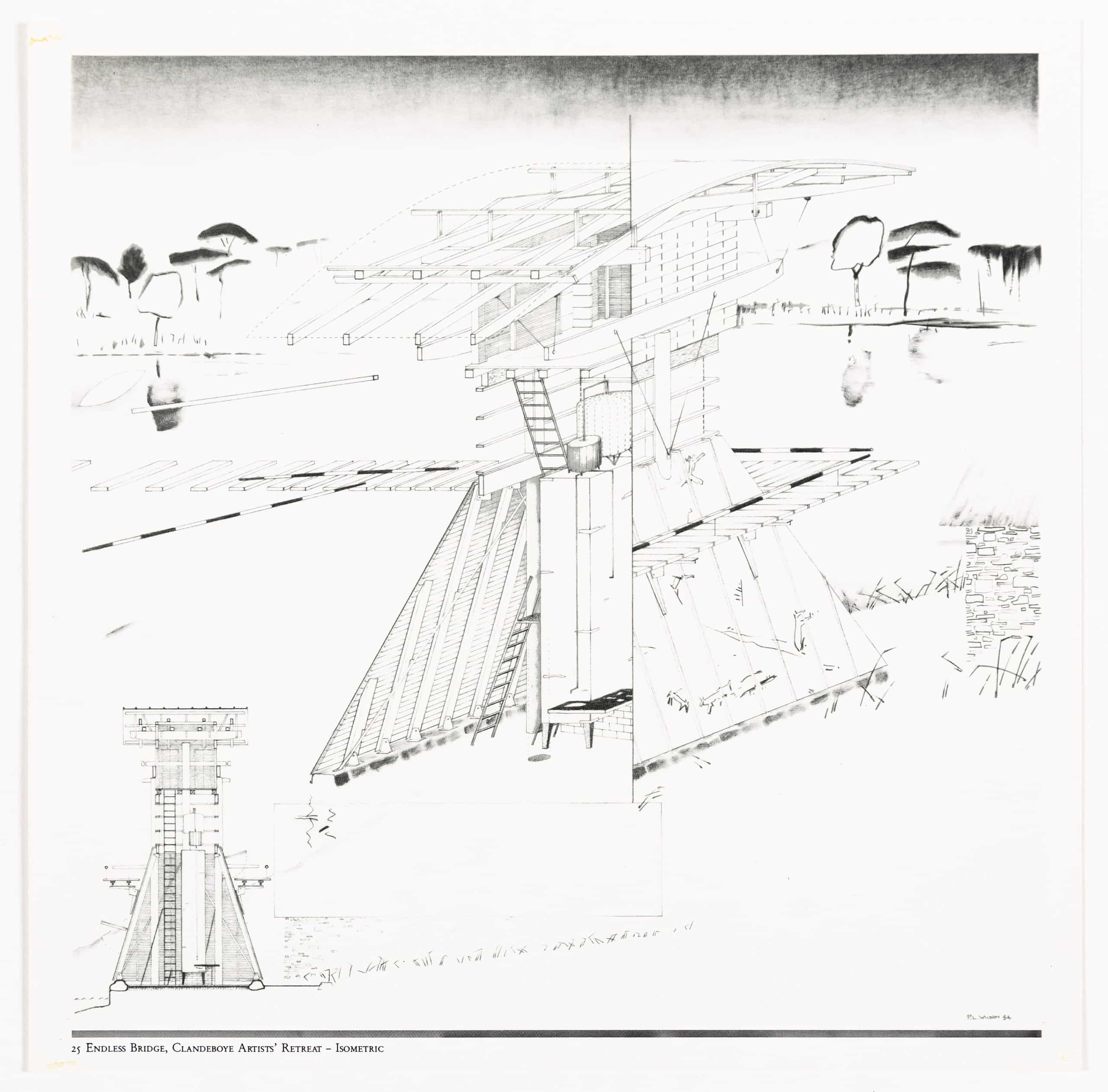
In 1984, Wilson and his AA diploma students envisaged structures to be embedded into the Clandeboye estate in Northern Ireland; to re-evaluate the role of the country house in contemporary culture. Wilson’s work for the project resulted in a series of ideas, a gate house, two bridges, and two artist residences, which Wilson rendered with a Japanese cloud-and-smoke technique. The site was given by the AA’s director Alvin Boyarsky, who was in search of patronage for the school with the owners of the estate, Lord and Lady Dufferin. Drawing Matter holds drawings from all stages of its progress, from sketches, preparatory compositions, and prints to paintings.
Find a description of the project in Wilson’s own words here.
PONTE DELL’ACCADEMIA, 1985-1986
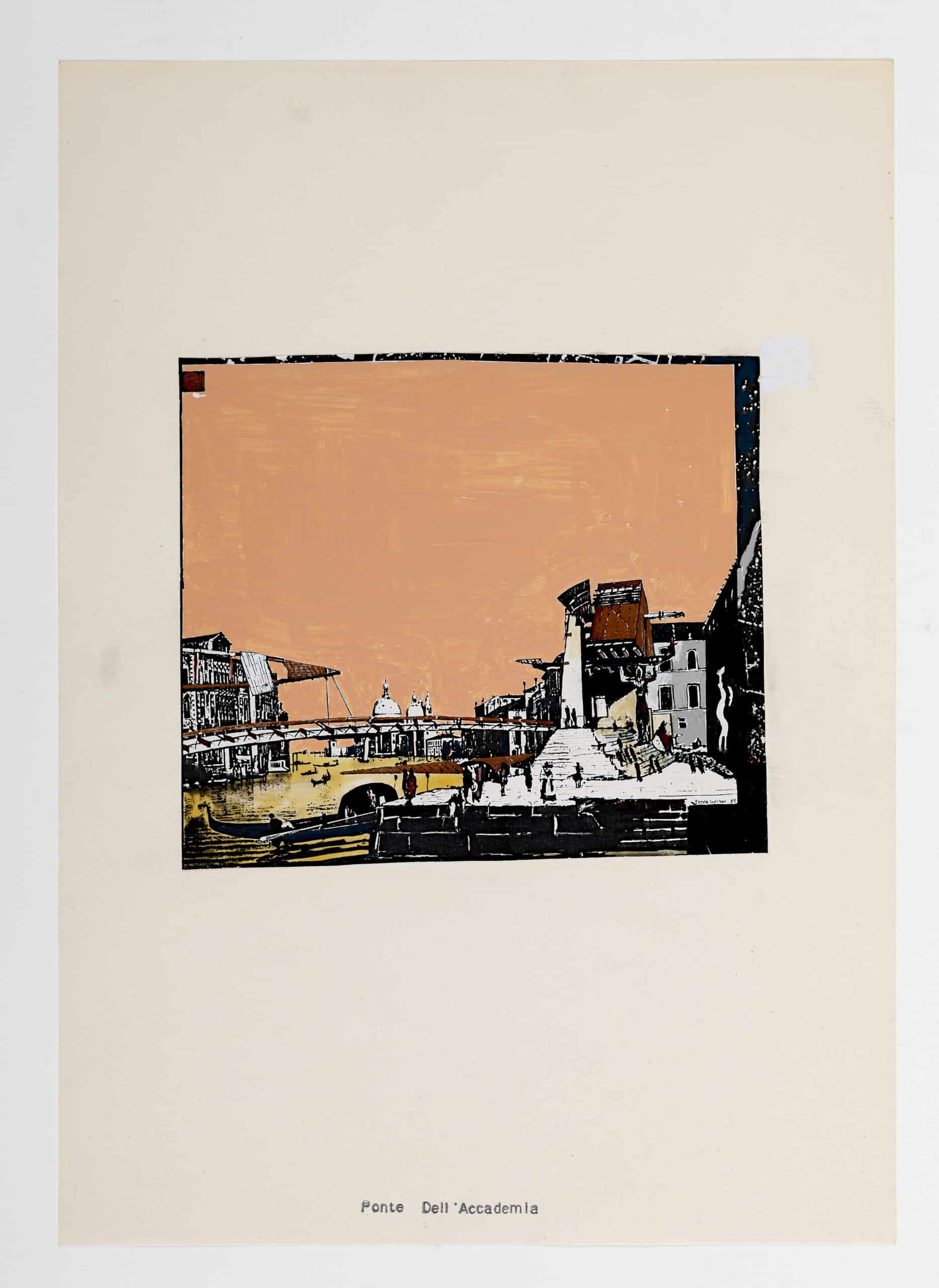
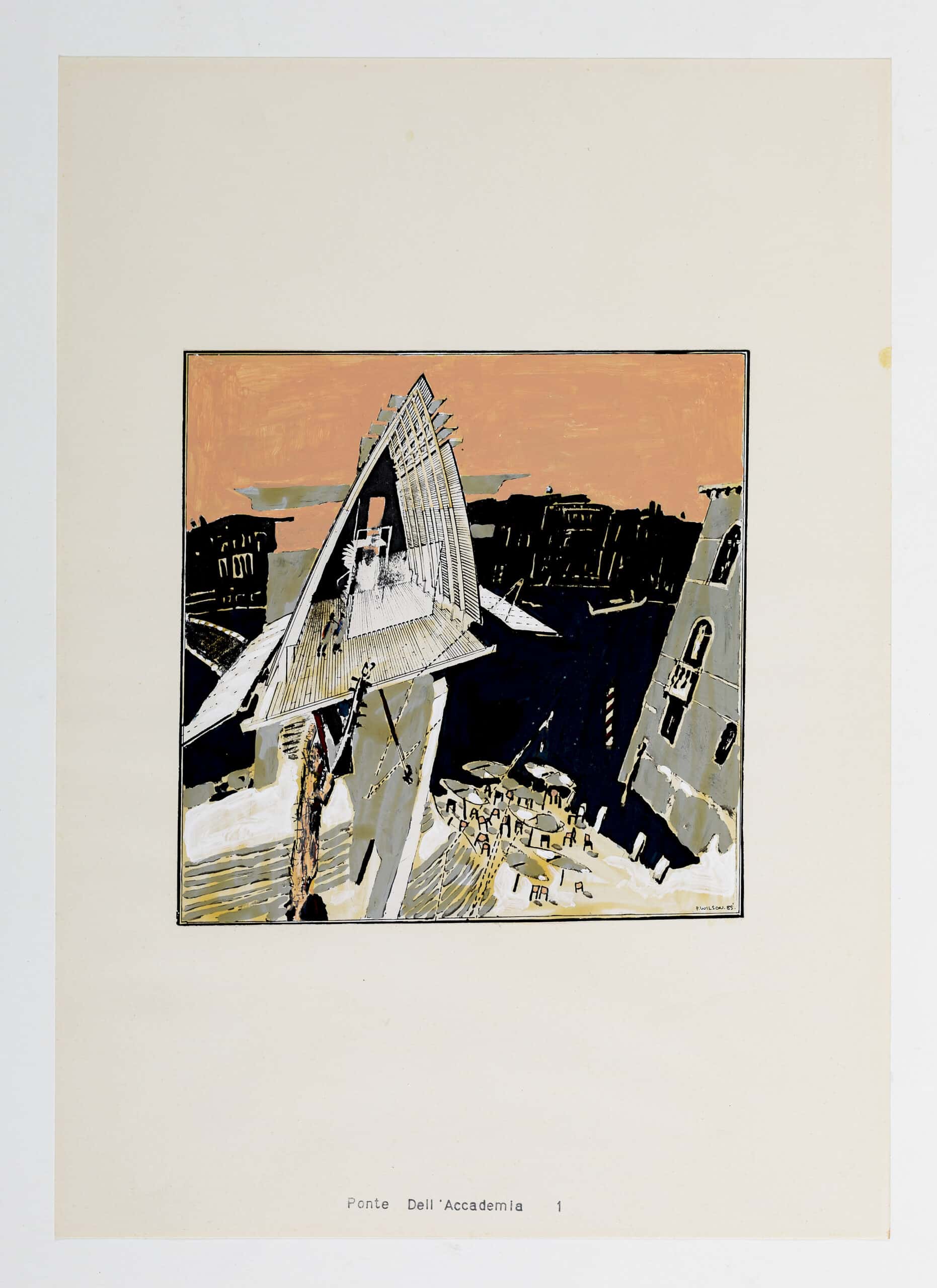
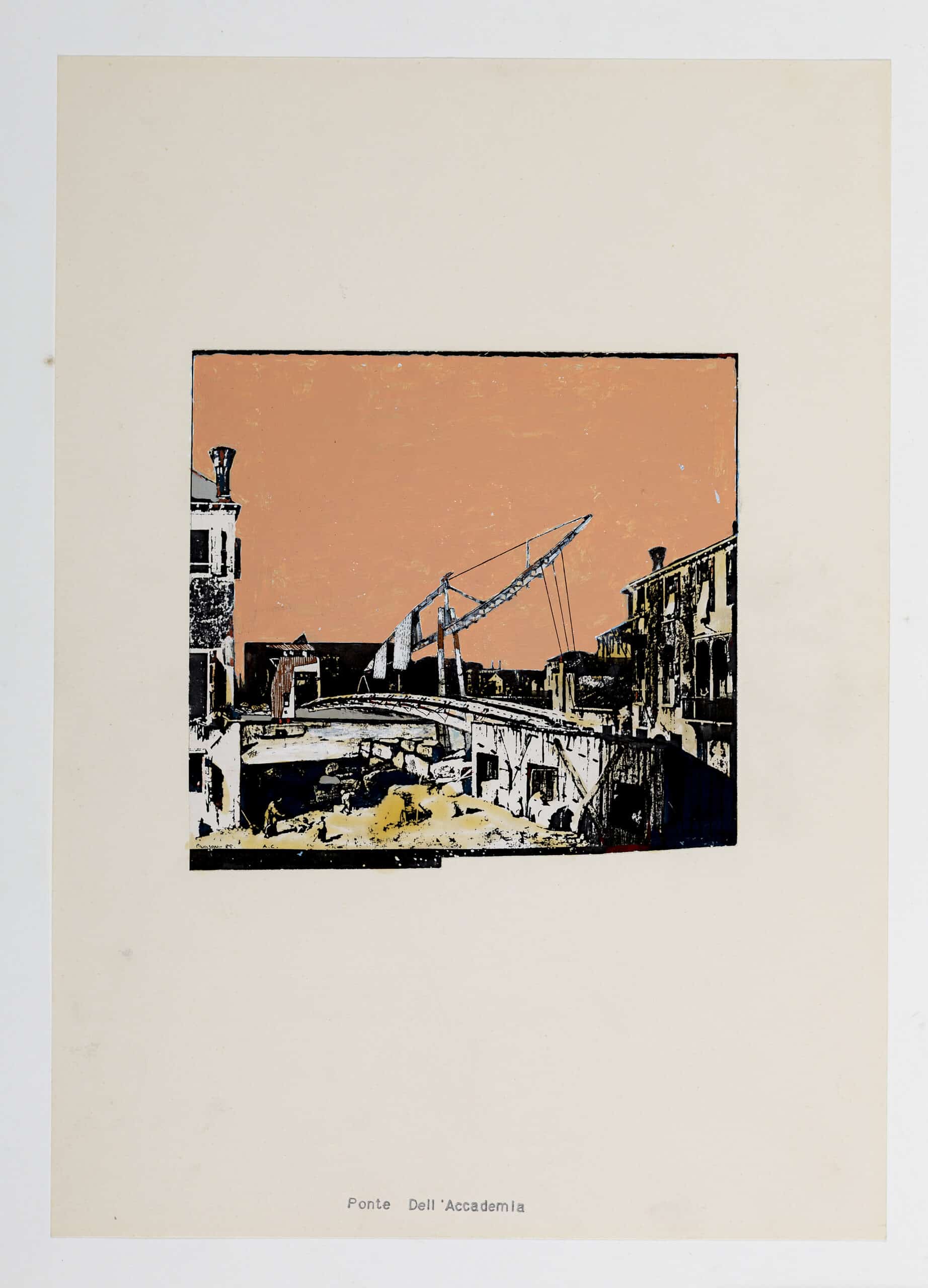
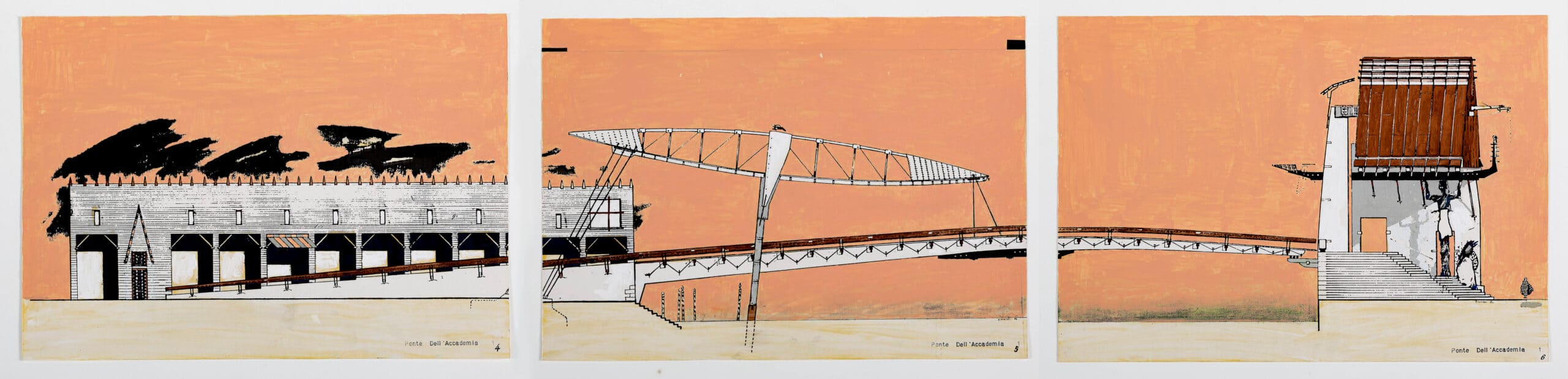
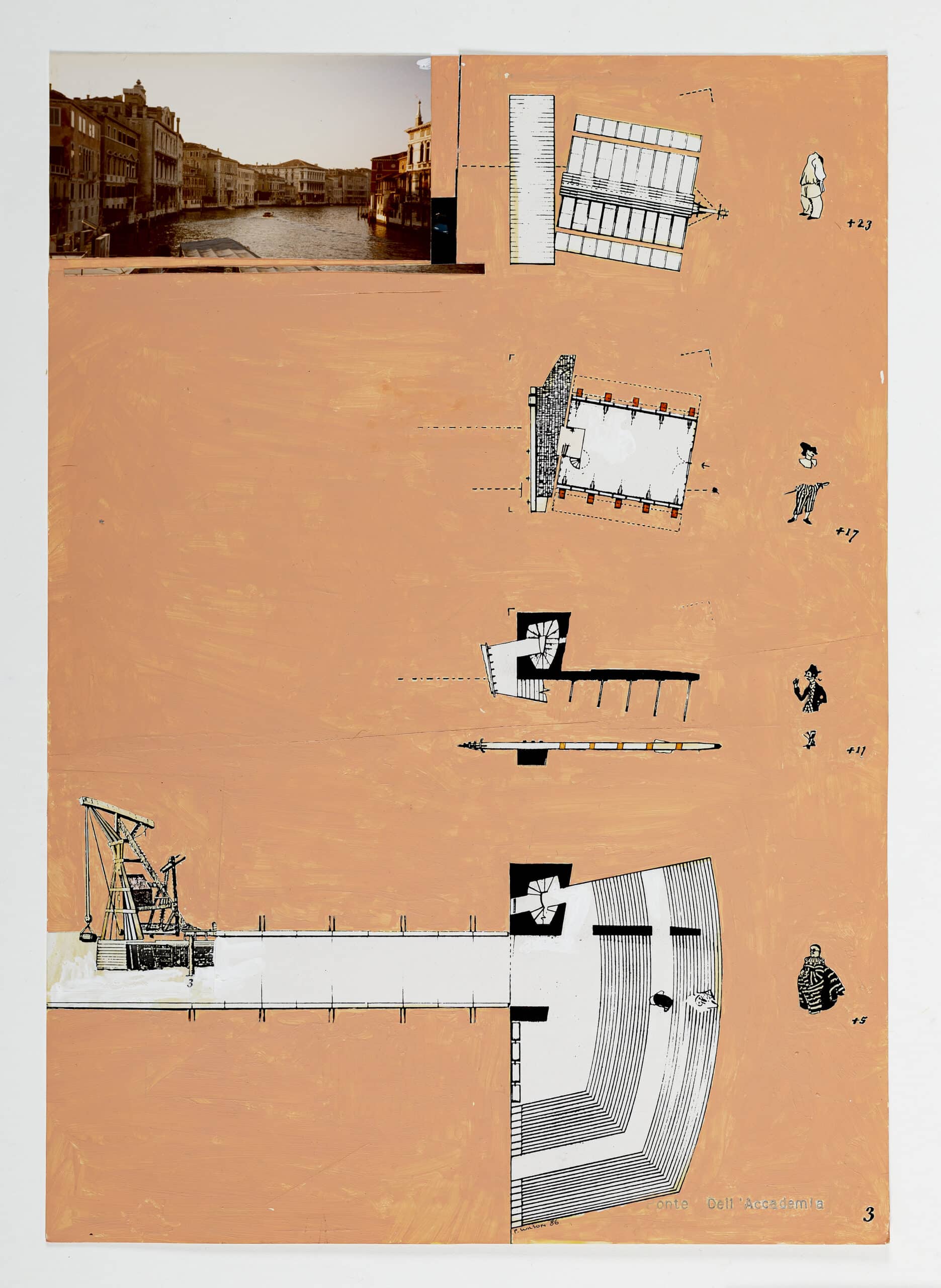
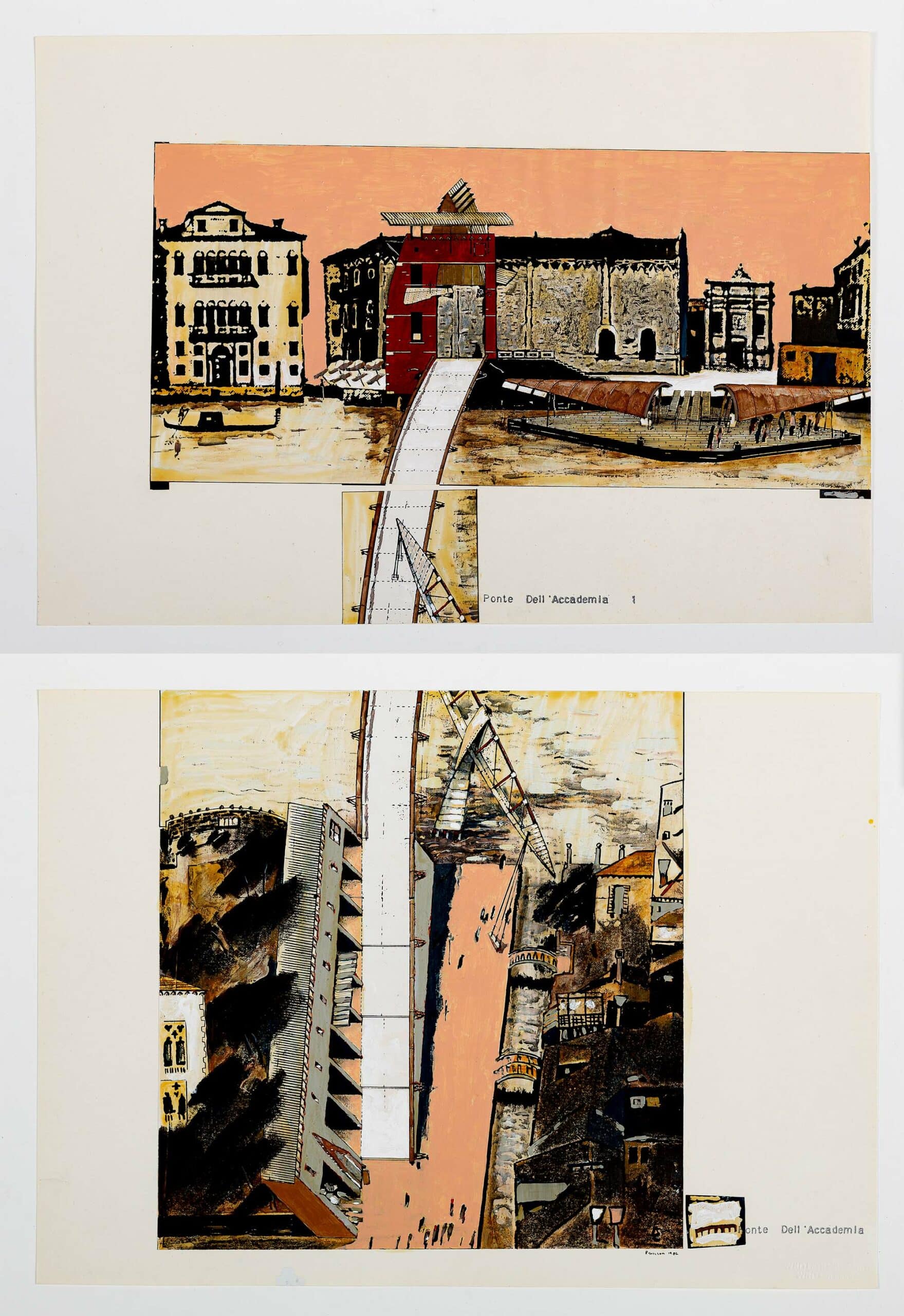
Drawing Matter holds twelve presentation drawings for Wilson’s entry to the Third International Architecture Exhibition of the Venice Biennale, held in 1985. The biennale was curated by Aldo Rossi on the theme of upgrading ‘specific areas of Venice and its hinterland’, including Eugenio Miozzi’s timber Ponte dell’Accademia. The timber bridge had been conceived as a temporary solution that anticipated a more permanent stone structure. Wilson proposed an assemblage of pieces: a market wall, a flying truss, a public palazzo, a raised copper-clad Biennale gallery supported on the sculptural figure of a ‘guardian’, a new performance space by the entrance steps, and a ship-shaped vaporetto stop. These are examples of what Wilson at the time referred to as ‘adjacencies’, highly articulated figurative elements, each speaking their own language and engaging with a localised condition both functionally and poetically.
Materially, the drawings are divided between the historic and the proposed; the bridge is drawn with clarity, whereas the palazzi of the Grand Canal are rendered as blurred photocopies. The drawings are enveloped by a thick layer of pink paint, which Wilson states he added before giving to Drawing Matter to ‘pep-up’ the yellowing 40 year old cartridge paper.
Find a comprehensive description of the project here and here.
TOKYO OPERA, 1986
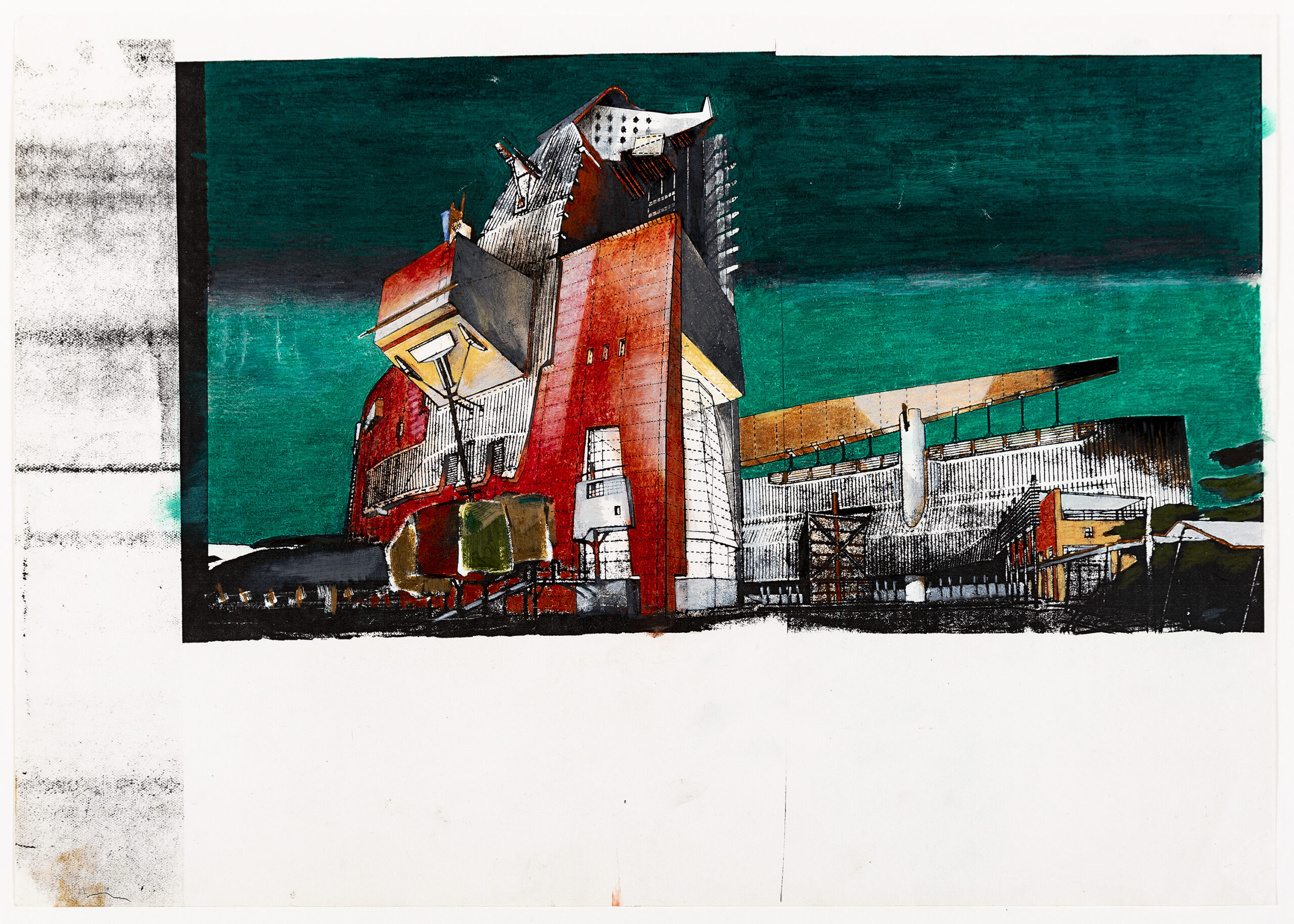
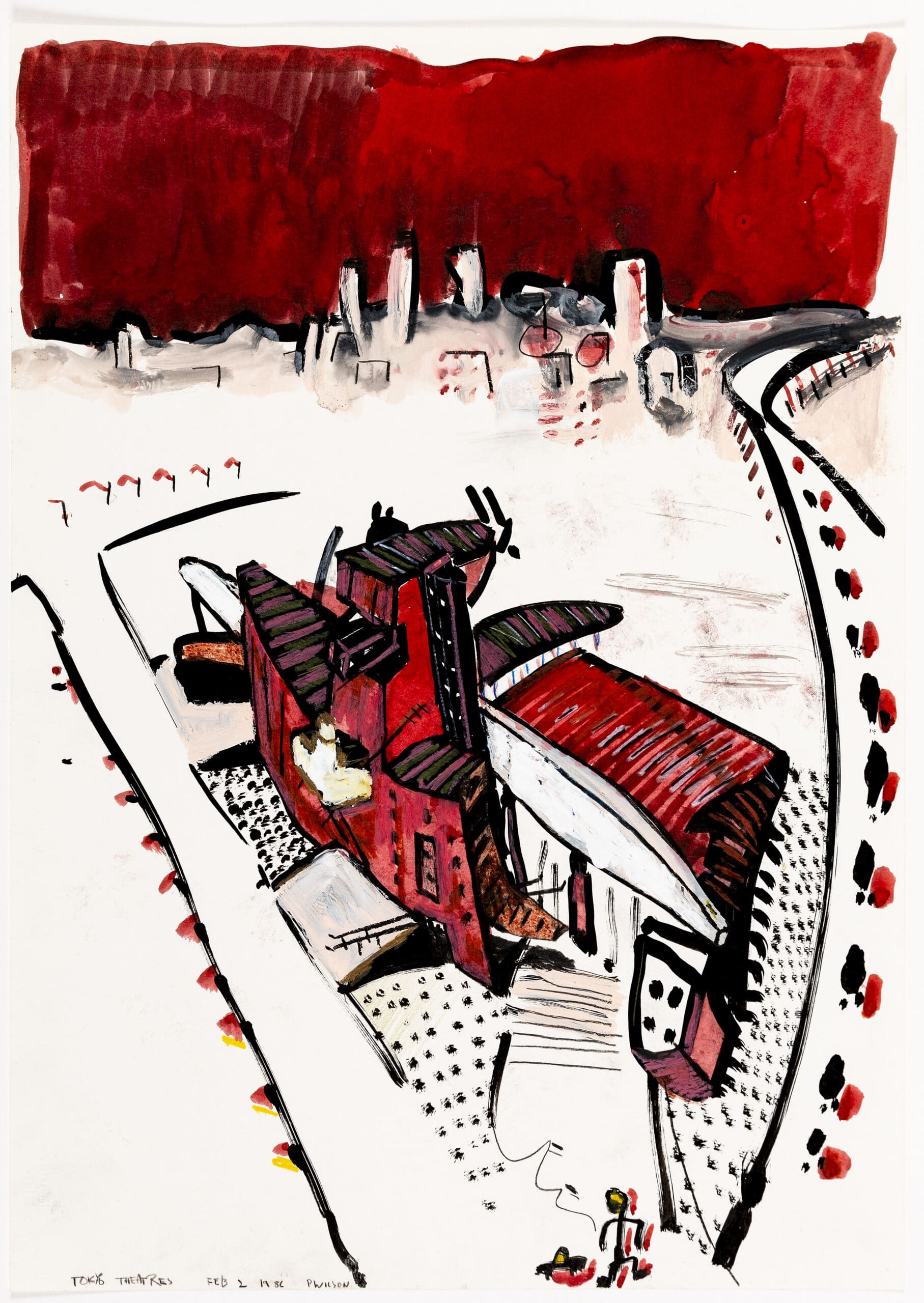
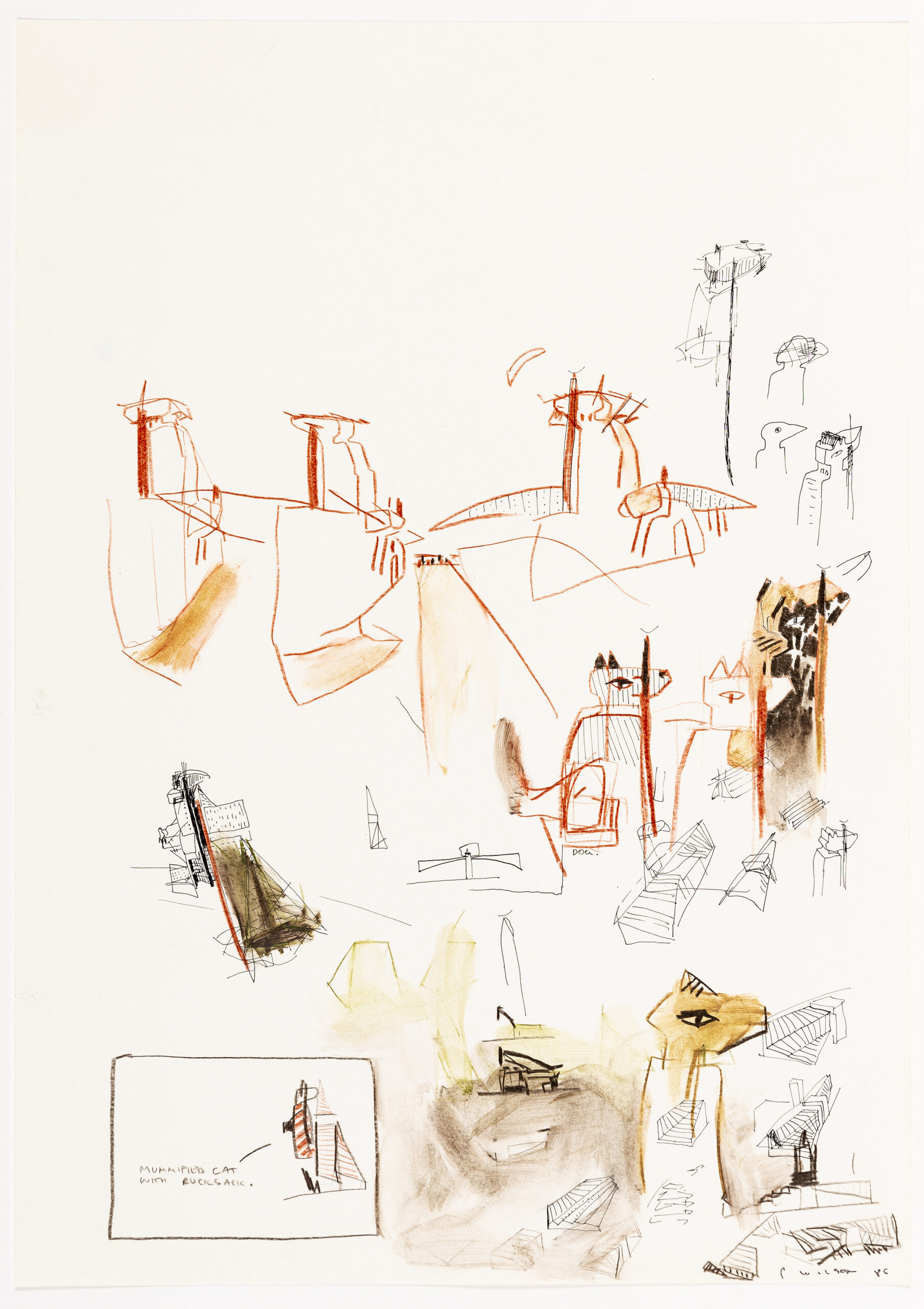
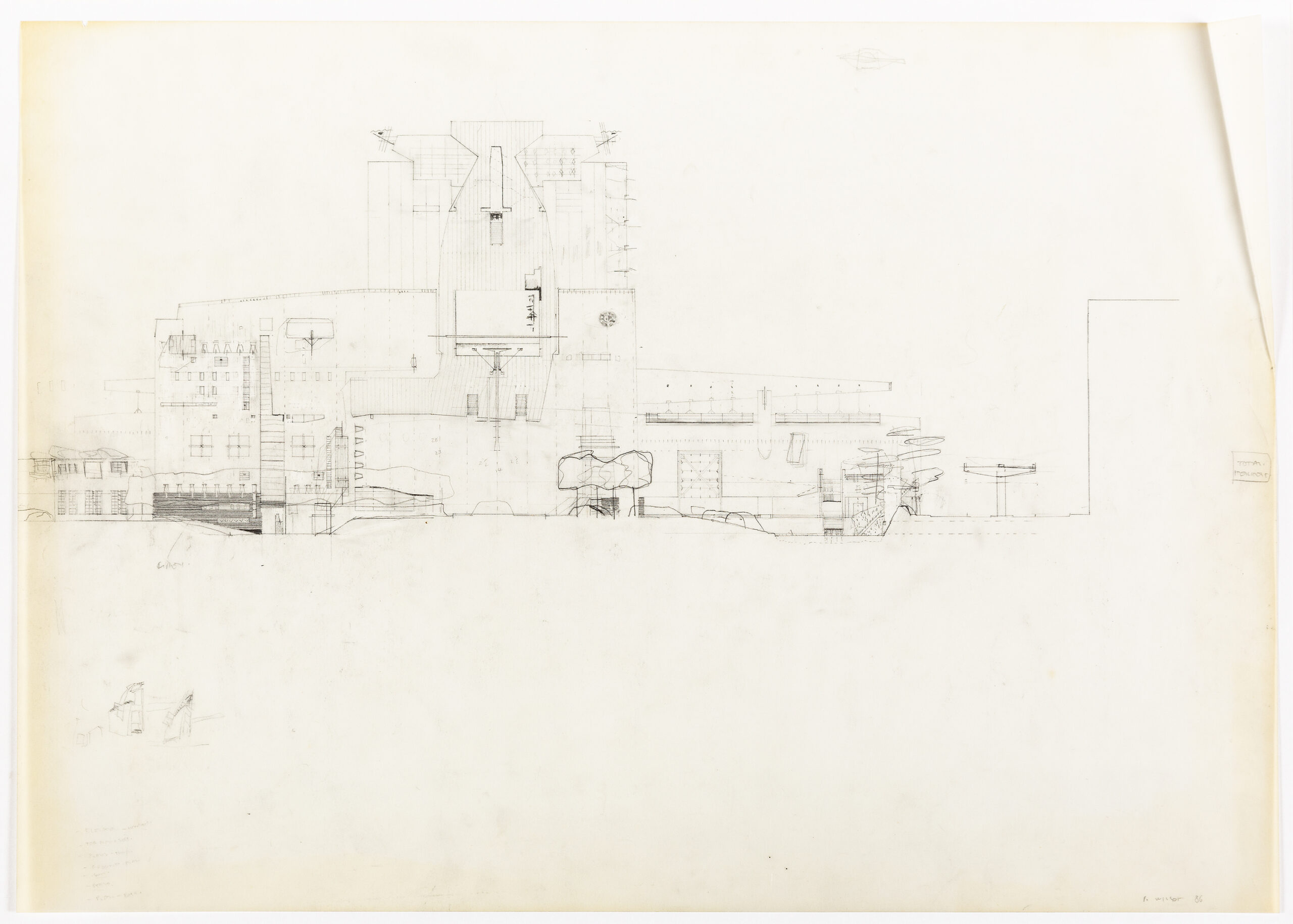
Wilson was one of 228 to enter the competition for a new national theatre and opera house in Tokyo. The project was originally for a site in Hatsudai, part of the Shibuya district in central Tokyo. Launched in 1986, at the height of the Japanese building boom, the competition attracted global attention. Wilson’s design offered a complex assemblage of forms. Wilson collaborated on the project with two of his former students, Guy Comely and Niel Porter.
BLACKBURN HOUSE, 1988
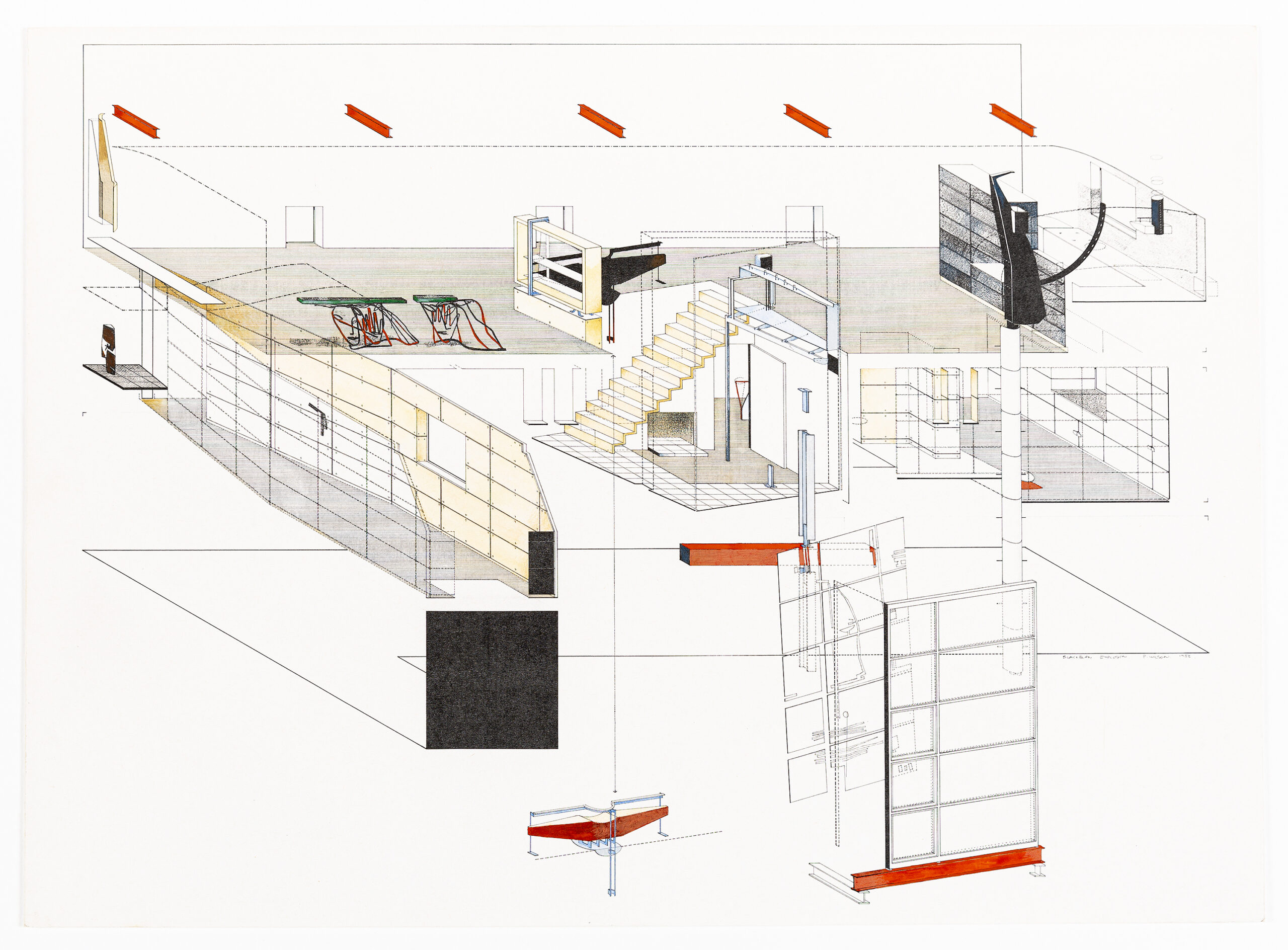
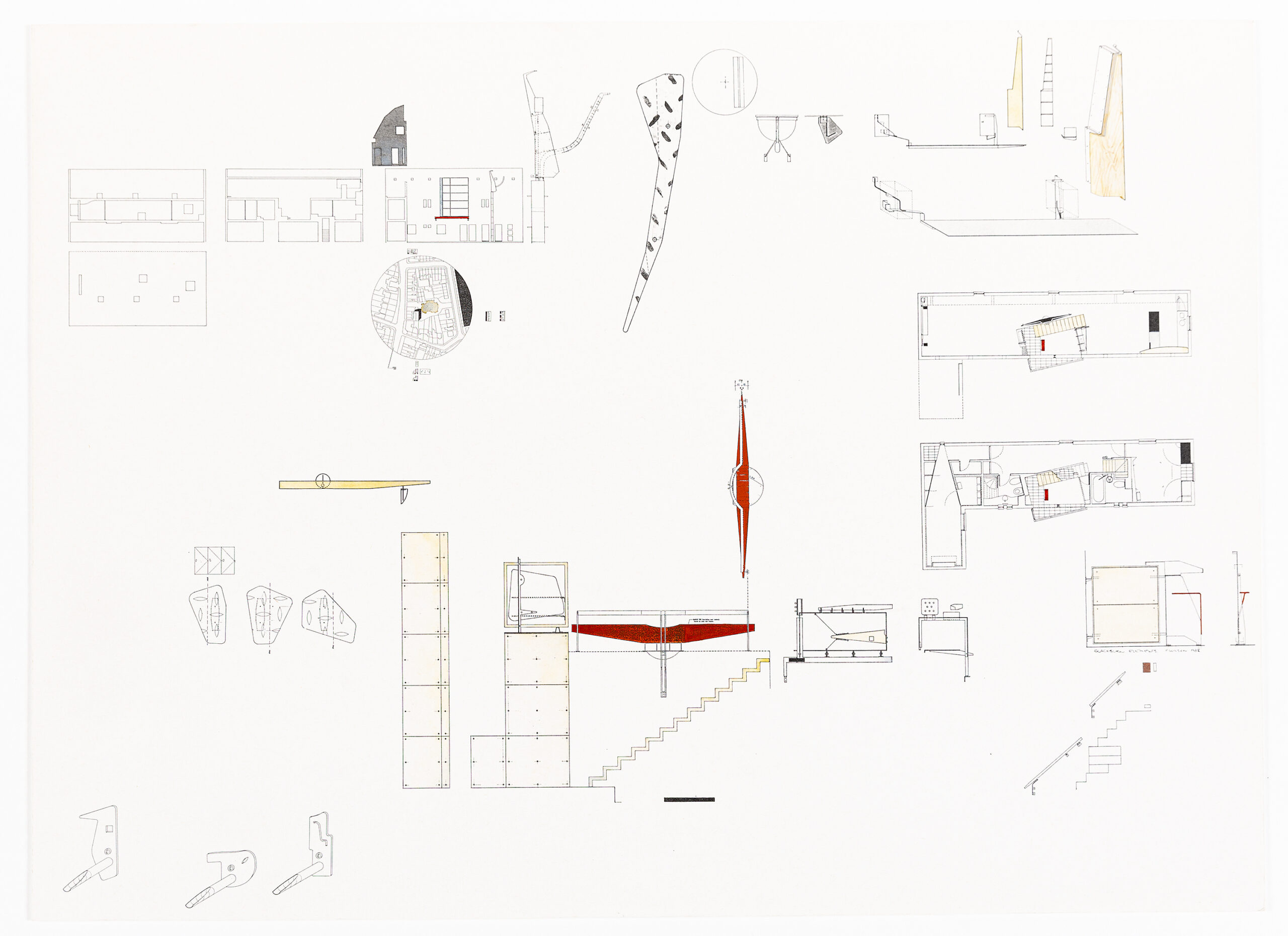
Blackburn House was a project to redevelop an existing mews house, conducted in collaboration with Chassay Wright Architects. The house plays with the frames of the original building, breaking the defined envelope of the mews by pushing a frosted glass wall into Rosslyn Mews. Built into the staircase are integrated display cases that could hold the client’s collection of works by Andy Warhol, Bruce McLean, and Ron Arad.
See more about the built project on the Bolles+Wilson website.
NINJA COMFORTABLE HOUSE, 1989
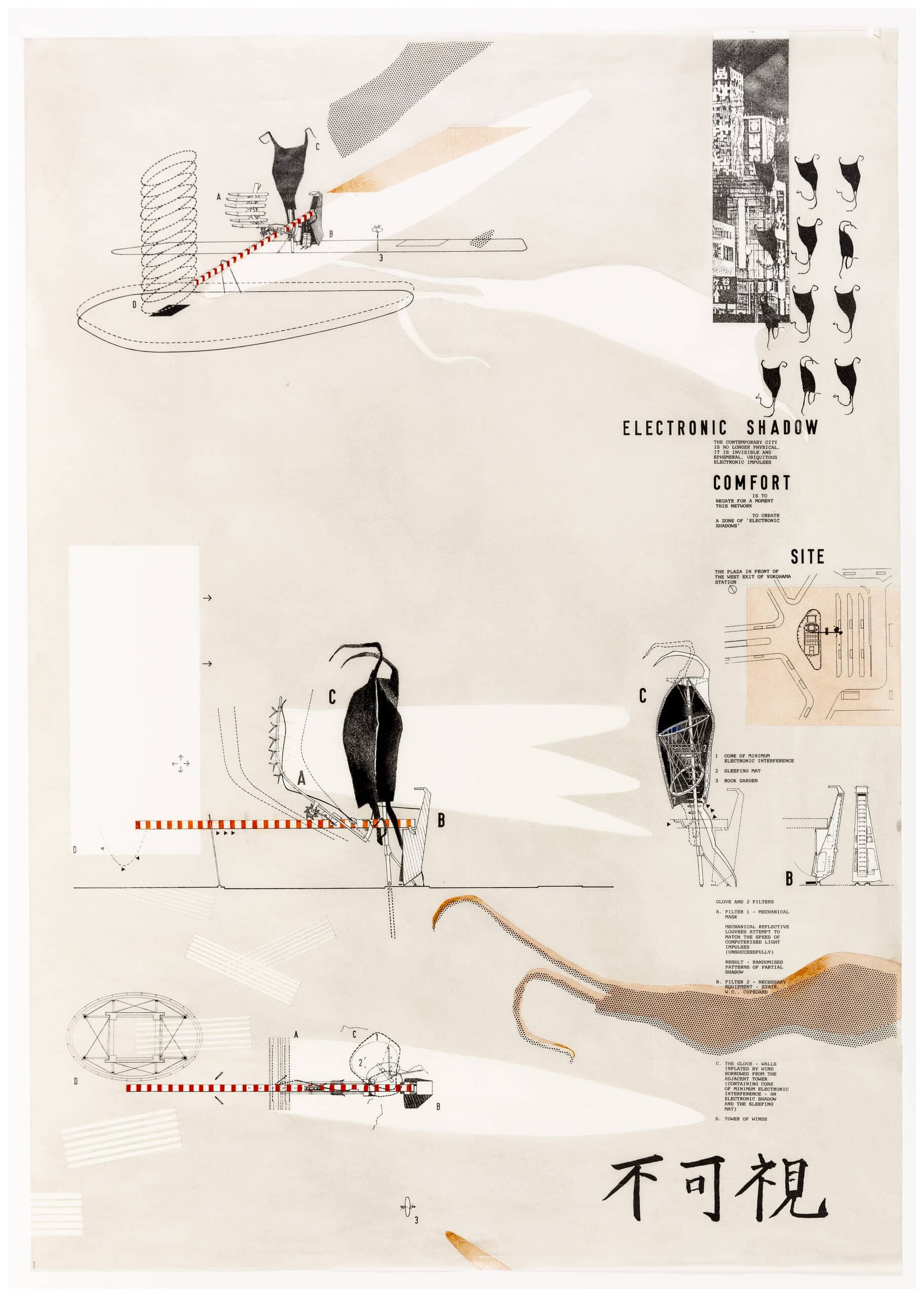
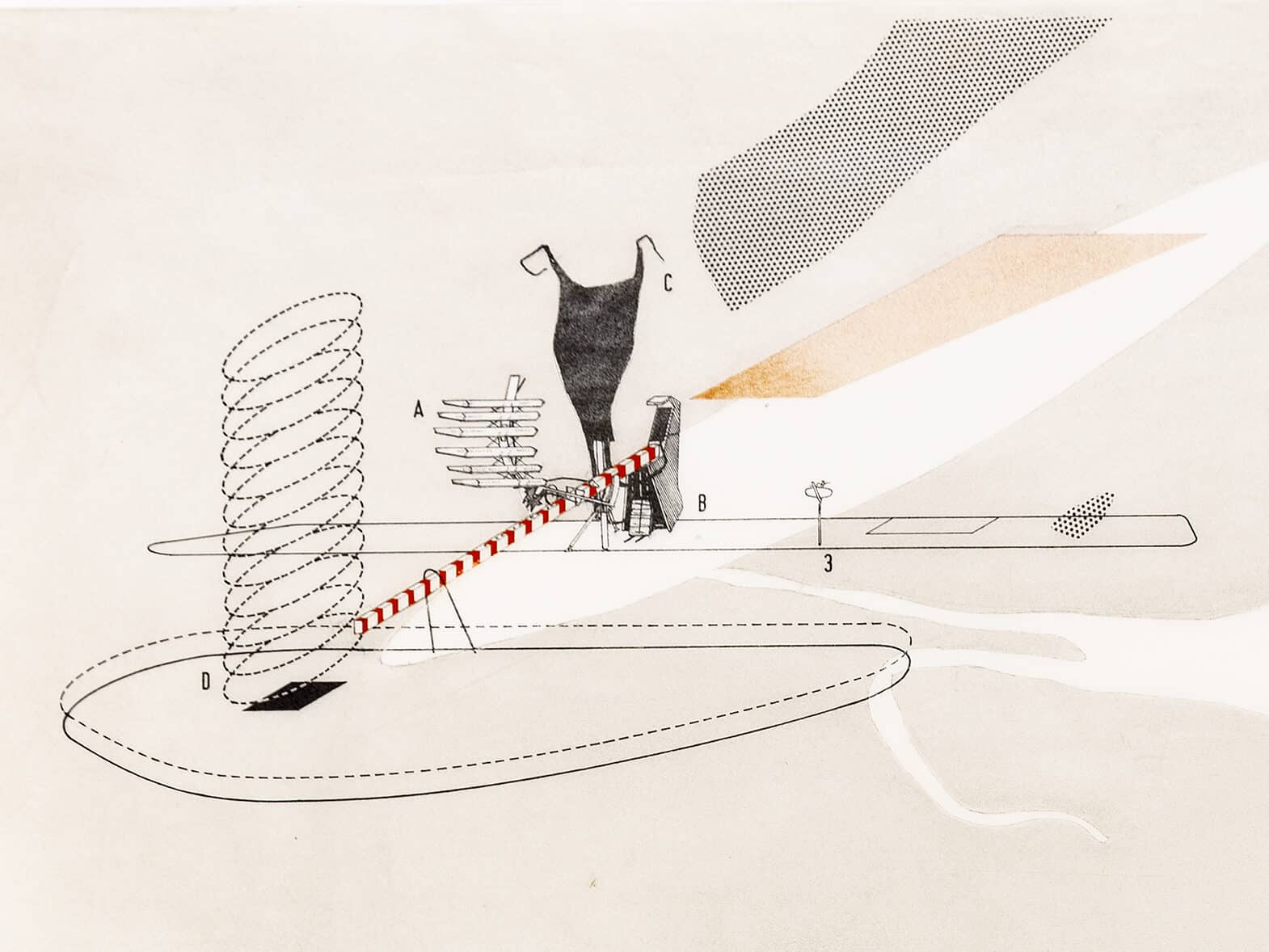
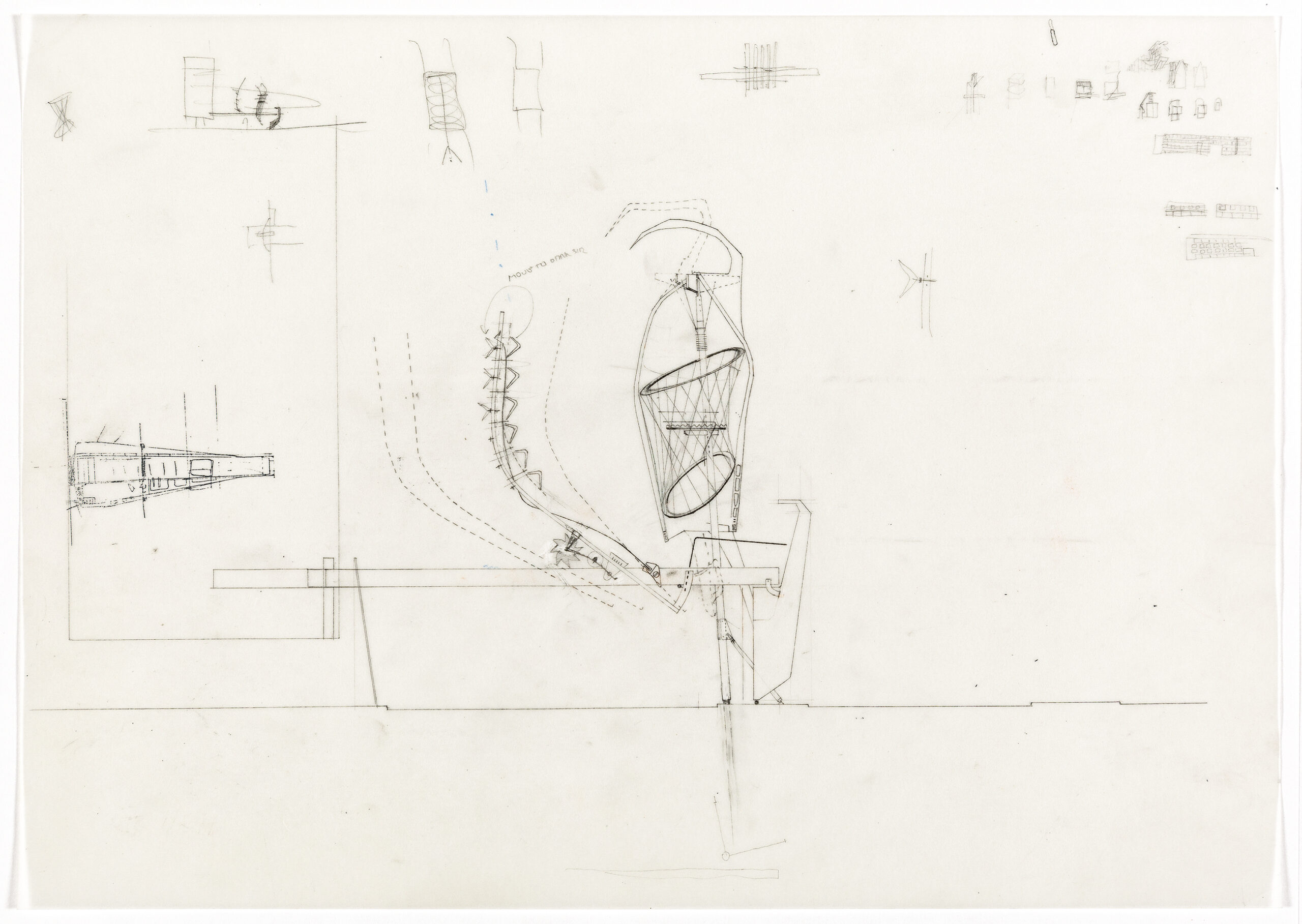
Drawing Matter holds a series of preparatory works and two presentation sheets for the Ninja Comfortable House, which won the 1989 Shinkenchiku (Japan Architect) competition; its brief set by Toyo Ito, who asked for designs for a ‘Comfortable House in the Electronic Metropolis’. Ito’s brief encompassed a significant paradigm shift by borrowing (judge) Peter Cooks Shinkenchiku theme from 10 years earlier but asking for a new digital spatiality.
Wilson locates the project in relation to Ito’s ‘Tower of the Winds’, a ventilation tower in Yokohama, and in doing so sets up an opposition between the tower’s rigidity and pulsating electronic lighting, against his proposal for a house. The Ninja Comfortable House is a ‘soft submarine’, ‘a moving shadow’ that offers a womb-like (a Farady Cage) refuge from the ‘satellite rain of digital information’ manifested in Ito’s digitally programmed traffic noise activated lighting. The form of the house has been likened to a ‘mermaid’s purse’.
Mark Dorrian writes on both of Wilson’s entries to the Shinkenchiku competition here.
COSMOS STREET, 1988-1989
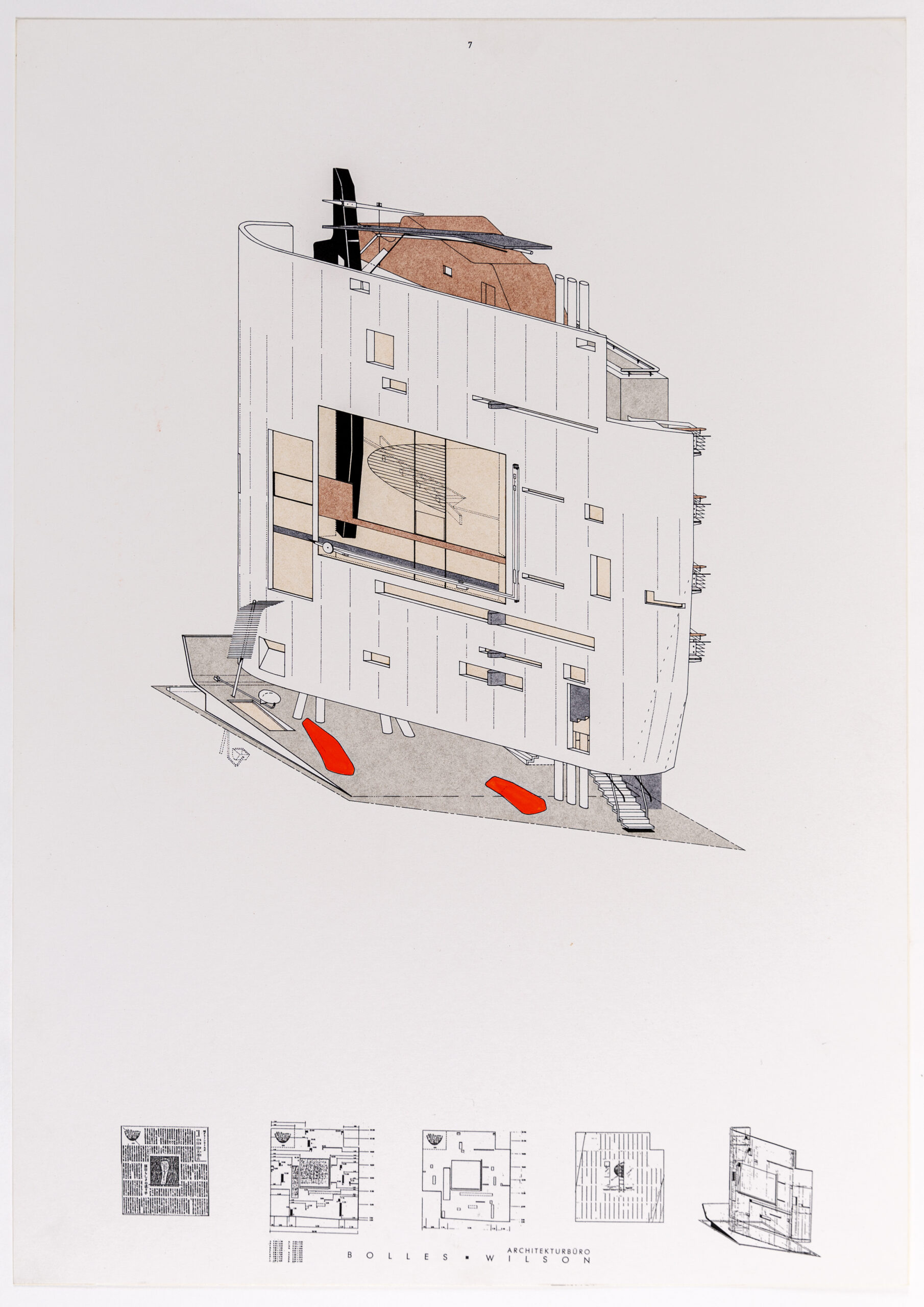
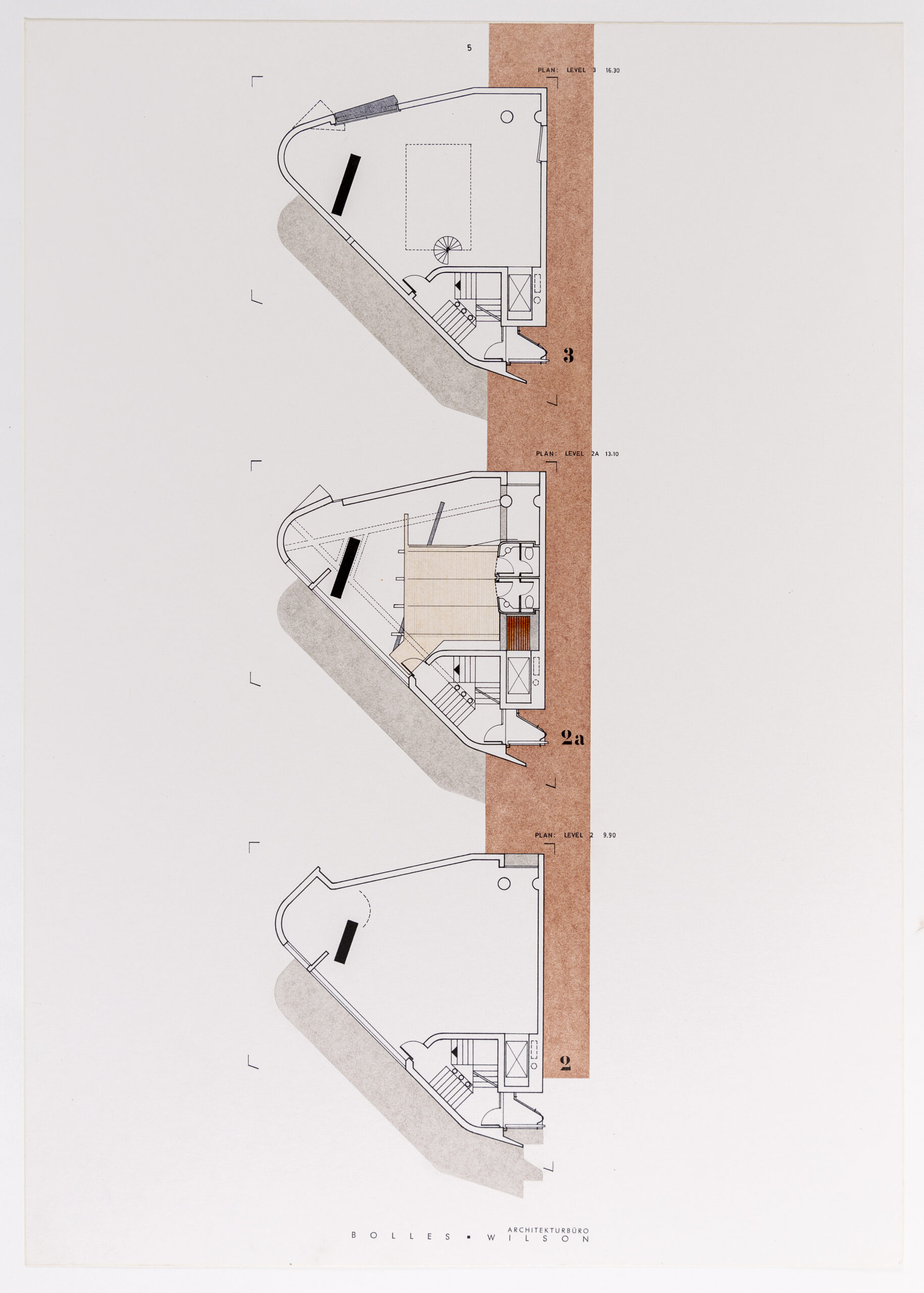
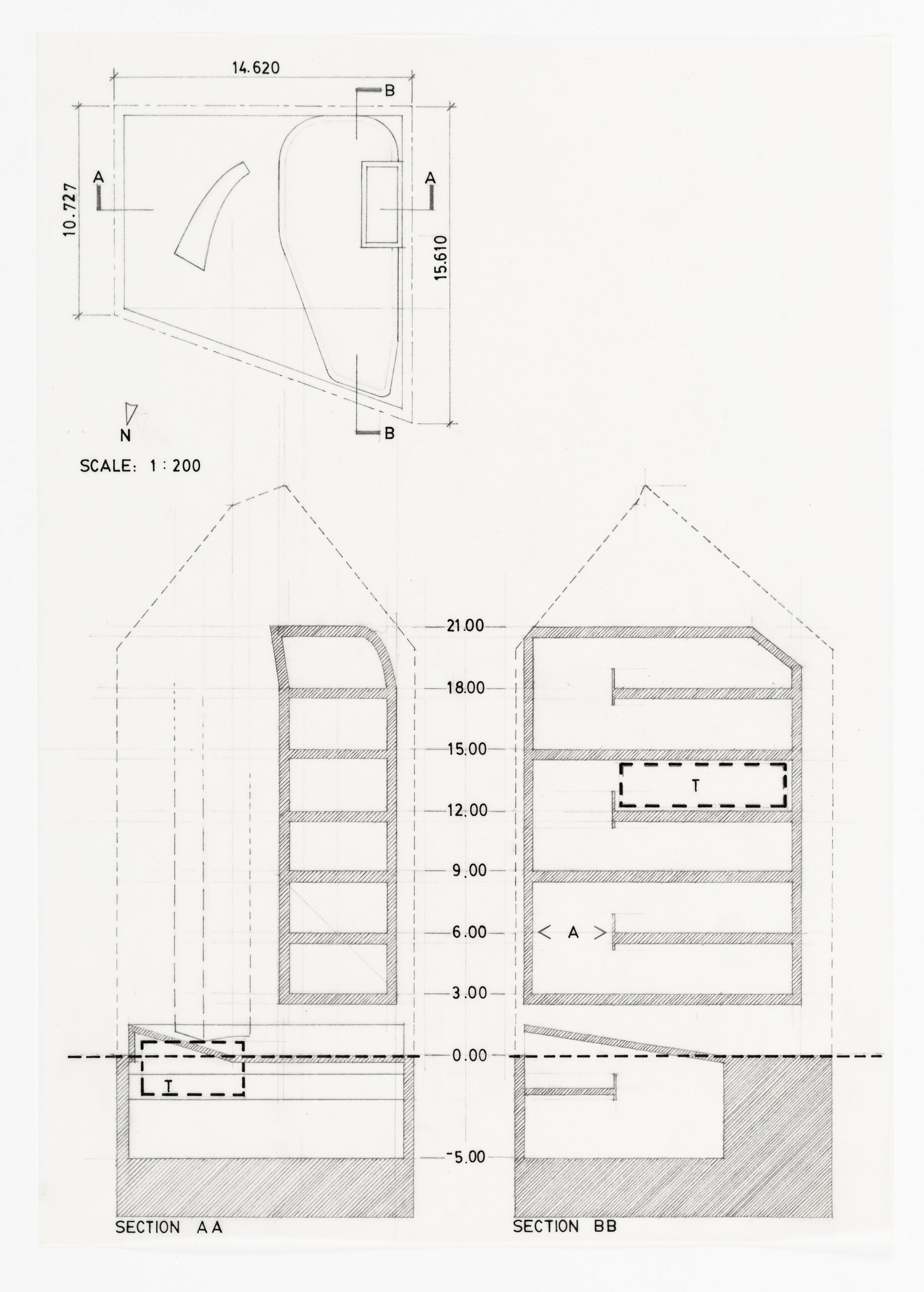
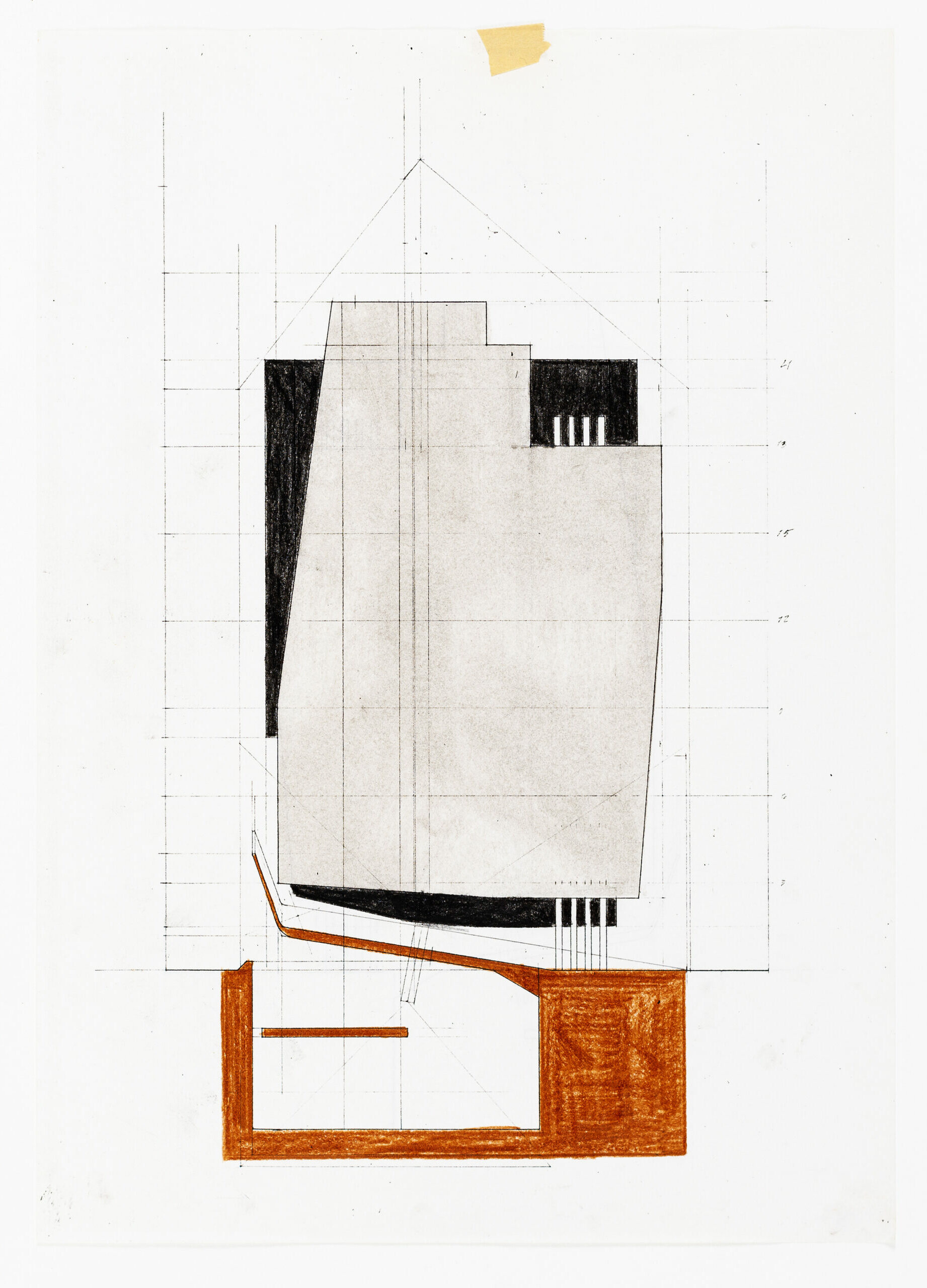
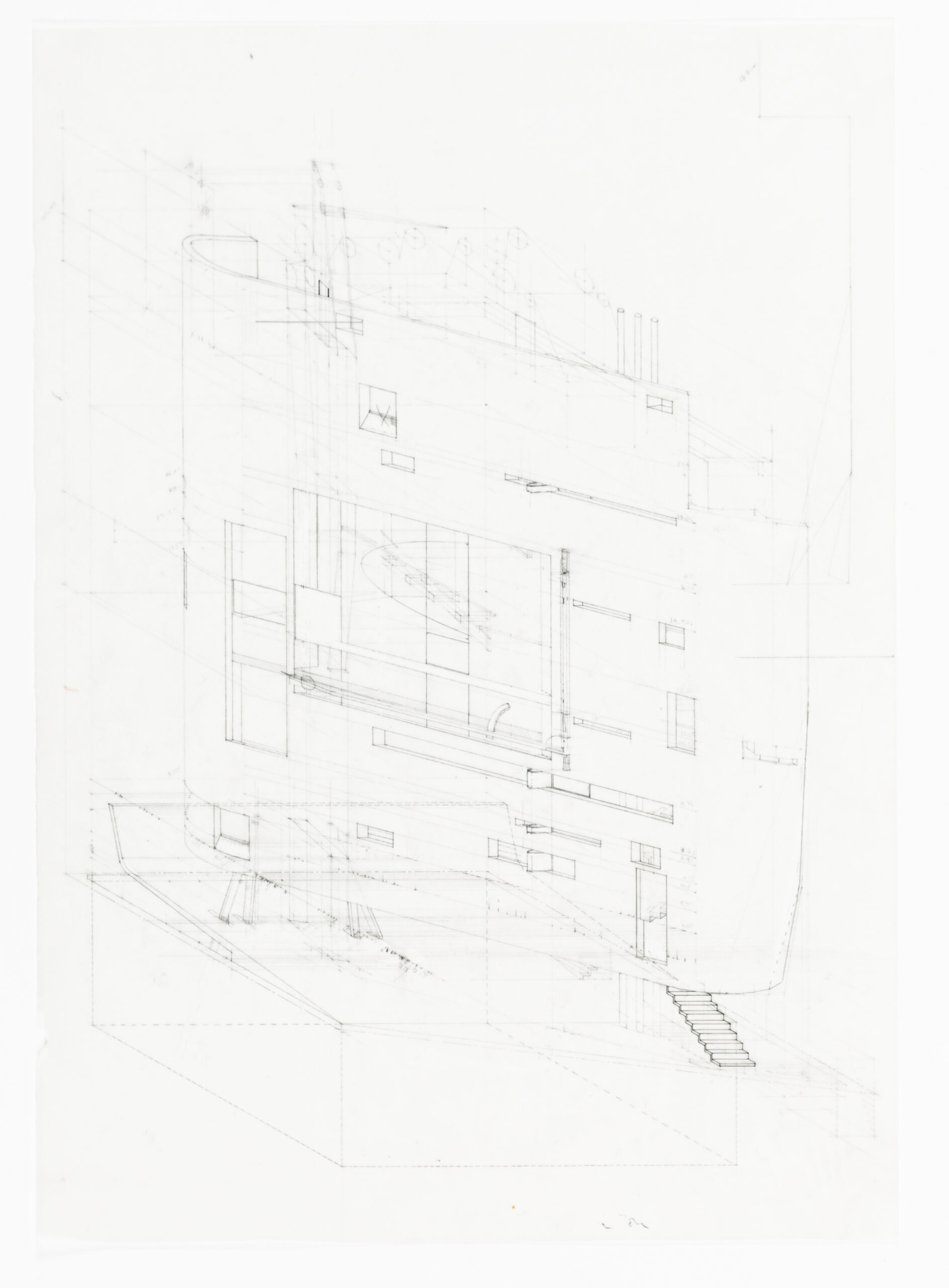
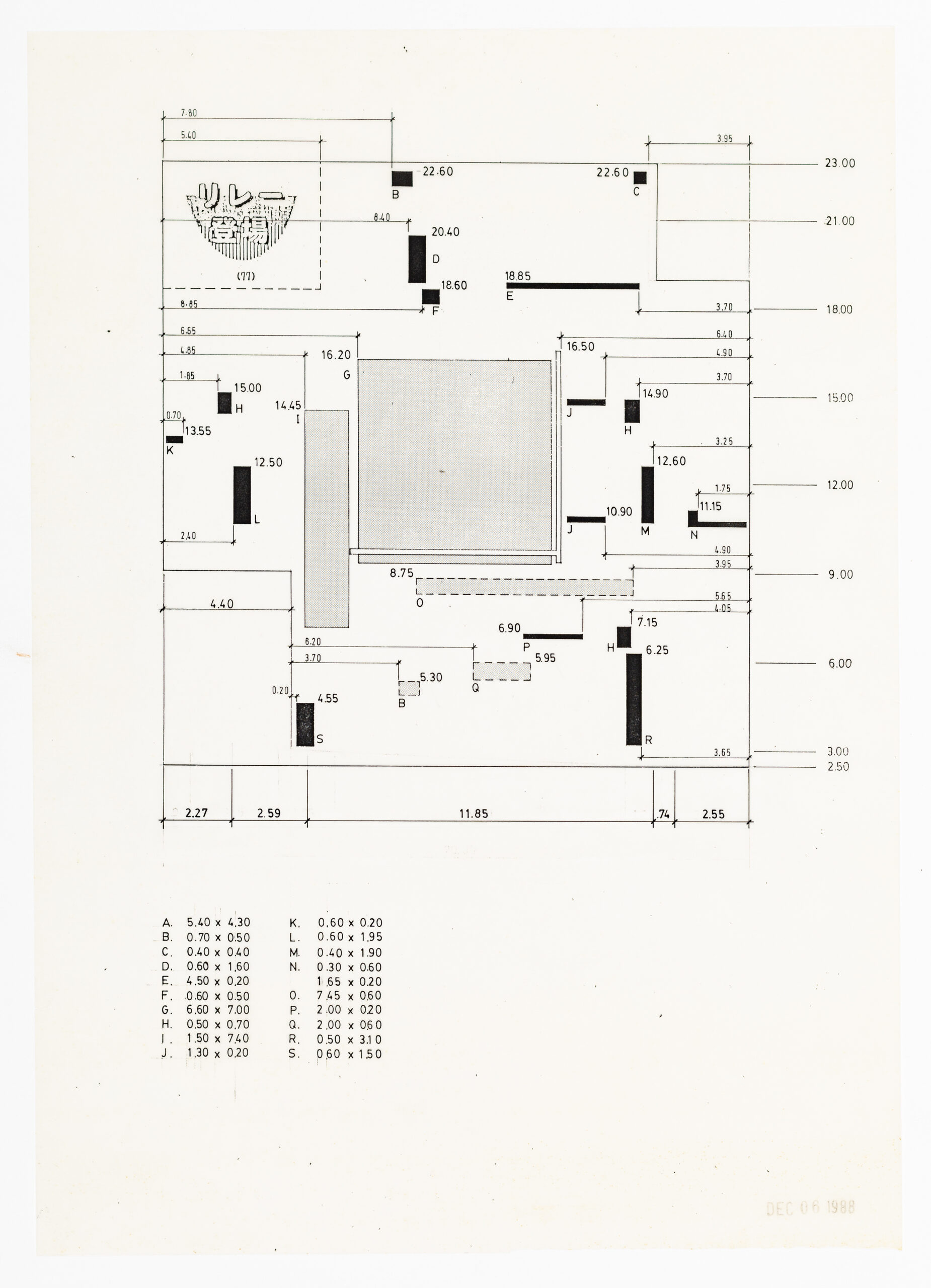
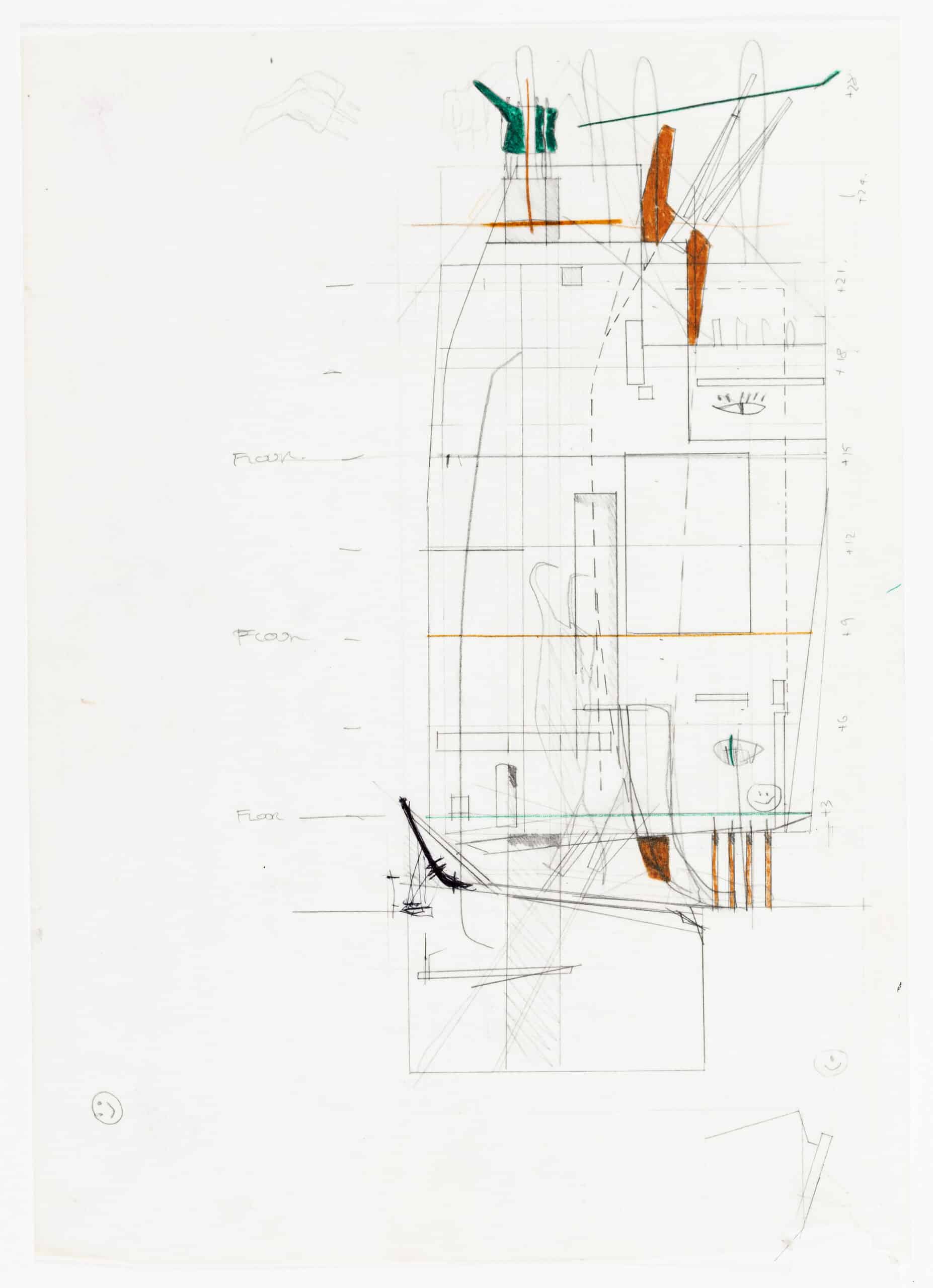
This project was commissioned by Mr Keitaro Nakamura as part of a redevelopment of many sites along Cosmos Street in Tokyo. Mr Nakamura wanted to increase the value of the street through ‘signature’ architect’s interventions, and hoped to rename it Architects Street. The client gave no programme for the building; the Cosmos building was functionless. Without programme as a generator of form, Bolles+Wilson looked to a newspaper clipping the client gave them. It was square in format with a photo of Nakamura at its centre; through measuring the composition of the clipping, the article turned into the basis of the facade. Contained within the structure we also see the shadowy form of the Ninja Comfortable House; this central black Ninja was structural, supporting the entire building, earthquake resistant like splayed columns in Japanese Buddhist temples. The project was not built; the only ‘signature’ design erected on Cosmos Street was by Shin Takamatsu.
Find a description of the project in Wilson’s own words here.
WESTERN OBJECTS EASTERN FIELDS, 1989
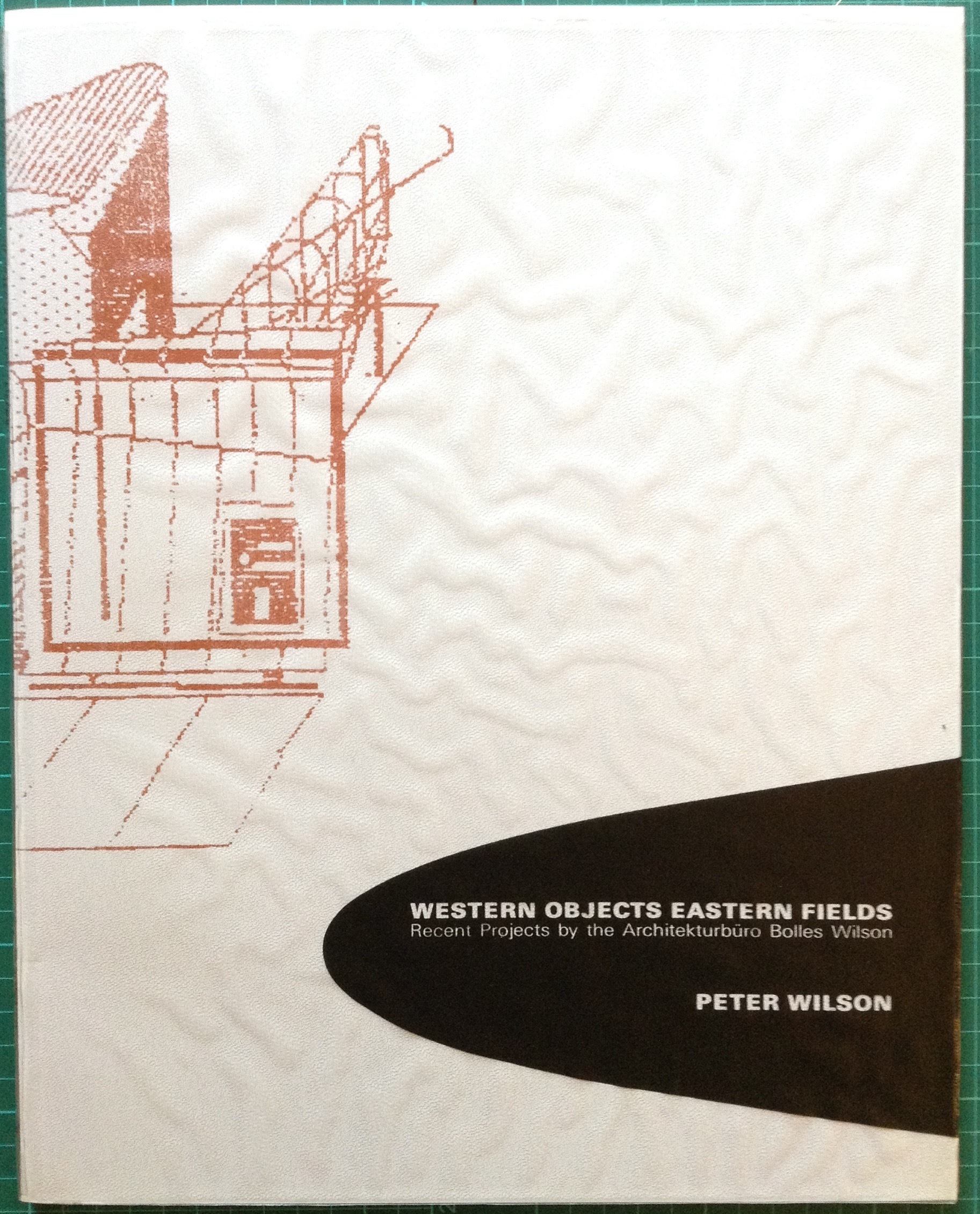
This catalogue was published by the Architectural Association to accompany an exhibition of Bolles+Wilson at the school from the 4-28 October 1989. The exhibition presented a selection of projects for Europe and Japan, including the Ninja Comfortable House, the Tokyo Opera, and the initial designs for the Münster Library.
OSAKA FOLLY, 1989-1990
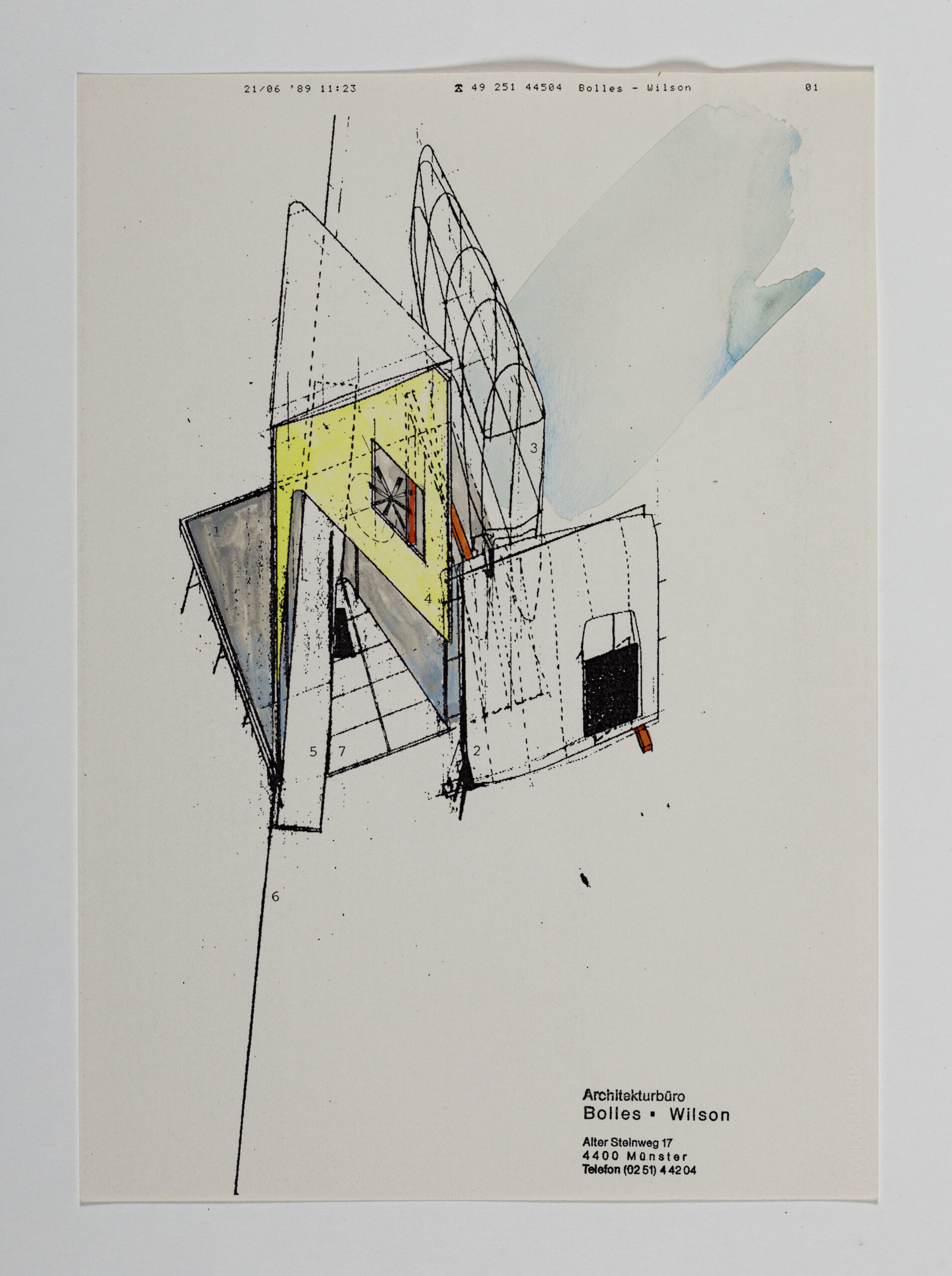
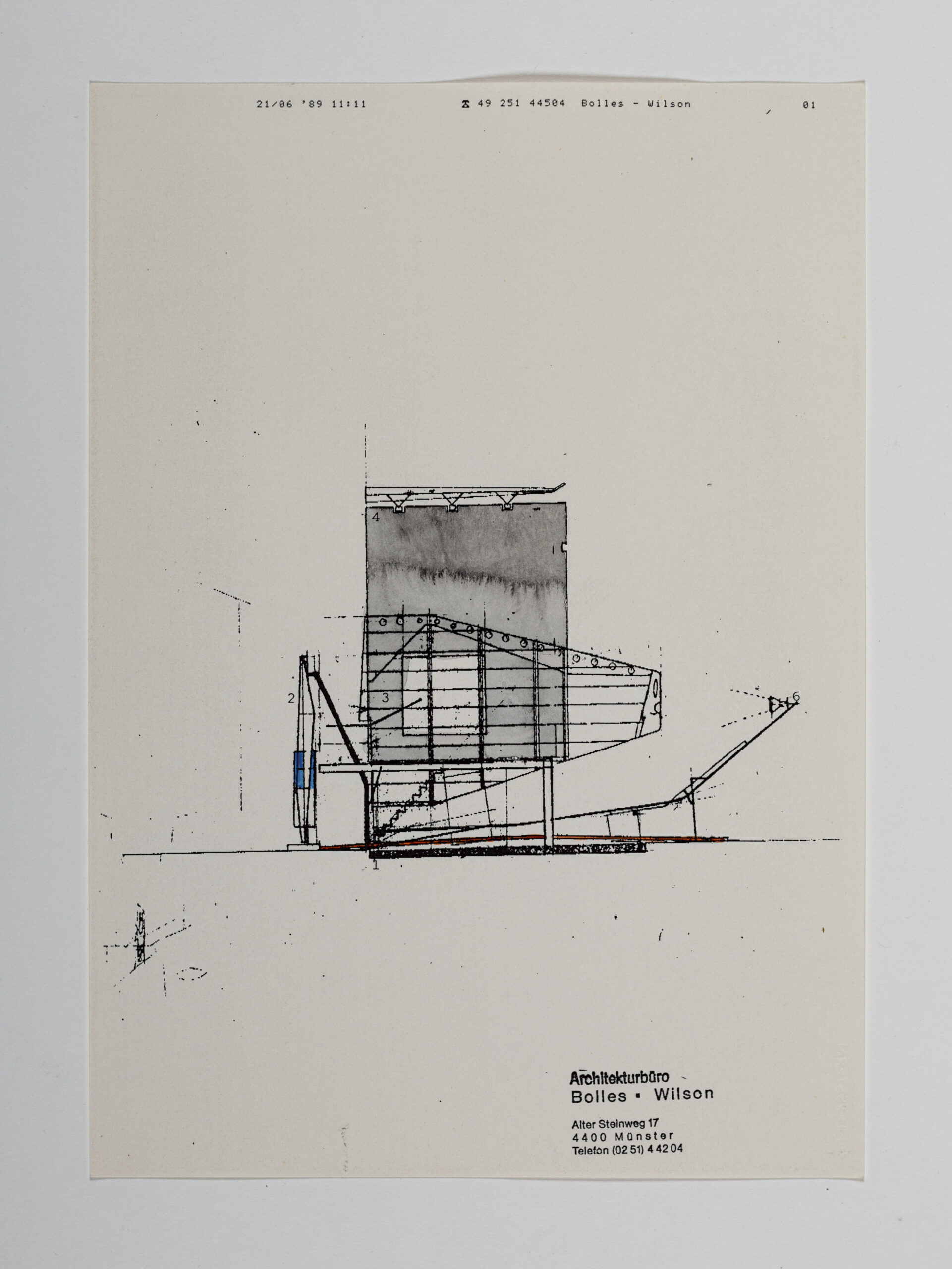
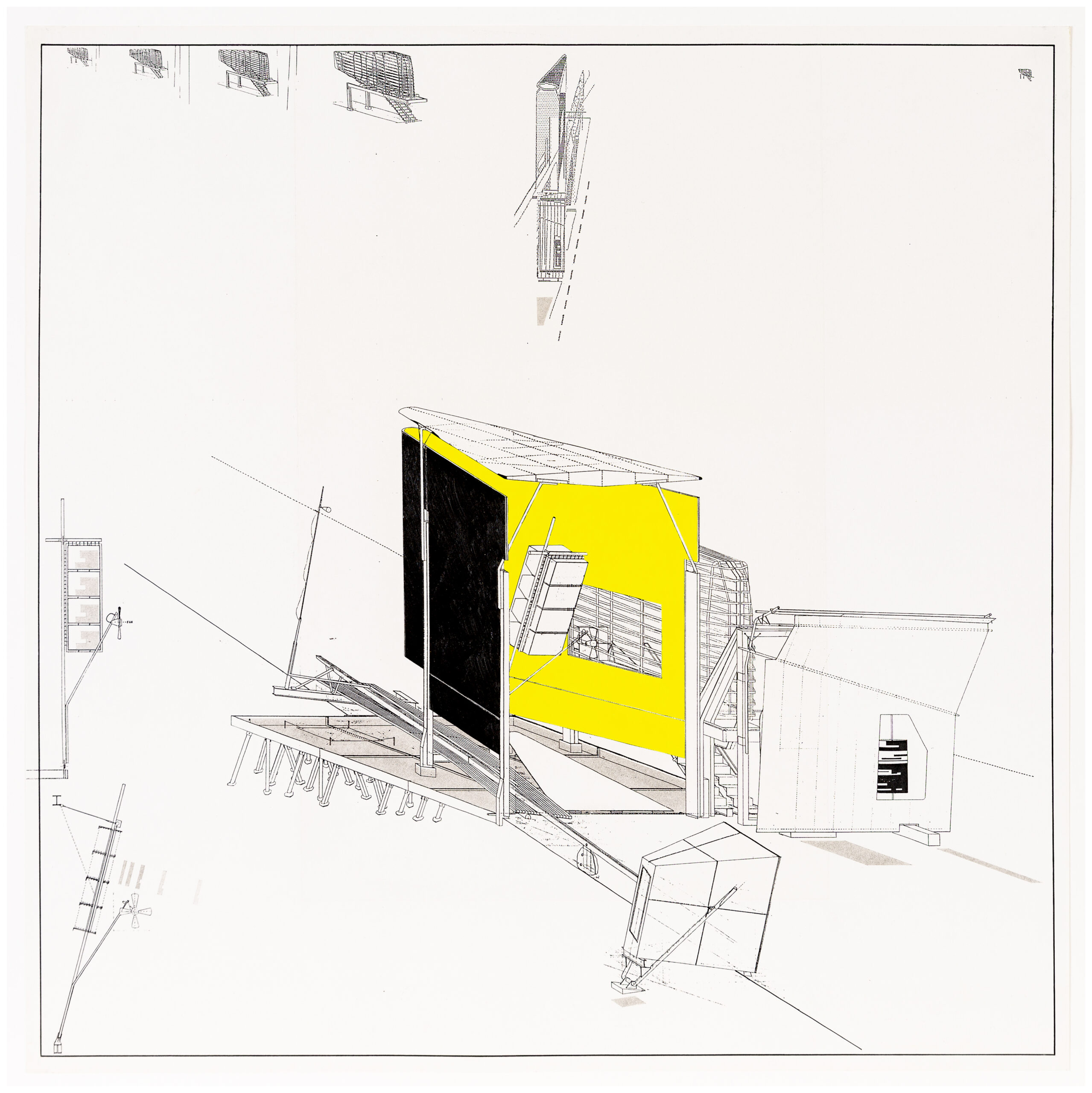
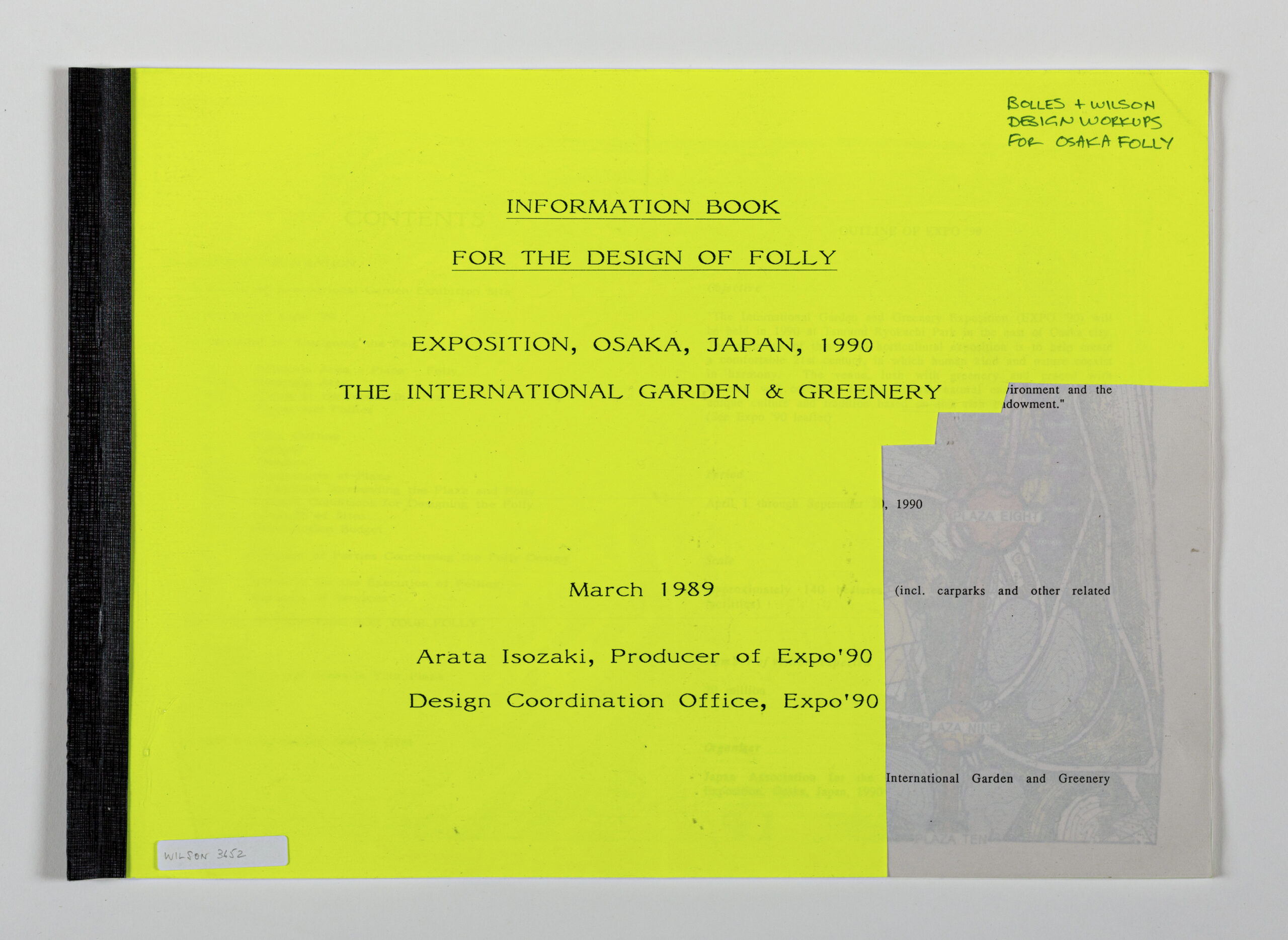
Bolles+Wilson created a folly for the International Garden and Greenery Exposition under Arata Isozaki’s theme of ‘The Harmonious Coexistence of Nature and Mankind.’ It ran from 1 April to 30 September 1990, and featured multiple follies. Alongside Bolles+Wilson, Chris Macdonald and Peter Salter, Andrea Branzi, Peter Cook and Christine Hawley, Eleni Gigantes and Elia Zenghelis, José Antonio Martínez Lapeña and Elías Torres Tur, Zaha Hadid, Daniel Libeskind, Morphosis, Hajime Yatsuka and Ryoji Suzuki, and Coop Himmelblau all created follies for the expo. The Drawing Matter collection holds 19 drawings for the project from sketches to presentation materials, as well as an information booklet containing a comprehensive outline of the brief and build process.
The info booklet provided by the exposition’s organisers had a yellow cover from which Bolles and Wilson cut strips for their generative design models; this yellow surviving as the yellow interior of the built Folly. Other components were designed by collapsing the form of a submarine; the submarine skeleton of the was made up of dripping water pipes. Wilson states it was a building size air conditioner, producing a localised micro-climate to combat the sweltering Osaka summer.
SUZUKI HOUSE, A HOUSE GLANCED BY A PASSING NINJA, 1992-1993
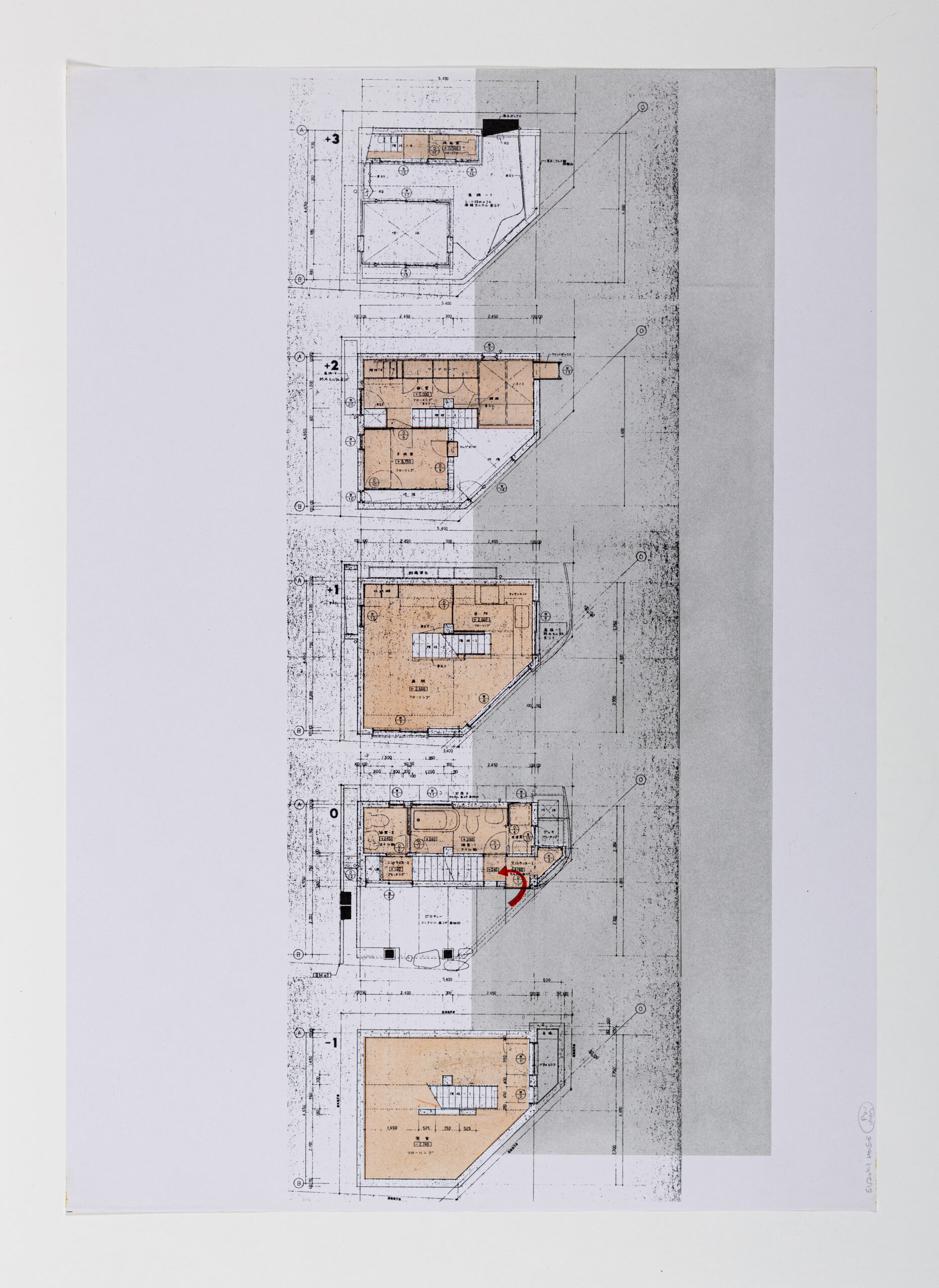
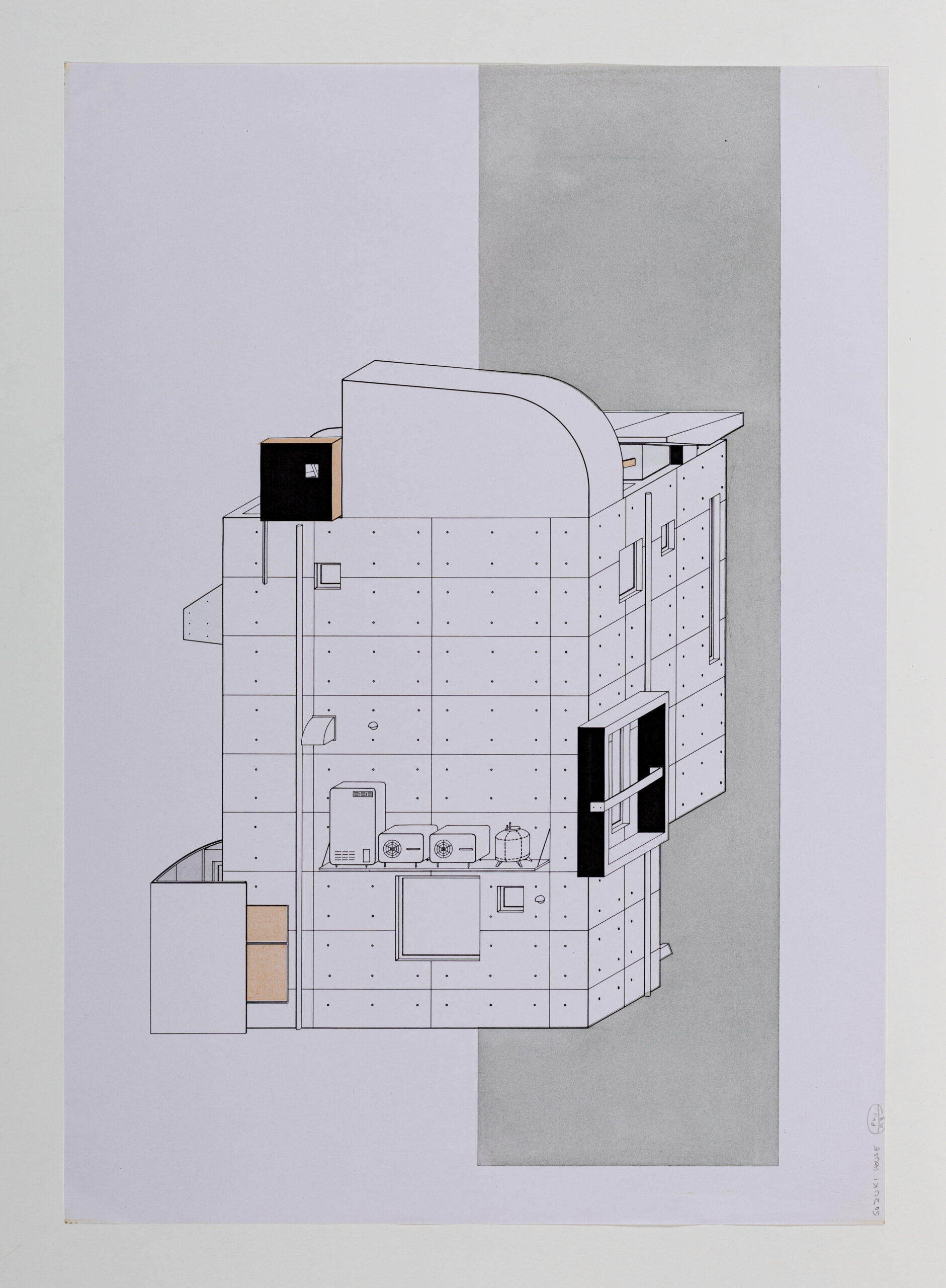
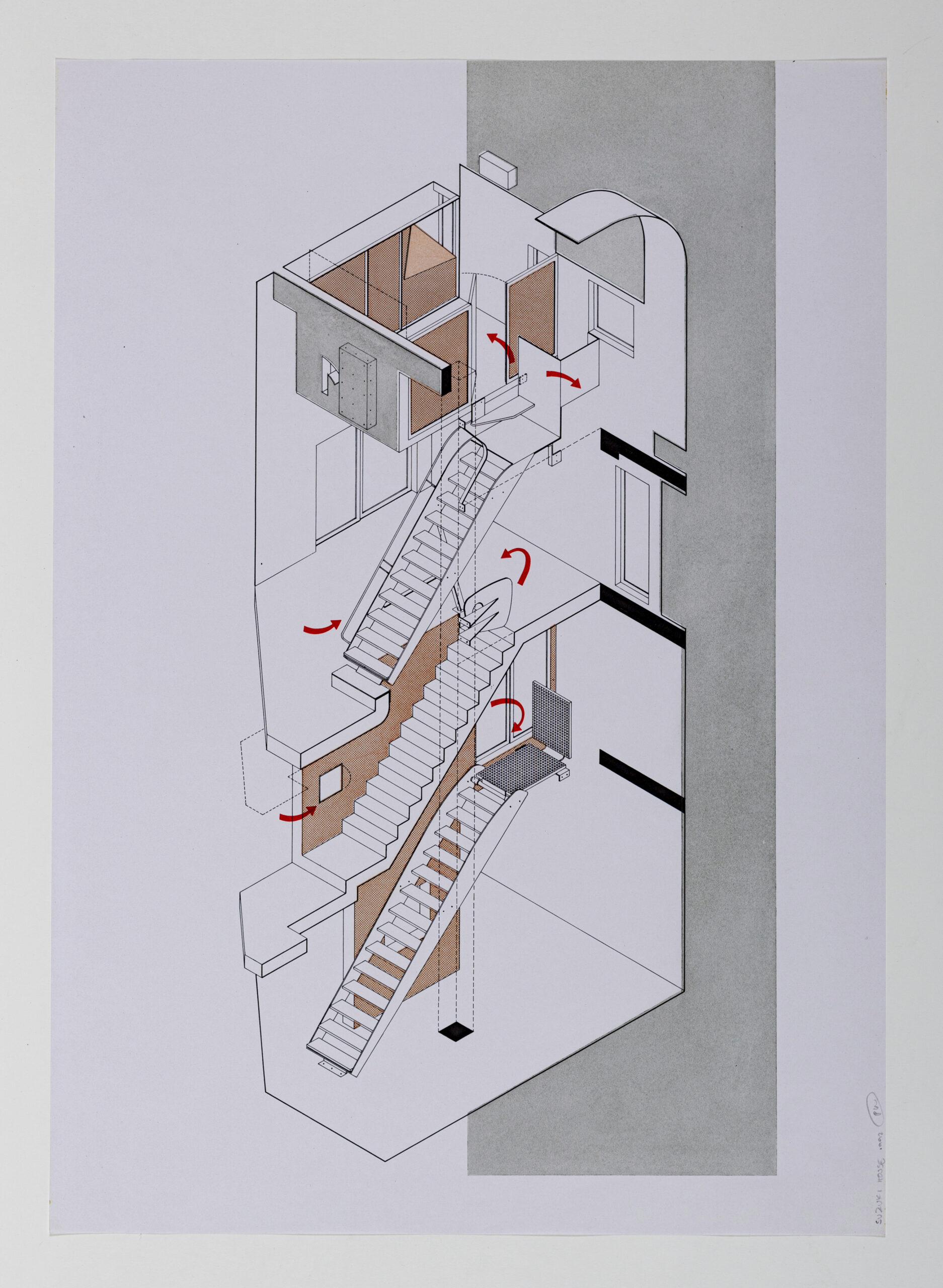
In 1993, Bolles+Wilson completed a house for Akira Suzuki and his family. The design centres around the suspension and adaptability of spaces; the child’s bedroom hangs on the top floor and the roof is a flat usable plane. The house had the subtitle, ‘A House Glanced by a Passing Ninja’, meaning it had been lightly touched by the Ninja figure of Wilson’s previous work, manifested in bruise-like blob embossed into the concrete house facade. The daughter of Suzuki described her house as a ‘Panda Bear’.
Drawing Matter holds three presentation drawings for the Suzuki House.
Find a description of the project in Wilson’s own words here and more information about the project on the Bolles+Wilson website.
ROTTERDAM MASTERPLAN & LUXOR THEATRE, 1992-1994
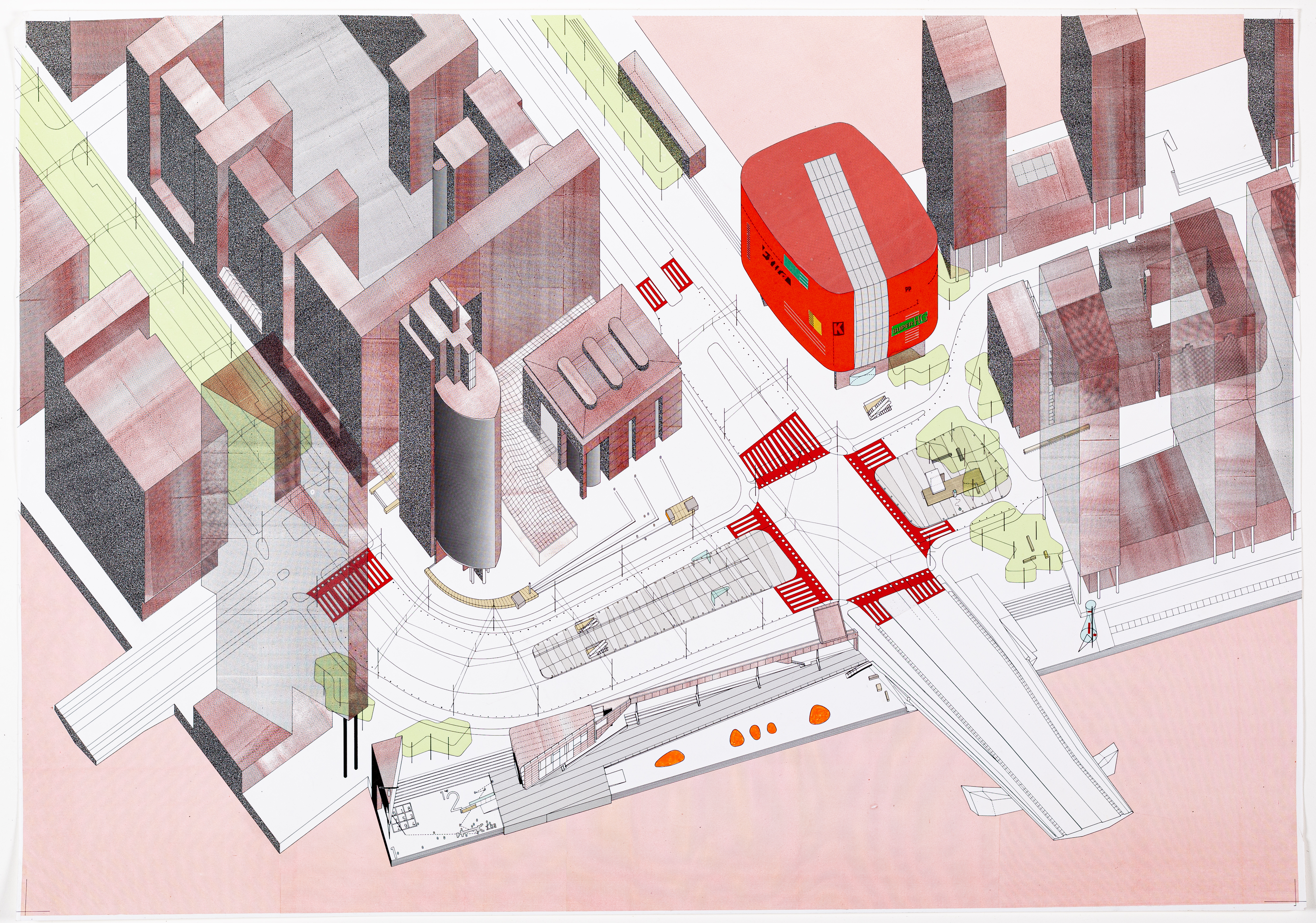
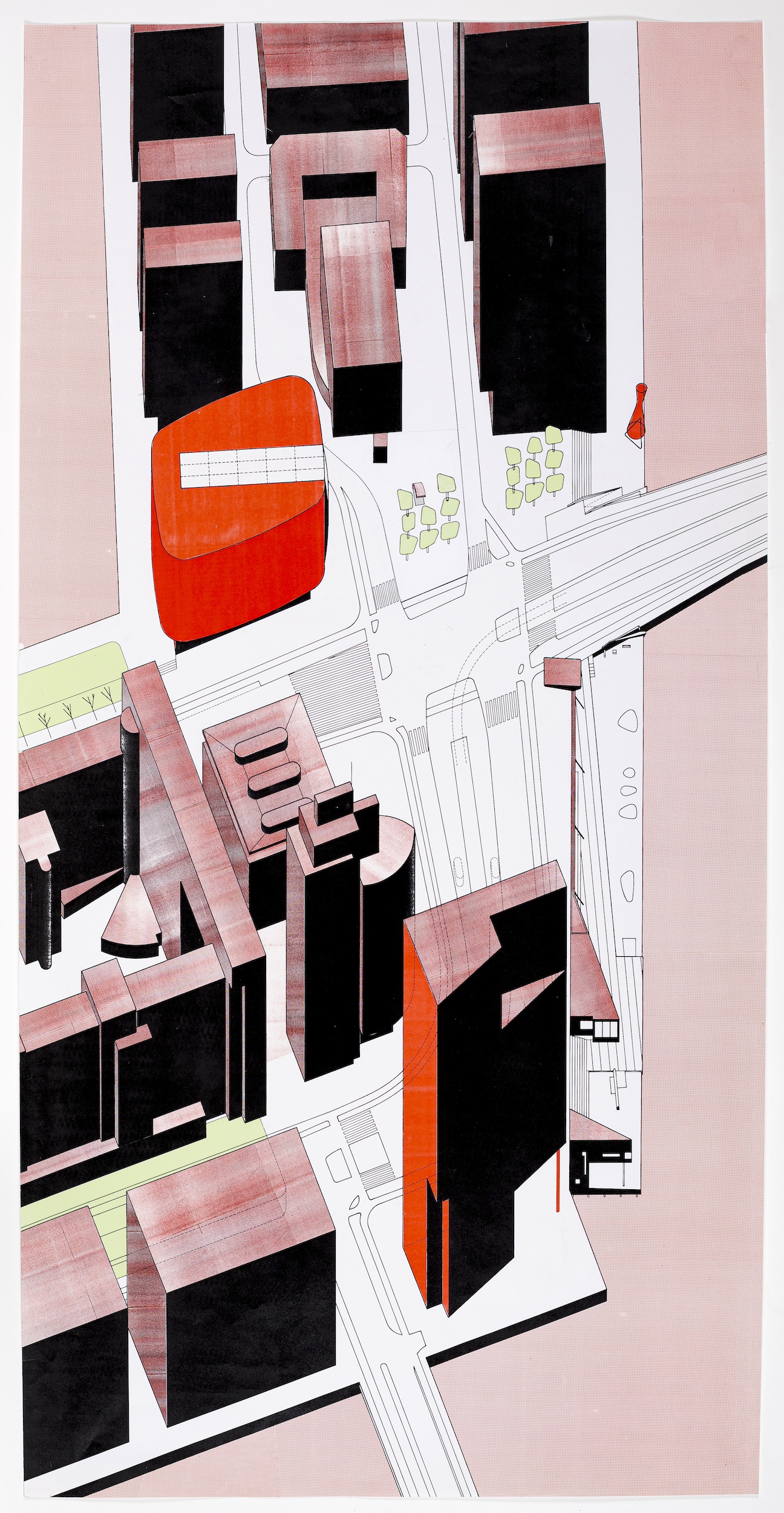
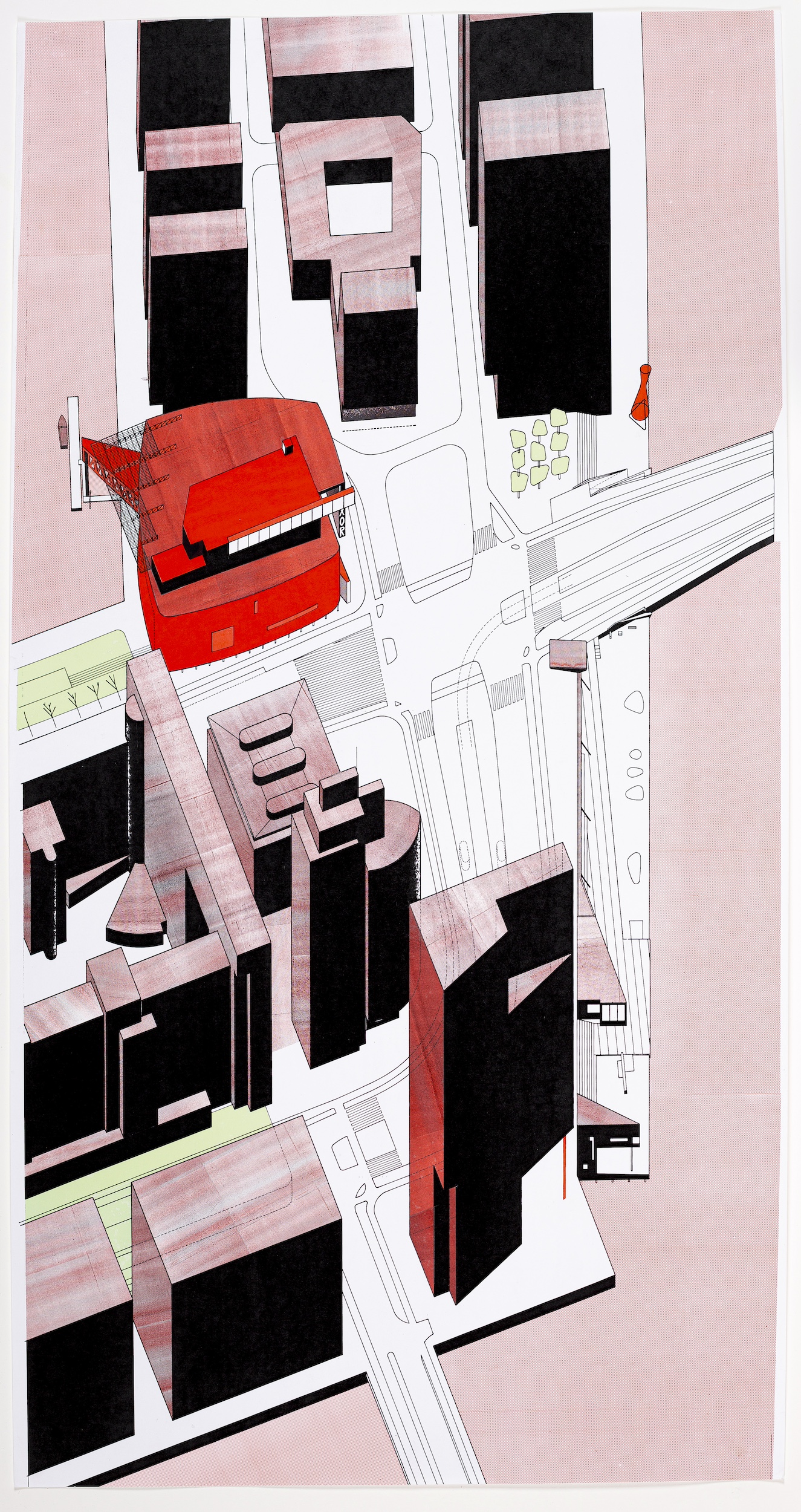
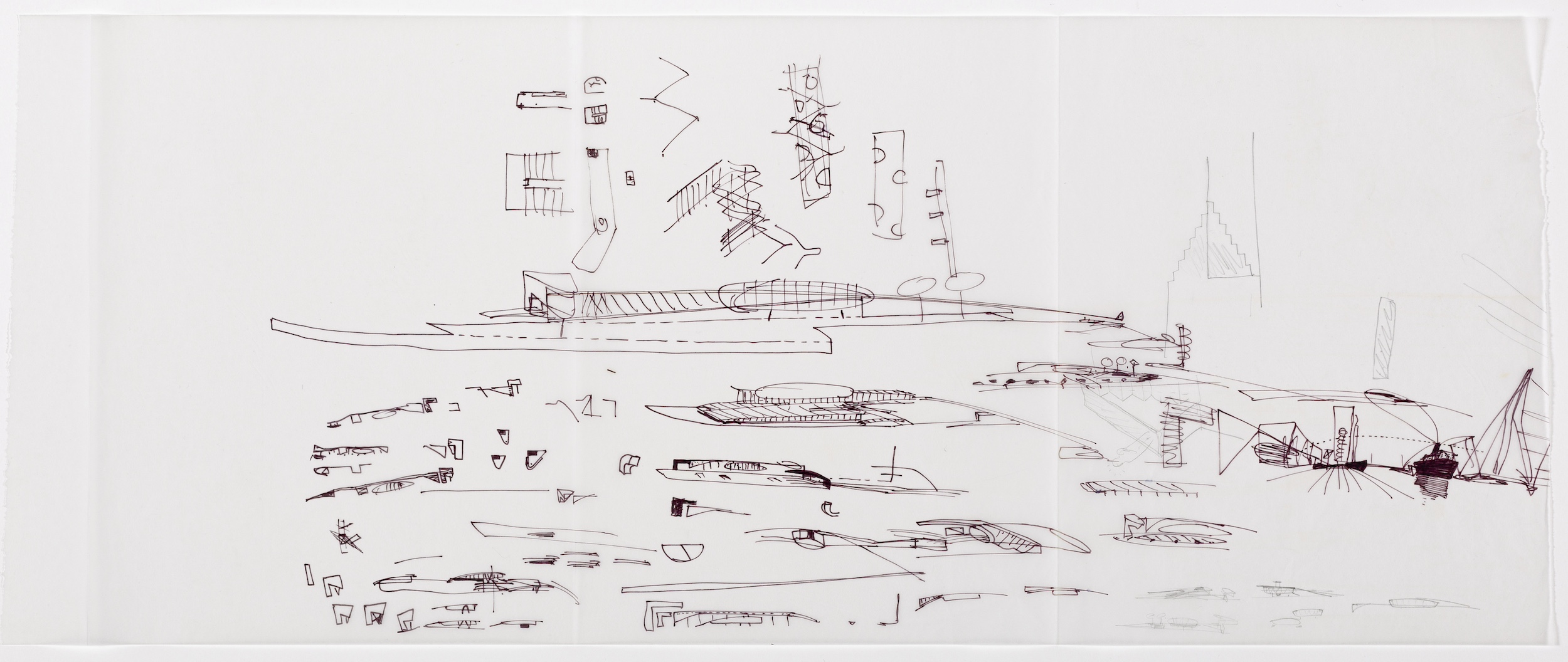
Bolles+Wilson were commissioned by the DS+V, the Rotterdam planning department responsible for the new development of the Wilhelmina Pier. Rotterdam had been largely destroyed in the Second World War and into the second half of the twentieth century had become a site of experimentation; planning authorities in the Netherlands were frequently commissioning young architectural practices to produce radical masterplans. Within the masterplan, titled ‘Landing Square Scenarios’, a free-standing red ‘blob’ was added to act as a hinge between two urban zones (with differing plan orientations); this site was later turned into a competition for the Luxor Theatre, which Bolles+Wilson would go on to win. Wilson has stated that these were the last full set of drawings made by hand from his office. Drawing Matter holds 20 drawings and prints for the masterplan project.
Find a description of the project in Wilson’s own words here.
MÜNSTER CITY LIBRARY, 1993
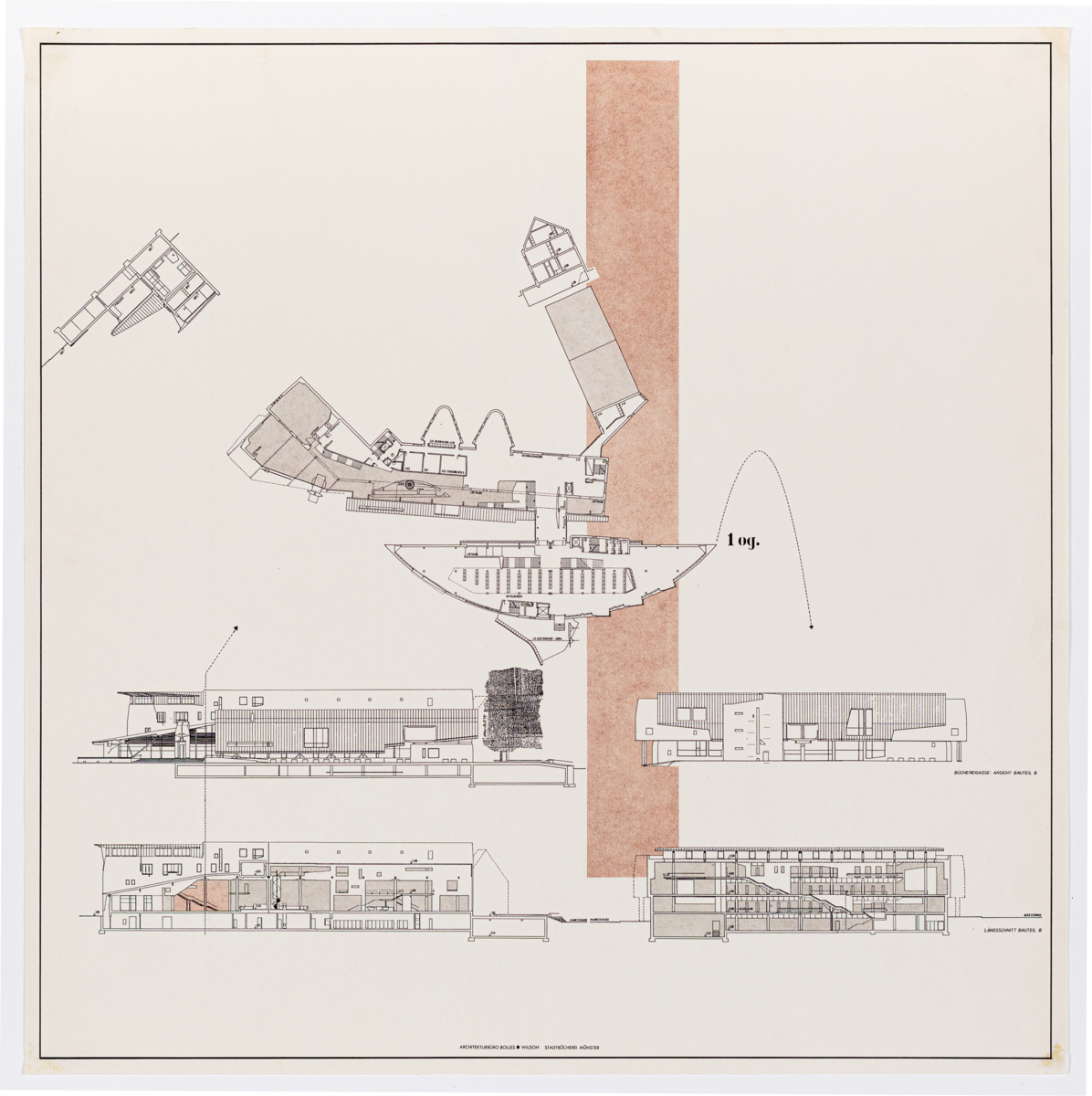
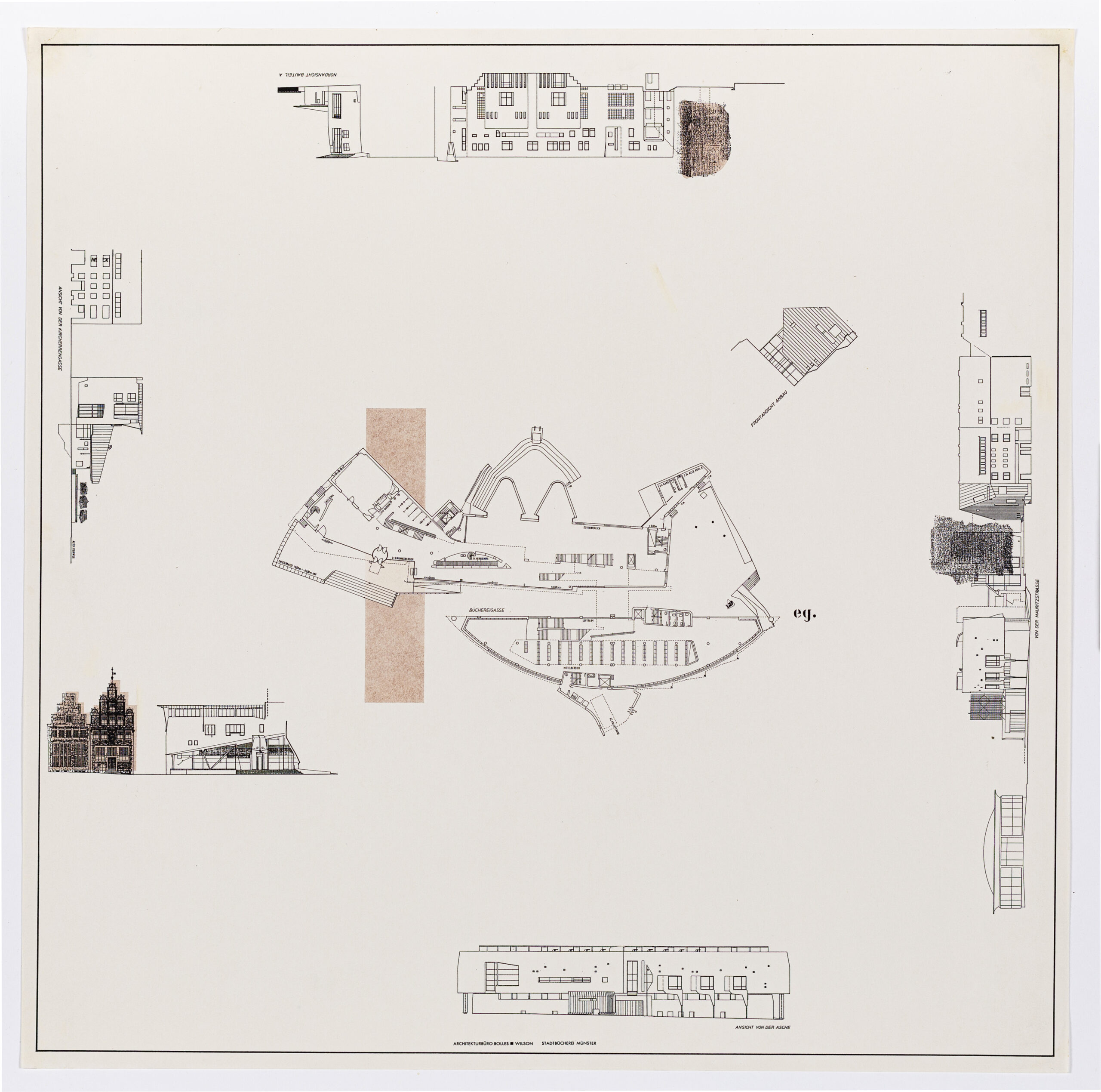
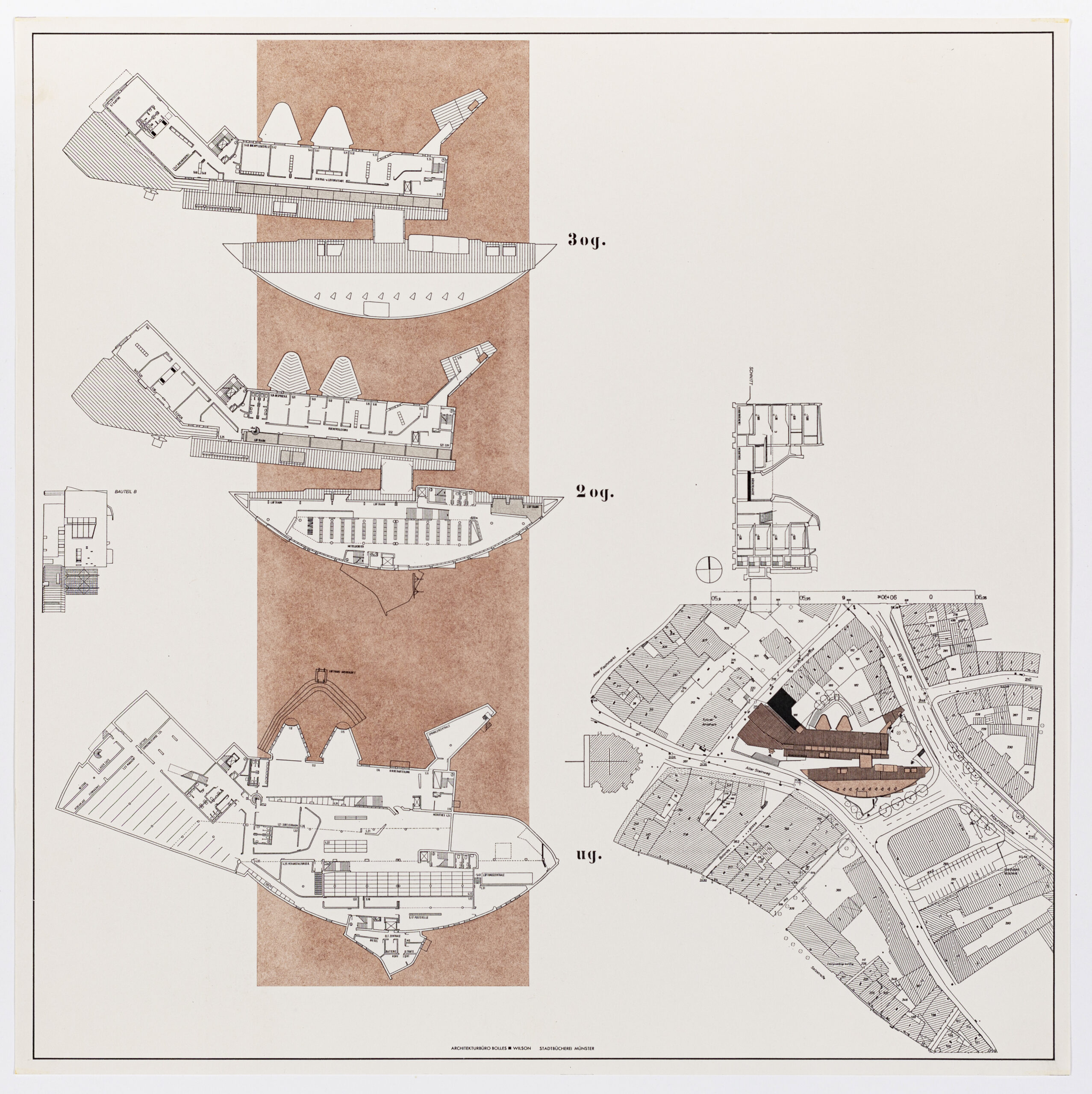
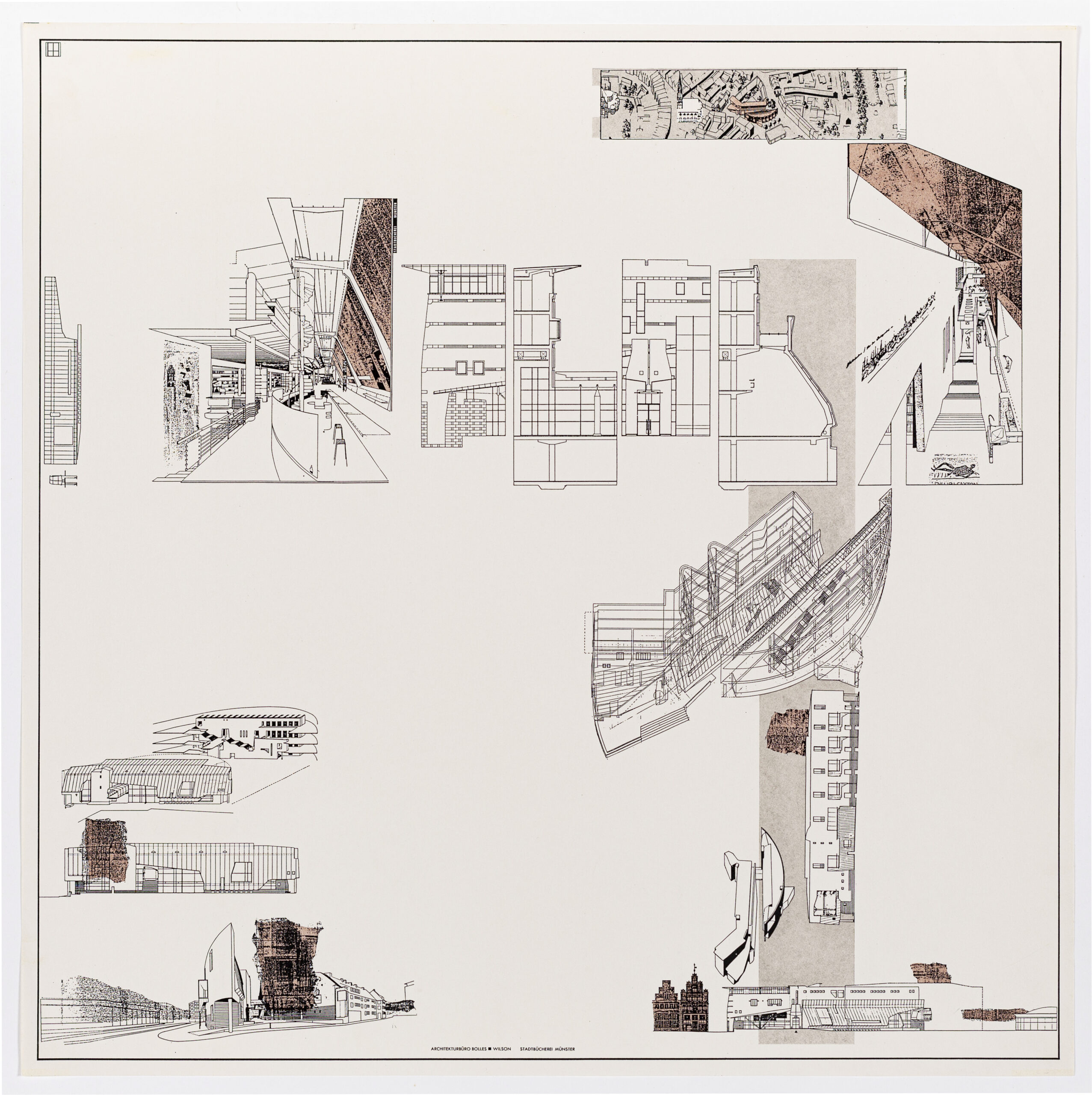
Drawing Matter holds four compilation of competition winning plans, construction sections and technical details
prints for Bolles+Wilson’s Münster City Library, their first major public commission. The city of Münster organised a competition for the design of a new library in 1987, to commemorate the city’s 1,200th anniversary. Bolles+Wilson’s design incorporated distinct spatial conditions: the library is bisected by a new pedestrian street placing visitors at the centre of the library before they have entered. This urban scale cut was then bandaged with huge copper walls, these are clad internally in perforated wood panels producing a warm and quiet library atmosphere within. The Münster Library also employed their ‘frame- adjacency’ strategy, with the principle white volumes as frame and secondary materially distinguished bits as adjacencies. The small details that populate the library interior are also to be seen as adjacencies: handrails, bookshelf feet, and library equipment.
See more information about the built project on the Bolles+Wilson website.
EUROLANDSCHAFT, 1998
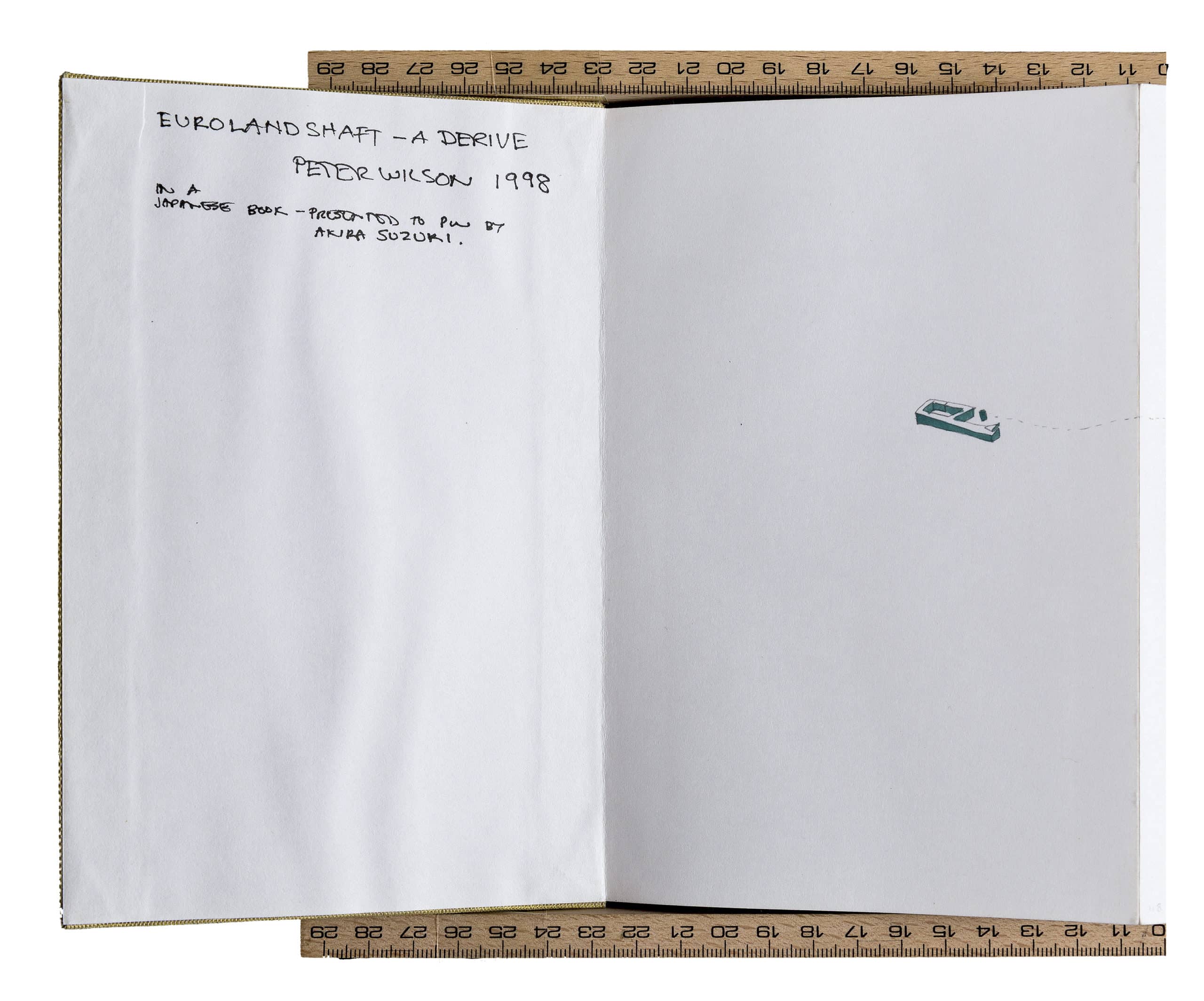
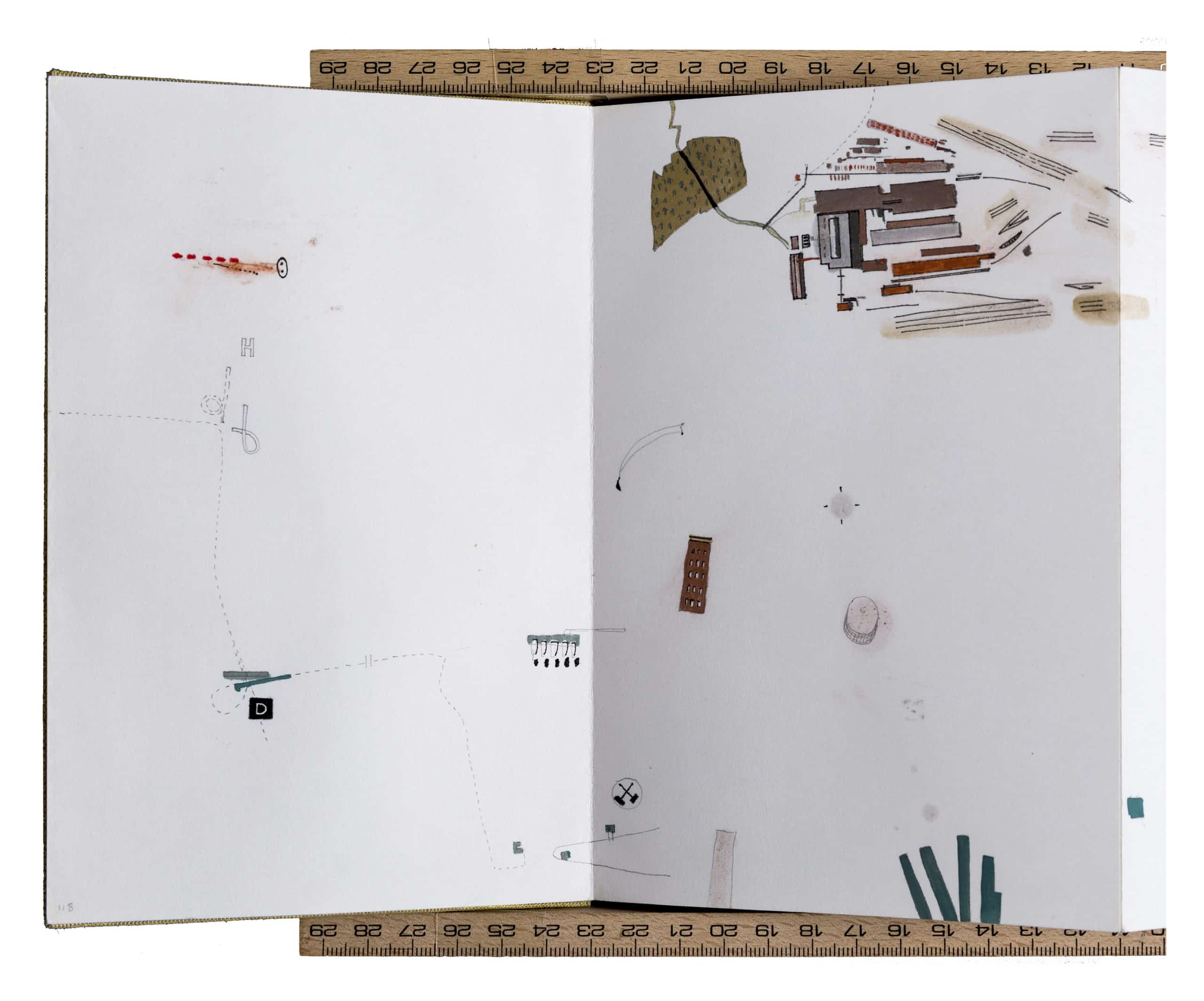
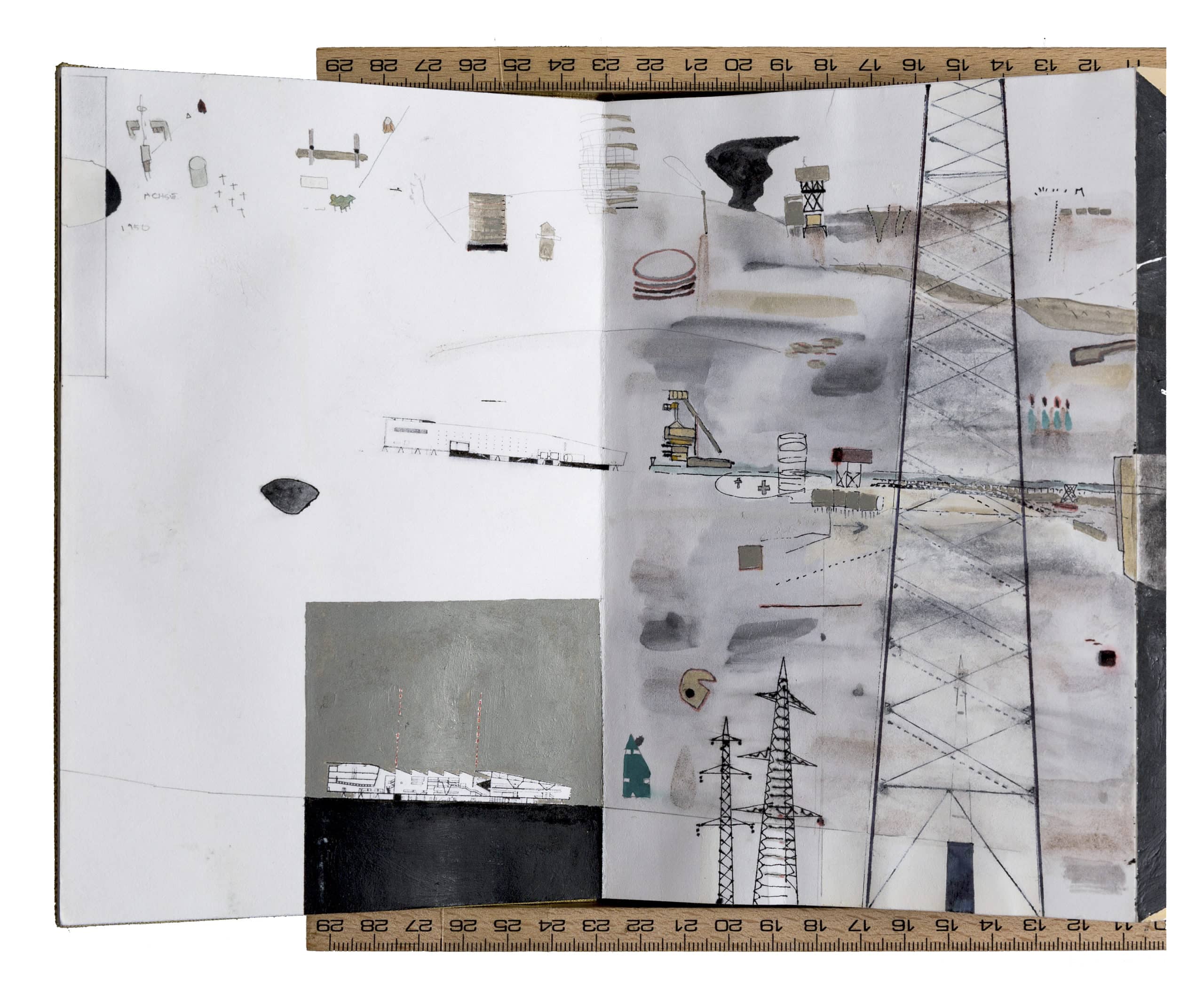
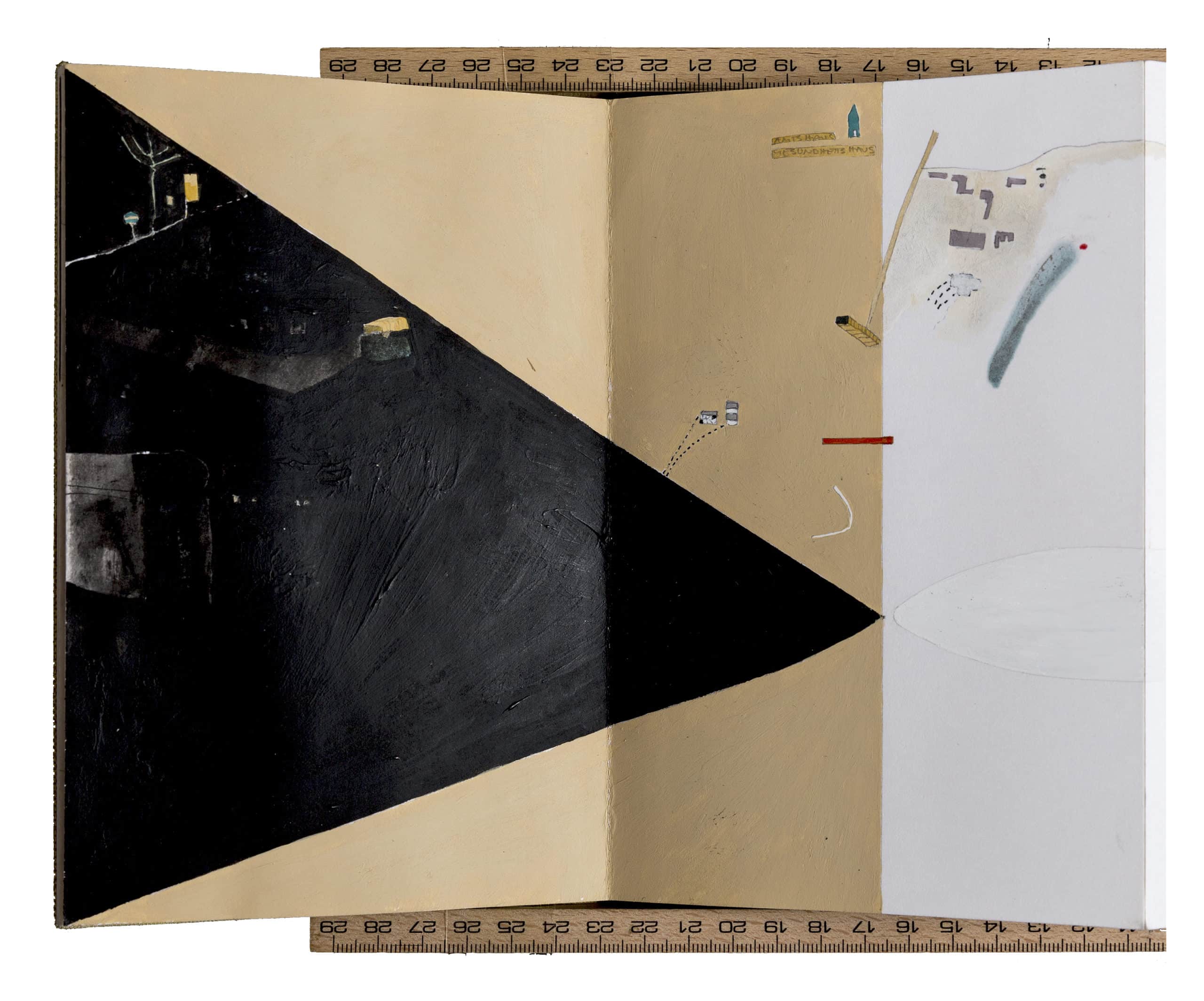
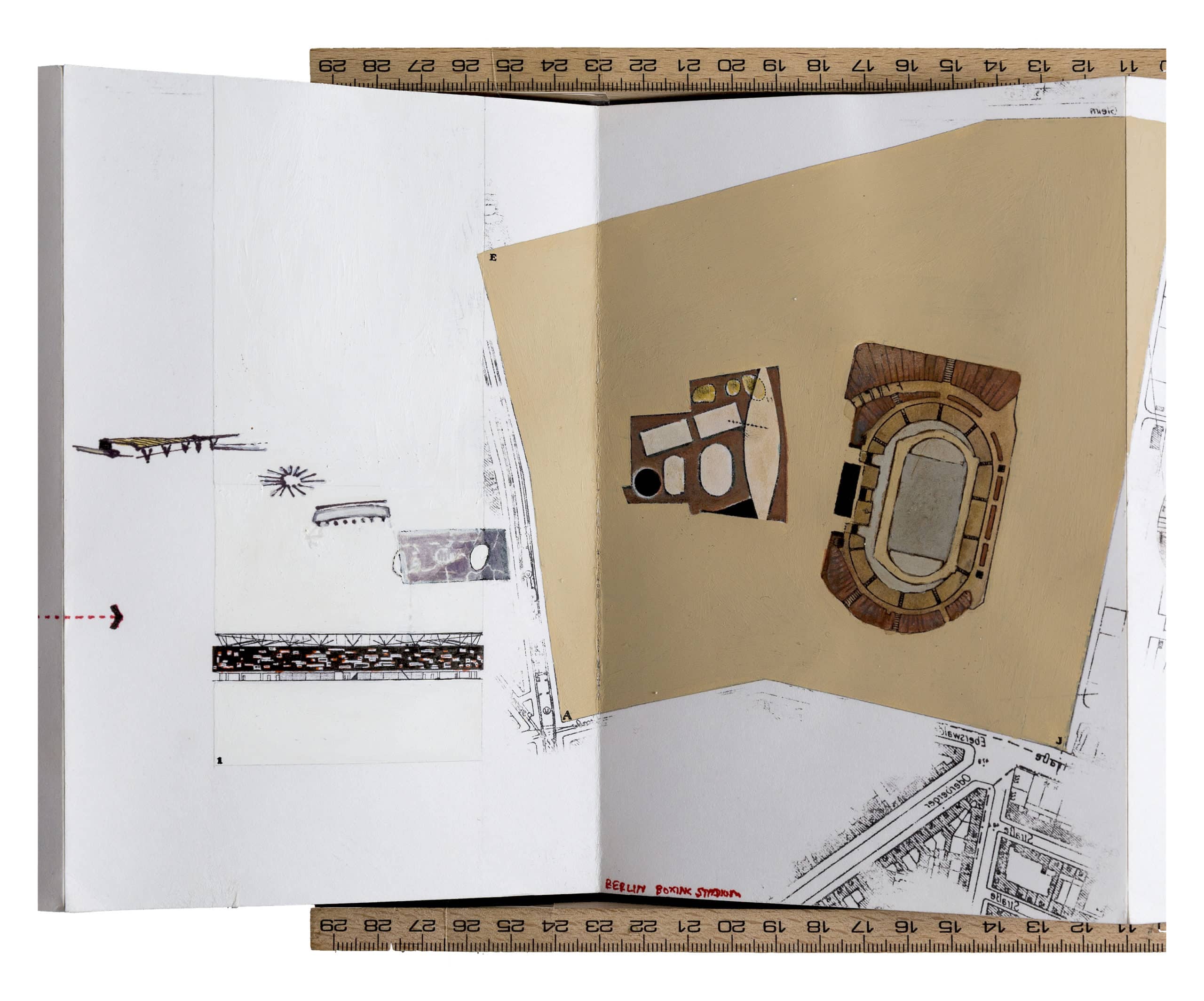
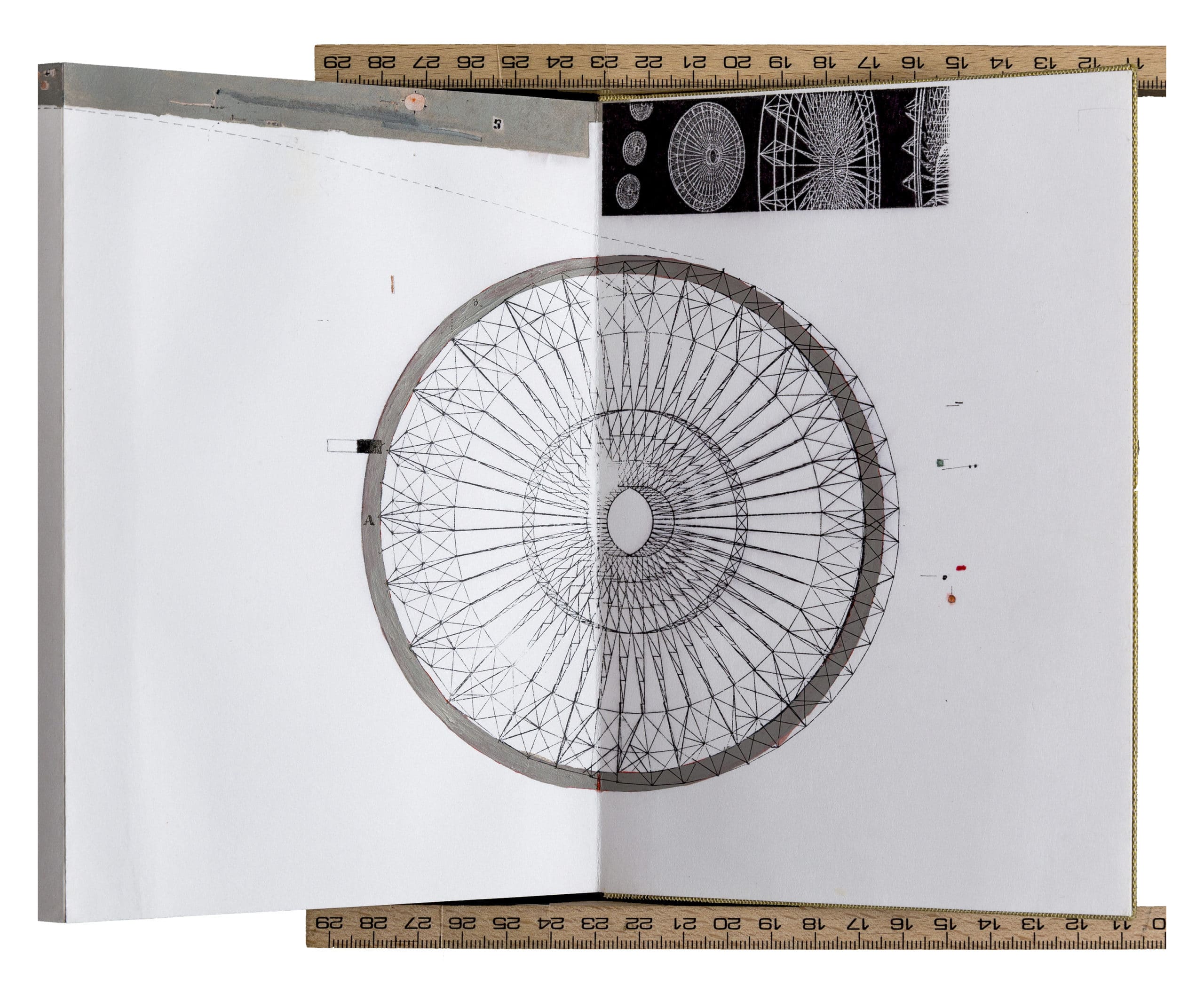
This concertina sketchbook in the Drawing Matter collection was given to Wilson by his client Akira Suzuki shortly after the completion of his house in 1993; it wasn’t until 1998 that Wilson decided to use it. Its format prompted his approach in drawing the post-industrial networked landscape of Germany, which which he frequently crossed by train following the practice’s move from London to Münster in 1988. It is about the dispersal patterns of functional fragments which had in earlier times conglomerated under the ‘city’; forms that are now dispersed networks across the entire landscape. Wilson analyses them as informed by a digital evaporation for the need for proximity. The drawings take the form of a dérive, moving from Bolles+Wilson’s own projects to the infrastructure that marks this Eurolandschaft.
Find a description of the project in Wilson’s own words here.
SKETCHBOOK, 1998-1999
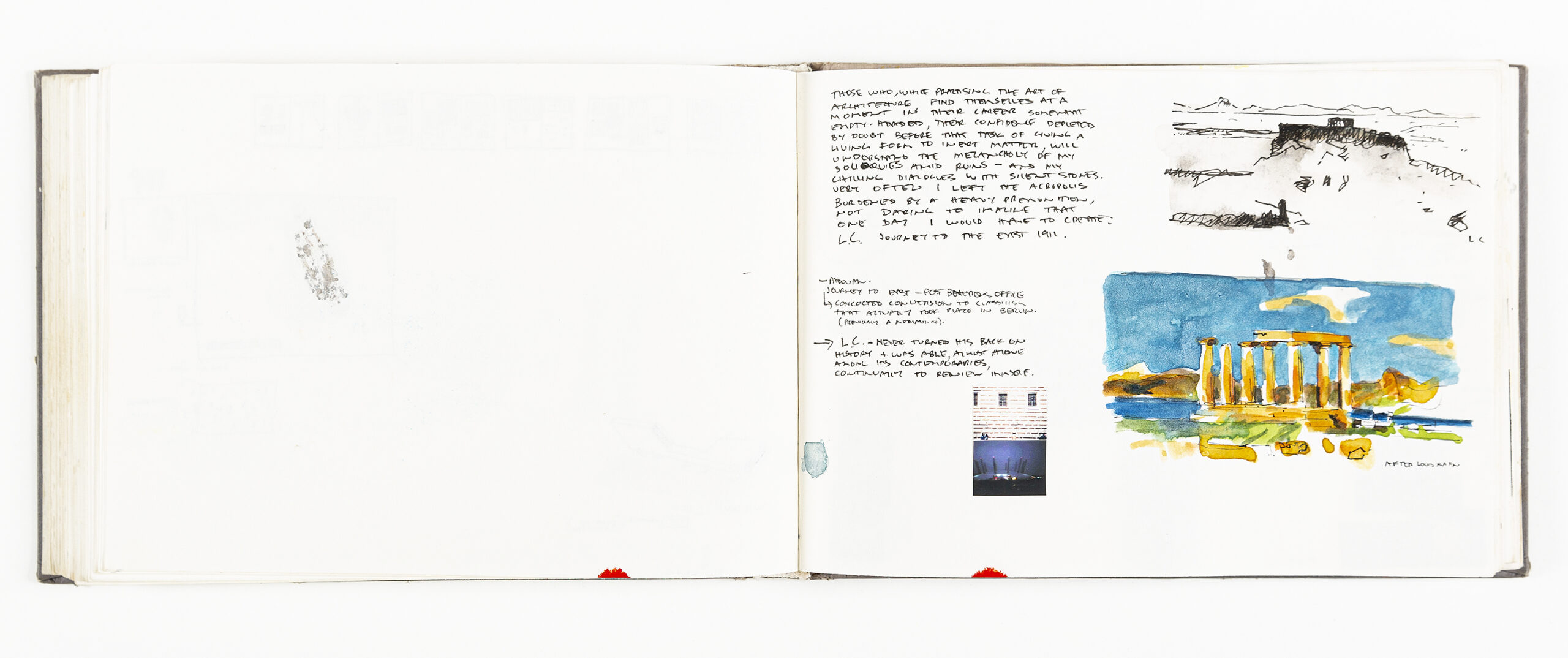
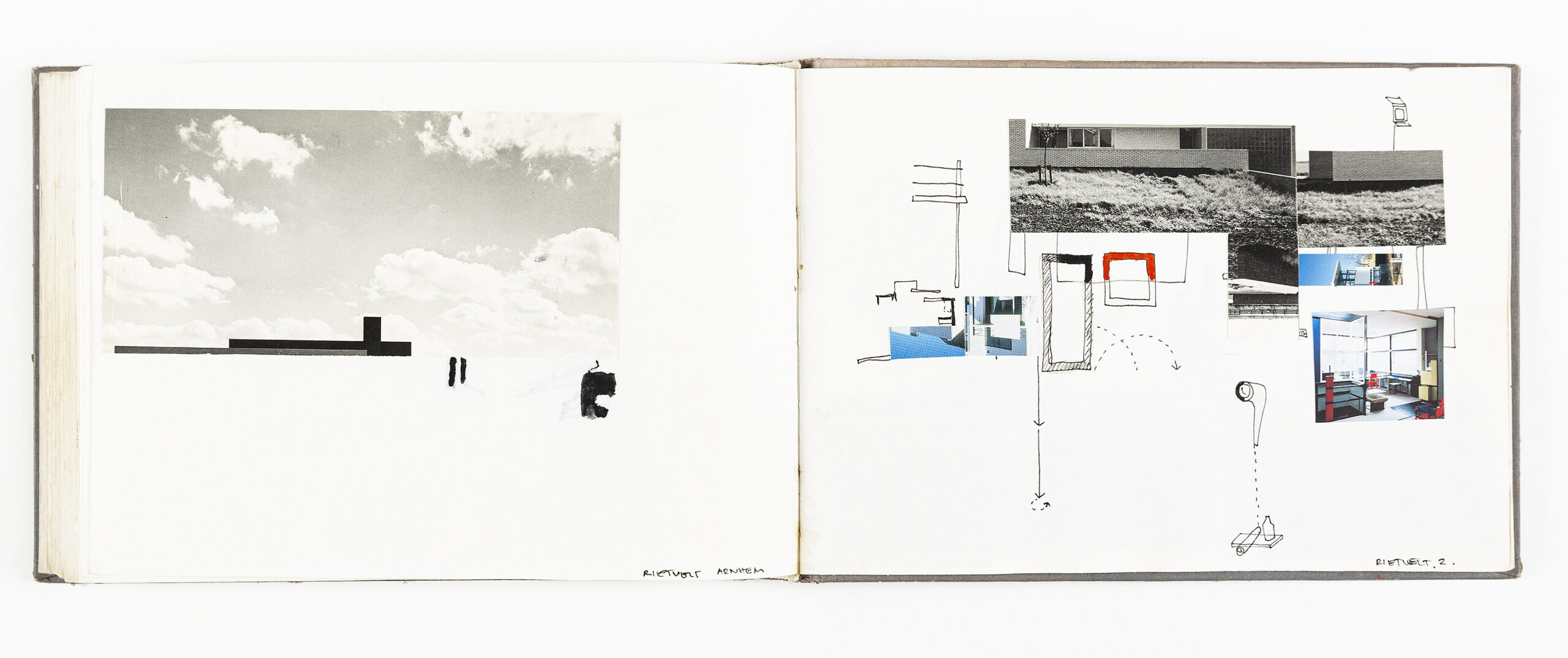
This later sketchbook by Wilson contains multiple projects, but also includes many travel sketches and studies ‘after’ canonical architects, such as Louis Kahn and Gerrit Rietveld.
BAZAAR GATE, 2024
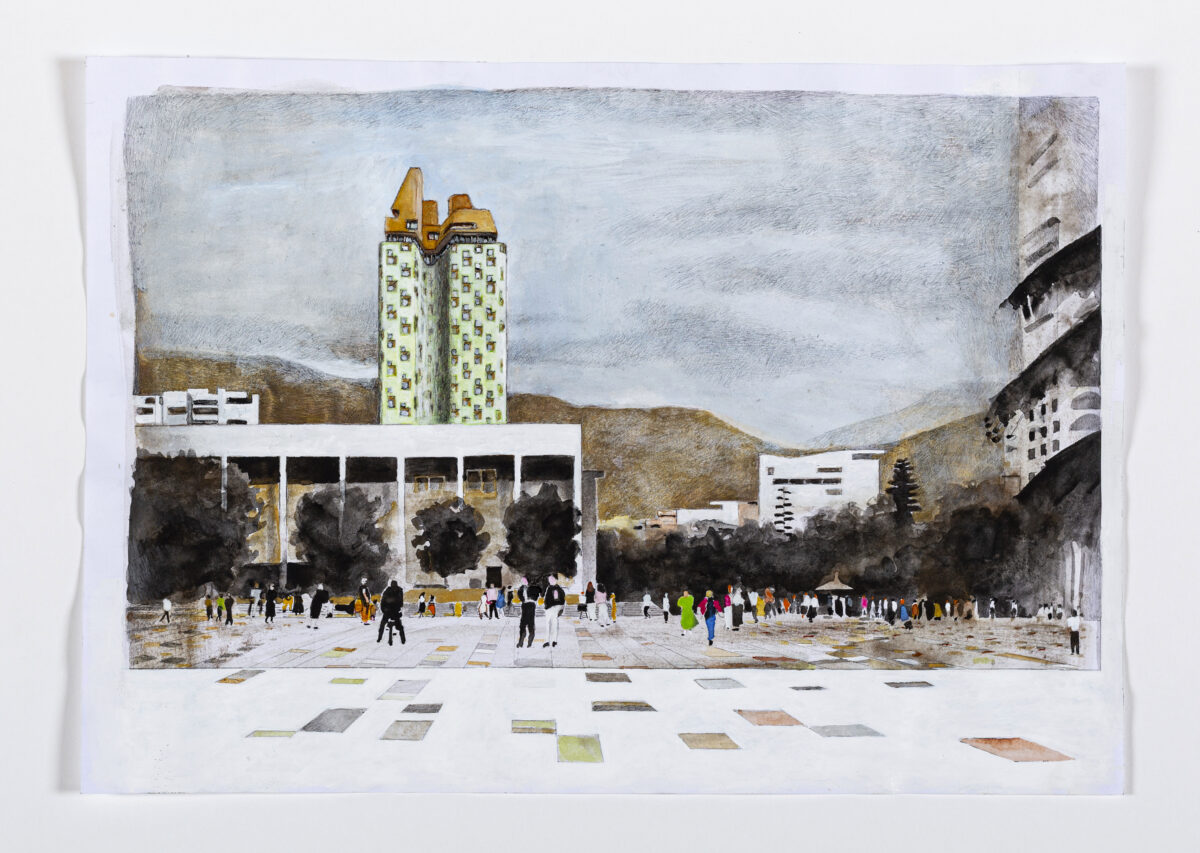
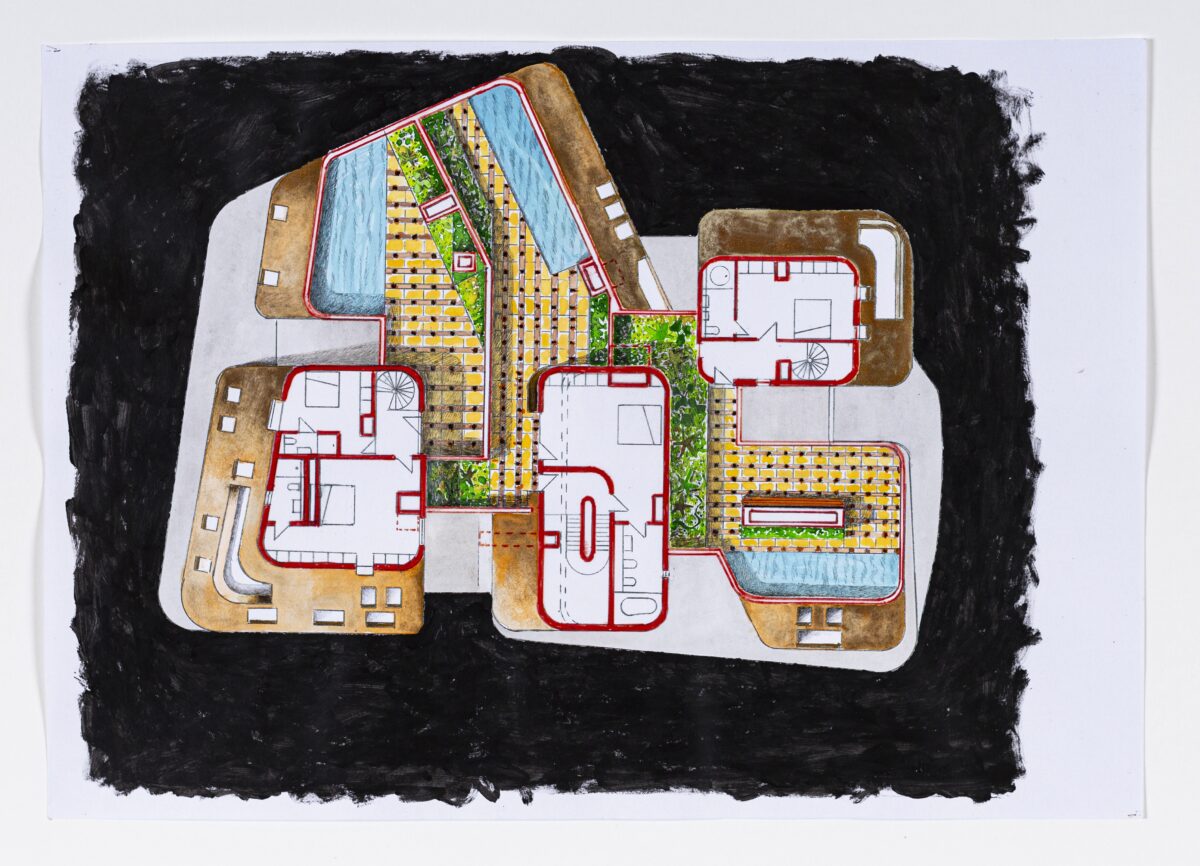
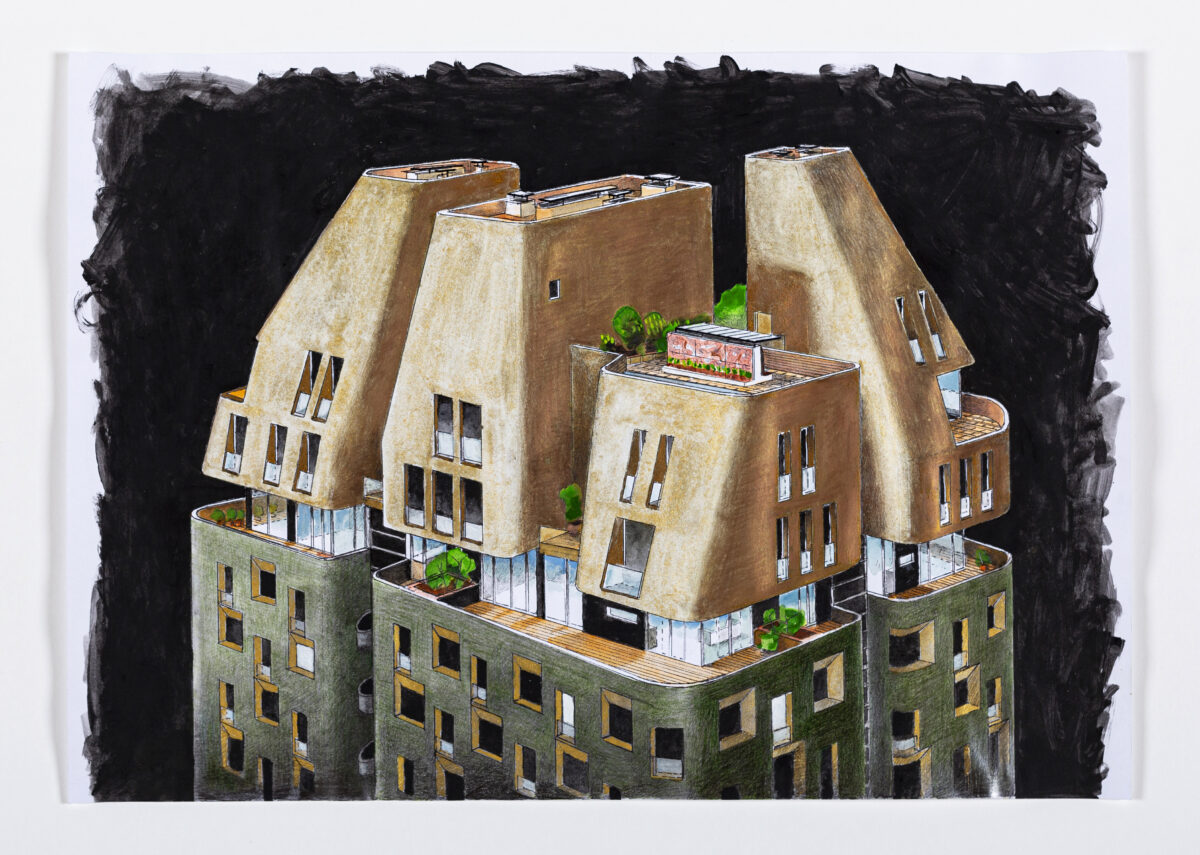
Drawing Matter holds three drawings for Bolles+Wilson’s 28-storey residential tower in central Tirana, between Skanderbeg Square and the Bazaar. Two of the drawings held within the collection focus on the top five floors, a cluster of golden penthouses, constituting a village in the sky. See more information about the project on the Bolles+Wilson website and read more about Bolles+Wilson’s work in Albania here.
Additions and amendments are welcomed at editors@drawingmatter.org
